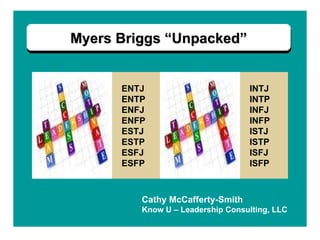
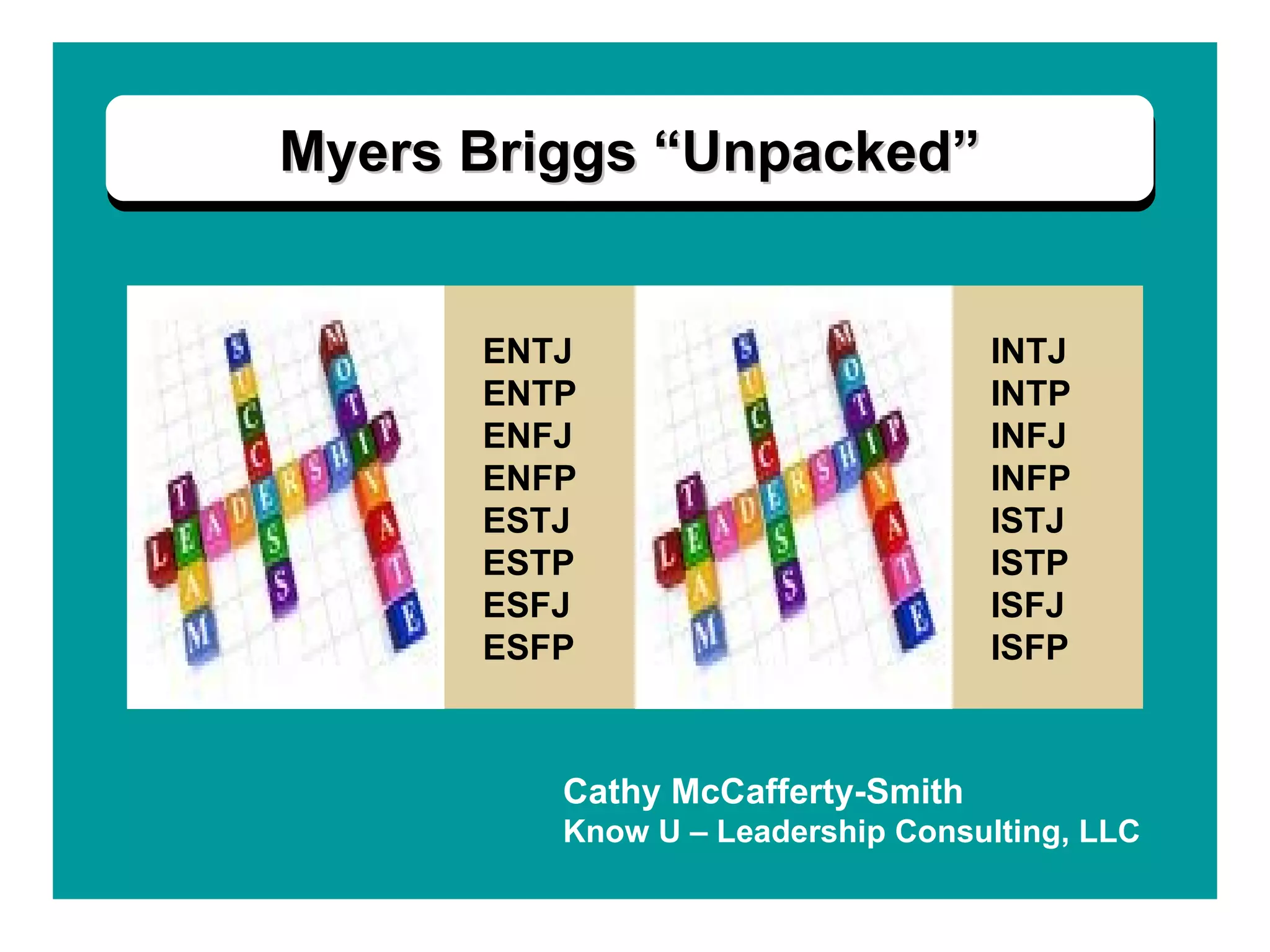
Myers Briggs “Unpacked” ENTJ ENTP ENFJ ENFP ESTJ ESTP ESFJ ESFP INTJ INTP INFJ INFP ISTJ ISTP ISFJ ISFP Cathy McCafferty-Smith Know U – Leadership Consulting, LLC
 
Exchange information  with someone else … Network Assessment (business cards or sticky notes)
Early work in 1923-1940’s (World War II)  Carl Jung (Psychologist)  Isabella Briggs Myers/Katherine Briggs (non psychologists)  Noticed people approached life differently/evidenced by observable behavior Classified behaviors to help people find their personality and “task”/career matches (”fit”)  (Spiritual Gifts) Most widely used psychological assessment, high reliability and validity Translated in many languages, millions have  taken the assessment Personality Type - MBTI origins
The MBTI® model (along with other personality  theories and psychometrics models) is particularly  useful for: understanding/developing yourself (and others)  understanding what motivates you (and others) understanding others' (and our own) strengths and lesser preferences working in teams - ensuring all relevant necessary capabilities are represented  MBTI psychometrics and uses
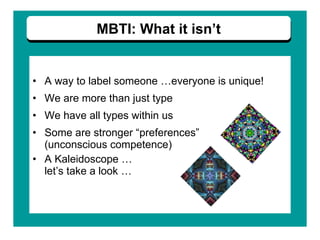
A way to label someone …everyone is unique! We are more than just type We have all types within us Some are stronger “preferences”  (unconscious competence) A Kaleidoscope …  let’s take a look … MBTI: What it isn’t
Pick up something to write with Switch hands Write your name … What were you thinking and feeling? What kind of behaviors did you “do?” Preferences?  Let’s do an activity!
You may wish to take notes for later. Label your notes in sections like this” E  versus  I  S  versus  N F  versus  T J  versus  P There will be a mini quiz! Let’s do an informal look at MBTI
Myers Briggs “unpacked” Two mental processes: Taking in information  How we make judgments  Two  mental “orientations” Inward/outward (where we get our energy) How we deal with/relate to outside world
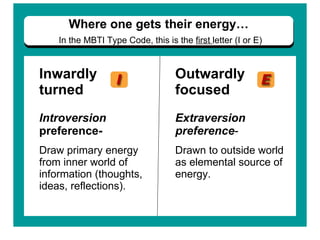
Inwardly  turned Introversion  preference-  Draw primary energy from inner world of information (thoughts, ideas, reflections).  Outwardly  focused Extraversion preference - Drawn to outside world as elemental source of energy.  Where one gets their energy…   In the MBTI Type Code, this is the  first  letter (I or E)
Thinks/reflects first , then acts Requires " private time " to recharge batteries Motivated  internally Prefers  one-to-one   communication and relationships   Introverted characteristics
Acts first , thinks/reflects later  Feels deprived when cutoff from  interaction   with “outside” world  Open to and motivated by outside  world of  people and things   Enjoys wide  variety and change  in  relationships   Extraverted characteristics
Those who prefer  Sensing   Favor clear, tangible  data and information  that fits in well with  their direct here-and-now   experience. Those who prefer  I n tuition Drawn to more abstract, conceptual, big-picture information that represents imaginative possibilities for the future.   How people “perceive" or take in information In the   MBTI Type Code, this is the  second  letter (S or N)
Memory recall rich in  present  opportunities  Using common sense, creating  practical   solutions is  automatic-instinctual Best improvises from  past experience   Likes  clear/concrete information ;  dislikes guessing  when facts are "fuzzy"   Sensing characteristics
Using  imagination  and creating/inventing  new possibilities is automatic-instinctual Mentally lives in future, attending to  future  possibilities Memory/recall emphasizes patterns,  contexts , and connections Best improvises from theoretical understanding   Comfortable with ambiguous, fuzzy data and guessing its meaning   Intuitive characteristics
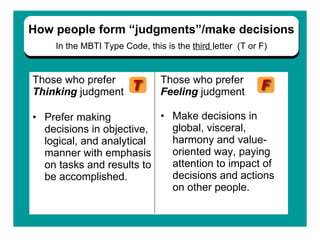
Those who prefer   Thinking   judgment Prefer making decisions in objective, logical, and analytical manner with emphasis on tasks and results to be accomplished.  Those who prefer  Feeling  judgment Make decisions in global, visceral, harmony and value-oriented way, paying attention to impact of decisions and actions on other people. .   How people form “judgments”/make decisions In the   MBTI Type Code, this is the  third  letter  (T or F)
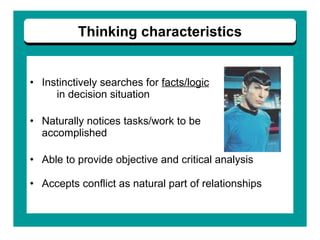
Instinctively searches for  facts/logic   in decision situation Naturally notices tasks/work to be  accomplished Able to provide objective and critical analysis Accepts conflict as natural part of relationships Thinking characteristics
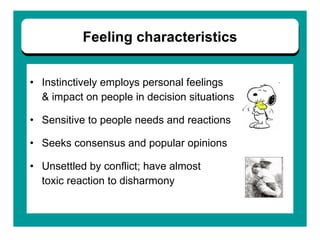
Instinctively employs personal feelings  & impact on people in decision situations Sensitive to people needs and reactions  Seeks consensus and popular opinions Unsettled by conflict; have almost toxic reaction to disharmony Feeling characteristics
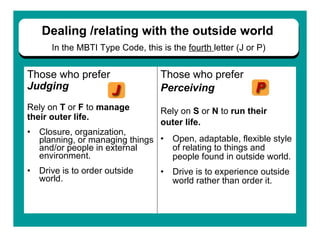
Those who prefer  Judging   Rely on  T  or  F  to  manage  their outer life.   Closure, organization, planning, or managing things and/or people in external environment.   Drive is to order outside world.   Those who prefer  Perceiving Rely on  S  or  N  to  run their  outer life.  Open, adaptable, flexible style of relating to things and people found in outside world.   Drive is to experience outside world rather than order it. Dealing /relating with the   outside world   In the   MBTI Type Code, this is the  fourth  letter (J or P)
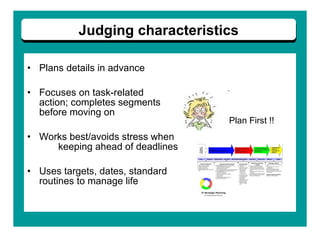
Plans details in advance Focuses on task-related  action; completes segments  before moving on Works best/avoids stress when  keeping ahead of deadlines Uses targets, dates, standard  routines to manage life Judging characteristics Plan First !!
Comfortable moving to action  without a plan;  plans on-the-go … Likes to multitask, have  variety ,  mixes work and play … Naturally tolerant of time pressure;  works best close to deadlines Avoids commitments which interfere  with flexibility, freedom and variety   Perceiving characteristics
Dominant  Intuitive  Types  INFJ , INTJ ,   ENFP , ENTP Dominant  Sensing  Types  ISFJ,  ISTJ,  ESFP , ESTP Dominant  Thinking  Types ISTP,  INTP, ESTJ ,   ENTJ Dominant  Feeling  Types  ISFP,  INFP, ESFJ,  ENFJ Development: Four primary personality types
Careers for Style Types INF P ’s Writers Counselors/Social Workers Teachers/Professors Psychologists Psychiatrists Musicians Clergy/Religious Workers INF J ’s Clergy/Religious Workers Teachers Medical Doctors & Dentists Alternative Health Care Professional – Chiropractors, Reflexologists Psychologists Psychiatrists Counselors & Social Workers Musicians Artists Photographers Childcare/Early Childhood Development
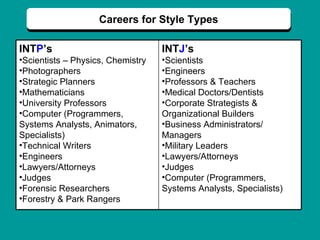
Careers for Style Types INT P ’s Scientists – Physics, Chemistry Photographers Strategic Planners Mathematicians University Professors Computer (Programmers, Systems Analysts, Animators, Specialists) Technical Writers Engineers Lawyers/Attorneys Judges Forensic Researchers Forestry & Park Rangers INT J ’s Scientists Engineers Professors & Teachers Medical Doctors/Dentists Corporate Strategists & Organizational Builders Business Administrators/ Managers Military Leaders Lawyers/Attorneys Judges Computer (Programmers, Systems Analysts, Specialists)
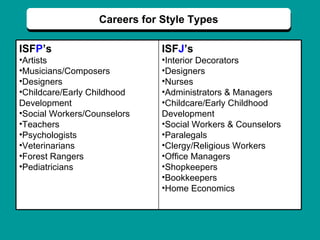
Careers for Style Types ISF P ’s Artists Musicians/Composers Designers Childcare/Early Childhood Development Social Workers/Counselors Teachers Psychologists Veterinarians Forest Rangers Pediatricians ISF J ’s Interior Decorators Designers Nurses Administrators & Managers Childcare/Early Childhood Development Social Workers & Counselors Paralegals Clergy/Religious Workers Office Managers Shopkeepers Bookkeepers Home Economics
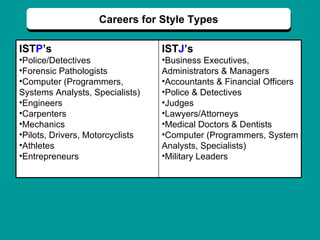
Careers for Style Types IST P ’s Police/Detectives Forensic Pathologists Computer (Programmers, Systems Analysts, Specialists) Engineers Carpenters Mechanics Pilots, Drivers, Motorcyclists Athletes Entrepreneurs IST J ’s Business Executives, Administrators & Managers Accountants & Financial Officers Police & Detectives Judges Lawyers/Attorneys  Medical Doctors & Dentists Computer (Programmers, System Analysts, Specialists) Military Leaders
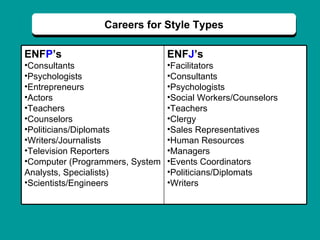
Careers for Style Types ENF P ’s Consultants Psychologists Entrepreneurs Actors Teachers Counselors Politicians/Diplomats Writers/Journalists Television Reporters Computer (Programmers, System Analysts, Specialists) Scientists/Engineers ENF J ’s Facilitators Consultants Psychologists Social Workers/Counselors Teachers Clergy Sales Representatives Human Resources Managers Events Coordinators Politicians/Diplomats Writers
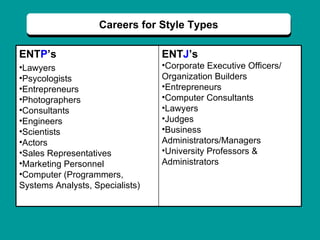
Careers for Style Types ENT P ’s Lawyers Psycologists Entrepreneurs Photographers Consultants Engineers Scientists Actors Sales Representatives Marketing Personnel Computer (Programmers, Systems Analysts, Specialists) ENT J ’s Corporate Executive Officers/ Organization Builders Entrepreneurs Computer Consultants Lawyers Judges Business Administrators/Managers University Professors & Administrators
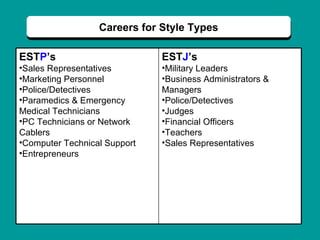
Careers for Style Types EST P ’s Sales Representatives Marketing Personnel Police/Detectives Paramedics & Emergency Medical Technicians PC Technicians or Network Cablers Computer Technical Support Entrepreneurs EST J ’s Military Leaders Business Administrators & Managers Police/Detectives Judges Financial Officers Teachers Sales Representatives
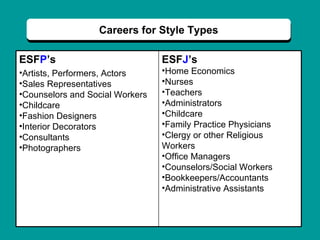
Careers for Style Types ESF P ’s Artists, Performers, Actors Sales Representatives Counselors and Social Workers Childcare Fashion Designers Interior Decorators Consultants Photographers  ESF J ’s Home Economics Nurses Teachers Administrators Childcare Family Practice Physicians Clergy or other Religious Workers Office Managers Counselors/Social Workers Bookkeepers/Accountants Administrative Assistants
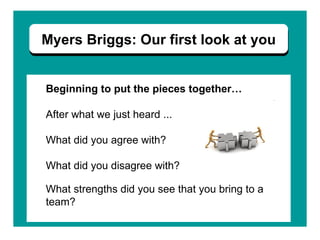
Myers Briggs: Our first look at you Beginning to put the pieces together… After what we just heard ... What did you agree with? What did you disagree with? What strengths did you see that you bring to a team?
Everyone has a boss Everyone has coworkers How can we find our best fit Ask : How can “I contribute to  solving problems  Know U- the “first” university you should attend ! How we act, what we need!
Interested in learning more?  And … thank you for allowing me to join you!   Cathy Smith, M.A., L.P.C.    Know U, LLC – Regional Consultant Organizational & Leadership Development    [email_address]   248-417-1987 Thank you!

Personality Assessment Presentation 12 16 10 Ab

  • 1.
    Myers Briggs “Unpacked”ENTJ ENTP ENFJ ENFP ESTJ ESTP ESFJ ESFP INTJ INTP INFJ INFP ISTJ ISTP ISFJ ISFP Cathy McCafferty-Smith Know U – Leadership Consulting, LLC
  • 2.
  • 3.
    Exchange information with someone else … Network Assessment (business cards or sticky notes)
  • 4.
    Early work in1923-1940’s (World War II) Carl Jung (Psychologist) Isabella Briggs Myers/Katherine Briggs (non psychologists) Noticed people approached life differently/evidenced by observable behavior Classified behaviors to help people find their personality and “task”/career matches (”fit”) (Spiritual Gifts) Most widely used psychological assessment, high reliability and validity Translated in many languages, millions have taken the assessment Personality Type - MBTI origins
  • 5.
    The MBTI® model(along with other personality theories and psychometrics models) is particularly useful for: understanding/developing yourself (and others) understanding what motivates you (and others) understanding others' (and our own) strengths and lesser preferences working in teams - ensuring all relevant necessary capabilities are represented MBTI psychometrics and uses
  • 6.
    A way tolabel someone …everyone is unique! We are more than just type We have all types within us Some are stronger “preferences” (unconscious competence) A Kaleidoscope … let’s take a look … MBTI: What it isn’t
  • 7.
    Pick up somethingto write with Switch hands Write your name … What were you thinking and feeling? What kind of behaviors did you “do?” Preferences? Let’s do an activity!
  • 8.
    You may wishto take notes for later. Label your notes in sections like this” E versus I S versus N F versus T J versus P There will be a mini quiz! Let’s do an informal look at MBTI
  • 9.
    Myers Briggs “unpacked”Two mental processes: Taking in information How we make judgments Two mental “orientations” Inward/outward (where we get our energy) How we deal with/relate to outside world
  • 10.
    Inwardly turnedIntroversion preference- Draw primary energy from inner world of information (thoughts, ideas, reflections). Outwardly focused Extraversion preference - Drawn to outside world as elemental source of energy. Where one gets their energy… In the MBTI Type Code, this is the first letter (I or E)
  • 11.
    Thinks/reflects first ,then acts Requires " private time " to recharge batteries Motivated internally Prefers one-to-one communication and relationships Introverted characteristics
  • 12.
    Acts first ,thinks/reflects later Feels deprived when cutoff from interaction with “outside” world Open to and motivated by outside world of people and things Enjoys wide variety and change in relationships Extraverted characteristics
  • 13.
    Those who prefer Sensing Favor clear, tangible data and information that fits in well with their direct here-and-now experience. Those who prefer I n tuition Drawn to more abstract, conceptual, big-picture information that represents imaginative possibilities for the future. How people “perceive" or take in information In the MBTI Type Code, this is the second letter (S or N)
  • 14.
    Memory recall richin present opportunities Using common sense, creating practical solutions is automatic-instinctual Best improvises from past experience Likes clear/concrete information ; dislikes guessing when facts are "fuzzy" Sensing characteristics
  • 15.
    Using imagination and creating/inventing new possibilities is automatic-instinctual Mentally lives in future, attending to future possibilities Memory/recall emphasizes patterns, contexts , and connections Best improvises from theoretical understanding Comfortable with ambiguous, fuzzy data and guessing its meaning Intuitive characteristics
  • 16.
    Those who prefer Thinking judgment Prefer making decisions in objective, logical, and analytical manner with emphasis on tasks and results to be accomplished. Those who prefer Feeling judgment Make decisions in global, visceral, harmony and value-oriented way, paying attention to impact of decisions and actions on other people. . How people form “judgments”/make decisions In the MBTI Type Code, this is the third letter (T or F)
  • 17.
    Instinctively searches for facts/logic in decision situation Naturally notices tasks/work to be accomplished Able to provide objective and critical analysis Accepts conflict as natural part of relationships Thinking characteristics
  • 18.
    Instinctively employs personalfeelings & impact on people in decision situations Sensitive to people needs and reactions Seeks consensus and popular opinions Unsettled by conflict; have almost toxic reaction to disharmony Feeling characteristics
  • 19.
    Those who prefer Judging Rely on T or F to manage their outer life. Closure, organization, planning, or managing things and/or people in external environment. Drive is to order outside world. Those who prefer Perceiving Rely on S or N to run their outer life. Open, adaptable, flexible style of relating to things and people found in outside world. Drive is to experience outside world rather than order it. Dealing /relating with the outside world In the MBTI Type Code, this is the fourth letter (J or P)
  • 20.
    Plans details inadvance Focuses on task-related action; completes segments before moving on Works best/avoids stress when keeping ahead of deadlines Uses targets, dates, standard routines to manage life Judging characteristics Plan First !!
  • 21.
    Comfortable moving toaction without a plan; plans on-the-go … Likes to multitask, have variety , mixes work and play … Naturally tolerant of time pressure; works best close to deadlines Avoids commitments which interfere with flexibility, freedom and variety Perceiving characteristics
  • 22.
    Dominant Intuitive Types INFJ , INTJ , ENFP , ENTP Dominant Sensing Types ISFJ, ISTJ, ESFP , ESTP Dominant Thinking Types ISTP, INTP, ESTJ , ENTJ Dominant Feeling Types ISFP, INFP, ESFJ, ENFJ Development: Four primary personality types
  • 23.
    Careers for StyleTypes INF P ’s Writers Counselors/Social Workers Teachers/Professors Psychologists Psychiatrists Musicians Clergy/Religious Workers INF J ’s Clergy/Religious Workers Teachers Medical Doctors & Dentists Alternative Health Care Professional – Chiropractors, Reflexologists Psychologists Psychiatrists Counselors & Social Workers Musicians Artists Photographers Childcare/Early Childhood Development
  • 24.
    Careers for StyleTypes INT P ’s Scientists – Physics, Chemistry Photographers Strategic Planners Mathematicians University Professors Computer (Programmers, Systems Analysts, Animators, Specialists) Technical Writers Engineers Lawyers/Attorneys Judges Forensic Researchers Forestry & Park Rangers INT J ’s Scientists Engineers Professors & Teachers Medical Doctors/Dentists Corporate Strategists & Organizational Builders Business Administrators/ Managers Military Leaders Lawyers/Attorneys Judges Computer (Programmers, Systems Analysts, Specialists)
  • 25.
    Careers for StyleTypes ISF P ’s Artists Musicians/Composers Designers Childcare/Early Childhood Development Social Workers/Counselors Teachers Psychologists Veterinarians Forest Rangers Pediatricians ISF J ’s Interior Decorators Designers Nurses Administrators & Managers Childcare/Early Childhood Development Social Workers & Counselors Paralegals Clergy/Religious Workers Office Managers Shopkeepers Bookkeepers Home Economics
  • 26.
    Careers for StyleTypes IST P ’s Police/Detectives Forensic Pathologists Computer (Programmers, Systems Analysts, Specialists) Engineers Carpenters Mechanics Pilots, Drivers, Motorcyclists Athletes Entrepreneurs IST J ’s Business Executives, Administrators & Managers Accountants & Financial Officers Police & Detectives Judges Lawyers/Attorneys Medical Doctors & Dentists Computer (Programmers, System Analysts, Specialists) Military Leaders
  • 27.
    Careers for StyleTypes ENF P ’s Consultants Psychologists Entrepreneurs Actors Teachers Counselors Politicians/Diplomats Writers/Journalists Television Reporters Computer (Programmers, System Analysts, Specialists) Scientists/Engineers ENF J ’s Facilitators Consultants Psychologists Social Workers/Counselors Teachers Clergy Sales Representatives Human Resources Managers Events Coordinators Politicians/Diplomats Writers
  • 28.
    Careers for StyleTypes ENT P ’s Lawyers Psycologists Entrepreneurs Photographers Consultants Engineers Scientists Actors Sales Representatives Marketing Personnel Computer (Programmers, Systems Analysts, Specialists) ENT J ’s Corporate Executive Officers/ Organization Builders Entrepreneurs Computer Consultants Lawyers Judges Business Administrators/Managers University Professors & Administrators
  • 29.
    Careers for StyleTypes EST P ’s Sales Representatives Marketing Personnel Police/Detectives Paramedics & Emergency Medical Technicians PC Technicians or Network Cablers Computer Technical Support Entrepreneurs EST J ’s Military Leaders Business Administrators & Managers Police/Detectives Judges Financial Officers Teachers Sales Representatives
  • 30.
    Careers for StyleTypes ESF P ’s Artists, Performers, Actors Sales Representatives Counselors and Social Workers Childcare Fashion Designers Interior Decorators Consultants Photographers ESF J ’s Home Economics Nurses Teachers Administrators Childcare Family Practice Physicians Clergy or other Religious Workers Office Managers Counselors/Social Workers Bookkeepers/Accountants Administrative Assistants
  • 31.
    Myers Briggs: Ourfirst look at you Beginning to put the pieces together… After what we just heard ... What did you agree with? What did you disagree with? What strengths did you see that you bring to a team?
  • 32.
    Everyone has aboss Everyone has coworkers How can we find our best fit Ask : How can “I contribute to solving problems Know U- the “first” university you should attend ! How we act, what we need!
  • 33.
    Interested in learningmore? And … thank you for allowing me to join you! Cathy Smith, M.A., L.P.C. Know U, LLC – Regional Consultant Organizational & Leadership Development [email_address] 248-417-1987 Thank you!

Editor's Notes

  • #13 Ask participants to take out their workbooks and take notes
  • #33 Ask participants to take out their workbooks and take notes