KNOW YOURSELF - KNOW OTHERS
TIPS FOR CROSS-FUNCTIONAL TEAMS
@HLTTAI
ABOUT ME
➤ Agile Coach
➤ CSM / CSPO / CSP
➤ Management 3.0 Facilitator
➤ Agile Vietnam Organizer
➤ IT Outsourcing & Offshoring
➤ Big Data & Complex Network
➤ Digital Marketing & Production
@hlttai
“INDIVIDUALS AND INTERACTIONS
OVER PROCESSES AND TOOLS
WE LIVE IN A HUMAN WORLD

BUT OFTEN NO PEACE
LET’S UNDERSTAND EACH OTHER
➤UNDERSTAND OURSELF
➤UNDERSTAND THE OTHER
➤SPEAK HIS/HER LANGUAGE
COLD READING
➤ Clothing
➤ Physicality
➤ Tattoos
➤ Skin & Teeth
➤ Hair & Facial Hair
➤ Watch
➤ Jewellery & Rings
➤ …
STAGE OF LIFE
➤ The Tryout 20s
➤ The Turbulent 30s
➤ The Flourishing 40s
➤ The Flaming 50s
PERSONALITY TRAITS
➤ Myers-Briggs Type Indicator®
➤ Pyscho-Geometrics®
➤ The Sixteen Personality Factor (16PF)
➤ DISC
MBTI®
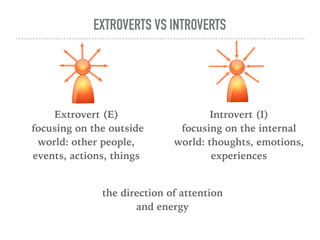
EXTROVERTS VS INTROVERTS
Extrovert (E)
focusing on the outside
world: other people,
events, actions, things  
Introvert (I)
focusing on the internal
world: thoughts, emotions,
experiences
the direction of attention
and energy
EXTROVERTS VS INTROVERTS
➤ Where do you focus your attention and energy?
SENSING VS INTUITION
Sensing (S)
focuses on the present:
current events
and facts
 
iNtuition (N)
focuses on the future:
new opportunities
and ideas
the way we are take in
information
SENSING VS INTUITION
➤ How do you prefer to take in information?
THINKING VS FEELING
Thinking (T)
makes decisions
objectively, using logic
 
Feeling (F)
makes decisions
subjectively, using feeling
the way we make decisions
THINKING VS FEELING
➤ How do you make decision?
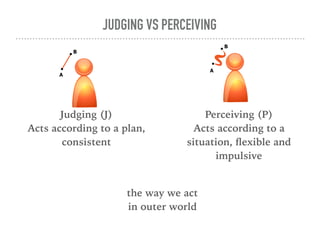
JUDGING VS PERCEIVING
Judging (J)
Acts according to a plan,
consistent
 
Perceiving (P)
Acts according to a
situation, flexible and
impulsive
the way we act
in outer world
JUDGING VS PERCEIVING
➤ How do you act in outer world?
5 MINS WORKSHOP
➤ Making two groups:
➤ Introverts in the left
➤ Extroverts in the right
➤ Answer the questions:
➤ What are you prefers in working?
➤ How people can communicate to you?
WORKING WITH INTROVERTS
introverts prefers:
➤ to spend time reflecting on decision
➤ to think before responding with
thoughts or ideas;
➤ quiet working place;
➤ direct communication
communicate with introverts:
➤ appreciate communication in writing
➤ giving them more time to think
about information
➤ allow introverts work by themselves
introverts contribute:
➤ great at paying attention to details
➤ really thinking about the problems
➤ think through and reflect on any project
to come up with the best solutions
MANAGING INTROVERTS
➤ Do give them advance notice
➤ Do help them to find a partner
➤ Do train them new skills
privately
➤ Don’t publicly reprimand them
➤ Don’t demand instant answers
➤ Don’t interrupt them
➤ Don’t try to make them
extroverts
WORKING WITH EXTROVERTS
extroverts prefers:
➤ verbal with their emotions and ideas
➤ group gathering & social workspaces
➤ welcome roundabout
communication
➤ brainstorm in a group
communicate with extroverts:
➤ give chance to volunteer their
ideas & opinions
➤ encourage ‘go go go’ mentality
➤ allow introverts work in team
extroverts contribute:
➤ motivate to others in the workplace
➤ encourage the creativity and keep
people ahead of schedule
MANAGING EXTROVERTS
➤ Do compliment them publicly
➤ Do allow them to talk things out
➤ Make physical and verbal
gestures of affection
➤ Offer them options
➤ Accept exuberance
➤ Don’t force them away from
others
➤ Don’t deflate their excitement
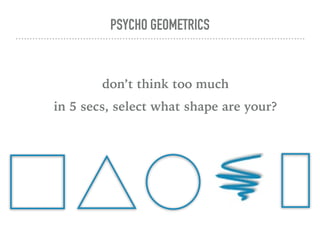
PSYCHO GEOMETRICS
don’t think too much
in 5 secs, select what shape are your?
WHAT DOES IT ALL MEAN?
➤ All of us have a DOMINANT shape which helps
us understand our own communication and
behavioural style.
➤ While we do have one dominant shape, we are
often combination of shapes, depending on
current situations, environment, etc.
➤ By understanding your shape, you can learn how
to adapt to others
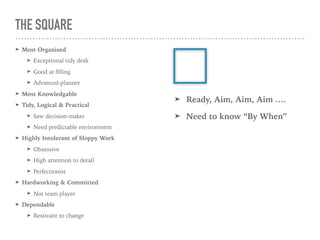
THE SQUARE
➤ Most Organised
➤ Exceptional tidy desk
➤ Good at filling
➤ Advanced-planner
➤ Most Knowledgable
➤ Tidy, Logical & Practical
➤ Saw decision-maker
➤ Need predictable environment
➤ Highly Intolerant of Sloppy Work
➤ Obsessive
➤ High attention to detail
➤ Perfectionist
➤ Hardworking & Committed
➤ Not team player
➤ Dependable
➤ Resistant to change
➤ Ready, Aim, Aim, Aim ….
➤ Need to know “By When”
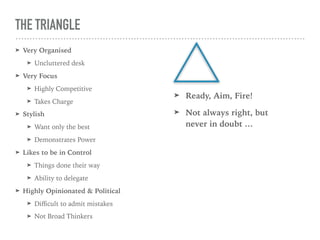
THE TRIANGLE
➤ Very Organised
➤ Uncluttered desk
➤ Very Focus
➤ Highly Competitive
➤ Takes Charge
➤ Stylish
➤ Want only the best
➤ Demonstrates Power
➤ Likes to be in Control
➤ Things done their way
➤ Ability to delegate
➤ Highly Opinionated & Political
➤ Difficult to admit mistakes
➤ Not Broad Thinkers
➤ Ready, Aim, Fire!
➤ Not always right, but
never in doubt …
THE SQUIGGLE
➤ Messiest & Least Organised
➤ Lack focus
➤ Creative, Flamboyant,
Dramatic & Witty
➤ Eager to share ideas
➤ Potentially volatile
➤ Not team players
➤ Easily Bored
➤ Struggles with routine work
➤ Needs constant change
➤ Ready, Fire … Aim?? … oops
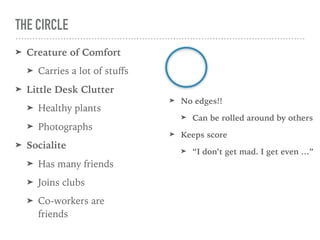
THE CIRCLE
➤ Creature of Comfort
➤ Carries a lot of stuffs
➤ Little Desk Clutter
➤ Healthy plants
➤ Photographs
➤ Socialite
➤ Has many friends
➤ Joins clubs
➤ Co-workers are
friends
➤ No edges!!
➤ Can be rolled around by others
➤ Keeps score
➤ “I don’t get mad. I get even …”
THE RECTANGLE
➤ Incredibly Messy
➤ Carries work with them
➤ Uncertain, Indecisive and
Inconsistent
➤ Shape-shifter!
➤ Lack of Focus
➤ Forgetful
➤ Inquisitive, Courageous
➤ Tries new things
➤ Prefers Large Groups
➤ Constant Transition and State of
Change
➤ Afraid of being put on the spot
SQUARE - TRIANGLE - SQUIGGLE - CIRCLE - RECTANGLE
➤ What is your “dominant” shape?
5 MINS WORKSHOP
➤ Making 5 groups for each shape
➤ Answer the questions:
➤ What are you prefers in working?
➤ How people can communicate to you?
ADAPTABILITY
➤ Willing and able to bend for a better relationship
➤ Managing your own compatibility
➤ harmony in living or working together
➤ Adjust your openness and directness and your
pace and priority to create harmony
ADAPTABILITY EXAMPLE
➤ Talking less
➤ Listening more
➤ Focusing on task at hand
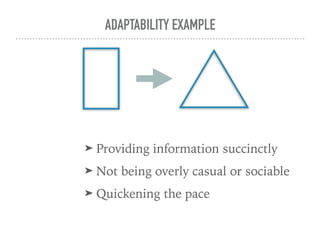
ADAPTABILITY EXAMPLE
➤ Providing information succinctly
➤ Not being overly casual or sociable
➤ Quickening the pace
WORKING WITH SQUARE
➤ Do not catch the square unprepared to
discuss a problem
➤ Avoid chaos, surprised and emotional
situations
➤ Think through your argument thoroughly
before approaching the square
➤ Keep abreast of your tasks and on schedule
➤ Save face for the square; they are concerned
with maintaining the respect of their
colleagues
➤ Stressful with
square:
➤ Circle
➤ Squiggle
➤ Rectangle
➤ Triangle
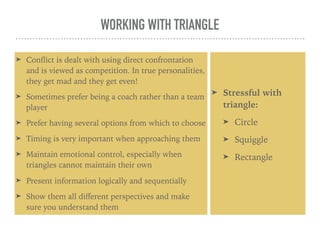
WORKING WITH TRIANGLE
➤ Conflict is dealt with using direct confrontation
and is viewed as competition. In true personalities,
they get mad and they get even!
➤ Sometimes prefer being a coach rather than a team
player
➤ Prefer having several options from which to choose
➤ Timing is very important when approaching them
➤ Maintain emotional control, especially when
triangles cannot maintain their own
➤ Present information logically and sequentially
➤ Show them all different perspectives and make
sure you understand them
➤ Stressful with
triangle:
➤ Circle
➤ Squiggle
➤ Rectangle
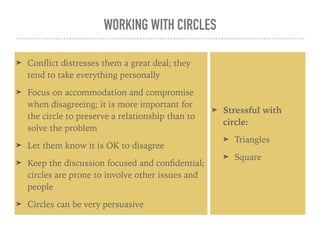
WORKING WITH CIRCLES
➤ Conflict distresses them a great deal; they
tend to take everything personally
➤ Focus on accommodation and compromise
when disagreeing; it is more important for
the circle to preserve a relationship than to
solve the problem
➤ Let them know it is OK to disagree
➤ Keep the discussion focused and confidential;
circles are prone to involve other issues and
people
➤ Circles can be very persuasive
➤ Stressful with
circle:
➤ Triangles
➤ Square
WORKING WITH SQUIGGLE
➤ Squiggles perceive most conflicts as
unimportant compared to other things they
need to do; however, when they do find it
worthwhile, they can be very persuasive and
competitive
➤ You may have to guard yourself against their
powerful energy if it is too overbearing
➤ Hold discussions in neutral locations
➤ When you reach an agreement you should
follow up and work out the details; the
squiggle will be off to other activities
➤ Stressful with
squiggle:
➤ Triangles
➤ Square
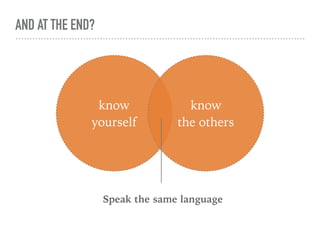
AND AT THE END?
know
yourself
know
the others
Speak the same language
PLATINUM IS STEP ABOVE GOLDEN
GOLDEN RULE
Treat people as you would like to be treated
PLATINUM RULE
Treat people as they would like to be treated
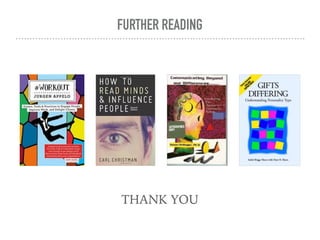
FURTHER READING
THANK YOU

Know yourself - Know others - Tips for cross-functional team

  • 1.
    KNOW YOURSELF -KNOW OTHERS TIPS FOR CROSS-FUNCTIONAL TEAMS @HLTTAI
  • 2.
    ABOUT ME ➤ AgileCoach ➤ CSM / CSPO / CSP ➤ Management 3.0 Facilitator ➤ Agile Vietnam Organizer ➤ IT Outsourcing & Offshoring ➤ Big Data & Complex Network ➤ Digital Marketing & Production @hlttai
  • 3.
  • 4.
    WE LIVE INA HUMAN WORLD
 BUT OFTEN NO PEACE
  • 5.
  • 6.
    ➤UNDERSTAND OURSELF ➤UNDERSTAND THEOTHER ➤SPEAK HIS/HER LANGUAGE
  • 7.
    COLD READING ➤ Clothing ➤Physicality ➤ Tattoos ➤ Skin & Teeth ➤ Hair & Facial Hair ➤ Watch ➤ Jewellery & Rings ➤ …
  • 8.
    STAGE OF LIFE ➤The Tryout 20s ➤ The Turbulent 30s ➤ The Flourishing 40s ➤ The Flaming 50s
  • 9.
    PERSONALITY TRAITS ➤ Myers-BriggsType Indicator® ➤ Pyscho-Geometrics® ➤ The Sixteen Personality Factor (16PF) ➤ DISC
  • 11.
  • 12.
    EXTROVERTS VS INTROVERTS Extrovert(E) focusing on the outside world: other people, events, actions, things   Introvert (I) focusing on the internal world: thoughts, emotions, experiences the direction of attention and energy
  • 14.
    EXTROVERTS VS INTROVERTS ➤Where do you focus your attention and energy?
  • 15.
    SENSING VS INTUITION Sensing(S) focuses on the present: current events and facts   iNtuition (N) focuses on the future: new opportunities and ideas the way we are take in information
  • 17.
    SENSING VS INTUITION ➤How do you prefer to take in information?
  • 18.
    THINKING VS FEELING Thinking(T) makes decisions objectively, using logic   Feeling (F) makes decisions subjectively, using feeling the way we make decisions
  • 20.
    THINKING VS FEELING ➤How do you make decision?
  • 21.
    JUDGING VS PERCEIVING Judging(J) Acts according to a plan, consistent   Perceiving (P) Acts according to a situation, flexible and impulsive the way we act in outer world
  • 23.
    JUDGING VS PERCEIVING ➤How do you act in outer world?
  • 24.
    5 MINS WORKSHOP ➤Making two groups: ➤ Introverts in the left ➤ Extroverts in the right ➤ Answer the questions: ➤ What are you prefers in working? ➤ How people can communicate to you?
  • 25.
    WORKING WITH INTROVERTS introvertsprefers: ➤ to spend time reflecting on decision ➤ to think before responding with thoughts or ideas; ➤ quiet working place; ➤ direct communication communicate with introverts: ➤ appreciate communication in writing ➤ giving them more time to think about information ➤ allow introverts work by themselves introverts contribute: ➤ great at paying attention to details ➤ really thinking about the problems ➤ think through and reflect on any project to come up with the best solutions
  • 26.
    MANAGING INTROVERTS ➤ Dogive them advance notice ➤ Do help them to find a partner ➤ Do train them new skills privately ➤ Don’t publicly reprimand them ➤ Don’t demand instant answers ➤ Don’t interrupt them ➤ Don’t try to make them extroverts
  • 27.
    WORKING WITH EXTROVERTS extrovertsprefers: ➤ verbal with their emotions and ideas ➤ group gathering & social workspaces ➤ welcome roundabout communication ➤ brainstorm in a group communicate with extroverts: ➤ give chance to volunteer their ideas & opinions ➤ encourage ‘go go go’ mentality ➤ allow introverts work in team extroverts contribute: ➤ motivate to others in the workplace ➤ encourage the creativity and keep people ahead of schedule
  • 28.
    MANAGING EXTROVERTS ➤ Docompliment them publicly ➤ Do allow them to talk things out ➤ Make physical and verbal gestures of affection ➤ Offer them options ➤ Accept exuberance ➤ Don’t force them away from others ➤ Don’t deflate their excitement
  • 29.
    PSYCHO GEOMETRICS don’t thinktoo much in 5 secs, select what shape are your?
  • 30.
    WHAT DOES ITALL MEAN? ➤ All of us have a DOMINANT shape which helps us understand our own communication and behavioural style. ➤ While we do have one dominant shape, we are often combination of shapes, depending on current situations, environment, etc. ➤ By understanding your shape, you can learn how to adapt to others
  • 31.
    THE SQUARE ➤ MostOrganised ➤ Exceptional tidy desk ➤ Good at filling ➤ Advanced-planner ➤ Most Knowledgable ➤ Tidy, Logical & Practical ➤ Saw decision-maker ➤ Need predictable environment ➤ Highly Intolerant of Sloppy Work ➤ Obsessive ➤ High attention to detail ➤ Perfectionist ➤ Hardworking & Committed ➤ Not team player ➤ Dependable ➤ Resistant to change ➤ Ready, Aim, Aim, Aim …. ➤ Need to know “By When”
  • 32.
    THE TRIANGLE ➤ VeryOrganised ➤ Uncluttered desk ➤ Very Focus ➤ Highly Competitive ➤ Takes Charge ➤ Stylish ➤ Want only the best ➤ Demonstrates Power ➤ Likes to be in Control ➤ Things done their way ➤ Ability to delegate ➤ Highly Opinionated & Political ➤ Difficult to admit mistakes ➤ Not Broad Thinkers ➤ Ready, Aim, Fire! ➤ Not always right, but never in doubt …
  • 33.
    THE SQUIGGLE ➤ Messiest& Least Organised ➤ Lack focus ➤ Creative, Flamboyant, Dramatic & Witty ➤ Eager to share ideas ➤ Potentially volatile ➤ Not team players ➤ Easily Bored ➤ Struggles with routine work ➤ Needs constant change ➤ Ready, Fire … Aim?? … oops
  • 34.
    THE CIRCLE ➤ Creatureof Comfort ➤ Carries a lot of stuffs ➤ Little Desk Clutter ➤ Healthy plants ➤ Photographs ➤ Socialite ➤ Has many friends ➤ Joins clubs ➤ Co-workers are friends ➤ No edges!! ➤ Can be rolled around by others ➤ Keeps score ➤ “I don’t get mad. I get even …”
  • 35.
    THE RECTANGLE ➤ IncrediblyMessy ➤ Carries work with them ➤ Uncertain, Indecisive and Inconsistent ➤ Shape-shifter! ➤ Lack of Focus ➤ Forgetful ➤ Inquisitive, Courageous ➤ Tries new things ➤ Prefers Large Groups ➤ Constant Transition and State of Change ➤ Afraid of being put on the spot
  • 36.
    SQUARE - TRIANGLE- SQUIGGLE - CIRCLE - RECTANGLE ➤ What is your “dominant” shape?
  • 37.
    5 MINS WORKSHOP ➤Making 5 groups for each shape ➤ Answer the questions: ➤ What are you prefers in working? ➤ How people can communicate to you?
  • 38.
    ADAPTABILITY ➤ Willing andable to bend for a better relationship ➤ Managing your own compatibility ➤ harmony in living or working together ➤ Adjust your openness and directness and your pace and priority to create harmony
  • 39.
    ADAPTABILITY EXAMPLE ➤ Talkingless ➤ Listening more ➤ Focusing on task at hand
  • 40.
    ADAPTABILITY EXAMPLE ➤ Providinginformation succinctly ➤ Not being overly casual or sociable ➤ Quickening the pace
  • 41.
    WORKING WITH SQUARE ➤Do not catch the square unprepared to discuss a problem ➤ Avoid chaos, surprised and emotional situations ➤ Think through your argument thoroughly before approaching the square ➤ Keep abreast of your tasks and on schedule ➤ Save face for the square; they are concerned with maintaining the respect of their colleagues ➤ Stressful with square: ➤ Circle ➤ Squiggle ➤ Rectangle ➤ Triangle
  • 42.
    WORKING WITH TRIANGLE ➤Conflict is dealt with using direct confrontation and is viewed as competition. In true personalities, they get mad and they get even! ➤ Sometimes prefer being a coach rather than a team player ➤ Prefer having several options from which to choose ➤ Timing is very important when approaching them ➤ Maintain emotional control, especially when triangles cannot maintain their own ➤ Present information logically and sequentially ➤ Show them all different perspectives and make sure you understand them ➤ Stressful with triangle: ➤ Circle ➤ Squiggle ➤ Rectangle
  • 43.
    WORKING WITH CIRCLES ➤Conflict distresses them a great deal; they tend to take everything personally ➤ Focus on accommodation and compromise when disagreeing; it is more important for the circle to preserve a relationship than to solve the problem ➤ Let them know it is OK to disagree ➤ Keep the discussion focused and confidential; circles are prone to involve other issues and people ➤ Circles can be very persuasive ➤ Stressful with circle: ➤ Triangles ➤ Square
  • 44.
    WORKING WITH SQUIGGLE ➤Squiggles perceive most conflicts as unimportant compared to other things they need to do; however, when they do find it worthwhile, they can be very persuasive and competitive ➤ You may have to guard yourself against their powerful energy if it is too overbearing ➤ Hold discussions in neutral locations ➤ When you reach an agreement you should follow up and work out the details; the squiggle will be off to other activities ➤ Stressful with squiggle: ➤ Triangles ➤ Square
  • 45.
    AND AT THEEND? know yourself know the others Speak the same language
  • 46.
    PLATINUM IS STEPABOVE GOLDEN GOLDEN RULE Treat people as you would like to be treated PLATINUM RULE Treat people as they would like to be treated
  • 47.