


 Muhammed Talha MCS-13-08
 Arslan Azam MCS-13-03
 Aitazaz Ahsan MCS-13-38
 Muhammed Sohail MCS-13-17
 Muhammed Yousaf MCS-13-23
 Abida Bibi MCS-13-22
 Tayyaba Ghani MCS-13-39
 Maximum CPU utilization is obtained with multiprogramming
◦ Several processes are kept in memory at one time
◦ Every time a running process has to wait, another process can
take over use of the CPU
 Scheduling of the CPU is fundamental to operating system design
 The process scheduler is the component of the operating system
that is responsible for deciding whether the currently running
process should continue running and, if not, which process should
run next.
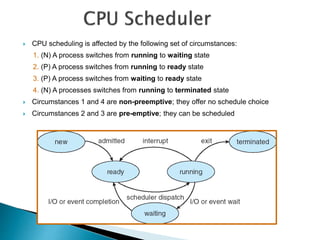
 CPU scheduling is affected by the following set of circumstances:
1. (N) A process switches from running to waiting state
2. (P) A process switches from running to ready state
3. (P) A process switches from waiting to ready state
4. (N) A processes switches from running to terminated state
 Circumstances 1 and 4 are non-preemptive; they offer no schedule choice
 Circumstances 2 and 3 are pre-emptive; they can be scheduled
 The dispatcher module gives control of the CPU to the process
selected by the short-term scheduler; this involves:
◦ switching context
◦ switching to user mode
◦ jumping to the proper location in the user program to restart that
program
 The dispatcher needs to run as fast as possible, since it is invoked
during process context switch
 The time it takes for the dispatcher to stop one process and start
another process is called dispatch latency
 Different CPU scheduling algorithms have different properties
 The choice of a particular algorithm may favour one class of
processes over another
 In choosing which algorithm to use, the properties of the various
algorithms should be considered
 Criteria for comparing CPU scheduling algorithms may include the following
◦ CPU utilization
◦ Throughput
◦ Turnaround time
◦ Response time
◦ Waiting time
 First Come, First Served (FCFS)
 Shortest Job First (SJF)
 Priority
 Round Robin (RR)
 Windows XP schedules threads using a priority-based, pre-emptive
scheduler with a flexible system of priority levels that includes round-robin
scheduling within each level
 The scheduler ensures that the highest priority thread will always run
Dispatcher
 The portion of the Windows kernel that handles scheduling is called
the dispatcher
 A thread selected to run by the dispatcher will run until it is preempted by a
higher-priority thread, until it terminates, until its time quantum ends, or until
it calls a blocking system call such as I/O
 If a higher-priority real-time thread becomes ready while a lower-priority
thread is running, lower-priority thread will be preempted
◦ This preemption gives a real-time thread preferential access to the CPU
when the thread needs such access
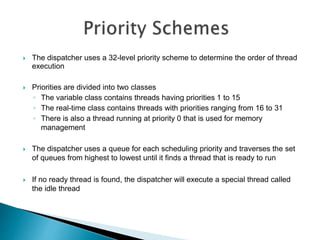
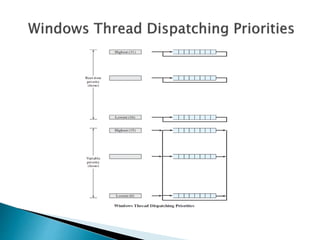
 The dispatcher uses a 32-level priority scheme to determine the order of thread
execution
 Priorities are divided into two classes
◦ The variable class contains threads having priorities 1 to 15
◦ The real-time class contains threads with priorities ranging from 16 to 31
◦ There is also a thread running at priority 0 that is used for memory
management
 The dispatcher uses a queue for each scheduling priority and traverses the set
of queues from highest to lowest until it finds a thread that is ready to run
 If no ready thread is found, the dispatcher will execute a special thread called
the idle thread
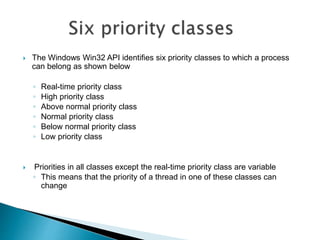
 The Windows Win32 API identifies six priority classes to which a process
can belong as shown below
◦ Real-time priority class
◦ High priority class
◦ Above normal priority class
◦ Normal priority class
◦ Below normal priority class
◦ Low priority class
 Priorities in all classes except the real-time priority class are variable
◦ This means that the priority of a thread in one of these classes can
change
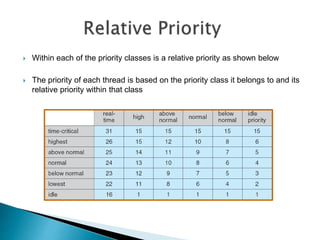
 Within each of the priority classes is a relative priority as shown below
 The priority of each thread is based on the priority class it belongs to and its
relative priority within that class
 The initial priority of a thread is typically the base priority of the process that the
thread belongs to
 When a thread’s time quantum runs out, that thread is interrupted
 If the thread is in the variable-priority class, its priority is lowered
◦ However, the priority is never lowered below the base priority
 Lowering the thread’s priority tends to limit the CPU consumption of compute-bound
threads
 When a variable-priority thread is released from a wait operation, the dispatcher
boosts the priority
◦ The amount of boost depends on what the thread was waiting for
 A thread that was waiting for keyboard I/O would get a large increase
 A thread that was waiting for a disk operation would get a moderate increase
 This strategy tends to give good response time to interactive threads that are using
the mouse and windows
 It also enables I/O-bound threads to keep the I/O devices busy while permitting
compute-bound threads to use spare CPU cycles in the background
 This strategy is used by several time-sharing operating systems, including UNIX
 In addition, the window with which the user is currently interacting receives a priority
boost to enhance its response time
 When a user is running an interactive program, the system needs to
provide especially good performance for that process
 Therefore, Windows XP has a special scheduling rule for processes in
the normal priority class
 Windows XP distinguishes between the foreground process that is
currently selected on the screen and the background processes that
are not currently selected
 When a process moves in the foreground, Windows XP increases the
scheduling quantum by some factor – typically by 3
 This increase gives the foreground process three times longer to run
before a time-sharing preemption occurs
 https://msdn.microsoft.com/en-
us/library/windows/desktop/ms685100(v=vs.85).aspx
 Earlier version of Windows provided a feature
known as Fiber.
 Fibers allowed several user-mode threads (fibers)
to be mapped to a single kernel thread.
 Fibers were of limited practical use.
 A fiber was unable to make calls to the windows
API
 So Microsoft introduced a UMS.
 Windows 7 introduced a user-mode scheduling (UMS),
Which allows application to create and manage threads
independently of the kernel
 Thus , an application can create and scheduled multiple
threads without involving the windows Kernel scheduler
 Scheduling threads in user mode is much more efficient
than kernel mode.
 http://superuser.com/questions/452780/scheduling-
algorithm-used-in-windows-7
CPU cycle-based thread scheduling
The scheduler was modified to use the cycle counter
register of modern processors to keep track of exactly
how many CPU cycles a thread has executed, rather
than just using an interval-timer interrupt routine
This new CPU cycle-based thread scheduling gives a
greater fairness and more deterministic app behavior.
http://en.wikipedia.org/wiki/Technical_features_new
_to_Windows_Vista#Kernel_and_core_OS_changes
WinJS Scheduling
 A new scheduler API in Windows 8.1 lets you set the
priority of tasks and manage jobs.
 This helps you write HTML5 apps that use system
resources more efficiently and provide a more
responsive experience to your users.
 https://msdn.microsoft.com/en-
us/library/windows/apps/dn751496.aspx
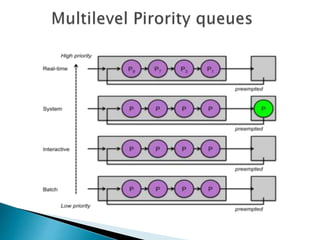
Pre-emptive scheduler with a flexible system of priority levels that includes
round-robin with multi level priority queues.
Dispatcher used a 32-level priority scheme to determine the order of thread
execution.
The Windows Win32 API identifies six priority classes
The priority of each thread is based on the priority class it belongs to and its
relative priority within that class.
The initial priority of a thread is typically the base priority of the process that
the thread belongs to
When a variable-priority thread is released from a wait operation, the
dispatcher boosts the priority
When a user is running an interactive program, the system needs to provide
especially good performance for that process
Windows XP distinguishes between the foreground process that is currently
selected on the screen and the background processes that are not currently
selected
 If processer are in idle state which type of
process are to be executed ?
 Why Fibers are reject to serve as UMS ?
 When dispatcher boost the priority which type of
thread get a large increase ?
 For Which Processes are scheduling quantum by
some factor are increased by (eg75%) ?
 what is the latest Process Scheduling feature
used in windows 8.1 ? And how it’ll beneficial for
programmers ?
 How many level priority scheme are used to
determine ?
Windows process scheduling presentation

Windows process scheduling presentation

  • 3.
     Muhammed TalhaMCS-13-08  Arslan Azam MCS-13-03  Aitazaz Ahsan MCS-13-38  Muhammed Sohail MCS-13-17  Muhammed Yousaf MCS-13-23  Abida Bibi MCS-13-22  Tayyaba Ghani MCS-13-39
  • 4.
     Maximum CPUutilization is obtained with multiprogramming ◦ Several processes are kept in memory at one time ◦ Every time a running process has to wait, another process can take over use of the CPU  Scheduling of the CPU is fundamental to operating system design  The process scheduler is the component of the operating system that is responsible for deciding whether the currently running process should continue running and, if not, which process should run next.
  • 5.
     CPU schedulingis affected by the following set of circumstances: 1. (N) A process switches from running to waiting state 2. (P) A process switches from running to ready state 3. (P) A process switches from waiting to ready state 4. (N) A processes switches from running to terminated state  Circumstances 1 and 4 are non-preemptive; they offer no schedule choice  Circumstances 2 and 3 are pre-emptive; they can be scheduled
  • 6.
     The dispatchermodule gives control of the CPU to the process selected by the short-term scheduler; this involves: ◦ switching context ◦ switching to user mode ◦ jumping to the proper location in the user program to restart that program  The dispatcher needs to run as fast as possible, since it is invoked during process context switch  The time it takes for the dispatcher to stop one process and start another process is called dispatch latency
  • 7.
     Different CPUscheduling algorithms have different properties  The choice of a particular algorithm may favour one class of processes over another  In choosing which algorithm to use, the properties of the various algorithms should be considered  Criteria for comparing CPU scheduling algorithms may include the following ◦ CPU utilization ◦ Throughput ◦ Turnaround time ◦ Response time ◦ Waiting time
  • 8.
     First Come,First Served (FCFS)  Shortest Job First (SJF)  Priority  Round Robin (RR)
  • 9.
     Windows XPschedules threads using a priority-based, pre-emptive scheduler with a flexible system of priority levels that includes round-robin scheduling within each level  The scheduler ensures that the highest priority thread will always run Dispatcher  The portion of the Windows kernel that handles scheduling is called the dispatcher  A thread selected to run by the dispatcher will run until it is preempted by a higher-priority thread, until it terminates, until its time quantum ends, or until it calls a blocking system call such as I/O  If a higher-priority real-time thread becomes ready while a lower-priority thread is running, lower-priority thread will be preempted ◦ This preemption gives a real-time thread preferential access to the CPU when the thread needs such access
  • 11.
     The dispatcheruses a 32-level priority scheme to determine the order of thread execution  Priorities are divided into two classes ◦ The variable class contains threads having priorities 1 to 15 ◦ The real-time class contains threads with priorities ranging from 16 to 31 ◦ There is also a thread running at priority 0 that is used for memory management  The dispatcher uses a queue for each scheduling priority and traverses the set of queues from highest to lowest until it finds a thread that is ready to run  If no ready thread is found, the dispatcher will execute a special thread called the idle thread
  • 13.
     The WindowsWin32 API identifies six priority classes to which a process can belong as shown below ◦ Real-time priority class ◦ High priority class ◦ Above normal priority class ◦ Normal priority class ◦ Below normal priority class ◦ Low priority class  Priorities in all classes except the real-time priority class are variable ◦ This means that the priority of a thread in one of these classes can change
  • 14.
     Within eachof the priority classes is a relative priority as shown below  The priority of each thread is based on the priority class it belongs to and its relative priority within that class
  • 15.
     The initialpriority of a thread is typically the base priority of the process that the thread belongs to  When a thread’s time quantum runs out, that thread is interrupted  If the thread is in the variable-priority class, its priority is lowered ◦ However, the priority is never lowered below the base priority  Lowering the thread’s priority tends to limit the CPU consumption of compute-bound threads
  • 16.
     When avariable-priority thread is released from a wait operation, the dispatcher boosts the priority ◦ The amount of boost depends on what the thread was waiting for  A thread that was waiting for keyboard I/O would get a large increase  A thread that was waiting for a disk operation would get a moderate increase  This strategy tends to give good response time to interactive threads that are using the mouse and windows  It also enables I/O-bound threads to keep the I/O devices busy while permitting compute-bound threads to use spare CPU cycles in the background  This strategy is used by several time-sharing operating systems, including UNIX  In addition, the window with which the user is currently interacting receives a priority boost to enhance its response time
  • 17.
     When auser is running an interactive program, the system needs to provide especially good performance for that process  Therefore, Windows XP has a special scheduling rule for processes in the normal priority class  Windows XP distinguishes between the foreground process that is currently selected on the screen and the background processes that are not currently selected  When a process moves in the foreground, Windows XP increases the scheduling quantum by some factor – typically by 3  This increase gives the foreground process three times longer to run before a time-sharing preemption occurs  https://msdn.microsoft.com/en- us/library/windows/desktop/ms685100(v=vs.85).aspx
  • 18.
     Earlier versionof Windows provided a feature known as Fiber.  Fibers allowed several user-mode threads (fibers) to be mapped to a single kernel thread.  Fibers were of limited practical use.  A fiber was unable to make calls to the windows API  So Microsoft introduced a UMS.
  • 19.
     Windows 7introduced a user-mode scheduling (UMS), Which allows application to create and manage threads independently of the kernel  Thus , an application can create and scheduled multiple threads without involving the windows Kernel scheduler  Scheduling threads in user mode is much more efficient than kernel mode.  http://superuser.com/questions/452780/scheduling- algorithm-used-in-windows-7
  • 20.
    CPU cycle-based threadscheduling The scheduler was modified to use the cycle counter register of modern processors to keep track of exactly how many CPU cycles a thread has executed, rather than just using an interval-timer interrupt routine This new CPU cycle-based thread scheduling gives a greater fairness and more deterministic app behavior. http://en.wikipedia.org/wiki/Technical_features_new _to_Windows_Vista#Kernel_and_core_OS_changes
  • 21.
    WinJS Scheduling  Anew scheduler API in Windows 8.1 lets you set the priority of tasks and manage jobs.  This helps you write HTML5 apps that use system resources more efficiently and provide a more responsive experience to your users.  https://msdn.microsoft.com/en- us/library/windows/apps/dn751496.aspx
  • 22.
    Pre-emptive scheduler witha flexible system of priority levels that includes round-robin with multi level priority queues. Dispatcher used a 32-level priority scheme to determine the order of thread execution. The Windows Win32 API identifies six priority classes The priority of each thread is based on the priority class it belongs to and its relative priority within that class. The initial priority of a thread is typically the base priority of the process that the thread belongs to When a variable-priority thread is released from a wait operation, the dispatcher boosts the priority When a user is running an interactive program, the system needs to provide especially good performance for that process Windows XP distinguishes between the foreground process that is currently selected on the screen and the background processes that are not currently selected
  • 23.
     If processerare in idle state which type of process are to be executed ?  Why Fibers are reject to serve as UMS ?  When dispatcher boost the priority which type of thread get a large increase ?  For Which Processes are scheduling quantum by some factor are increased by (eg75%) ?  what is the latest Process Scheduling feature used in windows 8.1 ? And how it’ll beneficial for programmers ?  How many level priority scheme are used to determine ?