CPU Scheduling
 In a multiprogramming environment, usually more programs to be executed than
could possibly be run time at one time. In CPU scheduling it switches from one
process to another process. CPU resource management is commonly known as
scheduling.
 Objective of the multiprogramming is to increases the CPU utilization.
 User program contains combination of CPU burst cycle and I/O burst cycles.
Process starts with CPU burst cycle then I/O burst cycle again CPU burst cycle again
I/O burst cycle. In this way the process completes its executions. Process will
terminates after final CPU burst cycle completions.
 Program execution sequence: CPU burst cycle I/O burst cycle CPU burst
→ →
cycle I/O burst cycle CPU burst cycle Program terminates.
→ → →
 A CPU bound process tends to use the processor time that the system allocates for
it. An I/O bound process tends to use the processor only briefly before generating
an I/O request. The CPU bound processes spend most of their time using the
processor.
CPU Scheduler
 CPU scheduler is also called as short scheduler. System programmers use
parameters like program size, resources required for program and any other
special devices are needed to determine scheduling policies.
 Scheduling mechanism is the part of the process manager that handles the
removal of the running process from the CPU and the selection of another
process on the basis of a particular strategy.
 Scheduler is responsible for multiplexing processes on the CPU:
Preemptive and Non-preemptive Scheduling
 The scheduling policy determines when it is time for process to be removed
from the CPU and which ready process should be allocated the CPU next. The
scheduling mechanism is composed of several different parts, depending on
exactly how it is implemented in any particular operating system.
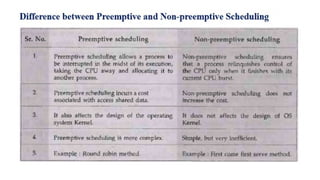
 CPU scheduling is divided into two types: Preemptive scheduling and non-
preemptive scheduling.
 Preemptive scheduling: A scheduling method that interrupts the
processing of a process and transfers the CPU to another process is
called a preemptive CPU scheduling. The process switches from running
state to the ready state and waiting the ready state state to the ready
state.
 Non-preemptive scheduling:Non-preemptive operation usually proceeds
towards completion uninterrupted. Once the system has assigned a
processor to a process, the system cannot remove that processor from the
process. The process switches from running state to the waiting state and
termination of process.
 Preemptive scheduling increases the cost and it has higher overheads. This
scheduling method is useful only in the high priority processes require rapid
response.
 Non-preemptive scheduling is simple to implement. It requires some hardware
platform. This method is attractive because of its simplicity. Windows 3.1 and
Apple Macintosh operating system uses this scheduling method.
Terminologies Used in CPU Scheduling
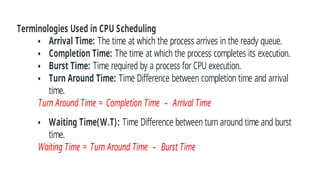
 Arrival Time: The time at which the process arrives in the ready queue.
 Completion Time: The time at which the process completes its execution.
 Burst Time: Time required by a process for CPU execution.
 Turn Around Time: Time Difference between completion time and arrival
time.
Turn Around Time = Completion Time – Arrival Time
 Waiting Time(W.T): Time Difference between turn around time and burst
time.
Waiting Time = Turn Around Time – Burst Time
CPU Scheduling Criteria
Depending on the system, CPU scheduling criteria will change.
1. Throughput: CPU scheduling should attempt to service the maximum number
of processes per unit time. The higher is the number, the more work is
done by the system.
NOTE; Total Time Taken: The time at which the last process finishes
execution
2. Waiting time: The average period of time a process spends waiting. Process is
normally in the ready queue in waiting time.
Waiting Time( W.T) : Time Difference between turn around time and burst time.
Waiting Time = Turn Around Time – Burst Time
3. Turnaround time: Turnaround time start from process submission to completion of
process.
Turnaround time = Burst time + Waiting time
Turn Around Time = Completion Time – Arrival Time
4. Response time: It is the time from the submission of a request until the first
response is produced.
5.CPU utilization: It is average function of time during which the processor is busy.
6. Fairness: Avoid the process from the starvation. All the processes mu given equal
opportunity to execute.
7. Priority: If the operating system assigns priorities to processes, the scheduling
mechanism should favor the higher priority processes.
8. Predictability: A given process always should run in about the same amount of
time under similar system loads.
Depending upon the nature of operations the scheduling policy may differ. The CPU
utilization and throughput are the system centered parameters. Fairness is snit
affect by user and system.
Dispatcher
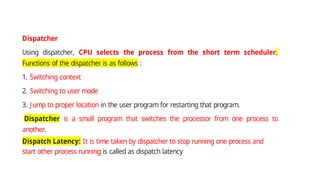
Using dispatcher, CPU selects the process from the short term scheduler.
Functions of the dispatcher is as follows :
1. Switching context
2. Switching to user mode
3. Jump to proper location in the user program for restarting that program.
Dispatcher is a small program that switches the processor from one process to
another.
Dispatch Latency: It is time taken by dispatcher to stop running one process and
start other process running is called as dispatch latency
Scheduling Algorithms/policies
Scheduling policies refer to the rules and criteria used to determine the order
in which tasks or jobs are processed in a system. Various scheduling policies
exist, each with its own advantages, disadvantages, and suitability for specific
scenarios. Here are some different scheduling policies:
CPU scheduling algorithms are as follows:
1. First In First Out (FIFO) scheduling
2. Shortest job first scheduling
3. Priority scheduling
4. Round robin scheduling
First Come First Serve Scheduling
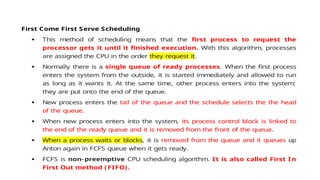
 This method of scheduling means that the first process to request the
processor gets it until it finished execution. With this algorithm, processes
are assigned the CPU in the order they request it.
 Normally there is a single queue of ready processes. When the first process
enters the system from the outside, it is started immediately and allowed to run
as long as it wants it. At the same time, other process enters into the system;
they are put onto the end of the queue.
 New process enters the tail of the queue and the schedule selects the the head
of the queue.
 When new process enters into the system, its process control block is linked to
the end of the ready queue and it is removed from the front of the queue.
 When a process waits or blocks, it is removed from the queue and it queues up
Anton again in FCFS queue when it gets ready.
 FCFS is non-preemptive CPU scheduling algorithm. It is also called First In
First Out method (FIFO).
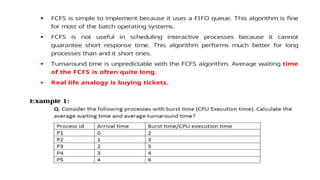
 FCFS is simple to implement because it uses a FIFO queue. This algorithm is fine
for most of the batch operating systems.
 FCFS is not useful in scheduling interactive processes because it cannot
guarantee short response time. This algorithm performs much better for long
processes than and it short ones.
 Turnaround time is unpredictable with the FCFS algorithm. Average waiting time
of the FCFS is often quite long.
 Real life analogy is buying tickets.
Shortest J ob First Scheduling
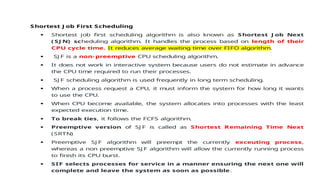
 Shortest job first scheduling algorithm is also known as Shortest J ob Next
( SJ N) scheduling algorithm. It handles the process based on length of their
CPU cycle time. It reduces average waiting time over FIFO algorithm.
 SJ F is a non- preemptive CPU scheduling algorithm.
 It does not work in interactive system because users do not estimate in advance
the CPU time required to run their processes.
 SJ F scheduling algorithm is used frequently in long term scheduling.
 When a process request a CPU, it must inform the system for how long it wants
to use the CPU.
 When CPU become available, the system allocates into processes with the least
expected execution time.
 To break ties, it follows the FCFS algorithm.
 Preemptive version of SJ F is called as Shortest Remaining Time Next
(SRTN)
 Preemptive SJ F algorithm will preempt the currently exceuting process,
whereas a non preemptive SJ F algorithm will allow the currently running process
to finish its CPU burst.
 SIF selects processes for service in a manner ensuring the next one will
complete and leave the system as soon as possible.
Round Robin Scheduling
 Round robin is a preemptive scheduling algorithm. It is used in interactive
system. Here process are given a limited amount of time of processor time
called a time slice or time quantum. If a process does not complete before its
quantum expires, the system preempts it and gives the processor to the next
waiting process. The system then places the preempted process at the back of
the ready queue.
 Processes are placed in the ready queue using a FI FO scheme. With the RR
algorithm, the principle design issue is the length of the time quantum to
be used. For short time slice, processes will move through the system relatively
quickly. It increases the processing overheads.
 When a process is given the CPU, a timer is set for a time quantum.
1. If the process finishes its burst before the time quantum timer
expires, then it is swapped out of the CPU just like the normal FCFS
algorithm.
2. If the timer goes off first, then the process is swapped out of the
CPU and moved to the back end of the ready queue.
 The ready queue is maintained as a circular queue, so when all processes have
had a turn, then the scheduler gives the first process another turn, and so
on.
 RR scheduling can give the effect of all processes sharing the CPU equally,
although the average wait time can be longer than with other scheduling
algorithms
Priority Scheduling
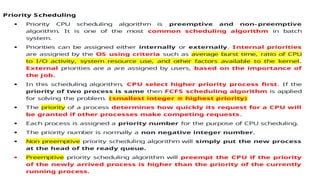
 Priority CPU scheduling algorithm is preemptive and non- preemptive
algorithm. It is one of the most common scheduling algorithm in batch
system.
 Priorities can be assigned either internally or externally. Internal priorities
are assigned by the OS using criteria such as average burst time, ratio of CPU
to I/O activity, system resource use, and other factors available to the kernel.
External priorities are a are assigned by users, based on the importance of
the job.
 In this scheduling algorithm, CPU select higher priority process first. If the
priority of two process is same then FCFS scheduling algorithm is applied
for solving the problem. ( smallest integer highest priority)
≡
 The priority of a process determines how quickly its request for a CPU will
be granted if other processes make competing requests.
 Each process is assigned a priority number for the purpose of CPU scheduling.
 The priority number is normally a non negative integer number.
 Non preemptive priority scheduling algorithm will simply put the new process
at the head of the ready queue.
 Preemptive priority scheduling algorithm will preempt the CPU if the priority
of the newly arrived process is higher than the priority of the currently
running process.
Implementation –
1. First input the processes with their arrival time, burst time and priority.
2. First process will schedule, which have the lowest arrival time, if two or
more processes will have lowest arrival time, then whoever has higher
priority will schedule first.
3. Now further processes will be schedule according to the arrival time and
priority of the process. (Here we are assuming that lower the priority
number having higher priority). If two process priority are same then
sort according to process number.
Note: In the question, They will clearly mention, which number will have
higher priority and which number will have lower priority.
4. Once all the processes have been arrived, we can schedule them based on
their priority.
ForfurtherexerciseskindlyrefertoUnitIV– CPUSchedulingandAlgorithm

CPU Scheduling_in_processManagement.pptx

  • 1.
  • 2.
     In amultiprogramming environment, usually more programs to be executed than could possibly be run time at one time. In CPU scheduling it switches from one process to another process. CPU resource management is commonly known as scheduling.  Objective of the multiprogramming is to increases the CPU utilization.  User program contains combination of CPU burst cycle and I/O burst cycles. Process starts with CPU burst cycle then I/O burst cycle again CPU burst cycle again I/O burst cycle. In this way the process completes its executions. Process will terminates after final CPU burst cycle completions.  Program execution sequence: CPU burst cycle I/O burst cycle CPU burst → → cycle I/O burst cycle CPU burst cycle Program terminates. → → →  A CPU bound process tends to use the processor time that the system allocates for it. An I/O bound process tends to use the processor only briefly before generating an I/O request. The CPU bound processes spend most of their time using the processor.
  • 3.
    CPU Scheduler  CPUscheduler is also called as short scheduler. System programmers use parameters like program size, resources required for program and any other special devices are needed to determine scheduling policies.  Scheduling mechanism is the part of the process manager that handles the removal of the running process from the CPU and the selection of another process on the basis of a particular strategy.  Scheduler is responsible for multiplexing processes on the CPU: Preemptive and Non-preemptive Scheduling  The scheduling policy determines when it is time for process to be removed from the CPU and which ready process should be allocated the CPU next. The scheduling mechanism is composed of several different parts, depending on exactly how it is implemented in any particular operating system.
  • 4.
     CPU schedulingis divided into two types: Preemptive scheduling and non- preemptive scheduling.  Preemptive scheduling: A scheduling method that interrupts the processing of a process and transfers the CPU to another process is called a preemptive CPU scheduling. The process switches from running state to the ready state and waiting the ready state state to the ready state.  Non-preemptive scheduling:Non-preemptive operation usually proceeds towards completion uninterrupted. Once the system has assigned a processor to a process, the system cannot remove that processor from the process. The process switches from running state to the waiting state and termination of process.  Preemptive scheduling increases the cost and it has higher overheads. This scheduling method is useful only in the high priority processes require rapid response.  Non-preemptive scheduling is simple to implement. It requires some hardware platform. This method is attractive because of its simplicity. Windows 3.1 and Apple Macintosh operating system uses this scheduling method.
  • 6.
    Terminologies Used inCPU Scheduling  Arrival Time: The time at which the process arrives in the ready queue.  Completion Time: The time at which the process completes its execution.  Burst Time: Time required by a process for CPU execution.  Turn Around Time: Time Difference between completion time and arrival time. Turn Around Time = Completion Time – Arrival Time  Waiting Time(W.T): Time Difference between turn around time and burst time. Waiting Time = Turn Around Time – Burst Time
  • 7.
    CPU Scheduling Criteria Dependingon the system, CPU scheduling criteria will change. 1. Throughput: CPU scheduling should attempt to service the maximum number of processes per unit time. The higher is the number, the more work is done by the system. NOTE; Total Time Taken: The time at which the last process finishes execution 2. Waiting time: The average period of time a process spends waiting. Process is normally in the ready queue in waiting time. Waiting Time( W.T) : Time Difference between turn around time and burst time. Waiting Time = Turn Around Time – Burst Time
  • 8.
    3. Turnaround time:Turnaround time start from process submission to completion of process. Turnaround time = Burst time + Waiting time Turn Around Time = Completion Time – Arrival Time 4. Response time: It is the time from the submission of a request until the first response is produced. 5.CPU utilization: It is average function of time during which the processor is busy. 6. Fairness: Avoid the process from the starvation. All the processes mu given equal opportunity to execute. 7. Priority: If the operating system assigns priorities to processes, the scheduling mechanism should favor the higher priority processes. 8. Predictability: A given process always should run in about the same amount of time under similar system loads. Depending upon the nature of operations the scheduling policy may differ. The CPU utilization and throughput are the system centered parameters. Fairness is snit affect by user and system.
  • 9.
    Dispatcher Using dispatcher, CPUselects the process from the short term scheduler. Functions of the dispatcher is as follows : 1. Switching context 2. Switching to user mode 3. Jump to proper location in the user program for restarting that program. Dispatcher is a small program that switches the processor from one process to another. Dispatch Latency: It is time taken by dispatcher to stop running one process and start other process running is called as dispatch latency
  • 10.
    Scheduling Algorithms/policies Scheduling policiesrefer to the rules and criteria used to determine the order in which tasks or jobs are processed in a system. Various scheduling policies exist, each with its own advantages, disadvantages, and suitability for specific scenarios. Here are some different scheduling policies: CPU scheduling algorithms are as follows: 1. First In First Out (FIFO) scheduling 2. Shortest job first scheduling 3. Priority scheduling 4. Round robin scheduling
  • 11.
    First Come FirstServe Scheduling  This method of scheduling means that the first process to request the processor gets it until it finished execution. With this algorithm, processes are assigned the CPU in the order they request it.  Normally there is a single queue of ready processes. When the first process enters the system from the outside, it is started immediately and allowed to run as long as it wants it. At the same time, other process enters into the system; they are put onto the end of the queue.  New process enters the tail of the queue and the schedule selects the the head of the queue.  When new process enters into the system, its process control block is linked to the end of the ready queue and it is removed from the front of the queue.  When a process waits or blocks, it is removed from the queue and it queues up Anton again in FCFS queue when it gets ready.  FCFS is non-preemptive CPU scheduling algorithm. It is also called First In First Out method (FIFO).
  • 12.
     FCFS issimple to implement because it uses a FIFO queue. This algorithm is fine for most of the batch operating systems.  FCFS is not useful in scheduling interactive processes because it cannot guarantee short response time. This algorithm performs much better for long processes than and it short ones.  Turnaround time is unpredictable with the FCFS algorithm. Average waiting time of the FCFS is often quite long.  Real life analogy is buying tickets.
  • 14.
    Shortest J obFirst Scheduling  Shortest job first scheduling algorithm is also known as Shortest J ob Next ( SJ N) scheduling algorithm. It handles the process based on length of their CPU cycle time. It reduces average waiting time over FIFO algorithm.  SJ F is a non- preemptive CPU scheduling algorithm.  It does not work in interactive system because users do not estimate in advance the CPU time required to run their processes.  SJ F scheduling algorithm is used frequently in long term scheduling.  When a process request a CPU, it must inform the system for how long it wants to use the CPU.  When CPU become available, the system allocates into processes with the least expected execution time.  To break ties, it follows the FCFS algorithm.  Preemptive version of SJ F is called as Shortest Remaining Time Next (SRTN)  Preemptive SJ F algorithm will preempt the currently exceuting process, whereas a non preemptive SJ F algorithm will allow the currently running process to finish its CPU burst.  SIF selects processes for service in a manner ensuring the next one will complete and leave the system as soon as possible.
  • 16.
    Round Robin Scheduling Round robin is a preemptive scheduling algorithm. It is used in interactive system. Here process are given a limited amount of time of processor time called a time slice or time quantum. If a process does not complete before its quantum expires, the system preempts it and gives the processor to the next waiting process. The system then places the preempted process at the back of the ready queue.  Processes are placed in the ready queue using a FI FO scheme. With the RR algorithm, the principle design issue is the length of the time quantum to be used. For short time slice, processes will move through the system relatively quickly. It increases the processing overheads.  When a process is given the CPU, a timer is set for a time quantum. 1. If the process finishes its burst before the time quantum timer expires, then it is swapped out of the CPU just like the normal FCFS algorithm. 2. If the timer goes off first, then the process is swapped out of the CPU and moved to the back end of the ready queue.  The ready queue is maintained as a circular queue, so when all processes have had a turn, then the scheduler gives the first process another turn, and so on.  RR scheduling can give the effect of all processes sharing the CPU equally, although the average wait time can be longer than with other scheduling algorithms
  • 18.
    Priority Scheduling  PriorityCPU scheduling algorithm is preemptive and non- preemptive algorithm. It is one of the most common scheduling algorithm in batch system.  Priorities can be assigned either internally or externally. Internal priorities are assigned by the OS using criteria such as average burst time, ratio of CPU to I/O activity, system resource use, and other factors available to the kernel. External priorities are a are assigned by users, based on the importance of the job.  In this scheduling algorithm, CPU select higher priority process first. If the priority of two process is same then FCFS scheduling algorithm is applied for solving the problem. ( smallest integer highest priority) ≡  The priority of a process determines how quickly its request for a CPU will be granted if other processes make competing requests.  Each process is assigned a priority number for the purpose of CPU scheduling.  The priority number is normally a non negative integer number.  Non preemptive priority scheduling algorithm will simply put the new process at the head of the ready queue.  Preemptive priority scheduling algorithm will preempt the CPU if the priority of the newly arrived process is higher than the priority of the currently running process.
  • 19.
    Implementation – 1. Firstinput the processes with their arrival time, burst time and priority. 2. First process will schedule, which have the lowest arrival time, if two or more processes will have lowest arrival time, then whoever has higher priority will schedule first. 3. Now further processes will be schedule according to the arrival time and priority of the process. (Here we are assuming that lower the priority number having higher priority). If two process priority are same then sort according to process number. Note: In the question, They will clearly mention, which number will have higher priority and which number will have lower priority. 4. Once all the processes have been arrived, we can schedule them based on their priority.
  • 21.