WINDOWS XP
SCHEDULING
BY-
SHIVANI MONGA(3034)
SHUBHAM GUPTA(3126)
Scheduling
It is a key concept in computer multitasking,
multiprocessing operating system and real-time
operating system designs.
Refers to the way processes are assigned to run
on the available CPU
This assignment is carried out by softwares
known as a scheduler and a dispatcher.
The process scheduling algorithms
used by an operating system reflect its
primary performance objectives.
Windows XP- real time processing and
User-perceived performance
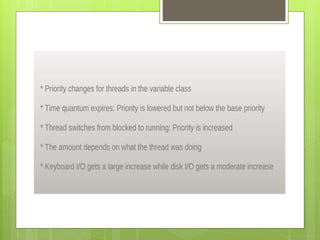
• All processes receive a priority boost after
a wait event, but processes that have
experienced a keyboard I/O wait get a larger
boost than those that have experienced a
disk I/O wait.
• “Foreground “ processes given a higher
priority.
Windows XP distinguishes between the
foreground processes that is currently selected
on the screen and the background processes
that are not currently selected.
The strategy tends to give good response times
to interactive threads that are using the mouse
and windows.
The I/O devices are kept busy.
WINDOWS XP
SCHEDULING
 Windows xp uses a quantum-based,
preemptive priority scheduling algorithm.
 Threads are scheduled rather than processes.
 Since the preemptive priority algorithm is
implemented with multiple queues, it can also
be considered a multiple feedback queue
algorithm.
 However, each class of thread is normally
restricted to a small band of 5 priority levels.
 Preemption can occur for any of 4 reasons:
 Higher priority thread becomes ready
 Thread terminates
 Time quantum exhausted
 Thread performs a blocking system call, such
as for I/O , in which case it leaves the READY
state and enters the WAITING state.
The scheduler is called a dispatcher.
 Priorities are divided into two classes:
 Variable class: priorities 1 to 15
 Real-time class: priorities 16 to 31
 There is a queue for each priority.
 The dispatcher traverses the set of queues from
highest to lowest until it finds a thread that is
ready to run.
 If there are no processes ready to run, the
dispatcher executes the idle thread.
PRIORITIES
 Processe are given a priority class upon creation:
 REAL_TIME_PRIORITY_CLASS
 HIGH_PRIORITY_CLASS
 ABOVE_NORMAL_PRIORITY_CLASS
 NORMAL_PRIORITY_CLASS
 BELOW_NORMAL_PRIORITY_CLASS
 IDLE_PRIORITY_CLASS
 Priorities in all classes except the
REAL_TIME_PRIORITY class can change.
Thank You…!!!

windows xp scheduling

  • 1.
  • 2.
    Scheduling It is akey concept in computer multitasking, multiprocessing operating system and real-time operating system designs. Refers to the way processes are assigned to run on the available CPU This assignment is carried out by softwares known as a scheduler and a dispatcher.
  • 4.
    The process schedulingalgorithms used by an operating system reflect its primary performance objectives. Windows XP- real time processing and User-perceived performance
  • 5.
    • All processesreceive a priority boost after a wait event, but processes that have experienced a keyboard I/O wait get a larger boost than those that have experienced a disk I/O wait. • “Foreground “ processes given a higher priority.
  • 6.
    Windows XP distinguishesbetween the foreground processes that is currently selected on the screen and the background processes that are not currently selected. The strategy tends to give good response times to interactive threads that are using the mouse and windows. The I/O devices are kept busy.
  • 7.
    WINDOWS XP SCHEDULING  Windowsxp uses a quantum-based, preemptive priority scheduling algorithm.  Threads are scheduled rather than processes.  Since the preemptive priority algorithm is implemented with multiple queues, it can also be considered a multiple feedback queue algorithm.  However, each class of thread is normally restricted to a small band of 5 priority levels.
  • 8.
     Preemption canoccur for any of 4 reasons:  Higher priority thread becomes ready  Thread terminates  Time quantum exhausted  Thread performs a blocking system call, such as for I/O , in which case it leaves the READY state and enters the WAITING state. The scheduler is called a dispatcher.
  • 9.
     Priorities aredivided into two classes:  Variable class: priorities 1 to 15  Real-time class: priorities 16 to 31  There is a queue for each priority.  The dispatcher traverses the set of queues from highest to lowest until it finds a thread that is ready to run.  If there are no processes ready to run, the dispatcher executes the idle thread. PRIORITIES
  • 10.
     Processe aregiven a priority class upon creation:  REAL_TIME_PRIORITY_CLASS  HIGH_PRIORITY_CLASS  ABOVE_NORMAL_PRIORITY_CLASS  NORMAL_PRIORITY_CLASS  BELOW_NORMAL_PRIORITY_CLASS  IDLE_PRIORITY_CLASS  Priorities in all classes except the REAL_TIME_PRIORITY class can change.
  • 13.