Memory Management
Ch.7 and Ch.8
Introduction
Memory refers to storage needed by the
kernel, the other components of the
operating system and the user programs.
In a multi-processing, multi-user system,
the structure of the memory is quite
complex. Efficient memory management is
very critical for good performance of the
entire system. In this discussion we will
study memory management policies,
techniques and their implementations.
Topics for discussion
Memory management requirements
Memory management techniques
Related issues: relocation, loading and linking
Virtual memory
Principle of locality
Paging
Segmentation
Page replacement policies
Examples: NT and System V
Memory management
requirements
Relocation: Branch addresses and data
references within a program memory space
(user address space) have to be translated into
references in the memory range a program is
loaded into.
Protection: Each process should be protected
against unwanted (unauthorized) interference
by other processes, whether accidental or
intentional. Fortunately, mechanisms that
support relocation also form the base for
satisfying protection requirements.
Memory management
requirements (contd.)
Sharing : Allow several processes to access
the same portion of main memory : very
common in many applications. Ex. many
server-threads executing the same service
routine.
Logical organization : allow separate
compilation and run-time resolution of
references. To provide different access
privileges (RWX). To allow sharing. Ex:
segmentation.
...requirements(contd.)
Physical organization: Memory hierarchy
or level of memory. Organization of each
of these levels and movement and address
translation among the various levels.
Overhead : should be low. System should
be spending not much time compared
execution time, on the memory
management techniques.
Memory management
techniques
Fixed partitioning: Main memory statically divided
into fixed-sized partitions: could be equal-sized or
unequal-sized. Simple to implement. Inefficient use
of memory and results in internal-fragmentation.
Dynamic partitioning : Partitions are dynamically
created. Compaction needed to counter external
fragmentation. Inefficient use of processor.
Simple paging: Both main memory and process
space are divided into number of equal-sized
frames. A process may in non-contiguous main
memory pages.
Memory management
techniques
Simple segmentation : To accommodate
dynamically growing partitions: Compiler
tables, for example. No fragmentation, but
needs compaction.
Virtual memory with paging: Same as simple
paging but the pages currently needed are in
the main memory. Known as demand paging.
Virtual memory with segmentation: Same
as simple segmentation but only those
segments needed are in the main memory.
Segmented-paged virtual memory
Basic memory operations:
Relocation
A process in the memory includes instructions plus
data. Instruction contain memory references:
Addresses of data items, addresses of instructions.
These are logical addresses: relative addresses are
examples of this. These are addresses which are
expressed with reference to some known point,
usually the beginning of the program.
Physical addresses are absolute addresses in the
memory.
Relative addressing or position independence helps
easy relocation of programs.
Basic memory operations:
Linking and loading
The function of a linker is to take as input a collection
of object modules and produce a load module that
consists of an integrated set of program and data
modules to be passed to the loader. It also resolves all
the external symbolic references in the load module
(linkage).
The nature of the address linkage will depend on the
types of load module created and the time of linkage:
static, load-time dynamic linking, run-time dynamic
linking.
Dynamic linking: Deferring the linkage of external
references until load-module is created: load module
contains unresolved references to other programs.
Virtual memory
Consider a typical, large application:
 There are many components that are mutually
exclusive. Example: A unique function selected
dependent on user choice.
 Error routines and exception handlers are very
rarely used.
 Most programs exhibit a slowly changing
locality of reference. There are two types of
locality: spatial and temporal.
Locality
Temporal locality: Addresses that are referenced
at some time Ts will be accessed in the near
future (Ts + delta_time) with high probability.
Example : Execution in a loop.
Spatial locality: Items whose addresses are near
one another tend to be referenced close together
in time. Example: Accessing array elements.
How can we exploit this characteristics of
programs? Keep only the current locality in the
main memory. Need not keep the entire program
in the main memory.
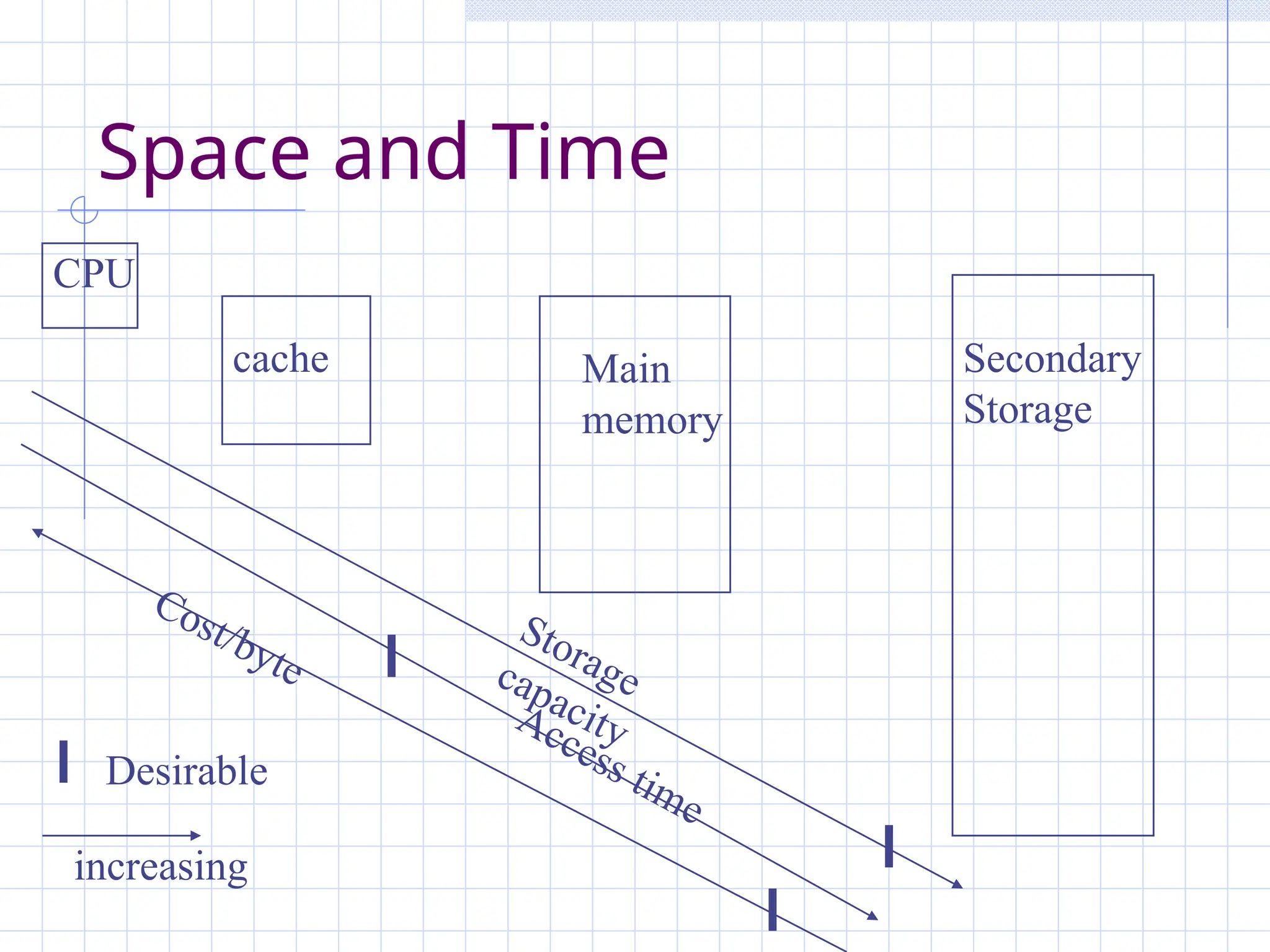
Space and Time
Storage
capacity
Access time
CPU
cache Main
memory
Secondary
Storage
Cost/byte
Desirable
increasing
Demand paging
Main memory (physical address space) as well as
user address space (virtual address space) are
logically partitioned into equal chunks known as
pages. Main memory pages (sometimes known as
frames) and virtual memory pages are of the same
size.
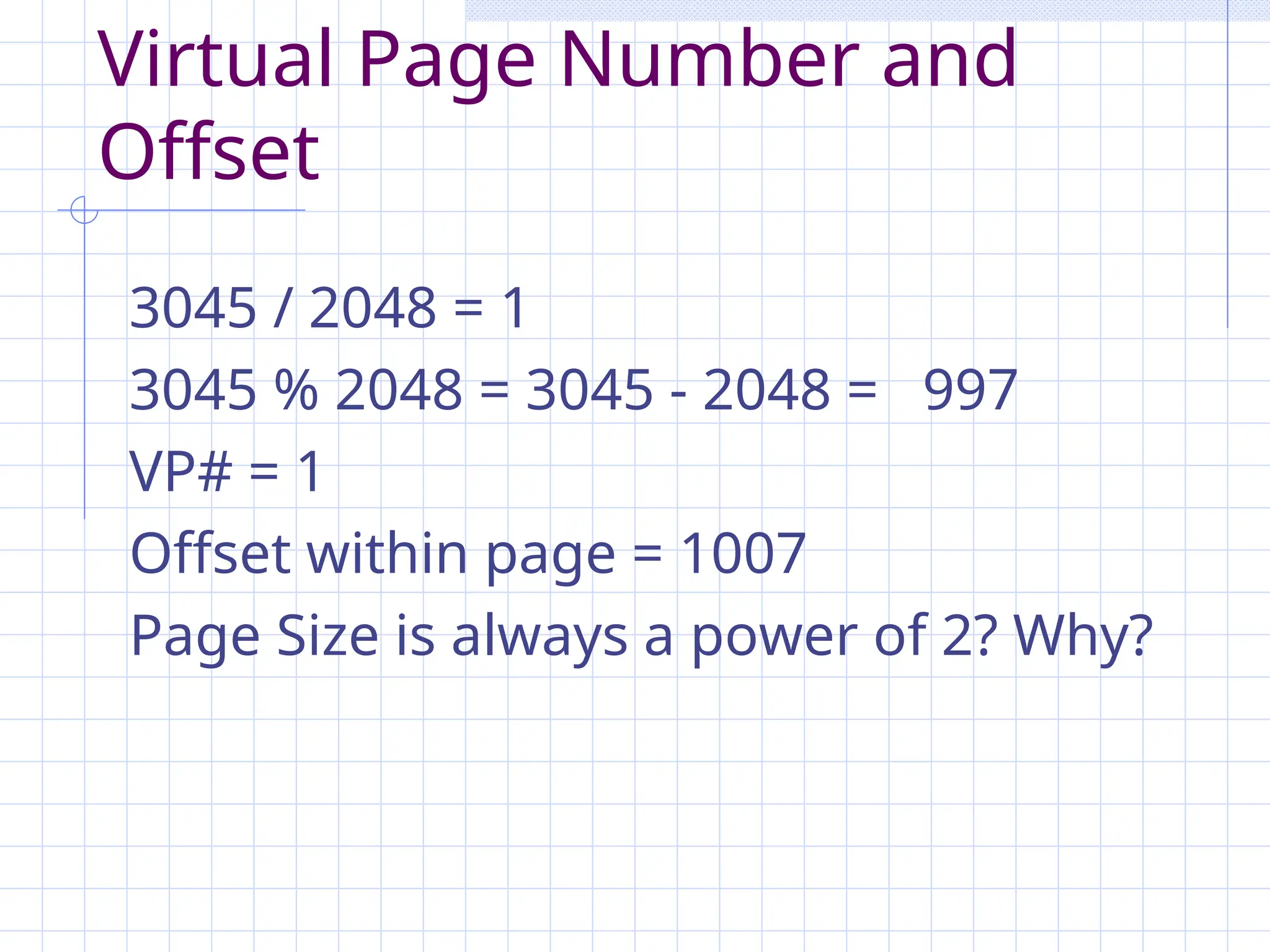
Virtual address (VA) is viewed as a pair (virtual page
number, offset within the page). Example: Consider a
virtual space of 16K , with 2K page size and an
address 3045. What the virtual page number and
offset corresponding to this VA?
Virtual Page Number and
Offset
3045 / 2048 = 1
3045 % 2048 = 3045 - 2048 = 997
VP# = 1
Offset within page = 1007
Page Size is always a power of 2? Why?
Page Size Criteria
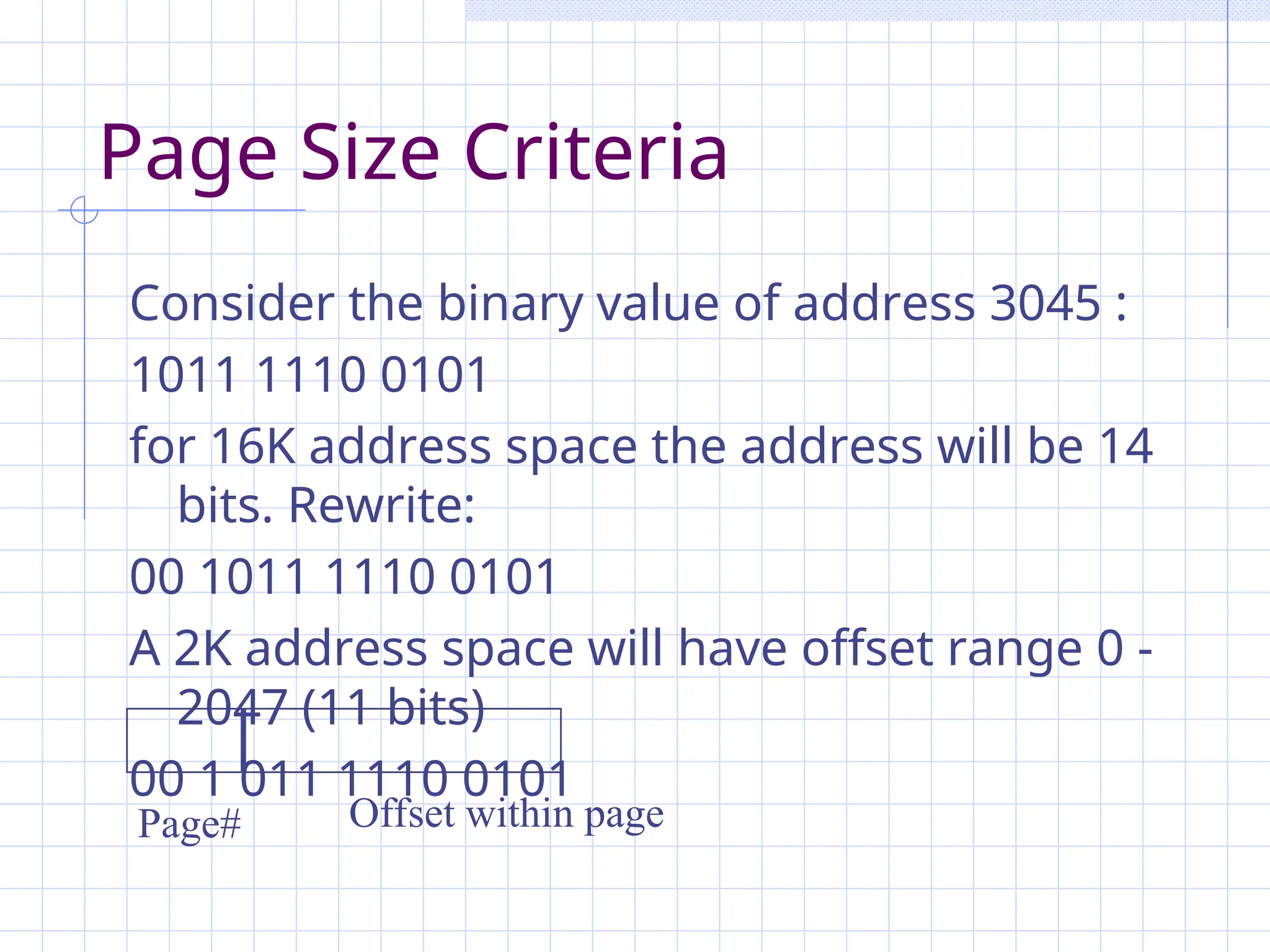
Consider the binary value of address 3045 :
1011 1110 0101
for 16K address space the address will be 14
bits. Rewrite:
00 1011 1110 0101
A 2K address space will have offset range 0 -
2047 (11 bits)
00 1 011 1110 0101
Offset within page
Page#
Demand paging (contd.)
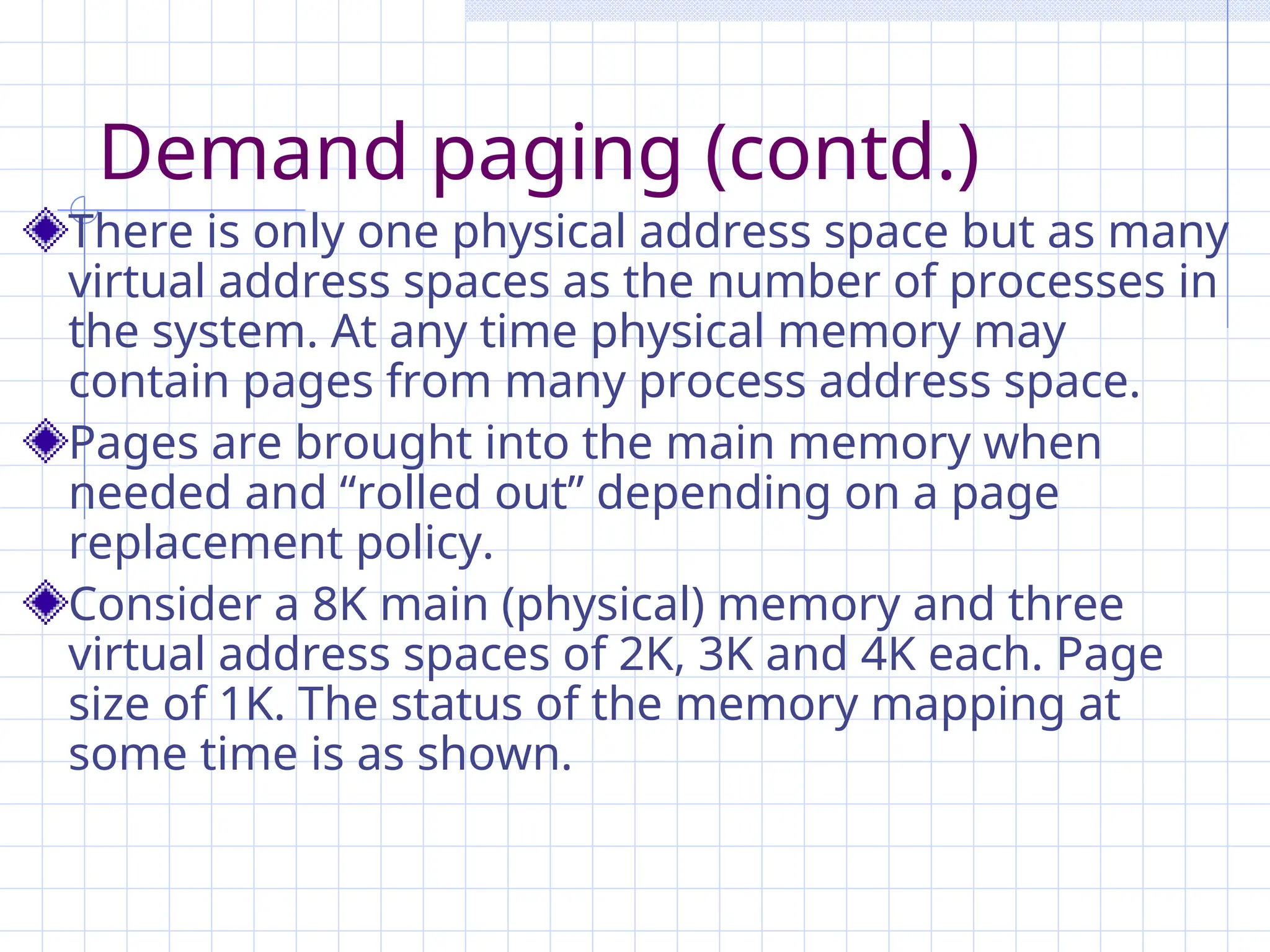
There is only one physical address space but as many
virtual address spaces as the number of processes in
the system. At any time physical memory may
contain pages from many process address space.
Pages are brought into the main memory when
needed and “rolled out” depending on a page
replacement policy.
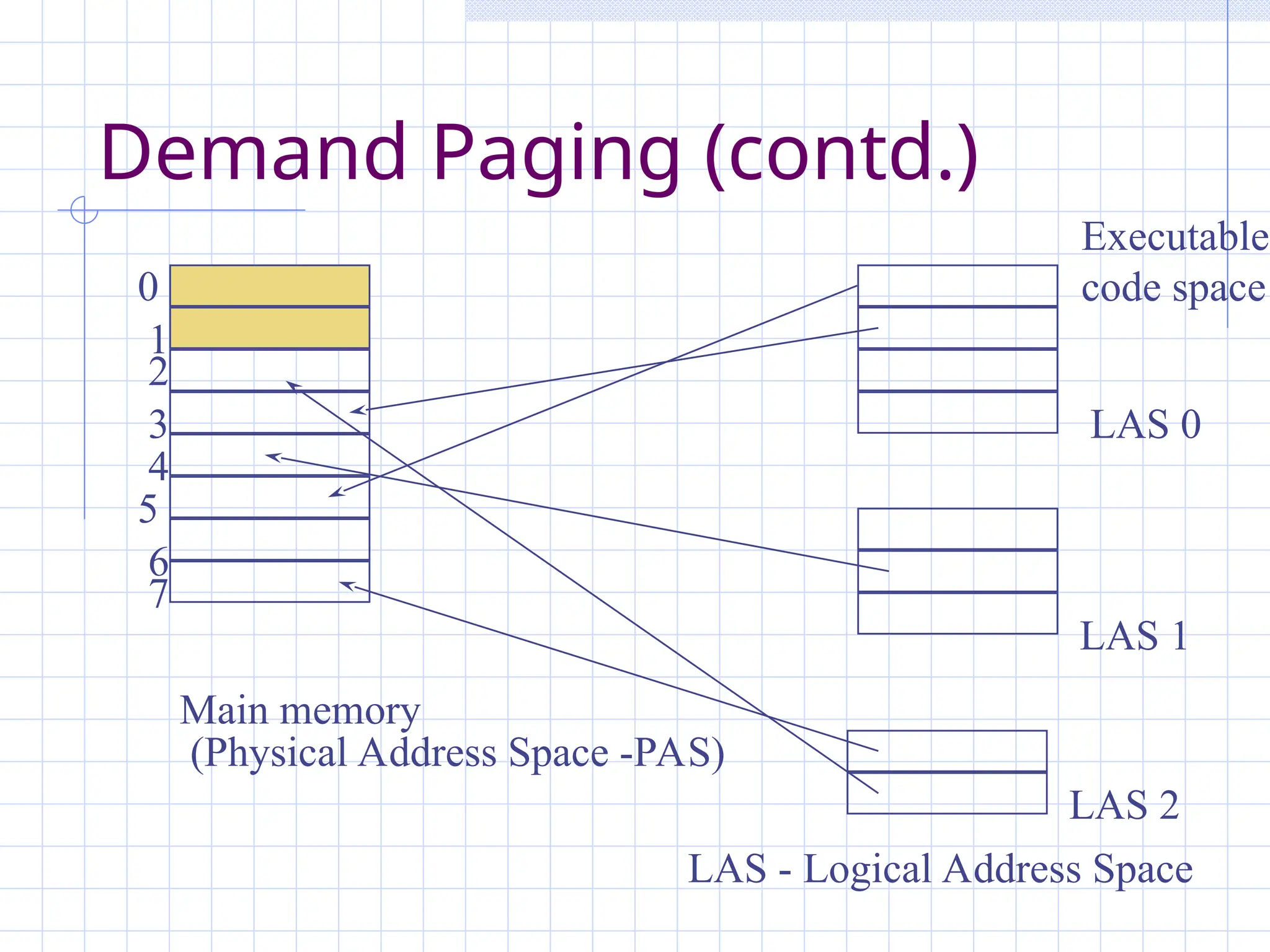
Consider a 8K main (physical) memory and three
virtual address spaces of 2K, 3K and 4K each. Page
size of 1K. The status of the memory mapping at
some time is as shown.
Demand Paging (contd.)
0
1
2
3
4
5
6
7
Main memory
LAS 0
LAS 1
LAS 2
(Physical Address Space -PAS)
LAS - Logical Address Space
Executable
code space
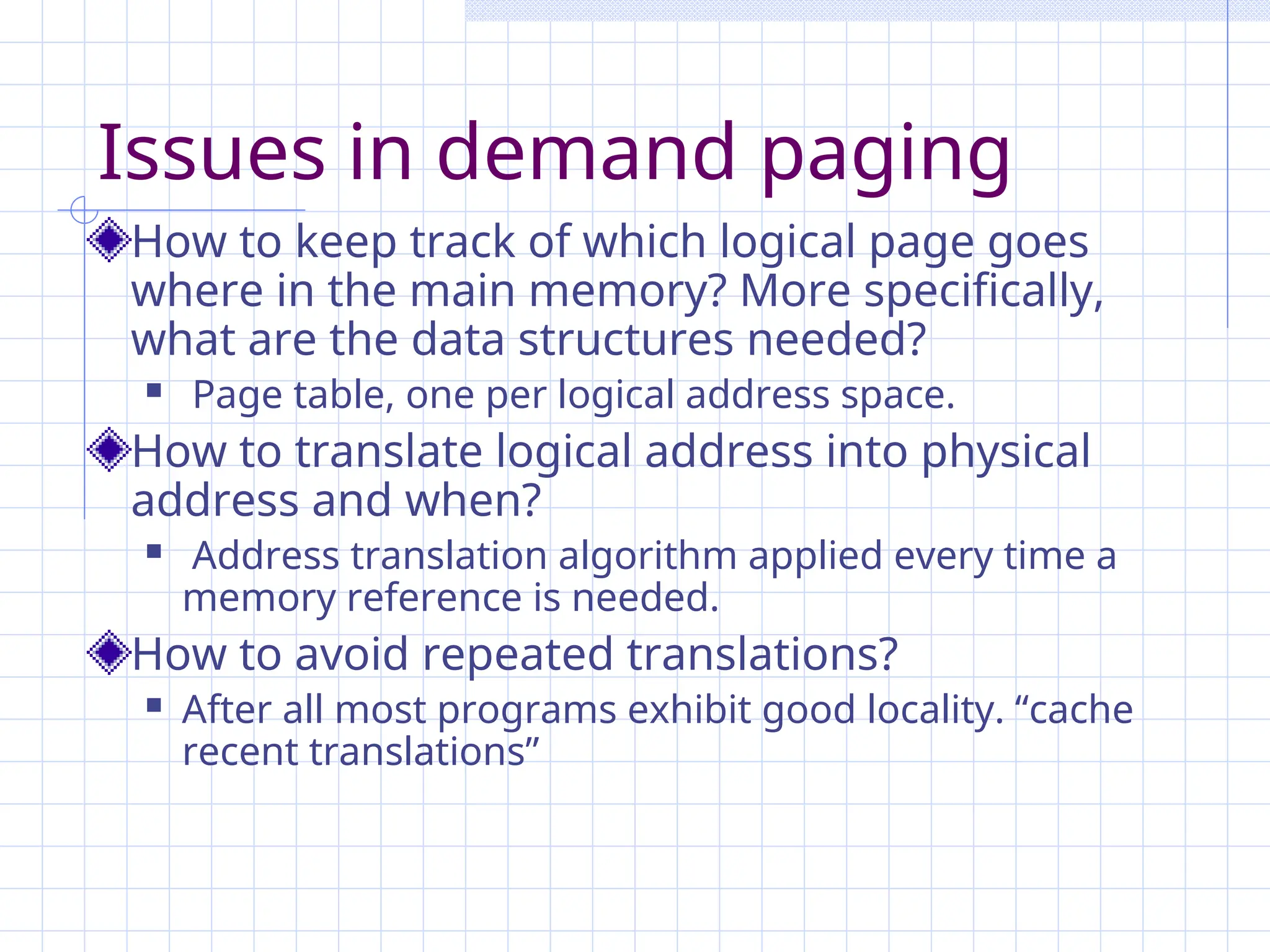
Issues in demand paging
How to keep track of which logical page goes
where in the main memory? More specifically,
what are the data structures needed?
 Page table, one per logical address space.
How to translate logical address into physical
address and when?
 Address translation algorithm applied every time a
memory reference is needed.
How to avoid repeated translations?
 After all most programs exhibit good locality. “cache
recent translations”
Issues in demand paging
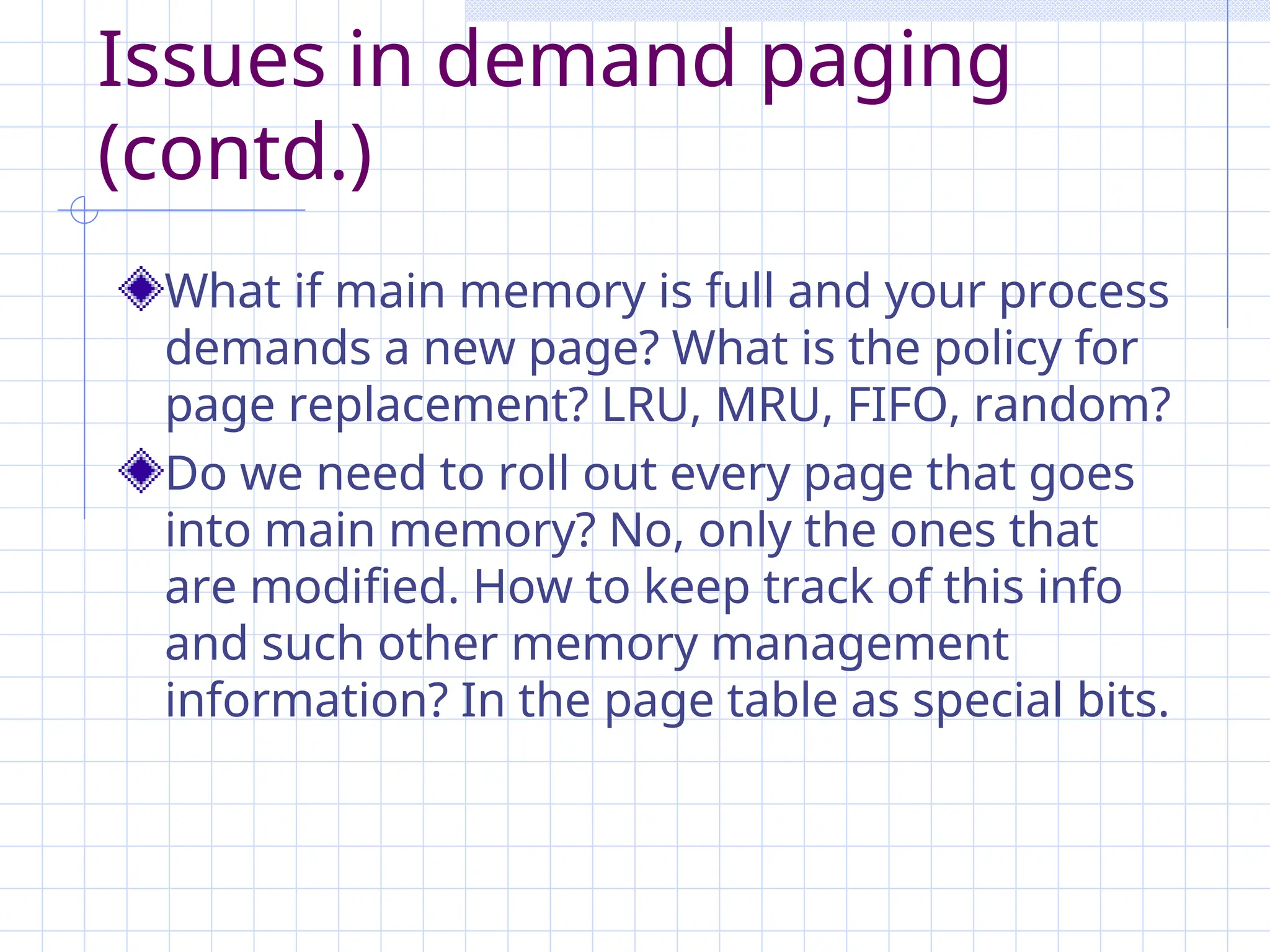
(contd.)
What if main memory is full and your process
demands a new page? What is the policy for
page replacement? LRU, MRU, FIFO, random?
Do we need to roll out every page that goes
into main memory? No, only the ones that
are modified. How to keep track of this info
and such other memory management
information? In the page table as special bits.
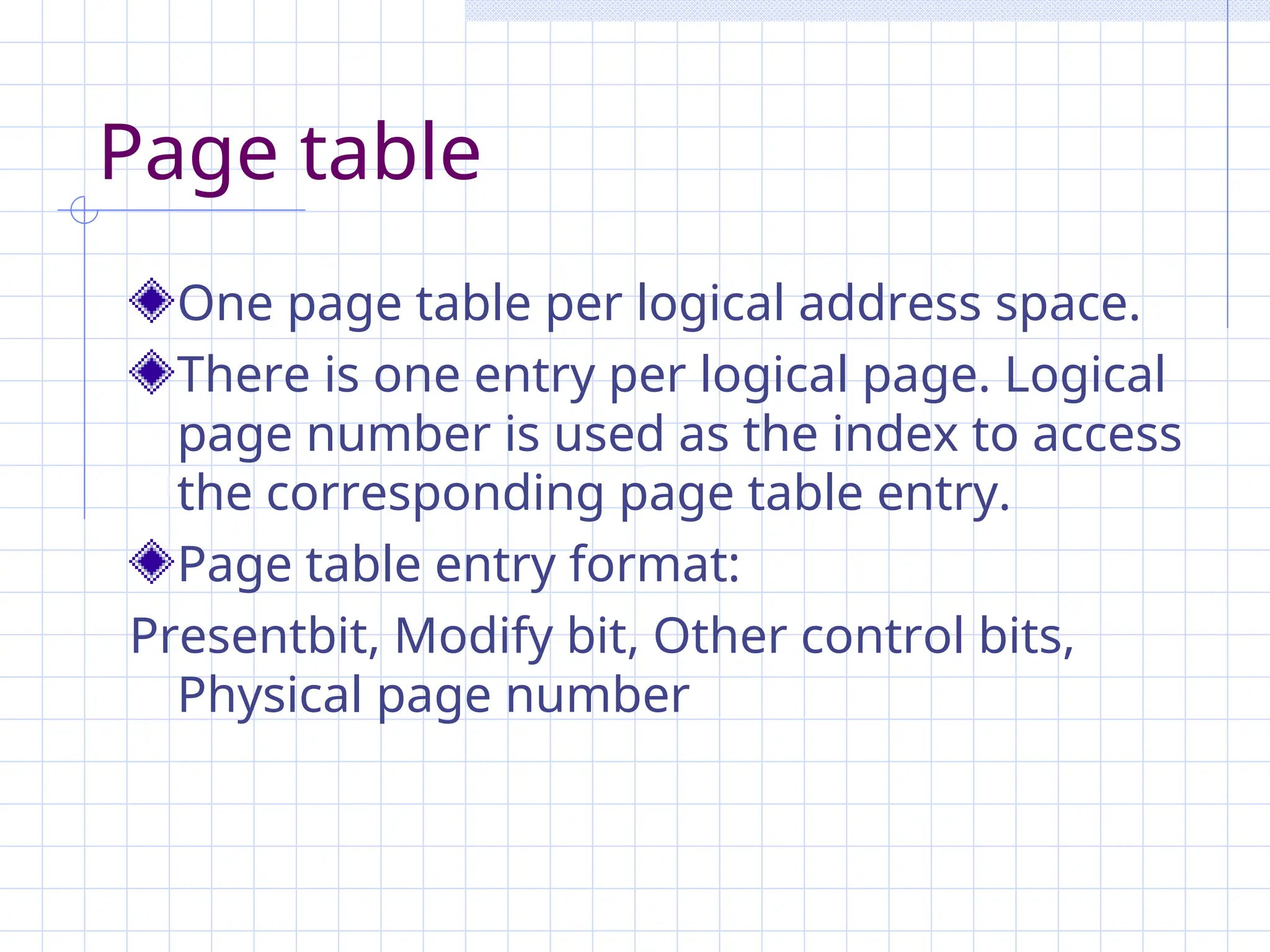
Page table
One page table per logical address space.
There is one entry per logical page. Logical
page number is used as the index to access
the corresponding page table entry.
Page table entry format:
Presentbit, Modify bit, Other control bits,
Physical page number
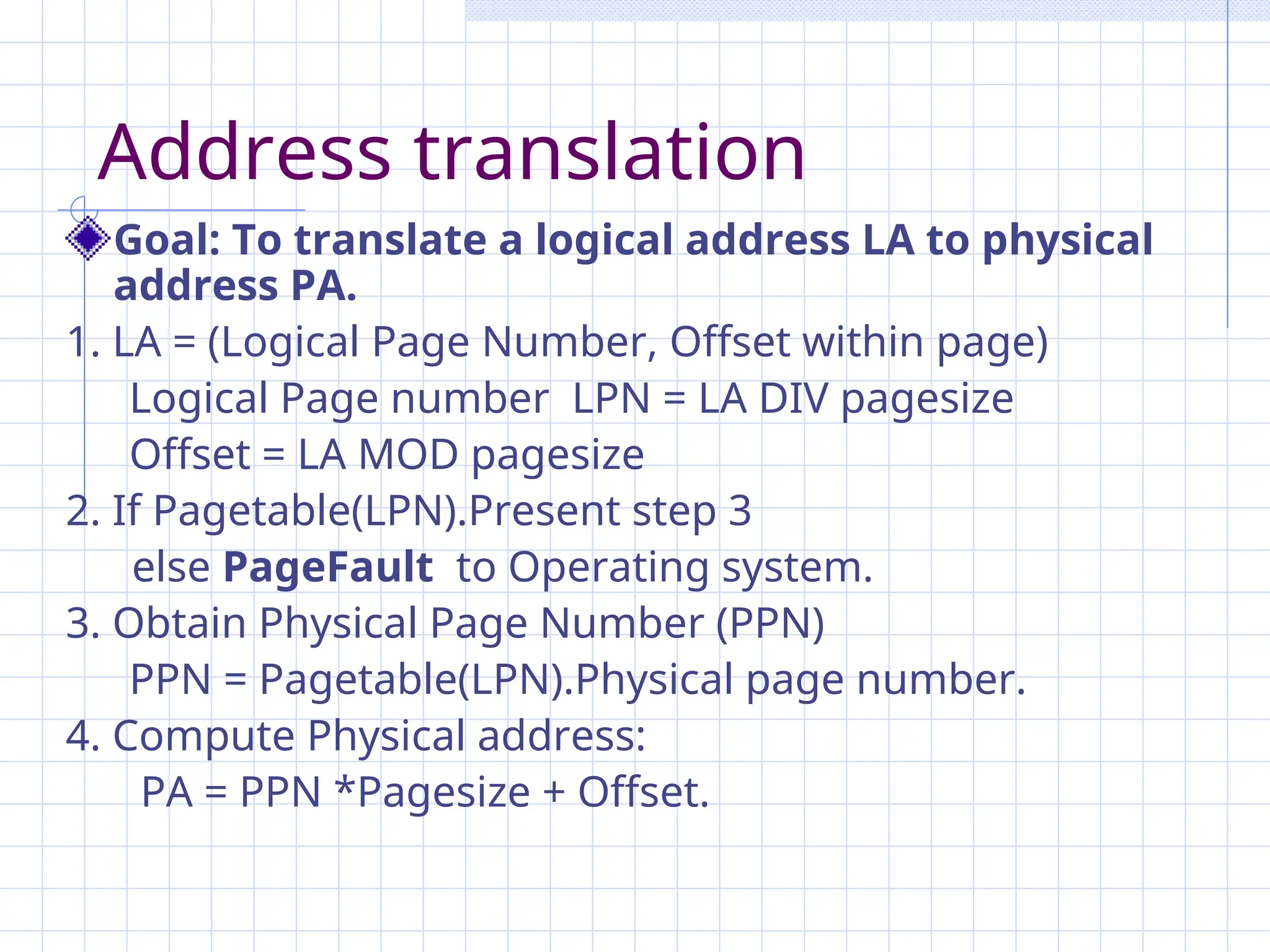
Address translation
Goal: To translate a logical address LA to physical
address PA.
1. LA = (Logical Page Number, Offset within page)
Logical Page number LPN = LA DIV pagesize
Offset = LA MOD pagesize
2. If Pagetable(LPN).Present step 3
else PageFault to Operating system.
3. Obtain Physical Page Number (PPN)
PPN = Pagetable(LPN).Physical page number.
4. Compute Physical address:
PA = PPN *Pagesize + Offset.
Example
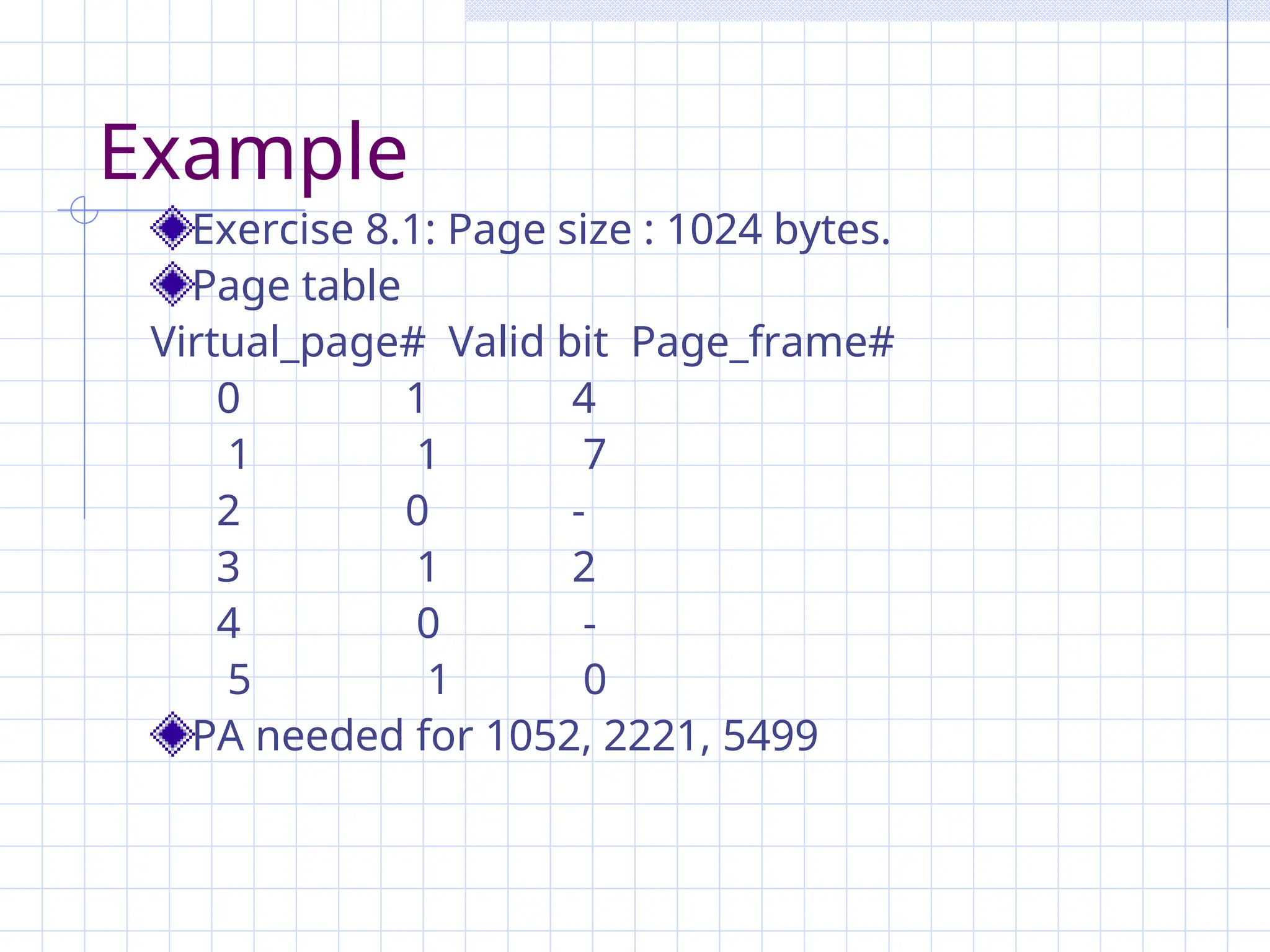
Exercise 8.1: Page size : 1024 bytes.
Page table
Virtual_page# Valid bit Page_frame#
0 1 4
1 1 7
2 0 -
3 1 2
4 0 -
5 1 0
PA needed for 1052, 2221, 5499
Page fault handler
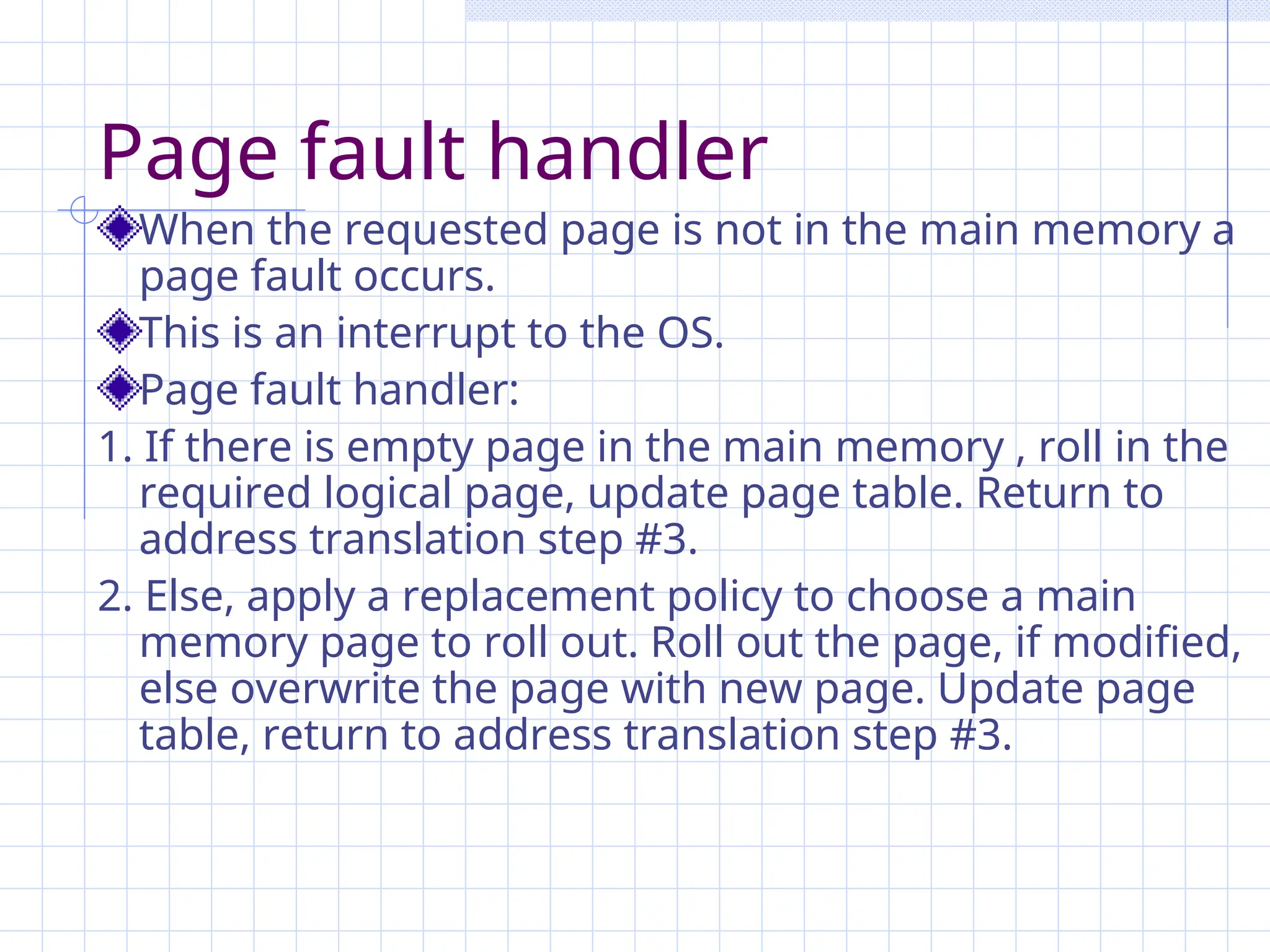
When the requested page is not in the main memory a
page fault occurs.
This is an interrupt to the OS.
Page fault handler:
1. If there is empty page in the main memory , roll in the
required logical page, update page table. Return to
address translation step #3.
2. Else, apply a replacement policy to choose a main
memory page to roll out. Roll out the page, if modified,
else overwrite the page with new page. Update page
table, return to address translation step #3.
Replacement policies
FIFO: first-in first-out.
LRU: Least Recently used.
NRU: Not recently used.
Clock-based.
Belady’s optimal min. (theoretical).
Exercise 8.2
Translation look-aside buffer
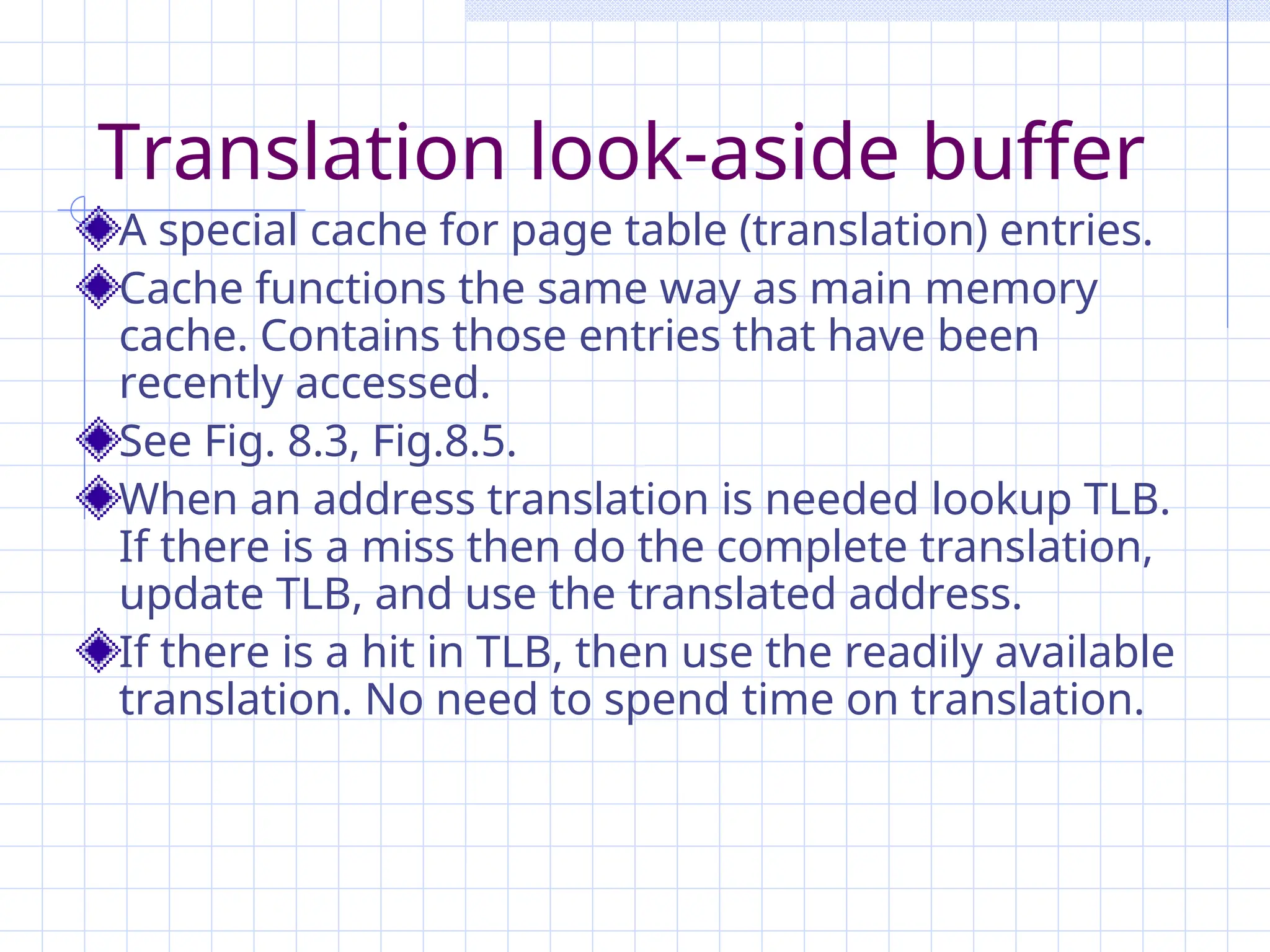
A special cache for page table (translation) entries.
Cache functions the same way as main memory
cache. Contains those entries that have been
recently accessed.
See Fig. 8.3, Fig.8.5.
When an address translation is needed lookup TLB.
If there is a miss then do the complete translation,
update TLB, and use the translated address.
If there is a hit in TLB, then use the readily available
translation. No need to spend time on translation.
Resident Set Management
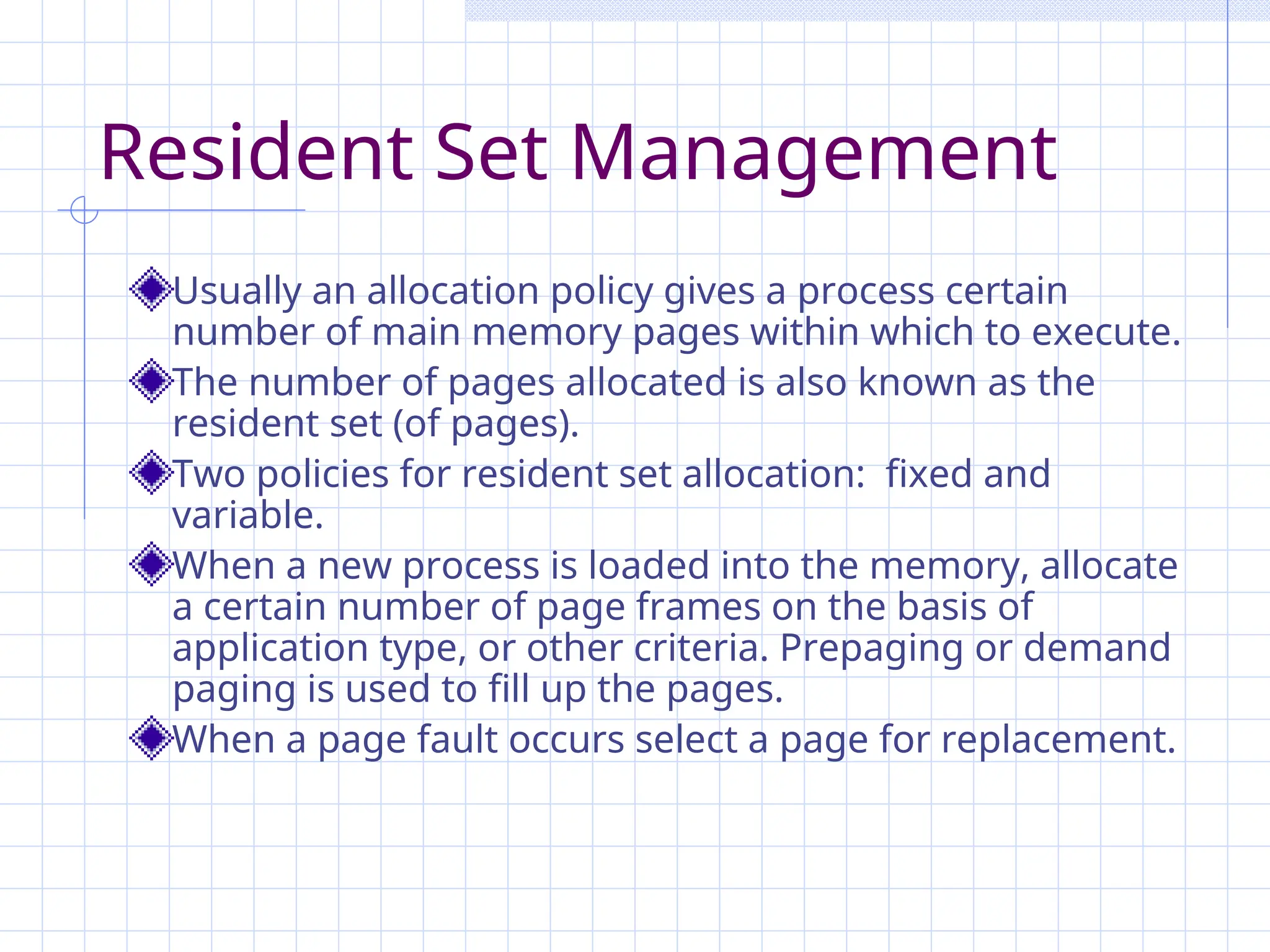
Usually an allocation policy gives a process certain
number of main memory pages within which to execute.
The number of pages allocated is also known as the
resident set (of pages).
Two policies for resident set allocation: fixed and
variable.
When a new process is loaded into the memory, allocate
a certain number of page frames on the basis of
application type, or other criteria. Prepaging or demand
paging is used to fill up the pages.
When a page fault occurs select a page for replacement.
Resident Set Management
(contd.)
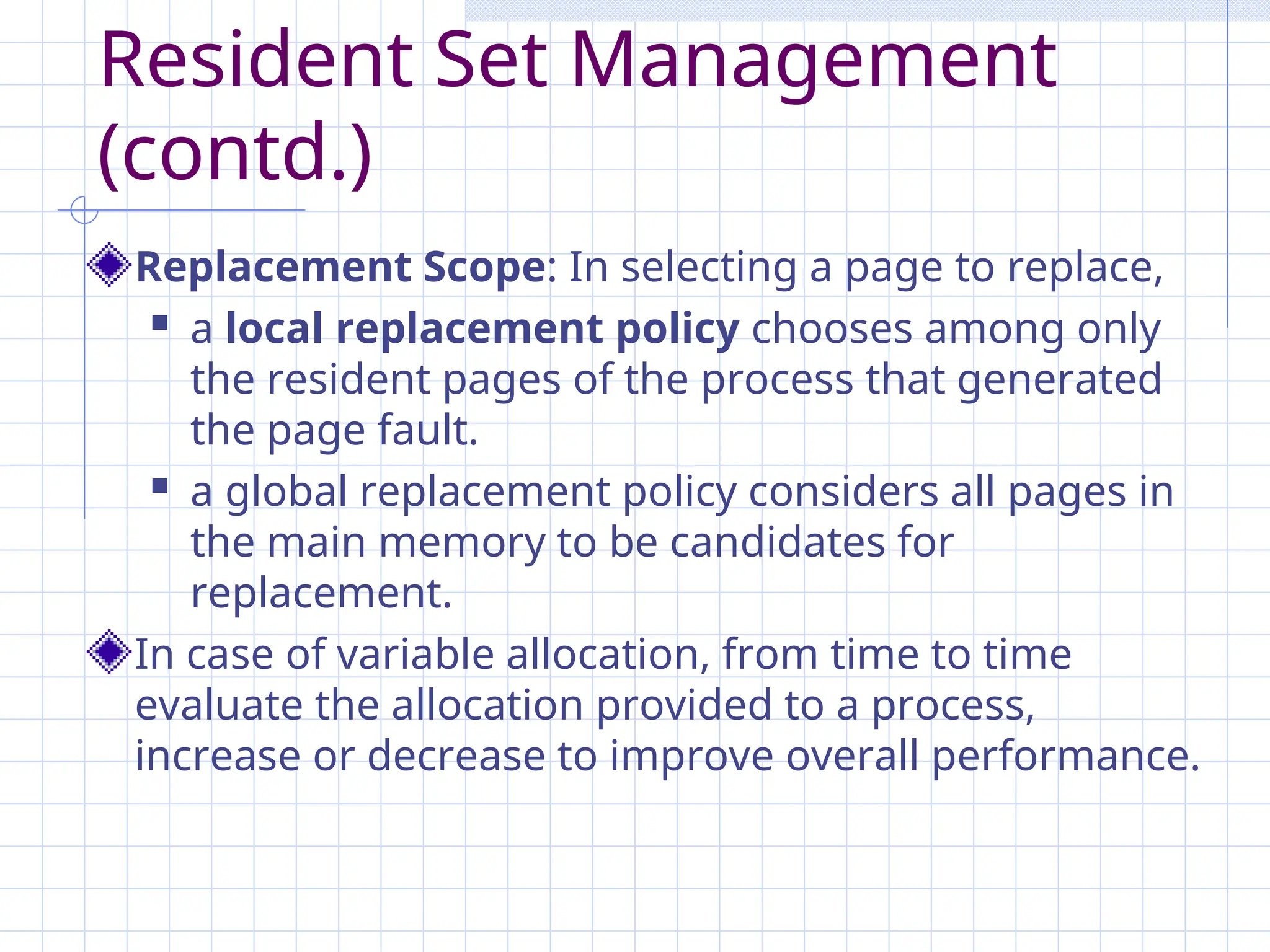
Replacement Scope: In selecting a page to replace,
 a local replacement policy chooses among only
the resident pages of the process that generated
the page fault.
 a global replacement policy considers all pages in
the main memory to be candidates for
replacement.
In case of variable allocation, from time to time
evaluate the allocation provided to a process,
increase or decrease to improve overall performance.
Load control
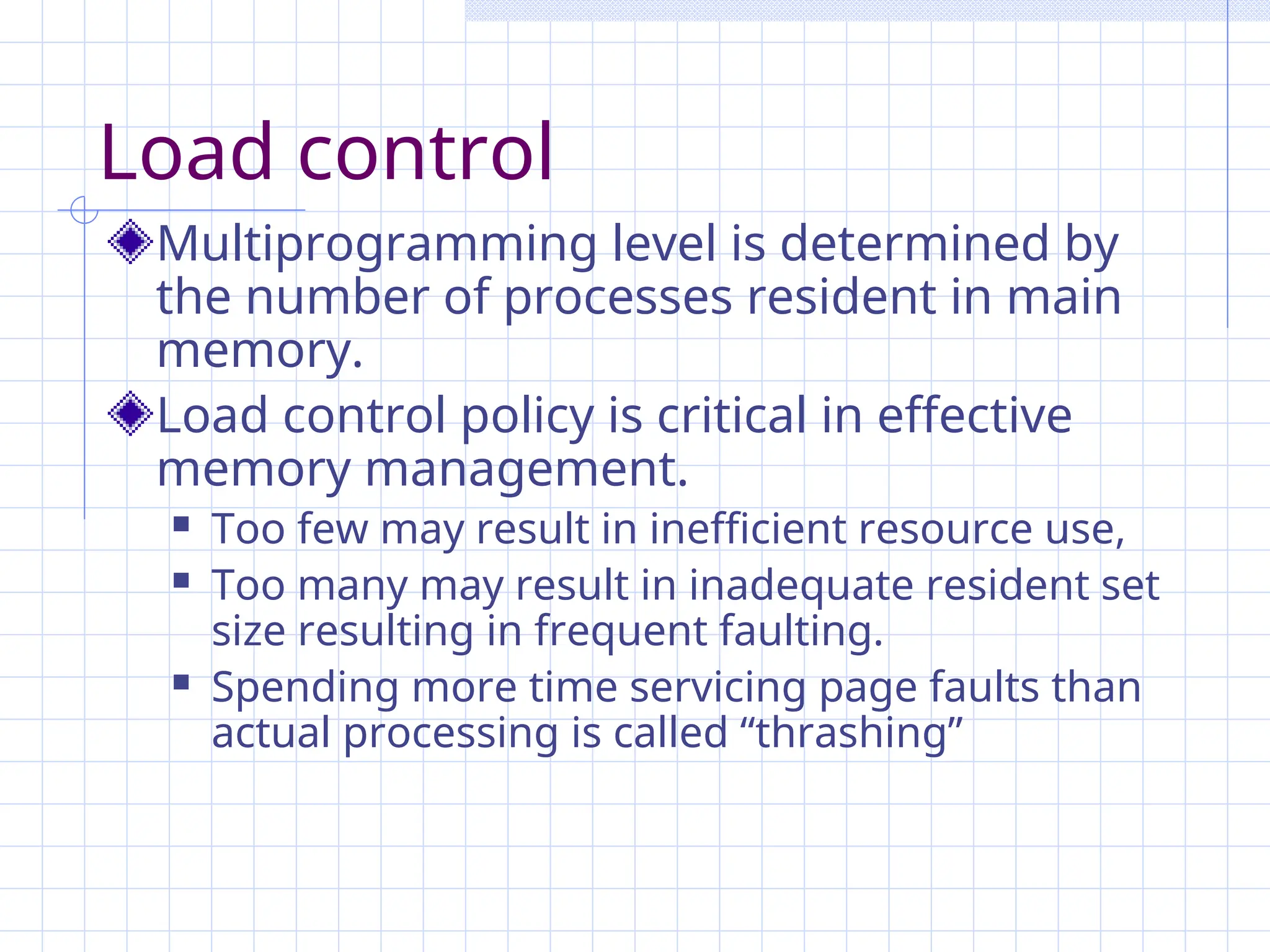
Multiprogramming level is determined by
the number of processes resident in main
memory.
Load control policy is critical in effective
memory management.
 Too few may result in inefficient resource use,
 Too many may result in inadequate resident set
size resulting in frequent faulting.
 Spending more time servicing page faults than
actual processing is called “thrashing”
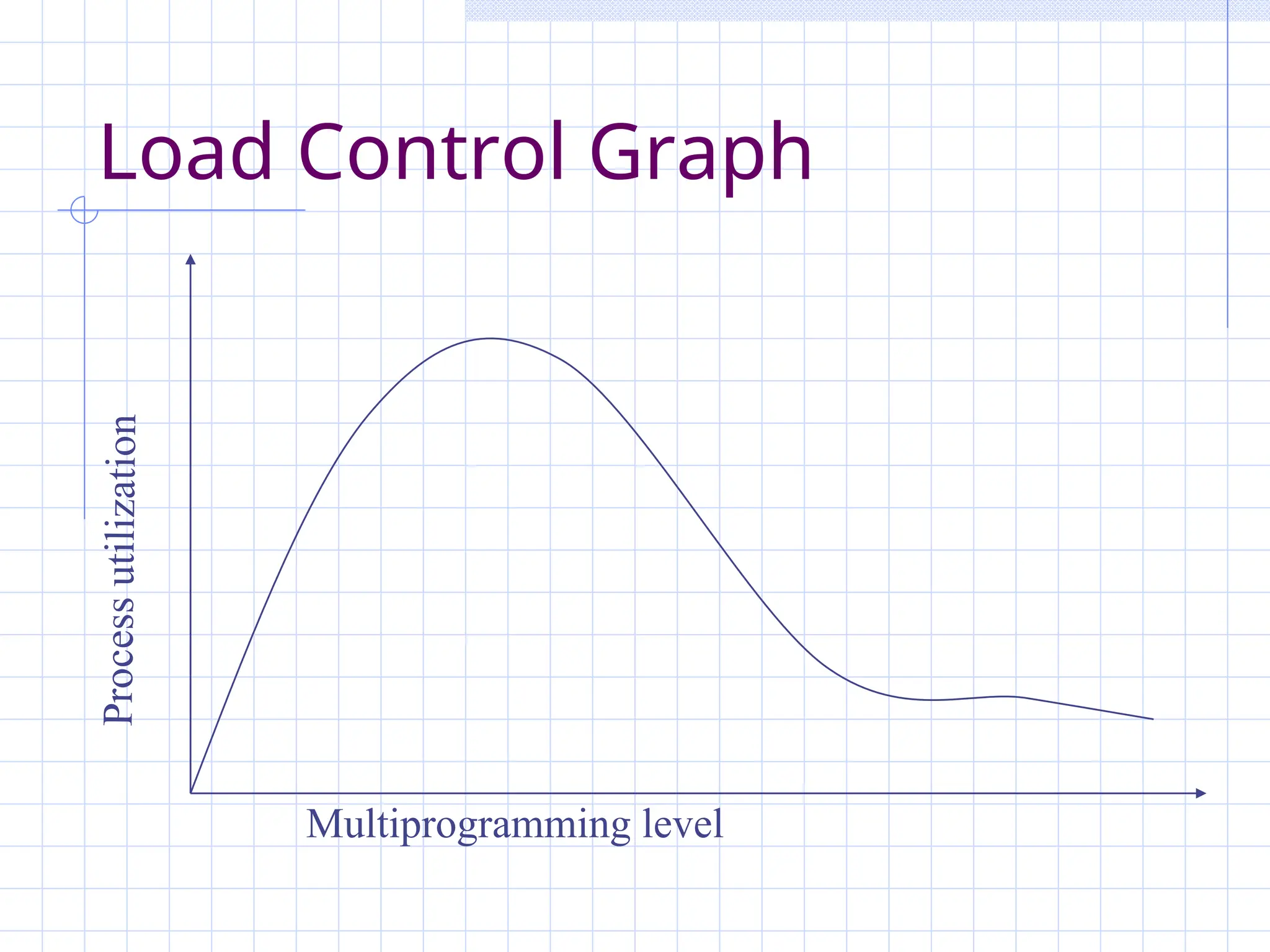
Load Control Graph
Proce
ss
utili
zatio
n
Multiprogramming level
Load control (contd.)
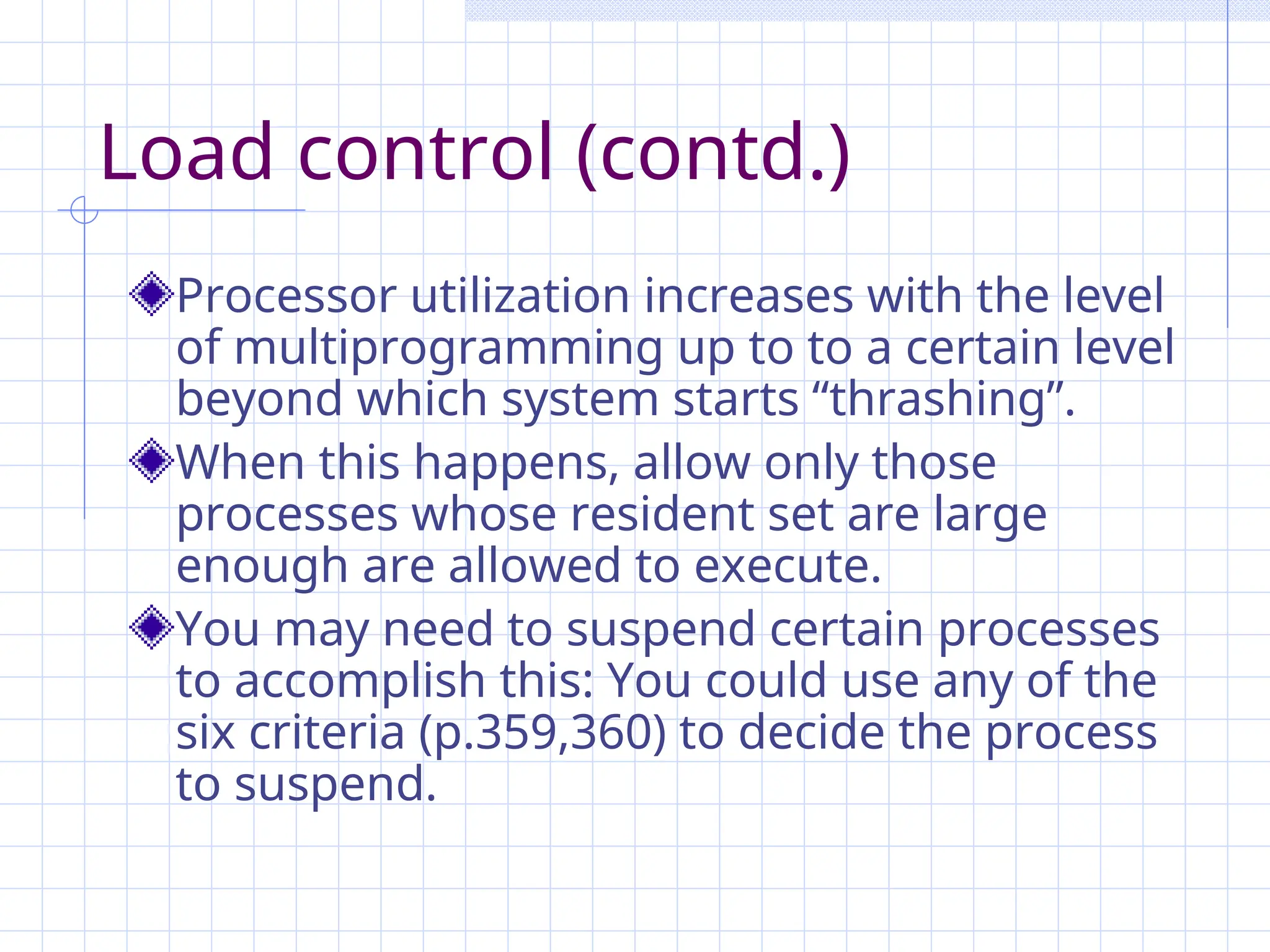
Processor utilization increases with the level
of multiprogramming up to to a certain level
beyond which system starts “thrashing”.
When this happens, allow only those
processes whose resident set are large
enough are allowed to execute.
You may need to suspend certain processes
to accomplish this: You could use any of the
six criteria (p.359,360) to decide the process
to suspend.
Summary
We studied a number of design issues
related to memory management:
Fetch policy, replacement policy,
translation mechanisms, resident set
management, and load control.
Homework#3: 6.2, 6.3, 6.8
Homework #4:8.2, 8.3, 8.13, 8.14
LECture no78 Memory in OperaManagement.PPT

  • 1.
  • 2.
    Introduction Memory refers tostorage needed by the kernel, the other components of the operating system and the user programs. In a multi-processing, multi-user system, the structure of the memory is quite complex. Efficient memory management is very critical for good performance of the entire system. In this discussion we will study memory management policies, techniques and their implementations.
  • 3.
    Topics for discussion Memorymanagement requirements Memory management techniques Related issues: relocation, loading and linking Virtual memory Principle of locality Paging Segmentation Page replacement policies Examples: NT and System V
  • 4.
    Memory management requirements Relocation: Branchaddresses and data references within a program memory space (user address space) have to be translated into references in the memory range a program is loaded into. Protection: Each process should be protected against unwanted (unauthorized) interference by other processes, whether accidental or intentional. Fortunately, mechanisms that support relocation also form the base for satisfying protection requirements.
  • 5.
    Memory management requirements (contd.) Sharing: Allow several processes to access the same portion of main memory : very common in many applications. Ex. many server-threads executing the same service routine. Logical organization : allow separate compilation and run-time resolution of references. To provide different access privileges (RWX). To allow sharing. Ex: segmentation.
  • 6.
    ...requirements(contd.) Physical organization: Memoryhierarchy or level of memory. Organization of each of these levels and movement and address translation among the various levels. Overhead : should be low. System should be spending not much time compared execution time, on the memory management techniques.
  • 7.
    Memory management techniques Fixed partitioning:Main memory statically divided into fixed-sized partitions: could be equal-sized or unequal-sized. Simple to implement. Inefficient use of memory and results in internal-fragmentation. Dynamic partitioning : Partitions are dynamically created. Compaction needed to counter external fragmentation. Inefficient use of processor. Simple paging: Both main memory and process space are divided into number of equal-sized frames. A process may in non-contiguous main memory pages.
  • 8.
    Memory management techniques Simple segmentation: To accommodate dynamically growing partitions: Compiler tables, for example. No fragmentation, but needs compaction. Virtual memory with paging: Same as simple paging but the pages currently needed are in the main memory. Known as demand paging. Virtual memory with segmentation: Same as simple segmentation but only those segments needed are in the main memory. Segmented-paged virtual memory
  • 9.
    Basic memory operations: Relocation Aprocess in the memory includes instructions plus data. Instruction contain memory references: Addresses of data items, addresses of instructions. These are logical addresses: relative addresses are examples of this. These are addresses which are expressed with reference to some known point, usually the beginning of the program. Physical addresses are absolute addresses in the memory. Relative addressing or position independence helps easy relocation of programs.
  • 10.
    Basic memory operations: Linkingand loading The function of a linker is to take as input a collection of object modules and produce a load module that consists of an integrated set of program and data modules to be passed to the loader. It also resolves all the external symbolic references in the load module (linkage). The nature of the address linkage will depend on the types of load module created and the time of linkage: static, load-time dynamic linking, run-time dynamic linking. Dynamic linking: Deferring the linkage of external references until load-module is created: load module contains unresolved references to other programs.
  • 11.
    Virtual memory Consider atypical, large application:  There are many components that are mutually exclusive. Example: A unique function selected dependent on user choice.  Error routines and exception handlers are very rarely used.  Most programs exhibit a slowly changing locality of reference. There are two types of locality: spatial and temporal.
  • 12.
    Locality Temporal locality: Addressesthat are referenced at some time Ts will be accessed in the near future (Ts + delta_time) with high probability. Example : Execution in a loop. Spatial locality: Items whose addresses are near one another tend to be referenced close together in time. Example: Accessing array elements. How can we exploit this characteristics of programs? Keep only the current locality in the main memory. Need not keep the entire program in the main memory.
  • 13.
    Space and Time Storage capacity Accesstime CPU cache Main memory Secondary Storage Cost/byte Desirable increasing
  • 14.
    Demand paging Main memory(physical address space) as well as user address space (virtual address space) are logically partitioned into equal chunks known as pages. Main memory pages (sometimes known as frames) and virtual memory pages are of the same size. Virtual address (VA) is viewed as a pair (virtual page number, offset within the page). Example: Consider a virtual space of 16K , with 2K page size and an address 3045. What the virtual page number and offset corresponding to this VA?
  • 15.
    Virtual Page Numberand Offset 3045 / 2048 = 1 3045 % 2048 = 3045 - 2048 = 997 VP# = 1 Offset within page = 1007 Page Size is always a power of 2? Why?
  • 16.
    Page Size Criteria Considerthe binary value of address 3045 : 1011 1110 0101 for 16K address space the address will be 14 bits. Rewrite: 00 1011 1110 0101 A 2K address space will have offset range 0 - 2047 (11 bits) 00 1 011 1110 0101 Offset within page Page#
  • 17.
    Demand paging (contd.) Thereis only one physical address space but as many virtual address spaces as the number of processes in the system. At any time physical memory may contain pages from many process address space. Pages are brought into the main memory when needed and “rolled out” depending on a page replacement policy. Consider a 8K main (physical) memory and three virtual address spaces of 2K, 3K and 4K each. Page size of 1K. The status of the memory mapping at some time is as shown.
  • 18.
    Demand Paging (contd.) 0 1 2 3 4 5 6 7 Mainmemory LAS 0 LAS 1 LAS 2 (Physical Address Space -PAS) LAS - Logical Address Space Executable code space
  • 19.
    Issues in demandpaging How to keep track of which logical page goes where in the main memory? More specifically, what are the data structures needed?  Page table, one per logical address space. How to translate logical address into physical address and when?  Address translation algorithm applied every time a memory reference is needed. How to avoid repeated translations?  After all most programs exhibit good locality. “cache recent translations”
  • 20.
    Issues in demandpaging (contd.) What if main memory is full and your process demands a new page? What is the policy for page replacement? LRU, MRU, FIFO, random? Do we need to roll out every page that goes into main memory? No, only the ones that are modified. How to keep track of this info and such other memory management information? In the page table as special bits.
  • 21.
    Page table One pagetable per logical address space. There is one entry per logical page. Logical page number is used as the index to access the corresponding page table entry. Page table entry format: Presentbit, Modify bit, Other control bits, Physical page number
  • 22.
    Address translation Goal: Totranslate a logical address LA to physical address PA. 1. LA = (Logical Page Number, Offset within page) Logical Page number LPN = LA DIV pagesize Offset = LA MOD pagesize 2. If Pagetable(LPN).Present step 3 else PageFault to Operating system. 3. Obtain Physical Page Number (PPN) PPN = Pagetable(LPN).Physical page number. 4. Compute Physical address: PA = PPN *Pagesize + Offset.
  • 23.
    Example Exercise 8.1: Pagesize : 1024 bytes. Page table Virtual_page# Valid bit Page_frame# 0 1 4 1 1 7 2 0 - 3 1 2 4 0 - 5 1 0 PA needed for 1052, 2221, 5499
  • 24.
    Page fault handler Whenthe requested page is not in the main memory a page fault occurs. This is an interrupt to the OS. Page fault handler: 1. If there is empty page in the main memory , roll in the required logical page, update page table. Return to address translation step #3. 2. Else, apply a replacement policy to choose a main memory page to roll out. Roll out the page, if modified, else overwrite the page with new page. Update page table, return to address translation step #3.
  • 25.
    Replacement policies FIFO: first-infirst-out. LRU: Least Recently used. NRU: Not recently used. Clock-based. Belady’s optimal min. (theoretical). Exercise 8.2
  • 26.
    Translation look-aside buffer Aspecial cache for page table (translation) entries. Cache functions the same way as main memory cache. Contains those entries that have been recently accessed. See Fig. 8.3, Fig.8.5. When an address translation is needed lookup TLB. If there is a miss then do the complete translation, update TLB, and use the translated address. If there is a hit in TLB, then use the readily available translation. No need to spend time on translation.
  • 27.
    Resident Set Management Usuallyan allocation policy gives a process certain number of main memory pages within which to execute. The number of pages allocated is also known as the resident set (of pages). Two policies for resident set allocation: fixed and variable. When a new process is loaded into the memory, allocate a certain number of page frames on the basis of application type, or other criteria. Prepaging or demand paging is used to fill up the pages. When a page fault occurs select a page for replacement.
  • 28.
    Resident Set Management (contd.) ReplacementScope: In selecting a page to replace,  a local replacement policy chooses among only the resident pages of the process that generated the page fault.  a global replacement policy considers all pages in the main memory to be candidates for replacement. In case of variable allocation, from time to time evaluate the allocation provided to a process, increase or decrease to improve overall performance.
  • 29.
    Load control Multiprogramming levelis determined by the number of processes resident in main memory. Load control policy is critical in effective memory management.  Too few may result in inefficient resource use,  Too many may result in inadequate resident set size resulting in frequent faulting.  Spending more time servicing page faults than actual processing is called “thrashing”
  • 30.
  • 31.
    Load control (contd.) Processorutilization increases with the level of multiprogramming up to to a certain level beyond which system starts “thrashing”. When this happens, allow only those processes whose resident set are large enough are allowed to execute. You may need to suspend certain processes to accomplish this: You could use any of the six criteria (p.359,360) to decide the process to suspend.
  • 32.
    Summary We studied anumber of design issues related to memory management: Fetch policy, replacement policy, translation mechanisms, resident set management, and load control. Homework#3: 6.2, 6.3, 6.8 Homework #4:8.2, 8.3, 8.13, 8.14