Windows IO Manager and
Layered Driver Framework

      Sisimon Soman
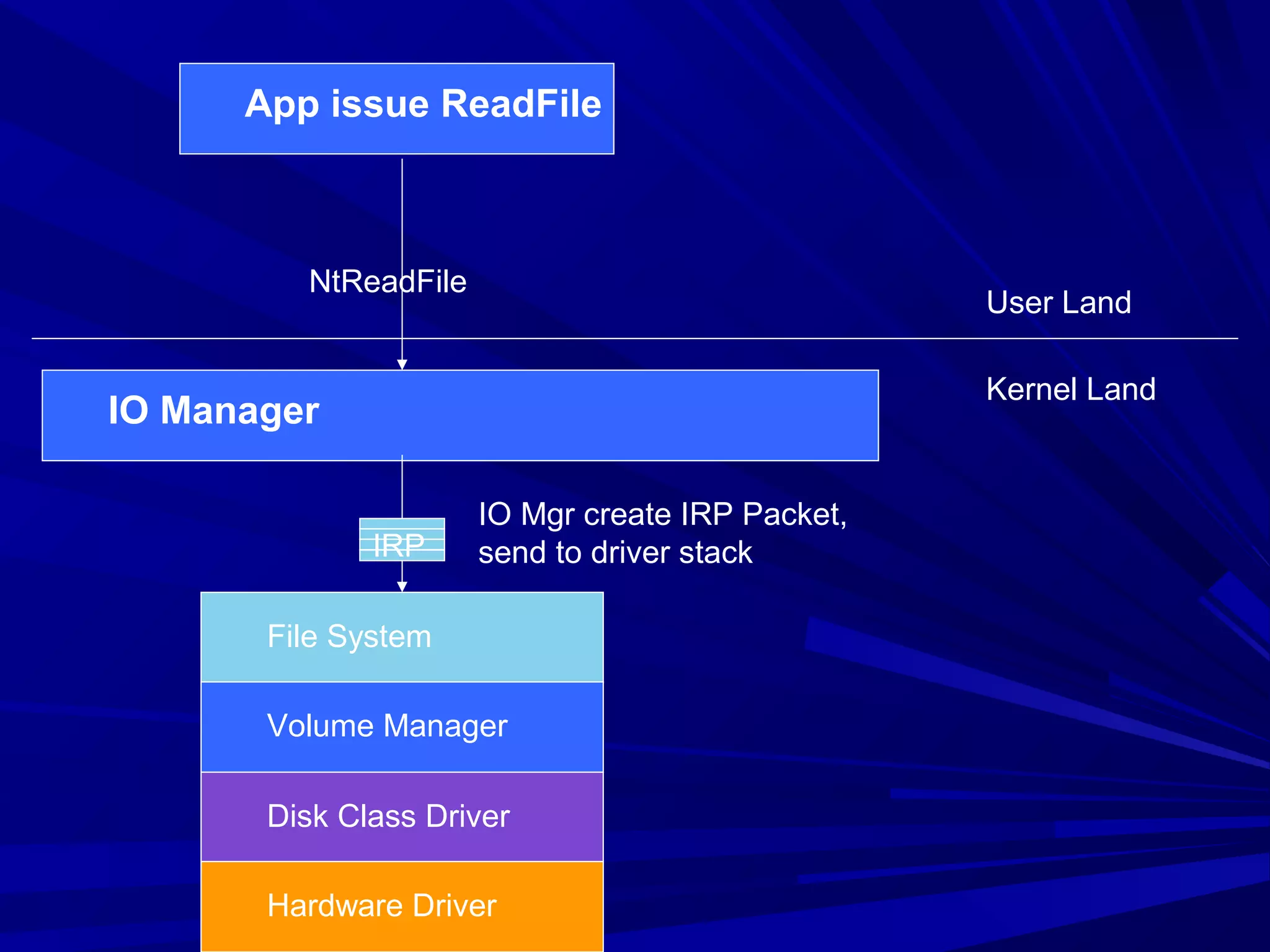
App issue ReadFile


         NtReadFile
                                                  User Land

                                                  Kernel Land
IO Manager

                      IO Mgr create IRP Packet,
              IRP     send to driver stack

       File System

       Volume Manager

       Disk Class Driver

       Hardware Driver
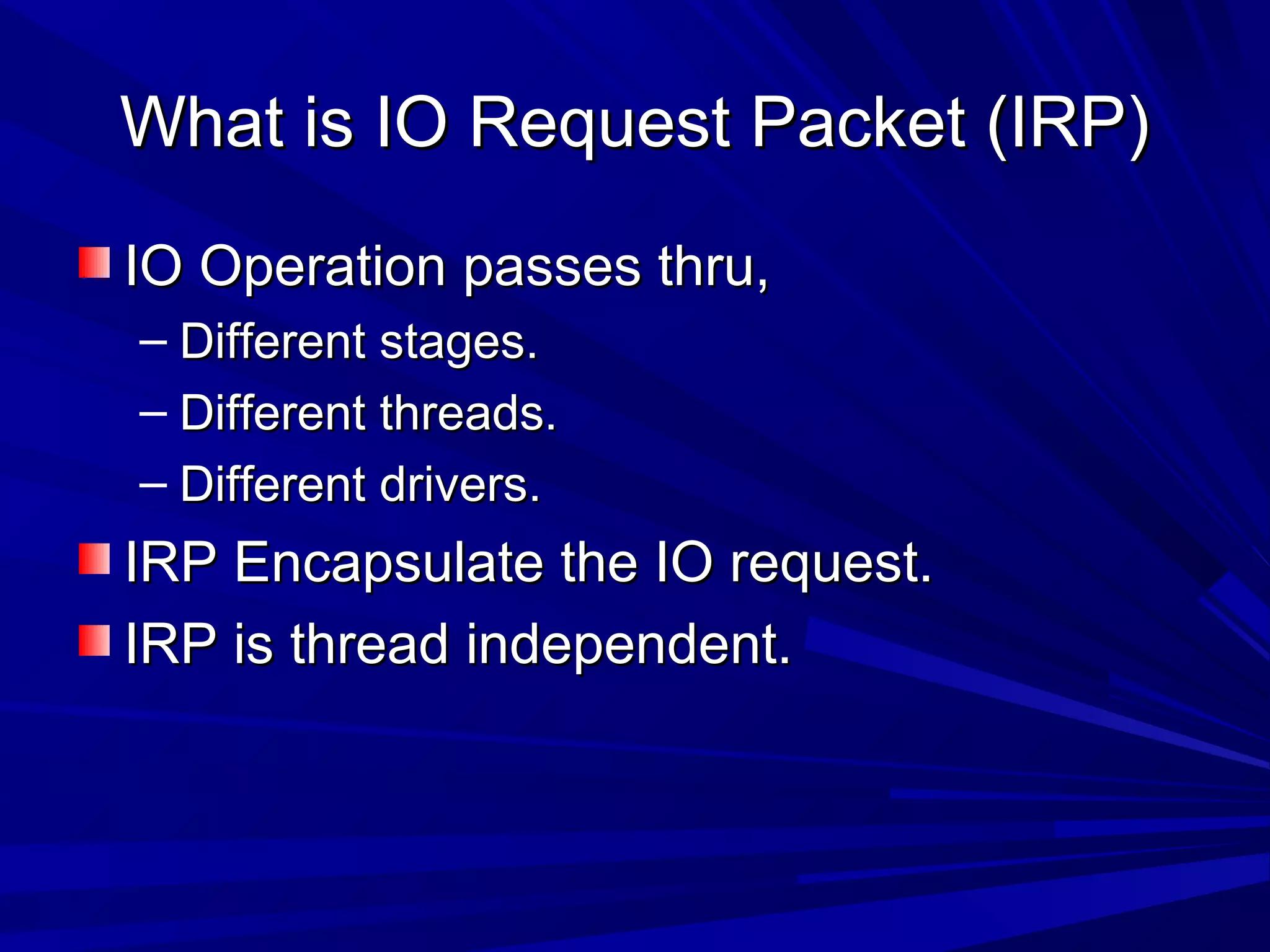
What is IO Request Packet (IRP)
IO Operation passes thru,
– Different stages.
– Different threads.
– Different drivers.
IRP Encapsulate the IO request.
IRP is thread independent.
IRP Continued..
Compare IRP with Windows Messages
-MSG structure.
Each driver in the stack do its own task,
finally forward the IRP to the lower driver
in the stack.
IRP can be processed synchronously or
asynchronously.
IRP Continued..

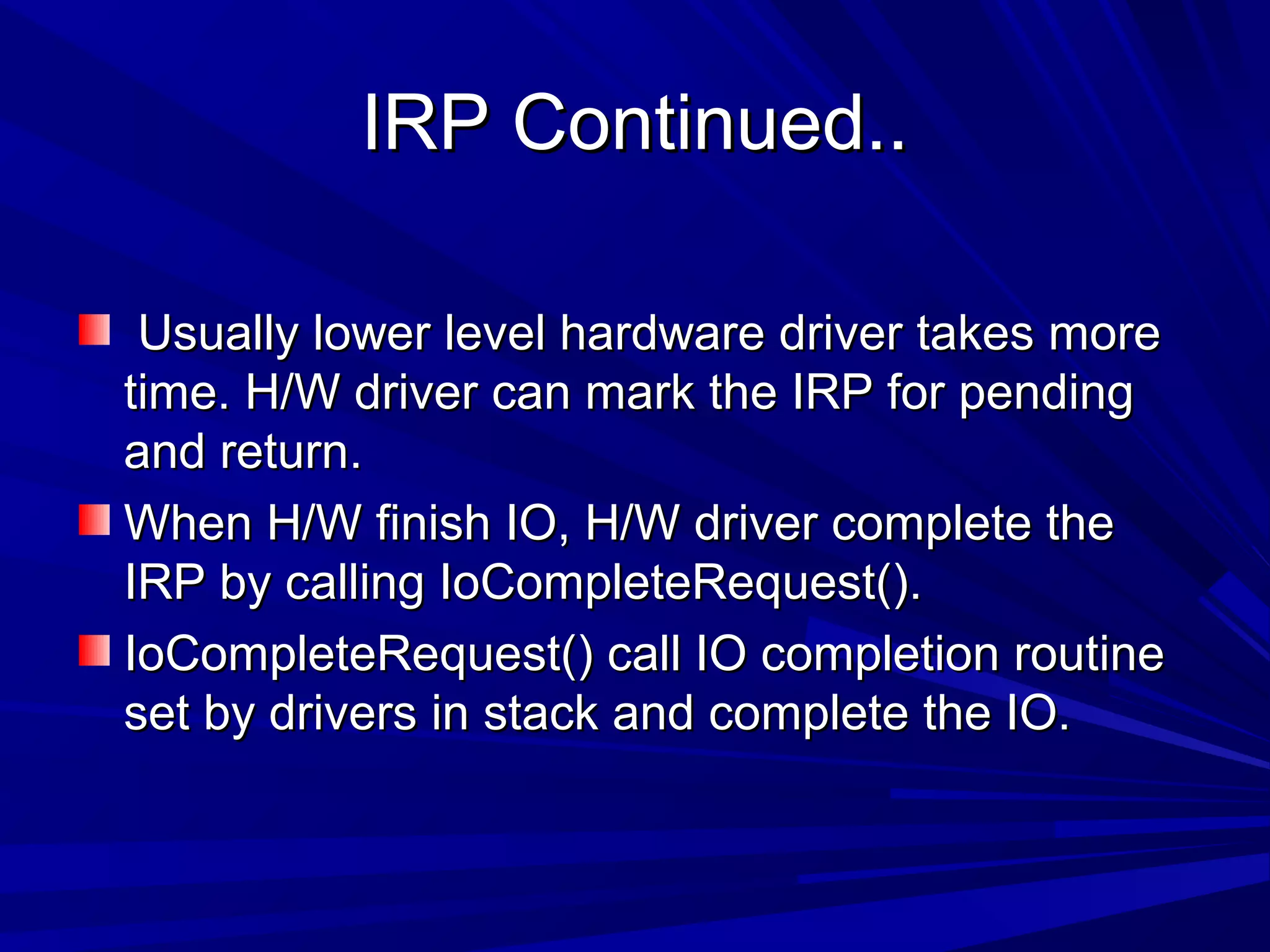
 Usually lower level hardware driver takes more
time. H/W driver can mark the IRP for pending
and return.
When H/W finish IO, H/W driver complete the
IRP by calling IoCompleteRequest().
IoCompleteRequest() call IO completion routine
set by drivers in stack and complete the IO.
Structure of IRP
Fixed IRP Header                IRP Header
Variable Stack locations –
– One sub stack per driver   Stack Location 1

                             Stack Location 2

                             Stack Location 3

                             Stack Location N
Flow of IRP
                                         IRP for Storage
                                         Stack


              Storage Stack
                                            IRP Header


             File System                 Stack Location 1

             Volume Manager              Stack Location 2

             Disk Class Driver           Stack Location 3

             Hardware Driver             Stack Location 4


Forward IRP to lower
driver in the stack
Flow of IRP Completion
                                     IRP for Storage
                                     Stack


                 Storage Stack
                                        IRP Header


               File System –
                                     Stack Location 1
              Completion Routine
               Volume Manager –
                                     Stack Location 2
              Completion Routine
               Disk Class Driver –
                                     Stack Location 3
              Completion Routine
               Hardware Driver –
                                     Stack Location 4
               Complete the IRP


Call the completion routine while
completing the IRP
IRP Header
IO buffer Information.
Flags
– Page IO Flag
– No Caching IO flag


IO Status – On Completion set this to IO
Completed.
IRP cancel routine
IRP Stack Location
IO Manager get the driver count in the
stack from the top device in the stack.
While creating IRP, IO manager allocate
the IO stack locations equal to the device
count from the top device object.
Contents of IO Stack Location
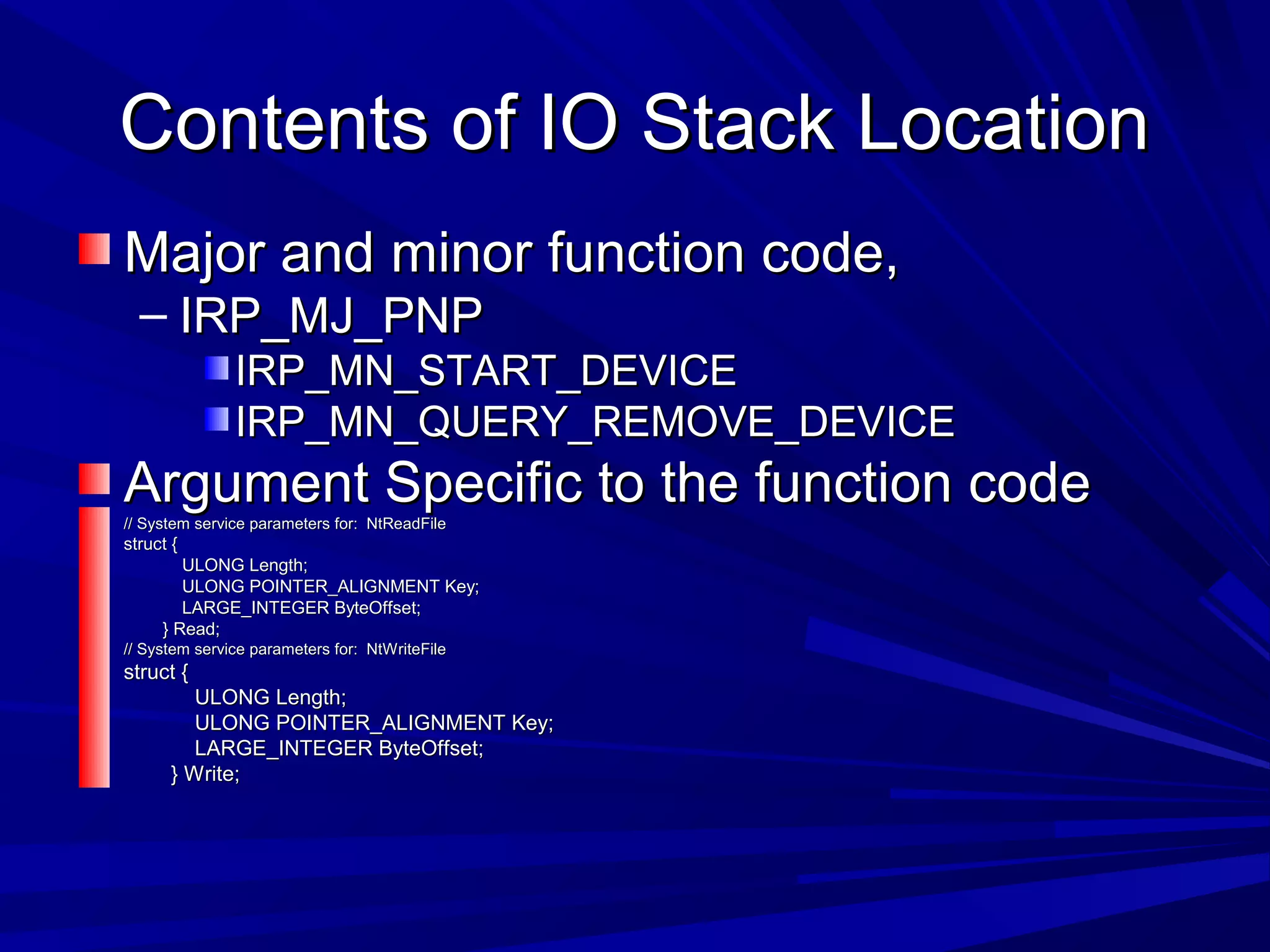
Major and minor function code,
  – IRP_MJ_PNP
               IRP_MN_START_DEVICE
               IRP_MN_QUERY_REMOVE_DEVICE
Argument Specific to the function code
// System service parameters for: NtReadFile
struct {
        ULONG Length;
        ULONG POINTER_ALIGNMENT Key;
        LARGE_INTEGER ByteOffset;
     } Read;
// System service parameters for: NtWriteFile
struct {
         ULONG Length;
         ULONG POINTER_ALIGNMENT Key;
         LARGE_INTEGER ByteOffset;
      } Write;
Contents of IO Stack Location
IO Completion routine specific to the
driver.
File object specific to the request.
Asynchronous IO
CreateFile(…, FILE_FLAG_OVERLAPPED ,..),
ReadFile(.., LPOVERLAPPED)
When complete the IO operation, IO Mgr
signal the EVENT in LPOVERLAPPED.
How Async IO work in Kernel
Lower layer driver complete IRP in arbitrary
thread context.
IO Mgr call IO Completion routine in reverse
order.
If operation is Async, IO Mgr queue an APC
specific to the initiator thread.
This APC has complete info of buffer, size info.
This APC get executed later in the context of
initiator thread, which copy buffer to user space,
trigger the event set by App.
Common issues related IRP
After forward the IRP down, don’t touch it (except from
IO completion routine).
If lower driver mark the IRP for pending, all top layer
driver should do the same.
If a middle level driver need to keep the IRP for further
processing after completing it by lower driver, it can
return STATUS_MORE_PROCESSING REQUIRED
from completion routine.
Middle layer driver should complete it later.
See ReactOS source code (instead of reading 20 page
doc)
FastIO - Concepts
Part 2

How device stack setup
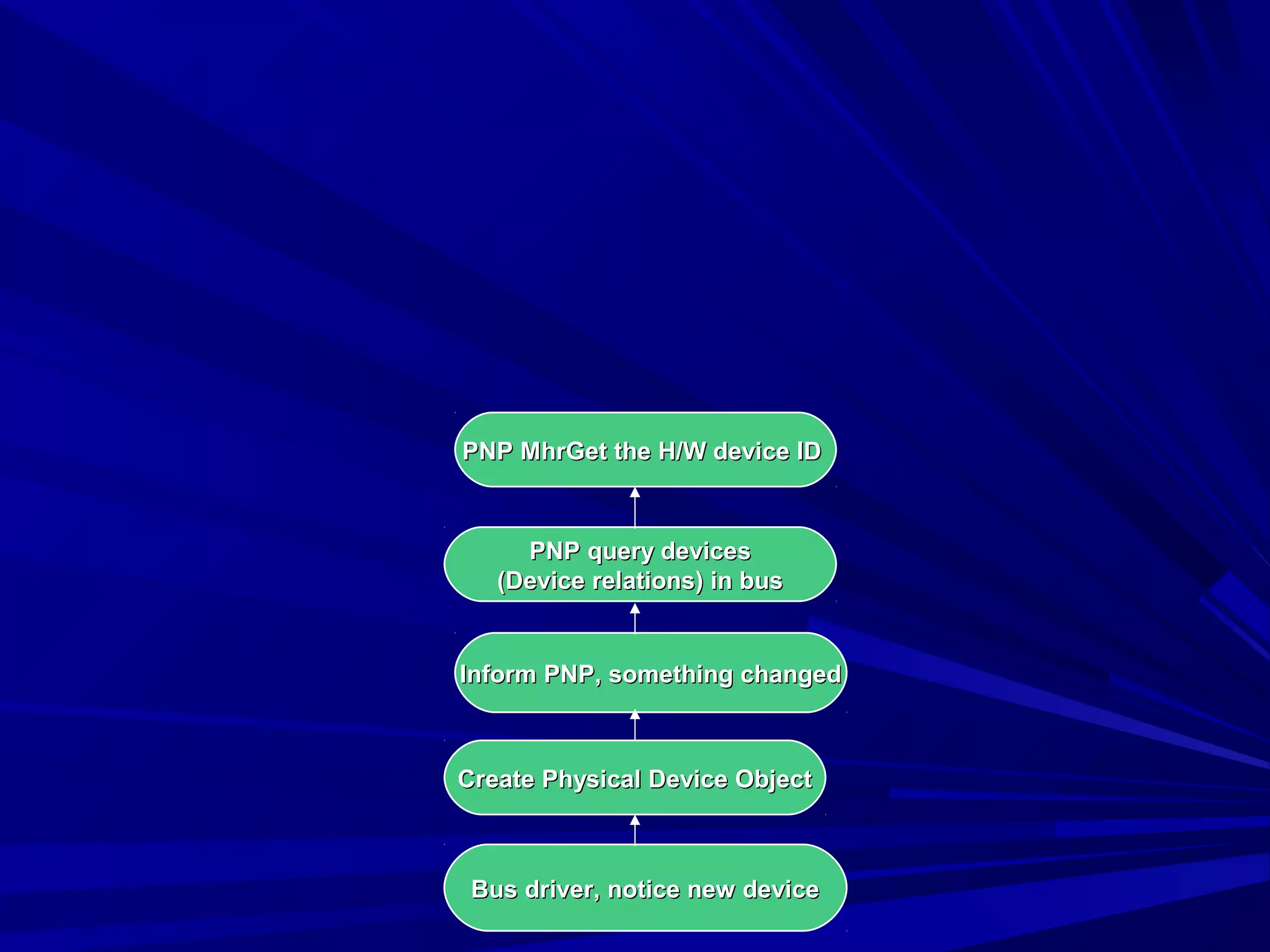
Bus driver, notice new device
Create Physical Device Object


 Bus driver, notice new device
Inform PNP, something changed


Create Physical Device Object


 Bus driver, notice new device
PNP query devices
  (Device relations) in bus


Inform PNP, something changed


Create Physical Device Object


 Bus driver, notice new device
PNP MhrGet the H/W device ID


     PNP query devices
   (Device relations) in bus


Inform PNP, something changed


Create Physical Device Object


 Bus driver, notice new device
Get Functional Driver Info from
 registry using H/W Device ID


PNP MhrGet the H/W device ID


     PNP query devices
   (Device relations) in bus


Inform PNP, something changed


Create Physical Device Object


 Bus driver, notice new device
Load Functional driver,call
         AddDevice()
    Pass PDO of device also

Get Functional Driver Info from
 registry using H/W Device ID


PNP MhrGet the H/W device ID


     PNP query devices
   (Device relations) in bus


Inform PNP, something changed


Create Physical Device Object


 Bus driver, notice new device
Create FDO of device,Attach to
PDO,Continue this for all devices


   Load Functional driver,call
         AddDevice()
    Pass PDO of device also

Get Functional Driver Info from
 registry using H/W Device ID


PNP MhrGet the H/W device ID


     PNP query devices
   (Device relations) in bus


Inform PNP, something changed


Create Physical Device Object


 Bus driver, notice new device
PDO-FDO pair with
                             registered filter driver for a
                             Device


PDO-FDO pair for a Device              Upper Filter


                                 Functional Device Object


  Functional Device Object
                                       Lower Filter

   Physical Device Object
                                  Physical Device Object
Real world example
How storage stack build up
Questions ?

Windows io manager

  • 1.
    Windows IO Managerand Layered Driver Framework Sisimon Soman
  • 2.
    App issue ReadFile NtReadFile User Land Kernel Land IO Manager IO Mgr create IRP Packet, IRP send to driver stack File System Volume Manager Disk Class Driver Hardware Driver
  • 3.
    What is IORequest Packet (IRP) IO Operation passes thru, – Different stages. – Different threads. – Different drivers. IRP Encapsulate the IO request. IRP is thread independent.
  • 4.
    IRP Continued.. Compare IRPwith Windows Messages -MSG structure. Each driver in the stack do its own task, finally forward the IRP to the lower driver in the stack. IRP can be processed synchronously or asynchronously.
  • 5.
    IRP Continued.. Usuallylower level hardware driver takes more time. H/W driver can mark the IRP for pending and return. When H/W finish IO, H/W driver complete the IRP by calling IoCompleteRequest(). IoCompleteRequest() call IO completion routine set by drivers in stack and complete the IO.
  • 6.
    Structure of IRP FixedIRP Header IRP Header Variable Stack locations – – One sub stack per driver Stack Location 1 Stack Location 2 Stack Location 3 Stack Location N
  • 7.
    Flow of IRP IRP for Storage Stack Storage Stack IRP Header File System Stack Location 1 Volume Manager Stack Location 2 Disk Class Driver Stack Location 3 Hardware Driver Stack Location 4 Forward IRP to lower driver in the stack
  • 8.
    Flow of IRPCompletion IRP for Storage Stack Storage Stack IRP Header File System – Stack Location 1 Completion Routine Volume Manager – Stack Location 2 Completion Routine Disk Class Driver – Stack Location 3 Completion Routine Hardware Driver – Stack Location 4 Complete the IRP Call the completion routine while completing the IRP
  • 9.
    IRP Header IO bufferInformation. Flags – Page IO Flag – No Caching IO flag IO Status – On Completion set this to IO Completed. IRP cancel routine
  • 10.
    IRP Stack Location IOManager get the driver count in the stack from the top device in the stack. While creating IRP, IO manager allocate the IO stack locations equal to the device count from the top device object.
  • 11.
    Contents of IOStack Location Major and minor function code, – IRP_MJ_PNP IRP_MN_START_DEVICE IRP_MN_QUERY_REMOVE_DEVICE Argument Specific to the function code // System service parameters for: NtReadFile struct { ULONG Length; ULONG POINTER_ALIGNMENT Key; LARGE_INTEGER ByteOffset; } Read; // System service parameters for: NtWriteFile struct { ULONG Length; ULONG POINTER_ALIGNMENT Key; LARGE_INTEGER ByteOffset; } Write;
  • 12.
    Contents of IOStack Location IO Completion routine specific to the driver. File object specific to the request.
  • 13.
    Asynchronous IO CreateFile(…, FILE_FLAG_OVERLAPPED,..), ReadFile(.., LPOVERLAPPED) When complete the IO operation, IO Mgr signal the EVENT in LPOVERLAPPED.
  • 14.
    How Async IOwork in Kernel Lower layer driver complete IRP in arbitrary thread context. IO Mgr call IO Completion routine in reverse order. If operation is Async, IO Mgr queue an APC specific to the initiator thread. This APC has complete info of buffer, size info. This APC get executed later in the context of initiator thread, which copy buffer to user space, trigger the event set by App.
  • 15.
    Common issues relatedIRP After forward the IRP down, don’t touch it (except from IO completion routine). If lower driver mark the IRP for pending, all top layer driver should do the same. If a middle level driver need to keep the IRP for further processing after completing it by lower driver, it can return STATUS_MORE_PROCESSING REQUIRED from completion routine. Middle layer driver should complete it later. See ReactOS source code (instead of reading 20 page doc) FastIO - Concepts
  • 16.
    Part 2 How devicestack setup
  • 17.
  • 18.
    Create Physical DeviceObject Bus driver, notice new device
  • 19.
    Inform PNP, somethingchanged Create Physical Device Object Bus driver, notice new device
  • 20.
    PNP query devices (Device relations) in bus Inform PNP, something changed Create Physical Device Object Bus driver, notice new device
  • 21.
    PNP MhrGet theH/W device ID PNP query devices (Device relations) in bus Inform PNP, something changed Create Physical Device Object Bus driver, notice new device
  • 22.
    Get Functional DriverInfo from registry using H/W Device ID PNP MhrGet the H/W device ID PNP query devices (Device relations) in bus Inform PNP, something changed Create Physical Device Object Bus driver, notice new device
  • 23.
    Load Functional driver,call AddDevice() Pass PDO of device also Get Functional Driver Info from registry using H/W Device ID PNP MhrGet the H/W device ID PNP query devices (Device relations) in bus Inform PNP, something changed Create Physical Device Object Bus driver, notice new device
  • 24.
    Create FDO ofdevice,Attach to PDO,Continue this for all devices Load Functional driver,call AddDevice() Pass PDO of device also Get Functional Driver Info from registry using H/W Device ID PNP MhrGet the H/W device ID PNP query devices (Device relations) in bus Inform PNP, something changed Create Physical Device Object Bus driver, notice new device
  • 25.
    PDO-FDO pair with registered filter driver for a Device PDO-FDO pair for a Device Upper Filter Functional Device Object Functional Device Object Lower Filter Physical Device Object Physical Device Object
  • 26.
    Real world example Howstorage stack build up
  • 27.