2
Link
A component forming a part of a chain; generally rigid with
provision at each end for connection to two other links
Mechanism
A combination of rigid bodies (links) connected by
kinematic pairs.
Kinematic pair
A joint which is formed by the contact between two bodies
and allows relative motion between them.
Machine
A collection of mechanisms which transmit force from the
source of power to the resistance to be overcome.
TERMINOLOGY
MECHANISM
When a kinematic chain with one of its link is fixed,
is called a mechanism.
A mechanism is a skeleton diagram of a machine to
transmit the definite motions between various
links.
Example: type writer, clock work, etc.
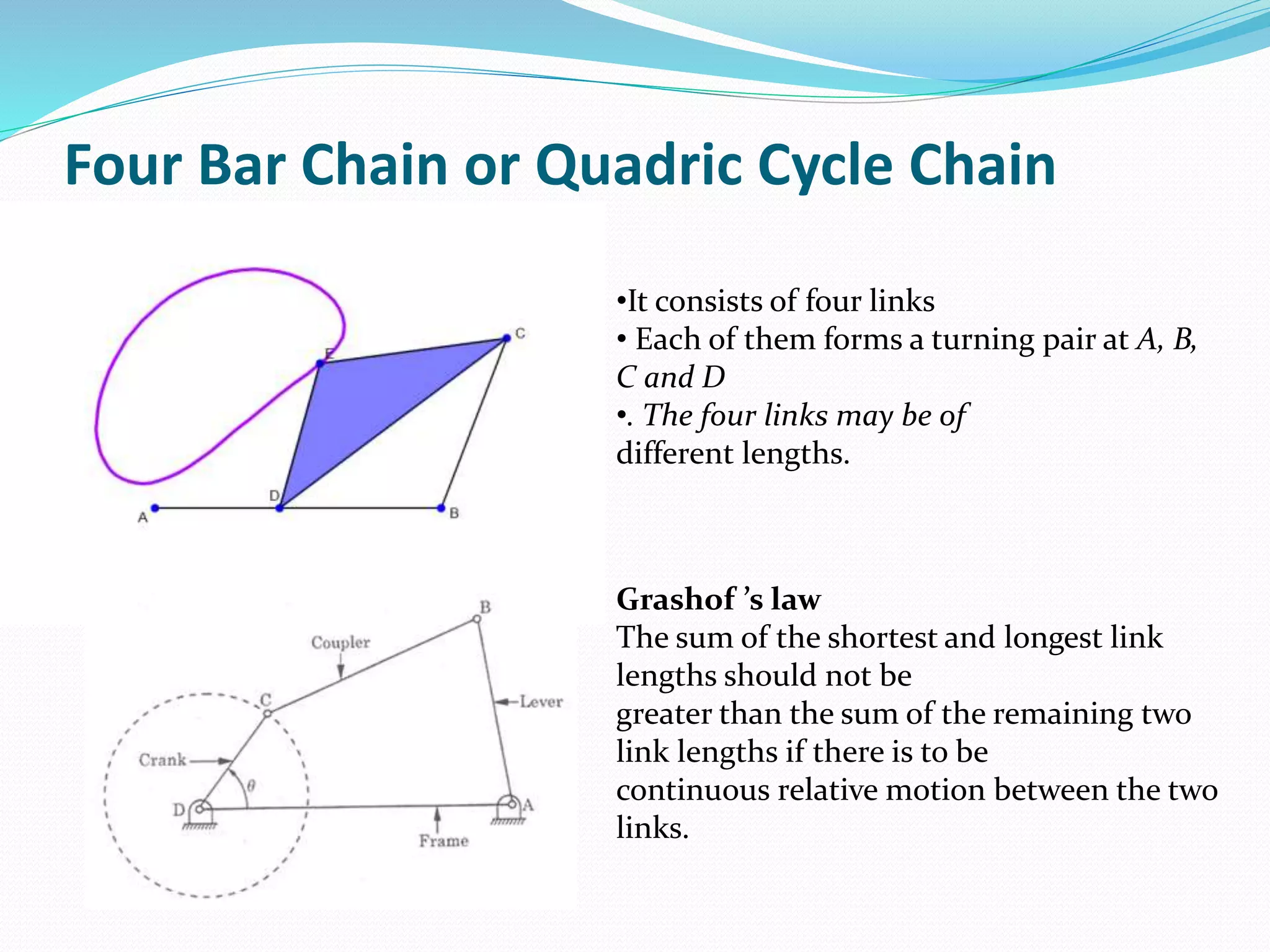
Four Bar Chain or Quadric Cycle Chain
•It consists of four links
• Each of them forms a turning pair at A, B,
C and D
•. The four links may be of
different lengths.
Grashof ’s law
The sum of the shortest and longest link
lengths should not be
greater than the sum of the remaining two
link lengths if there is to be
continuous relative motion between the two
links.
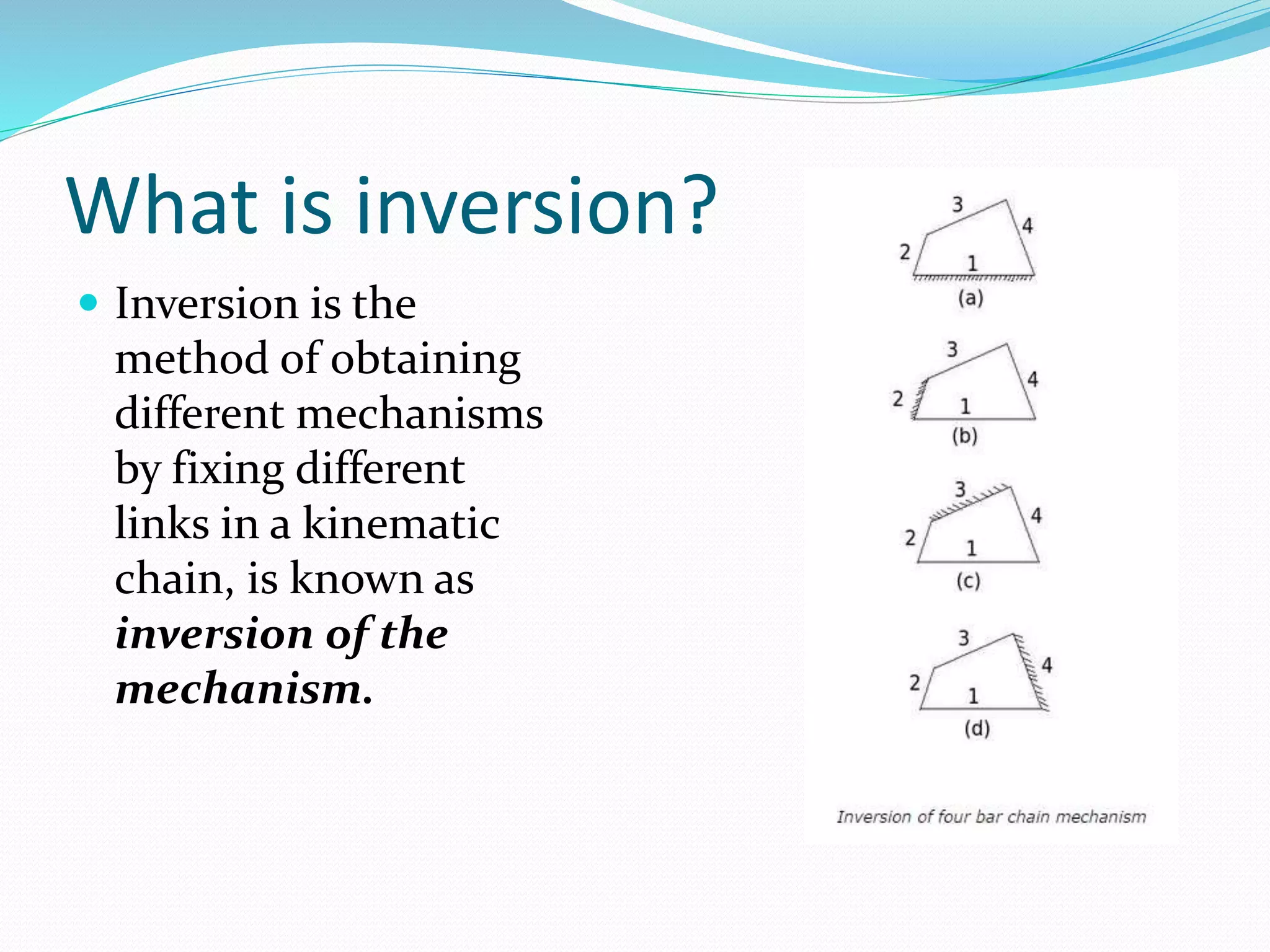
What is inversion?
 Inversion is the
method of obtaining
different mechanisms
by fixing different
links in a kinematic
chain, is known as
inversion of the
mechanism.
INVERSIONS of FOUR BAR
CHAIN
BEAM ENGINE (CRANK
OR LEVER MECHANISM)
COUPLING ROD OF A
LOCOMOTIVE(DOUBLE
CRANK MECHANISM)
WATTS INDICATOR
(DOUBLE LEVER
MECAHNISM)
Inversions of four bar kinematic
chain
 The four bar chain mechanism consists of four turning
pairs.
 The four different mechanisms are obtained by fixing
one link at a time.
 Kinematically, all four inversions of kinematic chain
are identical.
 However there mobility can be varied by suitably
changing the proportions of lengths of various links.
BEAM ENGINE A part of the mechanism of a beam engine (also known as
crank and lever mechanism).
 Beam engine introduced in Wanlockhead in 1745
 Consists of 4 links.
 The purpose of this mechanism to convert rotary motion
into reciprocating machine..
The crank rotates about the fixed center A, the
lever oscillates about a fixed Centre D. The end E of
the lever CDE is connected to a piston rod which
reciprocates due to the rotation of the crank.
Beam engine mechanism
Applications
 It is used to draw out water from mines, as well as to
pump water into canals.
 This mechanism is widely used in steam engines but
nowadays it is used in water pumps, oil rings, specially
sewing machine.
 It is type of steam engine where a pivoted overhead beam
is used to apply the force from a vertical piston to a
vertical connecting rod
 It is basically 6 link mechanism that converts rotary
motion of crank into reciprocating motion of piston.
Degree of freedom(DOF)
 DOF of a mechanical system is the no of
independent parameters that defines its
configuration.
 n = 3 (l – 1) – 2 j – h
 It has two degree of freedom i.e rotation of link
about axis perpendicular to the plan and vertical
motion.
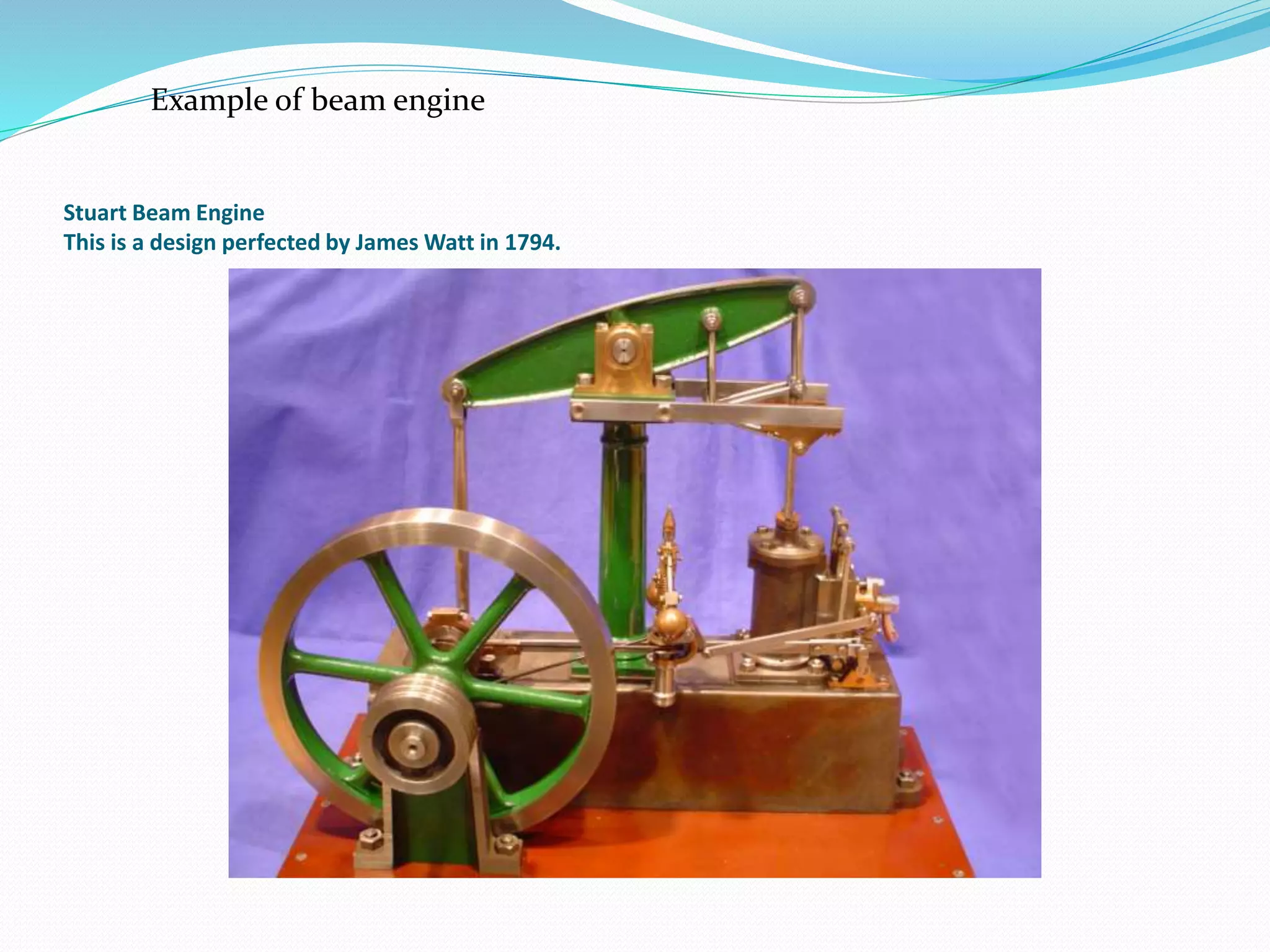
Stuart Beam Engine
This is a design perfected by James Watt in 1794.
Example of beam engine
A watt engine : showing entry of steam
and water
Beam engine

Beam engine

  • 2.
    2 Link A component forminga part of a chain; generally rigid with provision at each end for connection to two other links Mechanism A combination of rigid bodies (links) connected by kinematic pairs. Kinematic pair A joint which is formed by the contact between two bodies and allows relative motion between them. Machine A collection of mechanisms which transmit force from the source of power to the resistance to be overcome. TERMINOLOGY
  • 3.
    MECHANISM When a kinematicchain with one of its link is fixed, is called a mechanism. A mechanism is a skeleton diagram of a machine to transmit the definite motions between various links. Example: type writer, clock work, etc.
  • 4.
    Four Bar Chainor Quadric Cycle Chain •It consists of four links • Each of them forms a turning pair at A, B, C and D •. The four links may be of different lengths. Grashof ’s law The sum of the shortest and longest link lengths should not be greater than the sum of the remaining two link lengths if there is to be continuous relative motion between the two links.
  • 5.
    What is inversion? Inversion is the method of obtaining different mechanisms by fixing different links in a kinematic chain, is known as inversion of the mechanism.
  • 6.
    INVERSIONS of FOURBAR CHAIN BEAM ENGINE (CRANK OR LEVER MECHANISM) COUPLING ROD OF A LOCOMOTIVE(DOUBLE CRANK MECHANISM) WATTS INDICATOR (DOUBLE LEVER MECAHNISM)
  • 7.
    Inversions of fourbar kinematic chain  The four bar chain mechanism consists of four turning pairs.  The four different mechanisms are obtained by fixing one link at a time.  Kinematically, all four inversions of kinematic chain are identical.  However there mobility can be varied by suitably changing the proportions of lengths of various links.
  • 8.
    BEAM ENGINE Apart of the mechanism of a beam engine (also known as crank and lever mechanism).  Beam engine introduced in Wanlockhead in 1745  Consists of 4 links.  The purpose of this mechanism to convert rotary motion into reciprocating machine..
  • 9.
    The crank rotatesabout the fixed center A, the lever oscillates about a fixed Centre D. The end E of the lever CDE is connected to a piston rod which reciprocates due to the rotation of the crank.
  • 11.
  • 12.
    Applications  It isused to draw out water from mines, as well as to pump water into canals.  This mechanism is widely used in steam engines but nowadays it is used in water pumps, oil rings, specially sewing machine.  It is type of steam engine where a pivoted overhead beam is used to apply the force from a vertical piston to a vertical connecting rod  It is basically 6 link mechanism that converts rotary motion of crank into reciprocating motion of piston.
  • 13.
    Degree of freedom(DOF) DOF of a mechanical system is the no of independent parameters that defines its configuration.  n = 3 (l – 1) – 2 j – h  It has two degree of freedom i.e rotation of link about axis perpendicular to the plan and vertical motion.
  • 14.
    Stuart Beam Engine Thisis a design perfected by James Watt in 1794. Example of beam engine
  • 15.
    A watt engine: showing entry of steam and water