1
Topic. Human wildlife conflict
Presented by. Sajjad Hameed
Mughal
Class. Mphil. Zoology
Roll no. 20
The university of Poonch
Rawalakot AJK.
Presented to. Hon. Dr. Nausheen Irshad
Definition
Human-wildlife conflict is defined by
the world wide fund for nature as “any
interaction between humans and wildlife
that results in negative impact on human
social, economic or cultural life, on the
conservation of wildlife populations, or on
the environment.”
2
Introduction
 The word ‘ conflict’ is defined as ‘ an incompatibility
between opinions or principles
 A situation that arises because of differences in
perception, attitude and insufficient understanding,
mostly, on part of the wiser party.
 Any condition that arises where the behavior of one
(either people or wildlife) is unacceptability
disadvantageous to the other’.
3
Cont,,,, INTRODUCTION…..
• With the increase in wildlife population in
response to protection, human-wildlife
conflict also has increased.
• Large-scale forest degradation, rapid
infrastructure development and population
explosion, conflicts between domestic stock
and wild carnivores have increased.
4
Man-wildlifeconflict
 wildlife is unacceptably disadvantageous to other
 Increase in man wildlife conflict is due to resource
limitation like :
 1. Space 2. Food 3. Shelter
 It is also due to Increasing population of human
beings , Loss of forest, decrease in quality of forest
and development activities.
 It is also caused by resource reduction of human
and/or wild animals.
5
HUMANS AND WILDLIFE IN PERSPECTIVE
Humans and wildlife interacted throughout history
1) exploited wild animals for food
2) exploited animals for sports and culture
3) we have modified landscapes
4) we have moved species around the world
Types of interactions
Positive: Agriculture and food production, aesthetics
Negative: Wild animals eat our livestock, damage our crops, compete
for prey, maybe even kill or injure us
6
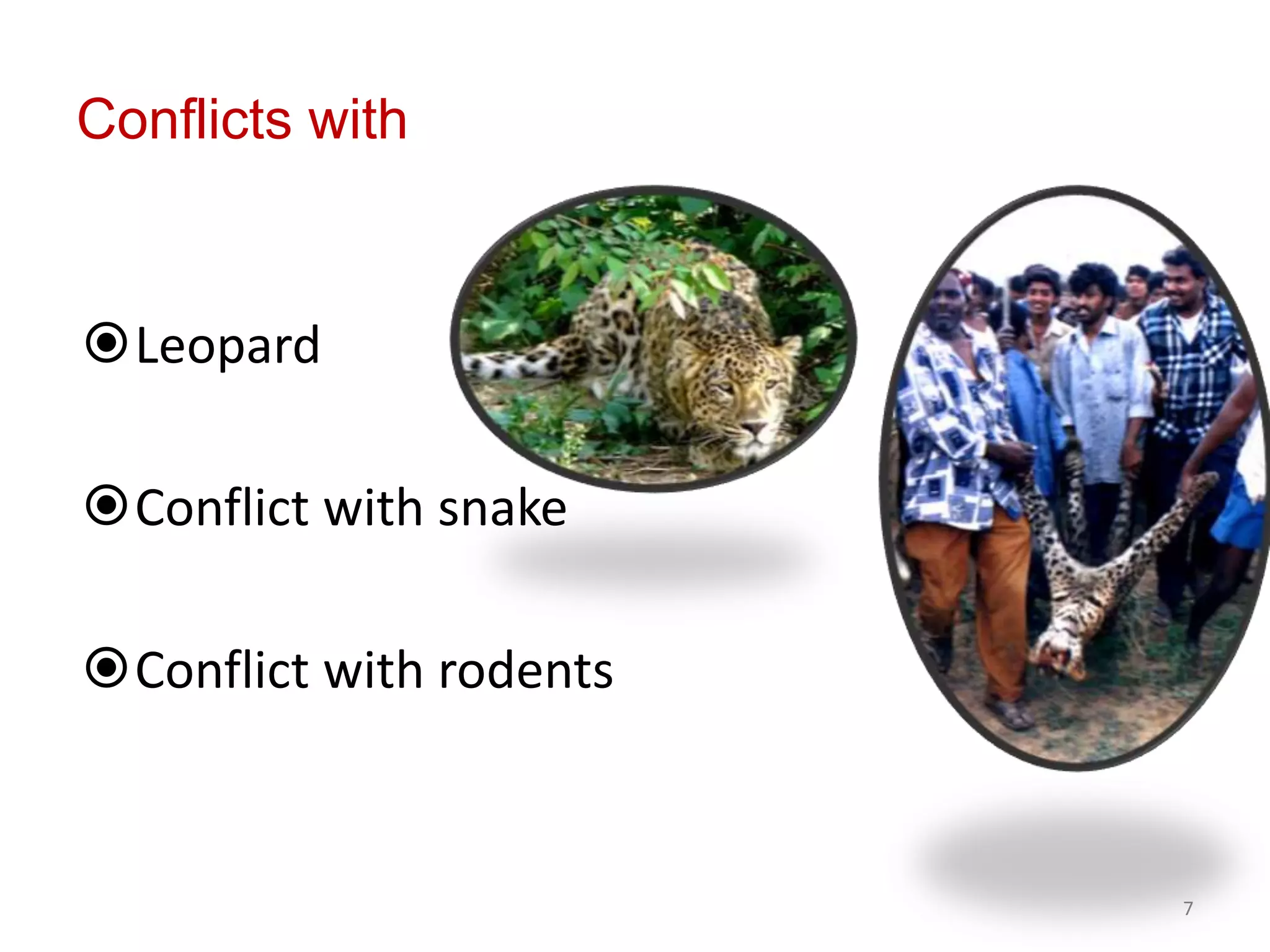
Conflicts with
Leopard
Conflict with snake
Conflict with rodents
7
Conflict with Leopard
• Second most prevalent
conflict with the leopard
• The conflict caused by the
leopard kill is more on
sheep and horses and its
preferences to these
species over other animals
are not yet known
8
Human Leopard conflict in Machiara N.
Park
• The study was conducted in 30 villages of Azad
Jammu and Kashmir to investigate the human-
leopard conflict in terms of livestock depredation,
human causalities and perception of people
about the leopard. The livestock predation by
leopard viz., goat 2.08 (50.50%), sheep 1.17
(28.53%), cow/ox 0.23 (5.63%), buffalo 0.10
(2.58%), horse/donkey 0.07 (1.75%), dog 0.19
(4.80%) and chicken 0.25 (6.18%) was recorded
(Sohail et al., 2013).
9
Human Leopard conflict in Pir Lasura
N. park
No. of killed Site year Area(NP) M/F or Uk Villages Killed by
2 Village Before 2000 Inside M/F Pehli
Khandar
Shoot
2 Village 2008 Outside M/F Simti Un Known
1 Forest Before 2000 Outside M Mehra Shoot
1 Village Before 2000 Outside M Nailan Shoot
1 Village Before 2000 inside F Bermoch Shoot
1 Forest Before 2000 Outside M Majhan Shoot
1 Village 2009 outside M Majhan unknown
1 Forest 2010 Inside M Gharbi Poisoned
1 Forest 2010 Inside F Latehri Poisoned
1 Forest 2010 outside Unknown Qamrooti Stones, axe
Total killing 12
10(Muhammad and Kabir, 2010).
Human-snake
ConflictSnakes are accidentally/in self
defense killed by human in
response sometimes snake
may also bite the human.
some estimates put the
number at 5.4 million
snakebites every year.
2.5 million envenoming,
resulting in perhaps 125,000
deaths. (Winkel et al., 2008)
11
Human-rodents
ConflictThe most
probable reason of
conflict with rodents is
crop damage and
damaging household.
rodents included:
Porcupine, squirrel and
Mice
12
conflict
Damage to
Agri. crop
Killing of
livestock
Killing of
Humans
House
Damage
Accidental
injury
13
Causes
Anthropogenic/Man made causes
 Habitat loss
 Agricultural practices
 Entry into forests
 Insufficient prey base
 Poverty
 Population pollution
 Exploitation of forests
 Culture and society
14
Winkel, K., Kasturiratne., Anuradhani., Wickremasinghe, A. Rajitha., de
Silva., Nilanthi., Gunawardena, N., Kithsiri., Pathmeswaran., Arunasalam.,
2008. "The Global Burden of Snakebite. A Literature Analysis and Modelling Based on
Regional Estimates of Envenoming and Deaths". PLOS Medicine . journal.pme, 5: 218.
IUCN. World Parks Congress . 2003.
WWF. 2003. congress on human wildlife conflict.
15
Muhammad, W., M. Kabir. 2010. Human leopard conflict assessment in Pir Lasora National Park
Kotli, Azad Jammu and Kashmir, Pakistan. WWF Pakistan.
Sohail, A C., S. Iqbal., Z. Rasheed., A. Razzaq. , M. Husain and M.N. Abbas. 2013. Human-
Leopard Conflict In Machiara National Park (Mnp), Azad Jamu And Kashmir (Aj And K), Pakistan.
Jour. Glob. Innov. Agric. Soc. Sci., 1(1): 17-21.

Human wildlife conflict

  • 1.
    1 Topic. Human wildlifeconflict Presented by. Sajjad Hameed Mughal Class. Mphil. Zoology Roll no. 20 The university of Poonch Rawalakot AJK. Presented to. Hon. Dr. Nausheen Irshad
  • 2.
    Definition Human-wildlife conflict isdefined by the world wide fund for nature as “any interaction between humans and wildlife that results in negative impact on human social, economic or cultural life, on the conservation of wildlife populations, or on the environment.” 2
  • 3.
    Introduction  The word‘ conflict’ is defined as ‘ an incompatibility between opinions or principles  A situation that arises because of differences in perception, attitude and insufficient understanding, mostly, on part of the wiser party.  Any condition that arises where the behavior of one (either people or wildlife) is unacceptability disadvantageous to the other’. 3
  • 4.
    Cont,,,, INTRODUCTION….. • Withthe increase in wildlife population in response to protection, human-wildlife conflict also has increased. • Large-scale forest degradation, rapid infrastructure development and population explosion, conflicts between domestic stock and wild carnivores have increased. 4
  • 5.
    Man-wildlifeconflict  wildlife isunacceptably disadvantageous to other  Increase in man wildlife conflict is due to resource limitation like :  1. Space 2. Food 3. Shelter  It is also due to Increasing population of human beings , Loss of forest, decrease in quality of forest and development activities.  It is also caused by resource reduction of human and/or wild animals. 5
  • 6.
    HUMANS AND WILDLIFEIN PERSPECTIVE Humans and wildlife interacted throughout history 1) exploited wild animals for food 2) exploited animals for sports and culture 3) we have modified landscapes 4) we have moved species around the world Types of interactions Positive: Agriculture and food production, aesthetics Negative: Wild animals eat our livestock, damage our crops, compete for prey, maybe even kill or injure us 6
  • 7.
    Conflicts with Leopard Conflict withsnake Conflict with rodents 7
  • 8.
    Conflict with Leopard •Second most prevalent conflict with the leopard • The conflict caused by the leopard kill is more on sheep and horses and its preferences to these species over other animals are not yet known 8
  • 9.
    Human Leopard conflictin Machiara N. Park • The study was conducted in 30 villages of Azad Jammu and Kashmir to investigate the human- leopard conflict in terms of livestock depredation, human causalities and perception of people about the leopard. The livestock predation by leopard viz., goat 2.08 (50.50%), sheep 1.17 (28.53%), cow/ox 0.23 (5.63%), buffalo 0.10 (2.58%), horse/donkey 0.07 (1.75%), dog 0.19 (4.80%) and chicken 0.25 (6.18%) was recorded (Sohail et al., 2013). 9
  • 10.
    Human Leopard conflictin Pir Lasura N. park No. of killed Site year Area(NP) M/F or Uk Villages Killed by 2 Village Before 2000 Inside M/F Pehli Khandar Shoot 2 Village 2008 Outside M/F Simti Un Known 1 Forest Before 2000 Outside M Mehra Shoot 1 Village Before 2000 Outside M Nailan Shoot 1 Village Before 2000 inside F Bermoch Shoot 1 Forest Before 2000 Outside M Majhan Shoot 1 Village 2009 outside M Majhan unknown 1 Forest 2010 Inside M Gharbi Poisoned 1 Forest 2010 Inside F Latehri Poisoned 1 Forest 2010 outside Unknown Qamrooti Stones, axe Total killing 12 10(Muhammad and Kabir, 2010).
  • 11.
    Human-snake ConflictSnakes are accidentally/inself defense killed by human in response sometimes snake may also bite the human. some estimates put the number at 5.4 million snakebites every year. 2.5 million envenoming, resulting in perhaps 125,000 deaths. (Winkel et al., 2008) 11
  • 12.
    Human-rodents ConflictThe most probable reasonof conflict with rodents is crop damage and damaging household. rodents included: Porcupine, squirrel and Mice 12
  • 13.
    conflict Damage to Agri. crop Killingof livestock Killing of Humans House Damage Accidental injury 13
  • 14.
    Causes Anthropogenic/Man made causes Habitat loss  Agricultural practices  Entry into forests  Insufficient prey base  Poverty  Population pollution  Exploitation of forests  Culture and society 14
  • 15.
    Winkel, K., Kasturiratne.,Anuradhani., Wickremasinghe, A. Rajitha., de Silva., Nilanthi., Gunawardena, N., Kithsiri., Pathmeswaran., Arunasalam., 2008. "The Global Burden of Snakebite. A Literature Analysis and Modelling Based on Regional Estimates of Envenoming and Deaths". PLOS Medicine . journal.pme, 5: 218. IUCN. World Parks Congress . 2003. WWF. 2003. congress on human wildlife conflict. 15 Muhammad, W., M. Kabir. 2010. Human leopard conflict assessment in Pir Lasora National Park Kotli, Azad Jammu and Kashmir, Pakistan. WWF Pakistan. Sohail, A C., S. Iqbal., Z. Rasheed., A. Razzaq. , M. Husain and M.N. Abbas. 2013. Human- Leopard Conflict In Machiara National Park (Mnp), Azad Jamu And Kashmir (Aj And K), Pakistan. Jour. Glob. Innov. Agric. Soc. Sci., 1(1): 17-21.