Multifetal pregnancy
Zenebe Wolde (MD)
October 2011
Introduction
Definition:
Simultaneous development of more than
one fetus in the uterus
 Two- twins, commonest
 Three- Triplet
 Four-Quadruplet
 Five- Quintuplet, etc
Number & rate of multi-fetal gestation have
increased
 Infertility therapy
 Higher diagnostic rate
 Elderly Primigravidae
Introduction
Types of twins:
Dizygotic twins (70 %) : the result of two
ova and two sperms
By definition they are dichorionic and
diamniotic
When the blastocyst implantation site is
proximal one to another single fused
placental disc results
Type of twins...
When implantation site is not proximal
two separated placentae result
Same or different fetal sex
Variable incidence, affected by risk
factors
No anastomoses between fetal vessels
Monozygotic twins
 Monozygotic twins (30%): a single
fertilized ovum splits into two distinct
individuals
 Incidence: 1:250 deliveries, almost
constant
 Almost always same sex
 Placenta: one fused or two separate
 Risk factors: not influenced except
ART
Type of twins...
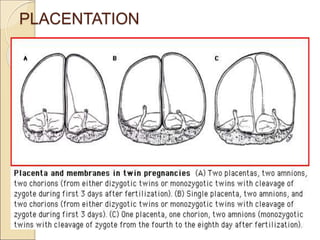
Timing of egg division determines
placentation in monozygotic twins
Dichorionic Diamniotic placentation (24%)
occurs with division prior to the morula
stage (within 3 days post fertilization)
Monochorionic Diamniotic placentation (75%)
occur with division b/n days 4 and 8 post
fertilization
Type of twins...
Monochorionic Monoamniotic
Placentation (1%) occurs with division
b/n days 8 and 13 post fertilization
Division at or after day 13 results in
conjoined twins (1/60,000)
PLACENTATION
Incidence
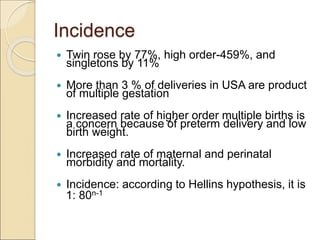
 Twin rose by 77%, high order-459%, and
singletons by 11%
 More than 3 % of deliveries in USA are product
of multiple gestation
 Increased rate of higher order multiple births is
a concern because of preterm delivery and low
birth weight.
 Increased rate of maternal and perinatal
morbidity and mortality.
 Incidence: according to Hellins hypothesis, it is
1: 80n-1
Incidence
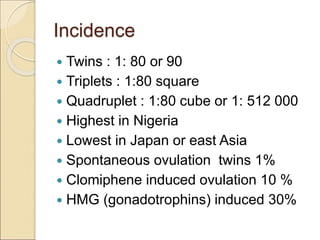
 Twins : 1: 80 or 90
 Triplets : 1:80 square
 Quadruplet : 1:80 cube or 1: 512 000
 Highest in Nigeria
 Lowest in Japan or east Asia
 Spontaneous ovulation twins 1%
 Clomiphene induced ovulation 10 %
 HMG (gonadotrophins) induced 30%
Incidence...
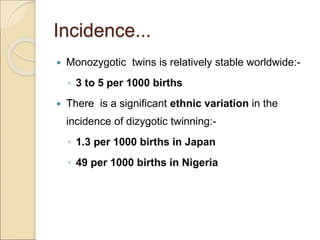
 Monozygotic twins is relatively stable worldwide:-
◦ 3 to 5 per 1000 births
 There is a significant ethnic variation in the
incidence of dizygotic twinning:-
◦ 1.3 per 1000 births in Japan
◦ 49 per 1000 births in Nigeria
Incidence...
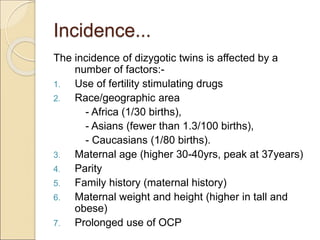
The incidence of dizygotic twins is affected by a
number of factors:-
1. Use of fertility stimulating drugs
2. Race/geographic area
- Africa (1/30 births),
- Asians (fewer than 1.3/100 births),
- Caucasians (1/80 births).
3. Maternal age (higher 30-40yrs, peak at 37years)
4. Parity
5. Family history (maternal history)
6. Maternal weight and height (higher in tall and
obese)
7. Prolonged use of OCP
Determination of zygosity, chorionicity,
amniocity
Objective: aid in obstetrical risk assessment &
guide management of multifetal gestation
 Monochorionic gestations are at increased
risk
 Zygosity determination needs
sophisticated genetic tests
1. Ultrasound evaluation: thickness of
separating membrane, number of
placenta, sex of fetuses, twin peak sign &
T- sign
Zygosity...
2. Placental examination: establishes
zygosity in two-third of multifetal
pregnancies
3. Infant sex
4. Blood group
5. DNA technique
Terminologies
 Superfecundation
 Superfetation
 Fetus papyeraceous
 Fetus compressus
 Vanishing twins: 36% twins, 53% triplets
 Fetal acardiacus
Physiological changes
 Increased weight gain
 Increased cardiac output
 Plasma volume increased by 500ml from
singletons
 Increased GFR, Tidal volume & alpha
fetoprotein
 Lie & presentation:
- Vertex-vertex:42.5
- Vertex-nonvertex:38.4%
- Nonvertex-vertex/nonvertex:19.1%
Diagnosis
 History, examination & investigations:
- Risk factors
- Exaggerated minor ailments
- Anemia
- Preeclampsia
- Unusual weight gain
- Barrel- shaped abdomen
- Positive discrepancy
- Palpation of multifetal parts
- Two distinct FHB of at least d/ce of 10BPM
Diagnosis...
- Palpation of more than two fetal poles
- Ultrasound: diagnosis, chorionicity, GA,
viability, fetal anomalies, presentation,
etc
- Radiography: rarely done these days
- Biochemical: serum hCG, aFP &
unconjugated estriol. They are almost
doubled.
Diagnosis...
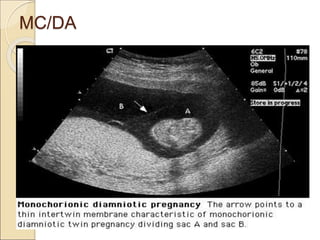
Chorionicity can be determined several
ways:-
 If separate placentas = DC/DA
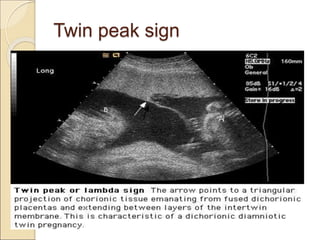
 “Twin peak" or "lambda" = DC/DA
 Discordant genders = DC/DA
 Intertwin membrane thickness
Twin peak sign
MC/DA
Complications
Maternal:
 Nausea & vomiting
 Anemia
 Preeclampsia: 3 times
 Hydramnios- 10%
 APH
 Malpresentations
 Preterm labor-50%
 Mechanical distress
Maternal Complications...
During labor
-Early ROM & cord prolapse
-Increased operative interference
-Bleeding
-PPH
Puerperium
-Sub involution
-Infection
Fetal complications
 Miscarriage
 Prematurity
 Growth problems- discordant-25%
 Intrauterine fetal death of one fetus
 Fetal anomalies
 Asphyxia & stillbirth
NB: complications are more common in
monochorionic twin pregnancy
Prognosis
 Maternal mortality is increased in
twins than singletons due to
hemorrhage, preeclampsia & anemia
 Perinatal mortality is increased mainly
due to prematurity though others
contribute
 One-third is stillbirth & two-third is
neonatal death.
Prognosis...
 Published perinatal mortality rate for twins in
developed countries range b/n 47 and 120 per
1000 twins birth this represent 5 fold increased
compared to singleton
 The mortality risk is greater for second twins
compared to the first twins
 Greater for monozygotic compared with dizygotic
 Greater for triplet and other high order
pregnancy
Prognosis...
Contributors to the increased risk of
perinatal mortality Include:
Increased frequency of congenital
anomaly
Placental abruption
Cord accident
Preeclampsia
Malpresentations
Birth trauma and
IUGR
Prognosis...
Although twins represent only 2% of live birth they
account for more than :
 15% of all very low birth infant
 11 % of neonatal death
 3.4 % post neonatal death
 8.4 %of infant death
 Twins represent more than 10% of all admissions to
newborn intensive care unit
 5% to10% of all cases of cerebral palsy in the USA
Complications specific to twinning
 Twin-twin transfusion syndrome
(TTTS)
 Dead fetus syndrome
 Twin reversed arterial perfusion
(TRAP) acardiac twin
 Conjoined twins (Simians twin)
 Growth discordance
Peculiar Complications
A. PRETERM BIRTH
 The most serious risk of multiple gestations,
associated with increased perinatal mortality and
short-term and long-term morbidity
 The relative risk of preterm birth compared to
singletons = 5.4 for twins and 9.4 for triplets
 Rate of preterm delivery of twins = 42 to 54 percent,
 The overall rate of preterm delivery 9-11%
 10 to 14 percent of preterm births were attributable
to twin deliveries
Peculiar Complications...
 The gestational age at delivery decreases as fetal
number increases.
 The average gestational age is:-
◦ 35 weeks for twins ,
◦ 32 weeks triplets ,
◦ 30 weeks quadruplets , and
◦ 29 weeks for quintuplets and higher order
multiples
 Preterm twins are at risk for developing
complications that result from anatomic or
functional immaturity
TWIN-TWIN TRANSFUSION
SYNDROME
 Occur in Monochorionic placentae
 Artery-to-artery, vein-to-vein, and artery-to-
vein
 Results from unbalanced blood flow through
vascular anastomoses
 One twin becomes the donor and the other is
the recipient
 Discordance in fetal growth and amniotic fluid
volumes
 TTTS complicates 10 to 15 percent of
Monochorionic twin pregnancies
TTTS...
 Responsible for 16 percent of perinatal
deaths
 Ultrasonography:-
◦ AFV, Growth disparity, Sex, chorionicity
The recipient twin
 The larger fetus in the amniotic sac with
Polyhydramnios
The donor twin is
 The smaller fetus and is in the
oligohydramniotic sac
TTTS...
 Donor twin:-
◦ Have severe IUGR with anemia, hypovolemia,
and renal insufficiency.
◦ Severe Oligohydramnios ("stuck twin"),
pulmonary hypoplasia and deformations.
 Recipient twin:-
◦ Excessive volume can lead to CVS
decompensation with cardiomegaly, and hydrops
fetalis.
◦ Polycythemia, thrombosis or jaundice after birth
* Diagnostic criteria?
Conjoined twins
 Occurs when MZ twins fail to separate into two
individuals
 Ranges from simple joining of ectodermal tissues to the
extreme case when one twin is contained within the
other.
 Incidence 1 in 60,000
 The ratio of females to males is 3:1.
 Classified by the site of their most prominent union,
which is ventral (87%) or dorsal (13%)
 The abnormality is named with the suffix pagus, which
means fixed
Conjoined twins...
 Distribution of ventral unions:
◦ Cephalopagus — 11 percent
◦ Thoracopagus — 19 percent
◦ Omphalopagus — 18 percent
◦ Ischiopagus — 11 percent
◦ Parapagus— 28 percent
 Distribution of dorsal unions:
◦ Craniopagus — 5 percent
◦ Rachiopagus (vertebral column) — 2
percent
◦ Pygopagus (sacrum) — 6 percent
Conjoined twins...
Diagnosis
 A fixed position of the fetal heads,
 Inability to detect separate bodies or
skin contours
 The lack of separating membranes
Management
Antenatal management:
 Diet: additional 300kcal /day
 Rest
 Supplementary iron & folate
 Frequent antenatal visits
 Fetal surveillance every 3-4 weeks
 Admission not mandatory
 Tocolytics & steroids are not
indicated
Management...
Management during labor:
 Place of delivery in a hospital
 First stage same as singletons
 Experts: obstetrician/ anesthesiologist
 Avoid general anesthesia
 Avoid uterotonics after 1st baby
 Mode of delivery depends on obstetric
factors, presentation of 1st baby, chorionicity
& amniocity
Mode of delivery
Cesarean delivery:
Obstetric: Placenta previa, previous C/D, cord
prolapse of 1st baby, contracted pelvis, abnormal
uterine contraction
Twins:
 1st nonvertex
 Twins with complications: IUGR, conjoined
 Monoamniotic twins
 TTTS
 Collision of both heads preventing engagement
Delivery of second twins
 Depends on presentation, lie, FHB, fetal
weight, cord prolapse
 Vaginal: longitudinal lie
 Indications of urgent delivery of second
twin:
 Severe intrapartum vaginal bleeding
 Cord prolapse of second baby
 1st delivery under GA
 Occurrence of fetal distress
 Inadvertent use of ergometrine after 1st
baby
Intrapartum management
 Epidural anesthesia is recommended
 The capacity for immediate cesarean is important
 Both twins should be monitored continuously
during labor (CTG for all)
 After delivery of the first twin,
◦ the heart rate and position ultrasound and
ECM.
 Oxytocin if labor does not resume.
 Amniotomy can be performed when the
presenting part is engaged.
 Umbilical cords should be marked with
progressive numbers of clamps
Intrapartum management...
 Active third stage management
 Observe the woman for the 1st 2 hours

Multifetal gestation (Dr. Zenebe).ppt

  • 1.
  • 2.
    Introduction Definition: Simultaneous development ofmore than one fetus in the uterus  Two- twins, commonest  Three- Triplet  Four-Quadruplet  Five- Quintuplet, etc Number & rate of multi-fetal gestation have increased  Infertility therapy  Higher diagnostic rate  Elderly Primigravidae
  • 3.
    Introduction Types of twins: Dizygotictwins (70 %) : the result of two ova and two sperms By definition they are dichorionic and diamniotic When the blastocyst implantation site is proximal one to another single fused placental disc results
  • 4.
    Type of twins... Whenimplantation site is not proximal two separated placentae result Same or different fetal sex Variable incidence, affected by risk factors No anastomoses between fetal vessels
  • 5.
    Monozygotic twins  Monozygotictwins (30%): a single fertilized ovum splits into two distinct individuals  Incidence: 1:250 deliveries, almost constant  Almost always same sex  Placenta: one fused or two separate  Risk factors: not influenced except ART
  • 6.
    Type of twins... Timingof egg division determines placentation in monozygotic twins Dichorionic Diamniotic placentation (24%) occurs with division prior to the morula stage (within 3 days post fertilization) Monochorionic Diamniotic placentation (75%) occur with division b/n days 4 and 8 post fertilization
  • 7.
    Type of twins... MonochorionicMonoamniotic Placentation (1%) occurs with division b/n days 8 and 13 post fertilization Division at or after day 13 results in conjoined twins (1/60,000)
  • 8.
  • 9.
    Incidence  Twin roseby 77%, high order-459%, and singletons by 11%  More than 3 % of deliveries in USA are product of multiple gestation  Increased rate of higher order multiple births is a concern because of preterm delivery and low birth weight.  Increased rate of maternal and perinatal morbidity and mortality.  Incidence: according to Hellins hypothesis, it is 1: 80n-1
  • 10.
    Incidence  Twins :1: 80 or 90  Triplets : 1:80 square  Quadruplet : 1:80 cube or 1: 512 000  Highest in Nigeria  Lowest in Japan or east Asia  Spontaneous ovulation twins 1%  Clomiphene induced ovulation 10 %  HMG (gonadotrophins) induced 30%
  • 11.
    Incidence...  Monozygotic twinsis relatively stable worldwide:- ◦ 3 to 5 per 1000 births  There is a significant ethnic variation in the incidence of dizygotic twinning:- ◦ 1.3 per 1000 births in Japan ◦ 49 per 1000 births in Nigeria
  • 12.
    Incidence... The incidence ofdizygotic twins is affected by a number of factors:- 1. Use of fertility stimulating drugs 2. Race/geographic area - Africa (1/30 births), - Asians (fewer than 1.3/100 births), - Caucasians (1/80 births). 3. Maternal age (higher 30-40yrs, peak at 37years) 4. Parity 5. Family history (maternal history) 6. Maternal weight and height (higher in tall and obese) 7. Prolonged use of OCP
  • 13.
    Determination of zygosity,chorionicity, amniocity Objective: aid in obstetrical risk assessment & guide management of multifetal gestation  Monochorionic gestations are at increased risk  Zygosity determination needs sophisticated genetic tests 1. Ultrasound evaluation: thickness of separating membrane, number of placenta, sex of fetuses, twin peak sign & T- sign
  • 14.
    Zygosity... 2. Placental examination:establishes zygosity in two-third of multifetal pregnancies 3. Infant sex 4. Blood group 5. DNA technique
  • 15.
    Terminologies  Superfecundation  Superfetation Fetus papyeraceous  Fetus compressus  Vanishing twins: 36% twins, 53% triplets  Fetal acardiacus
  • 16.
    Physiological changes  Increasedweight gain  Increased cardiac output  Plasma volume increased by 500ml from singletons  Increased GFR, Tidal volume & alpha fetoprotein  Lie & presentation: - Vertex-vertex:42.5 - Vertex-nonvertex:38.4% - Nonvertex-vertex/nonvertex:19.1%
  • 17.
    Diagnosis  History, examination& investigations: - Risk factors - Exaggerated minor ailments - Anemia - Preeclampsia - Unusual weight gain - Barrel- shaped abdomen - Positive discrepancy - Palpation of multifetal parts - Two distinct FHB of at least d/ce of 10BPM
  • 18.
    Diagnosis... - Palpation ofmore than two fetal poles - Ultrasound: diagnosis, chorionicity, GA, viability, fetal anomalies, presentation, etc - Radiography: rarely done these days - Biochemical: serum hCG, aFP & unconjugated estriol. They are almost doubled.
  • 19.
    Diagnosis... Chorionicity can bedetermined several ways:-  If separate placentas = DC/DA  “Twin peak" or "lambda" = DC/DA  Discordant genders = DC/DA  Intertwin membrane thickness
  • 20.
  • 21.
  • 22.
    Complications Maternal:  Nausea &vomiting  Anemia  Preeclampsia: 3 times  Hydramnios- 10%  APH  Malpresentations  Preterm labor-50%  Mechanical distress
  • 23.
    Maternal Complications... During labor -EarlyROM & cord prolapse -Increased operative interference -Bleeding -PPH Puerperium -Sub involution -Infection
  • 24.
    Fetal complications  Miscarriage Prematurity  Growth problems- discordant-25%  Intrauterine fetal death of one fetus  Fetal anomalies  Asphyxia & stillbirth NB: complications are more common in monochorionic twin pregnancy
  • 25.
    Prognosis  Maternal mortalityis increased in twins than singletons due to hemorrhage, preeclampsia & anemia  Perinatal mortality is increased mainly due to prematurity though others contribute  One-third is stillbirth & two-third is neonatal death.
  • 26.
    Prognosis...  Published perinatalmortality rate for twins in developed countries range b/n 47 and 120 per 1000 twins birth this represent 5 fold increased compared to singleton  The mortality risk is greater for second twins compared to the first twins  Greater for monozygotic compared with dizygotic  Greater for triplet and other high order pregnancy
  • 27.
    Prognosis... Contributors to theincreased risk of perinatal mortality Include: Increased frequency of congenital anomaly Placental abruption Cord accident Preeclampsia Malpresentations Birth trauma and IUGR
  • 28.
    Prognosis... Although twins representonly 2% of live birth they account for more than :  15% of all very low birth infant  11 % of neonatal death  3.4 % post neonatal death  8.4 %of infant death  Twins represent more than 10% of all admissions to newborn intensive care unit  5% to10% of all cases of cerebral palsy in the USA
  • 29.
    Complications specific totwinning  Twin-twin transfusion syndrome (TTTS)  Dead fetus syndrome  Twin reversed arterial perfusion (TRAP) acardiac twin  Conjoined twins (Simians twin)  Growth discordance
  • 30.
    Peculiar Complications A. PRETERMBIRTH  The most serious risk of multiple gestations, associated with increased perinatal mortality and short-term and long-term morbidity  The relative risk of preterm birth compared to singletons = 5.4 for twins and 9.4 for triplets  Rate of preterm delivery of twins = 42 to 54 percent,  The overall rate of preterm delivery 9-11%  10 to 14 percent of preterm births were attributable to twin deliveries
  • 31.
    Peculiar Complications...  Thegestational age at delivery decreases as fetal number increases.  The average gestational age is:- ◦ 35 weeks for twins , ◦ 32 weeks triplets , ◦ 30 weeks quadruplets , and ◦ 29 weeks for quintuplets and higher order multiples  Preterm twins are at risk for developing complications that result from anatomic or functional immaturity
  • 32.
    TWIN-TWIN TRANSFUSION SYNDROME  Occurin Monochorionic placentae  Artery-to-artery, vein-to-vein, and artery-to- vein  Results from unbalanced blood flow through vascular anastomoses  One twin becomes the donor and the other is the recipient  Discordance in fetal growth and amniotic fluid volumes  TTTS complicates 10 to 15 percent of Monochorionic twin pregnancies
  • 33.
    TTTS...  Responsible for16 percent of perinatal deaths  Ultrasonography:- ◦ AFV, Growth disparity, Sex, chorionicity The recipient twin  The larger fetus in the amniotic sac with Polyhydramnios The donor twin is  The smaller fetus and is in the oligohydramniotic sac
  • 34.
    TTTS...  Donor twin:- ◦Have severe IUGR with anemia, hypovolemia, and renal insufficiency. ◦ Severe Oligohydramnios ("stuck twin"), pulmonary hypoplasia and deformations.  Recipient twin:- ◦ Excessive volume can lead to CVS decompensation with cardiomegaly, and hydrops fetalis. ◦ Polycythemia, thrombosis or jaundice after birth * Diagnostic criteria?
  • 35.
    Conjoined twins  Occurswhen MZ twins fail to separate into two individuals  Ranges from simple joining of ectodermal tissues to the extreme case when one twin is contained within the other.  Incidence 1 in 60,000  The ratio of females to males is 3:1.  Classified by the site of their most prominent union, which is ventral (87%) or dorsal (13%)  The abnormality is named with the suffix pagus, which means fixed
  • 36.
    Conjoined twins...  Distributionof ventral unions: ◦ Cephalopagus — 11 percent ◦ Thoracopagus — 19 percent ◦ Omphalopagus — 18 percent ◦ Ischiopagus — 11 percent ◦ Parapagus— 28 percent  Distribution of dorsal unions: ◦ Craniopagus — 5 percent ◦ Rachiopagus (vertebral column) — 2 percent ◦ Pygopagus (sacrum) — 6 percent
  • 37.
    Conjoined twins... Diagnosis  Afixed position of the fetal heads,  Inability to detect separate bodies or skin contours  The lack of separating membranes
  • 38.
    Management Antenatal management:  Diet:additional 300kcal /day  Rest  Supplementary iron & folate  Frequent antenatal visits  Fetal surveillance every 3-4 weeks  Admission not mandatory  Tocolytics & steroids are not indicated
  • 39.
    Management... Management during labor: Place of delivery in a hospital  First stage same as singletons  Experts: obstetrician/ anesthesiologist  Avoid general anesthesia  Avoid uterotonics after 1st baby  Mode of delivery depends on obstetric factors, presentation of 1st baby, chorionicity & amniocity
  • 40.
    Mode of delivery Cesareandelivery: Obstetric: Placenta previa, previous C/D, cord prolapse of 1st baby, contracted pelvis, abnormal uterine contraction Twins:  1st nonvertex  Twins with complications: IUGR, conjoined  Monoamniotic twins  TTTS  Collision of both heads preventing engagement
  • 41.
    Delivery of secondtwins  Depends on presentation, lie, FHB, fetal weight, cord prolapse  Vaginal: longitudinal lie  Indications of urgent delivery of second twin:  Severe intrapartum vaginal bleeding  Cord prolapse of second baby  1st delivery under GA  Occurrence of fetal distress  Inadvertent use of ergometrine after 1st baby
  • 42.
    Intrapartum management  Epiduralanesthesia is recommended  The capacity for immediate cesarean is important  Both twins should be monitored continuously during labor (CTG for all)  After delivery of the first twin, ◦ the heart rate and position ultrasound and ECM.  Oxytocin if labor does not resume.  Amniotomy can be performed when the presenting part is engaged.  Umbilical cords should be marked with progressive numbers of clamps
  • 43.
    Intrapartum management...  Activethird stage management  Observe the woman for the 1st 2 hours