Presented by:-
 Nishant Sinha
Branch: Information Technology
•   Introduction
•   Wi-Fi Technologies
•   Wi-Fi Architecture
•   Wi-Fi Network Elements
•   How a Wi-Fi Network Works
•   Wi-Fi Network Topologies
•   Wi-Fi Configurations
•   Applications of Wi-Fi
•   Wi-Fi Security
•   Advantages/ Disadvantages of Wi-Fi
•   Wireless Technology is an alternative to Wired
    Technology, which is commonly used, for
    connecting devices in wireless mode.

•   Wi-Fi (Wireless Fidelity) is a generic term that
    refers to the IEEE 802.11 communications
    standard for Wireless Local Area Networks
    (WLANs).

•   Wi-Fi Network connect computers to each
    other, to the internet and to the wired network.
Wi-Fi Networks use Radio Technologies to
transmit & receive data at high speed:

• IEEE 802.11b
• IEEE 802.11a
• IEEE 802.11g
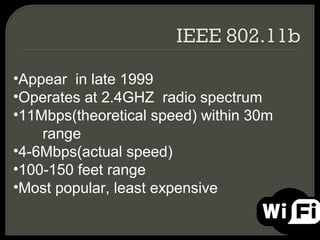
•Appear in late 1999
•Operates at 2.4GHZ radio spectrum
•11Mbps(theoretical speed) within 30m
    range
•4-6Mbps(actual speed)
•100-150 feet range
•Most popular, least expensive
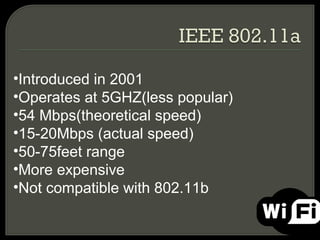
•Introduced in 2001
•Operates at 5GHZ(less popular)
•54 Mbps(theoretical speed)
•15-20Mbps (actual speed)
•50-75feet range
•More expensive
•Not compatible with 802.11b
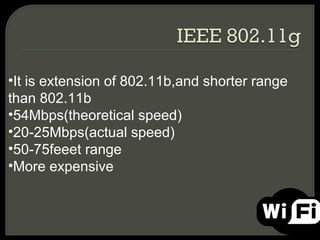
•It is extension of 802.11b,and shorter range
than 802.11b
•54Mbps(theoretical speed)
•20-25Mbps(actual speed)
•50-75feeet range
•More expensive
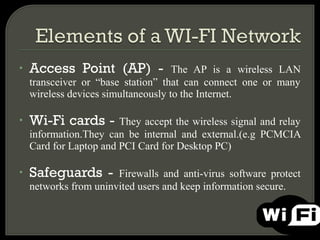
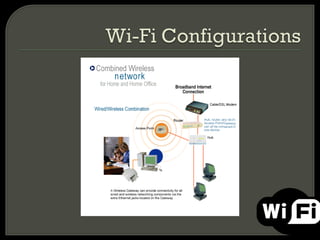
•   Access Point (AP) -              The AP is a wireless LAN
    transceiver or “base station” that can connect one or many
    wireless devices simultaneously to the Internet.

•   Wi-Fi cards -       They accept the wireless signal and relay
    information.They can be internal and external.(e.g PCMCIA
    Card for Laptop and PCI Card for Desktop PC)

•   Safeguards -       Firewalls and anti-virus software protect
    networks from uninvited users and keep information secure.
•   Basic concept is same as Walkie talkies.
•   A Wi-Fi hotspot is created by installing an access point
    to an internet connection.
•   An access point acts as a base station.
•   When Wi-Fi enabled device encounters a hotspot the
    device can then connect to that network wirelessly.
•   A single access point can support up to 30 users and
    can function within a range of 100 – 150 feet indoors
    and up to 300 feet outdoors.
•   Many access points can be connected to each other via
    Ethernet cables to create a single large network.
•   AP-based topology

•   Peer-to-peer topology

•   Point-to-multipoint bridge topology
•   Home
•   Small Businesses
•   Large Corporations & Campuses
•   Health Care
•   Wireless ISP (WISP)
•   Travellers
•   Wireless technology doesn’t remove any
    old security issues, but introduces new
    ones
    • Eavesdropping
    • Man-in-the-middle attacks
    • Denial of Service
• Service Set Identifier (SSID)

• Wired Equivalent Privacy (WEP)

• 802.1X Access Control

• Wireless Protected Access (WPA)

• IEEE 802.11i
•   Mobility
•   Ease of Installation
•   Flexibility
•   Cost
•   Reliability
•   Security
•   Use unlicensed part of the radio spectrum
•   Roaming
•   Speed
   Speed – Slower than cable
   Range – Affected by various medium
   Travels best through open space
   Reduced by walls, glass, water, etc
   Wi-Fi is one of the fastest growing
    technologies.The Demand for connecting
    devices without the use of cables is
    increasing everywhere.Wi-fi can be
    found on colleges campus,offices,& in
    many public areas.
   THANK YOU

Wifi technology

  • 1.
    Presented by:- NishantSinha Branch: Information Technology
  • 2.
    Introduction • Wi-Fi Technologies • Wi-Fi Architecture • Wi-Fi Network Elements • How a Wi-Fi Network Works • Wi-Fi Network Topologies • Wi-Fi Configurations • Applications of Wi-Fi • Wi-Fi Security • Advantages/ Disadvantages of Wi-Fi
  • 3.
    Wireless Technology is an alternative to Wired Technology, which is commonly used, for connecting devices in wireless mode. • Wi-Fi (Wireless Fidelity) is a generic term that refers to the IEEE 802.11 communications standard for Wireless Local Area Networks (WLANs). • Wi-Fi Network connect computers to each other, to the internet and to the wired network.
  • 4.
    Wi-Fi Networks useRadio Technologies to transmit & receive data at high speed: • IEEE 802.11b • IEEE 802.11a • IEEE 802.11g
  • 5.
    •Appear in late1999 •Operates at 2.4GHZ radio spectrum •11Mbps(theoretical speed) within 30m range •4-6Mbps(actual speed) •100-150 feet range •Most popular, least expensive
  • 6.
    •Introduced in 2001 •Operatesat 5GHZ(less popular) •54 Mbps(theoretical speed) •15-20Mbps (actual speed) •50-75feet range •More expensive •Not compatible with 802.11b
  • 7.
    •It is extensionof 802.11b,and shorter range than 802.11b •54Mbps(theoretical speed) •20-25Mbps(actual speed) •50-75feeet range •More expensive
  • 8.
    Access Point (AP) - The AP is a wireless LAN transceiver or “base station” that can connect one or many wireless devices simultaneously to the Internet. • Wi-Fi cards - They accept the wireless signal and relay information.They can be internal and external.(e.g PCMCIA Card for Laptop and PCI Card for Desktop PC) • Safeguards - Firewalls and anti-virus software protect networks from uninvited users and keep information secure.
  • 9.
    Basic concept is same as Walkie talkies. • A Wi-Fi hotspot is created by installing an access point to an internet connection. • An access point acts as a base station. • When Wi-Fi enabled device encounters a hotspot the device can then connect to that network wirelessly. • A single access point can support up to 30 users and can function within a range of 100 – 150 feet indoors and up to 300 feet outdoors. • Many access points can be connected to each other via Ethernet cables to create a single large network.
  • 10.
    AP-based topology • Peer-to-peer topology • Point-to-multipoint bridge topology
  • 12.
    Home • Small Businesses • Large Corporations & Campuses • Health Care • Wireless ISP (WISP) • Travellers
  • 13.
    Wireless technology doesn’t remove any old security issues, but introduces new ones • Eavesdropping • Man-in-the-middle attacks • Denial of Service
  • 14.
    • Service SetIdentifier (SSID) • Wired Equivalent Privacy (WEP) • 802.1X Access Control • Wireless Protected Access (WPA) • IEEE 802.11i
  • 15.
    Mobility • Ease of Installation • Flexibility • Cost • Reliability • Security • Use unlicensed part of the radio spectrum • Roaming • Speed
  • 16.
    Speed – Slower than cable  Range – Affected by various medium  Travels best through open space  Reduced by walls, glass, water, etc
  • 17.
    Wi-Fi is one of the fastest growing technologies.The Demand for connecting devices without the use of cables is increasing everywhere.Wi-fi can be found on colleges campus,offices,& in many public areas.
  • 18.
    THANK YOU