Presented by WUSL
(2010-2011 batch)
Agenda

    Wi-Fi
      Introduction
      Scope of Wi-Fi
      Working principle
      Products
      Building a Wi-Fi Network
      Wi-Fi Security
Wireless Fidelity (Wi-Fi)
Welcome to the World of Wireless
    A radio technology that networks the devices.

     Refers to wireless LAN products based on the IEEE
802.11g specification

    Provides easy connections to the internet and
business networks while traveling

      The main attractive feature of this technology
is that it can   provide     wireless     broadband
connection within a specific geographic boundary.
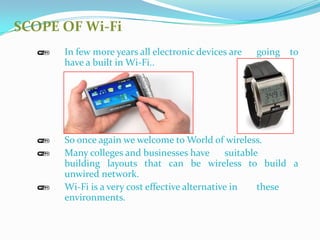
SCOPE OF Wi-Fi
      In few more years all electronic devices are   going   to
      have a built in Wi-Fi..


      So once again we welcome to World of wireless.
      Many colleges and businesses have        suitable
      building layouts that can be wireless to build a
      unwired network.
      Wi-Fi is a very cost effective alternative in    these
      environments.
Operating modes

      Infrastructure Mode

      AD HOC Mode
Building a WiFi

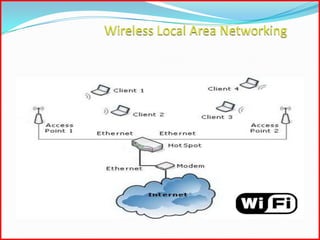
      A Wi-Fi hotspot is created by installing an access   point
 to   an internet connection.

      An access point acts as a base station.

      When Wi-Fi enabled device encounters a hotspot the
      device can then connect to that network wirelessly.

      A single access point can support up to 30 users and can
 function within a range of 100 – 150 feet   indoors       and
 up to 300 feet outdoors.

     Many access points can be connected to each other     via
 Ethernet cables to create a single large network.
Locating Hotspots


There are many Wi-Fi hotspots now
available in   public      places   like
restaurants,    hotels,   libraries and
airports.
For example, Katunayake Airport,
The number of hotspots in the world is
growing daily.
Wi-Fi Topologies
AP Based Topology
Peer to peer Topology
Point to multi-point bridge
 Topology
AP-based topology


   The client communicates through Access Point.
   It connects the PC’S by an AP.
   It consists of 2 or Base Stations.
   It includes 10-15% overlap to allow roaming.
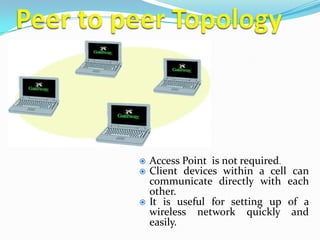
   Access Point is not required.
   Client devices within a cell can
    communicate directly with each
    other.
   It is useful for setting up of a
    wireless network quickly and
    easily.
   Used to connect a LAN in one building to a
    LANs in other buildings even if the buildings
    are miles apart.

   Range varies based on the type of wireless
    bridge and antenna used as well as the
    environmental conditions.
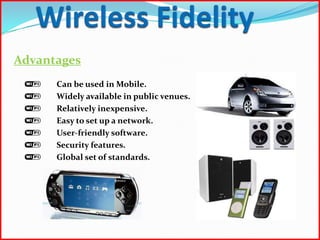
Advantages
      Can be used in Mobile.
      Widely available in public venues.
      Relatively inexpensive.
      Easy to set up a network.
      User-friendly software.
      Security features.
      Global set of standards.
Disadvantages
 Spectrum assignments & operational
  limitations
 Power consumption is fairly high
 Degradation in performance
 Networks have limited range
 Used to steal personal and confidential
  information
Wi-Fi Security
 WEP stands for Wired Equivalency Privacy

As its name implies, this standard was intended
to make wireless networks as secure as  wired
networks.

The common key lengths are currently 128- and
256-bit.

WPA Wi-Fi Protected Access is an early version
of the 802.11b security standard that was
developed by  the Wi-Fi Alliance to replace
WEP.
A SPECIAL SECURITY SOFTWARE
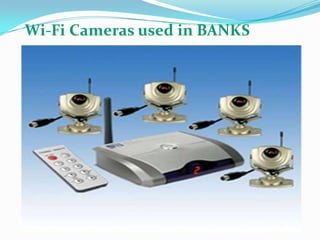
Wi-Fi Cameras used in BANKS
“Things that think…
              don’t make sense unless they link.”
Wi fi presentation

Wi fi presentation

  • 1.
  • 2.
    Agenda  Wi-Fi  Introduction  Scope of Wi-Fi  Working principle  Products  Building a Wi-Fi Network  Wi-Fi Security
  • 3.
    Wireless Fidelity (Wi-Fi) Welcometo the World of Wireless A radio technology that networks the devices. Refers to wireless LAN products based on the IEEE 802.11g specification Provides easy connections to the internet and business networks while traveling The main attractive feature of this technology is that it can provide wireless broadband connection within a specific geographic boundary.
  • 4.
    SCOPE OF Wi-Fi In few more years all electronic devices are going to have a built in Wi-Fi.. So once again we welcome to World of wireless. Many colleges and businesses have suitable building layouts that can be wireless to build a unwired network. Wi-Fi is a very cost effective alternative in these environments.
  • 5.
    Operating modes Infrastructure Mode AD HOC Mode
  • 6.
    Building a WiFi A Wi-Fi hotspot is created by installing an access point to an internet connection. An access point acts as a base station. When Wi-Fi enabled device encounters a hotspot the device can then connect to that network wirelessly. A single access point can support up to 30 users and can function within a range of 100 – 150 feet indoors and up to 300 feet outdoors. Many access points can be connected to each other via Ethernet cables to create a single large network.
  • 8.
    Locating Hotspots There aremany Wi-Fi hotspots now available in public places like restaurants, hotels, libraries and airports. For example, Katunayake Airport, The number of hotspots in the world is growing daily.
  • 9.
    Wi-Fi Topologies AP BasedTopology Peer to peer Topology Point to multi-point bridge Topology
  • 10.
    AP-based topology  The client communicates through Access Point.  It connects the PC’S by an AP.  It consists of 2 or Base Stations.  It includes 10-15% overlap to allow roaming.
  • 11.
    Access Point is not required.  Client devices within a cell can communicate directly with each other.  It is useful for setting up of a wireless network quickly and easily.
  • 12.
    Used to connect a LAN in one building to a LANs in other buildings even if the buildings are miles apart.  Range varies based on the type of wireless bridge and antenna used as well as the environmental conditions.
  • 13.
    Advantages Can be used in Mobile. Widely available in public venues. Relatively inexpensive. Easy to set up a network. User-friendly software. Security features. Global set of standards.
  • 14.
    Disadvantages  Spectrum assignments& operational limitations  Power consumption is fairly high  Degradation in performance  Networks have limited range  Used to steal personal and confidential information
  • 15.
    Wi-Fi Security WEPstands for Wired Equivalency Privacy As its name implies, this standard was intended to make wireless networks as secure as wired networks. The common key lengths are currently 128- and 256-bit. WPA Wi-Fi Protected Access is an early version of the 802.11b security standard that was developed by the Wi-Fi Alliance to replace WEP.
  • 17.
  • 18.
  • 20.
    “Things that think… don’t make sense unless they link.”