Wi-Fi & Bluetooth
NAME: TAHERA AL SABIBA
DEPARTMENT OF COMPUTER SCIENCE & ENGINEERING
Outlines
 Wi-Fi
 IEEE 802.11 Family
 Wi-Fi Network Topology
 Wi-Fi Direct & it’s Features
 Bluetooth
 Technical Specification
 Bluetooth Version
 Wi-Fi vs. Bluetooth
 Comparison Between Similar Technologies
Wi-Fi
 What is Wi-Fi
 Short for “Wireless Fidelity”
 A trademark of the Wi-Fi Alliance
 The brand name for products using the IEEE 802.11 family of standards
 Commonly used for “wireless local area network” (WLAN)
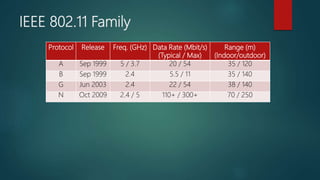
IEEE 802.11 Family
Protocol Release Freq. (GHz) Data Rate (Mbit/s)
(Typical / Max)
Range (m)
(Indoor/outdoor)
A Sep 1999 5 / 3.7 20 / 54 35 / 120
B Sep 1999 2.4 5.5 / 11 35 / 140
G Jun 2003 2.4 22 / 54 38 / 140
N Oct 2009 2.4 / 5 110+ / 300+ 70 / 250
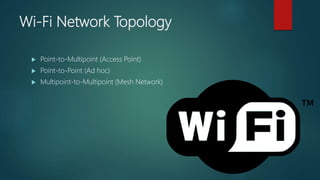
Wi-Fi Network Topology
 Point-to-Multipoint (Access Point)
 Point-to-Point (Ad hoc)
 Multipoint-to-Multipoint (Mesh Network)
Wi-Fi Direct & it’s Features
 Connects devices directly, with or without a Wi-Fi
network or hotspot available
 Makes the connection to open a world of
applications, including content sharing, synch,
printing, gaming and more
 Connects with almost any Wi-Fi CERTIFIED device
 Designed for portable and stationary devices
Bluetooth
 Wireless Personal Area Networks (WPAN)
 Design goal
 Cable replacement
 Low cost
 Low power
 Small size
 For mobile devices
 Standard: IEEE 802.15.1
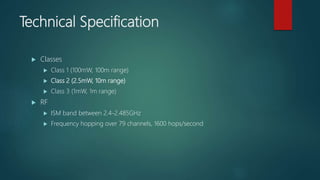
Technical Specification
 Classes
 Class 1 (100mW, 100m range)
 Class 2 (2.5mW, 10m range)
 Class 3 (1mW, 1m range)
 RF
 ISM band between 2.4-2.485GHz
 Frequency hopping over 79 channels, 1600 hops/second
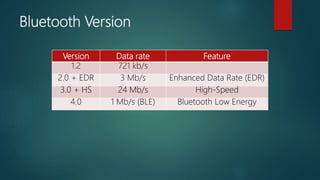
Bluetooth Version
Version Data rate Feature
1.2 721 kb/s
2.0 + EDR 3 Mb/s Enhanced Data Rate (EDR)
3.0 + HS 24 Mb/s High-Speed
4.0 1 Mb/s (BLE) Bluetooth Low Energy
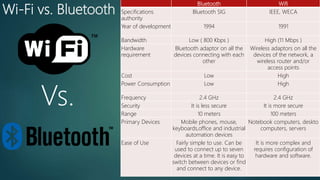
Wi-Fi vs. Bluetooth
Bluetooth Wifi
Specifications
authority
Bluetooth SIG IEEE, WECA
Year of development 1994 1991
Bandwidth Low ( 800 Kbps ) High (11 Mbps )
Hardware
requirement
Bluetooth adaptor on all the
devices connecting with each
other
Wireless adaptors on all the
devices of the network, a
wireless router and/or
access points
Cost Low High
Power Consumption Low High
Frequency 2.4 GHz 2.4 GHz
Security It is less secure It is more secure
Range 10 meters 100 meters
Primary Devices Mobile phones, mouse,
keyboards,office and industrial
automation devices
Notebook computers, deskto
computers, servers
Ease of Use Fairly simple to use. Can be
used to connect up to seven
devices at a time. It is easy to
switch between devices or find
and connect to any device.
It is more complex and
requires configuration of
hardware and software.
Vs.
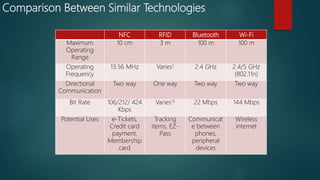
Comparison Between Similar Technologies
NFC RFID Bluetooth Wi-Fi
Maximum
Operating
Range
10 cm 3 m 100 m 100 m
Operating
Frequency
13.56 MHz Varies1 2.4 GHz 2.4/5 GHz
(802.11n)
Directional
Communication
Two way One way Two way Two way
Bit Rate 106/212/ 424
Kbps
Varies13 22 Mbps 144 Mbps
Potential Uses e-Tickets,
Credit card
payment,
Membership
card
Tracking
items, EZ-
Pass
Communicat
e between
phones,
peripheral
devices
Wireless
internet
Thank You
Do You Have any Question ?

WiFi & Bluetooth by TAS

  • 1.
    Wi-Fi & Bluetooth NAME:TAHERA AL SABIBA DEPARTMENT OF COMPUTER SCIENCE & ENGINEERING
  • 2.
    Outlines  Wi-Fi  IEEE802.11 Family  Wi-Fi Network Topology  Wi-Fi Direct & it’s Features  Bluetooth  Technical Specification  Bluetooth Version  Wi-Fi vs. Bluetooth  Comparison Between Similar Technologies
  • 3.
    Wi-Fi  What isWi-Fi  Short for “Wireless Fidelity”  A trademark of the Wi-Fi Alliance  The brand name for products using the IEEE 802.11 family of standards  Commonly used for “wireless local area network” (WLAN)
  • 4.
    IEEE 802.11 Family ProtocolRelease Freq. (GHz) Data Rate (Mbit/s) (Typical / Max) Range (m) (Indoor/outdoor) A Sep 1999 5 / 3.7 20 / 54 35 / 120 B Sep 1999 2.4 5.5 / 11 35 / 140 G Jun 2003 2.4 22 / 54 38 / 140 N Oct 2009 2.4 / 5 110+ / 300+ 70 / 250
  • 5.
    Wi-Fi Network Topology Point-to-Multipoint (Access Point)  Point-to-Point (Ad hoc)  Multipoint-to-Multipoint (Mesh Network)
  • 6.
    Wi-Fi Direct &it’s Features  Connects devices directly, with or without a Wi-Fi network or hotspot available  Makes the connection to open a world of applications, including content sharing, synch, printing, gaming and more  Connects with almost any Wi-Fi CERTIFIED device  Designed for portable and stationary devices
  • 7.
    Bluetooth  Wireless PersonalArea Networks (WPAN)  Design goal  Cable replacement  Low cost  Low power  Small size  For mobile devices  Standard: IEEE 802.15.1
  • 8.
    Technical Specification  Classes Class 1 (100mW, 100m range)  Class 2 (2.5mW, 10m range)  Class 3 (1mW, 1m range)  RF  ISM band between 2.4-2.485GHz  Frequency hopping over 79 channels, 1600 hops/second
  • 9.
    Bluetooth Version Version Datarate Feature 1.2 721 kb/s 2.0 + EDR 3 Mb/s Enhanced Data Rate (EDR) 3.0 + HS 24 Mb/s High-Speed 4.0 1 Mb/s (BLE) Bluetooth Low Energy
  • 10.
    Wi-Fi vs. Bluetooth BluetoothWifi Specifications authority Bluetooth SIG IEEE, WECA Year of development 1994 1991 Bandwidth Low ( 800 Kbps ) High (11 Mbps ) Hardware requirement Bluetooth adaptor on all the devices connecting with each other Wireless adaptors on all the devices of the network, a wireless router and/or access points Cost Low High Power Consumption Low High Frequency 2.4 GHz 2.4 GHz Security It is less secure It is more secure Range 10 meters 100 meters Primary Devices Mobile phones, mouse, keyboards,office and industrial automation devices Notebook computers, deskto computers, servers Ease of Use Fairly simple to use. Can be used to connect up to seven devices at a time. It is easy to switch between devices or find and connect to any device. It is more complex and requires configuration of hardware and software. Vs.
  • 11.
    Comparison Between SimilarTechnologies NFC RFID Bluetooth Wi-Fi Maximum Operating Range 10 cm 3 m 100 m 100 m Operating Frequency 13.56 MHz Varies1 2.4 GHz 2.4/5 GHz (802.11n) Directional Communication Two way One way Two way Two way Bit Rate 106/212/ 424 Kbps Varies13 22 Mbps 144 Mbps Potential Uses e-Tickets, Credit card payment, Membership card Tracking items, EZ- Pass Communicat e between phones, peripheral devices Wireless internet
  • 12.
    Thank You Do YouHave any Question ?