Name- Nazrin Parveen
Roll no. 33
outline
 What is Wi-Fi?
 purpose
 Wi-Fi network elements
 How a Wi-Fi network works
 Wi-Fi network topologies & security techniques
 Advantages & limitations of Wi-Fi
What is Wi-Fi?
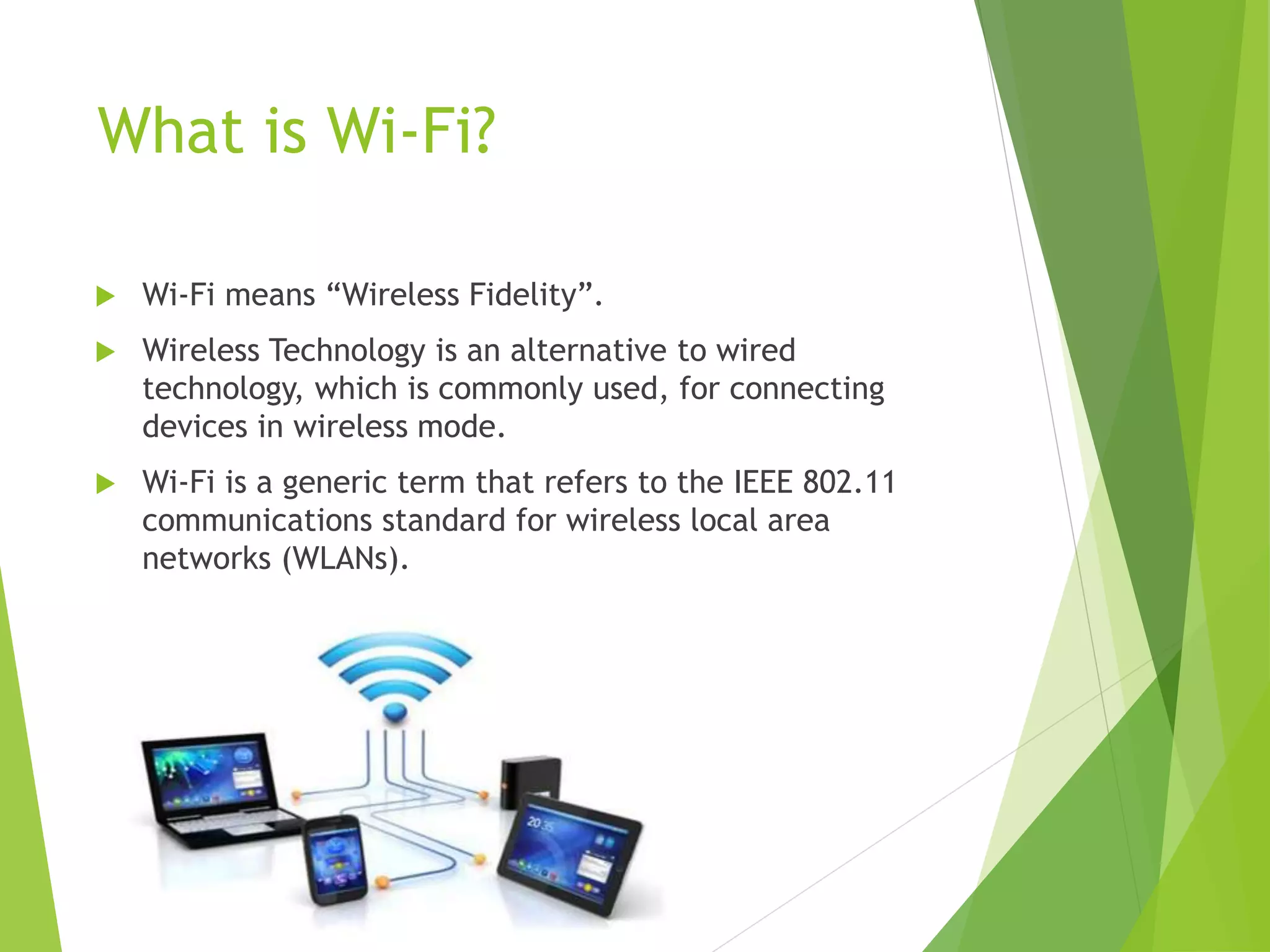
 Wi-Fi means “Wireless Fidelity”.
 Wireless Technology is an alternative to wired
technology, which is commonly used, for connecting
devices in wireless mode.
 Wi-Fi is a generic term that refers to the IEEE 802.11
communications standard for wireless local area
networks (WLANs).
Purpose
 The purpose of Wi-Fi is to hide complexity by enabling
wireless access to applications and data , media and
streams.
 The main aims of Wi-Fi are the following:
1. Make access to information easier.
2. Ensure compatibility and co-existence of devices
3. Eliminate cabling and wiring
4. Eliminate switches, adapters, plugs, pins and
connectors.
Wi-Fi network elements:
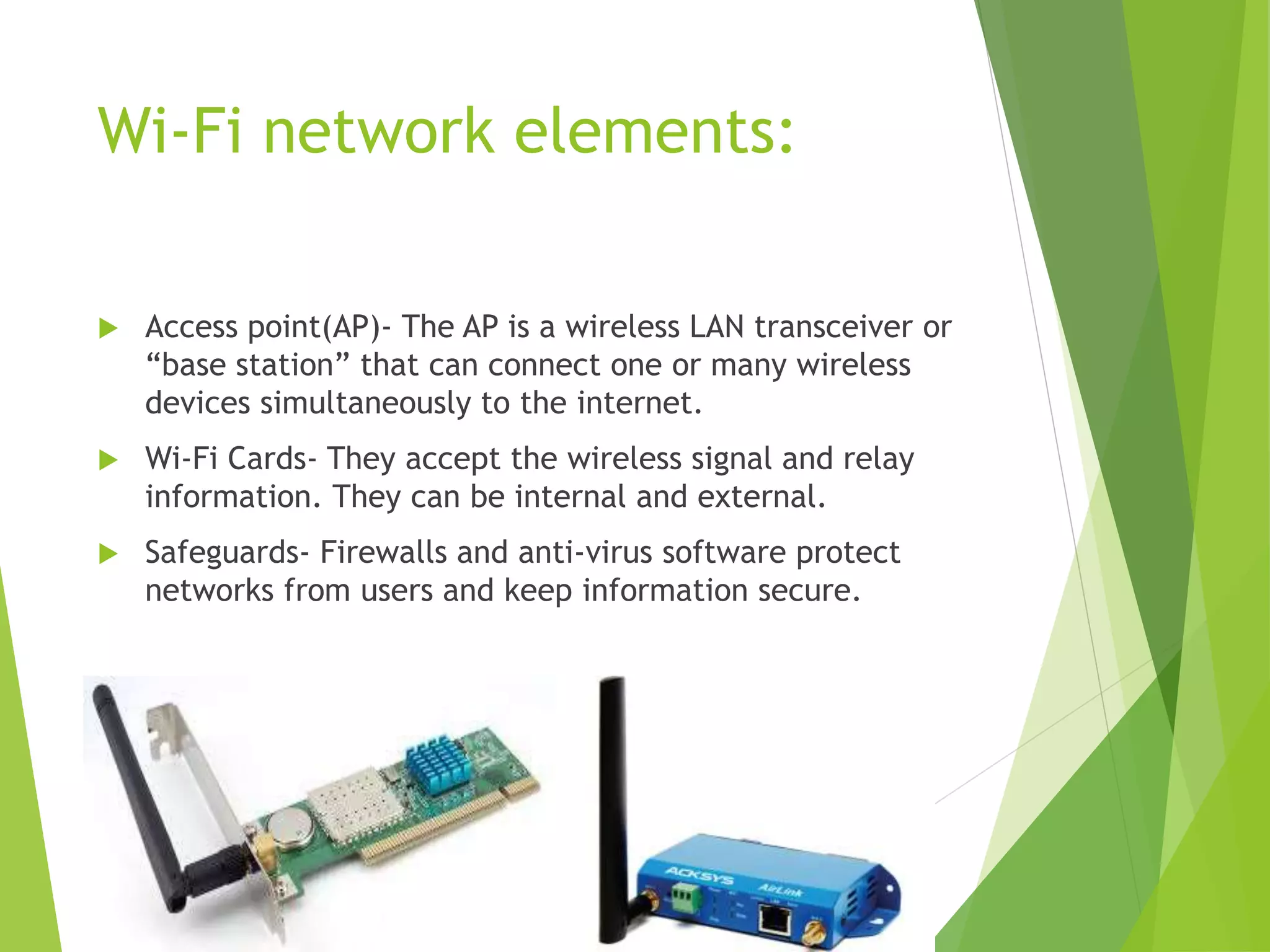
 Access point(AP)- The AP is a wireless LAN transceiver or
“base station” that can connect one or many wireless
devices simultaneously to the internet.
 Wi-Fi Cards- They accept the wireless signal and relay
information. They can be internal and external.
 Safeguards- Firewalls and anti-virus software protect
networks from users and keep information secure.
How a Wi-Fi network works
 Basic concept is same as walkie-talkies.
 A Wi-Fi hotspot is created by installing an access point
to an internet connection.
 An access point acts as a base station.
 When Wi-Fi enabled device encounters a hotspot the
device can then connect to the network wirelessly.
Wi-Fi network topologies
 Service set Identifier(SSID)
 Wired Equivalent Privacy(WEP)
 IEEE 802.11i
Wi-Fi security techniques
 AP-based topology( infrastructure mode)
 Peer-to-peer topology(Ad-hoc mode)
 Point-to-multipoint bridge topology
Advantages
 No wires- A truly wireless networking solution.
 No worries- A wireless networking system that is secure, easy to
manage, and built to grow with you.
 No waiting- Fast, easy deployments.
LIMITATIONS
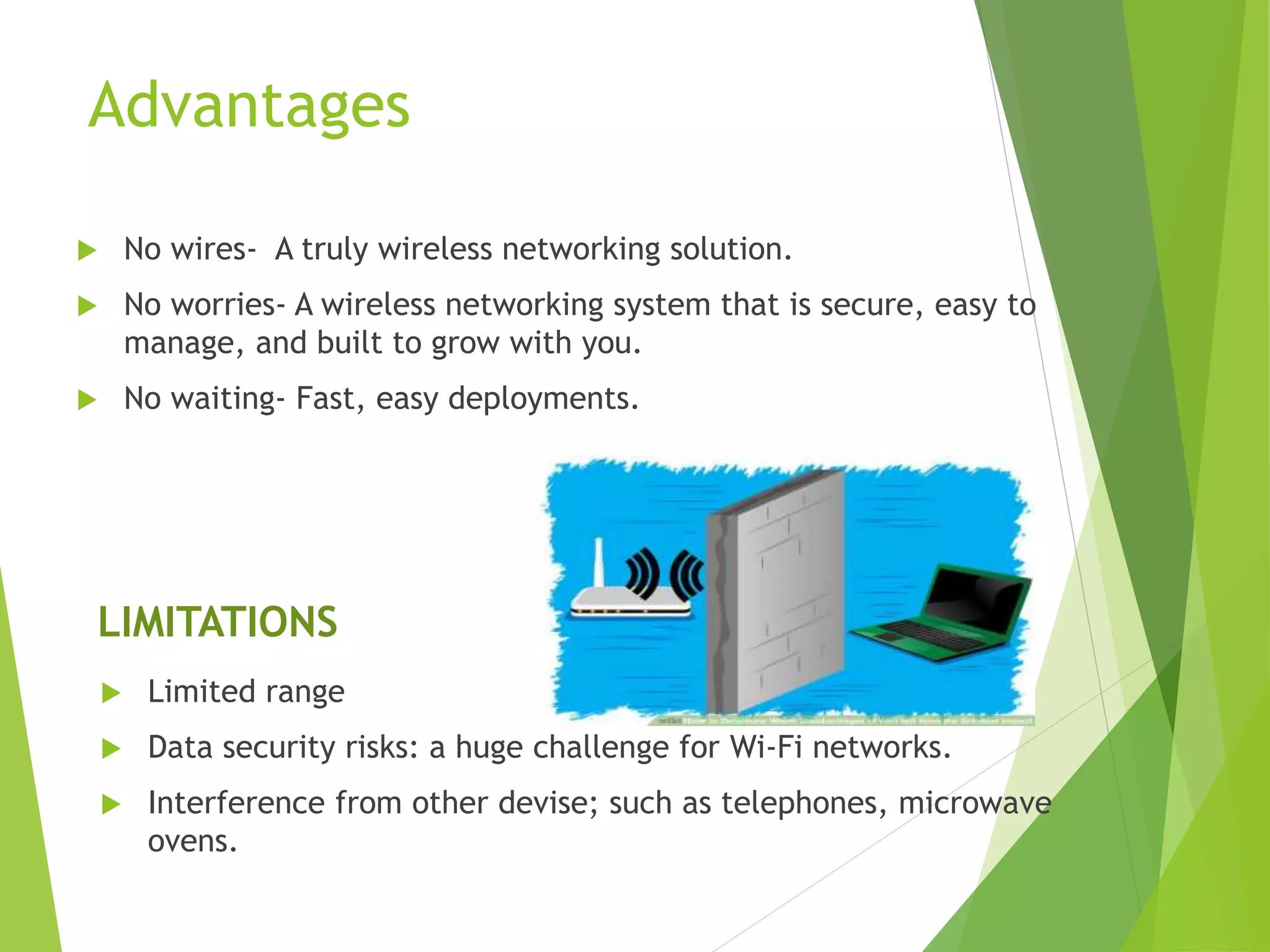
 Limited range
 Data security risks: a huge challenge for Wi-Fi networks.
 Interference from other devise; such as telephones, microwave
ovens.
Wi-Fi technology

Wi-Fi technology

  • 1.
  • 2.
    outline  What isWi-Fi?  purpose  Wi-Fi network elements  How a Wi-Fi network works  Wi-Fi network topologies & security techniques  Advantages & limitations of Wi-Fi
  • 3.
    What is Wi-Fi? Wi-Fi means “Wireless Fidelity”.  Wireless Technology is an alternative to wired technology, which is commonly used, for connecting devices in wireless mode.  Wi-Fi is a generic term that refers to the IEEE 802.11 communications standard for wireless local area networks (WLANs).
  • 4.
    Purpose  The purposeof Wi-Fi is to hide complexity by enabling wireless access to applications and data , media and streams.  The main aims of Wi-Fi are the following: 1. Make access to information easier. 2. Ensure compatibility and co-existence of devices 3. Eliminate cabling and wiring 4. Eliminate switches, adapters, plugs, pins and connectors.
  • 5.
    Wi-Fi network elements: Access point(AP)- The AP is a wireless LAN transceiver or “base station” that can connect one or many wireless devices simultaneously to the internet.  Wi-Fi Cards- They accept the wireless signal and relay information. They can be internal and external.  Safeguards- Firewalls and anti-virus software protect networks from users and keep information secure.
  • 6.
    How a Wi-Finetwork works  Basic concept is same as walkie-talkies.  A Wi-Fi hotspot is created by installing an access point to an internet connection.  An access point acts as a base station.  When Wi-Fi enabled device encounters a hotspot the device can then connect to the network wirelessly.
  • 7.
    Wi-Fi network topologies Service set Identifier(SSID)  Wired Equivalent Privacy(WEP)  IEEE 802.11i Wi-Fi security techniques  AP-based topology( infrastructure mode)  Peer-to-peer topology(Ad-hoc mode)  Point-to-multipoint bridge topology
  • 8.
    Advantages  No wires-A truly wireless networking solution.  No worries- A wireless networking system that is secure, easy to manage, and built to grow with you.  No waiting- Fast, easy deployments. LIMITATIONS  Limited range  Data security risks: a huge challenge for Wi-Fi networks.  Interference from other devise; such as telephones, microwave ovens.