WiMAX:
IEEE 802.16 - Wireless MANs
Sridhar Iyer
K R School of Information Technology
IIT Bombay
sri@it.iitb.ac.in
http://www.it.iitb.ac.in/~sri
Sridhar Iyer IIT Bombay 2
Wireless networks
 Wireless PANs (Bluetooth – IEEE
802.15)
– very low range
– wireless connection to printers etc
 Wireless LANs (WiFi – IEEE
802.11)
– infrastructure as well as ad-hoc
networks possible
– home/office networking
 Multihop Ad hoc Networks
– useful when infrastructure not
available, impractical, or expensive
– military applications, emergencies
 Wireless MANs (WiMAX-802.16)
– Similar to cellular networks
– traditional base station
infrastructure systems
Sridhar Iyer IIT Bombay 3
Sridhar Iyer IIT Bombay 4
WiMAX
 Goal: Provide high-speed Internet access to home and
business subscribers, without wires.
 Base stations (BS) and subscriber stations (SS)
 Centralized access control to prevents collisions
 Supports applications with different QoS requirements
 WiMAX is a subset of IEEE 802.16 standard
Sridhar Iyer IIT Bombay 5
IEEE 802.16 standards
 802.16.1 (10-66 GHz, line-of-sight, up to 134Mbit/s)
 802.16.2 (minimizing interference between coexisting
WMANs)
 802.16a (2-11 Ghz, Mesh, non-line-of-sight)
 802.16b (5-6 Ghz)
 802.16c (detailed system profiles)
 P802.16e (Mobile Wireless MAN)
Sridhar Iyer IIT Bombay 6
Sridhar Iyer IIT Bombay 7
Physical layer
 Allows use of directional antennas
 Allows use of two different duplexing schemes:
– Frequency Division Duplexing (FDD)
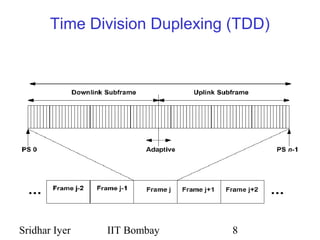
– Time Division Duplexing (TDD)
 Support for both full and half duplex stations
 Adaptive Data Burst profiles
– Transmission parameters (e.g. Modulation, FEC) can
be modified on a frame-by-frame basis for each SS
– Profiles are identified by ”Interval Usage Code”
Sridhar Iyer IIT Bombay 8
Time Division Duplexing (TDD)
Sridhar Iyer IIT Bombay 9
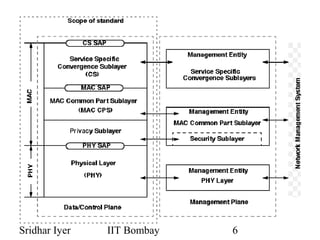
Media Acces Control (MAC)
 Connection oriented
– Connection ID (CID), Service Flows
 Channel access: decided by BS
– UL-MAP
– Defines uplink channel access
– Defines uplink data burst profiles
– DL-MAP
– Defines downlink data burst profiles
– UL-MAP and DL-MAP are both transmitted in the
beginning of each downlink subframe
Sridhar Iyer IIT Bombay 10
TDD Downlink subframe
Sridhar Iyer IIT Bombay 11
Uplink subframe
Sridhar Iyer IIT Bombay 12
Uplink periods
 Initial Maintenance opportunities
– Ranging - to determine network delay and to request power or
profile changes
– Collisions may occur in this interval
 Request opportunities
– SSs request bandwith in response to polling from BS
– Collisions may occur in this interval
 Data grants period
– SSs transmit data bursts in the intervals granted by the BS
– Transition gaps between data intervals for synchronization
Sridhar Iyer IIT Bombay 13
Bandwidth request
 SSs may request bandwidth in 3 ways:
– Use the ”contention request opportunities” interval
upon being polled by the BS
– Send a standalone MAC message called ”BW
request” in an allready granted slot
– Piggyback a BW request message on a data packet
Sridhar Iyer IIT Bombay 14
Bandwidth allocation
 BS grants/allocates bandwidth in one of two
modes:
– Grant Per Subscriber Station (GPSS)
– Grant Per Connection (GPC)
 Decision based on requested bandwidth and
QoS requirements vs available resources
 Grants are notified through the UL-MAP
Sridhar Iyer IIT Bombay 15
Bandwidth Request-Grant Protocol
BS
SS1
SS2
1
2.1
2.2
1. BS allocates bandwidth to SSs
for transmitting bandwidth
request.
2.1 SS1 transmits bandwidth
requests.
2.2 SS2 transmits bandwidth
requests.
4. BS allocates bandwidth to SSs
for transmitting data based on
their bandwidth requests.
Bandwidth is also allocated for
requesting more bandwidth.
5.1 SS1 transmits data and
bandwidth requests.
5.2 SS2 transmits data and
bandwidth requests.
4
5.1
5.2
Sridhar Iyer IIT Bombay 16
Scheduling services
 Unsolicited Grant Service (UGS)
– Real-time, periodic fixed size packets (e.g. VoIP)
– No periodic bandwith requests required
 Real-Time Polling Service (rtPS)
– Real-time, periodic variable sizes packets (e.g MPEG)
– BS issues periodic unicast polls
 Non-Real-Time Polling Service (nrtPS)
– Variable sized packets with loose delay requirements (FTP)
– BS issues unicast polls regularly (not necessarily periodic)
– Can also use contention requests and piggybacking
 Best Effort Service
– Never polled individually
– Can use contention requests and piggybacking
Sridhar Iyer IIT Bombay 17
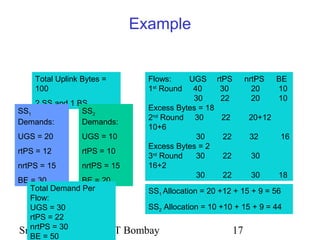
Example
Total Uplink Bytes =
100
2 SS and 1 BS
SS1
Demands:
UGS = 20
rtPS = 12
nrtPS = 15
BE = 30
SS2
Demands:
UGS = 10
rtPS = 10
nrtPS = 15
BE = 20
Total Demand Per
Flow:
UGS = 30
rtPS = 22
nrtPS = 30
BE = 50
Flows: UGS rtPS nrtPS BE
1st
Round 40 30 20 10
30 22 20 10
Excess Bytes = 18
2nd
Round 30 22 20+12
10+6
30 22 32 16
Excess Bytes = 2
3rd
Round 30 22 30
16+2
30 22 30 18
SS1 Allocation = 20 +12 + 15 + 9 = 56
SS2 Allocation = 10 +10 + 15 + 9 = 44
Sridhar Iyer IIT Bombay 18
References
 IEEE 802.16-2001. “IEEE Standard for Local and Metropolitan
Area Networks - Part 16: Air Interface for Fixed Broadband
Wireless Access Systems”. Apr. 8, 2002.
 C. Eklund, R. B. Marks, K. L. Stanwood, and S. Wang, “IEEE
Standard 802.16: A Technical Overview of the WirelessMANTM
Air Interface for Broadband Wireless Access”, IEEE
Communications Magazine, 40(6):98-107, June 2002.
 Andrew S. Tanenbaum, Computer Networks, Prentice-Hall
India, Fourth edition, 2003.
 S. Keshav. An Engineering Approach to Computer Networking.
Pearson Education, Sixth edition, 2003.
Sridhar Iyer IIT Bombay 19
Thank You
Other Tutorials at: www.it.iitb.ac.in/~sri
Google Search: Sridhar Iyer IIT Bombay
Contact Details:
Sridhar Iyer
School of Information Technology
IIT Bombay, Powai, Mumbai 400 076
Email: sri@it.iitb.ac.in

Wi max

  • 1.
    WiMAX: IEEE 802.16 -Wireless MANs Sridhar Iyer K R School of Information Technology IIT Bombay sri@it.iitb.ac.in http://www.it.iitb.ac.in/~sri
  • 2.
    Sridhar Iyer IITBombay 2 Wireless networks  Wireless PANs (Bluetooth – IEEE 802.15) – very low range – wireless connection to printers etc  Wireless LANs (WiFi – IEEE 802.11) – infrastructure as well as ad-hoc networks possible – home/office networking  Multihop Ad hoc Networks – useful when infrastructure not available, impractical, or expensive – military applications, emergencies  Wireless MANs (WiMAX-802.16) – Similar to cellular networks – traditional base station infrastructure systems
  • 3.
  • 4.
    Sridhar Iyer IITBombay 4 WiMAX  Goal: Provide high-speed Internet access to home and business subscribers, without wires.  Base stations (BS) and subscriber stations (SS)  Centralized access control to prevents collisions  Supports applications with different QoS requirements  WiMAX is a subset of IEEE 802.16 standard
  • 5.
    Sridhar Iyer IITBombay 5 IEEE 802.16 standards  802.16.1 (10-66 GHz, line-of-sight, up to 134Mbit/s)  802.16.2 (minimizing interference between coexisting WMANs)  802.16a (2-11 Ghz, Mesh, non-line-of-sight)  802.16b (5-6 Ghz)  802.16c (detailed system profiles)  P802.16e (Mobile Wireless MAN)
  • 6.
  • 7.
    Sridhar Iyer IITBombay 7 Physical layer  Allows use of directional antennas  Allows use of two different duplexing schemes: – Frequency Division Duplexing (FDD) – Time Division Duplexing (TDD)  Support for both full and half duplex stations  Adaptive Data Burst profiles – Transmission parameters (e.g. Modulation, FEC) can be modified on a frame-by-frame basis for each SS – Profiles are identified by ”Interval Usage Code”
  • 8.
    Sridhar Iyer IITBombay 8 Time Division Duplexing (TDD)
  • 9.
    Sridhar Iyer IITBombay 9 Media Acces Control (MAC)  Connection oriented – Connection ID (CID), Service Flows  Channel access: decided by BS – UL-MAP – Defines uplink channel access – Defines uplink data burst profiles – DL-MAP – Defines downlink data burst profiles – UL-MAP and DL-MAP are both transmitted in the beginning of each downlink subframe
  • 10.
    Sridhar Iyer IITBombay 10 TDD Downlink subframe
  • 11.
    Sridhar Iyer IITBombay 11 Uplink subframe
  • 12.
    Sridhar Iyer IITBombay 12 Uplink periods  Initial Maintenance opportunities – Ranging - to determine network delay and to request power or profile changes – Collisions may occur in this interval  Request opportunities – SSs request bandwith in response to polling from BS – Collisions may occur in this interval  Data grants period – SSs transmit data bursts in the intervals granted by the BS – Transition gaps between data intervals for synchronization
  • 13.
    Sridhar Iyer IITBombay 13 Bandwidth request  SSs may request bandwidth in 3 ways: – Use the ”contention request opportunities” interval upon being polled by the BS – Send a standalone MAC message called ”BW request” in an allready granted slot – Piggyback a BW request message on a data packet
  • 14.
    Sridhar Iyer IITBombay 14 Bandwidth allocation  BS grants/allocates bandwidth in one of two modes: – Grant Per Subscriber Station (GPSS) – Grant Per Connection (GPC)  Decision based on requested bandwidth and QoS requirements vs available resources  Grants are notified through the UL-MAP
  • 15.
    Sridhar Iyer IITBombay 15 Bandwidth Request-Grant Protocol BS SS1 SS2 1 2.1 2.2 1. BS allocates bandwidth to SSs for transmitting bandwidth request. 2.1 SS1 transmits bandwidth requests. 2.2 SS2 transmits bandwidth requests. 4. BS allocates bandwidth to SSs for transmitting data based on their bandwidth requests. Bandwidth is also allocated for requesting more bandwidth. 5.1 SS1 transmits data and bandwidth requests. 5.2 SS2 transmits data and bandwidth requests. 4 5.1 5.2
  • 16.
    Sridhar Iyer IITBombay 16 Scheduling services  Unsolicited Grant Service (UGS) – Real-time, periodic fixed size packets (e.g. VoIP) – No periodic bandwith requests required  Real-Time Polling Service (rtPS) – Real-time, periodic variable sizes packets (e.g MPEG) – BS issues periodic unicast polls  Non-Real-Time Polling Service (nrtPS) – Variable sized packets with loose delay requirements (FTP) – BS issues unicast polls regularly (not necessarily periodic) – Can also use contention requests and piggybacking  Best Effort Service – Never polled individually – Can use contention requests and piggybacking
  • 17.
    Sridhar Iyer IITBombay 17 Example Total Uplink Bytes = 100 2 SS and 1 BS SS1 Demands: UGS = 20 rtPS = 12 nrtPS = 15 BE = 30 SS2 Demands: UGS = 10 rtPS = 10 nrtPS = 15 BE = 20 Total Demand Per Flow: UGS = 30 rtPS = 22 nrtPS = 30 BE = 50 Flows: UGS rtPS nrtPS BE 1st Round 40 30 20 10 30 22 20 10 Excess Bytes = 18 2nd Round 30 22 20+12 10+6 30 22 32 16 Excess Bytes = 2 3rd Round 30 22 30 16+2 30 22 30 18 SS1 Allocation = 20 +12 + 15 + 9 = 56 SS2 Allocation = 10 +10 + 15 + 9 = 44
  • 18.
    Sridhar Iyer IITBombay 18 References  IEEE 802.16-2001. “IEEE Standard for Local and Metropolitan Area Networks - Part 16: Air Interface for Fixed Broadband Wireless Access Systems”. Apr. 8, 2002.  C. Eklund, R. B. Marks, K. L. Stanwood, and S. Wang, “IEEE Standard 802.16: A Technical Overview of the WirelessMANTM Air Interface for Broadband Wireless Access”, IEEE Communications Magazine, 40(6):98-107, June 2002.  Andrew S. Tanenbaum, Computer Networks, Prentice-Hall India, Fourth edition, 2003.  S. Keshav. An Engineering Approach to Computer Networking. Pearson Education, Sixth edition, 2003.
  • 19.
    Sridhar Iyer IITBombay 19 Thank You Other Tutorials at: www.it.iitb.ac.in/~sri Google Search: Sridhar Iyer IIT Bombay Contact Details: Sridhar Iyer School of Information Technology IIT Bombay, Powai, Mumbai 400 076 Email: sri@it.iitb.ac.in