IEEE 802.16
Presented By
Saba Arif
GCUF
Topics:
Introduction
 Overview of the IEEE 802.16 standard.
 What is WiMAX
 WiMAX Services
 Burst Profile
 Reference Model
 MAC PDU format
 MAC PDU Transmission
 Fragmentation/Packing
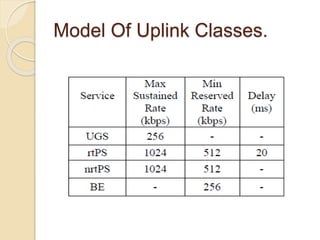
 Classes of Uplink service
 Power Management Handoff
Introduction:
 Wireless Networks are generally less efficient as
compared to wired network.
 Wireless medium has limited bandwidth
 Higher packet error rate
 In response to increase the QOS challenge , the IEEE
802.16 standard known as Worldwide Interoperability
for Microwave Access (WiMAX) , has emerged as the
strongest competitor for Broadband wireless
technology.
 Promise to offer guaranteed QOS for wireless users
 Aimed to provide last-mile wireless broadband
access.
Ref:
Overview of the IEEE 802.16
Standard
 Designed for point-to-point (PTP) and point-to-
multipoint (PTM) topologies but mainly deployed
for point to multipoint topologies.
 It also support mesh topologies. In PTM a base
station (BS) services many subscriber stations (SS)
which are mounted outdoors.
 IEEE 802.16 has three major versions; 802.16-
2001, 802.16-2004 and IEEE 802.16-2005.
ref: http://www.slideshare.net/sajidmarwatt/wimax-ieee-80216-
33468312
What is WiMAX:
 Today world moves to wireless network.
 There are two reasons for this:
i) People want to have access to the Internet,
home or office (fixed) where the wired access to
the Internet is either not available expensive.
ii) They want to access the Internet when they
are using their cell phones.
 The worldwide interoperability for microwave
access(WiMAX) has been designed for these type
of applications.
 It provide last-mile broadband wireless access.
Ref: Data Communication and Networking By Behrouz-
A.Forouzan(p#467)
WiMAX Services:
 It’s provide two types of services
i) Fixed WiMAX
Optimized for Home/Offices
ii) Mobile WiMAX
Optimized for Mobiles
Fixed WiMAX
Mobile WiMAX
Burst Profile
 The burst profile is a basic tool in the 802.16
standard
MAC Layer. The burst profile allocation, which
changes
dynamically and possibly very fast, is about
physical transmission.
 The burst profiles are used for the link adaptation
procedure.
Reference Model:
Reference Model:
Service Specific Convergence sublayer(CS)
 It is used for the transport of all packet based
protocols
 Such as internet protocol(IP)
 802.3 Ethernet protocol
 Connection benefits from a specific Qos.
Reference Model
MAC Layer
 Sub-layer of Data-Link Layer
 Define access method and frame format
 Bandwidth requestAllocation
 Connection Establishment  Maintainance
 Avoid collisions.
Reference Model:
Security SubLayer
 Provide authentication
 Encryption b/t SS & BS
Reference Model:
Physical Layer
 An interface between the MAC and the wireless
media where the frames are transmitted and
received .
 Encoding and Decoding of signals.
 Convert MAC layer frames into signals
MAC PDU Format
 Each MAC PDU consists of three components
i) A fixed-length Generic MAC Header
ii) A variable length Payload
iii) A CRC ( Cyclic Redundancy Check )
6 byte Variable 4 byte
MAC Header Payload Management
Message
Types of MAC header
HT EC TYPE BR CID HCS
Header Payload Management
Message
HT EC TYPE RSV CI EKS LEN CID HCS
Bandwidth request MAC header
Generic MAC header
Specification of MAC layer
 The first bit in a frame is frame identifier.
 EC. The encryption control field use one bit to
define weather the frame should be encrypted for
security purpose.
 Type. Type field use 6 bits to define the type of the
frame.
 CI. The checksum ID is used 1 bit to define
weather the field should be present or not.
 Length . Length bit use 11 bits to define the total
length of the frame.This field is present in generic
frame. Header + Payload + CRC ID (Connection
Identifier)
Specification of Mac layer
 Byte needed . use 16 bits to define the number of
bytes needed for allocated slots in physical layer
 Connection Identifier . use 16 bits to define
connection identifier for the current connection
 Header CRC. Both type of frame need to be have
8-bt header CRC field.
 Payload . The variable length define the payload
 CRC. The last field if present used for error
detection over the whole frame
MAC PDU Transmission
 The application first establishes the connection
with the BS as well as the associated service flow
(UGS, rtPS, nrtPS or BE).
 BS will assign the connection with a unique
connection ID (CID).
 All packets from the application layer in the SS are
classified by the connection classifier based on
CID and are forwarded to the appropriate queue.
So, the scheduler inside the BS has outdated
information about the current state of each uplink
connection due to the large Round Trip Delay
(RTD) and possible collision occurred in the uplink
channel transmission .
MAC PDU Transmission
 Multiple MAC PDUs may be concatenated into a
single transmission in either the uplink or downlink
directions.
 Fragmentation is the process in which a MAC SDU
is
divided into one or more MAC PDU fragments.
Ref: 1009.6091 pdf
Fragmentation/Packing
 It may be interesting to fragment a MAC SDU in
many
MAC PDUs or, inversely, to pack more than one
MSDU in
Single MAC PDUs.
 The advantage of fragmentation is to lower the risk
of
losing a whole MSDU to the risk of losing part of it.
Classes Of Uplink Services:
 The WiMAX Standard specifies the different
service classes. Classes are Set by Priority wise
UGS > rtPS > nrtPS > BE.
UGS
 Unsolicited Grant Service (UGS):
 No need to request bandwidth for each packet
 The BS periodically assigns slots
 Scheduling for DL UGS traffic is not required
Uplink Services
Real-time Polling Service (rtPS):
 Packets are not fixed in size
 BS polls the connection of this class periodically to
ask how much bandwidth is
needed.
 The packet with smaller deadline will be
transmitted earlier.
Uplink Classes
Non real-time Polling Service (nrtPS):
 Used to support traffic with no QoS.
 May have additional bandwidth allocated through
non periodic polling.
Best Effort (BE):
 Used to support traffic with no QoS.
 There is possibility that BE traffic is starved by the
lack of bandwidth.
Model Of Uplink Classes.
Power Management Handoff
 A telecommunication system (e.g., cable,
radio, satellite), as opposed to sensory
aspects of communication(e.g., audio, video).
 The standard addresses the support of
handovers for both mobile and stationary
users.
 For mobile users, handovers can occur when
wireless link conditions change due to the
users’ movement.
 For the stationary user, handovers become
imminent when the surrounding network
environment changes, making one network
more attractive than another.
Power Management Handoff
As an example, when
 Making a network transition during a phone
call, the handover procedures should be
executed in such a way that any perceptible
interruption to the conversation will be
minimized.
Thank You 

IEEE 806.16

  • 1.
  • 2.
    Topics: Introduction  Overview ofthe IEEE 802.16 standard.  What is WiMAX  WiMAX Services  Burst Profile  Reference Model  MAC PDU format  MAC PDU Transmission  Fragmentation/Packing  Classes of Uplink service  Power Management Handoff
  • 3.
    Introduction:  Wireless Networksare generally less efficient as compared to wired network.  Wireless medium has limited bandwidth  Higher packet error rate  In response to increase the QOS challenge , the IEEE 802.16 standard known as Worldwide Interoperability for Microwave Access (WiMAX) , has emerged as the strongest competitor for Broadband wireless technology.  Promise to offer guaranteed QOS for wireless users  Aimed to provide last-mile wireless broadband access. Ref:
  • 4.
    Overview of theIEEE 802.16 Standard  Designed for point-to-point (PTP) and point-to- multipoint (PTM) topologies but mainly deployed for point to multipoint topologies.  It also support mesh topologies. In PTM a base station (BS) services many subscriber stations (SS) which are mounted outdoors.  IEEE 802.16 has three major versions; 802.16- 2001, 802.16-2004 and IEEE 802.16-2005. ref: http://www.slideshare.net/sajidmarwatt/wimax-ieee-80216- 33468312
  • 5.
    What is WiMAX: Today world moves to wireless network.  There are two reasons for this: i) People want to have access to the Internet, home or office (fixed) where the wired access to the Internet is either not available expensive. ii) They want to access the Internet when they are using their cell phones.  The worldwide interoperability for microwave access(WiMAX) has been designed for these type of applications.  It provide last-mile broadband wireless access. Ref: Data Communication and Networking By Behrouz- A.Forouzan(p#467)
  • 6.
    WiMAX Services:  It’sprovide two types of services i) Fixed WiMAX Optimized for Home/Offices ii) Mobile WiMAX Optimized for Mobiles
  • 7.
  • 8.
  • 9.
    Burst Profile  Theburst profile is a basic tool in the 802.16 standard MAC Layer. The burst profile allocation, which changes dynamically and possibly very fast, is about physical transmission.  The burst profiles are used for the link adaptation procedure.
  • 10.
  • 11.
    Reference Model: Service SpecificConvergence sublayer(CS)  It is used for the transport of all packet based protocols  Such as internet protocol(IP)  802.3 Ethernet protocol  Connection benefits from a specific Qos.
  • 12.
    Reference Model MAC Layer Sub-layer of Data-Link Layer  Define access method and frame format  Bandwidth requestAllocation  Connection Establishment Maintainance  Avoid collisions.
  • 13.
    Reference Model: Security SubLayer Provide authentication  Encryption b/t SS & BS
  • 14.
    Reference Model: Physical Layer An interface between the MAC and the wireless media where the frames are transmitted and received .  Encoding and Decoding of signals.  Convert MAC layer frames into signals
  • 15.
    MAC PDU Format Each MAC PDU consists of three components i) A fixed-length Generic MAC Header ii) A variable length Payload iii) A CRC ( Cyclic Redundancy Check ) 6 byte Variable 4 byte MAC Header Payload Management Message
  • 16.
    Types of MACheader HT EC TYPE BR CID HCS Header Payload Management Message HT EC TYPE RSV CI EKS LEN CID HCS Bandwidth request MAC header Generic MAC header
  • 17.
    Specification of MAClayer  The first bit in a frame is frame identifier.  EC. The encryption control field use one bit to define weather the frame should be encrypted for security purpose.  Type. Type field use 6 bits to define the type of the frame.  CI. The checksum ID is used 1 bit to define weather the field should be present or not.  Length . Length bit use 11 bits to define the total length of the frame.This field is present in generic frame. Header + Payload + CRC ID (Connection Identifier)
  • 18.
    Specification of Maclayer  Byte needed . use 16 bits to define the number of bytes needed for allocated slots in physical layer  Connection Identifier . use 16 bits to define connection identifier for the current connection  Header CRC. Both type of frame need to be have 8-bt header CRC field.  Payload . The variable length define the payload  CRC. The last field if present used for error detection over the whole frame
  • 19.
    MAC PDU Transmission The application first establishes the connection with the BS as well as the associated service flow (UGS, rtPS, nrtPS or BE).  BS will assign the connection with a unique connection ID (CID).  All packets from the application layer in the SS are classified by the connection classifier based on CID and are forwarded to the appropriate queue. So, the scheduler inside the BS has outdated information about the current state of each uplink connection due to the large Round Trip Delay (RTD) and possible collision occurred in the uplink channel transmission .
  • 20.
    MAC PDU Transmission Multiple MAC PDUs may be concatenated into a single transmission in either the uplink or downlink directions.  Fragmentation is the process in which a MAC SDU is divided into one or more MAC PDU fragments. Ref: 1009.6091 pdf
  • 21.
    Fragmentation/Packing  It maybe interesting to fragment a MAC SDU in many MAC PDUs or, inversely, to pack more than one MSDU in Single MAC PDUs.  The advantage of fragmentation is to lower the risk of losing a whole MSDU to the risk of losing part of it.
  • 22.
    Classes Of UplinkServices:  The WiMAX Standard specifies the different service classes. Classes are Set by Priority wise UGS > rtPS > nrtPS > BE. UGS  Unsolicited Grant Service (UGS):  No need to request bandwidth for each packet  The BS periodically assigns slots  Scheduling for DL UGS traffic is not required
  • 23.
    Uplink Services Real-time PollingService (rtPS):  Packets are not fixed in size  BS polls the connection of this class periodically to ask how much bandwidth is needed.  The packet with smaller deadline will be transmitted earlier.
  • 24.
    Uplink Classes Non real-timePolling Service (nrtPS):  Used to support traffic with no QoS.  May have additional bandwidth allocated through non periodic polling. Best Effort (BE):  Used to support traffic with no QoS.  There is possibility that BE traffic is starved by the lack of bandwidth.
  • 25.
  • 26.
    Power Management Handoff A telecommunication system (e.g., cable, radio, satellite), as opposed to sensory aspects of communication(e.g., audio, video).  The standard addresses the support of handovers for both mobile and stationary users.  For mobile users, handovers can occur when wireless link conditions change due to the users’ movement.  For the stationary user, handovers become imminent when the surrounding network environment changes, making one network more attractive than another.
  • 27.
    Power Management Handoff Asan example, when  Making a network transition during a phone call, the handover procedures should be executed in such a way that any perceptible interruption to the conversation will be minimized.
  • 28.