Empowered communities Activity
Advocacy
Outline
•Basic Concept of Advocacy
•Community-led Advocacy
•Advocacy Strategy
• Advocacy M&E
•Overview Advocacy Activity
•NSA Visibility
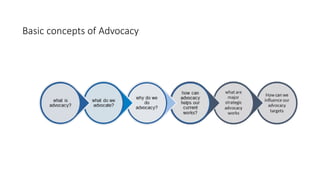
Basic concepts of Advocacy
What is the original meaning of advocacy?
 It’s definitions vary from context to context so that we come across many
different definitions of advocacy
 The word “advocacy” comes from the Latin ‘advocare’ and literally
means ‘to call out for support’
 From Cambridge dictionary; the word advocacy comes from advocātus
meaning
 witness, supporter, mediator or ‘one called on to aid
 “public support of an idea, plan, or way of doing something"
Definitions of advocacy
 It’s any action that speaks in favor of, recommends, argues for a cause, supports/ defends
and/or pleads on behalf of others for public’s consciousness about a particular issue
 Advocacy is any active action words that includes many aspects of civic engagement such as:
 identifying, influencing, supporting, recommending, representing, defending, intervening,
and changing legislation
 seeking change, promoting social justice, shaping social and political outcomes,
systematically influencing decision making, and educating the public with the purpose of
bringing about change
 challenging existing social structures and addresses population issues to be included
into policies and programs
Definition of advocacy
 It’s a strategic approach aims to inform and influence public opinion and
public policy within political and socio-economic context to create an enabling
environment and/or supportive policy for good governance
 It’s a tool for “putting a problem on the agenda, providing a solution to that
problem and building support for acting on both the problem and the solution”
What does mean advocacy as a field of study
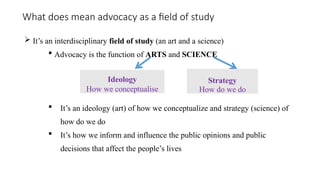
 It’s an interdisciplinary field of study (an art and a science)
 Advocacy is the function of ARTS and SCIENCE
 It’s an ideology (art) of how we conceptualize and strategy (science) of
how do we do
 It’s how we inform and influence the public opinions and public
decisions that affect the people’s lives
Ideology
How we conceptualise
Strategy
How do we do
Group discussions >>>
Why do we do advocacy?
We do Advocacy
• To address the root causes of public issues
• To improve the effectiveness and efficiency of public service delivery
• To influence public policies and specific initiatives
• To hold decision makers accountable
• To advance human rights
• To bring equitable & sustainable change
• To create a long lasting impacts
• To ensure good governance
Pair discussions
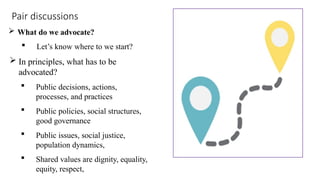
 What do we advocate?
 Let’s know where to we start?
 In principles, what has to be
advocated?
 Public decisions, actions,
processes, and practices
 Public policies, social structures,
good governance
 Public issues, social justice,
population dynamics,
 Shared values are dignity, equality,
equity, respect,
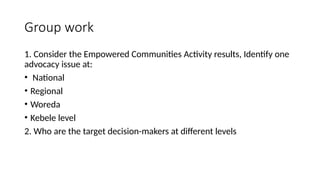
Group work
1. Consider the Empowered Communities Activity results, Identify one
advocacy issue at:
• National
• Regional
• Woreda
• Kebele level
2. Who are the target decision-makers at different levels
Advocacy and Related Concepts
Brainstorming
What are some concepts that are most
often confused with advocacy?
Advocacy and Related Concepts
Comparing Advocacy with each of the other concepts, you can see some
similarities but unlike other strategies:
• Advocacy must always have one or more decision maker/s as its target audience
• Advocacy must always have policy change as a goal, and such change must be
attained through a decision made by the target audience that is favorable to our
cause.
Advocacy activities can be as diverse as the group desires. This is one of the
reasons why Advocacy is easily confused with other strategies. Advocacy can use
IEC, public relations, lobbying, or community mobilization to achieve its goals.
Advocacy and Related Concepts
• Policy advocacy is… a set of targeted activities to inform and
influence decision makers to take a desired action to address
an issue.
• Advocacy is often confused with other types of strategies with
which it shares some features. It is important to distinguish
between Advocacy and other strategies so as to clarify what is
and what is not Advocacy.
Advocacy and Related Concepts
Reminder: In order to distinguish an Advocacy strategy from other
similar strategies, it is helpful to ask the following questions:
• Is the target audience a decision-maker?
• Is the main goal to generate policy change?
• If one of the answers is no, it is likely that this is not an Advocacy
strategy.
Advocacy Activities:
1.Campaigning for legislative reforms on healthcare or social issues.
2.Engaging media to raise awareness on key community concerns.
3.Collaborating with non-profits to address health disparities.
4.Conducting policy research to influence decision-makers.
5.Testifying at public hearings or government bodies on behalf of an
issue.
6.Coalition-building among stakeholders to support a cause.
7.Lobbying government officials to influence policy changes.
8.Grassroots organizing to mobilize communities for action.
• Non-Advocacy Activities:
1.Providing services directly to individuals (e.g., running a clinic or distributing food).
2.Fundraising for charity without an associated policy or issue-based goal.
3.Administrative work (e.g., managing organizational finances or staff).
4.Data collection without a specific goal to influence policy.
5.Delivering training programs not tied to advocacy outcomes.
6.Offering counseling or social work services.
7.Event planning for non-policy or non-advocacy purposes.
8.Project management for internal organizational activities.
9.Human resources tasks like hiring or employee onboarding.
10.
Technical assistance (e.g., helping organizations build capacity without promoting
specific change).
This distinction can help focus on activities that influence change versus those that
support operational goals.
What is a
community-led
advocacy approach?
Community-led advocacy approach
• A community-led advocacy approach is a strategy in which communities lead efforts
to address issues affecting them. Rather than being passive recipients of aid or
external solutions, community members actively participate in decision-making,
planning, and action.
Key principles of this approach include:
1.Empowerment: Communities are empowered to identify and prioritize their own
needs.
2.Participation: The community plays a central role in advocacy efforts, ensuring that
policymakers, institutions, or other stakeholders hear their voices.
3.Sustainability: By engaging the community in advocacy, the approach fosters more
sustainable outcomes because the solutions are rooted in local knowledge and
experience.
4.Equity and Inclusion: This approach aims to include marginalized or
underrepresented groups in advocacy, ensuring their perspectives are considered.
Community led advocacy approach
 Community-led-advocacy approach, in which:
 Empowering local communities able to demand their rights and giving citizens the
mandate to advocate and speaking up on their own behalf in addressing undernutrition
 Strengthening civil societies with the required capacities on advocacy roles and
positioning to
• advocate for the right of citizens and good governance
 It’s a collaborative approach between duty bears & right holders:
 To create working together with local communities, private sectors, CSOs, CBOs,
FBOs and OPDs to address undernutrition jointly and effectively
 Enable citizens in supporting their local leaders in making better decisions and
holding local government accountable for their own actions
 Enable duty bears being responsive in terms of equitable & increased service delivery
Community led advocacy approach…
 The impact of community-led-advocacy is much dependent on
strong
evidence and best practices from service delivery components.
 However, integrating service delivery and advocacy efforts has been
challenging
 because of a number of factors:
 poor community empowerment,
 lack of citizens access to information,
 political dominance, limit participation & voice of vulnerable groups,
 weak engagement b/n right holders & duty bears,
 lack of local ownership,
 poor transparence & accountability,
Designing Advocacy strategy
 How can we design
effective advocacy
strategy?
 What are the various
stages of advocacy
designing process in-
depth?
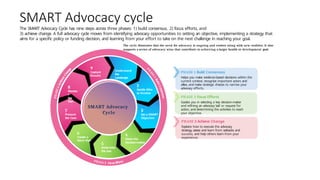
PHASE 1 Build Consensus
Helps you make evidence-based decisions within the
current context, recognize important actors and
allies, and make strategic choices to narrow your
advocacy efforts.
PHASE 2 Focus Efforts
Guides you in selecting a key decision-maker
and refining an advocacy ‘ask’ or request for
action, and determining the activities to reach
your objective.
Understand
the
Landscape
2
Decide Who
to Involve
3
Set a SMART
Objective
4
Know the
Decision-maker
5
Determine
the Ask
6
Create a
Work Plan
7
Present
the Case
8
Monito
r
the
Plan
9
Capture
Results
P
H
A
S
E
1
B
u
i
l
d
C
o
n
s
e
n
s
u
s
P
H
A
S
E
3
A
c
h
i
e
v
e
C
h
a
n
ge
PHASE 2 Fo
cus Efforts
SMART Advocacy
Cycle
PHASE 3 Achieve Change
Explains how to execute the advocacy
strategy, assess and learn from setbacks and
success, and help others learn from your
experience.
The SMART Advocacy Cycle has nine steps across three phases: 1) build consensus, 2) focus efforts, and
3) achieve change. A full advocacy cycle moves from identifying advocacy opportunities to setting an objective, implementing a strategy that
aims for a specific policy or funding decision, and learning from your effort to take on the next challenge in reaching your goal.
The cycle illustrates that the need for advocacy is ongoing and evolves along with new realities. It also
supports a series of advocacy wins that contribute to achieving a larger health or development goal.
1
SMART Advocacy cycle
Advocacy Steps : Central thoughts and reminders
•Advocacy initiatives are started because there is a
drive to change something
•Influencing the policy sphere may be a complex task
because of the various factors affecting such work.
Advocacy Steps : Central thoughts and reminders
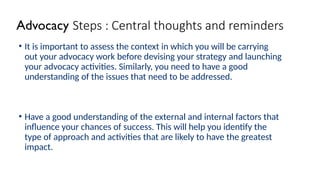
• It is important to assess the context in which you will be carrying
out your advocacy work before devising your strategy and launching
your advocacy activities. Similarly, you need to have a good
understanding of the issues that need to be addressed.
• Have a good understanding of the external and internal factors that
influence your chances of success. This will help you identify the
type of approach and activities that are likely to have the greatest
impact.
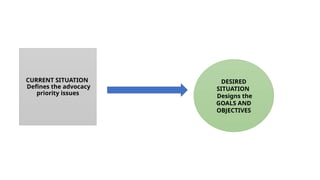
CURRENT SITUATION
Defines the advocacy
priority issues
DESIRED
SITUATION
Designs the
GOALS AND
OBJECTIVES
ADVOCACY M&E
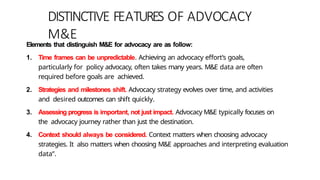
DISTINCTIVE FEATURES OF ADVOCACY
M&E
Elements that distinguish M&E for advocacy are as follow:
1. Time frames can be unpredictable. Achieving an advocacy effort’s goals,
particularly for policy advocacy, often takes many years. M&E data are often
required before goals are achieved.
2. Strategies and milestones shift. Advocacy strategy evolves over time, and activities
and desired outcomes can shift quickly.
3. Assessing progress is important, not just impact. Advocacy M&E typically focuses on
the advocacy journey rather than just the destination.
4. Context should always be considered. Context matters when choosing advocacy
strategies. It also matters when choosing M&E approaches and interpreting evaluation
data”.
PLANNING ADVOCACY M&E
• Planning for evaluation should occur at the start of an advocacy effort,
ideally while the strategy is being developed or soon after.
FIVE QUESTIONS FOR PLANNING ADVOCACY M&E:
1. Who are the M&E users?
2. How will M&E be used?
3. What evaluation design should be used?
4. What should be measured?
5. What data collection tools should be used?
How will M&E be used?
• Accountability
• Informing decision-making
• National and global
learning
Advocacy toolbox
• Advocacy message
• Change stories
• Infographics
• Position paper
• Policy brief
• Shadow report
• Budget brief
• Documentary
Reporting in Advocacy
Group discussion:
Suppose you organized an advocacy workshop recently. In your Advocacy workshop report
summary, what key points should be included.
Reporting in Advocacy
• Reporting in advocacy is a critical aspect of any advocacy campaign or initiative. It
involves documenting, tracking, and sharing progress, outcomes, and lessons learned
throughout the advocacy process.
• Advocacy reporting serves multiple purposes, from ensuring transparency and
accountability to informing stakeholders and reinforcing the case for change.
advocacy reporting format.xlsx
ADVOCACY CAPACITY OF NSAs Overview
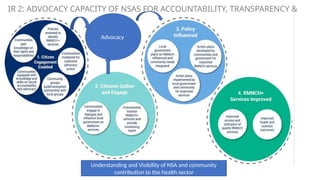
IR 2: ADVOCACY CAPACITY OF NSAS FOR ACCOUNTABILITY, TRANSPARENCY &
RESPONSIVENESS OF HEALTH SYSTEM STRENGTHENED
Advocacy
Understanding and Visibility of NSA and community
contribution to the health sector
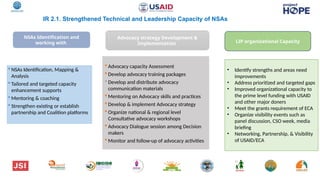
NSAs Identification and
working with
Advocacy strategy Development &
Implementation LIP organizational Capacity
IR 2.1. Strengthened Technical and Leadership Capacity of NSAs
 NSAs Identification, Mapping &
Analysis
 Tailored and targeted capacity
enhancement supports
 Mentoring & coaching
 Strengthen existing or establish
partnership and Coalition platforms
 Advocacy capacity Assessment
 Develop advocacy training packages
 Develop and distribute advocacy
communication materials
 Mentoring on Advocacy skills and practices
 Develop & implement Advocacy strategy
 Organize national & regional level
Consultative advocacy workshops
 Advocacy Dialogue session among Decision
makers
 Monitor and follow-up of advocacy activities
• Identify strengths and areas need
improvements
• Address prioritized and targeted gaps
• Improved organizational capacity to
the prime level funding with USAID
and other major doners
• Meet the grants requirement of ECA
• Organize visibility events such as
panel discussion, CSO week, media
briefing
• Networking, Partnership, & Visibility
of USAID/ECA
NSA Visibility
What comes to your mind when you read None State Actors (NSA)
Write down them, then discuss in your table (5 minutes)
Any relevance to the advocacy of RMNCAH-N service?, (10 minutes)
Non-State Actors
NSAs are non-government stakeholders, formally registered or non-registered,
national or international in the health care system, and can play a vital role in
strengthening health governance, specifically to ensure that disadvantaged
segments of the community get access to quality health care by strengthening
accountability and responsiveness.
Operational Definition of NSA
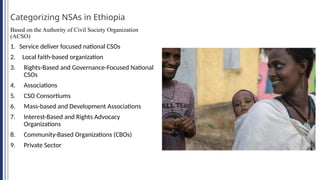
Categorizing NSAs in Ethiopia
Based on the Authority of Civil Society Organization
(ACSO)
1. Service deliver focused national CSOs
2. Local faith-based organization
3. Rights-Based and Governance-Focused National
CSOs
4. Associations
5. CSO Consortiums
6. Mass-based and Development Associations
7. Interest-Based and Rights Advocacy
Organizations
8. Community-Based Organizations (CBOs)
9. Private Sector
A Shift Towards a More Enabling Environment
1 Pre-2009
The period before 2009 witnessed a relatively open operating space for civil society organizations (CSOs) in Ethiopia. This era allowed for
greater freedom in terms of registration, funding, and program engagement. The government perceived CSOs as valuable partners in
development, fostering collaborative efforts.
2 2009-2019
This period saw a marked shift towards a more restrictive legal framework for CSOs. The enactment of Proclamation
#621/2009 imposed limitations on CSO operations, particularly regarding funding, registration, and program
implementation. These restrictions impacted the sector's capacity to operate effectively.
3 Post 2019
The passage of Proclamation #1113/2019 in 2019 marked a significant turning point for the Ethiopian civil society sector. The new law replaced
the restrictive Proclamation #621/2009, creating a more favorable environment for CSOs to operate, particularly concerning registration,
funding, and program engagement. This shift facilitated a greater role for self-regulation within the sector.
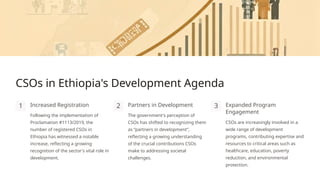
CSOs in Ethiopia's Development Agenda
1 Increased Registration
Following the implementation of
Proclamation #1113/2019, the
number of registered CSOs in
Ethiopia has witnessed a notable
increase, reflecting a growing
recognition of the sector's vital role in
development.
2 Partners in Development
The government's perception of
CSOs has shifted to recognizing them
as “partners in development”,
reflecting a growing understanding
of the crucial contributions CSOs
make to addressing societal
challenges.
3 Expanded Program
Engagement
CSOs are increasingly involved in a
wide range of development
programs, contributing expertise and
resources to critical areas such as
healthcare, education, poverty
reduction, and environmental
protection.
Self-Regulation and Collaboration: Key
Pillars of Growth
Self-Regulation
The new legal framework emphasizes self-regulation within the civil society sector, granting
CSOs greater autonomy in managing their operations and promoting ethical practices. This
approach aims to foster greater accountability and responsibility.
Ethiopian Civil Society Organizations Council (ECSOC)
The establishment of the ECSOC is a crucial step towards strengthening the CSO sector by
providing a platform for representation and ensuring self-regulation. The council serves as a
unifying body, fostering collaboration and advocating for CSOs' interests.
Government-CSO Collaboration
The revitalization of GO-CSO forums at the regional level has fostered stronger partnerships
between the government and CSOs. This enhanced collaboration encourages active
participation by CSOs in setting agendas and leading forums, creating a more inclusive and
collaborative environment for development initiatives.
Challenges and Opportunities
Challenges
Despite the positive developments, the Ethiopian CSO
sector continues to face challenges. These include
navigating the complexities of the regulatory
landscape, securing sustainable funding, and building
organizational capacity. There is also a need for
greater diversity within the sector to ensure inclusivity
and reach all communities effectively.
Opportunities
The sector presents exciting opportunities for
continued growth and impact. By leveraging the
newfound legal framework, strengthening self-
regulation, fostering partnerships, and addressing
challenges head-on, the Ethiopian CSO sector has the
potential to play an even greater role in promoting
sustainable development and improving the lives of
Ethiopians.
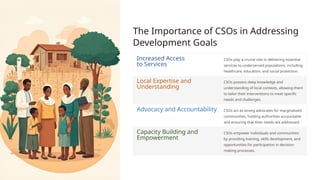
The Importance of CSOs in Addressing
Development Goals
Increased Access
to Services
CSOs play a crucial role in delivering essential
services to underserved populations, including
healthcare, education, and social protection.
Local Expertise and
Understanding
CSOs possess deep knowledge and
understanding of local contexts, allowing them
to tailor their interventions to meet specific
needs and challenges.
Advocacy and Accountability CSOs act as strong advocates for marginalized
communities, holding authorities accountable
and ensuring that their needs are addressed.
Capacity Building and
Empowerment
CSOs empower individuals and communities
by providing training, skills development, and
opportunities for participation in decision-
making processes.
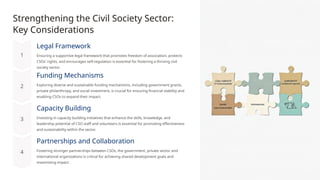
Strengthening the Civil Society Sector:
Key Considerations
Legal Framework
Ensuring a supportive legal framework that promotes freedom of association, protects
CSOs' rights, and encourages self-regulation is essential for fostering a thriving civil
society sector.
Funding Mechanisms
Exploring diverse and sustainable funding mechanisms, including government grants,
private philanthropy, and social investment, is crucial for ensuring financial stability and
enabling CSOs to expand their impact.
Capacity Building
Investing in capacity building initiatives that enhance the skills, knowledge, and
leadership potential of CSO staff and volunteers is essential for promoting effectiveness
and sustainability within the sector.
Partnerships and Collaboration
Fostering stronger partnerships between CSOs, the government, private sector, and
international organizations is critical for achieving shared development goals and
maximizing impact.
Future of NSAs: A Vision for Progress
Continued Growth
With a supportive legal
framework, increased funding,
and a focus on capacity building,
the Ethiopian CSO sector has the
potential to continue its growth
and expand its impact across all
sectors of society.
Enhanced Partnerships
Fostering strong partnerships
with the government, private
sector, and international
organizations will create a more
cohesive and impactful civil
society sector.
Advocacy and
Accountability
CSOs will continue to play a crucial
role in advocating for human
rights, promoting good
governance, and holding
authorities accountable for their
actions.
Empowerment and
Participation
Empowering communities and
fostering greater participation in
decision-making processes will
ensure that development
initiatives are truly inclusive and
sustainable.
NSA to the USAID/ECA project
• Actors having stakes in strengthening the Health Care System,
RMNCAH-N, not in state apparatus
• Pertinent Actors in our community, helping us to influence the
decision makers,
• NSAs who can support us in health-related service delivery, capacity
development, advocacy, and SA mechanisms
Key USAID-ECA roles LIP roles
• Map and analyze NSAs, kebele to
federal levels
• Assess advocacy capacity of
selected NSAs
• Provide targeted support to
selected NSAs in selected
capacities
• Jointly implement USAID/ECA
project, mainly to the advocacy
areas
• Support and facilitate NSAs
mapping, kebele to zonal levels
• Jointly assess the advocacy
capacity of selected NSAs
• Facilitate the provision of targeted
support to selected NSAs in your
target areas
• Collaborate, facilitate, and lead
the advocacy of RMNCAH-N
efforts in your target areas
Thanks, for your attention

Advocacy orientation training revised.pptx

  • 1.
  • 2.
    Outline •Basic Concept ofAdvocacy •Community-led Advocacy •Advocacy Strategy • Advocacy M&E •Overview Advocacy Activity •NSA Visibility
  • 3.
  • 4.
    What is theoriginal meaning of advocacy?  It’s definitions vary from context to context so that we come across many different definitions of advocacy  The word “advocacy” comes from the Latin ‘advocare’ and literally means ‘to call out for support’  From Cambridge dictionary; the word advocacy comes from advocātus meaning  witness, supporter, mediator or ‘one called on to aid  “public support of an idea, plan, or way of doing something"
  • 5.
    Definitions of advocacy It’s any action that speaks in favor of, recommends, argues for a cause, supports/ defends and/or pleads on behalf of others for public’s consciousness about a particular issue  Advocacy is any active action words that includes many aspects of civic engagement such as:  identifying, influencing, supporting, recommending, representing, defending, intervening, and changing legislation  seeking change, promoting social justice, shaping social and political outcomes, systematically influencing decision making, and educating the public with the purpose of bringing about change  challenging existing social structures and addresses population issues to be included into policies and programs
  • 6.
    Definition of advocacy It’s a strategic approach aims to inform and influence public opinion and public policy within political and socio-economic context to create an enabling environment and/or supportive policy for good governance  It’s a tool for “putting a problem on the agenda, providing a solution to that problem and building support for acting on both the problem and the solution”
  • 7.
    What does meanadvocacy as a field of study  It’s an interdisciplinary field of study (an art and a science)  Advocacy is the function of ARTS and SCIENCE  It’s an ideology (art) of how we conceptualize and strategy (science) of how do we do  It’s how we inform and influence the public opinions and public decisions that affect the people’s lives Ideology How we conceptualise Strategy How do we do
  • 8.
    Group discussions >>> Whydo we do advocacy?
  • 9.
    We do Advocacy •To address the root causes of public issues • To improve the effectiveness and efficiency of public service delivery • To influence public policies and specific initiatives • To hold decision makers accountable • To advance human rights • To bring equitable & sustainable change • To create a long lasting impacts • To ensure good governance
  • 10.
    Pair discussions  Whatdo we advocate?  Let’s know where to we start?  In principles, what has to be advocated?  Public decisions, actions, processes, and practices  Public policies, social structures, good governance  Public issues, social justice, population dynamics,  Shared values are dignity, equality, equity, respect,
  • 12.
    Group work 1. Considerthe Empowered Communities Activity results, Identify one advocacy issue at: • National • Regional • Woreda • Kebele level 2. Who are the target decision-makers at different levels
  • 13.
  • 14.
    Advocacy and RelatedConcepts Brainstorming What are some concepts that are most often confused with advocacy?
  • 15.
    Advocacy and RelatedConcepts Comparing Advocacy with each of the other concepts, you can see some similarities but unlike other strategies: • Advocacy must always have one or more decision maker/s as its target audience • Advocacy must always have policy change as a goal, and such change must be attained through a decision made by the target audience that is favorable to our cause. Advocacy activities can be as diverse as the group desires. This is one of the reasons why Advocacy is easily confused with other strategies. Advocacy can use IEC, public relations, lobbying, or community mobilization to achieve its goals.
  • 16.
    Advocacy and RelatedConcepts • Policy advocacy is… a set of targeted activities to inform and influence decision makers to take a desired action to address an issue. • Advocacy is often confused with other types of strategies with which it shares some features. It is important to distinguish between Advocacy and other strategies so as to clarify what is and what is not Advocacy.
  • 17.
    Advocacy and RelatedConcepts Reminder: In order to distinguish an Advocacy strategy from other similar strategies, it is helpful to ask the following questions: • Is the target audience a decision-maker? • Is the main goal to generate policy change? • If one of the answers is no, it is likely that this is not an Advocacy strategy.
  • 18.
    Advocacy Activities: 1.Campaigning forlegislative reforms on healthcare or social issues. 2.Engaging media to raise awareness on key community concerns. 3.Collaborating with non-profits to address health disparities. 4.Conducting policy research to influence decision-makers. 5.Testifying at public hearings or government bodies on behalf of an issue. 6.Coalition-building among stakeholders to support a cause. 7.Lobbying government officials to influence policy changes. 8.Grassroots organizing to mobilize communities for action.
  • 19.
    • Non-Advocacy Activities: 1.Providingservices directly to individuals (e.g., running a clinic or distributing food). 2.Fundraising for charity without an associated policy or issue-based goal. 3.Administrative work (e.g., managing organizational finances or staff). 4.Data collection without a specific goal to influence policy. 5.Delivering training programs not tied to advocacy outcomes. 6.Offering counseling or social work services. 7.Event planning for non-policy or non-advocacy purposes. 8.Project management for internal organizational activities. 9.Human resources tasks like hiring or employee onboarding. 10. Technical assistance (e.g., helping organizations build capacity without promoting specific change). This distinction can help focus on activities that influence change versus those that support operational goals.
  • 20.
  • 21.
    Community-led advocacy approach •A community-led advocacy approach is a strategy in which communities lead efforts to address issues affecting them. Rather than being passive recipients of aid or external solutions, community members actively participate in decision-making, planning, and action. Key principles of this approach include: 1.Empowerment: Communities are empowered to identify and prioritize their own needs. 2.Participation: The community plays a central role in advocacy efforts, ensuring that policymakers, institutions, or other stakeholders hear their voices. 3.Sustainability: By engaging the community in advocacy, the approach fosters more sustainable outcomes because the solutions are rooted in local knowledge and experience. 4.Equity and Inclusion: This approach aims to include marginalized or underrepresented groups in advocacy, ensuring their perspectives are considered.
  • 22.
    Community led advocacyapproach  Community-led-advocacy approach, in which:  Empowering local communities able to demand their rights and giving citizens the mandate to advocate and speaking up on their own behalf in addressing undernutrition  Strengthening civil societies with the required capacities on advocacy roles and positioning to • advocate for the right of citizens and good governance  It’s a collaborative approach between duty bears & right holders:  To create working together with local communities, private sectors, CSOs, CBOs, FBOs and OPDs to address undernutrition jointly and effectively  Enable citizens in supporting their local leaders in making better decisions and holding local government accountable for their own actions  Enable duty bears being responsive in terms of equitable & increased service delivery
  • 23.
    Community led advocacyapproach…  The impact of community-led-advocacy is much dependent on strong evidence and best practices from service delivery components.  However, integrating service delivery and advocacy efforts has been challenging  because of a number of factors:  poor community empowerment,  lack of citizens access to information,  political dominance, limit participation & voice of vulnerable groups,  weak engagement b/n right holders & duty bears,  lack of local ownership,  poor transparence & accountability,
  • 24.
    Designing Advocacy strategy How can we design effective advocacy strategy?  What are the various stages of advocacy designing process in- depth?
  • 25.
    PHASE 1 BuildConsensus Helps you make evidence-based decisions within the current context, recognize important actors and allies, and make strategic choices to narrow your advocacy efforts. PHASE 2 Focus Efforts Guides you in selecting a key decision-maker and refining an advocacy ‘ask’ or request for action, and determining the activities to reach your objective. Understand the Landscape 2 Decide Who to Involve 3 Set a SMART Objective 4 Know the Decision-maker 5 Determine the Ask 6 Create a Work Plan 7 Present the Case 8 Monito r the Plan 9 Capture Results P H A S E 1 B u i l d C o n s e n s u s P H A S E 3 A c h i e v e C h a n ge PHASE 2 Fo cus Efforts SMART Advocacy Cycle PHASE 3 Achieve Change Explains how to execute the advocacy strategy, assess and learn from setbacks and success, and help others learn from your experience. The SMART Advocacy Cycle has nine steps across three phases: 1) build consensus, 2) focus efforts, and 3) achieve change. A full advocacy cycle moves from identifying advocacy opportunities to setting an objective, implementing a strategy that aims for a specific policy or funding decision, and learning from your effort to take on the next challenge in reaching your goal. The cycle illustrates that the need for advocacy is ongoing and evolves along with new realities. It also supports a series of advocacy wins that contribute to achieving a larger health or development goal. 1 SMART Advocacy cycle
  • 26.
    Advocacy Steps :Central thoughts and reminders •Advocacy initiatives are started because there is a drive to change something •Influencing the policy sphere may be a complex task because of the various factors affecting such work.
  • 27.
    Advocacy Steps :Central thoughts and reminders • It is important to assess the context in which you will be carrying out your advocacy work before devising your strategy and launching your advocacy activities. Similarly, you need to have a good understanding of the issues that need to be addressed. • Have a good understanding of the external and internal factors that influence your chances of success. This will help you identify the type of approach and activities that are likely to have the greatest impact.
  • 28.
    CURRENT SITUATION Defines theadvocacy priority issues DESIRED SITUATION Designs the GOALS AND OBJECTIVES
  • 29.
  • 30.
    DISTINCTIVE FEATURES OFADVOCACY M&E Elements that distinguish M&E for advocacy are as follow: 1. Time frames can be unpredictable. Achieving an advocacy effort’s goals, particularly for policy advocacy, often takes many years. M&E data are often required before goals are achieved. 2. Strategies and milestones shift. Advocacy strategy evolves over time, and activities and desired outcomes can shift quickly. 3. Assessing progress is important, not just impact. Advocacy M&E typically focuses on the advocacy journey rather than just the destination. 4. Context should always be considered. Context matters when choosing advocacy strategies. It also matters when choosing M&E approaches and interpreting evaluation data”.
  • 31.
    PLANNING ADVOCACY M&E •Planning for evaluation should occur at the start of an advocacy effort, ideally while the strategy is being developed or soon after. FIVE QUESTIONS FOR PLANNING ADVOCACY M&E: 1. Who are the M&E users? 2. How will M&E be used? 3. What evaluation design should be used? 4. What should be measured? 5. What data collection tools should be used?
  • 32.
    How will M&Ebe used? • Accountability • Informing decision-making • National and global learning
  • 33.
    Advocacy toolbox • Advocacymessage • Change stories • Infographics • Position paper • Policy brief • Shadow report • Budget brief • Documentary
  • 34.
    Reporting in Advocacy Groupdiscussion: Suppose you organized an advocacy workshop recently. In your Advocacy workshop report summary, what key points should be included.
  • 35.
    Reporting in Advocacy •Reporting in advocacy is a critical aspect of any advocacy campaign or initiative. It involves documenting, tracking, and sharing progress, outcomes, and lessons learned throughout the advocacy process. • Advocacy reporting serves multiple purposes, from ensuring transparency and accountability to informing stakeholders and reinforcing the case for change. advocacy reporting format.xlsx
  • 36.
    ADVOCACY CAPACITY OFNSAs Overview
  • 37.
    IR 2: ADVOCACYCAPACITY OF NSAS FOR ACCOUNTABILITY, TRANSPARENCY & RESPONSIVENESS OF HEALTH SYSTEM STRENGTHENED Advocacy Understanding and Visibility of NSA and community contribution to the health sector
  • 38.
    NSAs Identification and workingwith Advocacy strategy Development & Implementation LIP organizational Capacity IR 2.1. Strengthened Technical and Leadership Capacity of NSAs  NSAs Identification, Mapping & Analysis  Tailored and targeted capacity enhancement supports  Mentoring & coaching  Strengthen existing or establish partnership and Coalition platforms  Advocacy capacity Assessment  Develop advocacy training packages  Develop and distribute advocacy communication materials  Mentoring on Advocacy skills and practices  Develop & implement Advocacy strategy  Organize national & regional level Consultative advocacy workshops  Advocacy Dialogue session among Decision makers  Monitor and follow-up of advocacy activities • Identify strengths and areas need improvements • Address prioritized and targeted gaps • Improved organizational capacity to the prime level funding with USAID and other major doners • Meet the grants requirement of ECA • Organize visibility events such as panel discussion, CSO week, media briefing • Networking, Partnership, & Visibility of USAID/ECA
  • 39.
  • 40.
    What comes toyour mind when you read None State Actors (NSA) Write down them, then discuss in your table (5 minutes) Any relevance to the advocacy of RMNCAH-N service?, (10 minutes) Non-State Actors
  • 41.
    NSAs are non-governmentstakeholders, formally registered or non-registered, national or international in the health care system, and can play a vital role in strengthening health governance, specifically to ensure that disadvantaged segments of the community get access to quality health care by strengthening accountability and responsiveness. Operational Definition of NSA
  • 42.
    Categorizing NSAs inEthiopia Based on the Authority of Civil Society Organization (ACSO) 1. Service deliver focused national CSOs 2. Local faith-based organization 3. Rights-Based and Governance-Focused National CSOs 4. Associations 5. CSO Consortiums 6. Mass-based and Development Associations 7. Interest-Based and Rights Advocacy Organizations 8. Community-Based Organizations (CBOs) 9. Private Sector
  • 43.
    A Shift Towardsa More Enabling Environment 1 Pre-2009 The period before 2009 witnessed a relatively open operating space for civil society organizations (CSOs) in Ethiopia. This era allowed for greater freedom in terms of registration, funding, and program engagement. The government perceived CSOs as valuable partners in development, fostering collaborative efforts. 2 2009-2019 This period saw a marked shift towards a more restrictive legal framework for CSOs. The enactment of Proclamation #621/2009 imposed limitations on CSO operations, particularly regarding funding, registration, and program implementation. These restrictions impacted the sector's capacity to operate effectively. 3 Post 2019 The passage of Proclamation #1113/2019 in 2019 marked a significant turning point for the Ethiopian civil society sector. The new law replaced the restrictive Proclamation #621/2009, creating a more favorable environment for CSOs to operate, particularly concerning registration, funding, and program engagement. This shift facilitated a greater role for self-regulation within the sector.
  • 44.
    CSOs in Ethiopia'sDevelopment Agenda 1 Increased Registration Following the implementation of Proclamation #1113/2019, the number of registered CSOs in Ethiopia has witnessed a notable increase, reflecting a growing recognition of the sector's vital role in development. 2 Partners in Development The government's perception of CSOs has shifted to recognizing them as “partners in development”, reflecting a growing understanding of the crucial contributions CSOs make to addressing societal challenges. 3 Expanded Program Engagement CSOs are increasingly involved in a wide range of development programs, contributing expertise and resources to critical areas such as healthcare, education, poverty reduction, and environmental protection.
  • 45.
    Self-Regulation and Collaboration:Key Pillars of Growth Self-Regulation The new legal framework emphasizes self-regulation within the civil society sector, granting CSOs greater autonomy in managing their operations and promoting ethical practices. This approach aims to foster greater accountability and responsibility. Ethiopian Civil Society Organizations Council (ECSOC) The establishment of the ECSOC is a crucial step towards strengthening the CSO sector by providing a platform for representation and ensuring self-regulation. The council serves as a unifying body, fostering collaboration and advocating for CSOs' interests. Government-CSO Collaboration The revitalization of GO-CSO forums at the regional level has fostered stronger partnerships between the government and CSOs. This enhanced collaboration encourages active participation by CSOs in setting agendas and leading forums, creating a more inclusive and collaborative environment for development initiatives.
  • 46.
    Challenges and Opportunities Challenges Despitethe positive developments, the Ethiopian CSO sector continues to face challenges. These include navigating the complexities of the regulatory landscape, securing sustainable funding, and building organizational capacity. There is also a need for greater diversity within the sector to ensure inclusivity and reach all communities effectively. Opportunities The sector presents exciting opportunities for continued growth and impact. By leveraging the newfound legal framework, strengthening self- regulation, fostering partnerships, and addressing challenges head-on, the Ethiopian CSO sector has the potential to play an even greater role in promoting sustainable development and improving the lives of Ethiopians.
  • 47.
    The Importance ofCSOs in Addressing Development Goals Increased Access to Services CSOs play a crucial role in delivering essential services to underserved populations, including healthcare, education, and social protection. Local Expertise and Understanding CSOs possess deep knowledge and understanding of local contexts, allowing them to tailor their interventions to meet specific needs and challenges. Advocacy and Accountability CSOs act as strong advocates for marginalized communities, holding authorities accountable and ensuring that their needs are addressed. Capacity Building and Empowerment CSOs empower individuals and communities by providing training, skills development, and opportunities for participation in decision- making processes.
  • 48.
    Strengthening the CivilSociety Sector: Key Considerations Legal Framework Ensuring a supportive legal framework that promotes freedom of association, protects CSOs' rights, and encourages self-regulation is essential for fostering a thriving civil society sector. Funding Mechanisms Exploring diverse and sustainable funding mechanisms, including government grants, private philanthropy, and social investment, is crucial for ensuring financial stability and enabling CSOs to expand their impact. Capacity Building Investing in capacity building initiatives that enhance the skills, knowledge, and leadership potential of CSO staff and volunteers is essential for promoting effectiveness and sustainability within the sector. Partnerships and Collaboration Fostering stronger partnerships between CSOs, the government, private sector, and international organizations is critical for achieving shared development goals and maximizing impact.
  • 49.
    Future of NSAs:A Vision for Progress Continued Growth With a supportive legal framework, increased funding, and a focus on capacity building, the Ethiopian CSO sector has the potential to continue its growth and expand its impact across all sectors of society. Enhanced Partnerships Fostering strong partnerships with the government, private sector, and international organizations will create a more cohesive and impactful civil society sector. Advocacy and Accountability CSOs will continue to play a crucial role in advocating for human rights, promoting good governance, and holding authorities accountable for their actions. Empowerment and Participation Empowering communities and fostering greater participation in decision-making processes will ensure that development initiatives are truly inclusive and sustainable.
  • 50.
    NSA to theUSAID/ECA project • Actors having stakes in strengthening the Health Care System, RMNCAH-N, not in state apparatus • Pertinent Actors in our community, helping us to influence the decision makers, • NSAs who can support us in health-related service delivery, capacity development, advocacy, and SA mechanisms
  • 51.
    Key USAID-ECA rolesLIP roles • Map and analyze NSAs, kebele to federal levels • Assess advocacy capacity of selected NSAs • Provide targeted support to selected NSAs in selected capacities • Jointly implement USAID/ECA project, mainly to the advocacy areas • Support and facilitate NSAs mapping, kebele to zonal levels • Jointly assess the advocacy capacity of selected NSAs • Facilitate the provision of targeted support to selected NSAs in your target areas • Collaborate, facilitate, and lead the advocacy of RMNCAH-N efforts in your target areas
  • 52.