

ADVOCACY 101
George Banks, Jr. | EDET722-J62
gbanksjr@email.sc.edu
20 minutes Click ANYWHERE on the screen to begin…
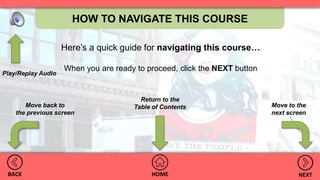
HOW TO NAVIGATE THIS COURSE
HOMEBACK NEXT
Here’s a quick guide for navigating this course…
When you are ready to proceed, click the NEXT button
Move back to
the previous screen
Move to the
next screen
Return to the
Table of Contents
Play/Replay Audio
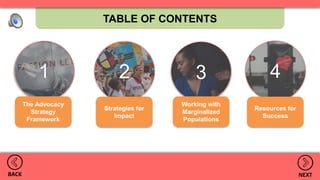
TABLE OF CONTENTS
BACK NEXT
1
The Advocacy
Strategy
Framework
2
Strategies for
Impact
3
Working with
Marginalized
Populations
4
Resources for
Success
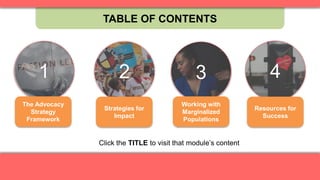
TABLE OF CONTENTS
1
The Advocacy
Strategy
Framework
2
Strategies for
Impact
3
Working with
Marginalized
Populations
4
Resources for
Success
Click the TITLE to visit that module’s content
WHAT WILL YOU LEARN TODAY?
HOMEBACK NEXT
Advocacy is “any action that speaks in favor of,
recommends, argues for a cause, supports or
defends, or pleads on behalf of others.”
- Alliance for Justice, 2017
This course will equip you with tools and strategies
to enhance how you conduct advocacy
PRETEST
HOMEBACK NEXT
What is your
personal
experience
with
advocacy?
How is
advocacy
related to the
current work
you do?
Why is
advocacy
important to
you?
PERFORMANCE OBJECTIVES
HOMEBACK NEXT
Given examples or characteristics of a group of individuals, the learner will be
able to identify the type of audience according to Coffman and Beer’s (2015)
Advocacy Strategy Framework.
2.1
Given Coffman and Beer’s (2015) Advocacy Strategy Framework, you will be
able to identify examples of the two axes: changes and audiences.
1.1
2.2
Given types of advocacy-related strategies, the learner will be able to
compare and contrast the most relevant outcome
By the end of the course, you will be able to perform the following…
PERFORMANCE OBJECTIVES (CONT.)
HOMEBACK NEXT
Given outcomes or solutions to issues facing marginalized populations, the
learner will be able to select the best advocacy-related strategy to reach
that outcome.
3.2
Given examples, learners will be able to discern between the characteristics of
a marginalized population and a general population..
3.1
4.1
Given examples of an advocacy-related issue or cause, the learner will be able
to identify the resource most beneficial to supporting that issue.
By the end of the course, you will be able to perform the following…
MODULE ONE
THE ADVOCACY STRATEGY FRAMEWORK
HOMEBACK NEXT
MODULE ONE OBJECTIVES
HOMEBACK NEXT
Given examples or characteristics of a group of individuals, the learner will be
able to identify the type of audience according to Coffman and Beer’s (2015)
Advocacy Strategy Framework.
2.1
Given Coffman and Beer’s (2015) Advocacy Strategy Framework, learners will
be able to identify examples of the two axes: changes and audiences.1.1
By the end of this module, you will be able to perform the following:
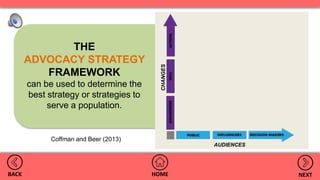
THE
ADVOCACY STRATEGY
FRAMEWORK
can be used to determine the
best strategy or strategies to
serve a population.
HOMEBACK NEXT
AUDIENCES
CHANGES
Coffman and Beer (2013)
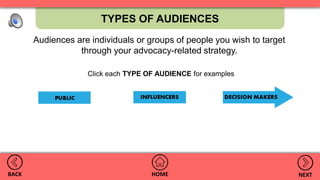
TYPES OF AUDIENCES
HOMEBACK NEXT
Audiences are individuals or groups of people you wish to target
through your advocacy-related strategy.
Click each TYPE OF AUDIENCE for examples
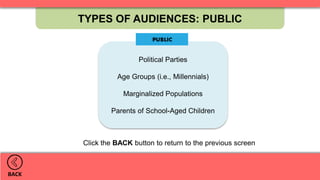
Political Parties
Age Groups (i.e., Millennials)
Marginalized Populations
Parents of School-Aged Children
TYPES OF AUDIENCES: PUBLIC
BACK
Click the BACK button to return to the previous screen
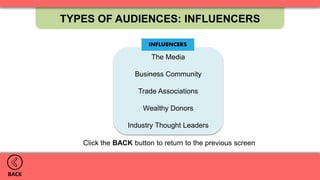
TYPES OF AUDIENCES: INFLUENCERS
BACK
The Media
Business Community
Trade Associations
Wealthy Donors
Industry Thought Leaders
Click the BACK button to return to the previous screen
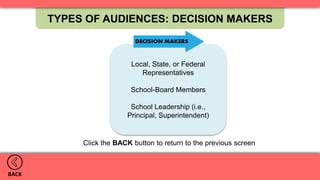
TYPES OF AUDIENCES: DECISION MAKERS
BACK
Local, State, or Federal
Representatives
School-Board Members
School Leadership (i.e.,
Principal, Superintendent)
Click the BACK button to return to the previous screen
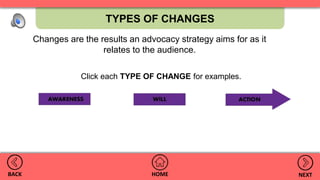
TYPES OF CHANGES
HOMEBACK NEXT
Changes are the results an advocacy strategy aims for as it
relates to the audience.
Click each TYPE OF CHANGE for examples.
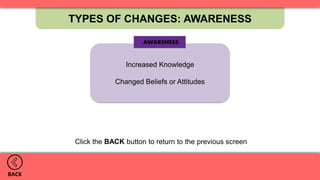
Increased Knowledge
Changed Beliefs or Attitudes
TYPES OF CHANGES: AWARENESS
BACK
Click the BACK button to return to the previous screen
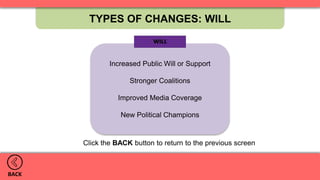
Increased Public Will or Support
Stronger Coalitions
Improved Media Coverage
New Political Champions
TYPES OF CHANGES: WILL
BACK
Click the BACK button to return to the previous screen
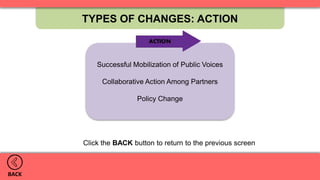
Successful Mobilization of Public Voices
Collaborative Action Among Partners
Policy Change
TYPES OF CHANGES: ACTION
BACK
Click the BACK button to return to the previous screen
An individual or collective
of people who have the
power to influence the
status quo and enact
change.
Individuals who have the
legislative authority and
power to enact change in
laws and policy at the
local, state, national or
international level.
The general population
or a specific segment of
the general population.
LET’S REVIEW!
HOMEBACK
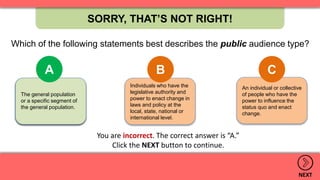
Which of the following statements best describes the public audience type?
A B C
.
Click a LETTER to respond.
An individual or collective
of people who have the
power to influence the
status quo and enact
change.
Individuals who have the
legislative authority and
power to enact change in
laws and policy at the
local, state, national or
international level.
The general population
or a specific segment of
the general population.
SORRY, THAT’S NOT RIGHT!
NEXT
A B C
.
The general population
or a specific segment of
the general population.
A
You are incorrect. The correct answer is “A.”
Click the NEXT button to continue.
Which of the following statements best describes the public audience type?
An individual or collective
of people who have the
power to influence the
status quo and enact
change.
Individuals who have the
legislative authority and
power to enact change in
laws and policy at the
local, state, national or
international level.
The general population
or a specific segment of
the general population.
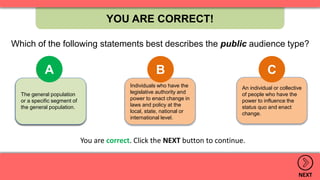
YOU ARE CORRECT!
NEXT
A B C
.
You are correct. Click the NEXT button to continue.
The general population
or a specific segment of
the general population.
A
Which of the following statements best describes the public audience type?
MODULE TWO
STRATEGIES FOR IMPACT
HOMEBACK NEXT
MODULE TWO OBJECTIVE
HOMEBACK NEXT
By the end of this module, you will be able to perform the following:
2.2
Given types of advocacy-related strategies, the learner will be able to
compare and contrast the most relevant outcome
THE
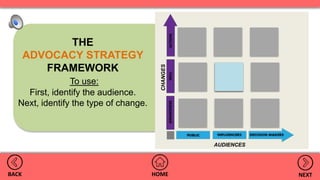
ADVOCACY STRATEGY
FRAMEWORK
To use:
First, identify the audience.
Next, identify the type of change.
HOMEBACK NEXT
AUDIENCES
CHANGES
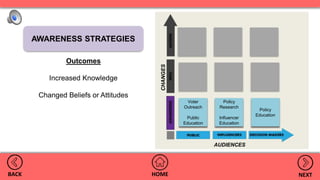
Outcomes
Increased Knowledge
Changed Beliefs or Attitudes
HOMEBACK NEXT
AUDIENCES
CHANGES
Voter
Outreach
Public
Education
Policy
Research
Influencer
Education
Policy
Education
AWARENESS STRATEGIES
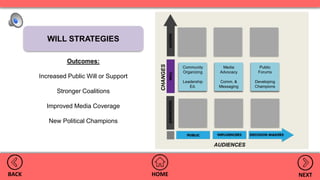
Outcomes:
Increased Public Will or Support
Stronger Coalitions
Improved Media Coverage
New Political Champions
HOMEBACK NEXT
AUDIENCES
CHANGES
Community
Organizing
Leadership
Ed.
Media
Advocacy
Comm. &
Messaging
Public
Forums
Developing
Champions
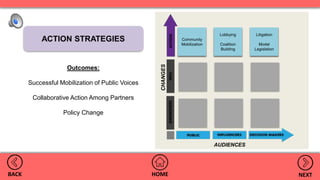
WILL STRATEGIES
Outcomes:
Successful Mobilization of Public Voices
Collaborative Action Among Partners
Policy Change
HOMEBACK NEXT
AUDIENCES
CHANGES
Community
Mobilization
Lobbying
Coalition
Building
Litigation
Model
Legislation
ACTION STRATEGIES
LET’S REVIEW!
HOMEBACK NEXT
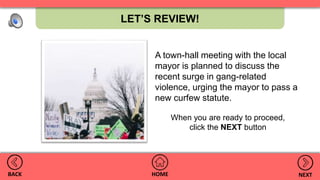
A town-hall meeting with the local
mayor is planned to discuss the
recent surge in gang-related
violence, urging the mayor to pass a
new curfew statute.
When you are ready to proceed,
click the NEXT button
More expansive
media coverage
Policy change at
the local level
Driving public
engagement with
this issue
LET’S REVIEW!
HOMEBACK
A B C
.
Click a LETTER to respond.
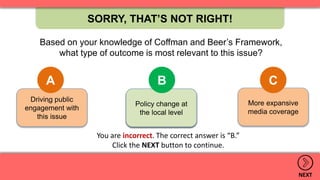
Based on your knowledge of Coffman and Beer’s Framework,
what type of outcome is most relevant to this issue?
More expansive
media coverage
Policy change at
the local level
Driving public
engagement with
this issue
YOU ARE CORRECT!
NEXT
Based on your knowledge of Coffman and Beer’s Framework,
what type of outcome is most relevant to this issue?
A B C
.
Policy change at
the local level
B
You are correct. Click the NEXT button to continue.
More expansive
media coverage
Policy change at
the local level
Driving public
engagement with
this issue
SORRY, THAT’S NOT RIGHT!
NEXT
Based on your knowledge of Coffman and Beer’s Framework,
what type of outcome is most relevant to this issue?
A B C
.
Policy change at
the local level
B
You are incorrect. The correct answer is “B.”
Click the NEXT button to continue.
MODULE THREE
UNDERSTANDING MARGINALIZED POPULATIONS
HOMEBACK NEXT
MODULE THREE OBJECTIVES
HOMEBACK NEXT
Given outcomes or solutions to issues facing marginalized populations,
you will be able to select the best advocacy-related strategy to reach that
outcome.
3.2
Given examples, you will be able to discern between the characteristics of
a marginalized population and a general population..
3.1
By the end of this module, you will be able to perform the following:
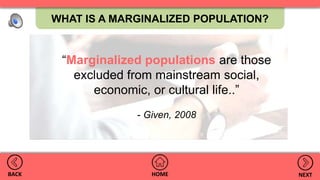
WHAT IS A MARGINALIZED POPULATION?
HOMEBACK NEXT
“Marginalized populations are those
excluded from mainstream social,
economic, or cultural life..”
- Given, 2008
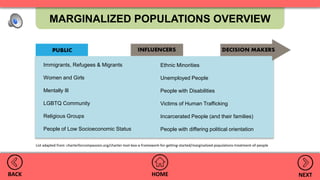
MARGINALIZED POPULATIONS OVERVIEW
HOMEBACK NEXT
Immigrants, Refugees & Migrants
Women and Girls
Mentally Ill
LGBTQ Community
Religious Groups
People of Low Socioeconomic Status
Ethnic Minorities
Unemployed People
People with Disabilities
Victims of Human Trafficking
Incarcerated People (and their families)
People with differing political orientation
List adapted from: charterforcompassion.org/charter-tool-box-a-framework-for-getting-started/marginalized-populations-treatment-of-people
MARGINALIZED POPULATIONS
HOMEBACK NEXT
AUDIENCES
CHANGES
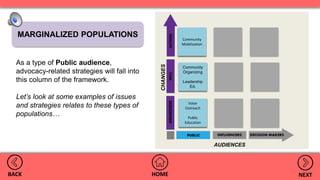
As a type of Public audience,
advocacy-related strategies will fall into
this column of the framework.
Let’s look at some examples of issues
and strategies relates to these types of
populations…
Voter
Outreach
Public
Education
Community
Organizing
Leadership
Ed.
Community
Mobilization
HOMEBACK NEXT
AUDIENCES
CHANGES
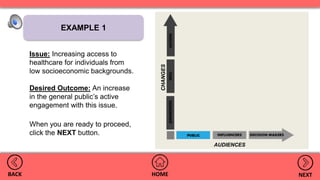
EXAMPLE 1
Issue: Increasing access to
healthcare for individuals from
low socioeconomic backgrounds.
Desired Outcome: An increase
in the general public’s active
engagement with this issue.
When you are ready to proceed,
click the NEXT button.
HOMEBACK NEXT
AUDIENCES
CHANGES
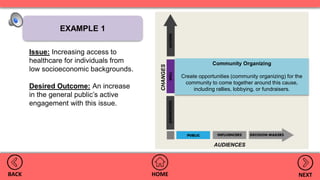
EXAMPLE 1
Issue: Increasing access to
healthcare for individuals from
low socioeconomic backgrounds.
Desired Outcome: An increase
in the general public’s active
engagement with this issue.
Community Organizing
Create opportunities (community organizing) for the
community to come together around this cause,
including rallies, lobbying, or fundraisers.
HOMEBACK NEXT
AUDIENCES
CHANGES
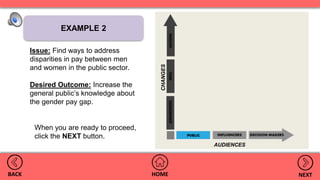
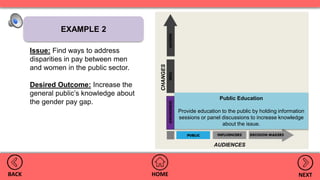
EXAMPLE 2
Issue: Find ways to address
disparities in pay between men
and women in the public sector.
Desired Outcome: Increase the
general public’s knowledge about
the gender pay gap.
When you are ready to proceed,
click the NEXT button.
HOMEBACK NEXT
AUDIENCES
CHANGES
EXAMPLE 2
Issue: Find ways to address
disparities in pay between men
and women in the public sector.
Desired Outcome: Increase the
general public’s knowledge about
the gender pay gap.
Public Education
Provide education to the public by holding information
sessions or panel discussions to increase knowledge
about the issue.
HOMEBACK NEXT
AUDIENCES
CHANGES
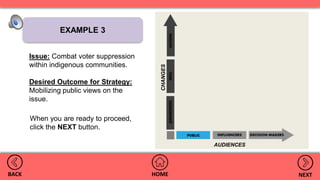
EXAMPLE 3
Issue: Combat voter suppression
within indigenous communities.
Desired Outcome for Strategy:
Mobilizing public views on the
issue.
When you are ready to proceed,
click the NEXT button.
HOMEBACK NEXT
AUDIENCES
CHANGES
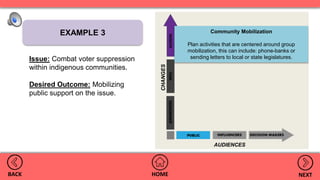
EXAMPLE 3
Issue: Combat voter suppression
within indigenous communities.
Desired Outcome: Mobilizing
public support on the issue.
Community Mobilization
Plan activities that are centered around group
mobilization, this can include: phone-banks or
sending letters to local or state legislatures.
LET’S REVIEW!
HOMEBACK NEXT
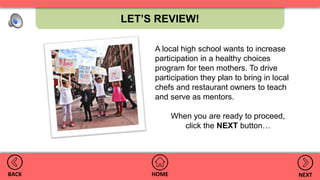
A local high school wants to increase
participation in a healthy choices
program for teen mothers. To drive
participation they plan to bring in local
chefs and restaurant owners to teach
and serve as mentors.
When you are ready to proceed,
click the NEXT button…
Changes in beliefs as
it refers to this issue
Mobilizing public
views on the issue
Increased
collaboration among
community leaders
LET’S REVIEW!
HOMEBACK
Based on your knowledge of Coffman and Beer’s Framework and marginalized
populations, what type of outcome is most relevant to this strategy?
A B C
.
Click a LETTER to respond.
SORRY, THAT’S NOT RIGHT!
NEXT
You are incorrect. The correct answer is “A.”
Click the NEXT button to continue.
Changes in beliefs as
it refers to this issue
Mobilizing public
views on the issue
Increased
collaboration among
community leaders
A B C
.
Based on your knowledge of Coffman and Beer’s Framework and marginalized
populations, what type of outcome is most relevant to this strategy?
YOU ARE CORRECT!
NEXT
.
You are correct. Click the NEXT button to continue.
Changes in beliefs as
it refers to this issue
Mobilizing public
views on the issue
Increased
collaboration among
community leaders
A B C
Based on your knowledge of Coffman and Beer’s Framework and marginalized
populations, what type of outcome is most relevant to this strategy?
MODULE FOUR
RESOURCES FOR SUCCESS
HOMEBACK NEXT
MODULE FOUR OBJECTIVE
HOMEBACK NEXT
4.1
Given examples of an advocacy-related issue or cause, you will be able to
identify the resource most beneficial to supporting that issue.
By the end of this module, you will be able to perform the following:
WHAT IS A COMMUNITY RESOURCE?
HOMEBACK NEXT
Support the strategy by providing infrastructure or space for the
strategy to be executed.
Physical
Support the strategy by providing manpower and dissemination
of information to the public..
Social
Support the strategy by providing funds or capital to enact the
required change.
Financial
A community resource is “anything that can be used to improve the
quality of a [particular] community’s life.” (Berkowitz and Wadud, 2016)
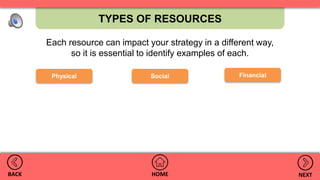
TYPES OF RESOURCES
HOMEBACK NEXT
Each resource can impact your strategy in a different way,
so it is essential to identify examples of each.
Physical Social Financial
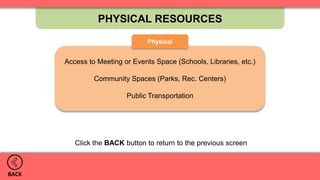
PHYSICAL RESOURCES
BACK
Access to Meeting or Events Space (Schools, Libraries, etc.)
Community Spaces (Parks, Rec. Centers)
Public Transportation
Physical
Click the BACK button to return to the previous screen
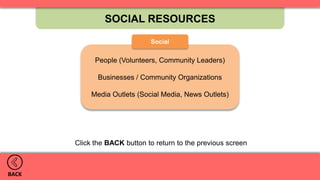
People (Volunteers, Community Leaders)
Businesses / Community Organizations
Media Outlets (Social Media, News Outlets)
SOCIAL RESOURCES
BACK
Social
Click the BACK button to return to the previous screen
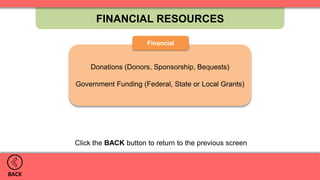
Donations (Donors, Sponsorship, Bequests)
Government Funding (Federal, State or Local Grants)
FINANCIAL RESOURCES
BACK
Financial
Click the BACK button to return to the previous screen
LET’S REVIEW
HOMEBACK NEXT
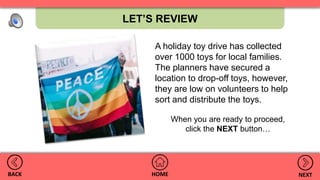
A holiday toy drive has collected
over 1000 toys for local families.
The planners have secured a
location to drop-off toys, however,
they are low on volunteers to help
sort and distribute the toys.
When you are ready to proceed,
click the NEXT button…
SocialPhysicalFinancial
LET’S REVIEW
HOMEBACK
A B C
.
Based on your knowledge of community resources, which type of
resource would be most beneficial to supporting this initiative?
Click a LETTER to respond.
SocialPhysicalFinancial
YOU ARE CORRECT!
NEXT
A B C
.
Based on your knowledge of community resources, which type of
resource would be most beneficial to supporting this initiative?
You are correct. Click the NEXT button to continue.
SocialPhysicalFinancial
SORRY, THAT’S NOT RIGHT!
NEXT
A B C
.
Based on your knowledge of community resources, which type of
resource would be most beneficial to supporting this initiative?
You are incorrect. The correct answer is “C”
Click the NEXT button to continue.
IT’S TIME FOR AN ASSESSMENT!
HOMEBACK
https://goo.gl/forms/1whkh4mv9cw3g2UJ2
Congratulations! You’ve completed all content for this course.
It’s time to assess what you’ve learned.
Click the link below to take your assessment.
REFERENCES
Adams, N. (2017, January 29). Little girls protest [Photograph]. Retrieved from:
https://unsplash.com/search/children?photo=mKw4eamvjKA
Coffman, J. & Beer, T. (2015, March) The Advocacy Strategy Framework: A tool for articulating an advocacy
theory of change. Retrieved from
http://www.evaluationinnovation.org/sites/default/files/Adocacy%20Strategy%20Framework.pdf
Charter for Compassion. (2017) Marginalized people: Treatment for compassion. Retrieved from
http://www/charterforcompassion.org/charter-tool-box-a-framework-for-getting-started/marginalized-
populations-treatment-of-people
Donovan-Rouse, A. (2017, January 27). Peace [Photograph] Retrieved from
https://unsplash.com/search/protest?photo=1TqTPPz3xpg
Donovan-Rouse, A. (2017, January 23). We the people [Photograph] Retrieved from
https://unsplash.com/search/protest?photo=LjAU2mwdmX0
REFERENCES
Given, L. (2008) The SAGE encyclopedia of qualitative research methods (Vol. 2). Los Angeles, CA:
Sage Publications.
Kaupanger, K. (2017, Feb 1). Make america love again [Photograph] Retrieved from
https://unsplash.com/collections/602629/advocacy?photo=ihH2ztuBTOs
Newman, C. (2016, September 26). Advocacy [Photograph] Retrieved from
https://unsplash.com/collections/602629/advocacy?photo=tnxRFtXI9dI
Schneider, I. (2016, February 16). Passion led us here [Photograph]
https://unsplash.com/search/passion?photo=TamMbr4okv4
Tchompalov, V. (2017, May 7th) . Water is life [Photograph] Retrieved from
https://unsplash.com/search/protest?photo=cpAKc-G6lPg

Advocacy 101 PowerPoint Presentation

  • 1.
    ADVOCACY 101 George Banks,Jr. | EDET722-J62 gbanksjr@email.sc.edu 20 minutes Click ANYWHERE on the screen to begin…
  • 2.
    HOW TO NAVIGATETHIS COURSE HOMEBACK NEXT Here’s a quick guide for navigating this course… When you are ready to proceed, click the NEXT button Move back to the previous screen Move to the next screen Return to the Table of Contents Play/Replay Audio
  • 3.
    TABLE OF CONTENTS BACKNEXT 1 The Advocacy Strategy Framework 2 Strategies for Impact 3 Working with Marginalized Populations 4 Resources for Success
  • 4.
    TABLE OF CONTENTS 1 TheAdvocacy Strategy Framework 2 Strategies for Impact 3 Working with Marginalized Populations 4 Resources for Success Click the TITLE to visit that module’s content
  • 5.
    WHAT WILL YOULEARN TODAY? HOMEBACK NEXT Advocacy is “any action that speaks in favor of, recommends, argues for a cause, supports or defends, or pleads on behalf of others.” - Alliance for Justice, 2017 This course will equip you with tools and strategies to enhance how you conduct advocacy
  • 6.
    PRETEST HOMEBACK NEXT What isyour personal experience with advocacy? How is advocacy related to the current work you do? Why is advocacy important to you?
  • 7.
    PERFORMANCE OBJECTIVES HOMEBACK NEXT Givenexamples or characteristics of a group of individuals, the learner will be able to identify the type of audience according to Coffman and Beer’s (2015) Advocacy Strategy Framework. 2.1 Given Coffman and Beer’s (2015) Advocacy Strategy Framework, you will be able to identify examples of the two axes: changes and audiences. 1.1 2.2 Given types of advocacy-related strategies, the learner will be able to compare and contrast the most relevant outcome By the end of the course, you will be able to perform the following…
  • 8.
    PERFORMANCE OBJECTIVES (CONT.) HOMEBACKNEXT Given outcomes or solutions to issues facing marginalized populations, the learner will be able to select the best advocacy-related strategy to reach that outcome. 3.2 Given examples, learners will be able to discern between the characteristics of a marginalized population and a general population.. 3.1 4.1 Given examples of an advocacy-related issue or cause, the learner will be able to identify the resource most beneficial to supporting that issue. By the end of the course, you will be able to perform the following…
  • 9.
    MODULE ONE THE ADVOCACYSTRATEGY FRAMEWORK HOMEBACK NEXT
  • 10.
    MODULE ONE OBJECTIVES HOMEBACKNEXT Given examples or characteristics of a group of individuals, the learner will be able to identify the type of audience according to Coffman and Beer’s (2015) Advocacy Strategy Framework. 2.1 Given Coffman and Beer’s (2015) Advocacy Strategy Framework, learners will be able to identify examples of the two axes: changes and audiences.1.1 By the end of this module, you will be able to perform the following:
  • 11.
    THE ADVOCACY STRATEGY FRAMEWORK can beused to determine the best strategy or strategies to serve a population. HOMEBACK NEXT AUDIENCES CHANGES Coffman and Beer (2013)
  • 12.
    TYPES OF AUDIENCES HOMEBACKNEXT Audiences are individuals or groups of people you wish to target through your advocacy-related strategy. Click each TYPE OF AUDIENCE for examples
  • 13.
    Political Parties Age Groups(i.e., Millennials) Marginalized Populations Parents of School-Aged Children TYPES OF AUDIENCES: PUBLIC BACK Click the BACK button to return to the previous screen
  • 14.
    TYPES OF AUDIENCES:INFLUENCERS BACK The Media Business Community Trade Associations Wealthy Donors Industry Thought Leaders Click the BACK button to return to the previous screen
  • 15.
    TYPES OF AUDIENCES:DECISION MAKERS BACK Local, State, or Federal Representatives School-Board Members School Leadership (i.e., Principal, Superintendent) Click the BACK button to return to the previous screen
  • 16.
    TYPES OF CHANGES HOMEBACKNEXT Changes are the results an advocacy strategy aims for as it relates to the audience. Click each TYPE OF CHANGE for examples.
  • 17.
    Increased Knowledge Changed Beliefsor Attitudes TYPES OF CHANGES: AWARENESS BACK Click the BACK button to return to the previous screen
  • 18.
    Increased Public Willor Support Stronger Coalitions Improved Media Coverage New Political Champions TYPES OF CHANGES: WILL BACK Click the BACK button to return to the previous screen
  • 19.
    Successful Mobilization ofPublic Voices Collaborative Action Among Partners Policy Change TYPES OF CHANGES: ACTION BACK Click the BACK button to return to the previous screen
  • 20.
    An individual orcollective of people who have the power to influence the status quo and enact change. Individuals who have the legislative authority and power to enact change in laws and policy at the local, state, national or international level. The general population or a specific segment of the general population. LET’S REVIEW! HOMEBACK Which of the following statements best describes the public audience type? A B C . Click a LETTER to respond.
  • 21.
    An individual orcollective of people who have the power to influence the status quo and enact change. Individuals who have the legislative authority and power to enact change in laws and policy at the local, state, national or international level. The general population or a specific segment of the general population. SORRY, THAT’S NOT RIGHT! NEXT A B C . The general population or a specific segment of the general population. A You are incorrect. The correct answer is “A.” Click the NEXT button to continue. Which of the following statements best describes the public audience type?
  • 22.
    An individual orcollective of people who have the power to influence the status quo and enact change. Individuals who have the legislative authority and power to enact change in laws and policy at the local, state, national or international level. The general population or a specific segment of the general population. YOU ARE CORRECT! NEXT A B C . You are correct. Click the NEXT button to continue. The general population or a specific segment of the general population. A Which of the following statements best describes the public audience type?
  • 23.
    MODULE TWO STRATEGIES FORIMPACT HOMEBACK NEXT
  • 24.
    MODULE TWO OBJECTIVE HOMEBACKNEXT By the end of this module, you will be able to perform the following: 2.2 Given types of advocacy-related strategies, the learner will be able to compare and contrast the most relevant outcome
  • 25.
    THE ADVOCACY STRATEGY FRAMEWORK To use: First,identify the audience. Next, identify the type of change. HOMEBACK NEXT AUDIENCES CHANGES
  • 26.
    Outcomes Increased Knowledge Changed Beliefsor Attitudes HOMEBACK NEXT AUDIENCES CHANGES Voter Outreach Public Education Policy Research Influencer Education Policy Education AWARENESS STRATEGIES
  • 27.
    Outcomes: Increased Public Willor Support Stronger Coalitions Improved Media Coverage New Political Champions HOMEBACK NEXT AUDIENCES CHANGES Community Organizing Leadership Ed. Media Advocacy Comm. & Messaging Public Forums Developing Champions WILL STRATEGIES
  • 28.
    Outcomes: Successful Mobilization ofPublic Voices Collaborative Action Among Partners Policy Change HOMEBACK NEXT AUDIENCES CHANGES Community Mobilization Lobbying Coalition Building Litigation Model Legislation ACTION STRATEGIES
  • 29.
    LET’S REVIEW! HOMEBACK NEXT Atown-hall meeting with the local mayor is planned to discuss the recent surge in gang-related violence, urging the mayor to pass a new curfew statute. When you are ready to proceed, click the NEXT button
  • 30.
    More expansive media coverage Policychange at the local level Driving public engagement with this issue LET’S REVIEW! HOMEBACK A B C . Click a LETTER to respond. Based on your knowledge of Coffman and Beer’s Framework, what type of outcome is most relevant to this issue?
  • 31.
    More expansive media coverage Policychange at the local level Driving public engagement with this issue YOU ARE CORRECT! NEXT Based on your knowledge of Coffman and Beer’s Framework, what type of outcome is most relevant to this issue? A B C . Policy change at the local level B You are correct. Click the NEXT button to continue.
  • 32.
    More expansive media coverage Policychange at the local level Driving public engagement with this issue SORRY, THAT’S NOT RIGHT! NEXT Based on your knowledge of Coffman and Beer’s Framework, what type of outcome is most relevant to this issue? A B C . Policy change at the local level B You are incorrect. The correct answer is “B.” Click the NEXT button to continue.
  • 33.
    MODULE THREE UNDERSTANDING MARGINALIZEDPOPULATIONS HOMEBACK NEXT
  • 34.
    MODULE THREE OBJECTIVES HOMEBACKNEXT Given outcomes or solutions to issues facing marginalized populations, you will be able to select the best advocacy-related strategy to reach that outcome. 3.2 Given examples, you will be able to discern between the characteristics of a marginalized population and a general population.. 3.1 By the end of this module, you will be able to perform the following:
  • 35.
    WHAT IS AMARGINALIZED POPULATION? HOMEBACK NEXT “Marginalized populations are those excluded from mainstream social, economic, or cultural life..” - Given, 2008
  • 36.
    MARGINALIZED POPULATIONS OVERVIEW HOMEBACKNEXT Immigrants, Refugees & Migrants Women and Girls Mentally Ill LGBTQ Community Religious Groups People of Low Socioeconomic Status Ethnic Minorities Unemployed People People with Disabilities Victims of Human Trafficking Incarcerated People (and their families) People with differing political orientation List adapted from: charterforcompassion.org/charter-tool-box-a-framework-for-getting-started/marginalized-populations-treatment-of-people
  • 37.
    MARGINALIZED POPULATIONS HOMEBACK NEXT AUDIENCES CHANGES Asa type of Public audience, advocacy-related strategies will fall into this column of the framework. Let’s look at some examples of issues and strategies relates to these types of populations… Voter Outreach Public Education Community Organizing Leadership Ed. Community Mobilization
  • 38.
    HOMEBACK NEXT AUDIENCES CHANGES EXAMPLE 1 Issue:Increasing access to healthcare for individuals from low socioeconomic backgrounds. Desired Outcome: An increase in the general public’s active engagement with this issue. When you are ready to proceed, click the NEXT button.
  • 39.
    HOMEBACK NEXT AUDIENCES CHANGES EXAMPLE 1 Issue:Increasing access to healthcare for individuals from low socioeconomic backgrounds. Desired Outcome: An increase in the general public’s active engagement with this issue. Community Organizing Create opportunities (community organizing) for the community to come together around this cause, including rallies, lobbying, or fundraisers.
  • 40.
    HOMEBACK NEXT AUDIENCES CHANGES EXAMPLE 2 Issue:Find ways to address disparities in pay between men and women in the public sector. Desired Outcome: Increase the general public’s knowledge about the gender pay gap. When you are ready to proceed, click the NEXT button.
  • 41.
    HOMEBACK NEXT AUDIENCES CHANGES EXAMPLE 2 Issue:Find ways to address disparities in pay between men and women in the public sector. Desired Outcome: Increase the general public’s knowledge about the gender pay gap. Public Education Provide education to the public by holding information sessions or panel discussions to increase knowledge about the issue.
  • 42.
    HOMEBACK NEXT AUDIENCES CHANGES EXAMPLE 3 Issue:Combat voter suppression within indigenous communities. Desired Outcome for Strategy: Mobilizing public views on the issue. When you are ready to proceed, click the NEXT button.
  • 43.
    HOMEBACK NEXT AUDIENCES CHANGES EXAMPLE 3 Issue:Combat voter suppression within indigenous communities. Desired Outcome: Mobilizing public support on the issue. Community Mobilization Plan activities that are centered around group mobilization, this can include: phone-banks or sending letters to local or state legislatures.
  • 44.
    LET’S REVIEW! HOMEBACK NEXT Alocal high school wants to increase participation in a healthy choices program for teen mothers. To drive participation they plan to bring in local chefs and restaurant owners to teach and serve as mentors. When you are ready to proceed, click the NEXT button…
  • 45.
    Changes in beliefsas it refers to this issue Mobilizing public views on the issue Increased collaboration among community leaders LET’S REVIEW! HOMEBACK Based on your knowledge of Coffman and Beer’s Framework and marginalized populations, what type of outcome is most relevant to this strategy? A B C . Click a LETTER to respond.
  • 46.
    SORRY, THAT’S NOTRIGHT! NEXT You are incorrect. The correct answer is “A.” Click the NEXT button to continue. Changes in beliefs as it refers to this issue Mobilizing public views on the issue Increased collaboration among community leaders A B C . Based on your knowledge of Coffman and Beer’s Framework and marginalized populations, what type of outcome is most relevant to this strategy?
  • 47.
    YOU ARE CORRECT! NEXT . Youare correct. Click the NEXT button to continue. Changes in beliefs as it refers to this issue Mobilizing public views on the issue Increased collaboration among community leaders A B C Based on your knowledge of Coffman and Beer’s Framework and marginalized populations, what type of outcome is most relevant to this strategy?
  • 48.
    MODULE FOUR RESOURCES FORSUCCESS HOMEBACK NEXT
  • 49.
    MODULE FOUR OBJECTIVE HOMEBACKNEXT 4.1 Given examples of an advocacy-related issue or cause, you will be able to identify the resource most beneficial to supporting that issue. By the end of this module, you will be able to perform the following:
  • 50.
    WHAT IS ACOMMUNITY RESOURCE? HOMEBACK NEXT Support the strategy by providing infrastructure or space for the strategy to be executed. Physical Support the strategy by providing manpower and dissemination of information to the public.. Social Support the strategy by providing funds or capital to enact the required change. Financial A community resource is “anything that can be used to improve the quality of a [particular] community’s life.” (Berkowitz and Wadud, 2016)
  • 51.
    TYPES OF RESOURCES HOMEBACKNEXT Each resource can impact your strategy in a different way, so it is essential to identify examples of each. Physical Social Financial
  • 52.
    PHYSICAL RESOURCES BACK Access toMeeting or Events Space (Schools, Libraries, etc.) Community Spaces (Parks, Rec. Centers) Public Transportation Physical Click the BACK button to return to the previous screen
  • 53.
    People (Volunteers, CommunityLeaders) Businesses / Community Organizations Media Outlets (Social Media, News Outlets) SOCIAL RESOURCES BACK Social Click the BACK button to return to the previous screen
  • 54.
    Donations (Donors, Sponsorship,Bequests) Government Funding (Federal, State or Local Grants) FINANCIAL RESOURCES BACK Financial Click the BACK button to return to the previous screen
  • 55.
    LET’S REVIEW HOMEBACK NEXT Aholiday toy drive has collected over 1000 toys for local families. The planners have secured a location to drop-off toys, however, they are low on volunteers to help sort and distribute the toys. When you are ready to proceed, click the NEXT button…
  • 56.
    SocialPhysicalFinancial LET’S REVIEW HOMEBACK A BC . Based on your knowledge of community resources, which type of resource would be most beneficial to supporting this initiative? Click a LETTER to respond.
  • 57.
    SocialPhysicalFinancial YOU ARE CORRECT! NEXT AB C . Based on your knowledge of community resources, which type of resource would be most beneficial to supporting this initiative? You are correct. Click the NEXT button to continue.
  • 58.
    SocialPhysicalFinancial SORRY, THAT’S NOTRIGHT! NEXT A B C . Based on your knowledge of community resources, which type of resource would be most beneficial to supporting this initiative? You are incorrect. The correct answer is “C” Click the NEXT button to continue.
  • 59.
    IT’S TIME FORAN ASSESSMENT! HOMEBACK https://goo.gl/forms/1whkh4mv9cw3g2UJ2 Congratulations! You’ve completed all content for this course. It’s time to assess what you’ve learned. Click the link below to take your assessment.
  • 60.
    REFERENCES Adams, N. (2017,January 29). Little girls protest [Photograph]. Retrieved from: https://unsplash.com/search/children?photo=mKw4eamvjKA Coffman, J. & Beer, T. (2015, March) The Advocacy Strategy Framework: A tool for articulating an advocacy theory of change. Retrieved from http://www.evaluationinnovation.org/sites/default/files/Adocacy%20Strategy%20Framework.pdf Charter for Compassion. (2017) Marginalized people: Treatment for compassion. Retrieved from http://www/charterforcompassion.org/charter-tool-box-a-framework-for-getting-started/marginalized- populations-treatment-of-people Donovan-Rouse, A. (2017, January 27). Peace [Photograph] Retrieved from https://unsplash.com/search/protest?photo=1TqTPPz3xpg Donovan-Rouse, A. (2017, January 23). We the people [Photograph] Retrieved from https://unsplash.com/search/protest?photo=LjAU2mwdmX0
  • 61.
    REFERENCES Given, L. (2008)The SAGE encyclopedia of qualitative research methods (Vol. 2). Los Angeles, CA: Sage Publications. Kaupanger, K. (2017, Feb 1). Make america love again [Photograph] Retrieved from https://unsplash.com/collections/602629/advocacy?photo=ihH2ztuBTOs Newman, C. (2016, September 26). Advocacy [Photograph] Retrieved from https://unsplash.com/collections/602629/advocacy?photo=tnxRFtXI9dI Schneider, I. (2016, February 16). Passion led us here [Photograph] https://unsplash.com/search/passion?photo=TamMbr4okv4 Tchompalov, V. (2017, May 7th) . Water is life [Photograph] Retrieved from https://unsplash.com/search/protest?photo=cpAKc-G6lPg

Editor's Notes

  • #2 Welcome to Advocacy 101 – This course will take you approximately 20 minutes to complete. To begin click anywhere on the screen.
  • #3 Here’s a quick guide for navigating this course, when you are ready to begin this course, click the next button.
  • #4 This course is split into four brief modules. Section 1: The Advocacy Strategy Framework – will review Coffman and Beer’s framework of advocacy-related strategies Section 2 :Will dive deeper into specific strategies you can use to make an impact on your community. Section 3: As working with marginalized populations is a large part of the advocacy related work you do, Section 3 reviews strategies relevant to these types of populations. Lastly, Section 4: Resources for success, will highlight specific community resources that support your advocacy strategies.
  • #5 This course is split into four brief modules. Section 1: The Advocacy Strategy Framework – will review Coffman and Beer’s framework of advocacy-related strategies Section 2 :Will dive deeper into specific strategies you can use to make an impact on your community. Section 3: As working with marginalized populations is a large part of the advocacy related work you do, Section 3 reviews strategies relevant to these types of populations. Lastly, Section 4: Resources for success, will highlight specific community resources that support your advocacy strategies.
  • #6 According to Alliance for Justice, Advocacy is “any action that speaks in favor of, recommends, argues for a cause, supports or defends, In order to successfully uplift it is essential to develop strategies and outcomes. This course will equip you with tools and strategies to help you become a better advocate and make a greater impact on the communities you serve.
  • #7 As you take this course, think about the following questions: What is your personal experience with advocacy? How is advocacy related to the work you do? Why is advocacy important to you? This will better prepare you to utilize the tips and tools you’ve learned after taking this course.
  • #8 By the end of this course you will be able to meet these learning objectives.
  • #9 By the end of this instruction unit you will be able to meet these learning objectives
  • #10 In this section we will review Coffman and Beer’s Advocacy Strategy Framework.
  • #12 The Advocacy Strategy Framework can be used to determine the best strategy or strategies to serve a population. It is organized around two concepts. Audiences that you wish to target (the x-axis) and Changes or impacts you wish to make through these audiences (the y-axis). Based on the audience types and changes a strategy can be selected. These strategies will be reviewed later in this training module.
  • #13 Audiences relate to an individual or collective of people who have the power to influence the status quo and enact change. There are three types of audiences in the Advocacy Strategy Framework. Public definition: The general population or a specific segment of the general population.   Influencers definition: An individual or collective of people who have the power to influence the status quo and enact change.   Decision Makers definition: Individuals who have the legislative authority and power to enact change in laws and policy at the local, state, national or international level.
  • #14 Audiences relate to an individual or collective of people who have the power to influence the status quo and enact change. There are three types of audiences in the Advocacy Strategy Framework. Public definition: The general population or a specific segment of the general population.   Influencers definition: An individual or collective of people who have the power to influence the status quo and enact change.   Decision Makers definition: Individuals who have the legislative authority and power to enact change in laws and policy at the local, state, national or international level.
  • #15 Audiences relate to an individual or collective of people who have the power to influence the status quo and enact change. There are three types of audiences in the Advocacy Strategy Framework. Public definition: The general population or a specific segment of the general population.   Influencers definition: An individual or collective of people who have the power to influence the status quo and enact change.   Decision Makers definition: Individuals who have the legislative authority and power to enact change in laws and policy at the local, state, national or international level.
  • #16 Audiences relate to an individual or collective of people who have the power to influence the status quo and enact change. There are three types of audiences in the Advocacy Strategy Framework. Public definition: The general population or a specific segment of the general population.   Influencers definition: An individual or collective of people who have the power to influence the status quo and enact change.   Decision Makers definition: Individuals who have the legislative authority and power to enact change in laws and policy at the local, state, national or international level.
  • #17 In order to work with an audience to make an impact, you need to be able to identify the type of results you are looking for. By keeping the type of change you wish to create in mind, you can then select the best advocacy related strategy. This framework includes three types of changes. Awareness definition: Will definition: Increasing an audience’s desire to take action on a specific issue, cause or policy.   Action definition: When an audience is actively involved in tasks or activities that drive change for a specific issue, cause or policy.
  • #18 In order to work with an audience to make an impact, you need to be able to identify the type of results you are looking for. By keeping the type of change you wish to create in mind, you can then select the best advocacy related strategy. This framework includes three types of changes. Awareness definition: Will definition: Increasing an audience’s desire to take action on a specific issue, cause or policy.   Action definition: When an audience is actively involved in tasks or activities that drive change for a specific issue, cause or policy.
  • #19 In order to work with an audience to make an impact, you need to be able to identify the type of results you are looking for. By keeping the type of change you wish to create in mind, you can then select the best advocacy related strategy. This framework includes three types of changes. Awareness definition: Will definition: Increasing an audience’s desire to take action on a specific issue, cause or policy.   Action definition: When an audience is actively involved in tasks or activities that drive change for a specific issue, cause or policy.
  • #20 In order to work with an audience to make an impact, you need to be able to identify the type of results you are looking for. By keeping the type of change you wish to create in mind, you can then select the best advocacy related strategy. This framework includes three types of changes. Awareness definition: Will definition: Increasing an audience’s desire to take action on a specific issue, cause or policy.   Action definition: When an audience is actively involved in tasks or activities that drive change for a specific issue, cause or policy.
  • #21 Now that you’ve been provided an overview of the Advocacy Strategy Framework, it’s time to review what you just learned. To select the best answer, click a letter.
  • #22 Now that you’ve been provided an overview of the Advocacy Strategy Framework, it’s time to review what you just learned. To select the best answer, click a letter.
  • #23 Now that you’ve been provided an overview of the Advocacy Strategy Framework, it’s time to review what you just learned. To select the best answer, click a letter.
  • #25 In MODULE ONE you received an overview of the Advocacy Strategy Framework. In this section you will learn about the outcomes that these strategies can drive.
  • #26 In order to use the framework’s matrix correctly, you must first identify an audience, and then identify a specific the type of change. The matrix will then point you to a specific strategy to help you reach that outcome
  • #27 As you learned in Section 1, Awareness Strategies are geared toward increasing knowledge or changing an aundiences believes and attitudes. In order to reach this goal, these are some strategies you can employ.
  • #28 Will outcomes
  • #29 The Advocacy Strategy Framework can be used to determine the best strategy or strategies to serve an audience. It is organized around two concepts. Audiences that you wish to target (the x-axis) and Changes or impacts you wish to make through these audiences (the y-axis).
  • #30 Now that you’ve been provided an overview of the Advocacy Strategy Framework, it’s time to review what you just learned. Answer the following questions by selecting the best response.
  • #31 Now that you’ve been provided an overview of the Advocacy Strategy Framework, it’s time to review what you just learned. Answer the following questions by selecting the best response.
  • #32 Now that you’ve been provided an overview of the Advocacy Strategy Framework, it’s time to review what you just learned. Answer the following questions by selecting the best response.
  • #33 Now that you’ve been provided an overview of the Advocacy Strategy Framework, it’s time to review what you just learned. Answer the following questions by selecting the best response.
  • #34 Add CHIME
  • #35 By the end of this section you will be able to do the following.
  • #36 More often than not, advocacy strategies are related to supporting or impacting issues facing marginalized communities. Marginalized populations are groups or individuals who are excluded from mainstream social, economic or cultural life.”
  • #37 As it relates to the Advocacy Strategy Framework (Coffman and Beer, 2015), marginalized populations are typically classified as the “public audience type.” Some examples of marginalized populations are listed here.
  • #38 As you look to work with these populations and employ awareness, will and action strategies, there are additional considerations you should make. To illustrate these additional factors, let’s look at a few examples.
  • #39 Example 1: Historically, individuals form low-socioeconomic backgrounds have disproportionate access to health care. In order to change the status quo, and increase the general public’s engagement with this issue…what type of strategy might you employ? When you are ready to proceed, click the NEXT button.
  • #40 Example 1: Increasing active engagement on this issue would require a “will” strategy. The one most relevant here is Community Organizing as it would create opportunities for the general public to come together around this specific clause. Let’s look at another example…
  • #41 In this example, the issue is to find ways to address the pay gap between women and men. Your desired outcome for this issue would be to increase the general public’s knowledge about the gender pay back.
  • #42 To increase the public’s knowledge about the gender pay gap, it would be best to use an awareness strategy. This awareness strategy would utilize public education to disseminate information about this issue. Before moving on, let’s look at one more example.
  • #43 In this final example, our is to combat voter suppression within indigenous communities, and your desired outcome is to mobilize public views on this issue.
  • #44 Community mobilization is an action strategy. To mobilize the public support on this issue, would require you to plan activities that produce specific actions in support of this issue, this could include holding a phone-bank to call local or state legislatures, as well as sending letters. Now that we’ve reviewed strategies for working with marginalized populations, let’s do another quick review.
  • #45 Now that you’ve been provided an overview of the Advocacy Strategy Framework as it relates to marginalized populations, let’s review what you just learned. Read the scenario above, and when you are ready to proceed click the next button.
  • #46 Now that you’ve been provided an overview of the Advocacy Strategy Framework, it’s time to review what you just learned. Answer the following questions by selecting the best response.
  • #47 Now that you’ve been provided an overview of the Advocacy Strategy Framework, it’s time to review what you just learned. To select the best answer, click a letter.
  • #48 Now that you’ve been provided an overview of the Advocacy Strategy Framework, it’s time to review what you just learned. To select the best answer, click a letter.
  • #49 Lastly, Section 4: Resources for success, will highlight specific community resources that support your advocacy strategies.
  • #50 By the end of this section you will be able to perform the following:
  • #51 As we look to employ advocacy strategies in the work we do as advocates, it is important to identify community resources that help support and aid these strategies in being successful. A community resource is “anything that can be used to improve the quality of a particular community’s life.” As it relates to advocacy, there are three essential resources. Physical resources: which provide infrastructure or space for the strategy to be executed. Social resources: which support the strategy by providing manpower or disseminating information to the public. Financial resources: which provide funds or capital to enact the required change.
  • #52 Each resource can impact your strategy in a different way, so it’s important to be able to identify examples of each. Click each type of resource for examples.
  • #53 Each resource can impact your strategy in a different way, so it’s important to be able to identify examples of each. Click each type of resource for examples.
  • #54 Each resource can impact your strategy in a different way, so it’s important to be able to identify examples of each. Click each type of resource for examples.
  • #55 Each resource can impact your strategy in a different way, so it’s important to be able to identify examples of each. Click each type of resource for examples.
  • #56 Now that you know the different types of resources that support advocacy strategies, let’s do one last review…. Read the question, and select the best response.
  • #57 Now that you know the different types of resources that support advocacy strategies, let’s do one last review…. Read the question, and select the best response.
  • #58 Now that you know the different types of resources that support advocacy strategies, let’s do one last review…. Read the question, and select the best response.
  • #59 Now that you know the different types of resources that support advocacy strategies, let’s do one last review…. Read the question, and select the best response.
  • #60 Congratulations you’ve completed the course. It’s time for
  • #61 According to
  • #62 According to