Advocacy strategy planning workshop James Georgalakis Communications and Advocacy Manager, EveryChild
OPENING SESSION
How the workshop will be run We want you to learn Not too much lecturing from me Lots of thinking discussing and working in groups Success depends on participation
Workshop materials Save the Children’s Advocacy Toolkit EveryChild’s advocacy strategy planning guidelines Powerpoint slides introducing each topic Worksheets Examples and case stories
Working groups for advocacy planning Participants divided into working groups for each issue/objective Groups record their work on flip charts and worksheets throughout: - Keep them safe - Remember label each sheet with Session and  group
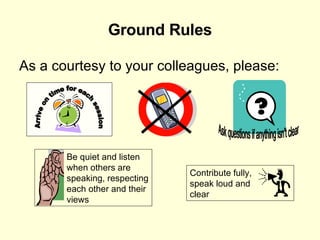
Ground Rules As a courtesy to your colleagues, please: Arrive on time for each session Ask questions if anything isn't clear Be quiet and listen when others are speaking, respecting each other and their views Contribute fully, speak loud and clear
SESSION 1. Welcome to Advocacy and Advocacy Planning
What is advocacy? Advocacy is a process not an event It happens at all levels – local, national, regional and international. It is about achieving specific outcomes However, there are different views about what type of outcomes advocacy should focus on, and who should do the advocacy SESSION 1.1
Advocacy outcomes Individuals and organisations tend to see advocacy as primarily focused on either: Change in institutional policy & practice Change in public attitudes & behaviour Change in the political process or system Increased power and influence for the poor and marginalised Or a combination of some or all of the above SESSION 1.1
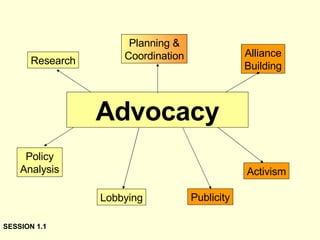
Advocacy Research Policy Analysis Lobbying Alliance Building Planning & Coordination Publicity Activism SESSION 1.1
Child rights advocacy Action taken directly to change the policies, positions and programmes of governments, institutions or organisations at all levels from community to international.  A social change process to ensure children have the right to grow up in a safe and secure family, free from poverty and exploitation. SESSION 1.1
Why are we doing this advocacy? To change people’s lives. Therefore our  aim  or  goal  is a statement of how a particular group of people’s lives will be changed if our advocacy is successful. SESSION 1.1
An advocacy strategy has to answer the following questions What change do we want to bring about? - What is going wrong? Evidence? - What must change? Alternative? Who can make the change? Who has the power? Who are our allies and opponents? How can you make them change? - How are we going to win?  - How will we see if the change has happened? SESSION 1.2
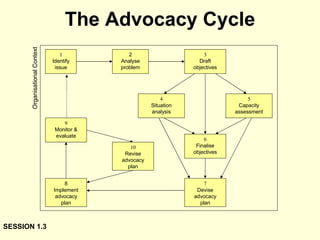
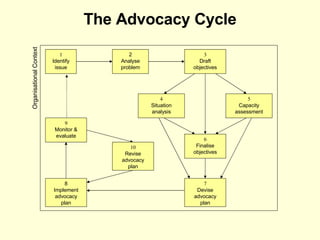
The Advocacy Cycle Organisational Context SESSION 1.3 1 Identify issue 2 Analyse problem 3 Draft objectives 5 Capacity assessment 4 Situation analysis 6 Finalise objectives 7 Devise advocacy plan 8 Implement advocacy plan 9 Monitor & evaluate 10 Revise advocacy plan
SESSION 2. Analysing the issue
What is an advocacy issue? When a situational analysis shows: Problems in the existing policy Lack of implementation or enforcement of policy Problem where political leaders need to take action Problem due to lack of civil society involvement with decision-making When the content or implementation of a policy, or the way in which policy decisions are made, could be changed to help make a dramatic impact on children’s lives. SESSION 2.1
Potential advocacy issues arise from Obstacles to the achievement of organisational vision/mission Views of children and partner organisations Own programme experience Opportunities in the external policy and media environment Views of staff, volunteers & supporters SESSION 2.1
Criteria to prioritise issues Relevant to organisation’s priorities? Relevant to programme work? Evidence available? Clear position, position alternative? Chance of success? Impact on children? Potential for alliances? Opportunities? Adequate staff and resources? SESSION 2.1
A good advocacy issue   Must be focused on a clear policy solution Must be based on a good policy analysis SESSION 2.1
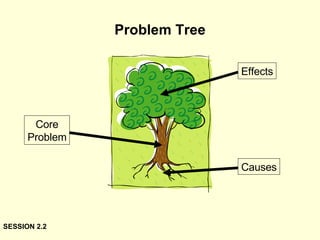
Problem Tree Core Problem Effects Causes SESSION 2.2
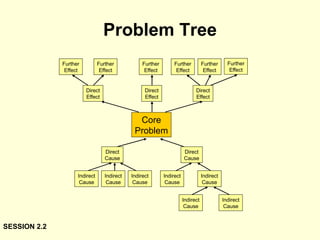
Problem Tree SESSION 2.2 Core Problem Direct Cause Indirect Cause Further Effect Direct Effect Indirect Cause Indirect Cause Indirect Cause Indirect Cause Indirect Cause Indirect Cause Direct Cause Direct Effect Direct Effect Further Effect Further Effect Further Effect Further Effect Further Effect
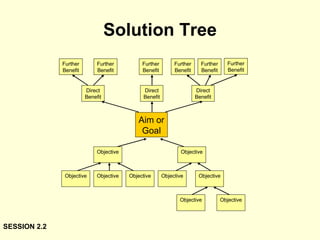
Solution Tree SESSION 2.2 Aim or Goal Objective Objective Further Benefit Direct Benefit Objective Objective Objective Objective Objective Objective Objective Direct Benefit Direct Benefit Further Benefit Further Benefit Further Benefit Further Benefit Further Benefit
Advocacy issue checklist How relevant is it to EveryChild’s focus on separation? How relevant is it to your programme work? Is documentation and research available? Do you have a clear position and a positive alternative? Is there a chance of success? How many children will benefit from the solution? What are the risk factors to people/or to your programs? Can you build strategic alliances? What strategic opportunities are there for influencing? Do you have adequate resources and staff? SESSION 2.2
SESSION 3. Setting Objectives
Advocacy goal and objectives You advocacy goal  is the long term result of your advocacy effort. It is your vision for change. You advocacy objective  is the specific change that you can bring about that contributes to reaching your goal. SESSION 3.1
SMART advocacy objectives Based on your long term advocacy goal, develop a few objectives that are on the road to the goal. Objectives should be SMART: Specific Measurable Achievable Realistic Time-bound SESSION 3.1
You advocacy objectives   The policy actor/decision maker The policy action or decision The timeline for change/degree of change Each advocacy objective should identify: SESSION 3.1
Advocacy Objectives Write the outcome not your activity. For example, don’t write: “ To lobby the government to reform childcare” “ To educate the public about the extent of child poverty” Instead, write: “ The government to reform childcare” “ The public to understand the extent of child poverty” SESSION 3.1
SESSION 4. Situational analysis and organisational capacity assessment
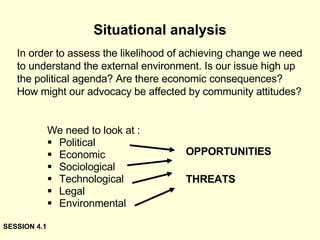
Situational analysis We need to look at : Political Economic Sociological  Technological  Legal Environmental In order to assess the likelihood of achieving change we need to understand the external environment. Is our issue high up the political agenda? Are there economic consequences? How might our advocacy be affected by community attitudes? SESSION 4.1 OPPORTUNITIES THREATS
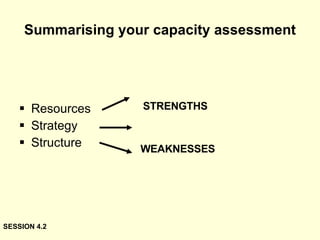
Organisational Advocacy Capacity Resources: People with skills, knowledge & commitment Appropriate funds, facilities & equipment Reputation, relationships & support Strategy: Clear, focused & coherent Based on external reality Matched to internal resources Structure: Integrated, coordinated & decisive SESSION 4.2
Summarising your capacity assessment Resources  Strategy  Structure STRENGTHS  WEAKNESSES SESSION 4.2
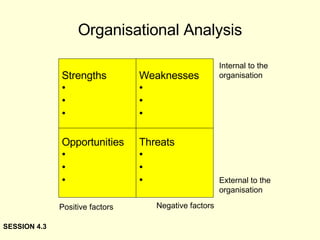
Organisational Analysis SESSION 4.3 Strengths Weaknesses Threats Opportunities Internal to the organisation External to the organisation Positive factors Negative factors
SESSION 5. Identifying targets & stakeholder analysis
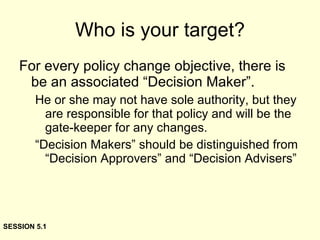
Who is your target? For every policy change objective, there is be an associated “Decision Maker”. He or she may not have sole authority, but they are responsible for that policy and will be the gate-keeper for any changes. “Decision Makers” should be distinguished from “Decision Approvers” and “Decision Advisers” SESSION 5.1
Influencing your target Can you get direct access to your target? If not, who can? Will your target be persuaded by your argument alone? If not, what else is needed? Is your target under pressure from anyone else? SESSION 5.1
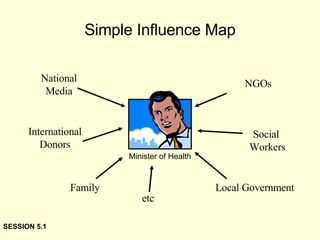
Simple Influence Map SESSION 5.1 Minister of Health National Media International Donors NGOs Local Government Family Social  Workers etc
Who are Stakeholders? Stakeholders can be individuals, types of people or organisations  who: Are affected by the issue Can influence the issue SESSION 5.1
Why are they important? Some are natural or potential allies Some are natural or potential opponents Some are undecided All can be subject to influence SESSION 5.1
Re-drafting objectives after identifying who our advocacy targets are Your objectives may need changing once you know who you wish to influence. For example: “ Children are involved in planning and carrying out actions for their interests.” May need to change to: “ Parents and community groups involve children in planning and carrying out actions for their interests.” SESSION 5.1
Analyse the Stakeholders We need to identify the most important stakeholders for our campaign We want to put our attention and resources where it will have most effect We don’t want to spread ourselves too thin SESSION 5.1
What do we need to know? How much do they agree or disagree with us? How important do they think the issue is? How much influence do they have over the issue? SESSION 5.1
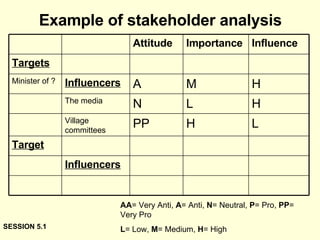
Example of stakeholder analysis AA = Very Anti,  A = Anti,  N = Neutral,  P = Pro,  PP = Very Pro L = Low,  M = Medium,  H = High SESSION 5.1 Target Minister of ? Targets Influencers L H PP Village committees H L N The media H M A Influencers Influence Importance Attitude
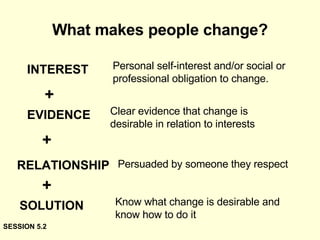
What makes people change? INTEREST Personal self-interest and/or social or professional obligation to change. + EVIDENCE Clear evidence that change is desirable in relation to interests + RELATIONSHIP Persuaded by someone they respect + SOLUTION Know what change is desirable and know how to do it SESSION 5.2
Different approaches Co-operative (as as insider) Confrontational (as an outsider) Persuasive (from inside and outside) From what you know about your targets, and from what has worked in the past, decided on style: SESSION 5.2
Co-operative advocacy tactics As an insider you develop relationships with your targets and gain their trust.   Advantages:  Get to know targets position and understand the processes they are involved with Disadvantages:  May have to compromise values, exclude stakeholders, be misrepresented by your target. Example: Service delivery - receiving funding from local government to pilot services SESSION 5.2
Confrontational advocacy tactics As a complete outsider you must try and force your issue onto the agenda.  Advantages:  Higher profile and greater freedom of action Disadvantages:  Can be counter productive if target feels under attack and can damage relationships. Risk of loss of funding, being marginalised and seen as radical. Example:  Mass mobilisation through public activism/demonstrations and media campaigns. SESSION 5.2
Persuasive advocacy tactics As a critical insider you present evidence that you hope will persuade your targets to recognise the merits of your arguments.   Advantages:  This approach can provide more opportunities for working with others and is often seen as more neutral, less aggressive Disadvantages:  You can be perceived as “sitting on the fence”. Example:  Simultaneous insider, outsider tactics such as publishing research in partnership with government, whilst organising children to lobby community leaders and local officials. SESSION 5.2
SESSION 6. Developing messages for advocacy
Advocacy communication Inform Persuade Move to action Any planned communication activity should seek to achieve the following goals: SESSION 6.1
What messages do you need? Position paper To set out agreed analysis of problem and solutions Core message To summarise your position and the change you want to bring about  Then use this to develop.. Messages tailored for different audiences Issues can be framed in different ways: What works best for your audience? One minute message To use any opportunity to get your message across SESSION 6.1
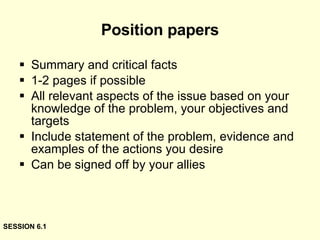
Position papers Summary and critical facts 1-2 pages if possible All relevant aspects of the issue based on your knowledge of the problem, your objectives and targets Include statement of the problem, evidence and examples of the actions you desire Can be signed off by your allies SESSION 6.1
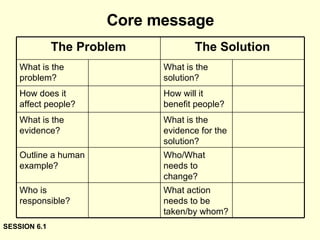
Core message SESSION 6.1 What action needs to be taken/by whom? Who is responsible? Who/What needs to change? Outline a human example? What is the evidence for the solution? What is the evidence? How will it benefit people? How does it affect people? What is the solution? What is the problem? The Solution The Problem
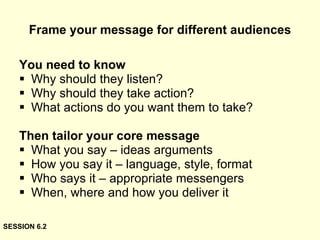
Frame your message for different audiences You need to know Why should they listen? Why should they take action? What actions do you want them to take? Then tailor your core message  What you say – ideas arguments How you say it – language, style, format Who says it – appropriate messengers When, where and how you deliver it SESSION 6.2
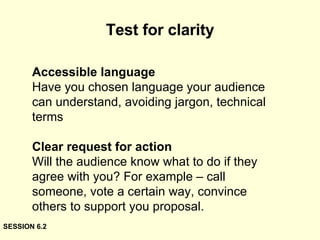
Test for clarity Accessible language Have you chosen language your audience can understand, avoiding jargon, technical terms Clear request for action Will the audience know what to do if they agree with you? For example – call someone, vote a certain way, convince others to support you proposal. SESSION 6.2
Possible channels of communication Newsletter Text message Banners Newspapers Leaflets Radio TV Internet Press conferences Public debates Briefing papers SESSION 6.2
The one minute message  Statement Evidence Example Call to action SESSION 6.2
SESSION 7. Identifying advocacy opportunities and action planning
Advocacy opportunities Think about: Who has power at different stages of the process? How can you involve children in advocacy? Plan strategically to build on key social or political events related to your advocacy issue during the decision making period SESSION 7.1
Examples of advocacy opportunities Conferences Workshops International awareness days such as Int’ Children’s Day Consultations on major policy reviews Official visits by political leaders and other VIPs Reporting on the UNCRC Elections Relevant social or political events might include: SESSION 7.1
What makes a good advocacy opportunity Timing is right in decision making process Decision makers have vested interest in outcome Chances to network and meet influential people There are opportunities for media attention to alert public Opportunity for children to present their views The agenda is not too crowded Concentrate your efforts where: SESSION 7.1
Devise Advocacy Plan Activities could include: Produce Position Paper/Policy Brief Publish Research & Analysis Form Networks and Alliances Communicate with Target Audiences Lobby Decision Makers & Advisers Engage with Opinion Formers & Influentials Mobilise Beneficiaries or Supporters SESSION 7.2
SESSION 8. Monitoring and Evaluation
Monitoring & Evaluation  of advocacy – why do it? To steer –  to identify how your plans need to be modified to achieve aims and objectives To learn –  so that your experience helps you to be more effective next time To be accountable –  to funders, managers, colleagues, partners, beneficiaries SESSION 8
Monitoring Track progress of your advocacy  Identify and deal with problems as they arise Respond quickly to changes in the advocacy environment Help decision making Look at advocacy  process  (tracks activities) Look at advocacy  progress  (tracks objectives) SESSION 8.1
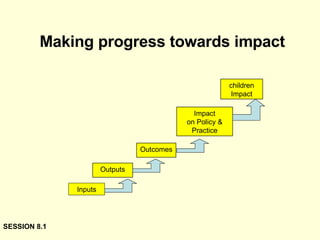
Making progress towards impact SESSION 8.1 Outputs Outcomes Impact on Policy & Practice children Impact Inputs
Advocacy milestones show progress Advocacy milestones on the way to achieving your objective Example: “produce and distribute report on violence against children at high level meeting..” Outcomes from specific events can be your milestones SESSION 8.1
Evaluation Determine if your strategy is successful Draw lessons from experience in order to improve quality of future advocacy work Demonstrate the results and impact to donors, supporters, other stakeholders Generate financial and political support for your advocacy activities SESSION 8.2
Evaluate progress towards objectives Go back to situational analysis consider what success will look like What will the effects of achieving your objectives be? Identify short, mid and long term indicators that relate to these effects Analyse expected and unexpected outcomes SESSION 8.2
Your exact choice of indicators of change will of course depend on your advocacy objectives. Here are some examples: Changes in the lives of children and young people  Changes in policy and practice affecting children and young people  Changes in children’s and young people’s participation and active citizenship  Changes in equity and non-discrimination of children and young people  Changes in communities' attitudes towards children's rights  Setting Indicators SESSION 8.2
Evaluate other advocacy outcomes How has advocacy work affected relationship with targets? How has it affected relationship with different audiences? How has it effected broader perception of the issue? SESSION 8.2
Evaluation methods Different approaches to evaluation, quantitative, qualitative Depends on what is possible to measure Use baseline research to compare before and after? Or use qualitative methods to assess change and cause of change. SESSION 8.2
CLOSING SESSION
The Advocacy Cycle Organisational Context 1 Identify issue 2 Analyse problem 3 Draft objectives 5 Capacity assessment 4 Situation analysis 6 Finalise objectives 7 Devise advocacy plan 8 Implement advocacy plan 9 Monitor & evaluate 10 Revise advocacy plan
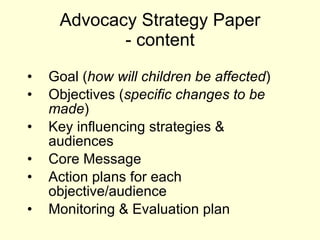
Advocacy Strategy Paper - content Goal ( how will children be affected ) Objectives ( specific changes to be made ) Key influencing strategies & audiences Core Message Action plans for each objective/audience Monitoring & Evaluation plan

Advocacy Workshop

  • 1.
    Advocacy strategy planningworkshop James Georgalakis Communications and Advocacy Manager, EveryChild
  • 2.
  • 3.
    How the workshopwill be run We want you to learn Not too much lecturing from me Lots of thinking discussing and working in groups Success depends on participation
  • 4.
    Workshop materials Savethe Children’s Advocacy Toolkit EveryChild’s advocacy strategy planning guidelines Powerpoint slides introducing each topic Worksheets Examples and case stories
  • 5.
    Working groups foradvocacy planning Participants divided into working groups for each issue/objective Groups record their work on flip charts and worksheets throughout: - Keep them safe - Remember label each sheet with Session and group
  • 6.
    Ground Rules Asa courtesy to your colleagues, please: Arrive on time for each session Ask questions if anything isn't clear Be quiet and listen when others are speaking, respecting each other and their views Contribute fully, speak loud and clear
  • 7.
    SESSION 1. Welcometo Advocacy and Advocacy Planning
  • 8.
    What is advocacy?Advocacy is a process not an event It happens at all levels – local, national, regional and international. It is about achieving specific outcomes However, there are different views about what type of outcomes advocacy should focus on, and who should do the advocacy SESSION 1.1
  • 9.
    Advocacy outcomes Individualsand organisations tend to see advocacy as primarily focused on either: Change in institutional policy & practice Change in public attitudes & behaviour Change in the political process or system Increased power and influence for the poor and marginalised Or a combination of some or all of the above SESSION 1.1
  • 10.
    Advocacy Research PolicyAnalysis Lobbying Alliance Building Planning & Coordination Publicity Activism SESSION 1.1
  • 11.
    Child rights advocacyAction taken directly to change the policies, positions and programmes of governments, institutions or organisations at all levels from community to international. A social change process to ensure children have the right to grow up in a safe and secure family, free from poverty and exploitation. SESSION 1.1
  • 12.
    Why are wedoing this advocacy? To change people’s lives. Therefore our aim or goal is a statement of how a particular group of people’s lives will be changed if our advocacy is successful. SESSION 1.1
  • 13.
    An advocacy strategyhas to answer the following questions What change do we want to bring about? - What is going wrong? Evidence? - What must change? Alternative? Who can make the change? Who has the power? Who are our allies and opponents? How can you make them change? - How are we going to win? - How will we see if the change has happened? SESSION 1.2
  • 14.
    The Advocacy CycleOrganisational Context SESSION 1.3 1 Identify issue 2 Analyse problem 3 Draft objectives 5 Capacity assessment 4 Situation analysis 6 Finalise objectives 7 Devise advocacy plan 8 Implement advocacy plan 9 Monitor & evaluate 10 Revise advocacy plan
  • 15.
  • 16.
    What is anadvocacy issue? When a situational analysis shows: Problems in the existing policy Lack of implementation or enforcement of policy Problem where political leaders need to take action Problem due to lack of civil society involvement with decision-making When the content or implementation of a policy, or the way in which policy decisions are made, could be changed to help make a dramatic impact on children’s lives. SESSION 2.1
  • 17.
    Potential advocacy issuesarise from Obstacles to the achievement of organisational vision/mission Views of children and partner organisations Own programme experience Opportunities in the external policy and media environment Views of staff, volunteers & supporters SESSION 2.1
  • 18.
    Criteria to prioritiseissues Relevant to organisation’s priorities? Relevant to programme work? Evidence available? Clear position, position alternative? Chance of success? Impact on children? Potential for alliances? Opportunities? Adequate staff and resources? SESSION 2.1
  • 19.
    A good advocacyissue Must be focused on a clear policy solution Must be based on a good policy analysis SESSION 2.1
  • 20.
    Problem Tree CoreProblem Effects Causes SESSION 2.2
  • 21.
    Problem Tree SESSION2.2 Core Problem Direct Cause Indirect Cause Further Effect Direct Effect Indirect Cause Indirect Cause Indirect Cause Indirect Cause Indirect Cause Indirect Cause Direct Cause Direct Effect Direct Effect Further Effect Further Effect Further Effect Further Effect Further Effect
  • 22.
    Solution Tree SESSION2.2 Aim or Goal Objective Objective Further Benefit Direct Benefit Objective Objective Objective Objective Objective Objective Objective Direct Benefit Direct Benefit Further Benefit Further Benefit Further Benefit Further Benefit Further Benefit
  • 23.
    Advocacy issue checklistHow relevant is it to EveryChild’s focus on separation? How relevant is it to your programme work? Is documentation and research available? Do you have a clear position and a positive alternative? Is there a chance of success? How many children will benefit from the solution? What are the risk factors to people/or to your programs? Can you build strategic alliances? What strategic opportunities are there for influencing? Do you have adequate resources and staff? SESSION 2.2
  • 24.
  • 25.
    Advocacy goal andobjectives You advocacy goal is the long term result of your advocacy effort. It is your vision for change. You advocacy objective is the specific change that you can bring about that contributes to reaching your goal. SESSION 3.1
  • 26.
    SMART advocacy objectivesBased on your long term advocacy goal, develop a few objectives that are on the road to the goal. Objectives should be SMART: Specific Measurable Achievable Realistic Time-bound SESSION 3.1
  • 27.
    You advocacy objectives The policy actor/decision maker The policy action or decision The timeline for change/degree of change Each advocacy objective should identify: SESSION 3.1
  • 28.
    Advocacy Objectives Writethe outcome not your activity. For example, don’t write: “ To lobby the government to reform childcare” “ To educate the public about the extent of child poverty” Instead, write: “ The government to reform childcare” “ The public to understand the extent of child poverty” SESSION 3.1
  • 29.
    SESSION 4. Situationalanalysis and organisational capacity assessment
  • 30.
    Situational analysis Weneed to look at : Political Economic Sociological Technological Legal Environmental In order to assess the likelihood of achieving change we need to understand the external environment. Is our issue high up the political agenda? Are there economic consequences? How might our advocacy be affected by community attitudes? SESSION 4.1 OPPORTUNITIES THREATS
  • 31.
    Organisational Advocacy CapacityResources: People with skills, knowledge & commitment Appropriate funds, facilities & equipment Reputation, relationships & support Strategy: Clear, focused & coherent Based on external reality Matched to internal resources Structure: Integrated, coordinated & decisive SESSION 4.2
  • 32.
    Summarising your capacityassessment Resources Strategy Structure STRENGTHS WEAKNESSES SESSION 4.2
  • 33.
    Organisational Analysis SESSION4.3 Strengths Weaknesses Threats Opportunities Internal to the organisation External to the organisation Positive factors Negative factors
  • 34.
    SESSION 5. Identifyingtargets & stakeholder analysis
  • 35.
    Who is yourtarget? For every policy change objective, there is be an associated “Decision Maker”. He or she may not have sole authority, but they are responsible for that policy and will be the gate-keeper for any changes. “Decision Makers” should be distinguished from “Decision Approvers” and “Decision Advisers” SESSION 5.1
  • 36.
    Influencing your targetCan you get direct access to your target? If not, who can? Will your target be persuaded by your argument alone? If not, what else is needed? Is your target under pressure from anyone else? SESSION 5.1
  • 37.
    Simple Influence MapSESSION 5.1 Minister of Health National Media International Donors NGOs Local Government Family Social Workers etc
  • 38.
    Who are Stakeholders?Stakeholders can be individuals, types of people or organisations who: Are affected by the issue Can influence the issue SESSION 5.1
  • 39.
    Why are theyimportant? Some are natural or potential allies Some are natural or potential opponents Some are undecided All can be subject to influence SESSION 5.1
  • 40.
    Re-drafting objectives afteridentifying who our advocacy targets are Your objectives may need changing once you know who you wish to influence. For example: “ Children are involved in planning and carrying out actions for their interests.” May need to change to: “ Parents and community groups involve children in planning and carrying out actions for their interests.” SESSION 5.1
  • 41.
    Analyse the StakeholdersWe need to identify the most important stakeholders for our campaign We want to put our attention and resources where it will have most effect We don’t want to spread ourselves too thin SESSION 5.1
  • 42.
    What do weneed to know? How much do they agree or disagree with us? How important do they think the issue is? How much influence do they have over the issue? SESSION 5.1
  • 43.
    Example of stakeholderanalysis AA = Very Anti, A = Anti, N = Neutral, P = Pro, PP = Very Pro L = Low, M = Medium, H = High SESSION 5.1 Target Minister of ? Targets Influencers L H PP Village committees H L N The media H M A Influencers Influence Importance Attitude
  • 44.
    What makes peoplechange? INTEREST Personal self-interest and/or social or professional obligation to change. + EVIDENCE Clear evidence that change is desirable in relation to interests + RELATIONSHIP Persuaded by someone they respect + SOLUTION Know what change is desirable and know how to do it SESSION 5.2
  • 45.
    Different approaches Co-operative(as as insider) Confrontational (as an outsider) Persuasive (from inside and outside) From what you know about your targets, and from what has worked in the past, decided on style: SESSION 5.2
  • 46.
    Co-operative advocacy tacticsAs an insider you develop relationships with your targets and gain their trust. Advantages: Get to know targets position and understand the processes they are involved with Disadvantages: May have to compromise values, exclude stakeholders, be misrepresented by your target. Example: Service delivery - receiving funding from local government to pilot services SESSION 5.2
  • 47.
    Confrontational advocacy tacticsAs a complete outsider you must try and force your issue onto the agenda. Advantages: Higher profile and greater freedom of action Disadvantages: Can be counter productive if target feels under attack and can damage relationships. Risk of loss of funding, being marginalised and seen as radical. Example: Mass mobilisation through public activism/demonstrations and media campaigns. SESSION 5.2
  • 48.
    Persuasive advocacy tacticsAs a critical insider you present evidence that you hope will persuade your targets to recognise the merits of your arguments. Advantages: This approach can provide more opportunities for working with others and is often seen as more neutral, less aggressive Disadvantages: You can be perceived as “sitting on the fence”. Example: Simultaneous insider, outsider tactics such as publishing research in partnership with government, whilst organising children to lobby community leaders and local officials. SESSION 5.2
  • 49.
    SESSION 6. Developingmessages for advocacy
  • 50.
    Advocacy communication InformPersuade Move to action Any planned communication activity should seek to achieve the following goals: SESSION 6.1
  • 51.
    What messages doyou need? Position paper To set out agreed analysis of problem and solutions Core message To summarise your position and the change you want to bring about Then use this to develop.. Messages tailored for different audiences Issues can be framed in different ways: What works best for your audience? One minute message To use any opportunity to get your message across SESSION 6.1
  • 52.
    Position papers Summaryand critical facts 1-2 pages if possible All relevant aspects of the issue based on your knowledge of the problem, your objectives and targets Include statement of the problem, evidence and examples of the actions you desire Can be signed off by your allies SESSION 6.1
  • 53.
    Core message SESSION6.1 What action needs to be taken/by whom? Who is responsible? Who/What needs to change? Outline a human example? What is the evidence for the solution? What is the evidence? How will it benefit people? How does it affect people? What is the solution? What is the problem? The Solution The Problem
  • 54.
    Frame your messagefor different audiences You need to know Why should they listen? Why should they take action? What actions do you want them to take? Then tailor your core message What you say – ideas arguments How you say it – language, style, format Who says it – appropriate messengers When, where and how you deliver it SESSION 6.2
  • 55.
    Test for clarityAccessible language Have you chosen language your audience can understand, avoiding jargon, technical terms Clear request for action Will the audience know what to do if they agree with you? For example – call someone, vote a certain way, convince others to support you proposal. SESSION 6.2
  • 56.
    Possible channels ofcommunication Newsletter Text message Banners Newspapers Leaflets Radio TV Internet Press conferences Public debates Briefing papers SESSION 6.2
  • 57.
    The one minutemessage Statement Evidence Example Call to action SESSION 6.2
  • 58.
    SESSION 7. Identifyingadvocacy opportunities and action planning
  • 59.
    Advocacy opportunities Thinkabout: Who has power at different stages of the process? How can you involve children in advocacy? Plan strategically to build on key social or political events related to your advocacy issue during the decision making period SESSION 7.1
  • 60.
    Examples of advocacyopportunities Conferences Workshops International awareness days such as Int’ Children’s Day Consultations on major policy reviews Official visits by political leaders and other VIPs Reporting on the UNCRC Elections Relevant social or political events might include: SESSION 7.1
  • 61.
    What makes agood advocacy opportunity Timing is right in decision making process Decision makers have vested interest in outcome Chances to network and meet influential people There are opportunities for media attention to alert public Opportunity for children to present their views The agenda is not too crowded Concentrate your efforts where: SESSION 7.1
  • 62.
    Devise Advocacy PlanActivities could include: Produce Position Paper/Policy Brief Publish Research & Analysis Form Networks and Alliances Communicate with Target Audiences Lobby Decision Makers & Advisers Engage with Opinion Formers & Influentials Mobilise Beneficiaries or Supporters SESSION 7.2
  • 63.
    SESSION 8. Monitoringand Evaluation
  • 64.
    Monitoring & Evaluation of advocacy – why do it? To steer – to identify how your plans need to be modified to achieve aims and objectives To learn – so that your experience helps you to be more effective next time To be accountable – to funders, managers, colleagues, partners, beneficiaries SESSION 8
  • 65.
    Monitoring Track progressof your advocacy Identify and deal with problems as they arise Respond quickly to changes in the advocacy environment Help decision making Look at advocacy process (tracks activities) Look at advocacy progress (tracks objectives) SESSION 8.1
  • 66.
    Making progress towardsimpact SESSION 8.1 Outputs Outcomes Impact on Policy & Practice children Impact Inputs
  • 67.
    Advocacy milestones showprogress Advocacy milestones on the way to achieving your objective Example: “produce and distribute report on violence against children at high level meeting..” Outcomes from specific events can be your milestones SESSION 8.1
  • 68.
    Evaluation Determine ifyour strategy is successful Draw lessons from experience in order to improve quality of future advocacy work Demonstrate the results and impact to donors, supporters, other stakeholders Generate financial and political support for your advocacy activities SESSION 8.2
  • 69.
    Evaluate progress towardsobjectives Go back to situational analysis consider what success will look like What will the effects of achieving your objectives be? Identify short, mid and long term indicators that relate to these effects Analyse expected and unexpected outcomes SESSION 8.2
  • 70.
    Your exact choiceof indicators of change will of course depend on your advocacy objectives. Here are some examples: Changes in the lives of children and young people Changes in policy and practice affecting children and young people Changes in children’s and young people’s participation and active citizenship Changes in equity and non-discrimination of children and young people Changes in communities' attitudes towards children's rights Setting Indicators SESSION 8.2
  • 71.
    Evaluate other advocacyoutcomes How has advocacy work affected relationship with targets? How has it affected relationship with different audiences? How has it effected broader perception of the issue? SESSION 8.2
  • 72.
    Evaluation methods Differentapproaches to evaluation, quantitative, qualitative Depends on what is possible to measure Use baseline research to compare before and after? Or use qualitative methods to assess change and cause of change. SESSION 8.2
  • 73.
  • 74.
    The Advocacy CycleOrganisational Context 1 Identify issue 2 Analyse problem 3 Draft objectives 5 Capacity assessment 4 Situation analysis 6 Finalise objectives 7 Devise advocacy plan 8 Implement advocacy plan 9 Monitor & evaluate 10 Revise advocacy plan
  • 75.
    Advocacy Strategy Paper- content Goal ( how will children be affected ) Objectives ( specific changes to be made ) Key influencing strategies & audiences Core Message Action plans for each objective/audience Monitoring & Evaluation plan