Function of Communities in
terms of structures, Dynamics
and Processes
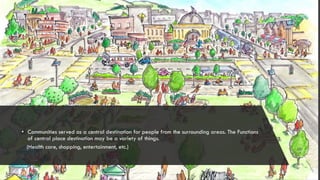
• Communities served as a central destination for people from the surrounding areas. The Functions
of central place destination may be a variety of things.
(Health care, shopping, entertainment, etc.)
STRUCTURE OF A COMMUNITY IN
TERMS OF FACTORS
Structure Factors to Explore
1. Demographics • Population size (total number of persons living in the
community)
• Density (ratio of people to the space they inhabit)
• Heterogeneity (the extent to which community members
have diverse characteristics)
• Ethnics groups in the community
• Names given to various parts of the community
• Areas known for having their own characteristics (ex:
industrial area, blue color families)
• Isolation from or closeness to other communities
• History of the area
• Changes and development in the area
Structure Factors to Explore
2. Geography
and
environmental
influences
• The community's physical environment
• The community's location and proximity to highways,
bodies of water, or mountains
• Existence of recreational areas
• Concerns regarding environment hazards such as pollution,
power shortages, among others.
3. Beliefs and
Attitudes
• Cultural values, traditions, and beliefs of various segments
of population
• Spiritual and political values of the residents
• Available social agencies and help they can extend
• Perceptions of residents as part of the community
4. Local Politics • Structure of government Decision making power and
control Major issues currently in debate
Structure Factors to Explore
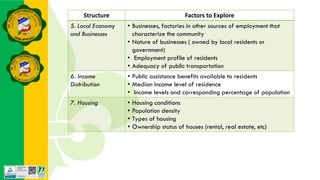
5. Local Economy
and Businesses
• Businesses, factories in other sources of employment that
characterize the community
• Nature of businesses ( owned by local residents or
government)
• Employment profile of residents
• Adequacy of public transportation
6. Income
Distribution
• Public assistance benefits available to residents
• Median income level of residence
• Income levels and corresponding percentage of population
7. Housing • Housing conditions
• Population density
• Types of housing
• Ownership status of houses (rental, real estate, etc)
Structure Factors to Explore
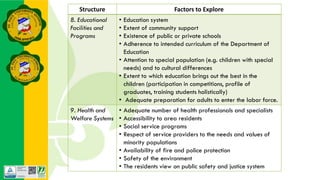
8. Educational
Facilities and
Programs
• Education system
• Extent of community support
• Existence of public or private schools
• Adherence to intended curriculum of the Department of
Education
• Attention to special population (e.g. children with special
needs) and to cultural differences
• Extent to which education brings out the best in the
children (participation in competitions, profile of
graduates, training students holistically)
• Adequate preparation for adults to enter the labor force.
9. Health and
Welfare Systems
• Adequate number of health professionals and specialists
• Accessibility to area residents
• Social service programs
• Respect of service providers to the needs and values of
minority populations
• Availability of fire and police protection
• Safety of the environment
• The residents view on public safety and justice system
Structure Factors to Explore
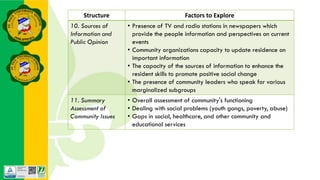
10. Sources of
Information and
Public Opinion
• Presence of TV and radio stations in newspapers which
provide the people information and perspectives on current
events
• Community organizations capacity to update residence on
important information
• The capacity of the sources of information to enhance the
resident skills to promote positive social change
• The presence of community leaders who speak for various
marginalized subgroups
11. Summary
Assessment of
Community Issues
• Overall assessment of community's functioning
• Dealing with social problems (youth gangs, poverty, abuse)
• Gaps in social, healthcare, and other community and
educational services
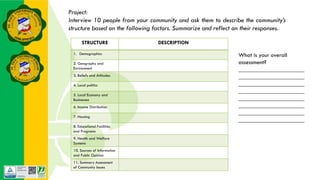
Project:
Interview 10 people from your community and ask them to describe the community’s
structure based on the following factors. Summarize and reflect on their responses.
STRUCTURE DESCRIPTION
1. Demographics
2. Geography and
Environment
3. Beliefs and Attitudes
4. Local politics
5. Local Economy and
Businesses
6. Income Distribution
7. Housing
8. Educational Facilities
and Programs
9. Health and Welfare
Systems
10. Sources of Information
and Public Opinion
11. Summary Assessment
of Community Issues
What is your overall
assessment?
______________________
______________________
______________________
______________________
______________________
______________________
______________________
______________________
Community Dynamics and Process
The dominant analytical approaches in studying
community dynamics and processes focus on
community power relations, leadership,
relationship and social change.
COMMUNITY POWER RELATIONS
Community Power is the
capacity of community to
exercise control over activities
and seek ways to employ
available resources to establish
a stronger and successful
community.
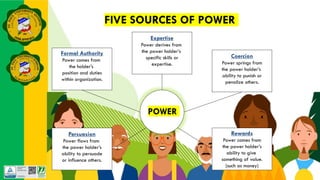
Formal Authority
Power comes from
the holder’s
position and duties
within organization.
Expertise
Power derives from
the power holder’s
specific skills or
expertise.
Coercion
Power springs from
the power holder’s
ability to punish or
penalize others.
Persuasion
Power flows from
the power holder’s
ability to persuade
or influence others.
Rewards
Power comes from
the power holder’s
ability to give
something of value.
(such as money)
POWER
FIVE SOURCES OF POWER
Five Bases of Power
In 1959, social psychologists John R. P. French and Bertram H. Raven identified five
sources or forms of power from which a person gets power. These sources are now known
as French and Raven's Five Bases of Power.
The French and Raven's five bases of power are briefly explained as follows:-
1. Referent Power
Referent power is also called as personal power and the power of personality.
This power comes from each leader individually. It is the personality of a person that
attracts followers. People follow because they are influenced or attracted by the magnetic
personality of the leader. The followers admire their leaders and may even try to copy
their behavior, dress, etc. John F. Kennedy, Martin Luther King, Dr. Babasaheb Ambedkar
and Mahatma Gandhi are the examples of leaders with referent power.
3. Expert Power
Expert power is also known as the power of knowledge. It comes from expert
knowledge and skills. Expert power means the expert influences another person's behavior.
This is because the expert has knowledge and skill which the other person needs but does
not possess. Persons like doctors, lawyers, accountants, etc., have expert power because
they have expert knowledge and skills, which others require.
2. Legitimate Power
Legitimate power is also known as position power and official power. It comes from
the higher authority. In an organization, a manager gets power because of his position or
post. It gives him the power to control resources and to reward and punish others. For e.g.
a chief executive officer (C.E.O) of a company gets legitimate powers because of the
position which he holds.
4. Coercive Power
Coercive power is the ability to punish others or to pose a threat to others.
Coercive power uses fear as a motivator. The leaders or managers with coercive
powers can threaten an employee's job security, cut his pay, withdraw certain facilities,
suspend him, etc. The coercive power may have an impact in the short-run. It will create
a negative impact on the receiver.
5. Reward Power
Reward power is opposite to coercive power. With the help of reward power,
the leader tries to motivate the followers to improve their performance. This power
enables the leader to provide additional facilities, increase in pay, promotion of the
subordinates, etc. The reward power also enables the leader to recognize the services
of the subordinate through appreciation.
LEADERSHIP
A leader is generally defined as
the person who has the
responsibility of controlling or
taking charge of a particular
group. This important figure will
guide the members to carry out
the plans in pursuit of the group's
objectives. The guidance of a
good leader in a group in source
documents of plans and better
implementation of programs
IMPORTANT COMPONENTS IN IMPROVING
LEADERSHIP IN A COMMUNITY
1. Effective Communication
- An open line communication is highly recommended for leaders and their
constituents
- There should be free access to important information concerning social issues and
public matters
2. Development of Social Capital Building
- Developing a resilient capital is among the most important contributors to
successful community leadership
3. Community Engagement
- It is important to encourage young leaders to participate
- Train younger generation of leaders so that they are ready to take over when
the time comes
4. Collaboration
- It is necessary to collaborate across and within the communities
- Leaders should learn to "bridges" and cooperate across communities
- Develop networks among community leaders within diverse fields
RELATIONSHIP
The success of a community will be more meaningful if its members have harmonious relationships with
each other. This is vital for members of both geographical and non-geographical communities. In forming
relationships, persons can give and receive support, encouragement, phrase and information. This can
provide feelings of belongingness and connectedness that most people seek in one way or another
regardless of one's belief system, cultural background and areas of interest.
SOCIAL CHANGE
• Social change refers to
changes that occur in the social
order of our society . This
changes may be related to
nature, social institutions, social
behavior, or social relations.
Social change can be driven by
cultural, religious, economics,
scientific, or technical forces .
Thank you so much for Listening
and Pauline peace to you!
Love ,
Sir Rayed

Functions of Communities

  • 1.
    Function of Communitiesin terms of structures, Dynamics and Processes
  • 2.
    • Communities servedas a central destination for people from the surrounding areas. The Functions of central place destination may be a variety of things. (Health care, shopping, entertainment, etc.)
  • 3.
    STRUCTURE OF ACOMMUNITY IN TERMS OF FACTORS Structure Factors to Explore 1. Demographics • Population size (total number of persons living in the community) • Density (ratio of people to the space they inhabit) • Heterogeneity (the extent to which community members have diverse characteristics) • Ethnics groups in the community • Names given to various parts of the community • Areas known for having their own characteristics (ex: industrial area, blue color families) • Isolation from or closeness to other communities • History of the area • Changes and development in the area
  • 4.
    Structure Factors toExplore 2. Geography and environmental influences • The community's physical environment • The community's location and proximity to highways, bodies of water, or mountains • Existence of recreational areas • Concerns regarding environment hazards such as pollution, power shortages, among others. 3. Beliefs and Attitudes • Cultural values, traditions, and beliefs of various segments of population • Spiritual and political values of the residents • Available social agencies and help they can extend • Perceptions of residents as part of the community 4. Local Politics • Structure of government Decision making power and control Major issues currently in debate
  • 5.
    Structure Factors toExplore 5. Local Economy and Businesses • Businesses, factories in other sources of employment that characterize the community • Nature of businesses ( owned by local residents or government) • Employment profile of residents • Adequacy of public transportation 6. Income Distribution • Public assistance benefits available to residents • Median income level of residence • Income levels and corresponding percentage of population 7. Housing • Housing conditions • Population density • Types of housing • Ownership status of houses (rental, real estate, etc)
  • 6.
    Structure Factors toExplore 8. Educational Facilities and Programs • Education system • Extent of community support • Existence of public or private schools • Adherence to intended curriculum of the Department of Education • Attention to special population (e.g. children with special needs) and to cultural differences • Extent to which education brings out the best in the children (participation in competitions, profile of graduates, training students holistically) • Adequate preparation for adults to enter the labor force. 9. Health and Welfare Systems • Adequate number of health professionals and specialists • Accessibility to area residents • Social service programs • Respect of service providers to the needs and values of minority populations • Availability of fire and police protection • Safety of the environment • The residents view on public safety and justice system
  • 7.
    Structure Factors toExplore 10. Sources of Information and Public Opinion • Presence of TV and radio stations in newspapers which provide the people information and perspectives on current events • Community organizations capacity to update residence on important information • The capacity of the sources of information to enhance the resident skills to promote positive social change • The presence of community leaders who speak for various marginalized subgroups 11. Summary Assessment of Community Issues • Overall assessment of community's functioning • Dealing with social problems (youth gangs, poverty, abuse) • Gaps in social, healthcare, and other community and educational services
  • 8.
    Project: Interview 10 peoplefrom your community and ask them to describe the community’s structure based on the following factors. Summarize and reflect on their responses. STRUCTURE DESCRIPTION 1. Demographics 2. Geography and Environment 3. Beliefs and Attitudes 4. Local politics 5. Local Economy and Businesses 6. Income Distribution 7. Housing 8. Educational Facilities and Programs 9. Health and Welfare Systems 10. Sources of Information and Public Opinion 11. Summary Assessment of Community Issues What is your overall assessment? ______________________ ______________________ ______________________ ______________________ ______________________ ______________________ ______________________ ______________________
  • 9.
    Community Dynamics andProcess The dominant analytical approaches in studying community dynamics and processes focus on community power relations, leadership, relationship and social change.
  • 10.
    COMMUNITY POWER RELATIONS CommunityPower is the capacity of community to exercise control over activities and seek ways to employ available resources to establish a stronger and successful community.
  • 11.
    Formal Authority Power comesfrom the holder’s position and duties within organization. Expertise Power derives from the power holder’s specific skills or expertise. Coercion Power springs from the power holder’s ability to punish or penalize others. Persuasion Power flows from the power holder’s ability to persuade or influence others. Rewards Power comes from the power holder’s ability to give something of value. (such as money) POWER FIVE SOURCES OF POWER
  • 12.
    Five Bases ofPower In 1959, social psychologists John R. P. French and Bertram H. Raven identified five sources or forms of power from which a person gets power. These sources are now known as French and Raven's Five Bases of Power. The French and Raven's five bases of power are briefly explained as follows:- 1. Referent Power Referent power is also called as personal power and the power of personality. This power comes from each leader individually. It is the personality of a person that attracts followers. People follow because they are influenced or attracted by the magnetic personality of the leader. The followers admire their leaders and may even try to copy their behavior, dress, etc. John F. Kennedy, Martin Luther King, Dr. Babasaheb Ambedkar and Mahatma Gandhi are the examples of leaders with referent power.
  • 13.
    3. Expert Power Expertpower is also known as the power of knowledge. It comes from expert knowledge and skills. Expert power means the expert influences another person's behavior. This is because the expert has knowledge and skill which the other person needs but does not possess. Persons like doctors, lawyers, accountants, etc., have expert power because they have expert knowledge and skills, which others require. 2. Legitimate Power Legitimate power is also known as position power and official power. It comes from the higher authority. In an organization, a manager gets power because of his position or post. It gives him the power to control resources and to reward and punish others. For e.g. a chief executive officer (C.E.O) of a company gets legitimate powers because of the position which he holds.
  • 14.
    4. Coercive Power Coercivepower is the ability to punish others or to pose a threat to others. Coercive power uses fear as a motivator. The leaders or managers with coercive powers can threaten an employee's job security, cut his pay, withdraw certain facilities, suspend him, etc. The coercive power may have an impact in the short-run. It will create a negative impact on the receiver. 5. Reward Power Reward power is opposite to coercive power. With the help of reward power, the leader tries to motivate the followers to improve their performance. This power enables the leader to provide additional facilities, increase in pay, promotion of the subordinates, etc. The reward power also enables the leader to recognize the services of the subordinate through appreciation.
  • 15.
    LEADERSHIP A leader isgenerally defined as the person who has the responsibility of controlling or taking charge of a particular group. This important figure will guide the members to carry out the plans in pursuit of the group's objectives. The guidance of a good leader in a group in source documents of plans and better implementation of programs
  • 16.
    IMPORTANT COMPONENTS INIMPROVING LEADERSHIP IN A COMMUNITY 1. Effective Communication - An open line communication is highly recommended for leaders and their constituents - There should be free access to important information concerning social issues and public matters 2. Development of Social Capital Building - Developing a resilient capital is among the most important contributors to successful community leadership 3. Community Engagement - It is important to encourage young leaders to participate - Train younger generation of leaders so that they are ready to take over when the time comes 4. Collaboration - It is necessary to collaborate across and within the communities - Leaders should learn to "bridges" and cooperate across communities - Develop networks among community leaders within diverse fields
  • 17.
    RELATIONSHIP The success ofa community will be more meaningful if its members have harmonious relationships with each other. This is vital for members of both geographical and non-geographical communities. In forming relationships, persons can give and receive support, encouragement, phrase and information. This can provide feelings of belongingness and connectedness that most people seek in one way or another regardless of one's belief system, cultural background and areas of interest.
  • 18.
    SOCIAL CHANGE • Socialchange refers to changes that occur in the social order of our society . This changes may be related to nature, social institutions, social behavior, or social relations. Social change can be driven by cultural, religious, economics, scientific, or technical forces .
  • 19.
    Thank you somuch for Listening and Pauline peace to you! Love , Sir Rayed