

Advocacy Strategy Development
Workshop
Sheila Ash
MSA – Nigeria, February 2013
INTRODUCTION
Section 1
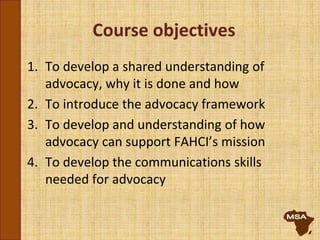
Course objectives
1. To develop a shared understanding of
advocacy, why it is done and how
2. To introduce the advocacy framework
3. To develop and understanding of how
advocacy can support FAHCI’s mission
4. To develop the communications skills
needed for advocacy
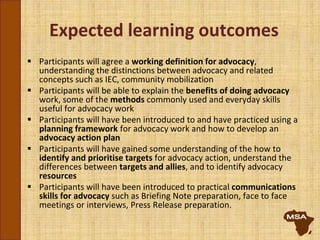
Expected learning outcomes
 Participants will agree a working definition for advocacy,
understanding the distinctions between advocacy and related
concepts such as IEC, community mobilization
 Participants will be able to explain the benefits of doing advocacy
work, some of the methods commonly used and everyday skills
useful for advocacy work
 Participants will have been introduced to and have practiced using a
planning framework for advocacy work and how to develop an
advocacy action plan
 Participants will have gained some understanding of the how to
identify and prioritise targets for advocacy action, understand the
differences between targets and allies, and to identify advocacy
resources
 Participants will have been introduced to practical communications
skills for advocacy such as Briefing Note preparation, face to face
meetings or interviews, Press Release preparation.
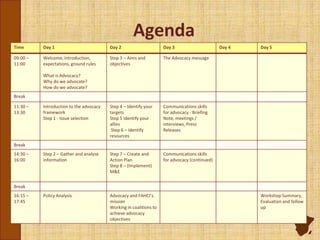
Agenda
Time Day 1 Day 2 Day 3 Day 4 Day 5
09:00 –
11:00
Welcome, Introduction,
expectations, ground rules
What is Advocacy?
Why do we advocate?
How do we advocate?
Step 3 – Aims and
objectives
The Advocacy message
Break
11:30 –
13:30
Introduction to the advocacy
framework
Step 1 - Issue selection
Step 4 – Identify your
targets
Step 5 Identify your
allies
Step 6 – Identify
resources
Communications skills
for advocacy - Briefing
Note, meetings /
interviews, Press
Releases
Break
14:30 –
16:00
Step 2 – Gather and analyse
information
Step 7 – Create and
Action Plan
Step 8 – (Implement)
M&E
Communications skills
for advocacy (continued)
Break
16:15 –
17:45
Policy Analysis Advocacy and FAHCI’s
mission
Working in coalitions to
achieve advocacy
objectives
Workshop Summary,
Evaluation and follow
up
WHAT IS ADVOCACY?
Workshop Session 1 (1.5h)
Session 1a - What is Advocacy?
 Objective: to develop a shared
understanding of what advocacy is
 Outcome: participants will have agreed a
working definition of advocacy for use
during the workshop
What key words do you associated with advocacy?
Agree working definition of
advocacy
 Group work
• Write a definition of advocacy
• Place all definitions on wall
• Group identifies common key words
• Use these to generate common definition
Group agrees workshop definition
Discussion Topics
 Which activities carried out by FAHCI can be
described as advocacy?
 How does our definition help us see the
differences between advocacy and other
activities?
 How suitable is our definition for describing
advocacy at local, national and international
levels?
Commonalities
Change
People
Policies/law/practices/attitudes/actions
Example definitions
 “The term advocacy encompasses a whole range of
methods and approaches used to change those policies and
practices, attitudes and behaviours that function as
obstacles to development and poverty eradication. While
technical support and the provision of services focus
primarily on the manifestations of poverty, advocacy
focuses on the causes of poverty and seeks change at this
level. At its best, the process of advocacy should involve
those people who are affected by the problems identified;
increase cooperation between NGOs and other civil groups;
and expand the space for open discussion between citizens,
governments and institutions.” (ActionAid UK, internal
paper for country programme staff)
Example definitions
 “Advocacy consists of actions designed to draw a community’s
attention to an issue and to direct policy-makers to a solution. It
consists of legal and political activities that influence the shape and
practice of laws. Advocacy initiatives require organisation, strategic
thinking, information, communication, outreach and mobilization”
(Human Rights Manual, Marge Schuler)
 “Advocacy can be defined as action aimed at changing the policies,
position and programmes of governments, institutions or
organisations involving an organised, systematic influencing process on
matters of public interest. In addition, advocacy can be a social change
process affecting attitudes, social relationships and power relations,
which strengthens civil society and opens up democratic spaces.”
(Working for Change in Education - A handbook for planning advocacy,
Save the Children Fund, UK)
Example definitions
 Advocacy involves different strategies aimed at influencing decision-making at
the local, provincial and national levels, specifically:
• who decides – elections, appointments, ministers, boards of advisors, judges, managing
directors, etc.
• what is decided – laws, policies, national priorities, programmes, services, budgets, etc.
• how it is decided – accessibility of information, consultation and/or involvement of people
in decision-making, responsiveness to citizens/stakeholders, accountability for decisions
(The Action Guide for Advocacy and Citizen Participation, Lisa Veneklasen, forthcoming)
 Put simply, advocacy means fighting for our rights. Advocacy includes figuring
out how bureaucracies and systems work, and fighting decisions that deny us
things we are legally entitled to – protection from discrimination, access to
social assistance and health care, fair treatment by the justice system, etc.
Advocacy also includes lobbying organizations, institutions, and various levels of
government to change their rules and regulations that deny people the full
economic, political, and legal rights set out in the United Nations' Universal
Declaration of Human Rights.
(Transcend – Transgender Support and Education Society)
Example definitions
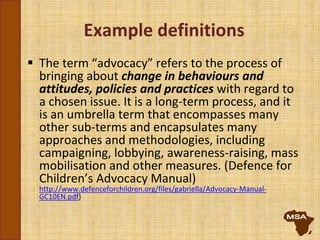
 The term “advocacy” refers to the process of
bringing about change in behaviours and
attitudes, policies and practices with regard to
a chosen issue. It is a long-term process, and it
is an umbrella term that encompasses many
other sub-terms and encapsulates many
approaches and methodologies, including
campaigning, lobbying, awareness-raising, mass
mobilisation and other measures. (Defence for
Children’s Advocacy Manual)
http://www.defenceforchildren.org/files/gabriella/Advocacy-Manual-
GC10EN.pdf)
Example definitions
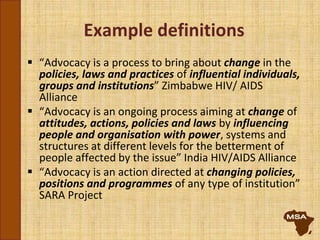
 “Advocacy is a process to bring about change in the
policies, laws and practices of influential individuals,
groups and institutions” Zimbabwe HIV/ AIDS
Alliance
 “Advocacy is an ongoing process aiming at change of
attitudes, actions, policies and laws by influencing
people and organisation with power, systems and
structures at different levels for the betterment of
people affected by the issue” India HIV/AIDS Alliance
 “Advocacy is an action directed at changing policies,
positions and programmes of any type of institution”
SARA Project
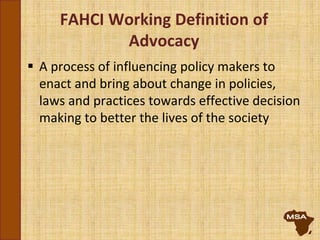
FAHCI Working Definition of
Advocacy
 A process of influencing policy makers to
enact and bring about change in policies,
laws and practices towards effective decision
making to better the lives of the society
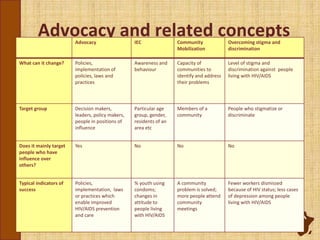
Advocacy and related conceptsAdvocacy IEC Community
Mobilization
Overcoming stigma and
discrimination
What can it change? Policies,
implementation of
policies, laws and
practices
Awareness and
behaviour
Capacity of
communities to
identify and address
their problems
Level of stigma and
discrimination against people
living with HIV/AIDS
Target group Decision makers,
leaders, policy makers,
people in positions of
influence
Particular age
group, gender,
residents of an
area etc
Members of a
community
People who stigmatize or
discriminate
Does it mainly target
people who have
influence over
others?
Yes No No No
Typical indicators of
success
Policies,
implementation, laws
or practices which
enable improved
HIV/AIDS prevention
and care
% youth using
condoms;
changes in
attitude to
people living
with HIV/AIDS
A community
problem is solved;
more people attend
community
meetings
Fewer workers dismissed
because of HIV status; less cases
of depression among people
living with HIV/AIDS
WHAT ARE THE BENEFITS OF DOING
ADVOCACY WORK?
Workshop Session 1b
Benefits of doing advocacy work
 Objective: by the end of this session participants will be
able to explain the benefits of doing advocacy work
 Group work - Think of examples of advocacy work
• Why was advocacy used to solve the problem?
• Is there anything advocacy can achieve that other methods
cannot?
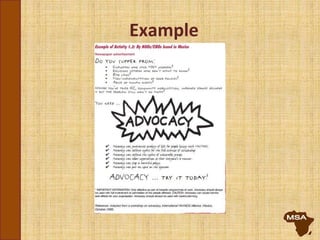
 Exercise – You are to create a pretend advert for TV,
radio or newspaper or a short speech which persuades
colleagues, other NGOs (not the public) of the benefits of
including advocacy in their work
 Outcome : participants understand the benefits of
undertaking advocacy work
Group Work Exercise
 You are to create a pretend advert for TV, radio or
newspaper or a short speech which persuades
colleagues, other NGOs (not the public) of the benefits of
including advocacy in their work
 As a whole group discuss the benefits of doing advocacy
as identified in the adverts etc
• What does advocacy offer to your organisation that you do
not already have?
• Is there anything that advocacy can achieve that other
methods cannot achieve?
• Were the adverts etc ‘selling’ advocacy or were they really
selling other things such as community mobilization, IEC?
• If advocacy is so good, why do many organizations not do it?
Example
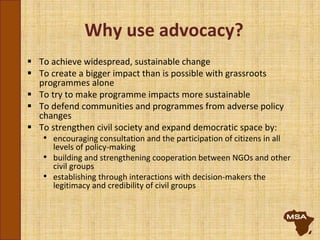
Why use advocacy?
 To achieve widespread, sustainable change
 To create a bigger impact than is possible with grassroots
programmes alone
 To try to make programme impacts more sustainable
 To defend communities and programmes from adverse policy
changes
 To strengthen civil society and expand democratic space by:
• encouraging consultation and the participation of citizens in all
levels of policy-making
• building and strengthening cooperation between NGOs and other
civil groups
• establishing through interactions with decision-makers the
legitimacy and credibility of civil groups
HOW DO WE DO ADVOCATE?
Workshop Session 1c
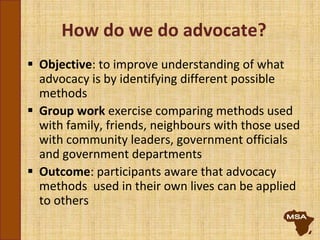
How do we do advocate?
 Objective: to improve understanding of what
advocacy is by identifying different possible
methods
 Group work exercise comparing methods used
with family, friends, neighbours with those used
with community leaders, government officials
and government departments
 Outcome: participants aware that advocacy
methods used in their own lives can be applied
to others
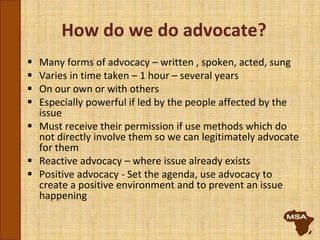
How do we do advocate?
 Many forms of advocacy – written , spoken, acted, sung
 Varies in time taken – 1 hour – several years
 On our own or with others
 Especially powerful if led by the people affected by the
issue
 Must receive their permission if use methods which do
not directly involve them so we can legitimately advocate
for them
 Reactive advocacy – where issue already exists
 Positive advocacy - Set the agenda, use advocacy to
create a positive environment and to prevent an issue
happening
Group Work Exercise
 Make a list of the ways in which you have
persuaded community leaders, government
officials, government departments to change
when an injustice or harmful practice has
occurred
 Make a list of methods you have used to
persuade members of their families, friends
or neighbours of their point of view on an
issue they have felt strongly about
Group work discussion topics
 Do your two lists overlap? If so, what does that
tell us?
 How do we decide which method to use?
 Which methods can be used for FAHCI’s
advocacy work?
 How can people directly affected by the issue
be involved in advocacy work? Or how can they
give their permission for the advocacy work?
 What are some example of proactive and
reactive advocacy work?
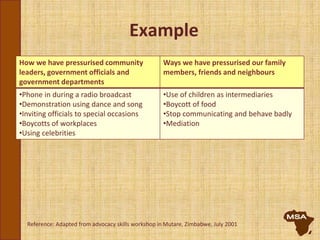
Example
How we have pressurised community
leaders, government officials and
government departments
Ways we have pressurised our family
members, friends and neighbours
•Phone in during a radio broadcast
•Demonstration using dance and song
•Inviting officials to special occasions
•Boycotts of workplaces
•Using celebrities
•Use of children as intermediaries
•Boycott of food
•Stop communicating and behave badly
•Mediation
Reference: Adapted from advocacy skills workshop in Mutare, Zimbabwe, July 2001
THE ADVOCACY FRAMEWORK
Workshop session 2 (2h)
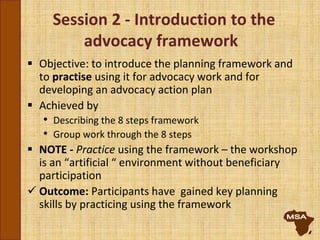
Session 2 - Introduction to the
advocacy framework
 Objective: to introduce the planning framework and
to practise using it for advocacy work and for
developing an advocacy action plan
 Achieved by
• Describing the 8 steps framework
• Group work through the 8 steps
 NOTE - Practice using the framework – the workshop
is an “artificial “ environment without beneficiary
participation
 Outcome: Participants have gained key planning
skills by practicing using the framework
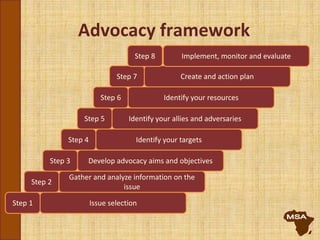
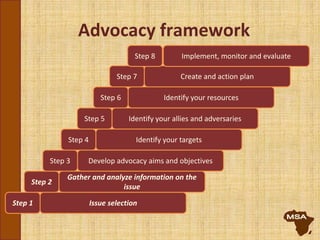
Advocacy framework
Issue selectionStep 1
Gather and analyze information on the
issue
Step 2
Develop advocacy aims and objectivesStep 3
Identify your targetsStep 4
Identify your resourcesStep 6
Identify your allies and adversariesStep 5
Create and action planStep 7
Implement, monitor and evaluateStep 8
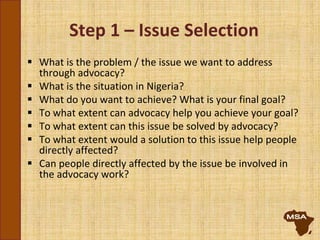
Step 1 – Issue Selection
 What is the problem / the issue we want to address
through advocacy?
 What is the situation in Nigeria?
 What do you want to achieve? What is your final goal?
 To what extent can advocacy help you achieve your goal?
 To what extent can this issue be solved by advocacy?
 To what extent would a solution to this issue help people
directly affected?
 Can people directly affected by the issue be involved in
the advocacy work?
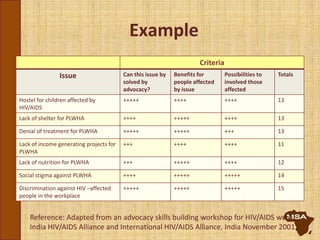
Example
Criteria
Issue Can this issue by
solved by
advocacy?
Benefits for
people affected
by issue
Possibilities to
involved those
affected
Totals
Hostel for children affected by
HIV/AIDS
+++++ ++++ ++++ 13
Lack of shelter for PLWHA ++++ +++++ ++++ 13
Denial of treatment for PLWHA +++++ +++++ +++ 13
Lack of income generating projects for
PLWHA
+++ ++++ ++++ 11
Lack of nutrition for PLWHA +++ +++++ ++++ 12
Social stigma against PLWHA ++++ +++++ +++++ 14
Discrimination against HIV –affected
people in the workplace
+++++ +++++ +++++ 15
Reference: Adapted from an advocacy skills building workshop for HIV/AIDS work,
India HIV/AIDS Alliance and International HIV/AIDS Alliance, India November 2001
Group work Exercise
 Brainstorm some real issues of interest to FAHCI
which could be addressed through advocacy at
your assigned level
 Create your own decision criteria, see Example
 Tool = Issue choice matrix ranking
 From your list of issues select the best one for
advocacy
 Groups pin flip chart paper on wall for display
Handout - Issue choice matrix
STEP 2 – RESEARCH AND ANALYSE
THE ISSUE
Workshop Session 3
Step 2 – Research and analyse issue
 Objective: to understand the issue and to identify 2-3 possible
advocacy solutions and gather information that supports their
analyses
 Achieved by
• Discussion of the importance of evidence
• Group work exercise
• Use of Cause and Effect Flowchart (Problem tree analysis) tool
 Outcome:
 Participants will have developed a deeper understanding of the
issue
 Participants will have identified possible solutions
 Participants will know how to gather supporting information
“To change the world, we must
first understand it”
Kofi Annan
former UN Secretary-General
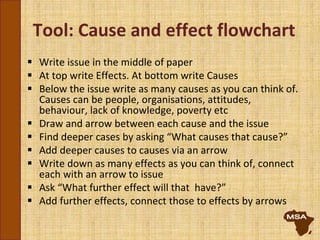
Tool: Cause and effect flowchart
 Write issue in the middle of paper
 At top write Effects. At bottom write Causes
 Below the issue write as many causes as you can think of.
Causes can be people, organisations, attitudes,
behaviour, lack of knowledge, poverty etc
 Draw and arrow between each cause and the issue
 Find deeper cases by asking “What causes that cause?”
 Add deeper causes to causes via an arrow
 Write down as many effects as you can think of, connect
each with an arrow to issue
 Ask “What further effect will that have?”
 Add further effects, connect those to effects by arrows
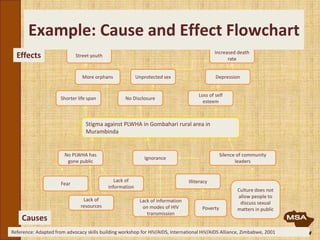
Stigma against PLWHA in Gombahari rural area in
Murambinda
Shorter life span No Disclosure
Loss of self
esteem
More orphans Unprotected sex Depression
Increased death
rate
Street youth
No PLWHA has
gone public
Ignorance
Silence of community
leaders
Fear
Lack of
resources
Lack of
information
Illiteracy
Lack of information
on modes of HIV
transmission
Poverty
Culture does not
allow people to
discuss sexual
matters in public
Reference: Adapted from advocacy skills building workshop for HIV/AIDS, International HIV/AIDS Alliance, Zimbabwe, 2001
Example: Cause and Effect Flowchart
Effects
Causes
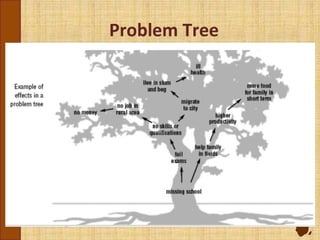
Problem Tree
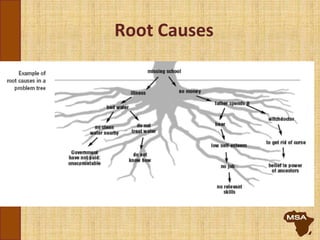
Root Causes
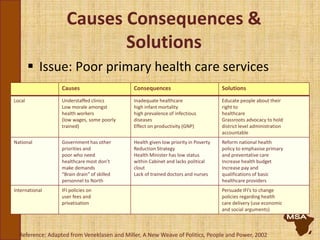
Causes Consequences &
Solutions
 Issue: Poor primary health care services
Causes Consequences Solutions
Local Understaffed clinics
Low morale amongst
health workers
(low wages, some poorly
trained)
Inadequate healthcare
high infant mortality
high prevalence of infectious
diseases
Effect on productivity (GNP)
Educate people about their
right to
healthcare
Grassroots advocacy to hold
district level administration
accountable
National Government has other
priorities and
poor who need
healthcare most don’t
make demands
“Brain drain” of skilled
personnel to North
Health given low priority in Poverty
Reduction Strategy
Health Minister has low status
within Cabinet and lacks political
clout
Lack of trained doctors and nurses
Reform national health
policy to emphasise primary
and preventative care
Increase health budget
Increase pay and
qualifications of basic
healthcare providers
International IFI policies on
user fees and
privatisation
Persuade IFI’s to change
policies regarding health
care delivery (use economic
and social arguments)
Reference: Adapted from Veneklasen and Miller, A New Weave of Politics, People and Power, 2002
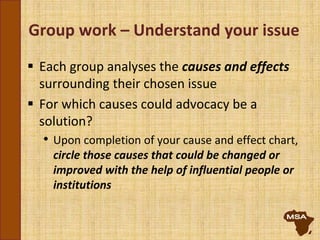
Group work – Understand your issue
 Each group analyses the causes and effects
surrounding their chosen issue
 For which causes could advocacy be a
solution?
• Upon completion of your cause and effect chart,
circle those causes that could be changed or
improved with the help of influential people or
institutions
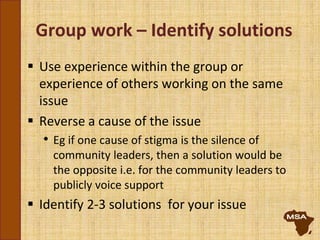
Group work – Identify solutions
 Use experience within the group or
experience of others working on the same
issue
 Reverse a cause of the issue
• Eg if one cause of stigma is the silence of
community leaders, then a solution would be
the opposite i.e. for the community leaders to
publicly voice support
 Identify 2-3 solutions for your issue
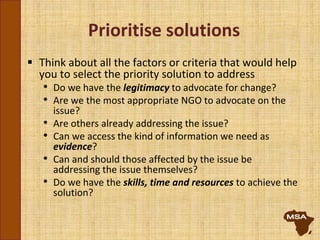
Prioritise solutions
 Think about all the factors or criteria that would help
you to select the priority solution to address
• Do we have the legitimacy to advocate for change?
• Are we the most appropriate NGO to advocate on the
issue?
• Are others already addressing the issue?
• Can we access the kind of information we need as
evidence?
• Can and should those affected by the issue be
addressing the issue themselves?
• Do we have the skills, time and resources to achieve the
solution?
Criteria for strategic issues (1)
 Successfully addressing the issue will result in a real improvement
in people’s lives
 ƒThe issue is are significant/important to your mission and
stakeholders and is consistent with your organisational priorities
 ƒIt is a ‘root’ issue that will block progress on other problems if not
addressed –but dealing with it successfully will unlock
possibilities for other changes
 ƒWork on the issue allows you to integrate programme and
advocacy work for greater impact
 ƒSuccessfully dealing with issue will magnify the impact of your
work
 ƒThe issue fits your expertise, experience or analysis
 Change can be achieved using methods you are comfortable with
Criteria for strategic issues (2)
 ƒYou know what it is you want to change, why it
should change, and how it should change.
 ƒThere are opportunities/possibilities to make the
changes needed
 ƒYour supporters and donors will support your work
on the issue
 ƒYour partners and constituents (beneficiaries) believe
the issue is important
 ƒThe risks involved in addressing the issue are
manageable
 ƒYour organisation has a unique contribution to make
on the issue and/or can bring added value to it
Discussion topic
 Step 2 is Research and analyse issue
• What is the purpose of gathering information?
• To what use will this information be put?
Uses of information and analyses
 To influence and inform
 To provide evidence for our position or those of
others
 To disprove statements by people who oppose
us
 To change perceptions of a problem
 To disprove myths, rumours and false
assumptions
 To explain why previous strategies have not
worked
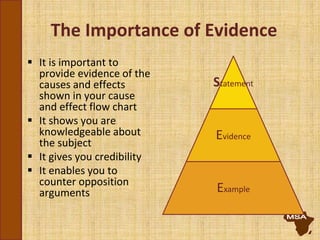
The Importance of Evidence
 It is important to
provide evidence of the
causes and effects
shown in your cause
and effect flow chart
 It shows you are
knowledgeable about
the subject
 It gives you credibility
 It enables you to
counter opposition
arguments
Statement
Evidence
Example
Example
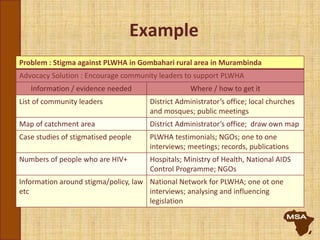
Problem : Stigma against PLWHA in Gombahari rural area in Murambinda
Advocacy Solution : Encourage community leaders to support PLWHA
Information / evidence needed Where / how to get it
List of community leaders District Administrator’s office; local churches
and mosques; public meetings
Map of catchment area District Administrator’s office; draw own map
Case studies of stigmatised people PLWHA testimonials; NGOs; one to one
interviews; meetings; records, publications
Numbers of people who are HIV+ Hospitals; Ministry of Health, National AIDS
Control Programme; NGOs
Information around stigma/policy, law
etc
National Network for PLWHA; one ot one
interviews; analysing and influencing
legislation
Group work – Research evidence
 Complete the Information Researching table
for 1 -2 solutions
 What Information / evidence is needed?
 Where / how to get it?
Discussion topics
 How can we involve those people directly
affected by the issue when planning Steps 1
and 2?
 What can we learn from our real life
experiences of identifying advocacy issues
and possible solutions?
Group work - feedback
 Look at the work of the other group
 Give feedback
 Guiding question
• How can the group improve its selected issue,
possible solutions and information gathering
plans?
 Think of 1 piece of advice for ANY NGO/CBO
planning Steps 1 and 2 of their advocacy
work
Handouts –
(1) Documentation and information gathering skills
(2) Advocacy in action Card 1 - Analysing and influencing legislation or
policy
POLICY ANALYSIS
Workshop Session 3 (1.5h)
Management Strategies for Africa ©
2013
Session 3 – Policy Analysis
 Objective: to demystify policy analysis
 Achieved by
• Reviewing a policy
Outcome: by the end of this session
participants will be able to identify at least 3
questions which are useful for analysing and
influencing policy or legislation
Policy Analysis
 Understanding the effects of a policy or law, or its
implementation is required in order to advocate for
improvement or implementation
• “You cannot change what you do not understand”
 Policies and legislation can be written or not
• eg traditional laws/ customs
• If their design and implementation is influenced by powerful
individuals/groups, then they can be challenged
 More difficult to analyse unwritten policies/legislation as
there may be disagreement on what it is
Group discussion
 Group gives examples of policy and
legislation at local, national and
international level, written and unwritten
 Why is analysing policy/legislation a useful
skill for advocacy work?
Policy Analysis
 Documents can be long, boring! Daunting!
 Skill of understanding them can be learned,
so practice it
 Involve beneficiaries, use drama and
problem trees to identify negative impacts
and suggest solutions
 Necessary to identify the precise parts /
clauses you want to change
Analysis process
 Read policy document
 Agree on what the policy is, or how it is implemented
 Use the questions to grasp its content
• Who benefits from this legislation or policy?
• Who loses?
• What will be the consequences 5 years from now of
enforcing this?
• How does the legislation or policy affect marginalized
groups?
 Identify areas on which you need more information
 Suggest how it can be improved, or implemented
better
Important Questions to Ask
 (What does the unwritten law/policy
/tradition say?)
 Who benefits from this legislation or policy?
 Who loses?
 What will be the consequences 5 years from
now of enforcing this?
 How does the legislation or policy affect
marginalized groups?
Reference: Adapted from Training for Transformation, Book 4 by Anne Hope and Sally Timmel, Mango Press, 2000
Additional Questions to ask
 Is this something ordinary people can understand?
 Who supports this law/policy, and why?
 How did this issue first come to the notice of decision
makers?
 What is the financial cost?
 Can it be enforced? If so, by whom, and how?
 What is the penalty if you don’t obey this law/policy?
 Does the law/policy violate the Un Declaration of Human
Rights or any other convention signed by you country?
 Is the law/policy consistent with your own country’s Bill
of Rights or Constitution?
Post group work discussion
 How did you find the process of analysing the policy?
 Which individuals/groups/institutions are affected by
it?
 How can you involved them in analysing it, to
increase your legitimacy?
 What are the differences between analysing written
and unwritten policies?
 At what stage in the advocacy process is policy ad
legislation analysis a useful skills?
 What advocacy methods can you use to influence the
policy/ legislation you have been analysing?
Policy analysis
Advantages
 Uses expertise of
NGO/CBOs in
understanding how the
lives of ordinary people
are affected
 Can encourage decision
makers to work closely
with NGOs
 Changes can affect many
people – large impact
possible
Disadvantages
 Technical jargon frightening
 Difficult and time
consuming
 Even constructive criticism
can offend policy makers
especially if polices took
long time to develop, are
politically sensitive. This can
have negative impact on
your organisation
Key ‘asks’ – messages
 Your advocacy ‘asks’ come from the
recommendations from issue research
 The key ‘asks’ are simply your demands – the
policy change that you want to achieve
 They are tailored messages to persuade
target audiences through selected channels
 On Day 3 we will look at how to write and
communicate those messages
RECAPPING DAY 1
Day 2
Advocacy framework
Issue selectionStep 1
Gather and analyze information on the
issue
Step 2
Develop advocacy aims and objectivesStep 3
Identify your targetsStep 4
Identify your resourcesStep 6
Identify your allies and adversariesStep 5
Create and action planStep 7
Implement, monitor and evaluateStep 8

Advocacy workshop day1

  • 1.
    Advocacy Strategy Development Workshop SheilaAsh MSA – Nigeria, February 2013
  • 2.
  • 3.
    Course objectives 1. Todevelop a shared understanding of advocacy, why it is done and how 2. To introduce the advocacy framework 3. To develop and understanding of how advocacy can support FAHCI’s mission 4. To develop the communications skills needed for advocacy
  • 4.
    Expected learning outcomes Participants will agree a working definition for advocacy, understanding the distinctions between advocacy and related concepts such as IEC, community mobilization  Participants will be able to explain the benefits of doing advocacy work, some of the methods commonly used and everyday skills useful for advocacy work  Participants will have been introduced to and have practiced using a planning framework for advocacy work and how to develop an advocacy action plan  Participants will have gained some understanding of the how to identify and prioritise targets for advocacy action, understand the differences between targets and allies, and to identify advocacy resources  Participants will have been introduced to practical communications skills for advocacy such as Briefing Note preparation, face to face meetings or interviews, Press Release preparation.
  • 5.
    Agenda Time Day 1Day 2 Day 3 Day 4 Day 5 09:00 – 11:00 Welcome, Introduction, expectations, ground rules What is Advocacy? Why do we advocate? How do we advocate? Step 3 – Aims and objectives The Advocacy message Break 11:30 – 13:30 Introduction to the advocacy framework Step 1 - Issue selection Step 4 – Identify your targets Step 5 Identify your allies Step 6 – Identify resources Communications skills for advocacy - Briefing Note, meetings / interviews, Press Releases Break 14:30 – 16:00 Step 2 – Gather and analyse information Step 7 – Create and Action Plan Step 8 – (Implement) M&E Communications skills for advocacy (continued) Break 16:15 – 17:45 Policy Analysis Advocacy and FAHCI’s mission Working in coalitions to achieve advocacy objectives Workshop Summary, Evaluation and follow up
  • 6.
  • 7.
    Session 1a -What is Advocacy?  Objective: to develop a shared understanding of what advocacy is  Outcome: participants will have agreed a working definition of advocacy for use during the workshop What key words do you associated with advocacy?
  • 8.
    Agree working definitionof advocacy  Group work • Write a definition of advocacy • Place all definitions on wall • Group identifies common key words • Use these to generate common definition Group agrees workshop definition
  • 9.
    Discussion Topics  Whichactivities carried out by FAHCI can be described as advocacy?  How does our definition help us see the differences between advocacy and other activities?  How suitable is our definition for describing advocacy at local, national and international levels?
  • 10.
  • 11.
    Example definitions  “Theterm advocacy encompasses a whole range of methods and approaches used to change those policies and practices, attitudes and behaviours that function as obstacles to development and poverty eradication. While technical support and the provision of services focus primarily on the manifestations of poverty, advocacy focuses on the causes of poverty and seeks change at this level. At its best, the process of advocacy should involve those people who are affected by the problems identified; increase cooperation between NGOs and other civil groups; and expand the space for open discussion between citizens, governments and institutions.” (ActionAid UK, internal paper for country programme staff)
  • 12.
    Example definitions  “Advocacyconsists of actions designed to draw a community’s attention to an issue and to direct policy-makers to a solution. It consists of legal and political activities that influence the shape and practice of laws. Advocacy initiatives require organisation, strategic thinking, information, communication, outreach and mobilization” (Human Rights Manual, Marge Schuler)  “Advocacy can be defined as action aimed at changing the policies, position and programmes of governments, institutions or organisations involving an organised, systematic influencing process on matters of public interest. In addition, advocacy can be a social change process affecting attitudes, social relationships and power relations, which strengthens civil society and opens up democratic spaces.” (Working for Change in Education - A handbook for planning advocacy, Save the Children Fund, UK)
  • 13.
    Example definitions  Advocacyinvolves different strategies aimed at influencing decision-making at the local, provincial and national levels, specifically: • who decides – elections, appointments, ministers, boards of advisors, judges, managing directors, etc. • what is decided – laws, policies, national priorities, programmes, services, budgets, etc. • how it is decided – accessibility of information, consultation and/or involvement of people in decision-making, responsiveness to citizens/stakeholders, accountability for decisions (The Action Guide for Advocacy and Citizen Participation, Lisa Veneklasen, forthcoming)  Put simply, advocacy means fighting for our rights. Advocacy includes figuring out how bureaucracies and systems work, and fighting decisions that deny us things we are legally entitled to – protection from discrimination, access to social assistance and health care, fair treatment by the justice system, etc. Advocacy also includes lobbying organizations, institutions, and various levels of government to change their rules and regulations that deny people the full economic, political, and legal rights set out in the United Nations' Universal Declaration of Human Rights. (Transcend – Transgender Support and Education Society)
  • 14.
    Example definitions  Theterm “advocacy” refers to the process of bringing about change in behaviours and attitudes, policies and practices with regard to a chosen issue. It is a long-term process, and it is an umbrella term that encompasses many other sub-terms and encapsulates many approaches and methodologies, including campaigning, lobbying, awareness-raising, mass mobilisation and other measures. (Defence for Children’s Advocacy Manual) http://www.defenceforchildren.org/files/gabriella/Advocacy-Manual- GC10EN.pdf)
  • 15.
    Example definitions  “Advocacyis a process to bring about change in the policies, laws and practices of influential individuals, groups and institutions” Zimbabwe HIV/ AIDS Alliance  “Advocacy is an ongoing process aiming at change of attitudes, actions, policies and laws by influencing people and organisation with power, systems and structures at different levels for the betterment of people affected by the issue” India HIV/AIDS Alliance  “Advocacy is an action directed at changing policies, positions and programmes of any type of institution” SARA Project
  • 16.
    FAHCI Working Definitionof Advocacy  A process of influencing policy makers to enact and bring about change in policies, laws and practices towards effective decision making to better the lives of the society
  • 17.
    Advocacy and relatedconceptsAdvocacy IEC Community Mobilization Overcoming stigma and discrimination What can it change? Policies, implementation of policies, laws and practices Awareness and behaviour Capacity of communities to identify and address their problems Level of stigma and discrimination against people living with HIV/AIDS Target group Decision makers, leaders, policy makers, people in positions of influence Particular age group, gender, residents of an area etc Members of a community People who stigmatize or discriminate Does it mainly target people who have influence over others? Yes No No No Typical indicators of success Policies, implementation, laws or practices which enable improved HIV/AIDS prevention and care % youth using condoms; changes in attitude to people living with HIV/AIDS A community problem is solved; more people attend community meetings Fewer workers dismissed because of HIV status; less cases of depression among people living with HIV/AIDS
  • 18.
    WHAT ARE THEBENEFITS OF DOING ADVOCACY WORK? Workshop Session 1b
  • 19.
    Benefits of doingadvocacy work  Objective: by the end of this session participants will be able to explain the benefits of doing advocacy work  Group work - Think of examples of advocacy work • Why was advocacy used to solve the problem? • Is there anything advocacy can achieve that other methods cannot?  Exercise – You are to create a pretend advert for TV, radio or newspaper or a short speech which persuades colleagues, other NGOs (not the public) of the benefits of including advocacy in their work  Outcome : participants understand the benefits of undertaking advocacy work
  • 20.
    Group Work Exercise You are to create a pretend advert for TV, radio or newspaper or a short speech which persuades colleagues, other NGOs (not the public) of the benefits of including advocacy in their work  As a whole group discuss the benefits of doing advocacy as identified in the adverts etc • What does advocacy offer to your organisation that you do not already have? • Is there anything that advocacy can achieve that other methods cannot achieve? • Were the adverts etc ‘selling’ advocacy or were they really selling other things such as community mobilization, IEC? • If advocacy is so good, why do many organizations not do it?
  • 21.
  • 22.
    Why use advocacy? To achieve widespread, sustainable change  To create a bigger impact than is possible with grassroots programmes alone  To try to make programme impacts more sustainable  To defend communities and programmes from adverse policy changes  To strengthen civil society and expand democratic space by: • encouraging consultation and the participation of citizens in all levels of policy-making • building and strengthening cooperation between NGOs and other civil groups • establishing through interactions with decision-makers the legitimacy and credibility of civil groups
  • 23.
    HOW DO WEDO ADVOCATE? Workshop Session 1c
  • 24.
    How do wedo advocate?  Objective: to improve understanding of what advocacy is by identifying different possible methods  Group work exercise comparing methods used with family, friends, neighbours with those used with community leaders, government officials and government departments  Outcome: participants aware that advocacy methods used in their own lives can be applied to others
  • 25.
    How do wedo advocate?  Many forms of advocacy – written , spoken, acted, sung  Varies in time taken – 1 hour – several years  On our own or with others  Especially powerful if led by the people affected by the issue  Must receive their permission if use methods which do not directly involve them so we can legitimately advocate for them  Reactive advocacy – where issue already exists  Positive advocacy - Set the agenda, use advocacy to create a positive environment and to prevent an issue happening
  • 26.
    Group Work Exercise Make a list of the ways in which you have persuaded community leaders, government officials, government departments to change when an injustice or harmful practice has occurred  Make a list of methods you have used to persuade members of their families, friends or neighbours of their point of view on an issue they have felt strongly about
  • 27.
    Group work discussiontopics  Do your two lists overlap? If so, what does that tell us?  How do we decide which method to use?  Which methods can be used for FAHCI’s advocacy work?  How can people directly affected by the issue be involved in advocacy work? Or how can they give their permission for the advocacy work?  What are some example of proactive and reactive advocacy work?
  • 28.
    Example How we havepressurised community leaders, government officials and government departments Ways we have pressurised our family members, friends and neighbours •Phone in during a radio broadcast •Demonstration using dance and song •Inviting officials to special occasions •Boycotts of workplaces •Using celebrities •Use of children as intermediaries •Boycott of food •Stop communicating and behave badly •Mediation Reference: Adapted from advocacy skills workshop in Mutare, Zimbabwe, July 2001
  • 29.
  • 30.
    Session 2 -Introduction to the advocacy framework  Objective: to introduce the planning framework and to practise using it for advocacy work and for developing an advocacy action plan  Achieved by • Describing the 8 steps framework • Group work through the 8 steps  NOTE - Practice using the framework – the workshop is an “artificial “ environment without beneficiary participation  Outcome: Participants have gained key planning skills by practicing using the framework
  • 31.
    Advocacy framework Issue selectionStep1 Gather and analyze information on the issue Step 2 Develop advocacy aims and objectivesStep 3 Identify your targetsStep 4 Identify your resourcesStep 6 Identify your allies and adversariesStep 5 Create and action planStep 7 Implement, monitor and evaluateStep 8
  • 32.
    Step 1 –Issue Selection  What is the problem / the issue we want to address through advocacy?  What is the situation in Nigeria?  What do you want to achieve? What is your final goal?  To what extent can advocacy help you achieve your goal?  To what extent can this issue be solved by advocacy?  To what extent would a solution to this issue help people directly affected?  Can people directly affected by the issue be involved in the advocacy work?
  • 33.
    Example Criteria Issue Can thisissue by solved by advocacy? Benefits for people affected by issue Possibilities to involved those affected Totals Hostel for children affected by HIV/AIDS +++++ ++++ ++++ 13 Lack of shelter for PLWHA ++++ +++++ ++++ 13 Denial of treatment for PLWHA +++++ +++++ +++ 13 Lack of income generating projects for PLWHA +++ ++++ ++++ 11 Lack of nutrition for PLWHA +++ +++++ ++++ 12 Social stigma against PLWHA ++++ +++++ +++++ 14 Discrimination against HIV –affected people in the workplace +++++ +++++ +++++ 15 Reference: Adapted from an advocacy skills building workshop for HIV/AIDS work, India HIV/AIDS Alliance and International HIV/AIDS Alliance, India November 2001
  • 34.
    Group work Exercise Brainstorm some real issues of interest to FAHCI which could be addressed through advocacy at your assigned level  Create your own decision criteria, see Example  Tool = Issue choice matrix ranking  From your list of issues select the best one for advocacy  Groups pin flip chart paper on wall for display
  • 35.
    Handout - Issuechoice matrix
  • 36.
    STEP 2 –RESEARCH AND ANALYSE THE ISSUE Workshop Session 3
  • 37.
    Step 2 –Research and analyse issue  Objective: to understand the issue and to identify 2-3 possible advocacy solutions and gather information that supports their analyses  Achieved by • Discussion of the importance of evidence • Group work exercise • Use of Cause and Effect Flowchart (Problem tree analysis) tool  Outcome:  Participants will have developed a deeper understanding of the issue  Participants will have identified possible solutions  Participants will know how to gather supporting information
  • 38.
    “To change theworld, we must first understand it” Kofi Annan former UN Secretary-General
  • 39.
    Tool: Cause andeffect flowchart  Write issue in the middle of paper  At top write Effects. At bottom write Causes  Below the issue write as many causes as you can think of. Causes can be people, organisations, attitudes, behaviour, lack of knowledge, poverty etc  Draw and arrow between each cause and the issue  Find deeper cases by asking “What causes that cause?”  Add deeper causes to causes via an arrow  Write down as many effects as you can think of, connect each with an arrow to issue  Ask “What further effect will that have?”  Add further effects, connect those to effects by arrows
  • 40.
    Stigma against PLWHAin Gombahari rural area in Murambinda Shorter life span No Disclosure Loss of self esteem More orphans Unprotected sex Depression Increased death rate Street youth No PLWHA has gone public Ignorance Silence of community leaders Fear Lack of resources Lack of information Illiteracy Lack of information on modes of HIV transmission Poverty Culture does not allow people to discuss sexual matters in public Reference: Adapted from advocacy skills building workshop for HIV/AIDS, International HIV/AIDS Alliance, Zimbabwe, 2001 Example: Cause and Effect Flowchart Effects Causes
  • 41.
  • 42.
  • 43.
    Causes Consequences & Solutions Issue: Poor primary health care services Causes Consequences Solutions Local Understaffed clinics Low morale amongst health workers (low wages, some poorly trained) Inadequate healthcare high infant mortality high prevalence of infectious diseases Effect on productivity (GNP) Educate people about their right to healthcare Grassroots advocacy to hold district level administration accountable National Government has other priorities and poor who need healthcare most don’t make demands “Brain drain” of skilled personnel to North Health given low priority in Poverty Reduction Strategy Health Minister has low status within Cabinet and lacks political clout Lack of trained doctors and nurses Reform national health policy to emphasise primary and preventative care Increase health budget Increase pay and qualifications of basic healthcare providers International IFI policies on user fees and privatisation Persuade IFI’s to change policies regarding health care delivery (use economic and social arguments) Reference: Adapted from Veneklasen and Miller, A New Weave of Politics, People and Power, 2002
  • 44.
    Group work –Understand your issue  Each group analyses the causes and effects surrounding their chosen issue  For which causes could advocacy be a solution? • Upon completion of your cause and effect chart, circle those causes that could be changed or improved with the help of influential people or institutions
  • 45.
    Group work –Identify solutions  Use experience within the group or experience of others working on the same issue  Reverse a cause of the issue • Eg if one cause of stigma is the silence of community leaders, then a solution would be the opposite i.e. for the community leaders to publicly voice support  Identify 2-3 solutions for your issue
  • 46.
    Prioritise solutions  Thinkabout all the factors or criteria that would help you to select the priority solution to address • Do we have the legitimacy to advocate for change? • Are we the most appropriate NGO to advocate on the issue? • Are others already addressing the issue? • Can we access the kind of information we need as evidence? • Can and should those affected by the issue be addressing the issue themselves? • Do we have the skills, time and resources to achieve the solution?
  • 47.
    Criteria for strategicissues (1)  Successfully addressing the issue will result in a real improvement in people’s lives  ƒThe issue is are significant/important to your mission and stakeholders and is consistent with your organisational priorities  ƒIt is a ‘root’ issue that will block progress on other problems if not addressed –but dealing with it successfully will unlock possibilities for other changes  ƒWork on the issue allows you to integrate programme and advocacy work for greater impact  ƒSuccessfully dealing with issue will magnify the impact of your work  ƒThe issue fits your expertise, experience or analysis  Change can be achieved using methods you are comfortable with
  • 48.
    Criteria for strategicissues (2)  ƒYou know what it is you want to change, why it should change, and how it should change.  ƒThere are opportunities/possibilities to make the changes needed  ƒYour supporters and donors will support your work on the issue  ƒYour partners and constituents (beneficiaries) believe the issue is important  ƒThe risks involved in addressing the issue are manageable  ƒYour organisation has a unique contribution to make on the issue and/or can bring added value to it
  • 49.
    Discussion topic  Step2 is Research and analyse issue • What is the purpose of gathering information? • To what use will this information be put?
  • 50.
    Uses of informationand analyses  To influence and inform  To provide evidence for our position or those of others  To disprove statements by people who oppose us  To change perceptions of a problem  To disprove myths, rumours and false assumptions  To explain why previous strategies have not worked
  • 51.
    The Importance ofEvidence  It is important to provide evidence of the causes and effects shown in your cause and effect flow chart  It shows you are knowledgeable about the subject  It gives you credibility  It enables you to counter opposition arguments Statement Evidence Example
  • 52.
    Example Problem : Stigmaagainst PLWHA in Gombahari rural area in Murambinda Advocacy Solution : Encourage community leaders to support PLWHA Information / evidence needed Where / how to get it List of community leaders District Administrator’s office; local churches and mosques; public meetings Map of catchment area District Administrator’s office; draw own map Case studies of stigmatised people PLWHA testimonials; NGOs; one to one interviews; meetings; records, publications Numbers of people who are HIV+ Hospitals; Ministry of Health, National AIDS Control Programme; NGOs Information around stigma/policy, law etc National Network for PLWHA; one ot one interviews; analysing and influencing legislation
  • 53.
    Group work –Research evidence  Complete the Information Researching table for 1 -2 solutions  What Information / evidence is needed?  Where / how to get it?
  • 54.
    Discussion topics  Howcan we involve those people directly affected by the issue when planning Steps 1 and 2?  What can we learn from our real life experiences of identifying advocacy issues and possible solutions?
  • 55.
    Group work -feedback  Look at the work of the other group  Give feedback  Guiding question • How can the group improve its selected issue, possible solutions and information gathering plans?  Think of 1 piece of advice for ANY NGO/CBO planning Steps 1 and 2 of their advocacy work
  • 56.
    Handouts – (1) Documentationand information gathering skills (2) Advocacy in action Card 1 - Analysing and influencing legislation or policy
  • 57.
    POLICY ANALYSIS Workshop Session3 (1.5h) Management Strategies for Africa © 2013
  • 58.
    Session 3 –Policy Analysis  Objective: to demystify policy analysis  Achieved by • Reviewing a policy Outcome: by the end of this session participants will be able to identify at least 3 questions which are useful for analysing and influencing policy or legislation
  • 59.
    Policy Analysis  Understandingthe effects of a policy or law, or its implementation is required in order to advocate for improvement or implementation • “You cannot change what you do not understand”  Policies and legislation can be written or not • eg traditional laws/ customs • If their design and implementation is influenced by powerful individuals/groups, then they can be challenged  More difficult to analyse unwritten policies/legislation as there may be disagreement on what it is
  • 60.
    Group discussion  Groupgives examples of policy and legislation at local, national and international level, written and unwritten  Why is analysing policy/legislation a useful skill for advocacy work?
  • 61.
    Policy Analysis  Documentscan be long, boring! Daunting!  Skill of understanding them can be learned, so practice it  Involve beneficiaries, use drama and problem trees to identify negative impacts and suggest solutions  Necessary to identify the precise parts / clauses you want to change
  • 62.
    Analysis process  Readpolicy document  Agree on what the policy is, or how it is implemented  Use the questions to grasp its content • Who benefits from this legislation or policy? • Who loses? • What will be the consequences 5 years from now of enforcing this? • How does the legislation or policy affect marginalized groups?  Identify areas on which you need more information  Suggest how it can be improved, or implemented better
  • 63.
    Important Questions toAsk  (What does the unwritten law/policy /tradition say?)  Who benefits from this legislation or policy?  Who loses?  What will be the consequences 5 years from now of enforcing this?  How does the legislation or policy affect marginalized groups? Reference: Adapted from Training for Transformation, Book 4 by Anne Hope and Sally Timmel, Mango Press, 2000
  • 64.
    Additional Questions toask  Is this something ordinary people can understand?  Who supports this law/policy, and why?  How did this issue first come to the notice of decision makers?  What is the financial cost?  Can it be enforced? If so, by whom, and how?  What is the penalty if you don’t obey this law/policy?  Does the law/policy violate the Un Declaration of Human Rights or any other convention signed by you country?  Is the law/policy consistent with your own country’s Bill of Rights or Constitution?
  • 65.
    Post group workdiscussion  How did you find the process of analysing the policy?  Which individuals/groups/institutions are affected by it?  How can you involved them in analysing it, to increase your legitimacy?  What are the differences between analysing written and unwritten policies?  At what stage in the advocacy process is policy ad legislation analysis a useful skills?  What advocacy methods can you use to influence the policy/ legislation you have been analysing?
  • 66.
    Policy analysis Advantages  Usesexpertise of NGO/CBOs in understanding how the lives of ordinary people are affected  Can encourage decision makers to work closely with NGOs  Changes can affect many people – large impact possible Disadvantages  Technical jargon frightening  Difficult and time consuming  Even constructive criticism can offend policy makers especially if polices took long time to develop, are politically sensitive. This can have negative impact on your organisation
  • 67.
    Key ‘asks’ –messages  Your advocacy ‘asks’ come from the recommendations from issue research  The key ‘asks’ are simply your demands – the policy change that you want to achieve  They are tailored messages to persuade target audiences through selected channels  On Day 3 we will look at how to write and communicate those messages
  • 68.
  • 69.
    Advocacy framework Issue selectionStep1 Gather and analyze information on the issue Step 2 Develop advocacy aims and objectivesStep 3 Identify your targetsStep 4 Identify your resourcesStep 6 Identify your allies and adversariesStep 5 Create and action planStep 7 Implement, monitor and evaluateStep 8

Editor's Notes

  • #4 Session structure ( NOTE: this is the planned structure but so far (February, 2013) only basic texts drafted so far) Objective - states what activity is designed to achieve Introduction – explains the subject of the activity and the key issues Instructions – outlining the steps to take to complete the activity, and the key questions / discussion topics to consider Facilitator’s notes – shares useful ideas about how to successfully lead participant’s through the activity Example – showing how an NGO/CBO has successfully put activity into action
  • #6 Timings are complete guess work!!!
  • #9 It can be difficult to define and to reach agreement. If so, use one of the example definitions and get participants to discuss and adapt Make sure participants are aware that advocacy around policies does not only include creating or changing policies but also includes putting policies into practice Be aware of possible confusion with related concepts IEC, community mobilization, networking
  • #16 No standard definition – these are some example
  • #18 If participants have their own case studies prepared prior to meeting then can use these If not then use some examples OR do the session on “Agree a working definition of advocacy?” Use examples from local, national and international levels to show advocacy can be achieved at each of these levels Levels here refers to where the power or influence lies rather than where the advocates are working
  • #22 It would be good to have some examples of advocacy success stories for the groups to use for this exercise
  • #32 Make sure the group’s methods are not forms of action eg community mobilisation, IEC, networking. Keep refering back to the working definition
  • #35 If the issue(s) selected to be worked on in the group work session affects people not represented at the workshop, it will be necessary to repeat the planning process after the workshop with participatory involvement from the people directed affected. Therefore the workshop emphasis will be on learning the advocacy planning process, rather than developing a real plan for action 3 possible Group work approaches depending on the group: As described herein Apply framework to a case study, thinking through the planning that would have been required Discuss the importance of each step by reflecting on past advocacy work and deciding how it could have been improved with better planning. Eg Which steps are the most important to plan carefully? Which steps are potentially the ost difficult to plan and why? Which steps might take longer to plan than others? Advantage: Participants can systematically practice each step so they can then repeat the process confidently with partners and beneficiary groups Disadvantage: Lengthy - Minimum 1.5 days Quicker than 1. Better when participants from different organisations which are not naturally allies working in the same field Disadvantage: May involve a lot of guesswork or be based on experiences of 1 NGO in the group Advantage: Participants can share a lot of experiences and really discuss the importance of planning at each stage. Participants can self facilitate Disadvantage: Participant may not be able to apply each step to one issue to see how the planning process used as a whole
  • #36 There are many different frameworks This framework was adapted from that developed by ICASO International Council of AIDS Service Organisations in Canada and has been used throughout the world It can also be used as a sort of checklist when making quick advocacy responses It can be applied at all levels – local, national, international It should “ring bells” as being similar to the process MSA uses for developing organisational Strategic Plans
  • #39 Make sure the groups Pick real issues Choose an issue that related to their advocacy level e.g that the Local group chooses a genuinely local issue, one relevant to a particular place ie a real village, district, province?
  • #40 Reference: Participatory Advocacy – a toolkit for VSO staff, volunteers and partners, page 82 Issue Choice Matrix This handout describes the tool and gives further example of possible criteria Give handout after (or part way through) group work, using group work to encourage participants to think up their own criteria
  • #63 If the issue(s) selected to be worked on in the group work session affects people not represented at the workshop, it will be necessary to repeat the planning process after the workshop with participatory involvement from the people directed affected. Therefore the workshop emphasis will be on learning the advocacy planning process, rather than developing a real plan for action 3 possible Group work approaches depending on the group: As described herein Apply framework to a case study, thinking through the planning that would have been required Discuss the importance of each step by reflecting on past advocacy work and deciding how it could have been improved with better planning. Eg Which steps are the most important to plan carefully? Which steps are potentially the ost difficult to plan and why? Which steps might take longer to plan than others? Advantage: Participants can systematically practice each step so they can then repeat the process confidently with partners and beneficiary groups Disadvantage: Lengthy - Minimum 1.5 days Quicker than 1. Better when participants from different organisations which are not naturally allies working in the same field Disadvantage: May involve a lot of guesswork or be based on experiences of 1 NGO in the group Advantage: Participants can share a lot of experiences and really discuss the importance of planning at each stage. Participants can self facilitate Disadvantage: Participant may not be able to apply each step to one issue to see how the planning process used as a whole
  • #74 There are many different frameworks This framework was adapted from that developed by ICASO International Council of AIDS Service Organisations in Canada and has been used throughout the world It can also be used as a sort of checklist when making quick advocacy responses It can be applied at all levels – local, national, international It should “ring bells” as being similar to the process MSA uses for developing organisational Strategic Plans