

Who Are You?
How YOU Communicate in the Workplace
As adapted from Robyn Baker Showalter, Penn Line Service, Inc.
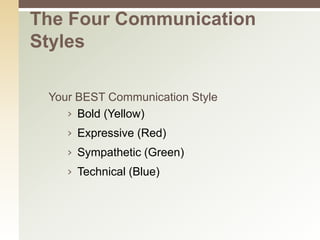
The Four Communication
Styles

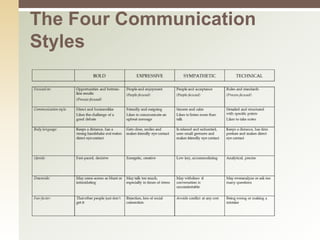
 Your BEST Communication Style
    › Bold (Yellow)
    › Expressive (Red)
    › Sympathetic (Green)
    › Technical (Blue)
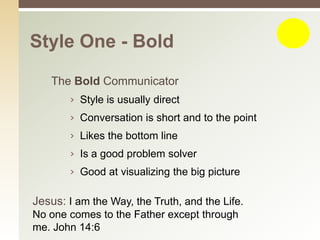
Style One - Bold

   The Bold Communicator
       › Style is usually direct
       › Conversation is short and to the point
       › Likes the bottom line
       › Is a good problem solver
       › Good at visualizing the big picture

Jesus: I am the Way, the Truth, and the Life.
No one comes to the Father except through
me. John 14:6
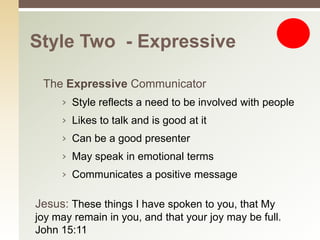
Style Two - Expressive

 The Expressive Communicator
     › Style reflects a need to be involved with people
     › Likes to talk and is good at it
     › Can be a good presenter
     › May speak in emotional terms
     › Communicates a positive message

Jesus: These things I have spoken to you, that My
joy may remain in you, and that your joy may be full.
John 15:11
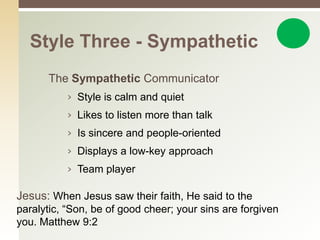
Style Three - Sympathetic
      The Sympathetic Communicator
           › Style is calm and quiet
           › Likes to listen more than talk
           › Is sincere and people-oriented
           › Displays a low-key approach
           › Team player

Jesus: When Jesus saw their faith, He said to the
paralytic, “Son, be of good cheer; your sins are forgiven
you. Matthew 9:2
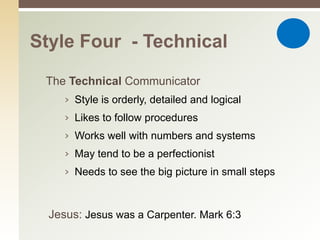
Style Four - Technical

 The Technical Communicator
     › Style is orderly, detailed and logical
     › Likes to follow procedures
     › Works well with numbers and systems
     › May tend to be a perfectionist
     › Needs to see the big picture in small steps


  Jesus: Jesus was a Carpenter. Mark 6:3
Group Activity


  › Why is your style the best?

  › What about your style might irritate others?

  › What about your style is vital to our faith?
The Four Communication
Styles
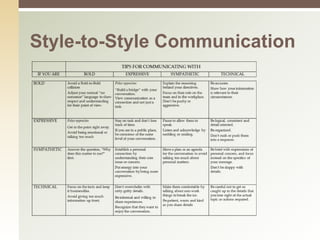
Style-to-Style Communication
The Four Communication
Styles

 To summarize:
 › Communicate your message to other people
   in a way that they will “hear” it.
 › Adapt your style based on interpersonal
   awareness.
 › Always consider the receiver before you
   speak.
Part Two
Effective Communication Techniques
Where Are We?

   THE UNITED STATES OF AMERICA
The Listening Process

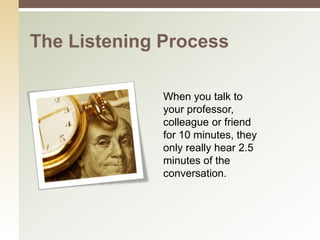
              When you talk to
              your professor,
              colleague or friend
              for 10 minutes, they
              only really hear 2.5
              minutes of the
              conversation.
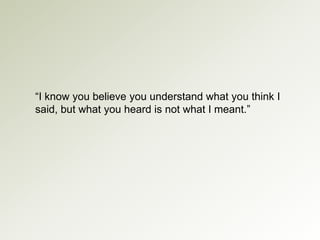
“I know you believe you understand what you think I
said, but what you heard is not what I meant.”
Effective Communication

  Common Barriers to Understanding
     › Physical noise/distractions
     › Mental noise/distractions
     › Bias about the speaker or subject
Effective Communication

  The Six Communication Commandments
   › Organize before you speak.
   › Be specific.
   › Be direct.
   › Repeat and reinforce.
   › Ask for feedback.
   › Listen actively.
The Six Commandments

 1. Organize before you speak.
    › Begin with the end in mind.
    › Decide what you want to accomplish with
      the conversation.
    › Say what’s most important first.
The Six Commandments

 2. Be specific.
    › Quantify and qualify. (Who, what, when
      where, why and how)
    › Give an example when appropriate.
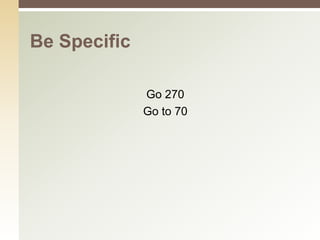
Be Specific

              Go 270
              Go to 70
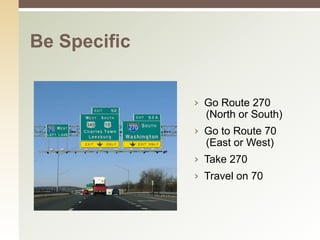
Be Specific


              › Go Route 270
                (North or South)
              › Go to Route 70
                (East or West)
              › Take 270
              › Travel on 70
The Six Commandments

 3. Be direct.
    › Say what you mean.
    › Don’t “sugarcoat” or use vague language to
      avoid conflict.
    › Make sure conflict ends in a resolution.
The Six Commandments

 4. Repeat and reinforce.
    › Rephrase the same statement a few
      different ways.
    › Recap/review at the end of the
      conversation.
    › Use a visual when possible.
The Six Commandments
 5. Ask for feedback.
      › Pause often, and give the listener a chance
        to speak.
      › Invite participation


 Examples
    Does this interest you?
    Am I making sense?
    What do you think?
    How do you think we could make this better?
The Six Commandments

 6. Listen actively
    › Tune out mental noise. Silence “self talk.”
    › Listen to understand, not respond.
    › Ask questions to clarify what you think you
      heard.
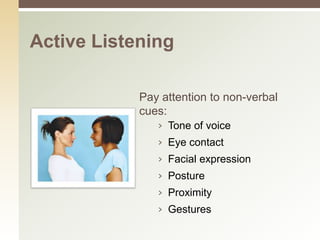
Active Listening

            Pay attention to non-verbal
            cues:
               › Tone of voice
               › Eye contact
               › Facial expression
               › Posture
               › Proximity
               › Gestures
Review

   › Know your style, and adapt it to your
     audience.
   › Plan ahead. Know what results you want.
   › Be detailed and direct.
   › Two-way communication: invite the
     listener’s participation.
   › Practice active listening techniques.
   › Find the time to communicate.
Questions?

Who are you

  • 1.
    Who Are You? HowYOU Communicate in the Workplace As adapted from Robyn Baker Showalter, Penn Line Service, Inc.
  • 2.
    The Four Communication Styles Your BEST Communication Style › Bold (Yellow) › Expressive (Red) › Sympathetic (Green) › Technical (Blue)
  • 3.
    Style One -Bold The Bold Communicator › Style is usually direct › Conversation is short and to the point › Likes the bottom line › Is a good problem solver › Good at visualizing the big picture Jesus: I am the Way, the Truth, and the Life. No one comes to the Father except through me. John 14:6
  • 4.
    Style Two -Expressive The Expressive Communicator › Style reflects a need to be involved with people › Likes to talk and is good at it › Can be a good presenter › May speak in emotional terms › Communicates a positive message Jesus: These things I have spoken to you, that My joy may remain in you, and that your joy may be full. John 15:11
  • 5.
    Style Three -Sympathetic The Sympathetic Communicator › Style is calm and quiet › Likes to listen more than talk › Is sincere and people-oriented › Displays a low-key approach › Team player Jesus: When Jesus saw their faith, He said to the paralytic, “Son, be of good cheer; your sins are forgiven you. Matthew 9:2
  • 6.
    Style Four -Technical The Technical Communicator › Style is orderly, detailed and logical › Likes to follow procedures › Works well with numbers and systems › May tend to be a perfectionist › Needs to see the big picture in small steps Jesus: Jesus was a Carpenter. Mark 6:3
  • 7.
    Group Activity › Why is your style the best? › What about your style might irritate others? › What about your style is vital to our faith?
  • 8.
  • 9.
  • 10.
    The Four Communication Styles To summarize: › Communicate your message to other people in a way that they will “hear” it. › Adapt your style based on interpersonal awareness. › Always consider the receiver before you speak.
  • 11.
  • 12.
    Where Are We? THE UNITED STATES OF AMERICA
  • 13.
    The Listening Process When you talk to your professor, colleague or friend for 10 minutes, they only really hear 2.5 minutes of the conversation.
  • 14.
    “I know youbelieve you understand what you think I said, but what you heard is not what I meant.”
  • 15.
    Effective Communication Common Barriers to Understanding › Physical noise/distractions › Mental noise/distractions › Bias about the speaker or subject
  • 16.
    Effective Communication The Six Communication Commandments › Organize before you speak. › Be specific. › Be direct. › Repeat and reinforce. › Ask for feedback. › Listen actively.
  • 17.
    The Six Commandments 1. Organize before you speak. › Begin with the end in mind. › Decide what you want to accomplish with the conversation. › Say what’s most important first.
  • 18.
    The Six Commandments 2. Be specific. › Quantify and qualify. (Who, what, when where, why and how) › Give an example when appropriate.
  • 19.
    Be Specific Go 270 Go to 70
  • 20.
    Be Specific › Go Route 270 (North or South) › Go to Route 70 (East or West) › Take 270 › Travel on 70
  • 21.
    The Six Commandments 3. Be direct. › Say what you mean. › Don’t “sugarcoat” or use vague language to avoid conflict. › Make sure conflict ends in a resolution.
  • 22.
    The Six Commandments 4. Repeat and reinforce. › Rephrase the same statement a few different ways. › Recap/review at the end of the conversation. › Use a visual when possible.
  • 23.
    The Six Commandments 5. Ask for feedback. › Pause often, and give the listener a chance to speak. › Invite participation Examples  Does this interest you?  Am I making sense?  What do you think?  How do you think we could make this better?
  • 24.
    The Six Commandments 6. Listen actively › Tune out mental noise. Silence “self talk.” › Listen to understand, not respond. › Ask questions to clarify what you think you heard.
  • 25.
    Active Listening Pay attention to non-verbal cues: › Tone of voice › Eye contact › Facial expression › Posture › Proximity › Gestures
  • 26.
    Review › Know your style, and adapt it to your audience. › Plan ahead. Know what results you want. › Be detailed and direct. › Two-way communication: invite the listener’s participation. › Practice active listening techniques. › Find the time to communicate.
  • 27.

Editor's Notes

  • #2 Hello and welcome to Who Are You? A look at how your personality influences the way you communicate, sponsored by Liberty University Society for Human Resource Management. Hopefully by now you have all identified the personality type that BEST fits you. There is going to be a little bit of overlap between them, you may move between types in different situations, and your personality may even change as time passes. We are going to talk about which personality type best fits you.Your personality really influences the way you communicate! Something that speaks very loudly or carries strong emphasis with you, may not for me, or someone else. We all hear and process things differently. We’re going to talk about how to use that to our advantage.Interaction: Pick someone “What is your name?” “What type did you choose?” “Why?” “Is anyone at your table also that type?” So let’s talk about the types.
  • #3 The four personality types are identified by the way you communicate best. The yellow personality is a bold communicator. The red personality is an expressive communicator. The green personality is a sympathetic communicator. The blue personality is a technical communicator.Jesus exhibited each of these styles at different points in His life and ministry. There’s also a different application for each of these in regards to our faith and sharing the gospel with others. We’re going to talk more about that as well.
  • #4 The first personality type we’re going to talk about is the yellows. This is the BOLD personality! This personality type is the go-to person when things need done. They have a lot of drive, a lot of initiative, they are clear and concise. One of their strengths is problem solving. Bold personalities make good leaders because they see the big picture.Jesus was bold ALL the time. Especially when He made statements like this.
  • #5 The expressive communicator is the people person. They feel very comfortable around people and are the most optimistic personality. They focus on intangible things, and are also big picture people.
  • #6 The sympathetic personality is the one that people like to go to for advice. They can sometimes be reserved, but they are very sincere. Like the expressivepersonality, the sympathetic personality has a tendency to want to connect on an emotional level with others. Jesus was a sympathetic personality type when he got on our level, taking the form of a human.
  • #7 The blue personality is the technical personality. This person thinks logically, they like to organize, and they may work well with numbers and systems.
  • #8 Split up into groups
  • #11 Since we’ve established that not everyone communicates the same way, you should use this knowledge to communicate more effectively. You don’t have to change your style or your personality, but you can present it in a way that will make sense to the person you’re talking to.
  • #12 I want to discuss some techniques that span every personality type. What kind of tactics can you use to communicate effectively? Talking and Listening?
  • #15 Real Life Example: Home to Katie and Mike
  • #16 Mental noise: Ever been in a conversation when a person is talking, and you’re thinking about something else? Or processing what they said? Or thinking about what you’ll say next?
  • #18 Know where you’re going before you even start! Often people go on rabbit trails, forgetting why they even started the conversation to begin with. I have been made fun of incessantly about the way I tell stories from my family and friends. I will start talking about the color orange and quickly end up thinking about celery or something. Don’t ever ask me “what are you thinking?” I will tell you. And I will tell you exactly how I got there too. So it’s important to know what you’ll say before you say it. And emphasize what’s important!
  • #22 Have you ever been in the situation where someone said something to a group of people, but you really know it was directed at you?