SOFT SKILLS
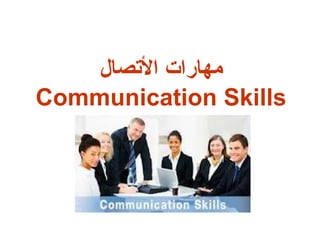
‫مهارات التصال‬
Communication Skills
•   Listening
•   Speaking
•   Reading
•   Writing
Definition ‫ما معنى التصال‬
Exchange information to gain
 Understanding and action
Three Golden rules
• The three golden rules of communication
  ARE TO BE:
• Clear
• Brief
• Relevant
Outcome of Effective communication
          ‫نتائج التصال الفعال‬
• Interpersonal Relation Satisfaction.
• Work Motivation.
• Get the responses you want.
• Gain other departments’ cooperation to
  implement ideas .
• Improve work environment.
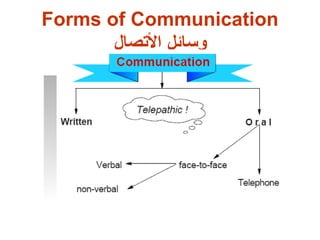
Forms of Communication
       ‫وسائل التصال‬
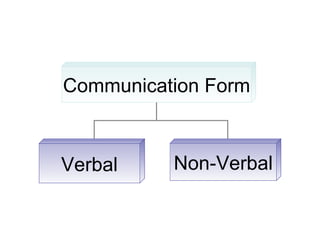
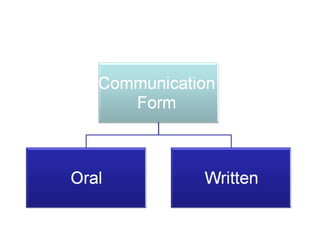
Communication Form


Verbal    Non-Verbal
Verbal Communication

• Verbal Communication occurred
  by using words.

• Ensure Your Words Are Always
  Understood.
Non-Verbal Communication

  • Non-Verbal Communication is a
    communication exchange that does
    not use words or may use words to
    carry more meaning than the strict
    definition of the words themselves .
Non-Verbal Communication
   • Eye Contact.

   • Voice Control.

   • Body Language.

   • Posture.
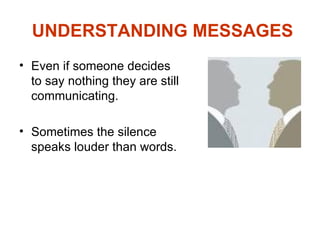
UNDERSTANDING MESSAGES
• Even if someone decides
  to say nothing they are still
  communicating.

• Sometimes the silence
  speaks louder than words.
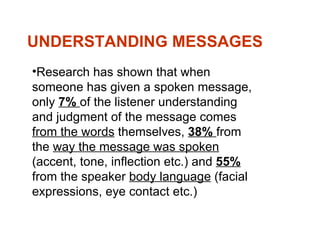
UNDERSTANDING MESSAGES
•Research has shown that when
someone has given a spoken message,
only 7% of the listener understanding
and judgment of the message comes
from the words themselves, 38% from
the way the message was spoken
(accent, tone, inflection etc.) and 55%
from the speaker body language (facial
expressions, eye contact etc.)
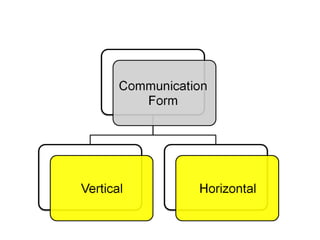
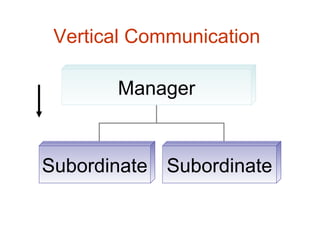
Vertical Communication

       Manager


Subordinate Subordinate
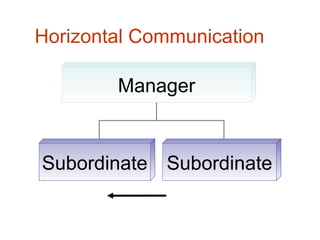
Horizontal Communication

        Manager


Subordinate Subordinate
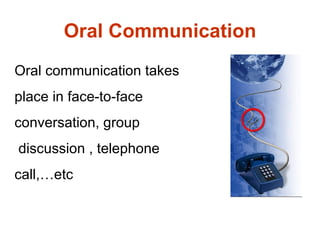
Oral Communication
Oral communication takes
place in face-to-face
conversation, group
discussion , telephone
call,…etc
Written Communication

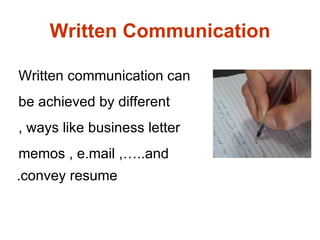
Written communication can
be achieved by different
, ways like business letter
memos , e.mail ,…..and
.convey resume
??What about meeting
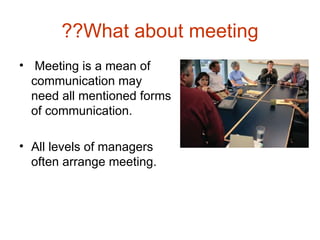
• Meeting is a mean of
  communication may
  need all mentioned forms
  of communication.

• All levels of managers
  often arrange meeting.
??How to run an effective meeting
    Meetings are wonderful tools for generating
       ideas and managing group activity BY:

    •   Good Preparing.
    •   Managing a Meeting.
    •   Time Keeping.
    •   Issuing Minutes.
Electronic Communication
 E.mail is one of the most
benefiicial tool of cmmunication .

•   Use Headlines.
•   Make One Point per Email.
•   Specify the Response You Want.
•   Be a Good Correspondent.
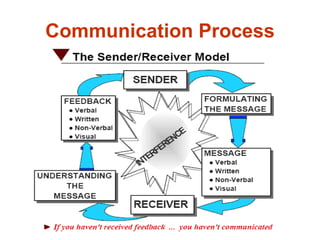
Communication Process
Interference ‫تشويش التصال‬
Interference includes the following to the
  required message
• Distortion
• Deletion
• Addition
Sources of Interference
       ‫مصادر تشويش الرسالة‬
• Sender
• (Incoherent for any reason)
• Formulating>>>> Bad Encoding
• Message >>>>>Not clear
• Receiver
(Unable or not interested to receive)
• Feedback
(Inadequate feedback-feedback type)
How to minimize Interference
•   Use Interactive Listening
•   Use Questioning Techniques
•   Interpret Body Language
•   Chose & Use right communication Method
•   Be on the same wavelength
LISTENING SKILLS
        ‫فن النصات‬
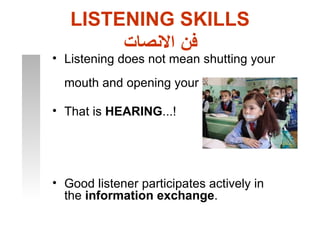
• Listening does not mean shutting your
  mouth and opening your ears!

• That is HEARING...!


• Good listener participates actively in
  the information exchange.
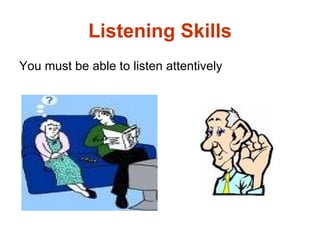
Listening Skills
You must be able to listen attentively
How to be an active listener
• Start by Understanding Your Own
  Communication Style.
• Think before speaking.
• Pay attention to speakers .
• Use Nonverbal Communication .
• Give Feedback.
• Use Question Techniques.
Improving Your Listening Skills
   1. Briefly restate what you have
      been told.
   2. Pay attention!
   3. Consider the source.
   4. Discipline yourself.
   5. Want to listen.
   6. Do not interrupt.
NINE KEYS
      TO
BETTER LISTENING
Nine Keys to Better Listening

•   Learn to recognize how important listening is to you
    and your job - you can't get ahead without it.
•   Relax when you feel tense. This makes
    communicating easier.
•   If you find yourself preoccupied, use empathy to
    force yourself to listen.
•   Tell yourself you are interested in what the other
    fellow is saying. Remember, self-centered people
    are poor listeners.
Nine Keys to Better Listening
•   Judge the worth of what you've heard after
    you have heard it.
•   Ask the other person for his ideas. Don't
    appear unwilling to listen.
•   Do not doodle or try to do two things at once,
    concentrate on what is being said.
•   Don't listen only to what the speaker says,
    listen to what he means.
•   Make listening the hi-fi of your
    communications. Remember, thousands of
    moneymaking ideas go unrecognized because
    people don't listen.
Be Prepared To Listen
    – Ask yourself "What new things can I learn
      from this person?"
    – There is no such thing as an uninteresting
      subject.
•    There are only uninterested people..!

    -Make sure you have paper and pencil.
    -Move away from distraction.
Questioning Skills
You must develop your questioning
 skills


• To minimize interference in your
  communication

• To get High quality information
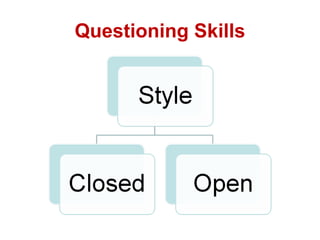
Questioning Skills
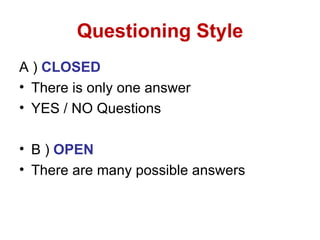
Questioning Style
A ) CLOSED
• There is only one answer
• YES / NO Questions

• B ) OPEN
• There are many possible answers
Communication Barriers
     ‫عوائق التصال‬
• Individual barriers ‫شخصية‬


• Organizational barriers ‫من خلل‬
  ‫المؤسسة‬
Individual barriers
• Conflicting. ‫التعارض‬
• Credibility about the subject‫مصداقية الموضوع‬
   ‫. المقدم‬
• Reluctance to communicate‫مقاومة التصال‬
• Poor listening skills. ‫ضعف مهارات النصات‬
• Predispositions about the subject. ‫رفض‬
  ‫مسبق للموضوع‬
‫‪Organizational barriers‬‬
 ‫قوانين ولوائح المؤسسة.‪• Semantics‬‬

 ‫فروقات ادارية.‪• Status or power differences‬‬
   ‫ووظيفية‬

 ‫عدم وجود بيئة جيدة للتواصل .‪• noise‬‬

 ‫ضغوط العمل الغير معتادة .‪• Overload‬‬
??How to Remove Barriers
Problems with communication can pop-up in
  different stage :
• Sender...
• Message...
• Channel...
• Receiver...
• Feedback...
• Context...
Make good environment of
effective communication
          at all
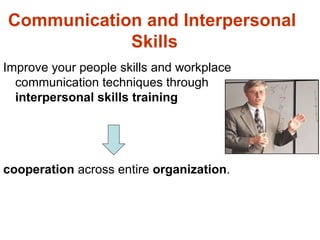
Communication and Interpersonal
            Skills
Improve your people skills and workplace
  communication techniques through
  interpersonal skills training


cooperation across entire organization.
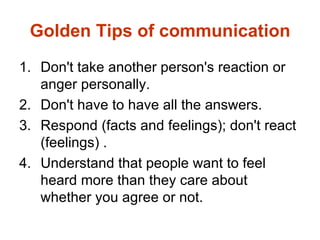
Golden Tips of communication
1. Don't take another person's reaction or
   anger personally.
2. Don't have to have all the answers.
3. Respond (facts and feelings); don't react
   (feelings) .
4. Understand that people want to feel
   heard more than they care about
   whether you agree or not.
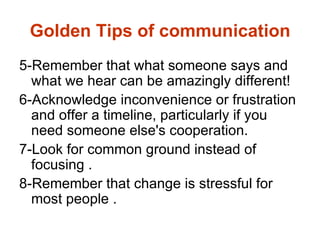
Golden Tips of communication
5-Remember that what someone says and
  what we hear can be amazingly different!
6-Acknowledge inconvenience or frustration
  and offer a timeline, particularly if you
  need someone else's cooperation.
7-Look for common ground instead of
  focusing .
8-Remember that change is stressful for
  most people .
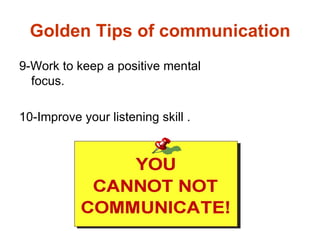
Golden Tips of communication
9-Work to keep a positive mental
  focus.

10-Improve your listening skill .
.Contact Info

   Prepared By:
 Eng.Amal Ibrahim

Amal_prod@yahoo.com
    01228314263

Communication skills

  • 1.
  • 2.
  • 3.
    Communication Skills • Listening • Speaking • Reading • Writing
  • 5.
    Definition ‫ما معنىالتصال‬ Exchange information to gain Understanding and action
  • 6.
    Three Golden rules •The three golden rules of communication ARE TO BE: • Clear • Brief • Relevant
  • 7.
    Outcome of Effectivecommunication ‫نتائج التصال الفعال‬ • Interpersonal Relation Satisfaction. • Work Motivation. • Get the responses you want. • Gain other departments’ cooperation to implement ideas . • Improve work environment.
  • 8.
    Forms of Communication ‫وسائل التصال‬
  • 9.
  • 10.
    Verbal Communication • VerbalCommunication occurred by using words. • Ensure Your Words Are Always Understood.
  • 11.
    Non-Verbal Communication • Non-Verbal Communication is a communication exchange that does not use words or may use words to carry more meaning than the strict definition of the words themselves .
  • 12.
    Non-Verbal Communication • Eye Contact. • Voice Control. • Body Language. • Posture.
  • 13.
    UNDERSTANDING MESSAGES • Evenif someone decides to say nothing they are still communicating. • Sometimes the silence speaks louder than words.
  • 14.
    UNDERSTANDING MESSAGES •Research hasshown that when someone has given a spoken message, only 7% of the listener understanding and judgment of the message comes from the words themselves, 38% from the way the message was spoken (accent, tone, inflection etc.) and 55% from the speaker body language (facial expressions, eye contact etc.)
  • 16.
    Vertical Communication Manager Subordinate Subordinate
  • 17.
    Horizontal Communication Manager Subordinate Subordinate
  • 19.
    Oral Communication Oral communicationtakes place in face-to-face conversation, group discussion , telephone call,…etc
  • 20.
    Written Communication Written communicationcan be achieved by different , ways like business letter memos , e.mail ,…..and .convey resume
  • 21.
    ??What about meeting •Meeting is a mean of communication may need all mentioned forms of communication. • All levels of managers often arrange meeting.
  • 22.
    ??How to runan effective meeting Meetings are wonderful tools for generating ideas and managing group activity BY: • Good Preparing. • Managing a Meeting. • Time Keeping. • Issuing Minutes.
  • 23.
    Electronic Communication E.mailis one of the most benefiicial tool of cmmunication . • Use Headlines. • Make One Point per Email. • Specify the Response You Want. • Be a Good Correspondent.
  • 24.
  • 25.
    Interference ‫تشويش التصال‬ Interferenceincludes the following to the required message • Distortion • Deletion • Addition
  • 26.
    Sources of Interference ‫مصادر تشويش الرسالة‬ • Sender • (Incoherent for any reason) • Formulating>>>> Bad Encoding • Message >>>>>Not clear • Receiver (Unable or not interested to receive) • Feedback (Inadequate feedback-feedback type)
  • 27.
    How to minimizeInterference • Use Interactive Listening • Use Questioning Techniques • Interpret Body Language • Chose & Use right communication Method • Be on the same wavelength
  • 28.
    LISTENING SKILLS ‫فن النصات‬ • Listening does not mean shutting your mouth and opening your ears! • That is HEARING...! • Good listener participates actively in the information exchange.
  • 29.
    Listening Skills You mustbe able to listen attentively
  • 30.
    How to bean active listener • Start by Understanding Your Own Communication Style. • Think before speaking. • Pay attention to speakers . • Use Nonverbal Communication . • Give Feedback. • Use Question Techniques.
  • 31.
    Improving Your ListeningSkills 1. Briefly restate what you have been told. 2. Pay attention! 3. Consider the source. 4. Discipline yourself. 5. Want to listen. 6. Do not interrupt.
  • 32.
    NINE KEYS TO BETTER LISTENING
  • 33.
    Nine Keys toBetter Listening • Learn to recognize how important listening is to you and your job - you can't get ahead without it. • Relax when you feel tense. This makes communicating easier. • If you find yourself preoccupied, use empathy to force yourself to listen. • Tell yourself you are interested in what the other fellow is saying. Remember, self-centered people are poor listeners.
  • 34.
    Nine Keys toBetter Listening • Judge the worth of what you've heard after you have heard it. • Ask the other person for his ideas. Don't appear unwilling to listen. • Do not doodle or try to do two things at once, concentrate on what is being said. • Don't listen only to what the speaker says, listen to what he means. • Make listening the hi-fi of your communications. Remember, thousands of moneymaking ideas go unrecognized because people don't listen.
  • 35.
    Be Prepared ToListen – Ask yourself "What new things can I learn from this person?" – There is no such thing as an uninteresting subject. • There are only uninterested people..! -Make sure you have paper and pencil. -Move away from distraction.
  • 36.
    Questioning Skills You mustdevelop your questioning skills • To minimize interference in your communication • To get High quality information
  • 37.
  • 38.
    Questioning Style A )CLOSED • There is only one answer • YES / NO Questions • B ) OPEN • There are many possible answers
  • 39.
    Communication Barriers ‫عوائق التصال‬ • Individual barriers ‫شخصية‬ • Organizational barriers ‫من خلل‬ ‫المؤسسة‬
  • 40.
    Individual barriers • Conflicting.‫التعارض‬ • Credibility about the subject‫مصداقية الموضوع‬ ‫. المقدم‬ • Reluctance to communicate‫مقاومة التصال‬ • Poor listening skills. ‫ضعف مهارات النصات‬ • Predispositions about the subject. ‫رفض‬ ‫مسبق للموضوع‬
  • 41.
    ‫‪Organizational barriers‬‬ ‫قوانينولوائح المؤسسة.‪• Semantics‬‬ ‫فروقات ادارية.‪• Status or power differences‬‬ ‫ووظيفية‬ ‫عدم وجود بيئة جيدة للتواصل .‪• noise‬‬ ‫ضغوط العمل الغير معتادة .‪• Overload‬‬
  • 42.
    ??How to RemoveBarriers Problems with communication can pop-up in different stage : • Sender... • Message... • Channel... • Receiver... • Feedback... • Context...
  • 43.
    Make good environmentof effective communication at all
  • 44.
    Communication and Interpersonal Skills Improve your people skills and workplace communication techniques through interpersonal skills training cooperation across entire organization.
  • 45.
    Golden Tips ofcommunication 1. Don't take another person's reaction or anger personally. 2. Don't have to have all the answers. 3. Respond (facts and feelings); don't react (feelings) . 4. Understand that people want to feel heard more than they care about whether you agree or not.
  • 46.
    Golden Tips ofcommunication 5-Remember that what someone says and what we hear can be amazingly different! 6-Acknowledge inconvenience or frustration and offer a timeline, particularly if you need someone else's cooperation. 7-Look for common ground instead of focusing . 8-Remember that change is stressful for most people .
  • 47.
    Golden Tips ofcommunication 9-Work to keep a positive mental focus. 10-Improve your listening skill .
  • 48.
    .Contact Info Prepared By: Eng.Amal Ibrahim Amal_prod@yahoo.com 01228314263