Thrive 2025 | For Internal Use Only | Company Confidential
Annual WHMIS Training
Fort Erie 2022
Thrive 2025 | For Internal Use Only | Company Confidential
Objective
1. WHMIS, HMIS and the Legislation
2. Labelling information
3. Hazard symbols (GHS)
4. Information Delivery – SDSs
Thrive 2025 | For Internal Use Only | Company Confidential
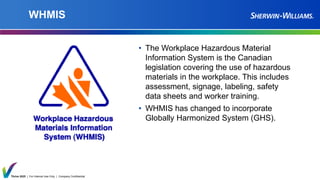
WHMIS
• The Workplace Hazardous Material
Information System is the Canadian
legislation covering the use of hazardous
materials in the workplace. This includes
assessment, signage, labeling, safety
data sheets and worker training.
• WHMIS has changed to incorporate
Globally Harmonized System (GHS).
Thrive 2025 | For Internal Use Only | Company Confidential
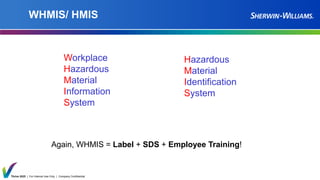
WHMIS/ HMIS
Again, WHMIS = Label + SDS + Employee Training!
Workplace
Hazardous
Material
Information
System
Hazardous
Material
Identification
System
Thrive 2025 | For Internal Use Only | Company Confidential
WHMIS
• So…What are the questions you should ask yourself when you
encounter a chemical?
What is it?
Can it hurt me?
How do I protect myself
from it?
What should I do if
something goes wrong?
Thrive 2025 | For Internal Use Only | Company Confidential
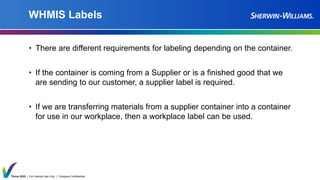
WHMIS Labels
• There are different requirements for labeling depending on the container.
• If the container is coming from a Supplier or is a finished good that we
are sending to our customer, a supplier label is required.
• If we are transferring materials from a supplier container into a container
for use in our workplace, then a workplace label can be used.
Thrive 2025 | For Internal Use Only | Company Confidential
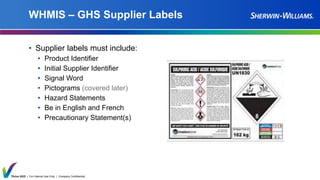
WHMIS – GHS Supplier Labels
• Supplier labels must include:
• Product Identifier
• Initial Supplier Identifier
• Signal Word
• Pictograms (covered later)
• Hazard Statements
• Be in English and French
• Precautionary Statement(s)
Thrive 2025 | For Internal Use Only | Company Confidential
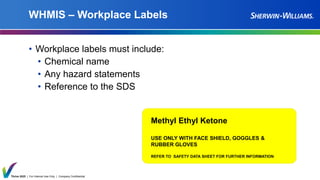
WHMIS – Workplace Labels
• Workplace labels must include:
• Chemical name
• Any hazard statements
• Reference to the SDS
Methyl Ethyl Ketone
USE ONLY WITH FACE SHIELD, GOGGLES &
RUBBER GLOVES
REFER TO SAFETY DATA SHEET FOR FURTHER INFORMATION
Thrive 2025 | For Internal Use Only | Company Confidential
WHMIS/GHS
• Hazard Class: groups of products with similar properties
• ~30 of them
• E.g. “Flammable Gases”
• Category: how hazardous the product is (the severity of hazard).
• Category 1 – always the most hazardous
• Category 2 – less hazardous than Cat. 1
• …etc.
• E.g. “Flammable Gas Cat 1” more hazardous than “Flammable Gas Cat 2”.
• Sub-category: also depending on the severity of the hazard
• E.g. “Flammable Gas Cat 1A” is more hazardous than “Flammable Gas Cat 1B”.
Thrive 2025 | For Internal Use Only | Company Confidential
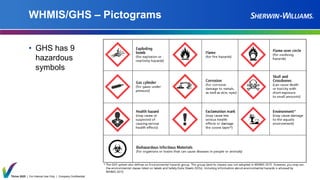
WHMIS/GHS – Pictograms
• GHS has 9
hazardous
symbols
Thrive 2025 | For Internal Use Only | Company Confidential
WHMIS: The Categories and Symbols of Controlled Products
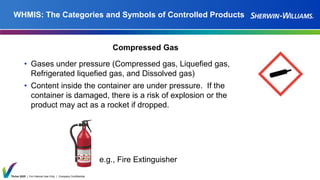
• Gases under pressure (Compressed gas, Liquefied gas,
Refrigerated liquefied gas, and Dissolved gas)
• Content inside the container are under pressure. If the
container is damaged, there is a risk of explosion or the
product may act as a rocket if dropped.
Compressed Gas
e.g., Fire Extinguisher
Thrive 2025 | For Internal Use Only | Company Confidential
WHMIS: The Categories and Symbols of Controlled Products
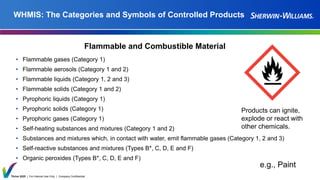
• Flammable gases (Category 1)
• Flammable aerosols (Category 1 and 2)
• Flammable liquids (Category 1, 2 and 3)
• Flammable solids (Category 1 and 2)
• Pyrophoric liquids (Category 1)
• Pyrophoric solids (Category 1)
• Pyrophoric gases (Category 1)
• Self-heating substances and mixtures (Category 1 and 2)
• Substances and mixtures which, in contact with water, emit flammable gases (Category 1, 2 and 3)
• Self-reactive substances and mixtures (Types B*, C, D, E and F)
• Organic peroxides (Types B*, C, D, E and F)
e.g., Paint
Flammable and Combustible Material
Products can ignite,
explode or react with
other chemicals.
Thrive 2025 | For Internal Use Only | Company Confidential
WHMIS: The Categories and Symbols of Controlled Products
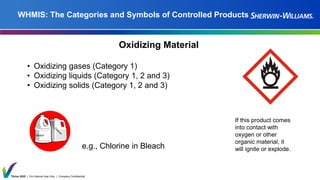
• Oxidizing gases (Category 1)
• Oxidizing liquids (Category 1, 2 and 3)
• Oxidizing solids (Category 1, 2 and 3)
If this product comes
into contact with
oxygen or other
organic material, it
will ignite or explode.
Bleach
e.g., Chlorine in Bleach
Oxidizing Material
Thrive 2025 | For Internal Use Only | Company Confidential
The Categories and Symbols of Controlled Products
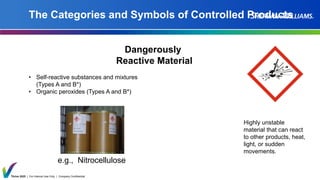
e.g., Nitrocellulose
Dangerously
Reactive Material
Highly unstable
material that can react
to other products, heat,
light, or sudden
movements.
• Self-reactive substances and mixtures
(Types A and B*)
• Organic peroxides (Types A and B*)
Thrive 2025 | For Internal Use Only | Company Confidential
The Classes and Symbols of Controlled Products
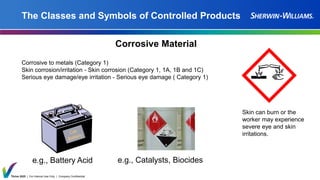
e.g., Battery Acid
Corrosive Material
Skin can burn or the
worker may experience
severe eye and skin
irritations.
e.g., Catalysts, Biocides
Corrosive to metals (Category 1)
Skin corrosion/irritation - Skin corrosion (Category 1, 1A, 1B and 1C)
Serious eye damage/eye irritation - Serious eye damage ( Category 1)
Thrive 2025 | For Internal Use Only | Company Confidential
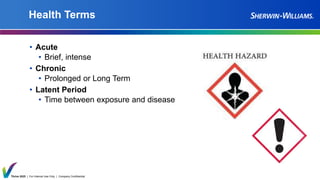
Health Terms
• Acute
• Brief, intense
• Chronic
• Prolonged or Long Term
• Latent Period
• Time between exposure and disease
Thrive 2025 | For Internal Use Only | Company Confidential
GHS: The Categories and Symbols of Controlled Products
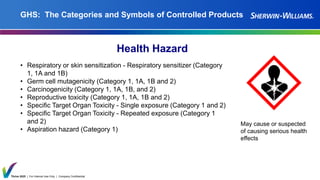
• Respiratory or skin sensitization - Respiratory sensitizer (Category
1, 1A and 1B)
• Germ cell mutagenicity (Category 1, 1A, 1B and 2)
• Carcinogenicity (Category 1, 1A, 1B, and 2)
• Reproductive toxicity (Category 1, 1A, 1B and 2)
• Specific Target Organ Toxicity - Single exposure (Category 1 and 2)
• Specific Target Organ Toxicity - Repeated exposure (Category 1
and 2)
• Aspiration hazard (Category 1)
Health Hazard
May cause or suspected
of causing serious health
effects
Thrive 2025 | For Internal Use Only | Company Confidential
WHMIS: The Categories and Symbols of Controlled Products
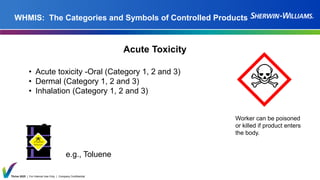
• Acute toxicity -Oral (Category 1, 2 and 3)
• Dermal (Category 1, 2 and 3)
• Inhalation (Category 1, 2 and 3)
Acute Toxicity
Worker can be poisoned
or killed if product enters
the body.
Toluene
POISON
e.g., Toluene
Thrive 2025 | For Internal Use Only | Company Confidential
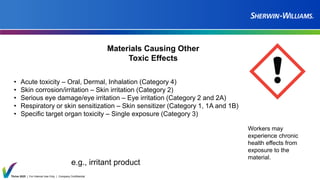
• Acute toxicity – Oral, Dermal, Inhalation (Category 4)
• Skin corrosion/irritation – Skin irritation (Category 2)
• Serious eye damage/eye irritation – Eye irritation (Category 2 and 2A)
• Respiratory or skin sensitization – Skin sensitizer (Category 1, 1A and 1B)
• Specific target organ toxicity – Single exposure (Category 3)
Materials Causing Other
Toxic Effects
Workers may
experience chronic
health effects from
exposure to the
material.
e.g., irritant product
Thrive 2025 | For Internal Use Only | Company Confidential
The Categories and Symbols of Controlled Products
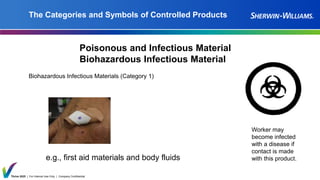
e.g., first aid materials and body fluids
Poisonous and Infectious Material
Biohazardous Infectious Material
Worker may
become infected
with a disease if
contact is made
with this product.
Biohazardous Infectious Materials (Category 1)
Thrive 2025 | For Internal Use Only | Company Confidential
GHS: The Classes and Symbols of Controlled Products
May cause damage to the aquatic environment
No previous WHMIS category
Environment
Thrive 2025 | For Internal Use Only | Company Confidential
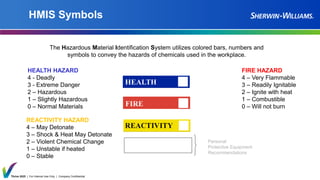
HMIS Symbols
HEALTH HAZARD
4 - Deadly
3 - Extreme Danger
2 – Hazardous
1 – Slightly Hazardous
0 – Normal Materials
REACTIVITY HAZARD
4 – May Detonate
3 – Shock & Heat May Detonate
2 – Violent Chemical Change
1 – Unstable if heated
0 – Stable
FIRE HAZARD
4 – Very Flammable
3 – Readily Ignitable
2 – Ignite with heat
1 – Combustible
0 – Will not burn
Personal
Protective Equipment
Recommendations
The Hazardous Material Identification System utilizes colored bars, numbers and
symbols to convey the hazards of chemicals used in the workplace.
Thrive 2025 | For Internal Use Only | Company Confidential
Occupational Health & Control Measures
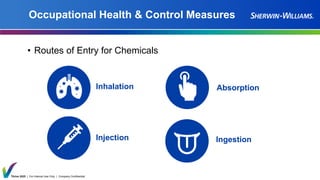
• Routes of Entry for Chemicals
Inhalation
Injection
Absorption
Ingestion
Thrive 2025 | For Internal Use Only | Company Confidential
Occupational Health & Control Measures
To Protect Yourself
• Recognize Hazards
• Assess Hazards
• Control Hazards
WHMIS & HMIS help us to
Recognize and Assess Hazards
Thrive 2025 | For Internal Use Only | Company Confidential
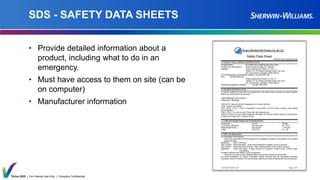
SDS - SAFETY DATA SHEETS
• Provide detailed information about a
product, including what to do in an
emergency.
• Must have access to them on site (can be
on computer)
• Manufacturer information
Thrive 2025 | For Internal Use Only | Company Confidential
SDS - SAFETY DATA SHEETS
• SDSs provide detailed information about hazardous materials
• 16 sections must be included: 1. Identification
2. Hazard(s) identification
3. Composition/information on ingredients
4. First-aid measures
5. Fire-fighting measures
6. Accidental release measures
7. Handling and Storage
8. Exposure controls/personal protection
9. Physical and chemical properties
10. Stability and reactivity
11. Toxicological information
12. Ecological information
13. Disposal considerations
14. Transport information
15. Regulatory information
16. Other information
Thrive 2025 | For Internal Use Only | Company Confidential
SDS - SAFETY DATA SHEETS
• All Raw Material and finished goods SDSs are now stored electronically
and are available through Kaleidoscope.
• Can be reviewed at any time
• Available in English or French

WHMIS Training

  • 1.
    Thrive 2025 |For Internal Use Only | Company Confidential Annual WHMIS Training Fort Erie 2022
  • 2.
    Thrive 2025 |For Internal Use Only | Company Confidential Objective 1. WHMIS, HMIS and the Legislation 2. Labelling information 3. Hazard symbols (GHS) 4. Information Delivery – SDSs
  • 3.
    Thrive 2025 |For Internal Use Only | Company Confidential WHMIS • The Workplace Hazardous Material Information System is the Canadian legislation covering the use of hazardous materials in the workplace. This includes assessment, signage, labeling, safety data sheets and worker training. • WHMIS has changed to incorporate Globally Harmonized System (GHS).
  • 4.
    Thrive 2025 |For Internal Use Only | Company Confidential WHMIS/ HMIS Again, WHMIS = Label + SDS + Employee Training! Workplace Hazardous Material Information System Hazardous Material Identification System
  • 5.
    Thrive 2025 |For Internal Use Only | Company Confidential WHMIS • So…What are the questions you should ask yourself when you encounter a chemical? What is it? Can it hurt me? How do I protect myself from it? What should I do if something goes wrong?
  • 6.
    Thrive 2025 |For Internal Use Only | Company Confidential WHMIS Labels • There are different requirements for labeling depending on the container. • If the container is coming from a Supplier or is a finished good that we are sending to our customer, a supplier label is required. • If we are transferring materials from a supplier container into a container for use in our workplace, then a workplace label can be used.
  • 7.
    Thrive 2025 |For Internal Use Only | Company Confidential WHMIS – GHS Supplier Labels • Supplier labels must include: • Product Identifier • Initial Supplier Identifier • Signal Word • Pictograms (covered later) • Hazard Statements • Be in English and French • Precautionary Statement(s)
  • 8.
    Thrive 2025 |For Internal Use Only | Company Confidential WHMIS – Workplace Labels • Workplace labels must include: • Chemical name • Any hazard statements • Reference to the SDS Methyl Ethyl Ketone USE ONLY WITH FACE SHIELD, GOGGLES & RUBBER GLOVES REFER TO SAFETY DATA SHEET FOR FURTHER INFORMATION
  • 9.
    Thrive 2025 |For Internal Use Only | Company Confidential WHMIS/GHS • Hazard Class: groups of products with similar properties • ~30 of them • E.g. “Flammable Gases” • Category: how hazardous the product is (the severity of hazard). • Category 1 – always the most hazardous • Category 2 – less hazardous than Cat. 1 • …etc. • E.g. “Flammable Gas Cat 1” more hazardous than “Flammable Gas Cat 2”. • Sub-category: also depending on the severity of the hazard • E.g. “Flammable Gas Cat 1A” is more hazardous than “Flammable Gas Cat 1B”.
  • 10.
    Thrive 2025 |For Internal Use Only | Company Confidential WHMIS/GHS – Pictograms • GHS has 9 hazardous symbols
  • 11.
    Thrive 2025 |For Internal Use Only | Company Confidential WHMIS: The Categories and Symbols of Controlled Products • Gases under pressure (Compressed gas, Liquefied gas, Refrigerated liquefied gas, and Dissolved gas) • Content inside the container are under pressure. If the container is damaged, there is a risk of explosion or the product may act as a rocket if dropped. Compressed Gas e.g., Fire Extinguisher
  • 12.
    Thrive 2025 |For Internal Use Only | Company Confidential WHMIS: The Categories and Symbols of Controlled Products • Flammable gases (Category 1) • Flammable aerosols (Category 1 and 2) • Flammable liquids (Category 1, 2 and 3) • Flammable solids (Category 1 and 2) • Pyrophoric liquids (Category 1) • Pyrophoric solids (Category 1) • Pyrophoric gases (Category 1) • Self-heating substances and mixtures (Category 1 and 2) • Substances and mixtures which, in contact with water, emit flammable gases (Category 1, 2 and 3) • Self-reactive substances and mixtures (Types B*, C, D, E and F) • Organic peroxides (Types B*, C, D, E and F) e.g., Paint Flammable and Combustible Material Products can ignite, explode or react with other chemicals.
  • 13.
    Thrive 2025 |For Internal Use Only | Company Confidential WHMIS: The Categories and Symbols of Controlled Products • Oxidizing gases (Category 1) • Oxidizing liquids (Category 1, 2 and 3) • Oxidizing solids (Category 1, 2 and 3) If this product comes into contact with oxygen or other organic material, it will ignite or explode. Bleach e.g., Chlorine in Bleach Oxidizing Material
  • 14.
    Thrive 2025 |For Internal Use Only | Company Confidential The Categories and Symbols of Controlled Products e.g., Nitrocellulose Dangerously Reactive Material Highly unstable material that can react to other products, heat, light, or sudden movements. • Self-reactive substances and mixtures (Types A and B*) • Organic peroxides (Types A and B*)
  • 15.
    Thrive 2025 |For Internal Use Only | Company Confidential The Classes and Symbols of Controlled Products e.g., Battery Acid Corrosive Material Skin can burn or the worker may experience severe eye and skin irritations. e.g., Catalysts, Biocides Corrosive to metals (Category 1) Skin corrosion/irritation - Skin corrosion (Category 1, 1A, 1B and 1C) Serious eye damage/eye irritation - Serious eye damage ( Category 1)
  • 16.
    Thrive 2025 |For Internal Use Only | Company Confidential Health Terms • Acute • Brief, intense • Chronic • Prolonged or Long Term • Latent Period • Time between exposure and disease
  • 17.
    Thrive 2025 |For Internal Use Only | Company Confidential GHS: The Categories and Symbols of Controlled Products • Respiratory or skin sensitization - Respiratory sensitizer (Category 1, 1A and 1B) • Germ cell mutagenicity (Category 1, 1A, 1B and 2) • Carcinogenicity (Category 1, 1A, 1B, and 2) • Reproductive toxicity (Category 1, 1A, 1B and 2) • Specific Target Organ Toxicity - Single exposure (Category 1 and 2) • Specific Target Organ Toxicity - Repeated exposure (Category 1 and 2) • Aspiration hazard (Category 1) Health Hazard May cause or suspected of causing serious health effects
  • 18.
    Thrive 2025 |For Internal Use Only | Company Confidential WHMIS: The Categories and Symbols of Controlled Products • Acute toxicity -Oral (Category 1, 2 and 3) • Dermal (Category 1, 2 and 3) • Inhalation (Category 1, 2 and 3) Acute Toxicity Worker can be poisoned or killed if product enters the body. Toluene POISON e.g., Toluene
  • 19.
    Thrive 2025 |For Internal Use Only | Company Confidential • Acute toxicity – Oral, Dermal, Inhalation (Category 4) • Skin corrosion/irritation – Skin irritation (Category 2) • Serious eye damage/eye irritation – Eye irritation (Category 2 and 2A) • Respiratory or skin sensitization – Skin sensitizer (Category 1, 1A and 1B) • Specific target organ toxicity – Single exposure (Category 3) Materials Causing Other Toxic Effects Workers may experience chronic health effects from exposure to the material. e.g., irritant product
  • 20.
    Thrive 2025 |For Internal Use Only | Company Confidential The Categories and Symbols of Controlled Products e.g., first aid materials and body fluids Poisonous and Infectious Material Biohazardous Infectious Material Worker may become infected with a disease if contact is made with this product. Biohazardous Infectious Materials (Category 1)
  • 21.
    Thrive 2025 |For Internal Use Only | Company Confidential GHS: The Classes and Symbols of Controlled Products May cause damage to the aquatic environment No previous WHMIS category Environment
  • 22.
    Thrive 2025 |For Internal Use Only | Company Confidential HMIS Symbols HEALTH HAZARD 4 - Deadly 3 - Extreme Danger 2 – Hazardous 1 – Slightly Hazardous 0 – Normal Materials REACTIVITY HAZARD 4 – May Detonate 3 – Shock & Heat May Detonate 2 – Violent Chemical Change 1 – Unstable if heated 0 – Stable FIRE HAZARD 4 – Very Flammable 3 – Readily Ignitable 2 – Ignite with heat 1 – Combustible 0 – Will not burn Personal Protective Equipment Recommendations The Hazardous Material Identification System utilizes colored bars, numbers and symbols to convey the hazards of chemicals used in the workplace.
  • 23.
    Thrive 2025 |For Internal Use Only | Company Confidential Occupational Health & Control Measures • Routes of Entry for Chemicals Inhalation Injection Absorption Ingestion
  • 24.
    Thrive 2025 |For Internal Use Only | Company Confidential Occupational Health & Control Measures To Protect Yourself • Recognize Hazards • Assess Hazards • Control Hazards WHMIS & HMIS help us to Recognize and Assess Hazards
  • 25.
    Thrive 2025 |For Internal Use Only | Company Confidential SDS - SAFETY DATA SHEETS • Provide detailed information about a product, including what to do in an emergency. • Must have access to them on site (can be on computer) • Manufacturer information
  • 26.
    Thrive 2025 |For Internal Use Only | Company Confidential SDS - SAFETY DATA SHEETS • SDSs provide detailed information about hazardous materials • 16 sections must be included: 1. Identification 2. Hazard(s) identification 3. Composition/information on ingredients 4. First-aid measures 5. Fire-fighting measures 6. Accidental release measures 7. Handling and Storage 8. Exposure controls/personal protection 9. Physical and chemical properties 10. Stability and reactivity 11. Toxicological information 12. Ecological information 13. Disposal considerations 14. Transport information 15. Regulatory information 16. Other information
  • 27.
    Thrive 2025 |For Internal Use Only | Company Confidential SDS - SAFETY DATA SHEETS • All Raw Material and finished goods SDSs are now stored electronically and are available through Kaleidoscope. • Can be reviewed at any time • Available in English or French

Editor's Notes

  • #3 Review WHMIS/HMIS requirements Details regarding a chemical manufacturing facility NC Storage and Handling Discuss plant safety rules (items of recent concern) Containers and dispensing equipment must be bonded and grounded when flammable liquids are dispensed 200 liter drums of flammable liquid must not be stored in the production area unless required for immediate use (during the shift) Flammable liquids must not be transported in open top containers Employees must follow the Company rules for “Handling and Storing of Nitrocellulose in the Factory Review recent H&S incidents (i.e. handling of NC and product gellation in tank) Review CSB Safety Video_Blast Wave in Danvers
  • #5 Similar but different.
  • #12 These materials are dangerous because they are under pressure. If the cylinder is broken, the container can 'rocket' or 'torpedo' at great speeds and this is a danger to anyone standing too close. If the cylinder is heated (by fire or rise in temperature), the gas may try to expand and the cylinder will explode. Leaking cylinders are also a danger because the gas that comes out is very cold and it may cause frostbite if it touches your skin (for example: carbon dioxide or propane). Common examples include: compressed air, carbon dioxide, propane, oxygen, ethylene oxide,
  • #14 Oxidizers can also be in the form of gases (oxygen, ozone), liquids (nitric acid, perchloric acid solutions) and solids (potassium permanganate, sodium chlorite). Some oxidizers such as the organic peroxide family are extremely hazardous because they will burn (they are combustible) as well as they have the ability to provide oxygen for the fire. They can have strong reactions which can result in an explosion.
  • #15 Material is considered to be dangerously reactive if it shows three different properties or abilities: first, if it can react very strongly and quickly (called "vigorously") with water to make a toxic gas; second, if it will react with itself when it gets shocked (bumped or dropped) or if the temperature or pressure increases; and thirdly, if it can vigorously join to itself (polymerization), break down (decomposition) or lose extra water such that it is a more dense material (condensation). If a material is dangerously reactive, it will most likely be described as "unstable". Most of these materials can be extremely hazardous if they are not handled properly because they can react in such a quick manner very easily. Examples of these products are nitrocellulose, ethyl acrylate, vinyl chloride, ethylene oxide, picric acid and anhydrous aluminum chloride. The symbol for dangerously reactive materials is a picture of a test tube with sparks or lines coming out of the tube surrounded by a letter "R" inside a circle.
  • #16 Corrosive is the name given to materials that can cause severe burns to skin and other human tissues such as the eye or lung, and can attack clothes and other materials including metal. Corrosives are grouped in this special class because their effects are permanent (irritants whose effects may be similar but temporary are grouped in Class D-2). Common corrosives include acids such as sulphuric and nitric acids, bases such as ammonium hydroxide and caustic soda and other materials such as ammonia gas, chlorine, and nitrogen dioxide. The symbol for a corrosive is a picture of two test tubes pouring liquid on a bar (piece of metal) and a hand with lines coming off of them inside a circle.
  • #19 These are materials that are very poisonous and immediately dangerous to life and health. Serious health effects such as burns, loss of consciousness, coma or death within just minutes or hours after exposure are grouped in this category. Most D-1 materials will also cause longer term effects as well (those effects that are not noticed for months or years). Examples of some D-1 materials include carbon monoxide, sodium cyanide, sulphuric acid, toluene-2,4-diisocyanate (TDI), and acrylonitrile. The symbol for Class D - Division 1 (D-1) is a skull and crossed bones inside a circle.
  • #20 These materials are poisonous as well. Their effects are not always quick, or if the effects are immediate but they are only temporary. The materials that do not have immediate effects, however, may still have very serious consequences such as cancer, allergies, reproductive problems or harm to the baby, changes to your genes, or irritation / sensitization which have resulted from small exposures over a long period of time (chronic effects). Examples include: asbestos fibres, mercury, acetone, benzene, quartz silica (crystalline), lead and cadmium. The symbol for materials causing other toxic effects looks like a "T" with an exclamation point "!" at the bottom inside a circle.
  • #21 These materials are organisms or the toxins they produce that can cause diseases in people or animals. Included in this division are bacteria, viruses, fungi and parasites. Because these organisms can live in body tissues or fluids (blood, urine), the tissues and fluids are also treated as toxic. Biohazardous infectious materials are usually found in a hospital, health care facility, laboratories, veterinary practices and research facilities. Workers in these places do not usually know which tissues or fluids contain dangerous organisms. For this reason, the workers assume that every sample is dangerous and proper protection is used all the time. Examples of biohazardous infectious materials include the AIDS/HIV virus, Hepatitis B and salmonella. The symbol for this division looks like three "c"s joined together with a little circle in the middle all inside a circle.
  • #22 These are materials that are very poisonous and immediately dangerous to life and health. Serious health effects such as burns, loss of consciousness, coma or death within just minutes or hours after exposure are grouped in this category. Most D-1 materials will also cause longer term effects as well (those effects that are not noticed for months or years). Examples of some D-1 materials include carbon monoxide, sodium cyanide, sulphuric acid, toluene-2,4-diisocyanate (TDI), and acrylonitrile. The symbol for Class D - Division 1 (D-1) is a skull and crossed bones inside a circle.
  • #23 Unlike WHMIS/GHS, HMIS starts the hazard rating from 0.