COMPLIANCE  TRAINING Fall Prevention & Protection
Goal To provide an understanding of our  Fall Prevention and Protection  Compliance Standard.   Effective Safety Committees
Objectives Understand the requirements of the Fall Prevention & Protection Compliance Standard. Understand the requirements for fall prevention. Understand the requirements for fall protection. Effective Safety Committees
General Requirement Each employee or contractor on a walking/working surface four feet or more above a lower level must be prevented or protected from falling. Prevention can be achieved by guardrails or stair rails,  Protection can be achieved by a personal fall arrest system – body harness and lanyard that is attached to an appropriate anchorage point Effective Safety Committees
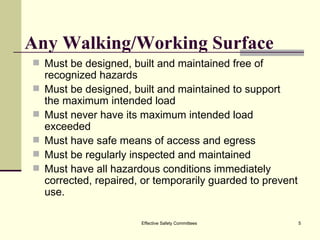
Any Walking/Working Surface Must be designed, built and maintained free of recognized hazards Must be designed, built and maintained to support the maximum intended load Must never have its maximum intended load exceeded Must have safe means of access and egress  Must be regularly inspected and maintained Must have all hazardous conditions immediately corrected, repaired, or temporarily guarded to prevent use. Effective Safety Committees
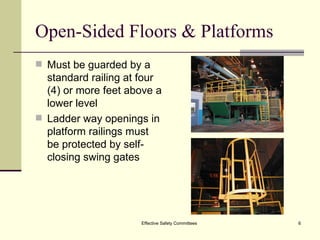
Open-Sided Floors & Platforms Must be guarded by a standard railing at four (4) or more feet above a lower level Ladder way openings in platform railings must be protected by self-closing swing gates Effective Safety Committees
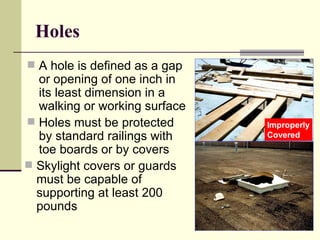
Holes A hole is defined as a gap or opening of one inch in its least dimension in a walking or working surface Holes must be protected by standard railings with toe boards or by covers Skylight covers or guards must be capable of supporting at least 200 pounds
Vertical Openings A vertical opening is a gap 30 inches or more high and 18 inches or more wide in a wall or partition through which an employee can fall to a lower level. All openings from which there is a drop of 4 feet or more and the bottom of the opening is less than 39 inches above the walking/working surface must be protected by standard railings. Effective Safety Committees
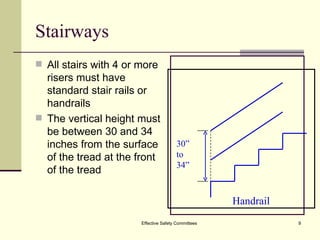
Stairways All stairs with 4 or more risers must have standard stair rails or handrails The vertical height must be between 30 and 34 inches from the surface of the tread at the front of the tread Effective Safety Committees 30” to 34” Handrail
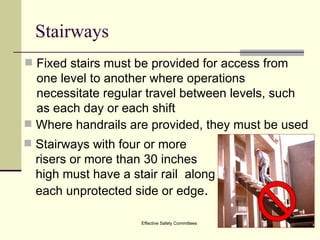
Stairways Fixed stairs must be provided for access from one level to another where operations necessitate regular travel between levels, such as each day or each shift Effective Safety Committees Where handrails are provided, they must be used Stairways with four or more risers or more than 30 inches high must have a stair rail  along each unprotected side or edge .
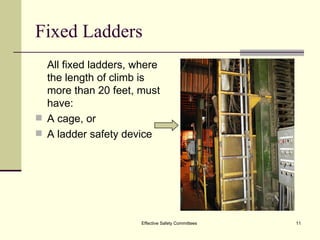
Fixed Ladders All fixed ladders, where the length of climb is more than 20 feet, must have: A cage, or A ladder safety device Effective Safety Committees
Portable Ladders A harness and lanyard is not required when using a portable ladder for its intended purpose The ladder must be properly erected, with the user facing it and maintaining a position with the belt buckle between the side rails at all times Effective Safety Committees
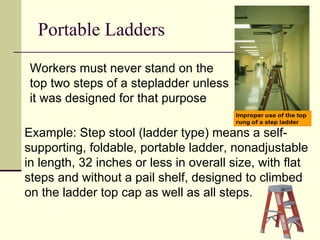
Portable Ladders Example: Step stool (ladder type) means a self-supporting, foldable, portable ladder, nonadjustable in length, 32 inches or less in overall size, with flat steps and without a pail shelf, designed to climbed on the ladder top cap as well as all steps.  Workers must never stand on the top two steps of a stepladder unless it was designed for that purpose
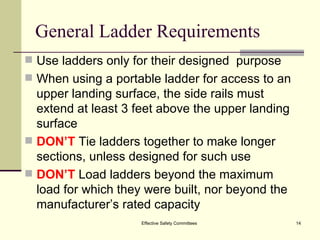
General Ladder Requirements Use ladders only for their designed  purpose When using a portable ladder for access to an upper landing surface, the side rails must extend at least 3 feet above the upper landing surface DON’T  Tie ladders together to make longer  sections, unless designed for such use DON’T  Load ladders beyond the maximum  load for which they were built, nor beyond the manufacturer’s rated capacity Effective Safety Committees
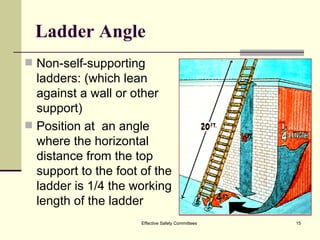
Ladder Angle Non-self-supporting ladders: (which lean against a wall or other support) Position at  an angle where the horizontal distance from the top support to the foot of the ladder is 1/4 the working length of the ladder Effective Safety Committees
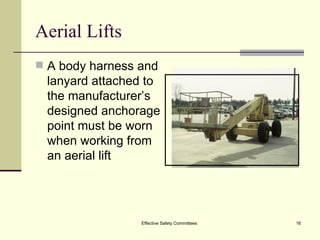
Aerial Lifts A body harness and lanyard attached to the manufacturer’s designed anchorage point must be worn when working from an aerial lift Effective Safety Committees
Aerial Lifts The area under an aerial lift in use must be blocked to prevent pedestrian or vehicle traffic. Effective Safety Committees
Personal Fall Arrest Systems If fall hazards of 4 feet or more cannot be controlled with standard rails or covers, or If the work cannot be performed with scaffolds, lifts or ladders, then… A personal fall arrest system must be used. NO FALL PROTECTION CAN BE WORN  WHILE OPERATING BUGGIES OR FORKLIFTS Effective Safety Committees
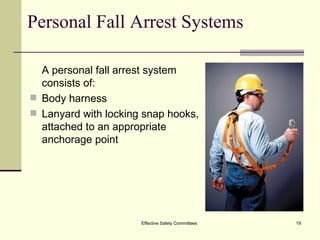
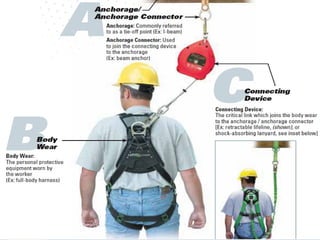
Personal Fall Arrest Systems Effective Safety Committees A personal fall arrest system consists of: Body harness Lanyard with locking snap hooks, attached to an appropriate anchorage point
Effective Safety Committees
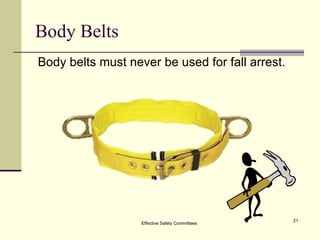
Body Belts Body belts must never be used for fall arrest. Effective Safety Committees
Anchorage Points Personal fall arrest equipment must be attached to an anchorage point: Capable of supporting 5,000 pounds per person attached to it, or Designed by a qualified person with a safety factor of twice the maximum anticipated force generated during a fall. Effective Safety Committees
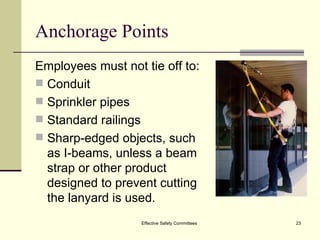
Anchorage Points Employees must not tie off to: Conduit Sprinkler pipes Standard railings Sharp-edged objects, such as I-beams, unless a beam strap or other product designed to prevent cutting the lanyard is used. Effective Safety Committees
Personal Fall Arrest System The fall arrest system must limit the force on a falling employee by: Using a deceleration device, such as a shock absorbing or self-retracting lanyard Limiting free fall to no more than 6 feet Not allowing a falling employee to contact a lower level. Anchorage points must be overhead whenever possible Effective Safety Committees
Personal Fall Arrest Equipment Personal fall arrest equipment must be inspected prior to use. Damaged or defective equipment must be removed from service. After a fall, the personal fall arrest equipment must be removed from service, and the anchorage point must be inspected for damage. Effective Safety Committees
Fall Protection Rescue Rescue protection for non-designated jobs less than 10 foot fall can be handled from a catwalk or floor level.  Rescue protection for non-designated jobs more than 10 foot fall will require preparation prior to job.  A man lift or extension ladder will be identified in the event that rescue is needed.  A secondary person will be assigned to monitor any non-routine jobs that require fall protection to alert area personal in case of an  emergency. Effective Safety Committees
Training Training must be conducted: Before person is exposed to fall hazards When there is a change in the workplace, fall protection systems or equipment When reason to believe that previously trained person does not have the required skills or understanding Effective Safety Committees

General Industry Fall Protection

  • 1.
    COMPLIANCE TRAININGFall Prevention & Protection
  • 2.
    Goal To providean understanding of our Fall Prevention and Protection Compliance Standard. Effective Safety Committees
  • 3.
    Objectives Understand therequirements of the Fall Prevention & Protection Compliance Standard. Understand the requirements for fall prevention. Understand the requirements for fall protection. Effective Safety Committees
  • 4.
    General Requirement Eachemployee or contractor on a walking/working surface four feet or more above a lower level must be prevented or protected from falling. Prevention can be achieved by guardrails or stair rails, Protection can be achieved by a personal fall arrest system – body harness and lanyard that is attached to an appropriate anchorage point Effective Safety Committees
  • 5.
    Any Walking/Working SurfaceMust be designed, built and maintained free of recognized hazards Must be designed, built and maintained to support the maximum intended load Must never have its maximum intended load exceeded Must have safe means of access and egress Must be regularly inspected and maintained Must have all hazardous conditions immediately corrected, repaired, or temporarily guarded to prevent use. Effective Safety Committees
  • 6.
    Open-Sided Floors &Platforms Must be guarded by a standard railing at four (4) or more feet above a lower level Ladder way openings in platform railings must be protected by self-closing swing gates Effective Safety Committees
  • 7.
    Holes A holeis defined as a gap or opening of one inch in its least dimension in a walking or working surface Holes must be protected by standard railings with toe boards or by covers Skylight covers or guards must be capable of supporting at least 200 pounds
  • 8.
    Vertical Openings Avertical opening is a gap 30 inches or more high and 18 inches or more wide in a wall or partition through which an employee can fall to a lower level. All openings from which there is a drop of 4 feet or more and the bottom of the opening is less than 39 inches above the walking/working surface must be protected by standard railings. Effective Safety Committees
  • 9.
    Stairways All stairswith 4 or more risers must have standard stair rails or handrails The vertical height must be between 30 and 34 inches from the surface of the tread at the front of the tread Effective Safety Committees 30” to 34” Handrail
  • 10.
    Stairways Fixed stairsmust be provided for access from one level to another where operations necessitate regular travel between levels, such as each day or each shift Effective Safety Committees Where handrails are provided, they must be used Stairways with four or more risers or more than 30 inches high must have a stair rail along each unprotected side or edge .
  • 11.
    Fixed Ladders Allfixed ladders, where the length of climb is more than 20 feet, must have: A cage, or A ladder safety device Effective Safety Committees
  • 12.
    Portable Ladders Aharness and lanyard is not required when using a portable ladder for its intended purpose The ladder must be properly erected, with the user facing it and maintaining a position with the belt buckle between the side rails at all times Effective Safety Committees
  • 13.
    Portable Ladders Example:Step stool (ladder type) means a self-supporting, foldable, portable ladder, nonadjustable in length, 32 inches or less in overall size, with flat steps and without a pail shelf, designed to climbed on the ladder top cap as well as all steps. Workers must never stand on the top two steps of a stepladder unless it was designed for that purpose
  • 14.
    General Ladder RequirementsUse ladders only for their designed purpose When using a portable ladder for access to an upper landing surface, the side rails must extend at least 3 feet above the upper landing surface DON’T Tie ladders together to make longer sections, unless designed for such use DON’T Load ladders beyond the maximum load for which they were built, nor beyond the manufacturer’s rated capacity Effective Safety Committees
  • 15.
    Ladder Angle Non-self-supportingladders: (which lean against a wall or other support) Position at an angle where the horizontal distance from the top support to the foot of the ladder is 1/4 the working length of the ladder Effective Safety Committees
  • 16.
    Aerial Lifts Abody harness and lanyard attached to the manufacturer’s designed anchorage point must be worn when working from an aerial lift Effective Safety Committees
  • 17.
    Aerial Lifts Thearea under an aerial lift in use must be blocked to prevent pedestrian or vehicle traffic. Effective Safety Committees
  • 18.
    Personal Fall ArrestSystems If fall hazards of 4 feet or more cannot be controlled with standard rails or covers, or If the work cannot be performed with scaffolds, lifts or ladders, then… A personal fall arrest system must be used. NO FALL PROTECTION CAN BE WORN WHILE OPERATING BUGGIES OR FORKLIFTS Effective Safety Committees
  • 19.
    Personal Fall ArrestSystems Effective Safety Committees A personal fall arrest system consists of: Body harness Lanyard with locking snap hooks, attached to an appropriate anchorage point
  • 20.
  • 21.
    Body Belts Bodybelts must never be used for fall arrest. Effective Safety Committees
  • 22.
    Anchorage Points Personalfall arrest equipment must be attached to an anchorage point: Capable of supporting 5,000 pounds per person attached to it, or Designed by a qualified person with a safety factor of twice the maximum anticipated force generated during a fall. Effective Safety Committees
  • 23.
    Anchorage Points Employeesmust not tie off to: Conduit Sprinkler pipes Standard railings Sharp-edged objects, such as I-beams, unless a beam strap or other product designed to prevent cutting the lanyard is used. Effective Safety Committees
  • 24.
    Personal Fall ArrestSystem The fall arrest system must limit the force on a falling employee by: Using a deceleration device, such as a shock absorbing or self-retracting lanyard Limiting free fall to no more than 6 feet Not allowing a falling employee to contact a lower level. Anchorage points must be overhead whenever possible Effective Safety Committees
  • 25.
    Personal Fall ArrestEquipment Personal fall arrest equipment must be inspected prior to use. Damaged or defective equipment must be removed from service. After a fall, the personal fall arrest equipment must be removed from service, and the anchorage point must be inspected for damage. Effective Safety Committees
  • 26.
    Fall Protection RescueRescue protection for non-designated jobs less than 10 foot fall can be handled from a catwalk or floor level. Rescue protection for non-designated jobs more than 10 foot fall will require preparation prior to job. A man lift or extension ladder will be identified in the event that rescue is needed. A secondary person will be assigned to monitor any non-routine jobs that require fall protection to alert area personal in case of an emergency. Effective Safety Committees
  • 27.
    Training Training mustbe conducted: Before person is exposed to fall hazards When there is a change in the workplace, fall protection systems or equipment When reason to believe that previously trained person does not have the required skills or understanding Effective Safety Committees