www.ccohs.ca
WHMIS and
OSHA Labels
Presented by:
Jessie Callaghan
Senior Technical Specialist
Canadian Centre for Occupational Health and Safety www.ccohs.ca
Today’s Presentation
 Review current WHMIS and OSHA supplier label
requirements
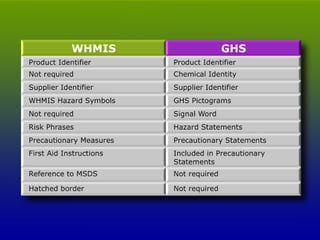
 Compare WHMIS and OSHA label requirements to the
GHS label requirements
 Provide some insight into how you can write WHMIS-
and OSHA-compliant labels today with an eye to
GHS implementation
Canadian Centre for Occupational Health and Safety www.ccohs.ca
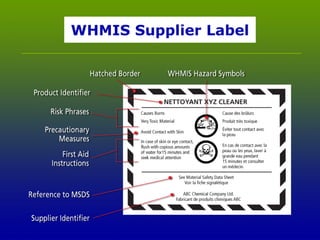
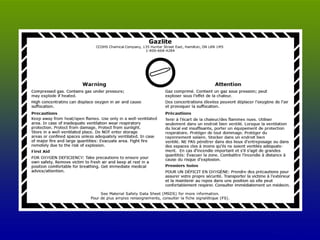
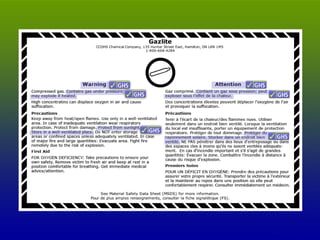
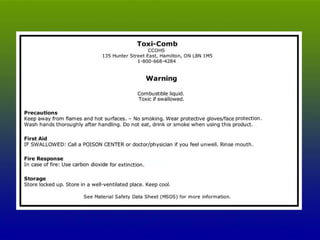
WHMIS Supplier Label
Canadian Centre for Occupational Health and Safety www.ccohs.ca
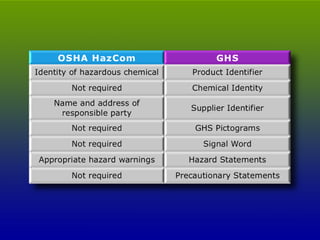
New GHS Label Elements
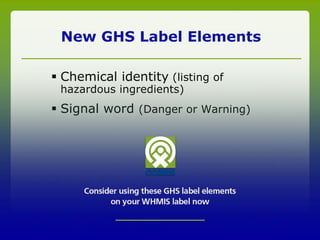
 Chemical identity (listing of
hazardous ingredients)
 Signal word (Danger or Warning)
Canadian Centre for Occupational Health and Safety www.ccohs.ca
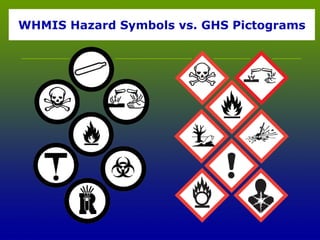
WHMIS Hazard Symbols vs. GHS Pictograms
Canadian Centre for Occupational Health and Safety www.ccohs.ca
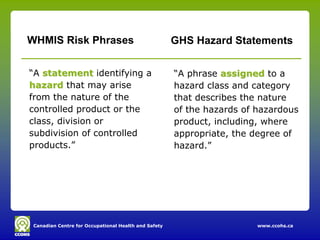
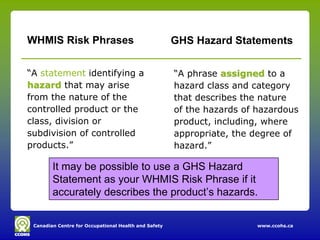
“A statementstatement identifying a
hazardhazard that may arise
from the nature of the
controlled product or the
class, division or
subdivision of controlled
products.”
“A phrase assignedassigned to a
hazard class and category
that describes the nature
of the hazards of hazardous
product, including, where
appropriate, the degree of
hazard.”
WHMIS Risk Phrases GHS Hazard Statements
Canadian Centre for Occupational Health and Safety www.ccohs.ca
“A statement identifying a
hazardhazard that may arise
from the nature of the
controlled product or the
class, division or
subdivision of controlled
products.”
“A phrase assignedassigned to a
hazard class and category
that describes the nature
of the hazards of hazardous
product, including, where
appropriate, the degree of
hazard.”
WHMIS Risk Phrases GHS Hazard Statements
It may be possible to use a GHS Hazard
Statement as your WHMIS Risk Phrase if it
accurately describes the product’s hazards.
Canadian Centre for Occupational Health and Safety www.ccohs.ca
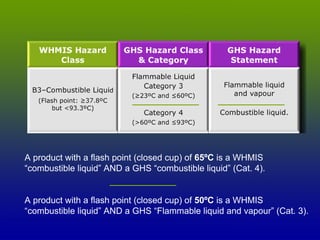
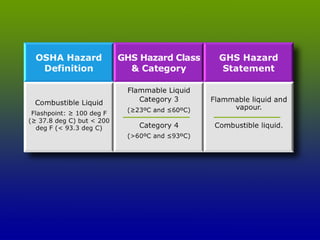
A product with a flash point (closed cup) of 65ºC is a WHMIS
“combustible liquid” AND a GHS “combustible liquid” (Cat. 4).
A product with a flash point (closed cup) of 50ºC is a WHMIS
“combustible liquid” AND a GHS “Flammable liquid and vapour” (Cat. 3).
Canadian Centre for Occupational Health and Safety www.ccohs.ca
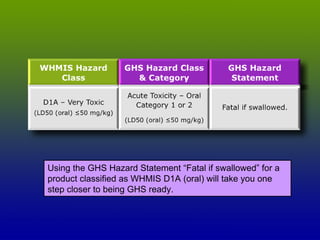
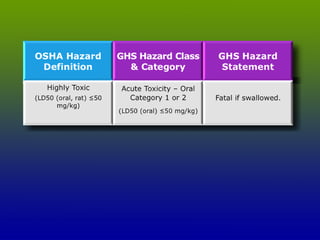
Using the GHS Hazard Statement “Fatal if swallowed” for a
product classified as WHMIS D1A (oral) will take you one
step closer to being GHS ready.
Canadian Centre for Occupational Health and Safety www.ccohs.ca
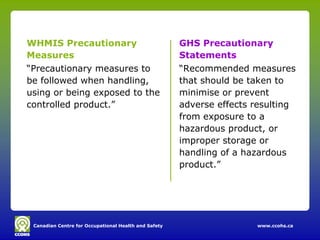
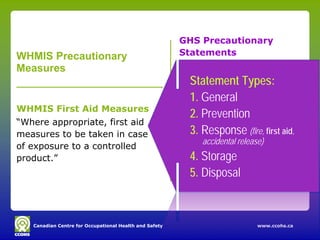
WHMIS Precautionary
Measures
“Precautionary measures to
be followed when handling,
using or being exposed to the
controlled product.”
GHS Precautionary
Statements
“Recommended measures
that should be taken to
minimise or prevent
adverse effects resulting
from exposure to a
hazardous product, or
improper storage or
handling of a hazardous
product.”
Canadian Centre for Occupational Health and Safety www.ccohs.ca
WHMIS Precautionary
Measures
WHMIS First Aid Measures
“Where appropriate, first aid
measures to be taken in case
of exposure to a controlled
product.”
GHS Precautionary
Statements
“Recommended measures
that should be taken to
minimise or prevent
adverse effects resulting
from exposure to a
hazardous product, or
improper storage or
handling of a hazardous
product.”
Statement Types:
1. General
2. Prevention
3. Response (fire, first aid,
accidental release)
4. Storage
5. Disposal
Canadian Centre for Occupational Health and Safety www.ccohs.ca
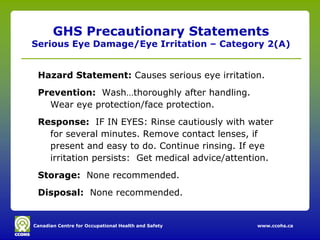
GHS Precautionary Statements
Serious Eye Damage/Eye Irritation – Category 2(A)
Hazard Statement: Causes serious eye irritation.
Prevention: Wash…thoroughly after handling.
Wear eye protection/face protection.
Response: IF IN EYES: Rinse cautiously with water
for several minutes. Remove contact lenses, if
present and easy to do. Continue rinsing. If eye
irritation persists: Get medical advice/attention.
Storage: None recommended.
Disposal: None recommended.
Canadian Centre for Occupational Health and Safety www.ccohs.ca
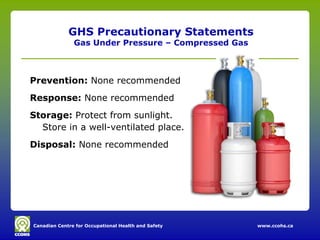
GHS Precautionary Statements
Gas Under Pressure – Compressed Gas
Prevention: None recommended
Response: None recommended
Storage: Protect from sunlight.
Store in a well-ventilated place.
Disposal: None recommended
Canadian Centre for Occupational Health and Safety www.ccohs.ca
WHMIS Label Elements Not Required
by the GHS
 Hatched border
 Reference to MSDS
These elements must be
present on a WHMIS-
compliant label today.
It is not known if they will be
retained following
implementation of the GHS in
WHMIS.
Canadian Centre for Occupational Health and Safety www.ccohs.ca
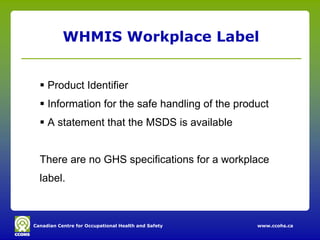
WHMIS Workplace Label
 Product Identifier
 Information for the safe handling of the product
 A statement that the MSDS is available
There are no GHS specifications for a workplace
label.
Canadian Centre for Occupational Health and Safety www.ccohs.ca
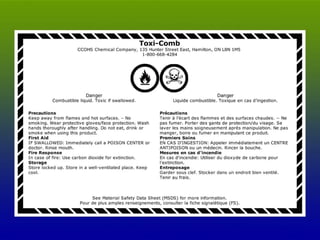
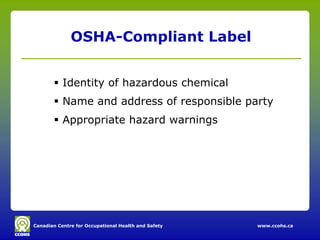
OSHA-Compliant Label
 Identity of hazardous chemical
 Name and address of responsible party
 Appropriate hazard warnings
Canadian Centre for Occupational Health and Safety www.ccohs.ca
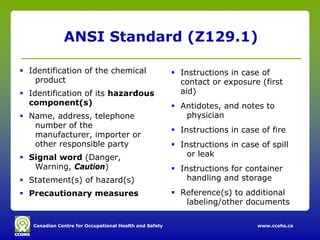
ANSI Standard (Z129.1)
 Identification of the chemical
product
 Identification of its hazardous
component(s)
 Name, address, telephone
number of the
manufacturer, importer or
other responsible party
 Signal word (Danger,
Warning, Caution)
 Statement(s) of hazard(s)
 Precautionary measures
 Instructions in case of
contact or exposure (first
aid)
 Antidotes, and notes to
physician
 Instructions in case of fire
 Instructions in case of spill
or leak
 Instructions for container
handling and storage
 Reference(s) to additional
labeling/other documents
Canadian Centre for Occupational Health and Safety www.ccohs.ca
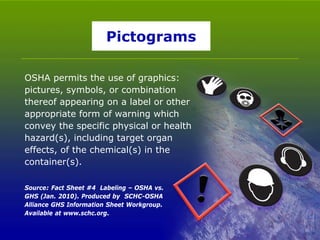
OSHA permits the use of graphics:
pictures, symbols, or combination
thereof appearing on a label or other
appropriate form of warning which
convey the specific physical or health
hazard(s), including target organ
effects, of the chemical(s) in the
container(s).
Source: Fact Sheet #4 Labeling – OSHA vs.
GHS (Jan. 2010). Produced by SCHC-OSHA
Alliance GHS Information Sheet Workgroup.
Available at www.schc.org.
Pictograms
Canadian Centre for Occupational Health and Safety www.ccohs.ca
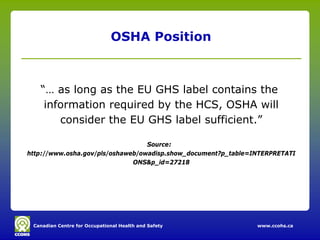
OSHA Position
“… as long as the EU GHS label contains the
information required by the HCS, OSHA will
consider the EU GHS label sufficient.”
Source:
http://www.osha.gov/pls/oshaweb/owadisp.show_document?p_table=INTERPRETATI
ONS&p_id=27218
Canadian Centre for Occupational Health and Safety www.ccohs.ca
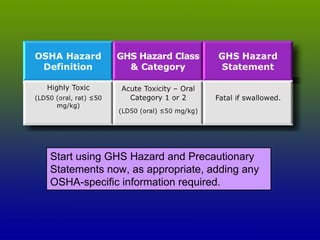
Start using GHS Hazard and Precautionary
Statements now, as appropriate, adding any
OSHA-specific information required.
Canadian Centre for Occupational Health and Safety www.ccohs.ca
Preparing for Change
• Compare the WHMIS and/or OSHA hazards of
your products to the GHS hazards.
• Start transitioning your label content as you
update or write new labels, as appropriate.

WHMIS and OSHA Labels

  • 1.
    www.ccohs.ca WHMIS and OSHA Labels Presentedby: Jessie Callaghan Senior Technical Specialist
  • 2.
    Canadian Centre forOccupational Health and Safety www.ccohs.ca Today’s Presentation  Review current WHMIS and OSHA supplier label requirements  Compare WHMIS and OSHA label requirements to the GHS label requirements  Provide some insight into how you can write WHMIS- and OSHA-compliant labels today with an eye to GHS implementation
  • 3.
    Canadian Centre forOccupational Health and Safety www.ccohs.ca WHMIS Supplier Label
  • 4.
    Canadian Centre forOccupational Health and Safety www.ccohs.ca
  • 5.
    Canadian Centre forOccupational Health and Safety www.ccohs.ca New GHS Label Elements  Chemical identity (listing of hazardous ingredients)  Signal word (Danger or Warning)
  • 6.
    Canadian Centre forOccupational Health and Safety www.ccohs.ca WHMIS Hazard Symbols vs. GHS Pictograms
  • 7.
    Canadian Centre forOccupational Health and Safety www.ccohs.ca “A statementstatement identifying a hazardhazard that may arise from the nature of the controlled product or the class, division or subdivision of controlled products.” “A phrase assignedassigned to a hazard class and category that describes the nature of the hazards of hazardous product, including, where appropriate, the degree of hazard.” WHMIS Risk Phrases GHS Hazard Statements
  • 8.
    Canadian Centre forOccupational Health and Safety www.ccohs.ca “A statement identifying a hazardhazard that may arise from the nature of the controlled product or the class, division or subdivision of controlled products.” “A phrase assignedassigned to a hazard class and category that describes the nature of the hazards of hazardous product, including, where appropriate, the degree of hazard.” WHMIS Risk Phrases GHS Hazard Statements It may be possible to use a GHS Hazard Statement as your WHMIS Risk Phrase if it accurately describes the product’s hazards.
  • 9.
    Canadian Centre forOccupational Health and Safety www.ccohs.ca A product with a flash point (closed cup) of 65ºC is a WHMIS “combustible liquid” AND a GHS “combustible liquid” (Cat. 4). A product with a flash point (closed cup) of 50ºC is a WHMIS “combustible liquid” AND a GHS “Flammable liquid and vapour” (Cat. 3).
  • 10.
    Canadian Centre forOccupational Health and Safety www.ccohs.ca Using the GHS Hazard Statement “Fatal if swallowed” for a product classified as WHMIS D1A (oral) will take you one step closer to being GHS ready.
  • 11.
    Canadian Centre forOccupational Health and Safety www.ccohs.ca WHMIS Precautionary Measures “Precautionary measures to be followed when handling, using or being exposed to the controlled product.” GHS Precautionary Statements “Recommended measures that should be taken to minimise or prevent adverse effects resulting from exposure to a hazardous product, or improper storage or handling of a hazardous product.”
  • 12.
    Canadian Centre forOccupational Health and Safety www.ccohs.ca WHMIS Precautionary Measures WHMIS First Aid Measures “Where appropriate, first aid measures to be taken in case of exposure to a controlled product.” GHS Precautionary Statements “Recommended measures that should be taken to minimise or prevent adverse effects resulting from exposure to a hazardous product, or improper storage or handling of a hazardous product.” Statement Types: 1. General 2. Prevention 3. Response (fire, first aid, accidental release) 4. Storage 5. Disposal
  • 13.
    Canadian Centre forOccupational Health and Safety www.ccohs.ca GHS Precautionary Statements Serious Eye Damage/Eye Irritation – Category 2(A) Hazard Statement: Causes serious eye irritation. Prevention: Wash…thoroughly after handling. Wear eye protection/face protection. Response: IF IN EYES: Rinse cautiously with water for several minutes. Remove contact lenses, if present and easy to do. Continue rinsing. If eye irritation persists: Get medical advice/attention. Storage: None recommended. Disposal: None recommended.
  • 14.
    Canadian Centre forOccupational Health and Safety www.ccohs.ca GHS Precautionary Statements Gas Under Pressure – Compressed Gas Prevention: None recommended Response: None recommended Storage: Protect from sunlight. Store in a well-ventilated place. Disposal: None recommended
  • 15.
    Canadian Centre forOccupational Health and Safety www.ccohs.ca WHMIS Label Elements Not Required by the GHS  Hatched border  Reference to MSDS These elements must be present on a WHMIS- compliant label today. It is not known if they will be retained following implementation of the GHS in WHMIS.
  • 16.
    Canadian Centre forOccupational Health and Safety www.ccohs.ca
  • 17.
    Canadian Centre forOccupational Health and Safety www.ccohs.ca
  • 18.
    Canadian Centre forOccupational Health and Safety www.ccohs.ca
  • 19.
    Canadian Centre forOccupational Health and Safety www.ccohs.ca
  • 20.
    Canadian Centre forOccupational Health and Safety www.ccohs.ca WHMIS Workplace Label  Product Identifier  Information for the safe handling of the product  A statement that the MSDS is available There are no GHS specifications for a workplace label.
  • 21.
    Canadian Centre forOccupational Health and Safety www.ccohs.ca OSHA-Compliant Label  Identity of hazardous chemical  Name and address of responsible party  Appropriate hazard warnings
  • 22.
    Canadian Centre forOccupational Health and Safety www.ccohs.ca
  • 23.
    Canadian Centre forOccupational Health and Safety www.ccohs.ca ANSI Standard (Z129.1)  Identification of the chemical product  Identification of its hazardous component(s)  Name, address, telephone number of the manufacturer, importer or other responsible party  Signal word (Danger, Warning, Caution)  Statement(s) of hazard(s)  Precautionary measures  Instructions in case of contact or exposure (first aid)  Antidotes, and notes to physician  Instructions in case of fire  Instructions in case of spill or leak  Instructions for container handling and storage  Reference(s) to additional labeling/other documents
  • 24.
    Canadian Centre forOccupational Health and Safety www.ccohs.ca OSHA permits the use of graphics: pictures, symbols, or combination thereof appearing on a label or other appropriate form of warning which convey the specific physical or health hazard(s), including target organ effects, of the chemical(s) in the container(s). Source: Fact Sheet #4 Labeling – OSHA vs. GHS (Jan. 2010). Produced by SCHC-OSHA Alliance GHS Information Sheet Workgroup. Available at www.schc.org. Pictograms
  • 25.
    Canadian Centre forOccupational Health and Safety www.ccohs.ca OSHA Position “… as long as the EU GHS label contains the information required by the HCS, OSHA will consider the EU GHS label sufficient.” Source: http://www.osha.gov/pls/oshaweb/owadisp.show_document?p_table=INTERPRETATI ONS&p_id=27218
  • 26.
    Canadian Centre forOccupational Health and Safety www.ccohs.ca
  • 27.
    Canadian Centre forOccupational Health and Safety www.ccohs.ca
  • 28.
    Canadian Centre forOccupational Health and Safety www.ccohs.ca Start using GHS Hazard and Precautionary Statements now, as appropriate, adding any OSHA-specific information required.
  • 29.
    Canadian Centre forOccupational Health and Safety www.ccohs.ca
  • 30.
    Canadian Centre forOccupational Health and Safety www.ccohs.ca
  • 31.
    Canadian Centre forOccupational Health and Safety www.ccohs.ca Preparing for Change • Compare the WHMIS and/or OSHA hazards of your products to the GHS hazards. • Start transitioning your label content as you update or write new labels, as appropriate.