This presentation is intended for Technology & Dual-Credit Students, Lambton CollegeWHMIS CertificationThe information & graphics contained in this presentation were obtained from AMDSB and ESAO, with thanks.Editorial Content : Rob Peat: SHDHS, Abby Hamilton: LCDesign: Casey James: Lambton College SCWI
WHMISWorkplaceHazardous MaterialsInformation SystemDefinitionWorkplace Hazardous Materials Information System
Purpose of WHMISThe Workplace Hazardous Material Information System (WHMIS) is a nationwide system to provide information on hazardous materials used in the workplace and involves both Federal and Provincial legislation.WHMIS recognizes the interests of workers, employers, suppliers and regulators, balancing the workers' right to know with the industry's right to protect confidential business information.
Hazardous Products Act (HPA)Federal legislation is the Hazardous Products Act (HPA)HPA controls product regulations and ingredient disclosure listsProvincial legislation is the Occupational Health and Safety Act (OHSA)OHSA is in charge of WHMIS regulations and references parts of the controlled product regulations
Key Elements Three Key Elements of  WHMIS are:1.	Labels 2.	Material Safety Data Sheets3. 	Worker Training
Why we need to KnowExposure to hazardous material can cause or contribute to a variety of health effects such as:Irritation, burns
Sensitization
Heart ailments
Kidney & lung damage
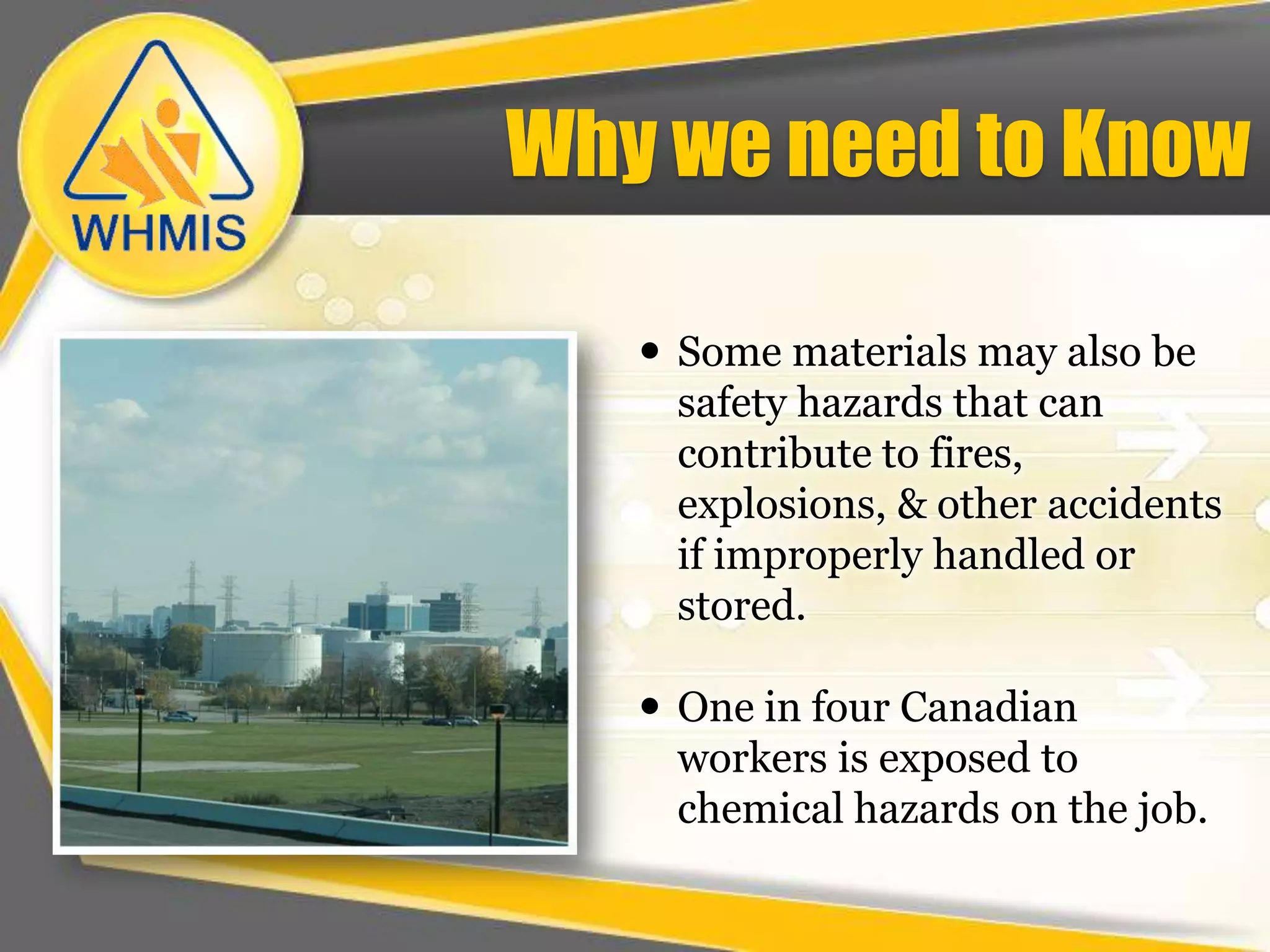
CancerWhy we need to KnowSome materials may also be safety hazards that can contribute to fires, explosions, & other accidents if improperly handled or stored.
One in four Canadian workers is exposed to chemical hazards on the job.Occupational Health & Safety ActIn Ontario workplace safety is a provincial responsibility.The OHSA outlines the responsibilities of the Employer, Supervisor and Employee.The OHSA gives the worker three main rights:Participate
Refuse unsafe work
The right to knowWHMISWHMISisbased on the tripartite model regulation, was adopted under the OHSA; this regulation sets out the employer duties under WHMIS. The Act also covers three other directly related areas:    Public Right To Know
   Workplace Inventories
   Hazardous Physical AgentsMain Responsibilities Under WHMISDetermine which of their products are    controlled products.Provideinformation about controlled products in the form of labels and MSDS
Labelsmust be in English and French.
UpdateMSDS and labels as new info.     becomes available & once every 3 years.Supplier/Manufacturer
Main Responsibilities Under WHMISObtain Material Safety Data Sheets (MSDS's)
Provision of information in medical emergencies
Assess products produced in-house and establish a WHMISprogram
Labels: create and apply
Worker education and training.Employer/Supervisor
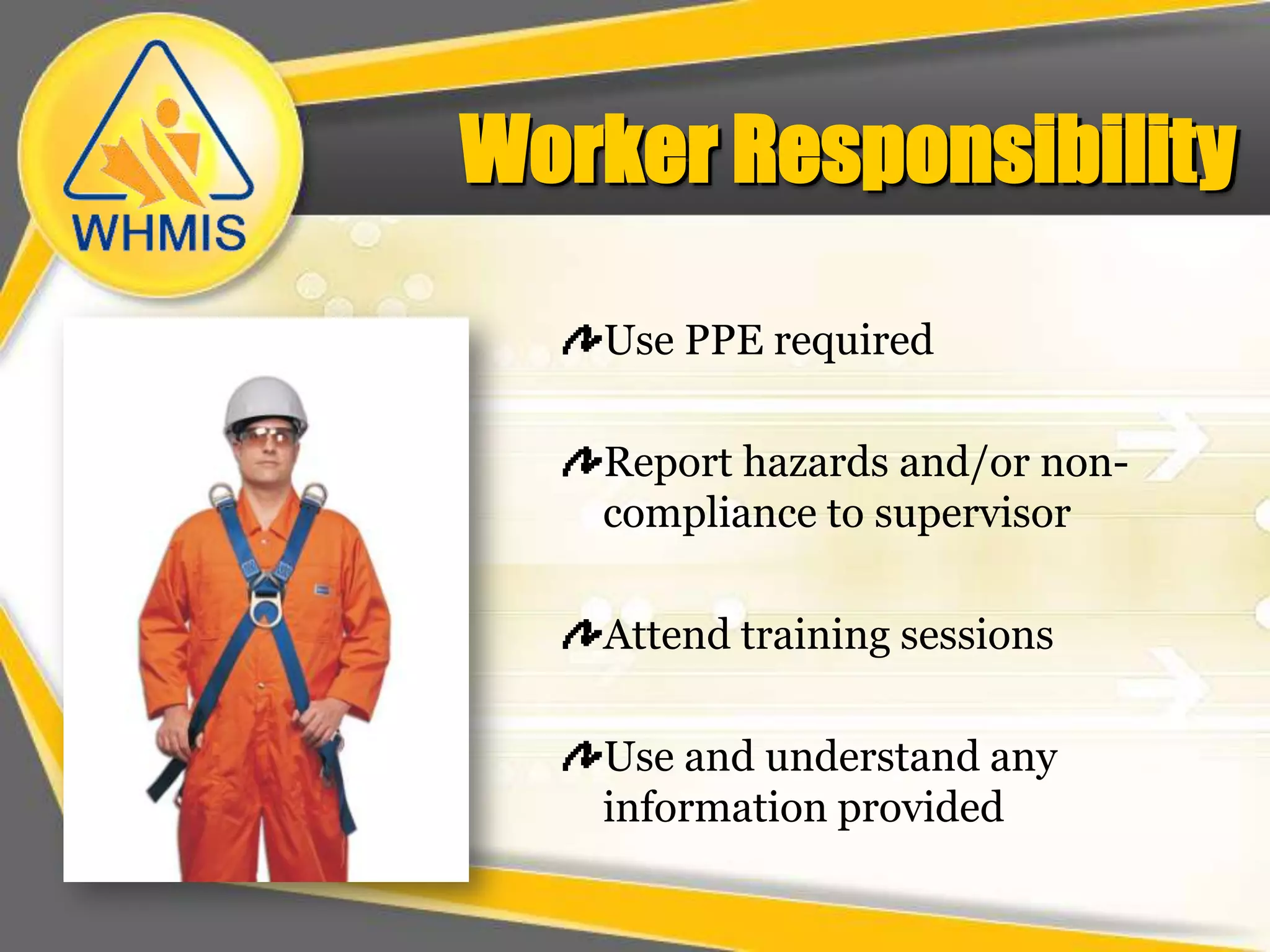
Worker ResponsibilityUse PPE requiredReport hazards and/or non-compliance to supervisorAttend training sessionsUse and understand any information provided
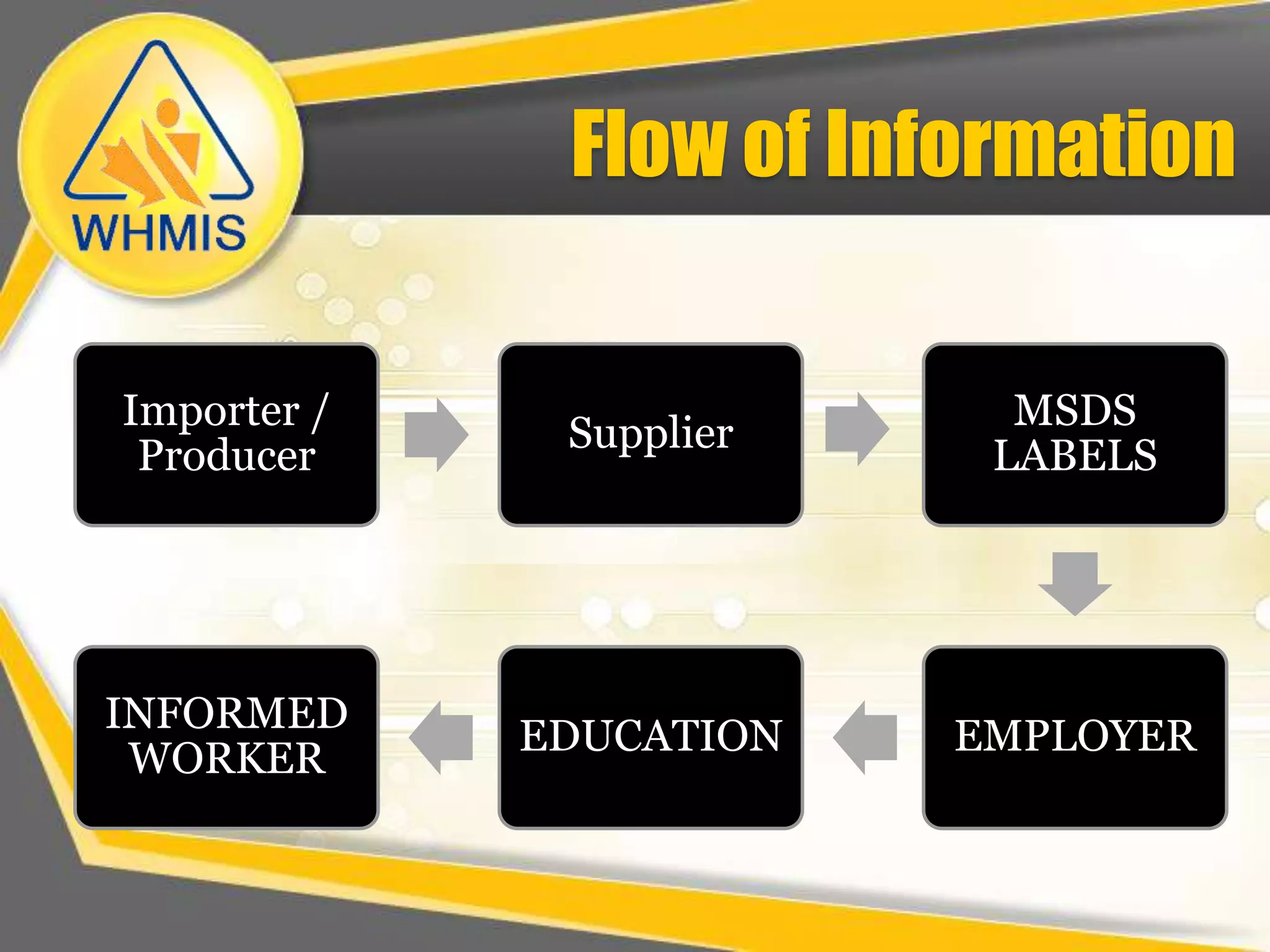
Flow of Information
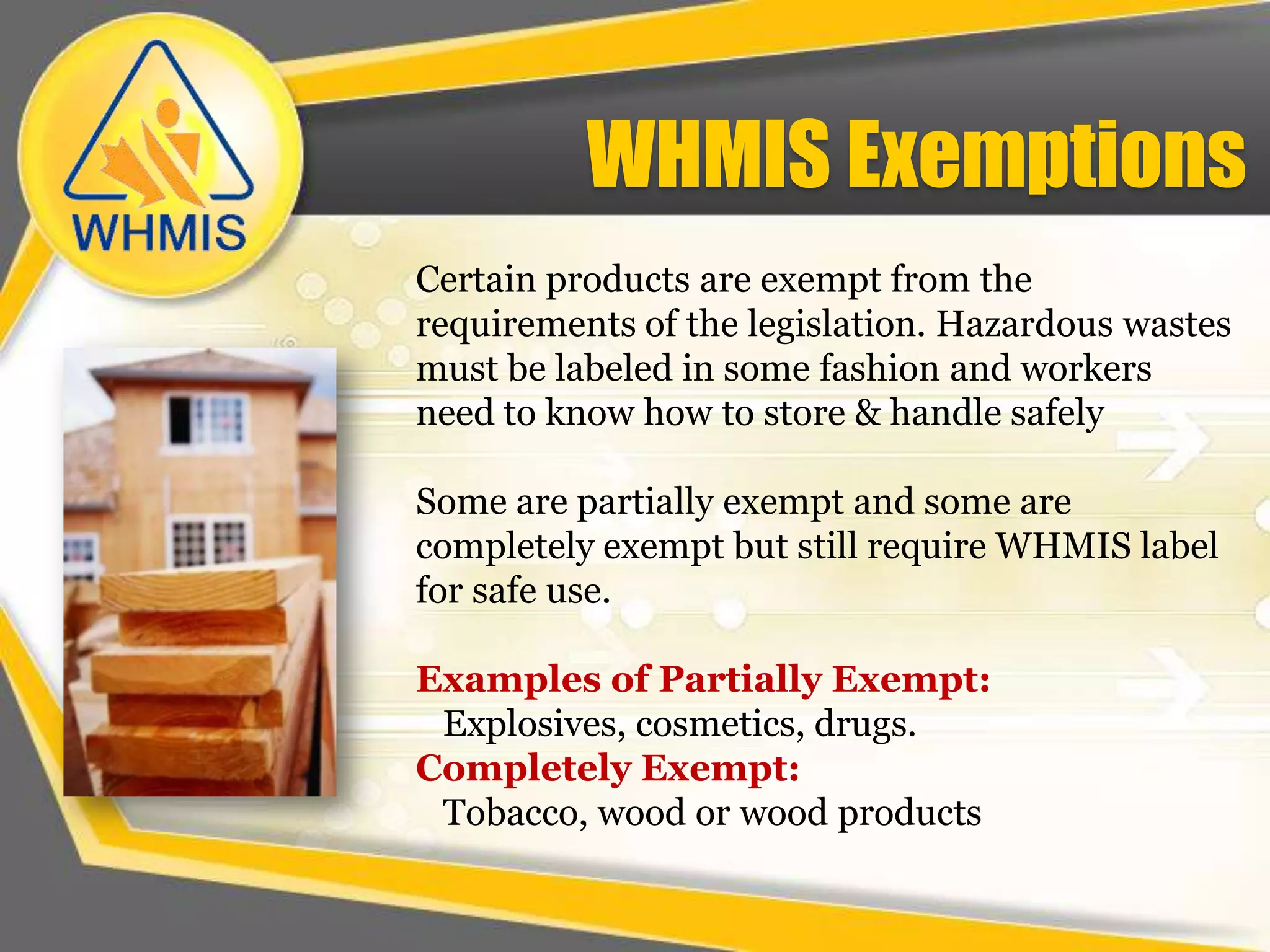
WHMIS ExemptionsCertain products are exempt from the requirements of the legislation. Hazardous wastes must be labeled in some fashion and workers need to know how to store & handle safelySome are partially exempt and some are completely exempt but still require WHMIS label for safe use.Examples of Partially Exempt:   Explosives, cosmetics, drugs.Completely Exempt:   Tobacco, wood or wood products
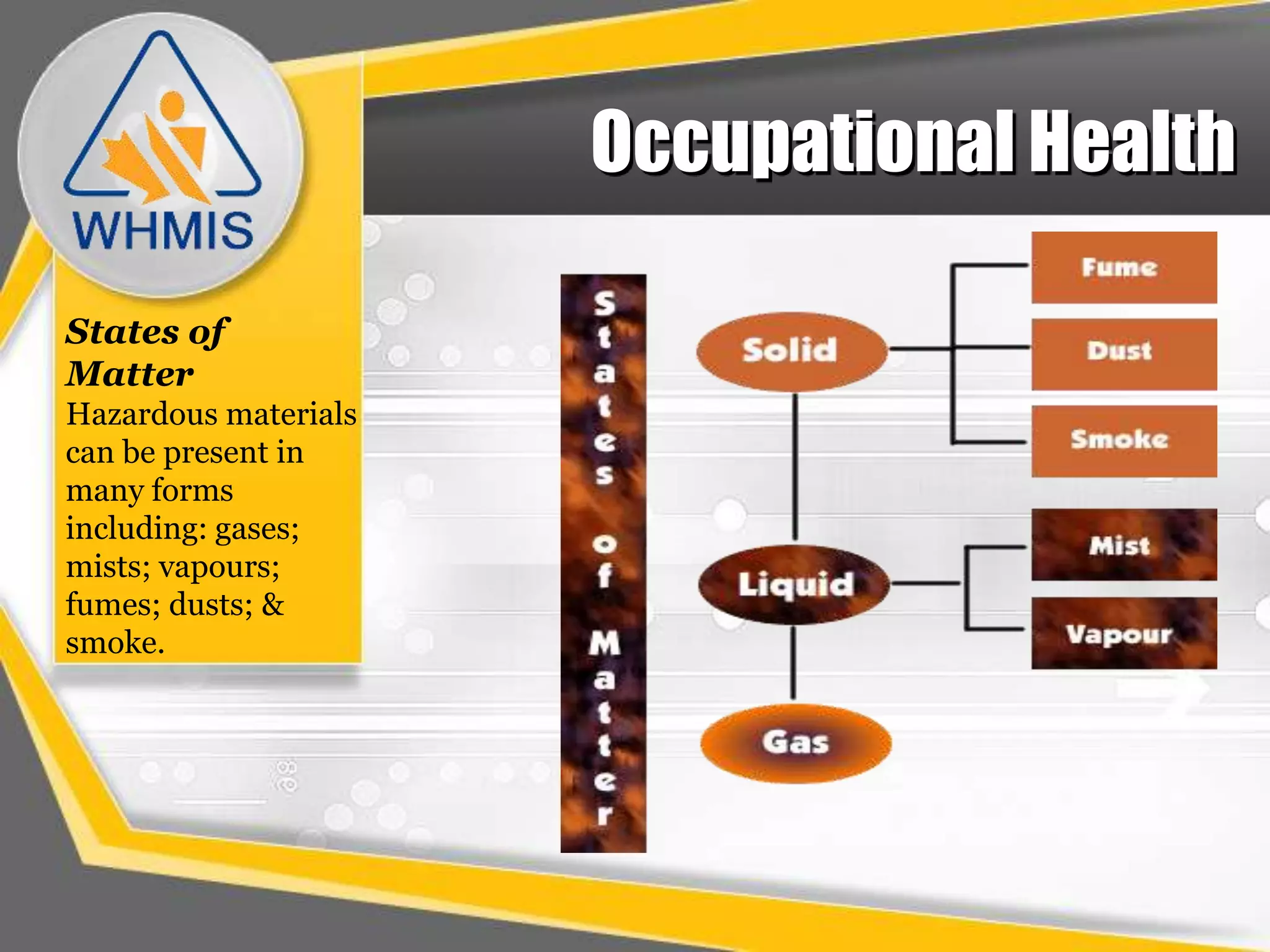
Occupational HealthStates of MatterHazardous materials can be present in many forms including: gases; mists; vapours; fumes; dusts; & smoke.
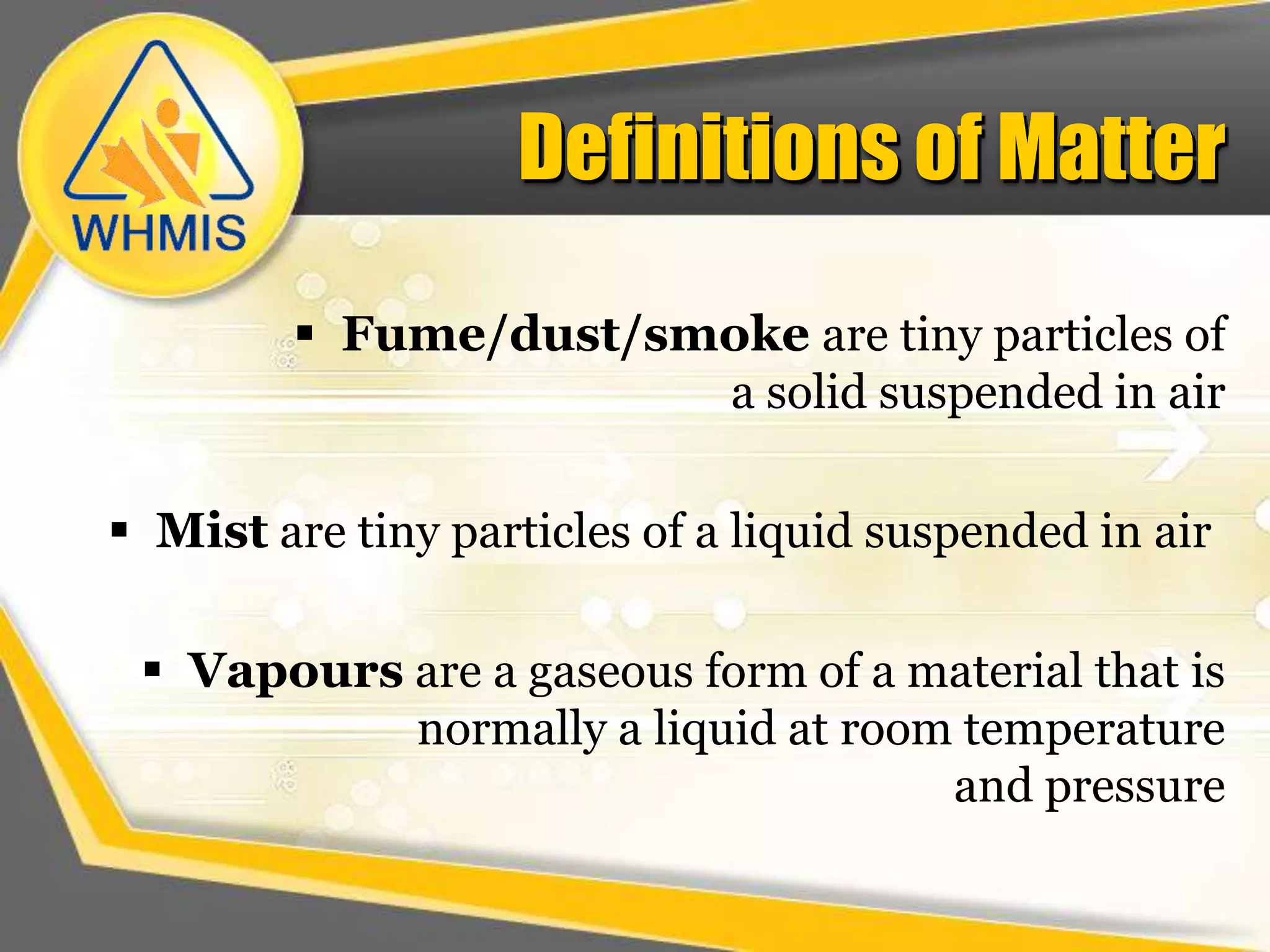
Definitions of MatterFume/dust/smoke are tiny particles of a solid suspended in air
Mist are tiny particles of a liquid suspended in air
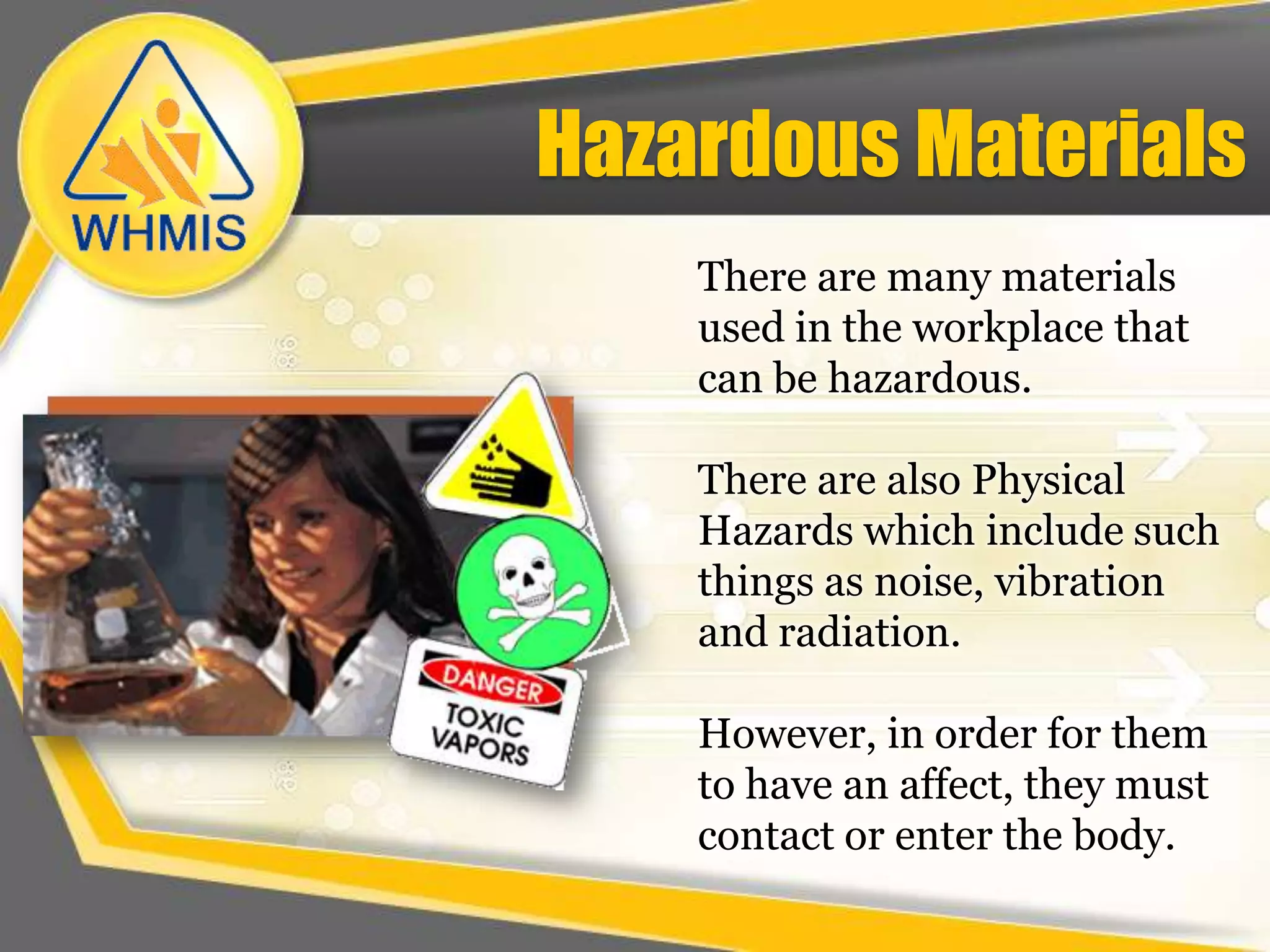
Vapoursare a gaseous form of a material that is normally a liquid at room temperature and pressureHazardous Materials There are many materials used in the workplace that can be hazardous.There are also Physical Hazards which include such things as noise, vibration and radiation.However, in order for them to have an affect, they must contact or enter the body.
Routes of EntryThere are four main routes that a hazardous material can enter the human body. InhalationHazardous material becomes inhaled (most common)AbsorptionAbsorbed through the skinInjectionHazardous material entering the  body through accidental  penetration of the skinIngestionSwallowed, toxic substances can enter the digestive tract
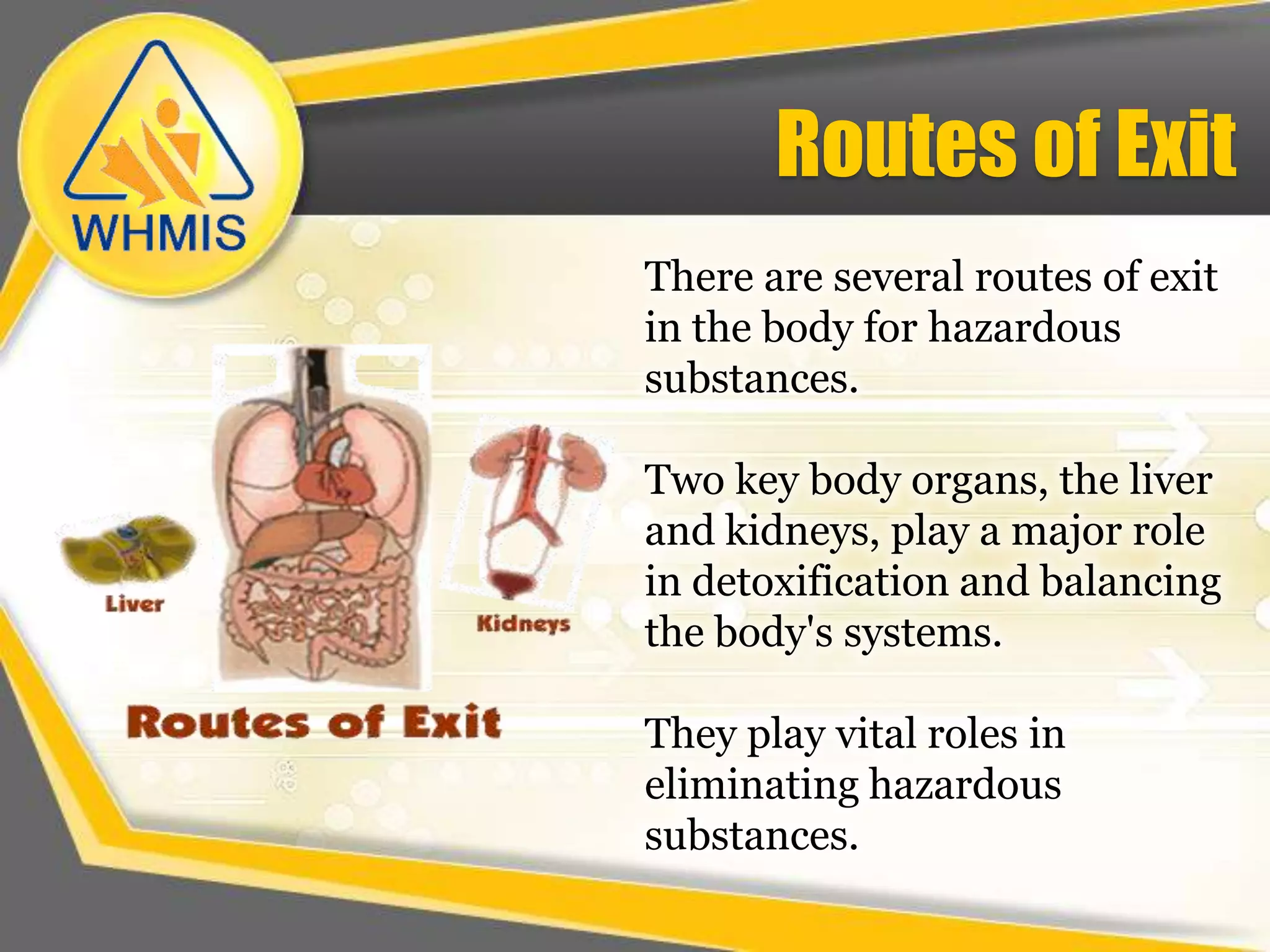
Routes of ExitThere are several routes of exit in the body for hazardous substances. Two key body organs, the liver and kidneys, play a major role in detoxification and balancing the body's systems. They play vital roles in eliminating hazardous substances. 
The Body and Health Effects
Toxicity Is the ability of a substance to produce an undesired effect when it has reached a sufficient concentration at a certain site in the body.LatencyLatency refers to the time lag between exposure to a hazardous material and the eventual development of the disease. This can be 10 years for example and, on average is considered to be 20 years.
Chronic vs. Acute ExposureExposure can be classified as chronic or acute. In chronic exposures, the dose is delivered at some frequency (daily or weekly usually) over a period of time. In acute exposures, the dose is delivered in a single event and absorption is rapid
Results of Exposure Exposure to hazardous materials can cause damage to the DNA in the body's cellsDefinitions...Carcinogen: A substance or physical agent     that can cause cancer in humans.     e.g. - Asbestos.Mutagen: A substance or physical agent     that can cause changes in one or more     heredity features by modifying genes.     e.g. - Ionizing radiation. Teratogen: A substance capable of causing    changes to the developing fetus.     e.g. Thalidomide.
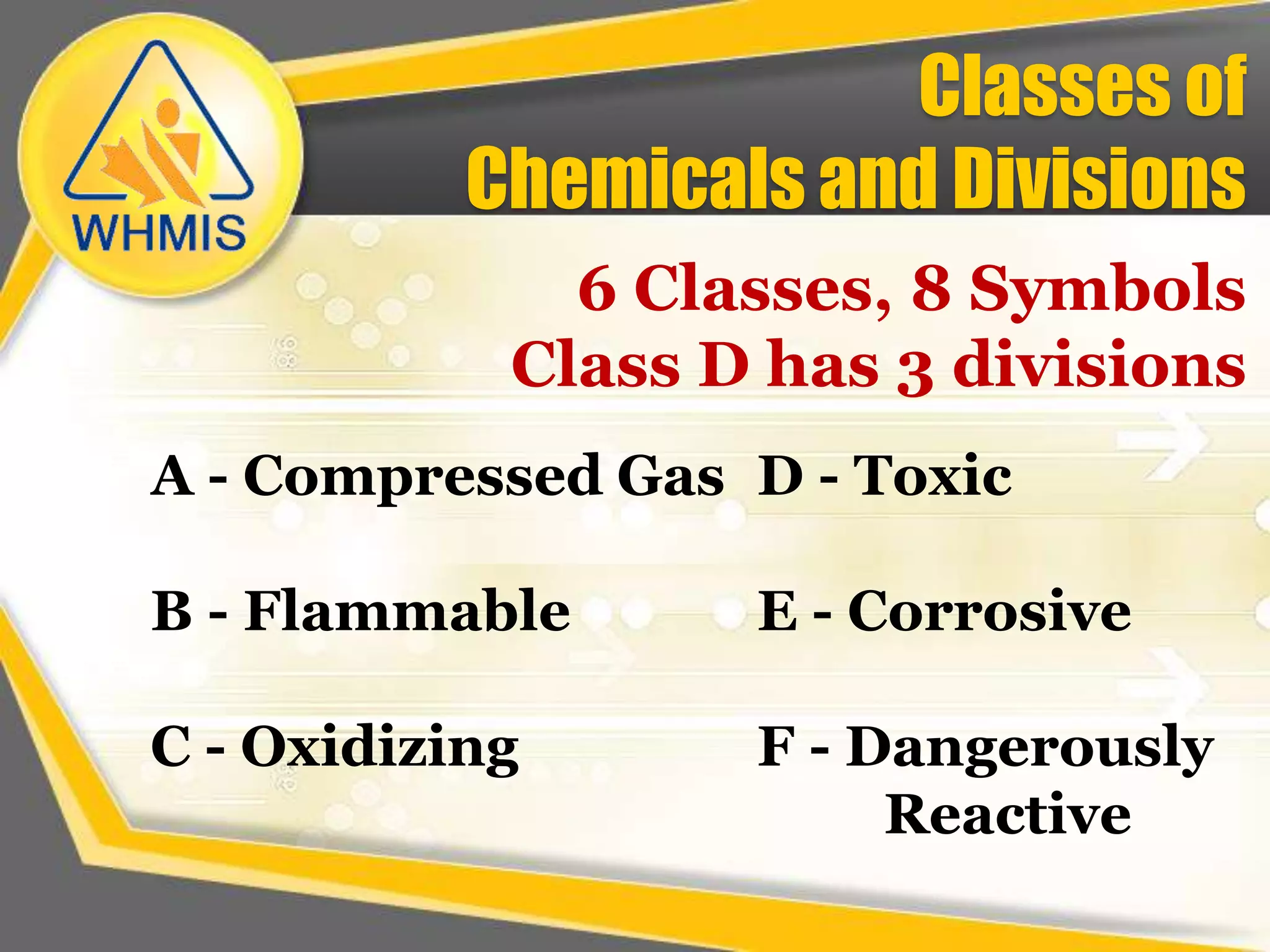
Classes ofChemicals and Divisions6 Classes, 8 SymbolsClass D has 3 divisionsA - Compressed GasB - FlammableC - OxidizingD - ToxicE - CorrosiveF - Dangerously   	Reactive
SYMBOLS
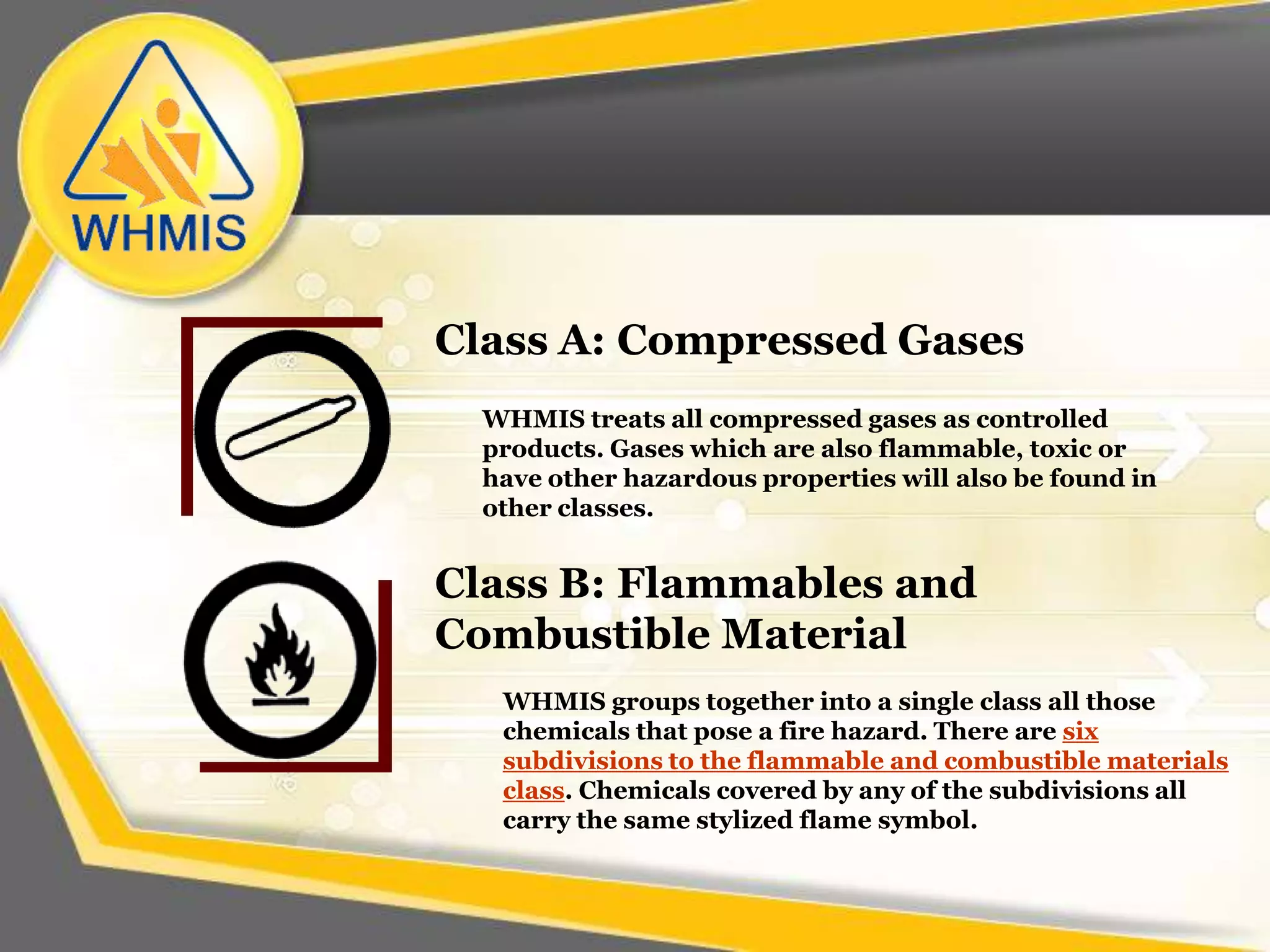
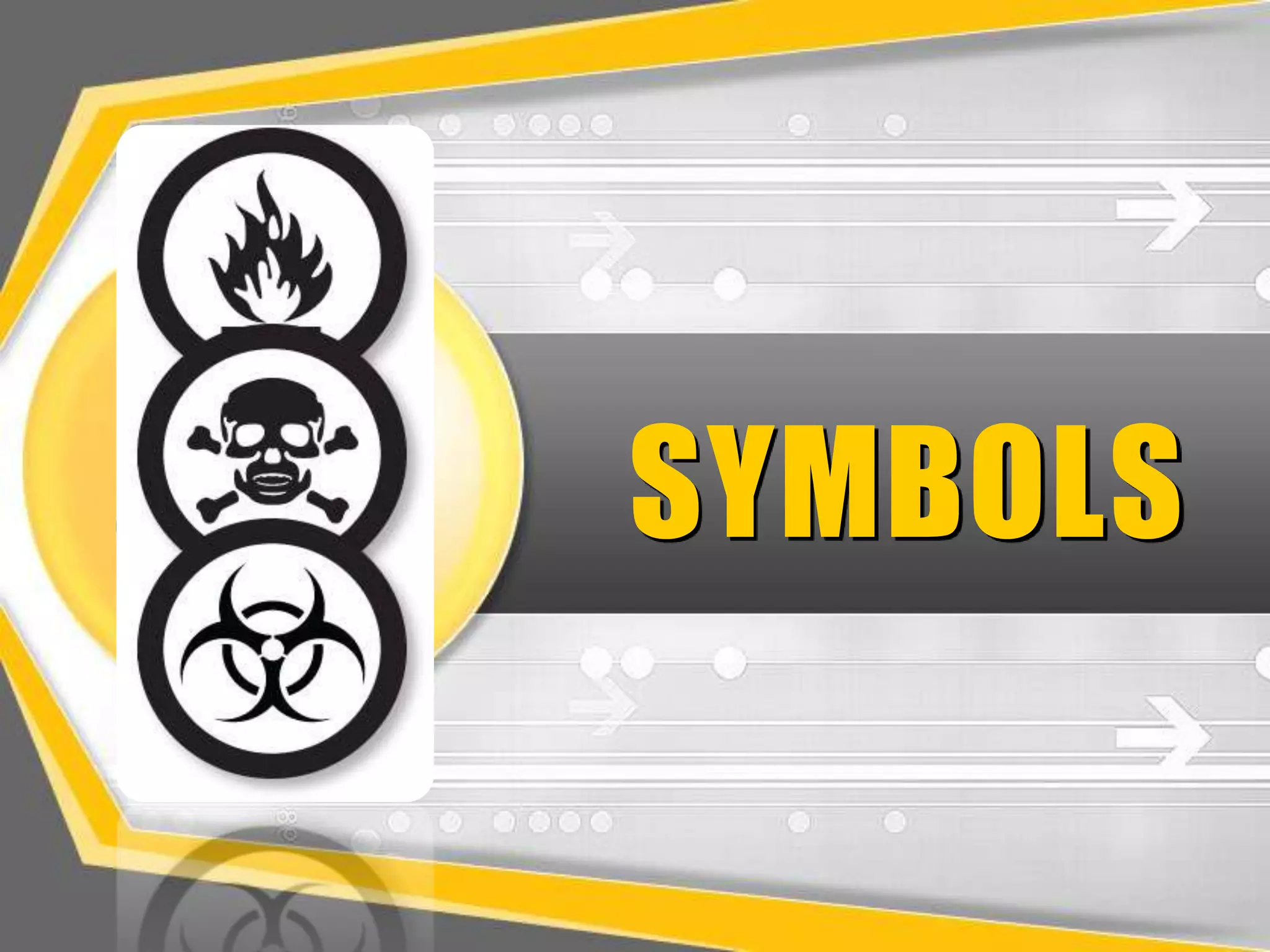
Class A: Compressed GasesWHMIS treats all compressed gases as controlled products. Gases which are also flammable, toxic or have other hazardous properties will also be found in other classes. Class B: Flammables and Combustible MaterialWHMIS groups together into a single class all those chemicals that pose a fire hazard. There are six subdivisions to the flammable and combustible materials class. Chemicals covered by any of the subdivisions all carry the same stylized flame symbol.
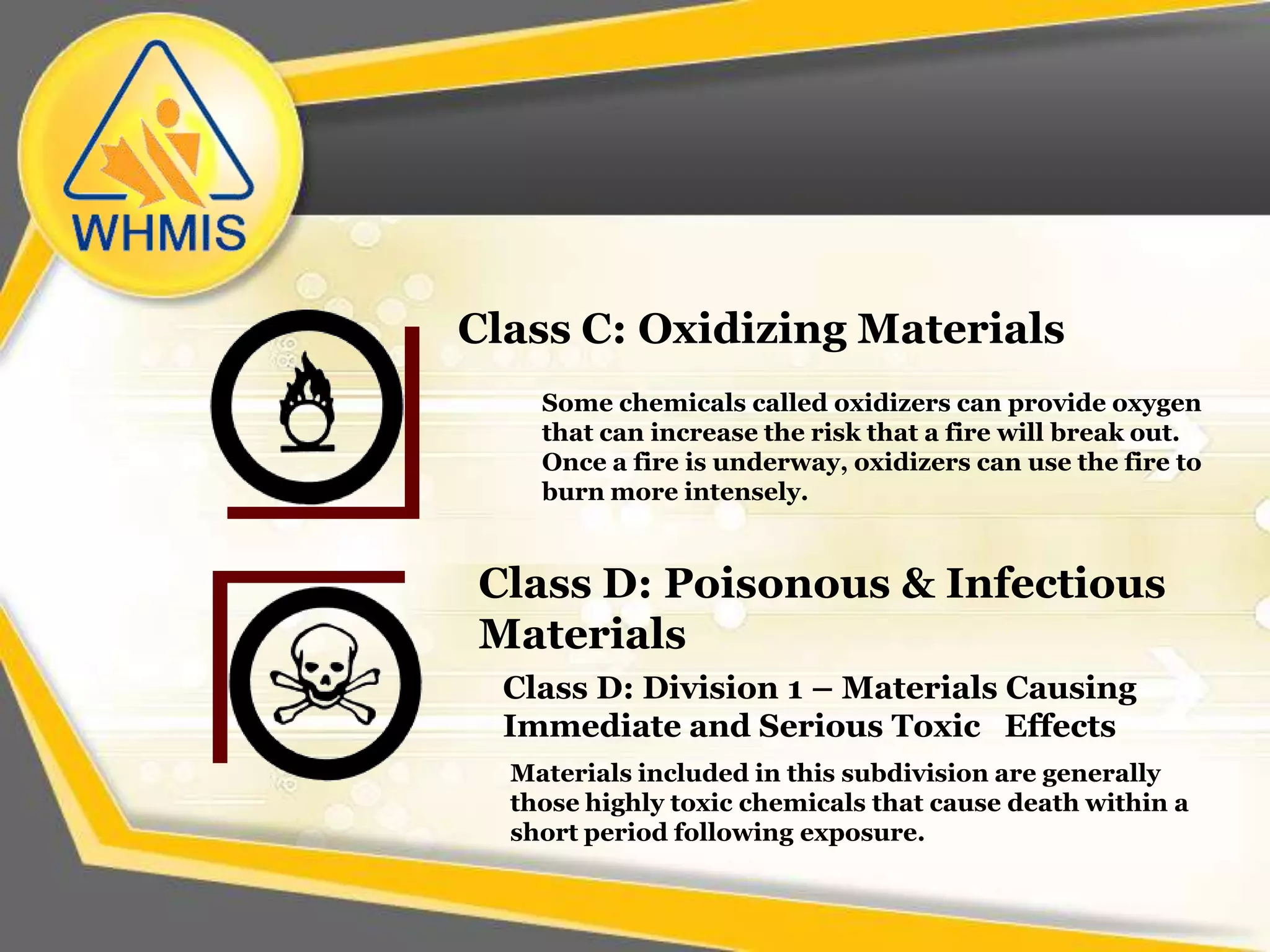
Class C: Oxidizing Materials Some chemicals called oxidizers can provide oxygen that can increase the risk that a fire will break out. Once a fire is underway, oxidizers can use the fire to burn more intensely. Class D: Poisonous & Infectious Materials Class D: Division 1 – Materials Causing Immediate and Serious Toxic   EffectsMaterials included in this subdivision are generally those highly toxic chemicals that cause death within a short period following exposure.
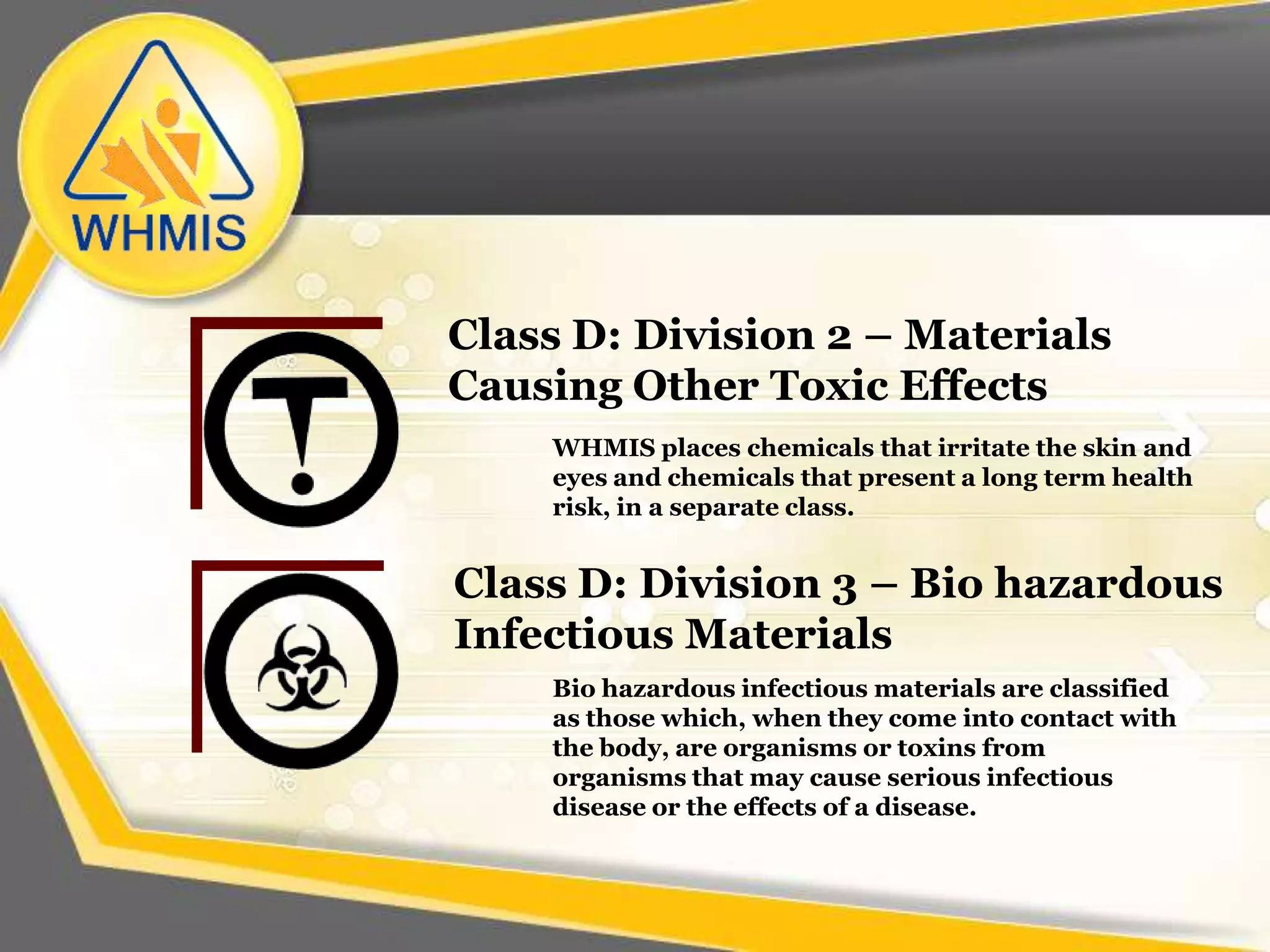
Class D: Division 2 – Materials Causing Other Toxic EffectsWHMIS places chemicals that irritate the skin and eyes and chemicals that present a long term health risk, in a separate class. Class D: Division 3 – Bio hazardous Infectious MaterialsBio hazardous infectious materials are classified as those which, when they come into contact with the body, are organisms or toxins from organisms that may cause serious infectious disease or the effects of a disease.
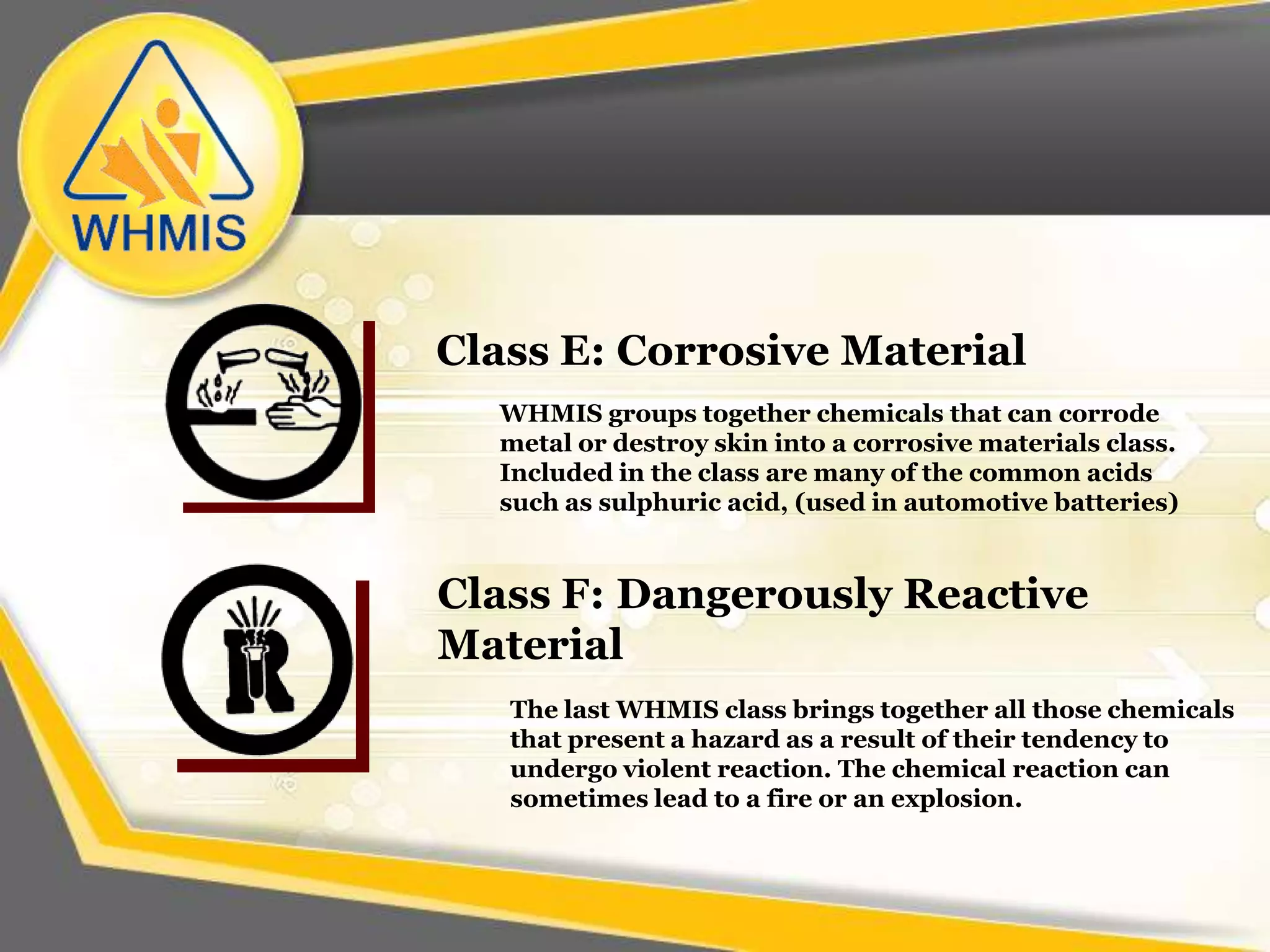
Class E: Corrosive MaterialWHMIS groups together chemicals that can corrode metal or destroy skin into a corrosive materials class. Included in the class are many of the common acids such as sulphuric acid, (used in automotive batteries) Class F: Dangerously Reactive Material The last WHMIS class brings together all those chemicals that present a hazard as a result of their tendency to undergo violent reaction. The chemical reaction can sometimes lead to a fire or an explosion.
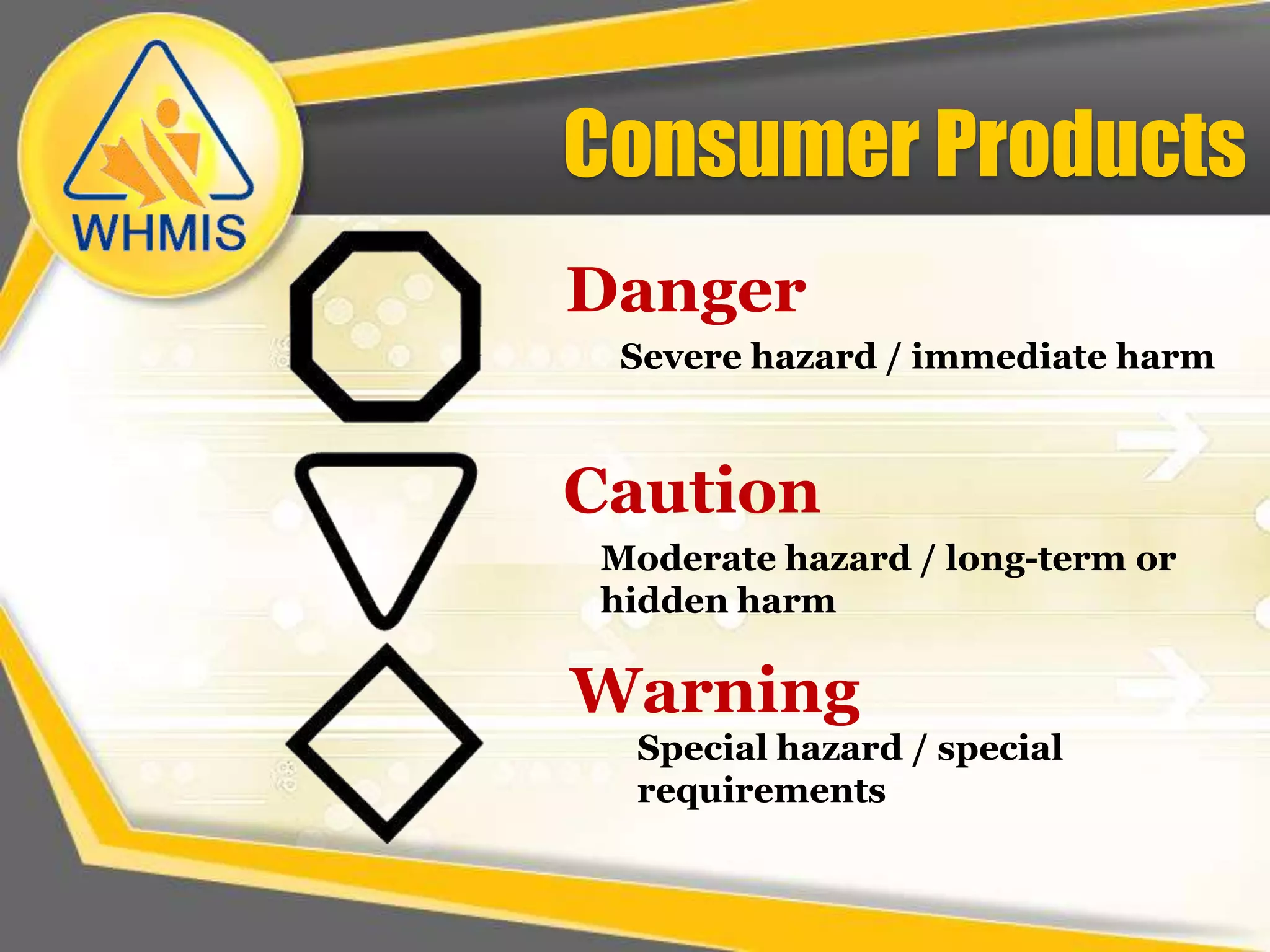
Consumer ProductsDangerSevere hazard / immediate harmCautionModerate hazard / long-term or hidden harmWarningSpecial hazard / special requirements
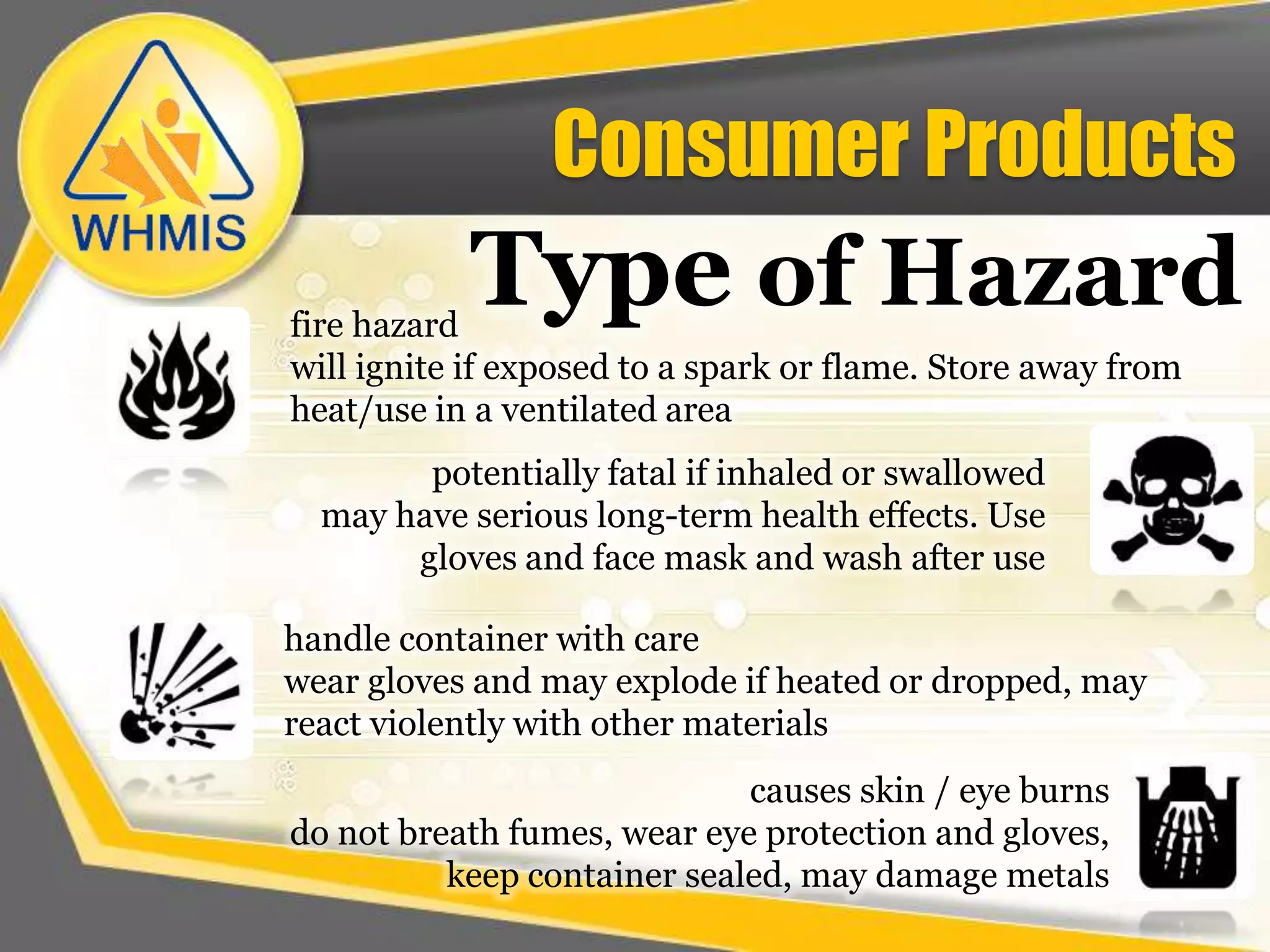
Consumer ProductsType of Hazardfire hazardwill ignite if exposed to a spark or flame. Store away from heat/use in a ventilated areapotentially fatal if inhaled or swallowedmay have serious long-term health effects. Use gloves and face mask and wash after usehandle container with carewear gloves and may explode if heated or dropped, may react violently with other materialscauses skin / eye burnsdo not breath fumes, wear eye protection and gloves, keep container sealed, may damage metals
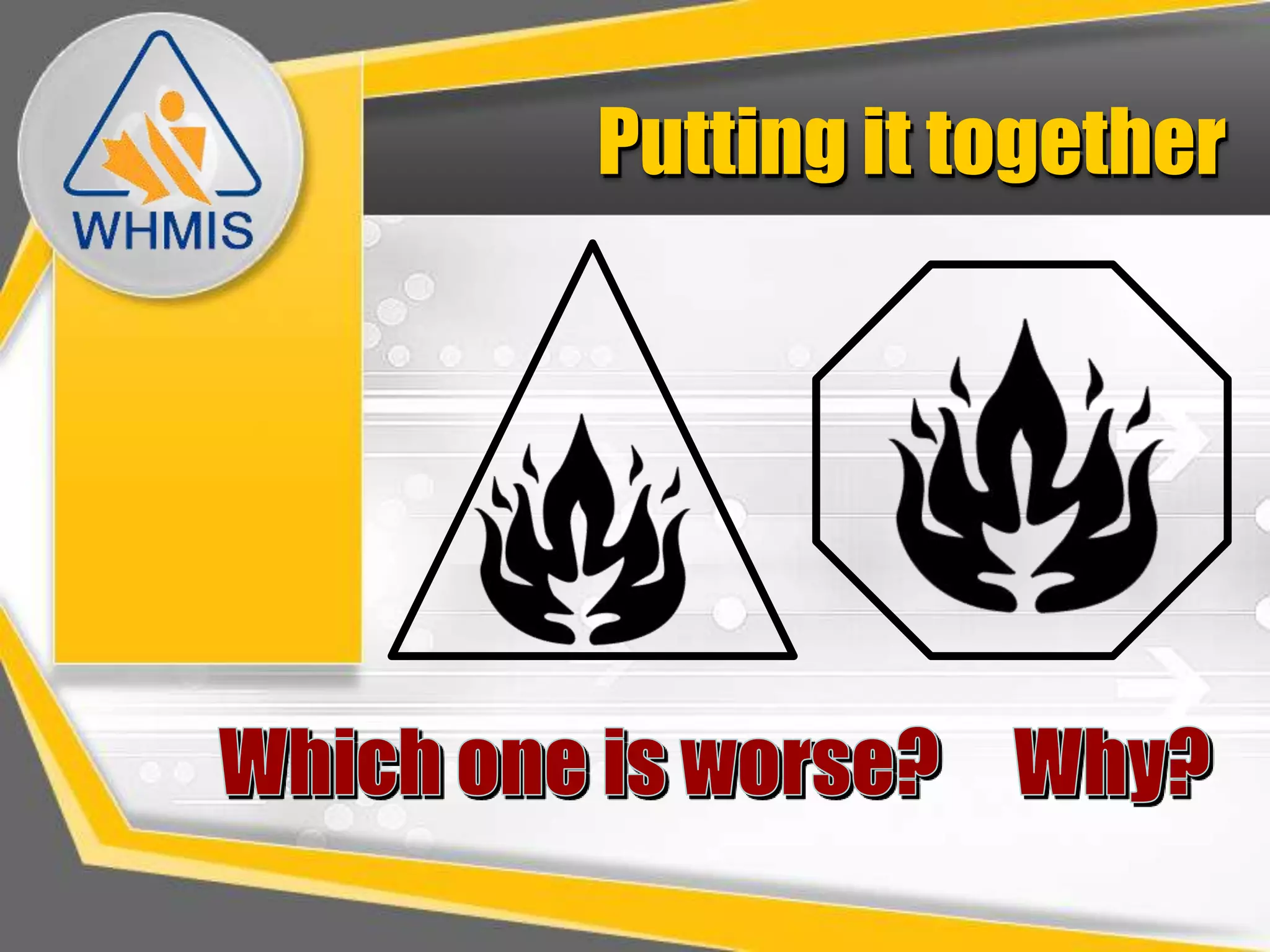
Putting it togetherWhich one is worse?     Why?
Consumer Product CategoriesToxic productsCorrosive productsFlammable productsQuick skin bonding adhesivesPressurized containers
Employer Responsibility and Worker TrainingUnder the Occupational Health & Safety Act, an employer must take all reasonable precautions to protect the health and safety of workers.
Therefore, it is an employer's responsibility to ensure that all workers who have come into contact with these products receive training on how to: Read consumer product labels
Recognize consumer product symbols
Properly use, handle, store, and dispose of the productsTransportation ofDangerous Goods: TDG• Transportation of Dangerous Goods Act - 1992• Co-operation between federal, 	provincial, and territorial 	governments• Legislation to ensure that there is a	minimum safety standard which 	applies to the shipment of hazardous 	materials throughout Canada.
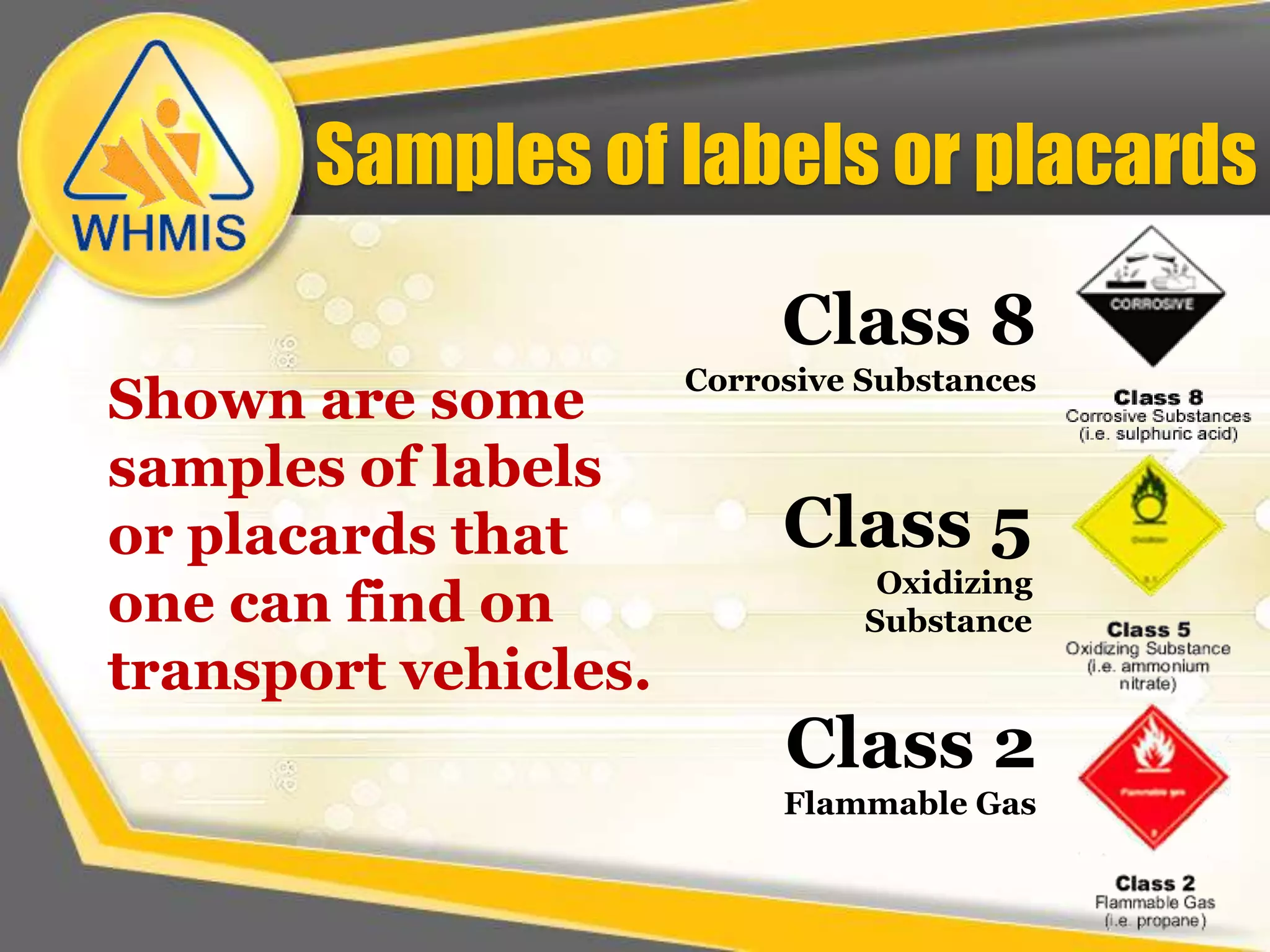
Samples of labels or placards Class 8Corrosive SubstancesShown are some samples of labels or placards that one can find on transport vehicles. Class 5 Oxidizing SubstanceClass 2 Flammable Gas
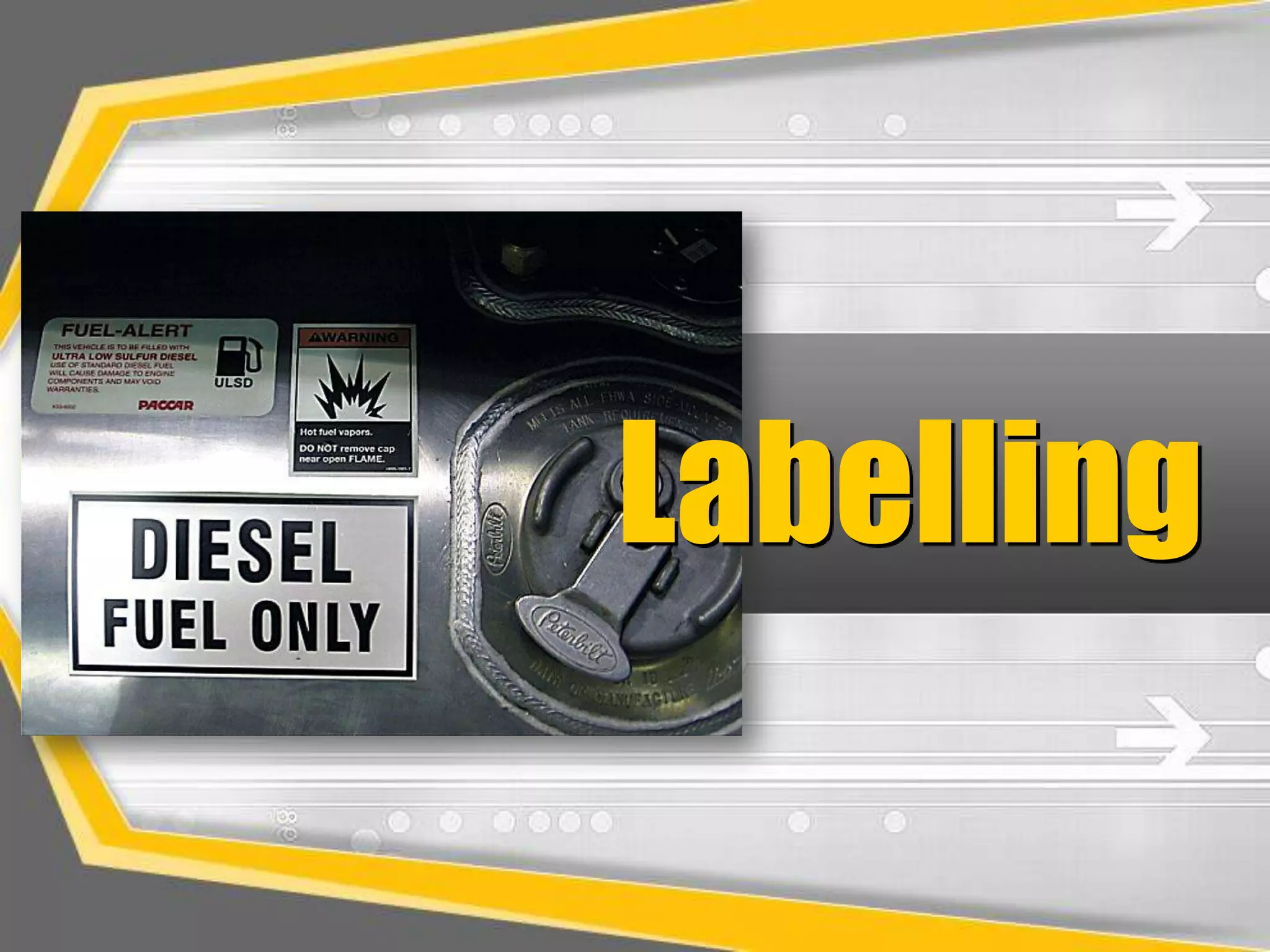
Labelling
The label is one of the primary methods to convey info. to people using hazardous substances.Labels are easily identifiable, appear on containers in some fashion, & contain easily understood information about the risks associated with the material inside the container.
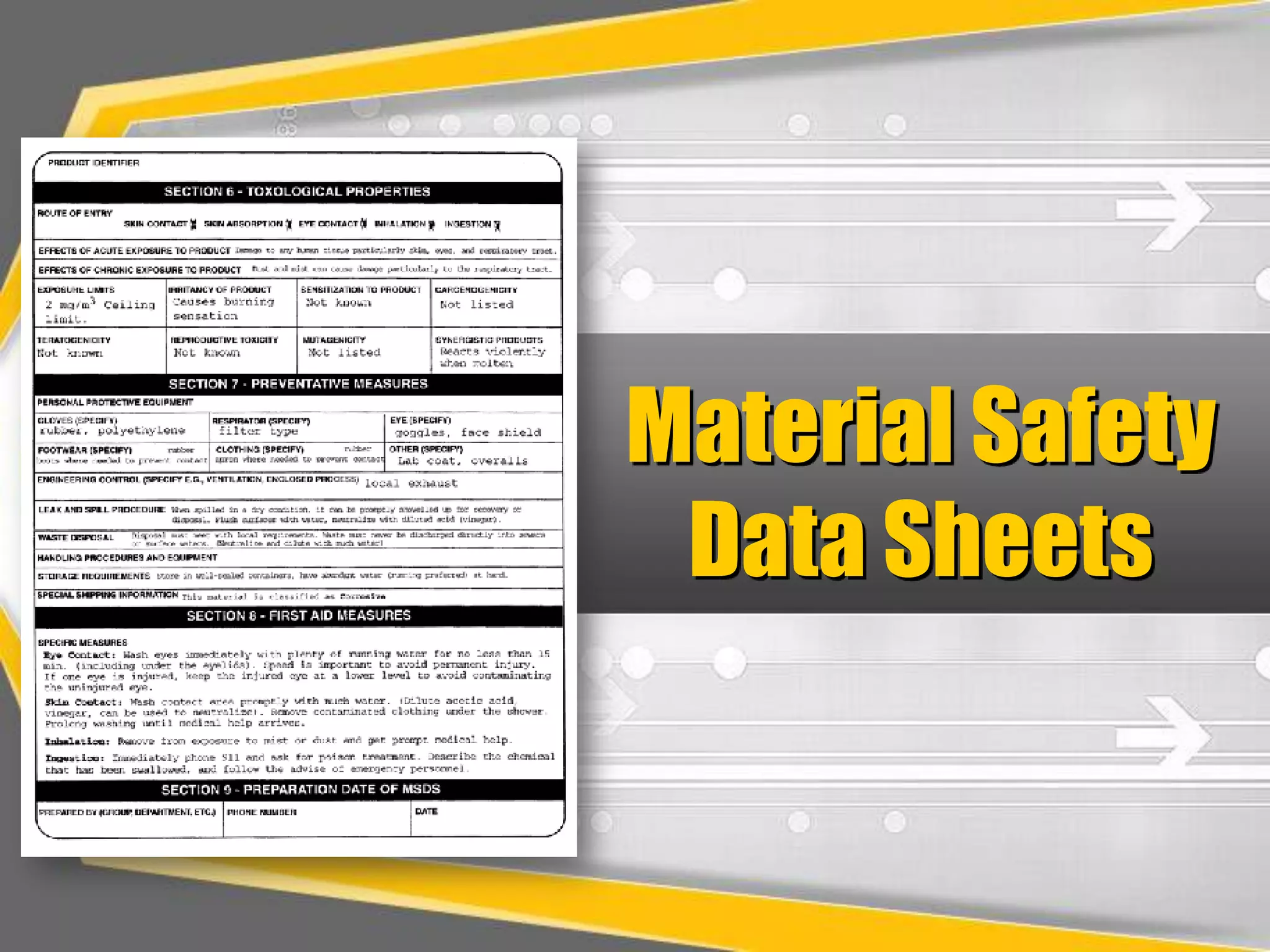
The label also directs the reader to the MSDS, one of the other main components in information delivery about hazardous materials to users. There are two types of labels required under WHMIS: Supplier labels and Workplace labels
In addition, WHMIS provides for the use of identifiers in place of workplace labels in some circumstances. Supplier LabelsThe responsibility for supplier labelsrests with the supplier. Under the HPA, a supplier cannot sell controlled products unless labels are attached to the containers with the prescribed information.
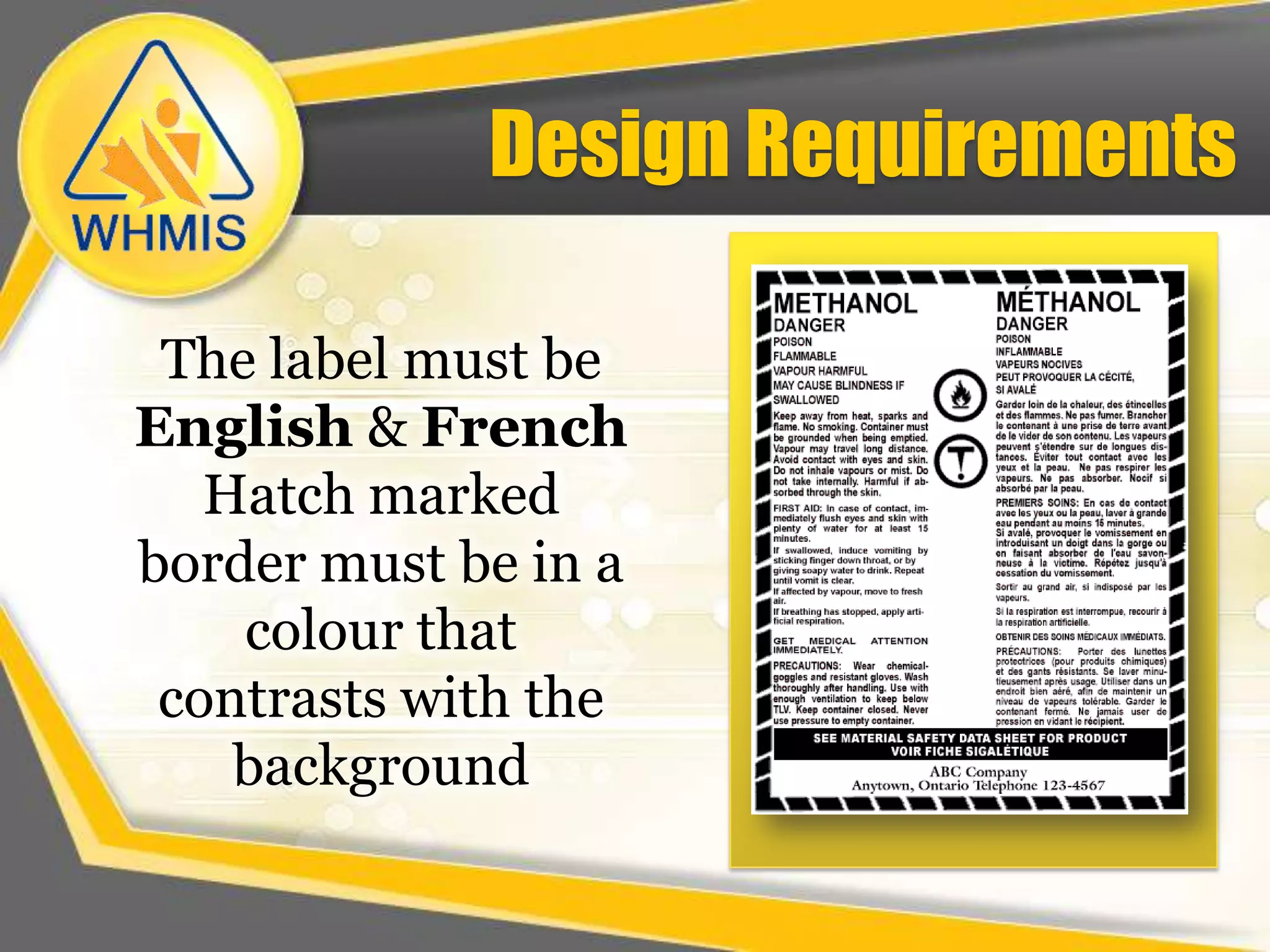
Design RequirementsThe label must be English& FrenchHatch marked border must be in a colour that contrasts with the background
7 Required pieces of information needed on a supplier label and are as follows:Name of product (can be chemical name, common name, generic name, or trade name)Labels also must be in both English and French and have a contrasting hatch marked borderName of supplier & reference to the MSDS First aid measures stating immediate steps to take in case of exposure
WHMIS / Hazard Symbol(s) as outlined/ referenced in the Classification Section of the manualRisk phrases which state the hazardous properties of the product Precautionary measures which state the precautions you should take when using the product (example: PPE)
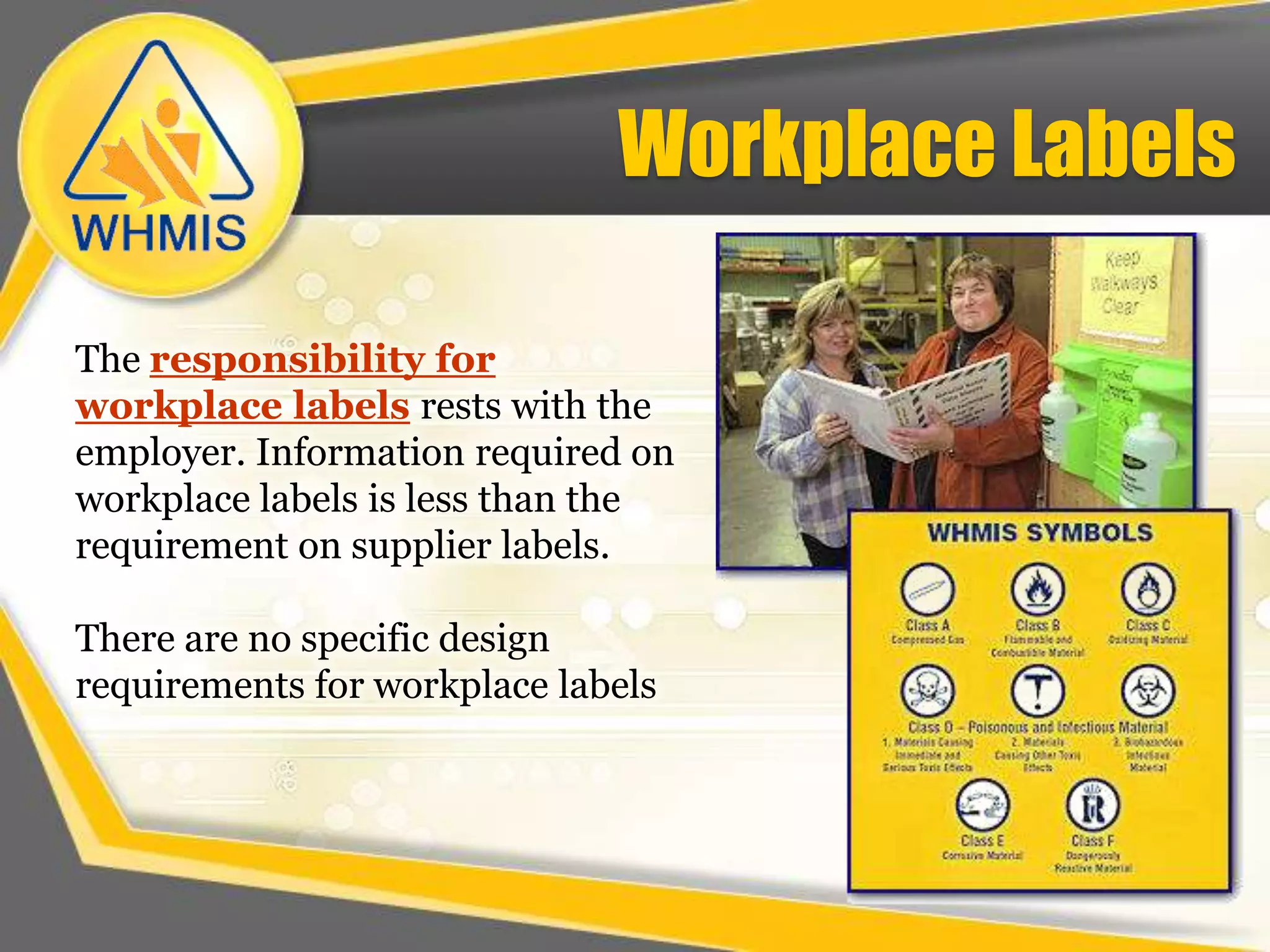
Workplace LabelsThe responsibility for workplace labelsrests with the employer. Information required on workplace labels is less than the requirement on supplier labels.There are no specific design requirements for workplace labels
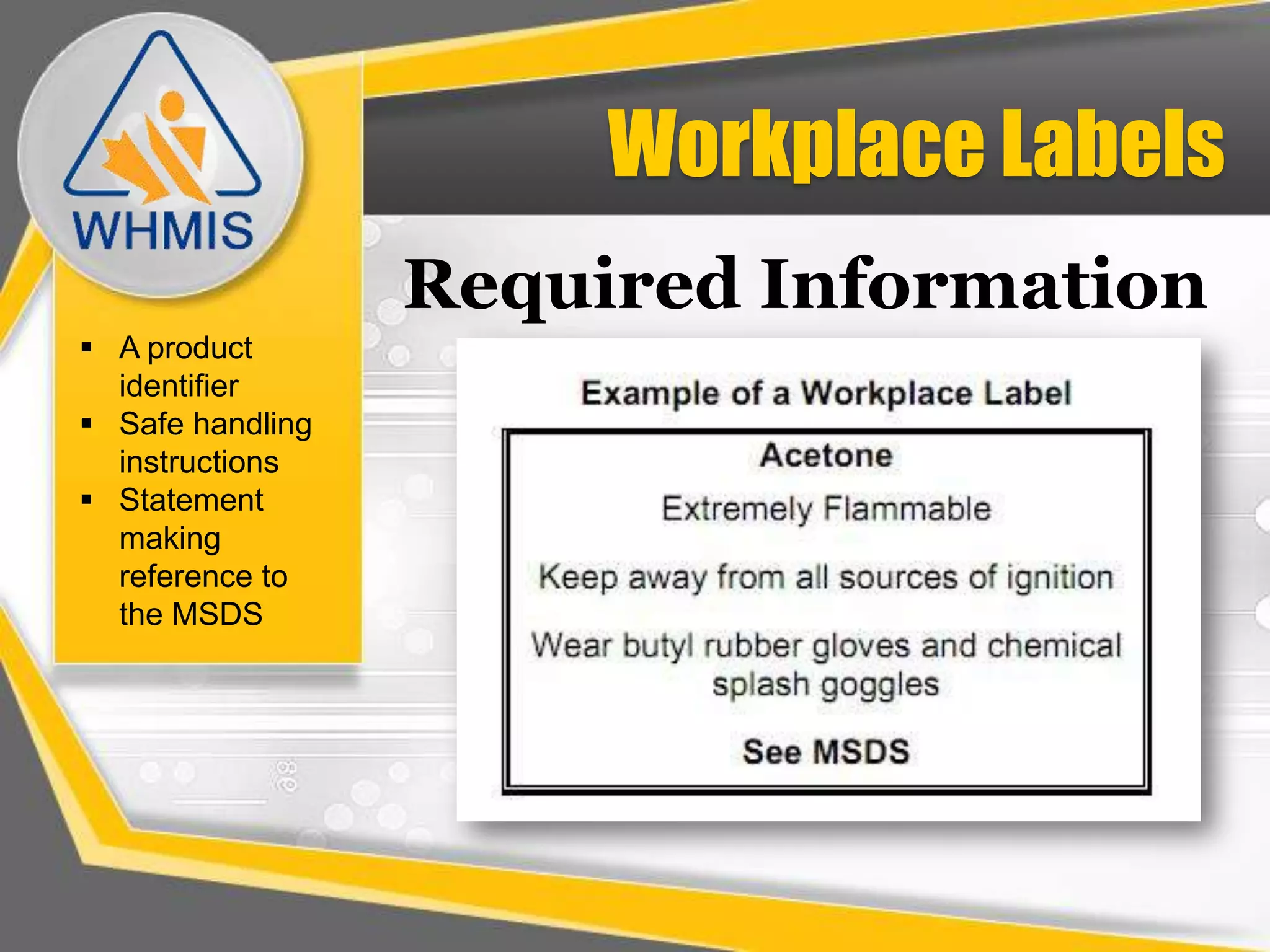
Workplace LabelsRequired InformationA product identifier
Safe handling instructions

Whmis Presentation 2011 Rev

  • 1.
    This presentation isintended for Technology & Dual-Credit Students, Lambton CollegeWHMIS CertificationThe information & graphics contained in this presentation were obtained from AMDSB and ESAO, with thanks.Editorial Content : Rob Peat: SHDHS, Abby Hamilton: LCDesign: Casey James: Lambton College SCWI
  • 2.
  • 3.
    Purpose of WHMISTheWorkplace Hazardous Material Information System (WHMIS) is a nationwide system to provide information on hazardous materials used in the workplace and involves both Federal and Provincial legislation.WHMIS recognizes the interests of workers, employers, suppliers and regulators, balancing the workers' right to know with the industry's right to protect confidential business information.
  • 4.
    Hazardous Products Act(HPA)Federal legislation is the Hazardous Products Act (HPA)HPA controls product regulations and ingredient disclosure listsProvincial legislation is the Occupational Health and Safety Act (OHSA)OHSA is in charge of WHMIS regulations and references parts of the controlled product regulations
  • 5.
    Key Elements ThreeKey Elements of WHMIS are:1. Labels 2. Material Safety Data Sheets3. Worker Training
  • 6.
    Why we needto KnowExposure to hazardous material can cause or contribute to a variety of health effects such as:Irritation, burns
  • 7.
  • 8.
  • 9.
  • 10.
    CancerWhy we needto KnowSome materials may also be safety hazards that can contribute to fires, explosions, & other accidents if improperly handled or stored.
  • 11.
    One in fourCanadian workers is exposed to chemical hazards on the job.Occupational Health & Safety ActIn Ontario workplace safety is a provincial responsibility.The OHSA outlines the responsibilities of the Employer, Supervisor and Employee.The OHSA gives the worker three main rights:Participate
  • 12.
  • 13.
    The right toknowWHMISWHMISisbased on the tripartite model regulation, was adopted under the OHSA; this regulation sets out the employer duties under WHMIS. The Act also covers three other directly related areas: Public Right To Know
  • 14.
    Workplace Inventories
  • 15.
    Hazardous Physical AgentsMain Responsibilities Under WHMISDetermine which of their products are controlled products.Provideinformation about controlled products in the form of labels and MSDS
  • 16.
    Labelsmust be inEnglish and French.
  • 17.
    UpdateMSDS and labelsas new info. becomes available & once every 3 years.Supplier/Manufacturer
  • 18.
    Main Responsibilities UnderWHMISObtain Material Safety Data Sheets (MSDS's)
  • 19.
    Provision of informationin medical emergencies
  • 20.
    Assess products producedin-house and establish a WHMISprogram
  • 21.
  • 22.
    Worker education andtraining.Employer/Supervisor
  • 23.
    Worker ResponsibilityUse PPErequiredReport hazards and/or non-compliance to supervisorAttend training sessionsUse and understand any information provided
  • 24.
  • 25.
    WHMIS ExemptionsCertain productsare exempt from the requirements of the legislation. Hazardous wastes must be labeled in some fashion and workers need to know how to store & handle safelySome are partially exempt and some are completely exempt but still require WHMIS label for safe use.Examples of Partially Exempt: Explosives, cosmetics, drugs.Completely Exempt: Tobacco, wood or wood products
  • 26.
    Occupational HealthStates ofMatterHazardous materials can be present in many forms including: gases; mists; vapours; fumes; dusts; & smoke.
  • 27.
    Definitions of MatterFume/dust/smokeare tiny particles of a solid suspended in air
  • 28.
    Mist are tinyparticles of a liquid suspended in air
  • 29.
    Vapoursare a gaseousform of a material that is normally a liquid at room temperature and pressureHazardous Materials There are many materials used in the workplace that can be hazardous.There are also Physical Hazards which include such things as noise, vibration and radiation.However, in order for them to have an affect, they must contact or enter the body.
  • 30.
    Routes of EntryThereare four main routes that a hazardous material can enter the human body. InhalationHazardous material becomes inhaled (most common)AbsorptionAbsorbed through the skinInjectionHazardous material entering the body through accidental penetration of the skinIngestionSwallowed, toxic substances can enter the digestive tract
  • 31.
    Routes of ExitThereare several routes of exit in the body for hazardous substances. Two key body organs, the liver and kidneys, play a major role in detoxification and balancing the body's systems. They play vital roles in eliminating hazardous substances. 
  • 32.
    The Body andHealth Effects
  • 33.
    Toxicity Is theability of a substance to produce an undesired effect when it has reached a sufficient concentration at a certain site in the body.LatencyLatency refers to the time lag between exposure to a hazardous material and the eventual development of the disease. This can be 10 years for example and, on average is considered to be 20 years.
  • 34.
    Chronic vs. AcuteExposureExposure can be classified as chronic or acute. In chronic exposures, the dose is delivered at some frequency (daily or weekly usually) over a period of time. In acute exposures, the dose is delivered in a single event and absorption is rapid
  • 35.
    Results of ExposureExposure to hazardous materials can cause damage to the DNA in the body's cellsDefinitions...Carcinogen: A substance or physical agent that can cause cancer in humans. e.g. - Asbestos.Mutagen: A substance or physical agent that can cause changes in one or more heredity features by modifying genes. e.g. - Ionizing radiation. Teratogen: A substance capable of causing changes to the developing fetus. e.g. Thalidomide.
  • 36.
    Classes ofChemicals andDivisions6 Classes, 8 SymbolsClass D has 3 divisionsA - Compressed GasB - FlammableC - OxidizingD - ToxicE - CorrosiveF - Dangerously Reactive
  • 37.
  • 38.
    Class A: CompressedGasesWHMIS treats all compressed gases as controlled products. Gases which are also flammable, toxic or have other hazardous properties will also be found in other classes. Class B: Flammables and Combustible MaterialWHMIS groups together into a single class all those chemicals that pose a fire hazard. There are six subdivisions to the flammable and combustible materials class. Chemicals covered by any of the subdivisions all carry the same stylized flame symbol.
  • 39.
    Class C: OxidizingMaterials Some chemicals called oxidizers can provide oxygen that can increase the risk that a fire will break out. Once a fire is underway, oxidizers can use the fire to burn more intensely. Class D: Poisonous & Infectious Materials Class D: Division 1 – Materials Causing Immediate and Serious Toxic   EffectsMaterials included in this subdivision are generally those highly toxic chemicals that cause death within a short period following exposure.
  • 40.
    Class D: Division2 – Materials Causing Other Toxic EffectsWHMIS places chemicals that irritate the skin and eyes and chemicals that present a long term health risk, in a separate class. Class D: Division 3 – Bio hazardous Infectious MaterialsBio hazardous infectious materials are classified as those which, when they come into contact with the body, are organisms or toxins from organisms that may cause serious infectious disease or the effects of a disease.
  • 41.
    Class E: CorrosiveMaterialWHMIS groups together chemicals that can corrode metal or destroy skin into a corrosive materials class. Included in the class are many of the common acids such as sulphuric acid, (used in automotive batteries) Class F: Dangerously Reactive Material The last WHMIS class brings together all those chemicals that present a hazard as a result of their tendency to undergo violent reaction. The chemical reaction can sometimes lead to a fire or an explosion.
  • 42.
    Consumer ProductsDangerSevere hazard/ immediate harmCautionModerate hazard / long-term or hidden harmWarningSpecial hazard / special requirements
  • 43.
    Consumer ProductsType ofHazardfire hazardwill ignite if exposed to a spark or flame. Store away from heat/use in a ventilated areapotentially fatal if inhaled or swallowedmay have serious long-term health effects. Use gloves and face mask and wash after usehandle container with carewear gloves and may explode if heated or dropped, may react violently with other materialscauses skin / eye burnsdo not breath fumes, wear eye protection and gloves, keep container sealed, may damage metals
  • 44.
    Putting it togetherWhichone is worse? Why?
  • 45.
    Consumer Product CategoriesToxicproductsCorrosive productsFlammable productsQuick skin bonding adhesivesPressurized containers
  • 47.
    Employer Responsibility andWorker TrainingUnder the Occupational Health & Safety Act, an employer must take all reasonable precautions to protect the health and safety of workers.
  • 48.
    Therefore, it isan employer's responsibility to ensure that all workers who have come into contact with these products receive training on how to: Read consumer product labels
  • 49.
  • 50.
    Properly use, handle,store, and dispose of the productsTransportation ofDangerous Goods: TDG• Transportation of Dangerous Goods Act - 1992• Co-operation between federal, provincial, and territorial governments• Legislation to ensure that there is a minimum safety standard which applies to the shipment of hazardous materials throughout Canada.
  • 51.
    Samples of labelsor placards Class 8Corrosive SubstancesShown are some samples of labels or placards that one can find on transport vehicles. Class 5 Oxidizing SubstanceClass 2 Flammable Gas
  • 52.
  • 53.
    The label isone of the primary methods to convey info. to people using hazardous substances.Labels are easily identifiable, appear on containers in some fashion, & contain easily understood information about the risks associated with the material inside the container.
  • 54.
    The label alsodirects the reader to the MSDS, one of the other main components in information delivery about hazardous materials to users. There are two types of labels required under WHMIS: Supplier labels and Workplace labels
  • 55.
    In addition, WHMISprovides for the use of identifiers in place of workplace labels in some circumstances. Supplier LabelsThe responsibility for supplier labelsrests with the supplier. Under the HPA, a supplier cannot sell controlled products unless labels are attached to the containers with the prescribed information.
  • 56.
    Design RequirementsThe labelmust be English& FrenchHatch marked border must be in a colour that contrasts with the background
  • 57.
    7 Required piecesof information needed on a supplier label and are as follows:Name of product (can be chemical name, common name, generic name, or trade name)Labels also must be in both English and French and have a contrasting hatch marked borderName of supplier & reference to the MSDS First aid measures stating immediate steps to take in case of exposure
  • 58.
    WHMIS / HazardSymbol(s) as outlined/ referenced in the Classification Section of the manualRisk phrases which state the hazardous properties of the product Precautionary measures which state the precautions you should take when using the product (example: PPE)
  • 59.
    Workplace LabelsThe responsibilityfor workplace labelsrests with the employer. Information required on workplace labels is less than the requirement on supplier labels.There are no specific design requirements for workplace labels
  • 60.
  • 61.
  • 62.
    Statement making referenceto the MSDSMaterial Safety Data Sheets
  • 63.
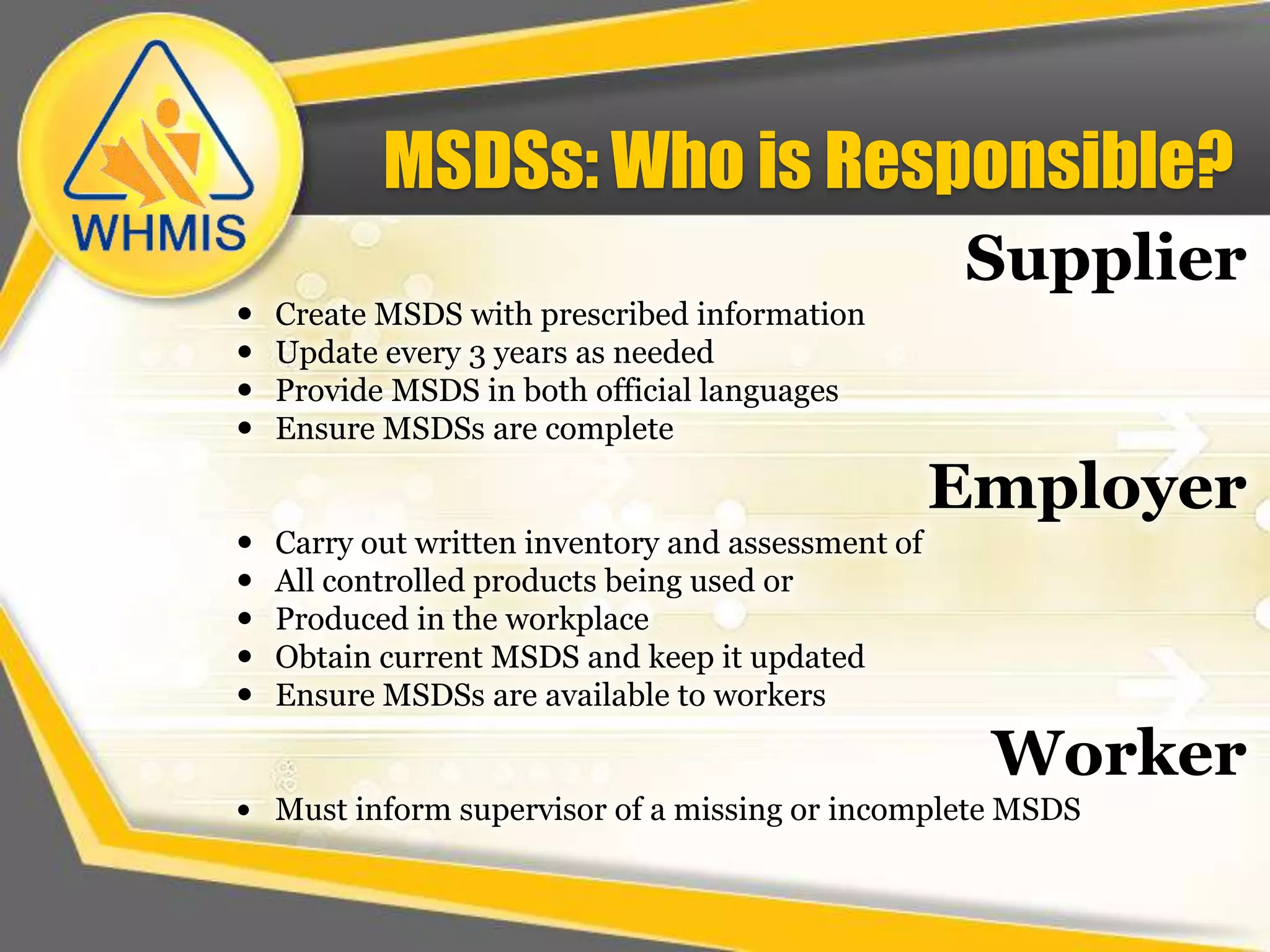
    MSDSs: Who isResponsible?SupplierCreate MSDS with prescribed information
  • 64.
    Update every 3years as needed
  • 65.
    Provide MSDS inboth official languages
  • 66.
    Ensure MSDSs arecompleteEmployerCarry out written inventory and assessment of
  • 67.
  • 68.
  • 69.
    Obtain current MSDSand keep it updated
  • 70.
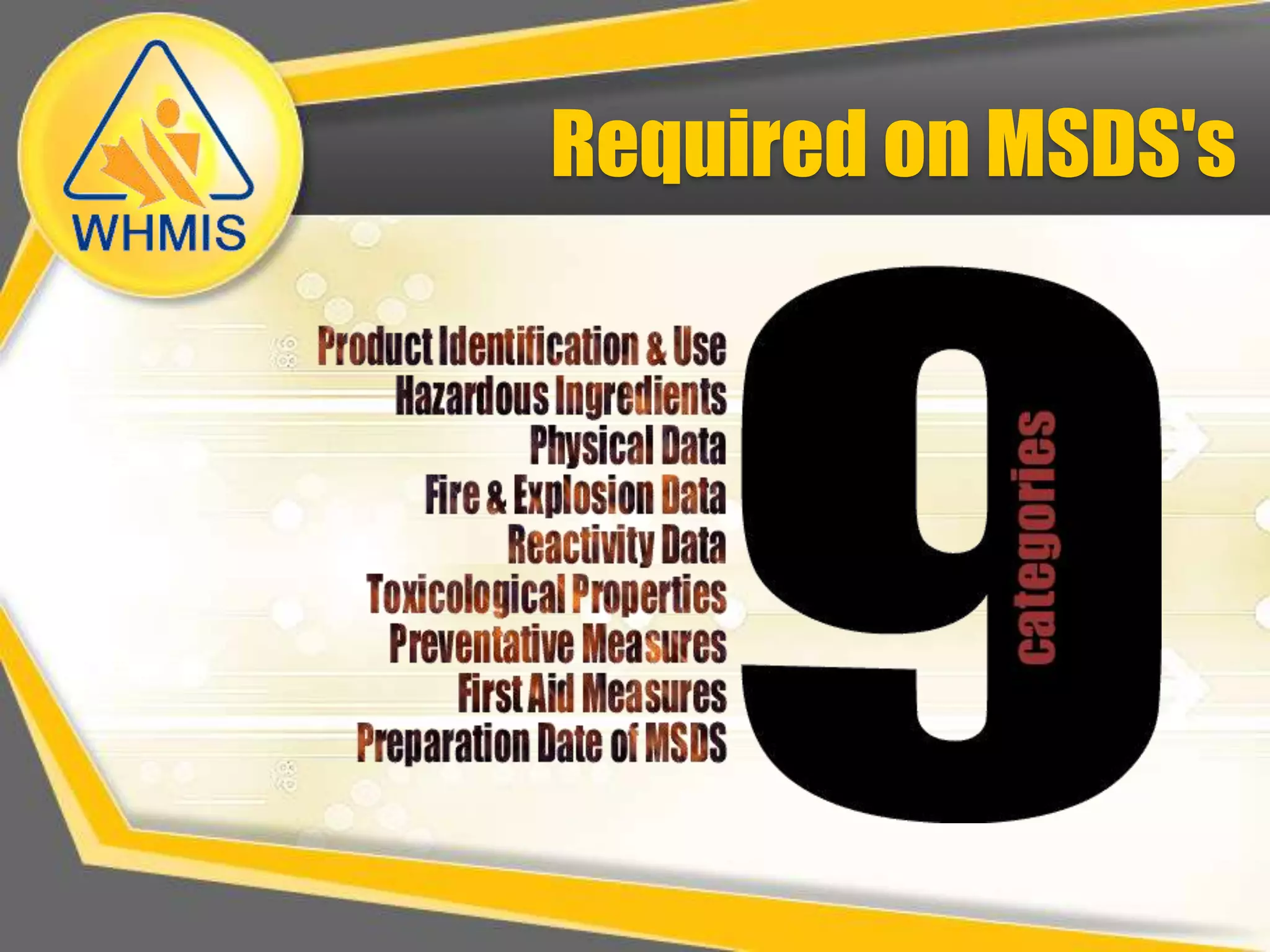
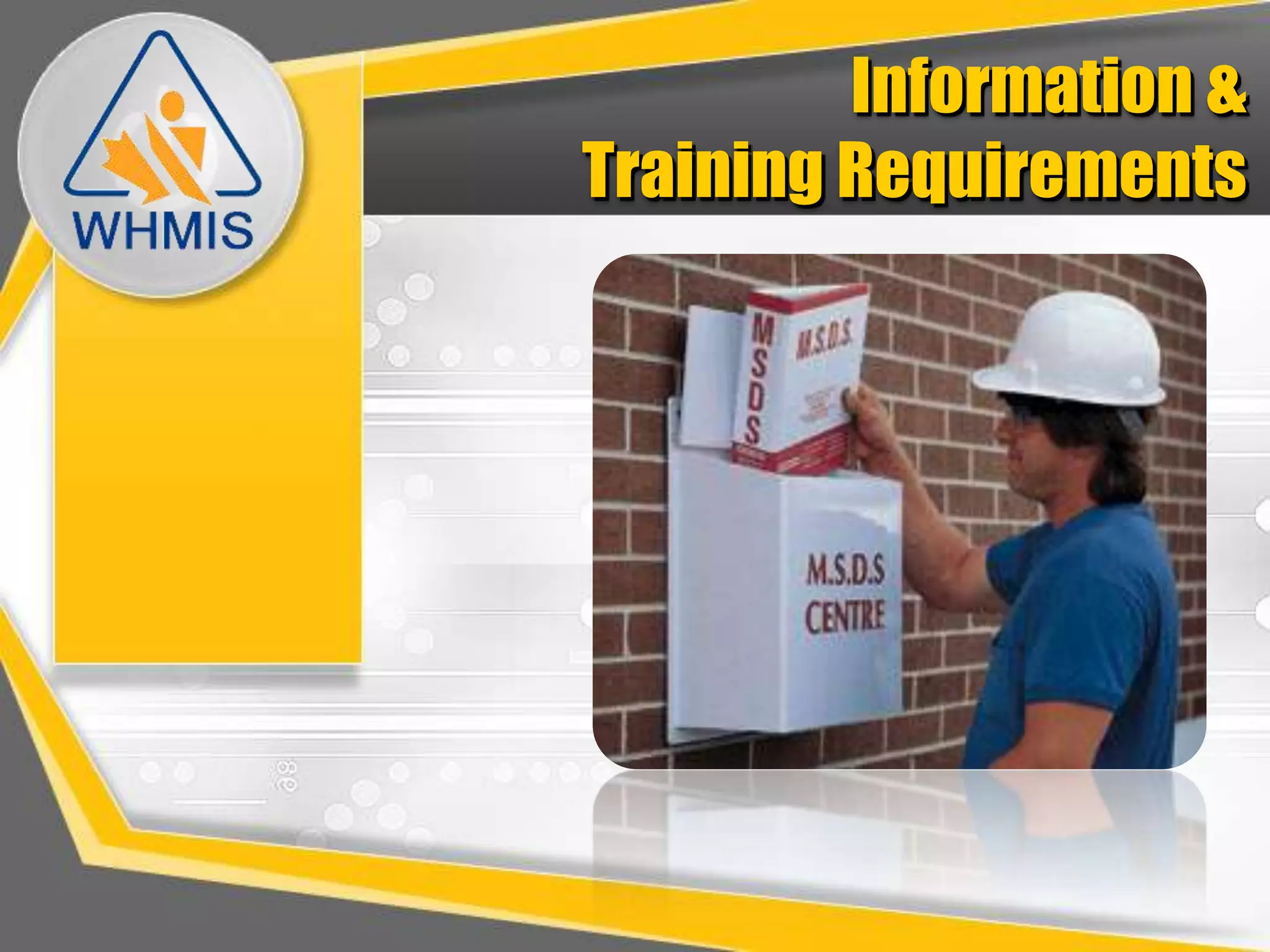
    Ensure MSDSs areavailable to workersWorkerMust inform supervisor of a missing or incomplete MSDSRequired on MSDS's
  • 71.
  • 72.
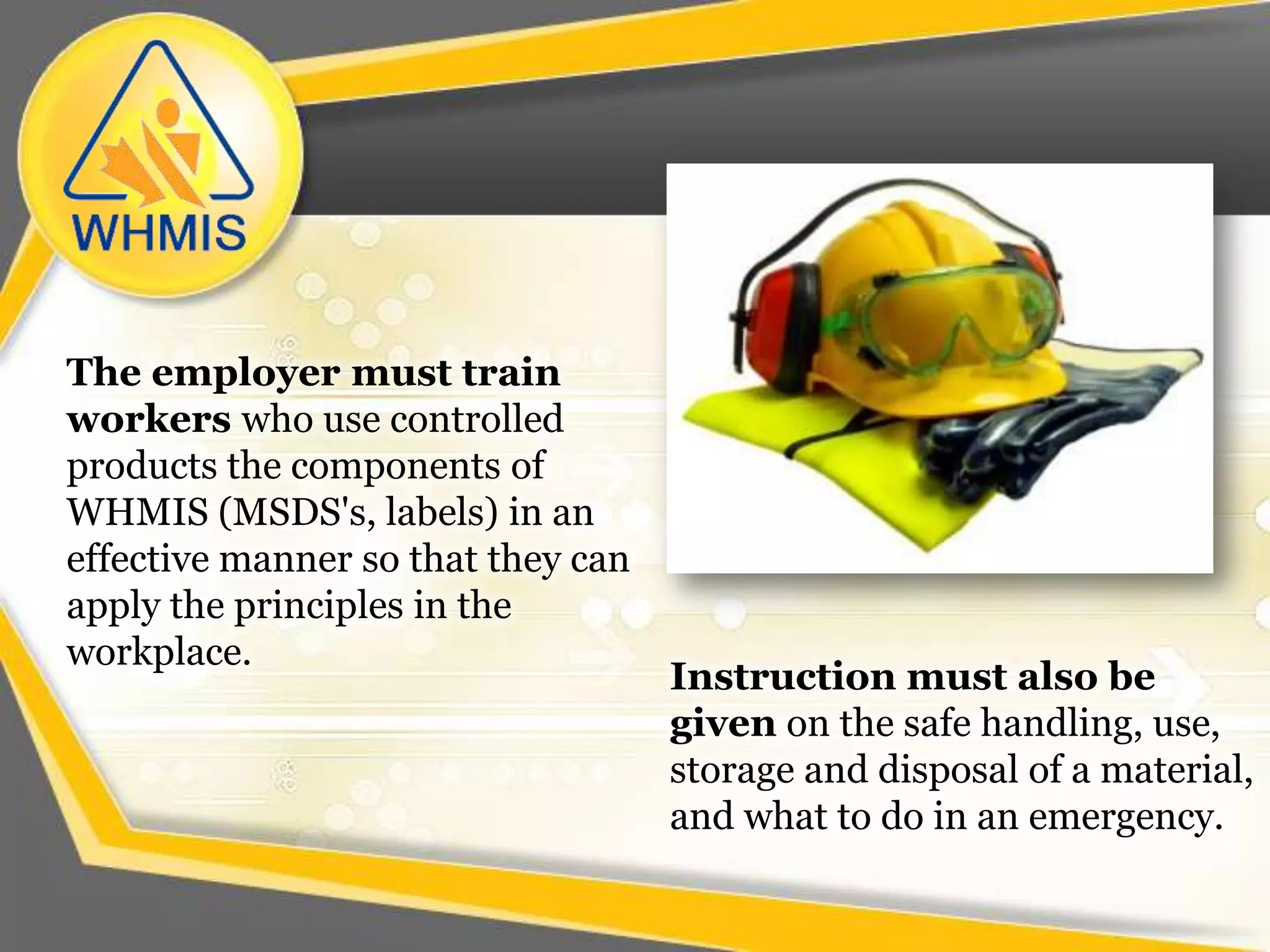
    The employer musttrain workers who use controlled products the components of WHMIS (MSDS's, labels) in an effective manner so that they can apply the principles in the workplace.Instruction must also be given on the safe handling, use, storage and disposal of a material, and what to do in an emergency.
  • 73.
    The employer mustconsult with the Joint OH&S Committee or the Safety Representative on the development, status, and implementation of the program.
  • 74.
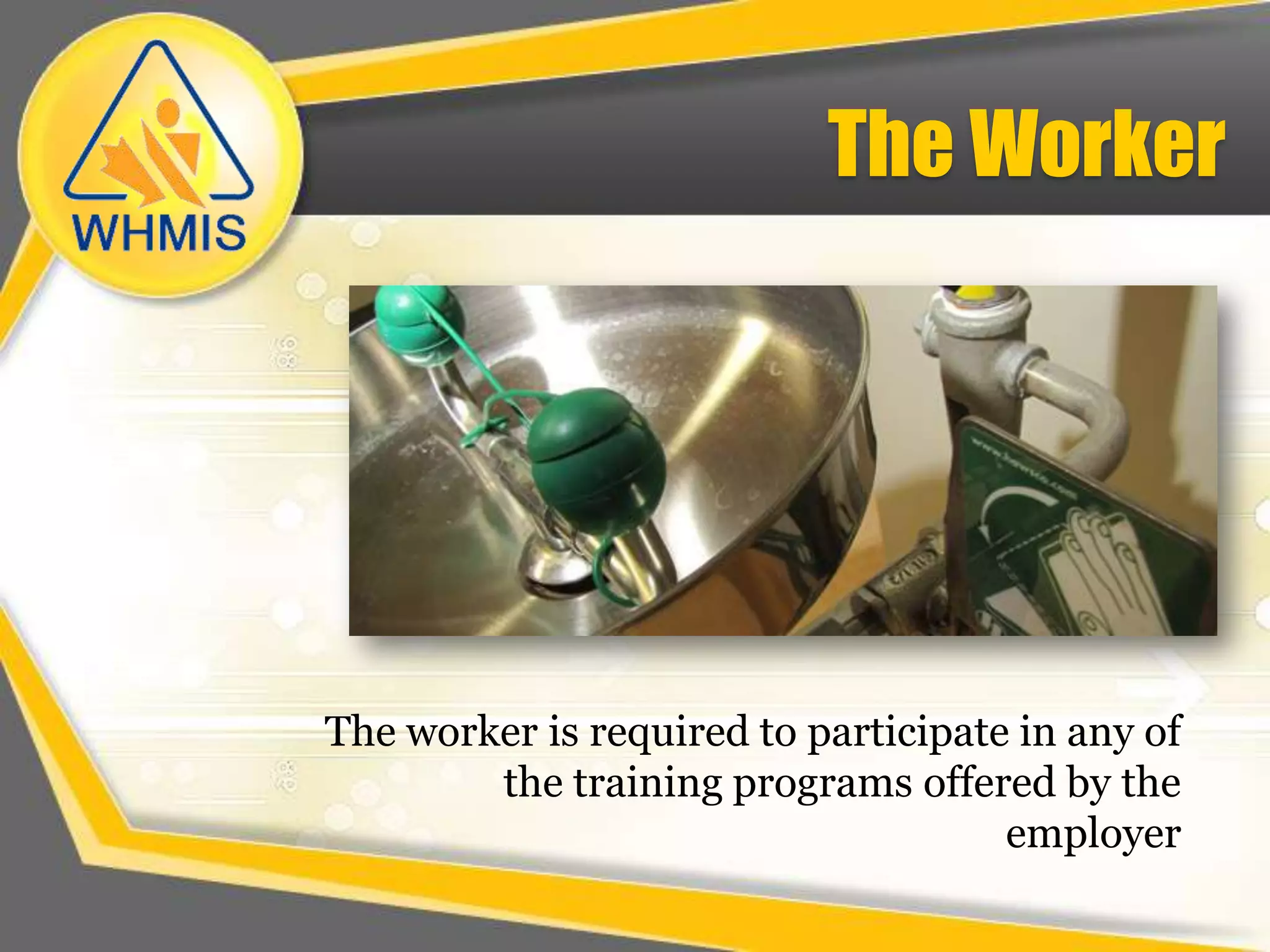
    The employer mustreview the program at least once a year or more often where new hazard material has become available or other circumstances. The review must include a review of the worker's familiarity with the information conveyed through training and supervision. The WorkerThe worker is required to participate in any of the training programs offered by the employer
  • 75.
  • 76.
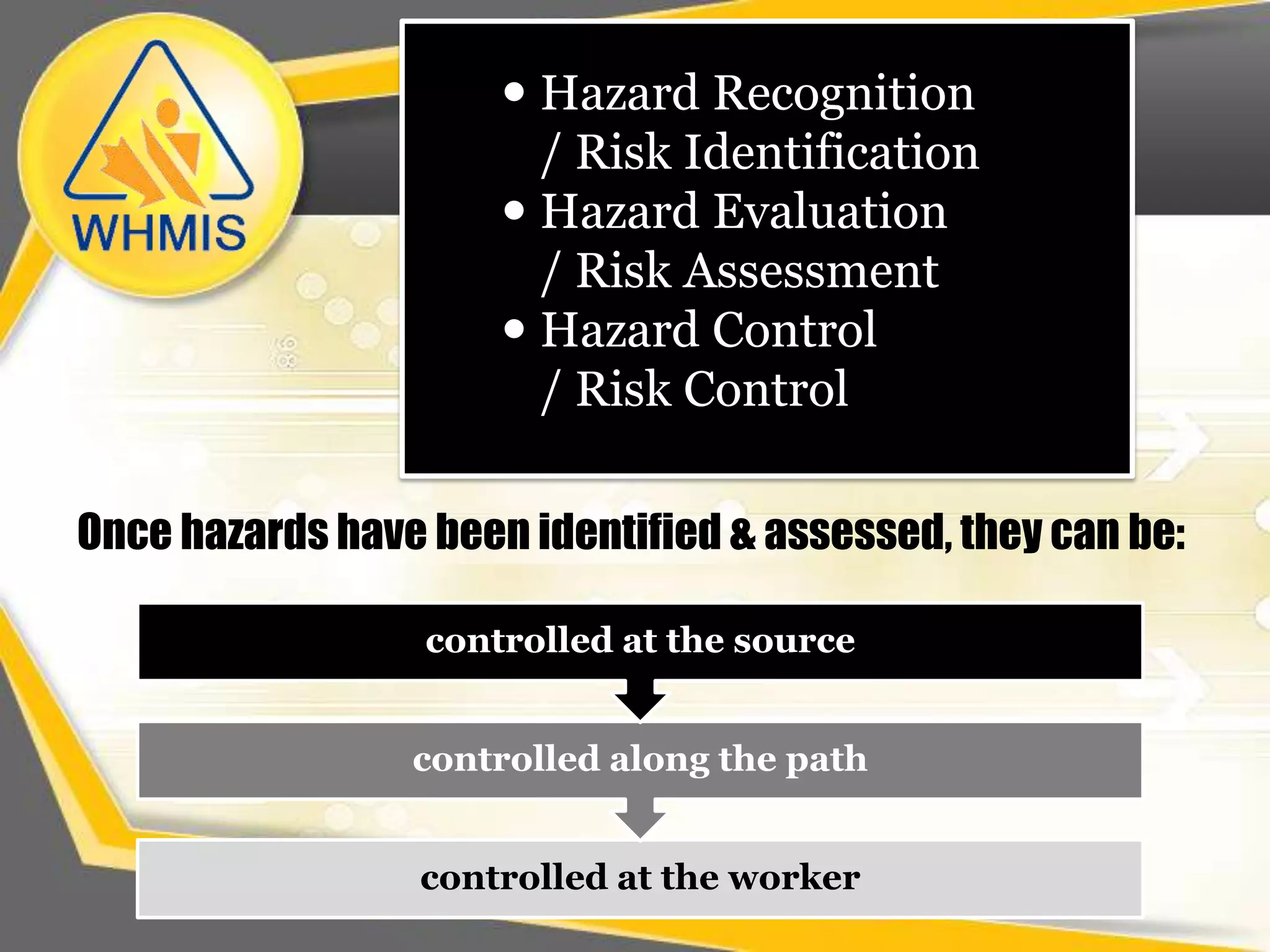
    Hazard Recognition /Risk Identification    
  • 77.
    Hazard Evaluation /Risk Assessment  
  • 78.
    Hazard Control /Risk ControlOnce hazards have been identified & assessed, they can be:
  • 79.
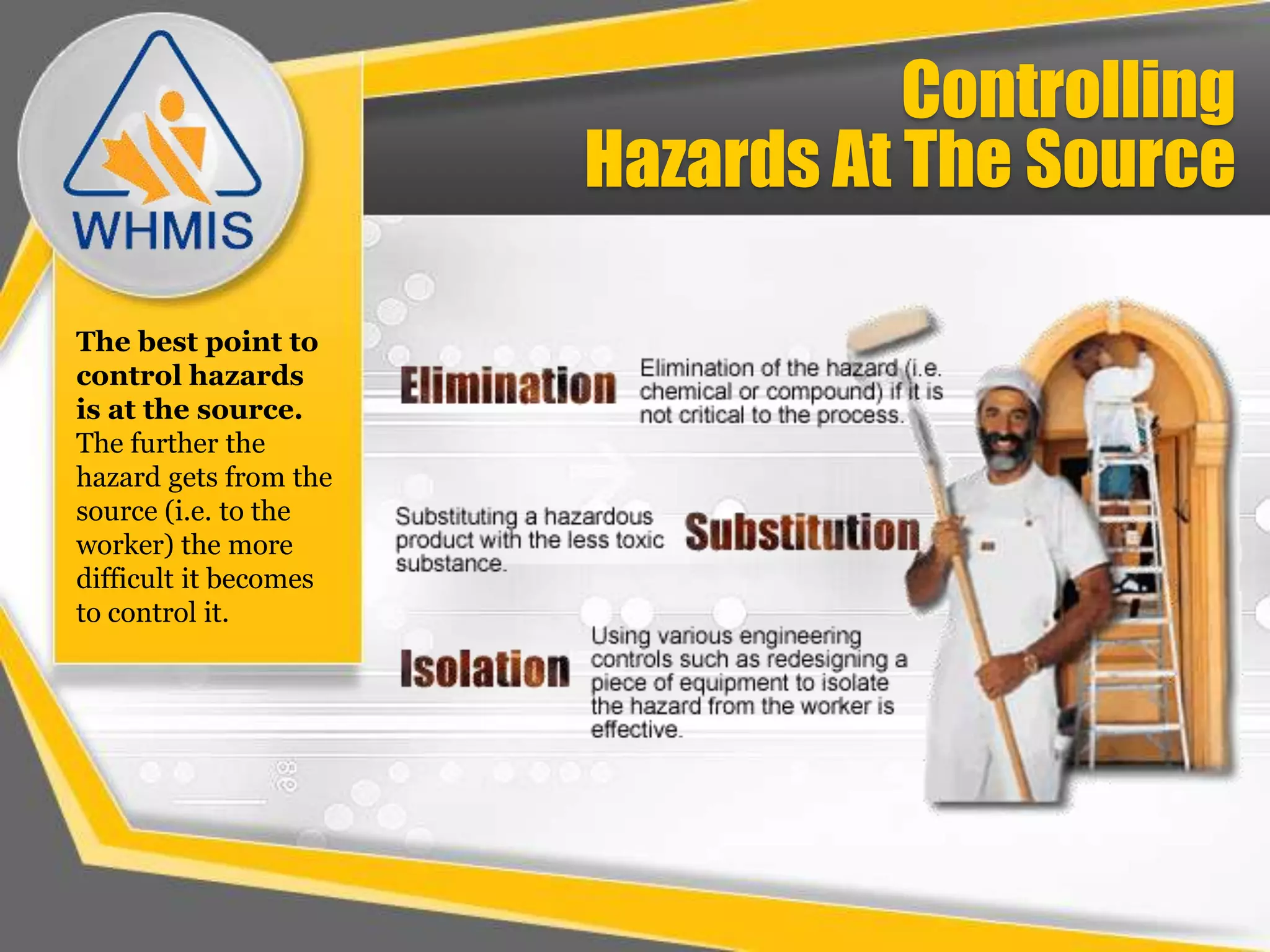
    Controlling Hazards AtThe Source The best point to control hazards is at the source. The further the hazard gets from the source (i.e. to the worker) the more difficult it becomes to control it.
  • 80.
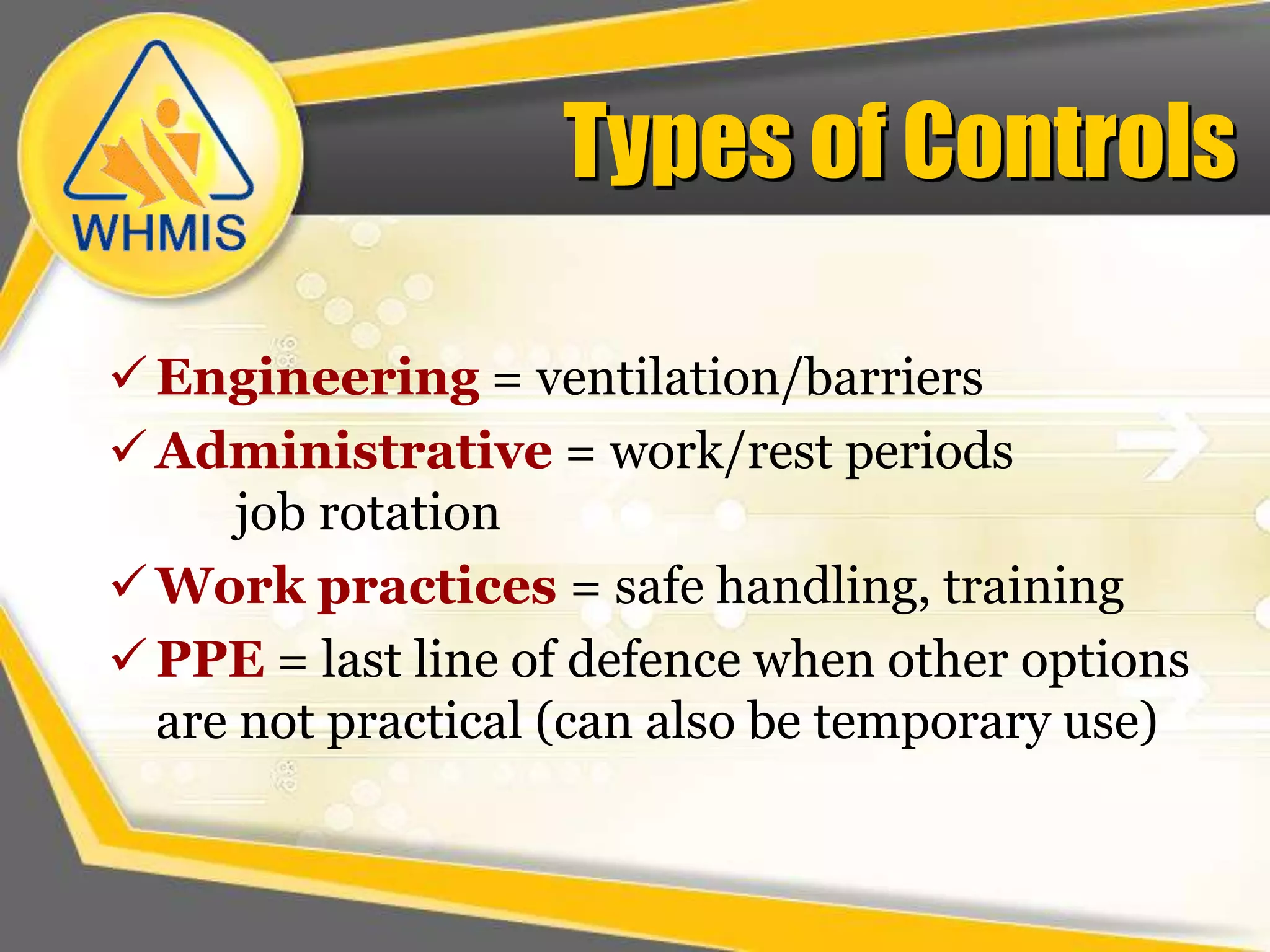
    Types of ControlsEngineering=ventilation/barriers
  • 81.
  • 82.
    Work practices =safe handling, training
  • 83.
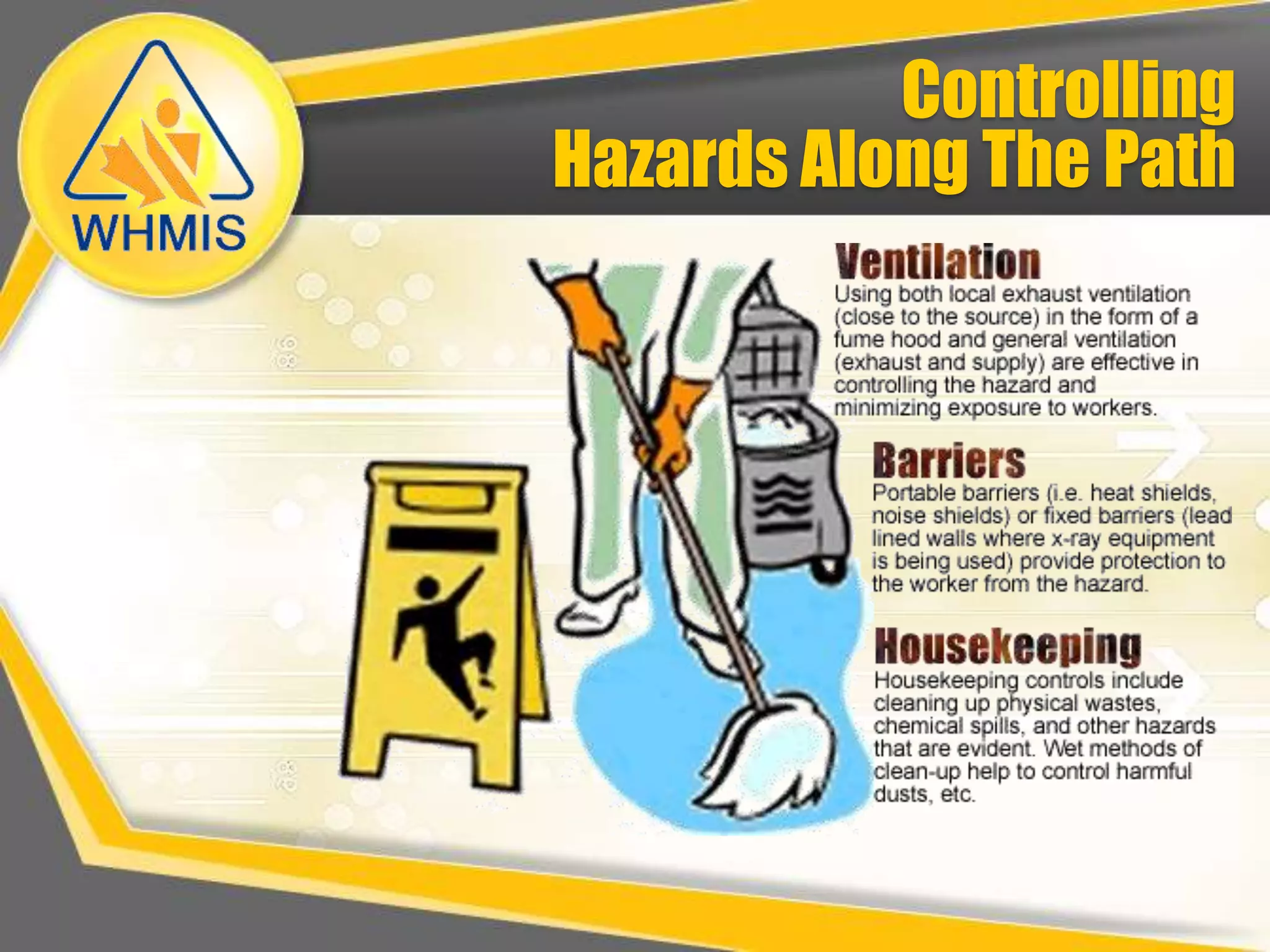
    PPE= last lineof defence when other options are not practical (can also be temporary use)Controlling Hazards Along The Path
  • 84.
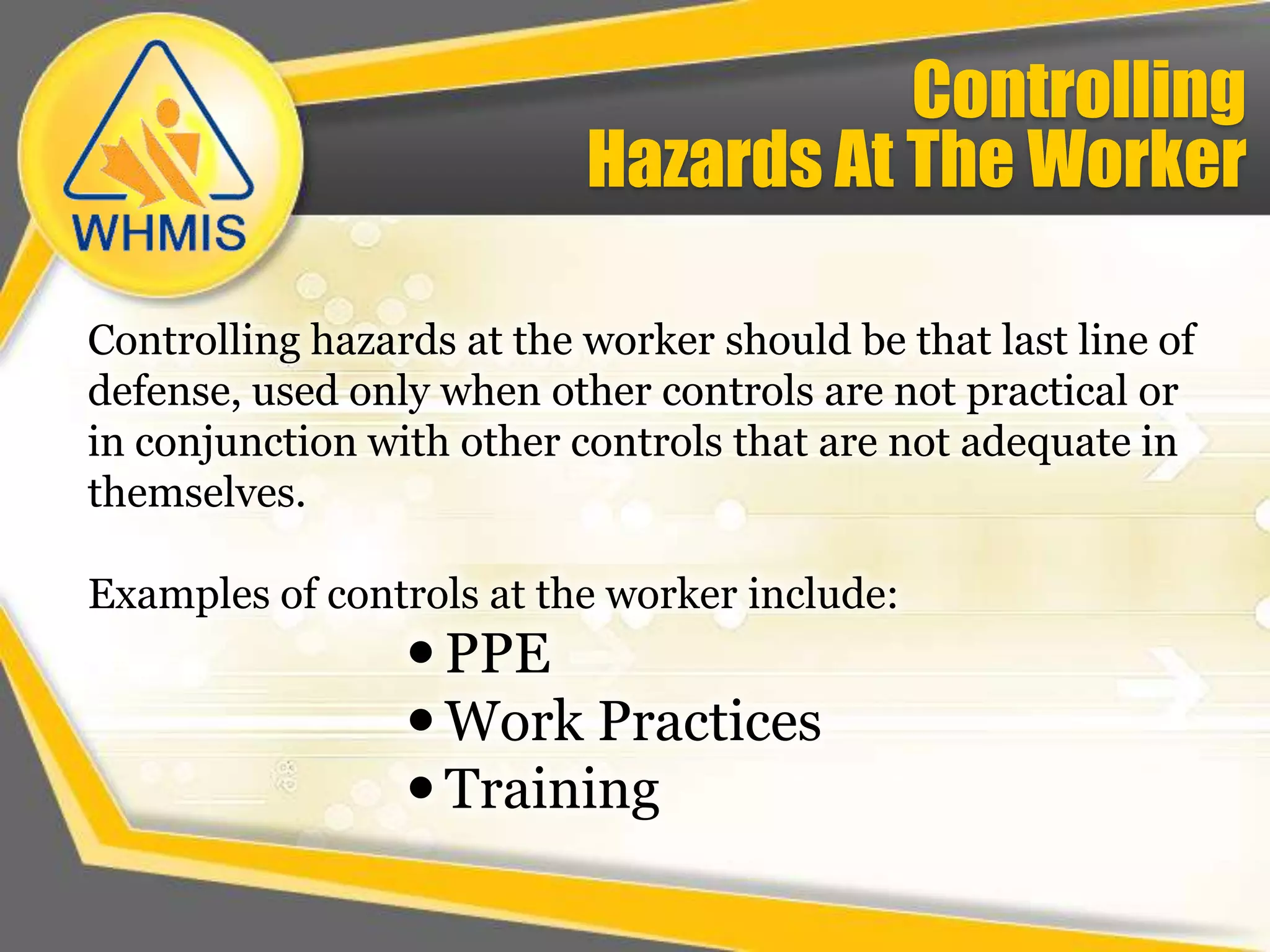
    Controlling Hazards AtThe WorkerControlling hazards at the worker should be that last line of defense, used only when other controls are not practical or in conjunction with other controls that are not adequate in themselves. Examples of controls at the worker include: PPE
  • 85.
  • 86.
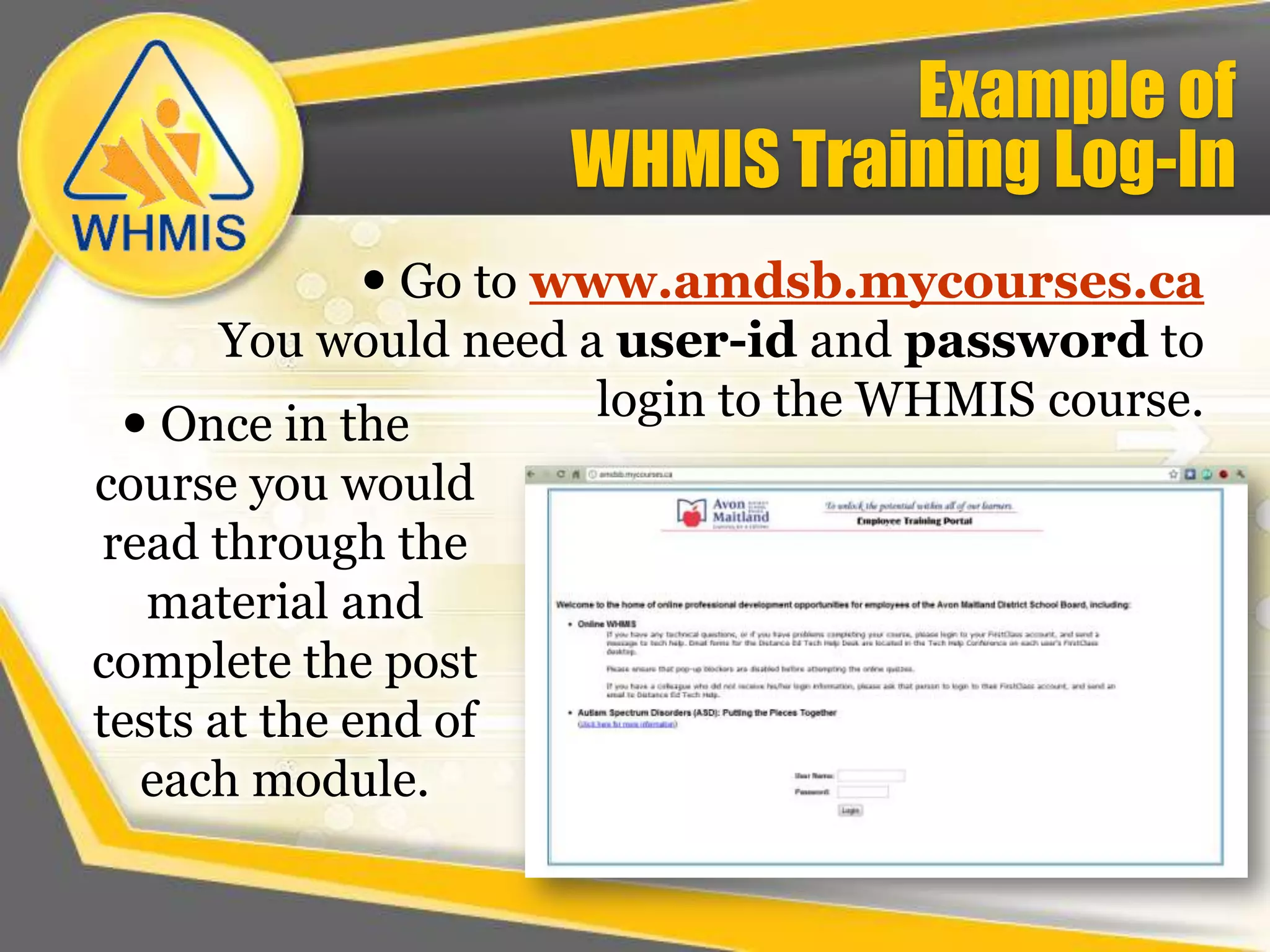
    TrainingExample of WHMISTraining Log-InGo to www.amdsb.mycourses.caYou would need a user-id and password to login to the WHMIS course.Once in the course you would read through the material and complete the post tests at the end of each module.Congratulations on completing the Certification Course