PROF.S.SUBBIAH et.al
RECENT SURGICAL UPDATES
ON PANCREATIC RESECTIONS
Department of Surgical Oncology
Centre for Oncology
GRH,Royapettah
PROF.S.SUBBIAH et.al
• Introduction:
-Local recurrence occurs in about 25–45% of patients following surgical
resection of PDAC.
-Median survival with surgery alone was 13 months and surgery with
chemotherapy was upto 25months
PROF.S.SUBBIAH et.al
Novel Techniques:
1) Cattell Braasch Manoeuvre with combined Artery first approach
2) Triangle Operation
3) Modified Appleby procedure
4) Perarterial Divestment technique in Whipple
5) Vein resection without reconstruction (VROR) in Whipple
6) Radical Antegrade Pancreatico-Splenectomy
PROF.S.SUBBIAH et.al
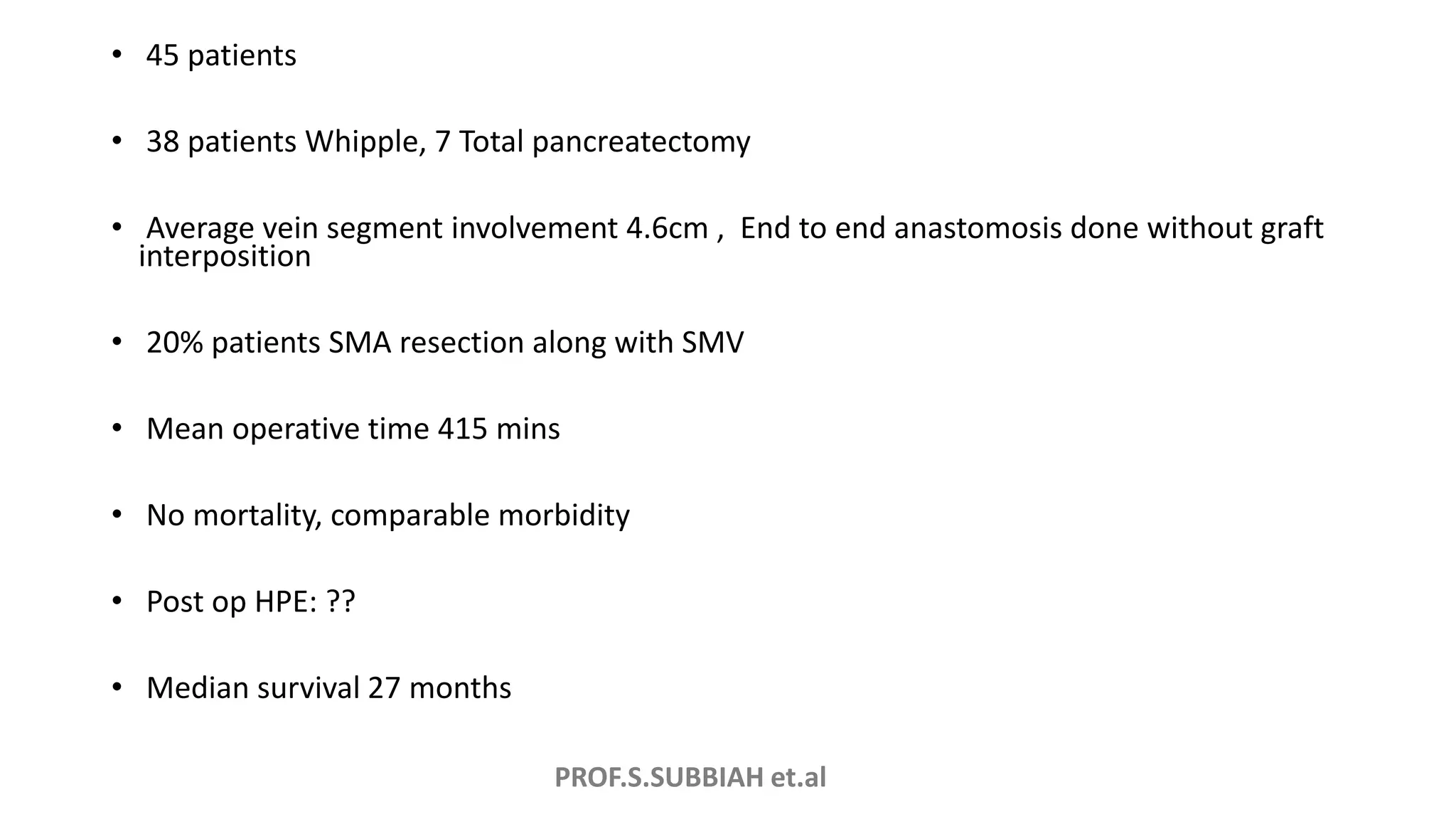
• 45 patients
• 38 patients Whipple, 7 Total pancreatectomy
• Average vein segment involvement 4.6cm , End to end anastomosis done without graft
interposition
• 20% patients SMA resection along with SMV
• Mean operative time 415 mins
• No mortality, comparable morbidity
• Post op HPE: ??
• Median survival 27 months
PROF.S.SUBBIAH et.al
Triangle Operation:
• Neoadjuvant therapy for borderline resectable (BR) and locally
advanced (LA) pancreatic cancer (PDAC) has become an important
treatment option.
• Resectability - 40–60% of patients.
• Not possible to differentiate between viable tumor and fibrous tissue.
• Better Disease free survival and overall survival in resection
PROF.S.SUBBIAH et.al
• Pancreatico duodenectomies, Total pancreatectomies and Distal
pancreatectomies.
• Artery first technique is employed identifying SMA , Coeliac artery
and Hepatic Artery.
• Soft tissue clearances done over the adventitia and skeletonization of
the arteries.
• Other routine steps , lymphadenectomies are carried out
PROF.S.SUBBIAH et.al
• Vein resection is done if tumour found infiltrated.
• 15 patients were included - . Median age of the patients was 60 years
(range 35–75 years), 8 were female, 7 male.
• Stable disease , < 30% decrease in tumour diameter.
PROF.S.SUBBIAH et.al
OVERVIEW OF OUTCOMES
PARAMETER RESULTS
Median surgery duration 320 min
Median Blood loss 1000 ml
Procedures 1 Whipple , 4 Distal Pancreatectomies, 9 Total Pancreatectomies
and 1 Remnant Pancreatectomies
Average duration of stay 13 days
Morbidity 7/15 , 2 needed ICU care, 1 re operation
Mortality nil
Follow up 352 days ( 3 recurrences  2 Liver mets and 1 local recurrence
Patient Outcomes 11 good QOL, 2 Frail, 1 persistent diarrhoea and 1 TPN
PROF.S.SUBBIAH et.al
“The technique offers the possibility to achieve a radical tumor removal after neoadjuvant
therapy in locally advanced PDAC encasing the CA or SMA without the need for an arterial
resection and reconstruction.”
PROF.S.SUBBIAH et.al
Modified Appleby Procedure:
• Tumors arising in the neck or body of the pancreas are particularly likely to
be locally advanced at the time of diagnosis and to have celiac and
common hepatic artery (CHA) involvement.
• Aggressive surgical resection of the neck, body, and tail of the pancreas
with en bloc resection of the celiac artery can be pursued for curative
intent.
• The gastroduodenal artery (GDA) is uninvolved and large enough for
retrograde hepatic artery perfusion through the SMA.
PROF.S.SUBBIAH et.al
• Pancreatic head , GDA, proper hepatic artery should be free.
• Most patients  Locally advanced adenocarcinoma of body and tail
of pancreas post NACT( FOLFIRINOX)  underwent DP- CAR
PROF.S.SUBBIAH et.al
• The CHA is excised close to the level of GDA, and the pancreas is
transected at the level of the neck.
• The splenic vein is transected at its confluence with the superior
mesenteric vein.
• Identify the SMA, which is used as a landmark and is followed
cephalad until the celiac trunk is reached.
• The celiac artery is then transected at its origin from the aorta
PROF.S.SUBBIAH et.al
• Reconstruction ? Artery / Vein
• Resection of the adjacent organs may be performed if they are
invaded by the tumor.
• The stomach is supplied by multiple arteries, including the right
gastric artery, right gastroepiploic artery, and left phrenic artery.
• Preoperative embolization vs Intra-operative Doppler assessment
after clamping
PROF.S.SUBBIAH et.al
• Reported overall perioperative mortality rates range between 3% and
16%.
• Despite low mortality rates, the morbidity rate remains high.
• DP-CAR has a pooled morbidity rate of 49%
• Patients treated with DP-CAR have an overall median survival of 15–
17 months, whereas unresected locally advanced disease has a
survival of 9–11 months
PROF.S.SUBBIAH et.al
• Some centers 35 months Overall survival.
Limitations:
- Morbidity
- patient selection is the key
- Vascular Anomaly:
1) Replaced RHA from SMA is an exception
2) Replaced LHA from Left Gastric - inadvertent injury
MORBIDITY RATE
POPF 31%
Ischemic Gastropathy 13%
Hepatic Infarction Uncommon
Delayed Gastric
Emptying
20%
PROF.S.SUBBIAH et.al
The necessity of vascular re implantation for hypoperfusion.
PROF.S.SUBBIAH et.al
The following considerations should therefore guide decision-making:
1)Arterial divestment seems to decrease the perioperative morbidity and mortality compared
with arterial resection (Cai et al 2020).
2) R1 resections still lead to an acceptable prognosis.
PROF.S.SUBBIAH et.al
• Thorough Laparotomy for distant metastasis
• Artery first approach with Cattel Brasch Manoeuvre
• Kocherisation and Identification of Tumour involvement of Coeliac
Artery and Common Hepatic artery.
• SMA identified and Triangle operation carried out.
• Portal Vein resection +/- , vascular controls taken
PROF.S.SUBBIAH et.al
• No large series reported.
• Compared to mortality and morbidity of arterial resection – provides
an alternative.
• Further RCTs required
PROF.S.SUBBIAH et.al
• Non-constructible venous encasement is regarded as criteria of
unresectability in pancreatic cancer.
• In long-standing extra-hepatic venous obstruction, hepatopetal blood
flow  collateralization in the hepatoduodenal and mesenteric
region.
• Their importance in pancreatic malignancies is being recently
acknowledged
PROF.S.SUBBIAH et.al
• Retrospective single institutional analysis was done 2012 – 2019
• 947 pancreatoduodenectomies were performed, 56 patients
underwent concomitant vein resection.
• Among these, six patients had significant collaterals due to venous
obstruction.
• All these patients successfully underwent pancreatoduodenectomy
with vein resection without vascular reconstruction
PROF.S.SUBBIAH et.al
• Collaterals in the hepatoduodenal, mesenteric, mesocolic and
retroperitoneal region
• Preservation of these collaterals can preclude portal vein-superior
mesenteric vein (PV-SMV) reconstruction.
• Locally advanced pancreatic tumours were recruited as per ISPSG
criteria were included
• Adenocarcinoma , neuro-endocrine tumours, SPEN were included
PROF.S.SUBBIAH et.al
• MDT  Pancreatic protocol CT was taken
• Neoadjuvant chemotherapy was given based on histology.
• No distal pancreatectomies included
PROF.S.SUBBIAH et.al
Case 1 : Neuro-endocrine tumour head of pancreas
PROF.S.SUBBIAH et.al
Case 2 : Pancreatic Adenocarcinoma Uncinate
PROF.S.SUBBIAH et.al
Inclusion criteria:
SMV-VROR:
a)Preservation of spleno-portal venous junction for adequate hepatopetal
flow.
b). Preservation of dominant collateral vessels for adequate mesenteric
decompression
c). Negative mesenteric venous clamping test.
Spleno-Portal VROR:
a)Preservation/reconstruction of LGV to maintain gastro-splenic outflow
b) Preservation/reconstruction of IMV or good calibre collateral vessel, with
intact colonic marginal vein to maintain mesenteric outflow
c). Negative mesenteric venous clamping test
PROF.S.SUBBIAH et.al
• Exclusion criteria:
a. Locally advanced pancreatic lesions (> 180° SMA involvement) with
no or minimal response to neoadjuvant therapy
b. Patients requiring total pancreatectomy
c. Small calibre collateral veins resulting in inadequate mesenteric
decompression
d. Positive mesenteric venous clamping test
PROF.S.SUBBIAH et.al
Technique:
• Standard steps  Thorough exploratory laparotomy
• Artery first technique to assess SMA, identification of SMV and
splenoportal access with extent of tumour involvement.
• Identification of collaterals. Mesentric venous clamping test
• Doubtful cases intra-operative ultrasound Doppler is used
• If negative  proceed with VROR
PROF.S.SUBBIAH et.al
• Standard reconstructive techniques to complete the procedure.
• Post operative :
- Monitored closely for acidosis, liver decompensation, gastrointestinal
bleeding and ascites.
- A Doppler ultrasound at 6 and 12 hours after surgery to assess for
portal vein blood flow.
Follow up: Portal hypertension features were looked for
PROF.S.SUBBIAH et.al
• Four patients underwent isolated SMV resection whereas two
patients required resection of the splenoportal venous junction.
• Largest series published so far with median OS - 3 years.
Median Blood loss 1650ml
Hospital stay 13 days
Morbidity Comparable POPF, 1 patient chyle leak
Mortality Nil
Portal Hypertension Nil (22 months post op)
Follow up R0( N = 4) , R1( N= 1)
PROF.S.SUBBIAH et.al
• “This novel approach will broaden the scope of surgery in advanced
pancreatic cancer and lessen the cases labelled as locally advanced
unresectable lesions”
PROF.S.SUBBIAH et.al
Conventional retrograde distal pancreatectomy and splenectomy for pancreatic adenocarcinoma of the body and
tail have been associated with high rates of positive margins, low lymph node retrieval, and poor overall survival.
Radical antegrade modular pancreatosplenectomy (RAMPS) was introduced in 2003 to overcome these limitations
Conventional distal pancreatectomy VS Antegrade
PROF.S.SUBBIAH et.al
• 2003, Strasberg et al - Washington University, introduced a novel
approach to the resection of a pancreatic adenocarcinoma in the
body and tail.
• Early parenchymal transection at the neck of the pancreas and
control of the splenic vessels, celiac and SMA.
• Lymphadenectomy, as well as full visualization of the retroperitoneal
plane of dissection.
PROF.S.SUBBIAH et.al
• Overall survival, Lymph node harvest and R0 resection were analysed.
• Modular – Plane of dissection Anterior or Posterior to Left Adrenal
PROF.S.SUBBIAH et.al
Technique:
• Laparotomy
• Division of gastrocolic ligament, hepatic flexure mobilisation and
kocherisation.
• Identify SMV and Portal Vein & Assess resectability
• Lesser curvature dissection : periportal, hepatic and coeliac
lymphadenectomy done. Splenic artery divided
• Tunnel of love created and Neck transected, Splenic vein divided
PROF.S.SUBBIAH et.al
• Dissection is continued to left . SMA exposed and lymphadenectomy is
done
• Left adrenal vein at junction of Left renal vein identified.
• Inferior mesenteric vein ligated
• Left adrenal vein ligation +/-
• Spleen attachments divided and Splenectomy completed
PROF.S.SUBBIAH et.al
• A retrospective study by Abe et al. significantly higher R0 resection rates
with RAMPS (90.5 vs. 67.5%; p = 0.005).
• Lower blood loss, decreased operation time
• Higher lymph node harvest “20”
• The largest series for pancreatic adenocarcinoma from Washington
University reported 78 patients whose median and 5-year overall survival
rates were 24.6 months and 25%.
PROF.S.SUBBIAH et.al
• Morbidity and mortality were comparable
• OS was 47 months vs 34 months.
• Effective and oncologically sound for body and tail tumours.
PROF.S.SUBBIAH et.al
Conclusion:
• Randomized controlled trial ( MAPLE-PD, NCT03317886).
• Accruing for RCT is a challenge
• Trend towards more radical treatment due to better understanding
of anatomy and recurrence pattern
• Choosing patients who would benefit – an ongoing research.

Recent surgical updates on pancreatic resections

  • 1.
    PROF.S.SUBBIAH et.al RECENT SURGICALUPDATES ON PANCREATIC RESECTIONS Department of Surgical Oncology Centre for Oncology GRH,Royapettah
  • 2.
    PROF.S.SUBBIAH et.al • Introduction: -Localrecurrence occurs in about 25–45% of patients following surgical resection of PDAC. -Median survival with surgery alone was 13 months and surgery with chemotherapy was upto 25months
  • 3.
    PROF.S.SUBBIAH et.al Novel Techniques: 1)Cattell Braasch Manoeuvre with combined Artery first approach 2) Triangle Operation 3) Modified Appleby procedure 4) Perarterial Divestment technique in Whipple 5) Vein resection without reconstruction (VROR) in Whipple 6) Radical Antegrade Pancreatico-Splenectomy
  • 4.
  • 5.
  • 6.
  • 7.
  • 8.
    PROF.S.SUBBIAH et.al • 45patients • 38 patients Whipple, 7 Total pancreatectomy • Average vein segment involvement 4.6cm , End to end anastomosis done without graft interposition • 20% patients SMA resection along with SMV • Mean operative time 415 mins • No mortality, comparable morbidity • Post op HPE: ?? • Median survival 27 months
  • 9.
    PROF.S.SUBBIAH et.al Triangle Operation: •Neoadjuvant therapy for borderline resectable (BR) and locally advanced (LA) pancreatic cancer (PDAC) has become an important treatment option. • Resectability - 40–60% of patients. • Not possible to differentiate between viable tumor and fibrous tissue. • Better Disease free survival and overall survival in resection
  • 10.
  • 11.
    PROF.S.SUBBIAH et.al • Pancreaticoduodenectomies, Total pancreatectomies and Distal pancreatectomies. • Artery first technique is employed identifying SMA , Coeliac artery and Hepatic Artery. • Soft tissue clearances done over the adventitia and skeletonization of the arteries. • Other routine steps , lymphadenectomies are carried out
  • 12.
    PROF.S.SUBBIAH et.al • Veinresection is done if tumour found infiltrated. • 15 patients were included - . Median age of the patients was 60 years (range 35–75 years), 8 were female, 7 male. • Stable disease , < 30% decrease in tumour diameter.
  • 13.
    PROF.S.SUBBIAH et.al OVERVIEW OFOUTCOMES PARAMETER RESULTS Median surgery duration 320 min Median Blood loss 1000 ml Procedures 1 Whipple , 4 Distal Pancreatectomies, 9 Total Pancreatectomies and 1 Remnant Pancreatectomies Average duration of stay 13 days Morbidity 7/15 , 2 needed ICU care, 1 re operation Mortality nil Follow up 352 days ( 3 recurrences  2 Liver mets and 1 local recurrence Patient Outcomes 11 good QOL, 2 Frail, 1 persistent diarrhoea and 1 TPN
  • 14.
  • 15.
    PROF.S.SUBBIAH et.al “The techniqueoffers the possibility to achieve a radical tumor removal after neoadjuvant therapy in locally advanced PDAC encasing the CA or SMA without the need for an arterial resection and reconstruction.”
  • 16.
  • 17.
    PROF.S.SUBBIAH et.al Modified ApplebyProcedure: • Tumors arising in the neck or body of the pancreas are particularly likely to be locally advanced at the time of diagnosis and to have celiac and common hepatic artery (CHA) involvement. • Aggressive surgical resection of the neck, body, and tail of the pancreas with en bloc resection of the celiac artery can be pursued for curative intent. • The gastroduodenal artery (GDA) is uninvolved and large enough for retrograde hepatic artery perfusion through the SMA.
  • 18.
  • 19.
    PROF.S.SUBBIAH et.al • Pancreatichead , GDA, proper hepatic artery should be free. • Most patients  Locally advanced adenocarcinoma of body and tail of pancreas post NACT( FOLFIRINOX)  underwent DP- CAR
  • 20.
    PROF.S.SUBBIAH et.al • TheCHA is excised close to the level of GDA, and the pancreas is transected at the level of the neck. • The splenic vein is transected at its confluence with the superior mesenteric vein. • Identify the SMA, which is used as a landmark and is followed cephalad until the celiac trunk is reached. • The celiac artery is then transected at its origin from the aorta
  • 21.
    PROF.S.SUBBIAH et.al • Reconstruction? Artery / Vein • Resection of the adjacent organs may be performed if they are invaded by the tumor. • The stomach is supplied by multiple arteries, including the right gastric artery, right gastroepiploic artery, and left phrenic artery. • Preoperative embolization vs Intra-operative Doppler assessment after clamping
  • 22.
  • 23.
    PROF.S.SUBBIAH et.al • Reportedoverall perioperative mortality rates range between 3% and 16%. • Despite low mortality rates, the morbidity rate remains high. • DP-CAR has a pooled morbidity rate of 49% • Patients treated with DP-CAR have an overall median survival of 15– 17 months, whereas unresected locally advanced disease has a survival of 9–11 months
  • 24.
    PROF.S.SUBBIAH et.al • Somecenters 35 months Overall survival. Limitations: - Morbidity - patient selection is the key - Vascular Anomaly: 1) Replaced RHA from SMA is an exception 2) Replaced LHA from Left Gastric - inadvertent injury MORBIDITY RATE POPF 31% Ischemic Gastropathy 13% Hepatic Infarction Uncommon Delayed Gastric Emptying 20%
  • 25.
    PROF.S.SUBBIAH et.al The necessityof vascular re implantation for hypoperfusion.
  • 26.
    PROF.S.SUBBIAH et.al The followingconsiderations should therefore guide decision-making: 1)Arterial divestment seems to decrease the perioperative morbidity and mortality compared with arterial resection (Cai et al 2020). 2) R1 resections still lead to an acceptable prognosis.
  • 27.
  • 28.
    PROF.S.SUBBIAH et.al • ThoroughLaparotomy for distant metastasis • Artery first approach with Cattel Brasch Manoeuvre • Kocherisation and Identification of Tumour involvement of Coeliac Artery and Common Hepatic artery. • SMA identified and Triangle operation carried out. • Portal Vein resection +/- , vascular controls taken
  • 29.
  • 30.
    PROF.S.SUBBIAH et.al • Nolarge series reported. • Compared to mortality and morbidity of arterial resection – provides an alternative. • Further RCTs required
  • 31.
  • 32.
    PROF.S.SUBBIAH et.al • Non-constructiblevenous encasement is regarded as criteria of unresectability in pancreatic cancer. • In long-standing extra-hepatic venous obstruction, hepatopetal blood flow  collateralization in the hepatoduodenal and mesenteric region. • Their importance in pancreatic malignancies is being recently acknowledged
  • 33.
    PROF.S.SUBBIAH et.al • Retrospectivesingle institutional analysis was done 2012 – 2019 • 947 pancreatoduodenectomies were performed, 56 patients underwent concomitant vein resection. • Among these, six patients had significant collaterals due to venous obstruction. • All these patients successfully underwent pancreatoduodenectomy with vein resection without vascular reconstruction
  • 34.
    PROF.S.SUBBIAH et.al • Collateralsin the hepatoduodenal, mesenteric, mesocolic and retroperitoneal region • Preservation of these collaterals can preclude portal vein-superior mesenteric vein (PV-SMV) reconstruction. • Locally advanced pancreatic tumours were recruited as per ISPSG criteria were included • Adenocarcinoma , neuro-endocrine tumours, SPEN were included
  • 35.
    PROF.S.SUBBIAH et.al • MDT Pancreatic protocol CT was taken • Neoadjuvant chemotherapy was given based on histology. • No distal pancreatectomies included
  • 36.
    PROF.S.SUBBIAH et.al Case 1: Neuro-endocrine tumour head of pancreas
  • 37.
    PROF.S.SUBBIAH et.al Case 2: Pancreatic Adenocarcinoma Uncinate
  • 38.
    PROF.S.SUBBIAH et.al Inclusion criteria: SMV-VROR: a)Preservationof spleno-portal venous junction for adequate hepatopetal flow. b). Preservation of dominant collateral vessels for adequate mesenteric decompression c). Negative mesenteric venous clamping test. Spleno-Portal VROR: a)Preservation/reconstruction of LGV to maintain gastro-splenic outflow b) Preservation/reconstruction of IMV or good calibre collateral vessel, with intact colonic marginal vein to maintain mesenteric outflow c). Negative mesenteric venous clamping test
  • 39.
    PROF.S.SUBBIAH et.al • Exclusioncriteria: a. Locally advanced pancreatic lesions (> 180° SMA involvement) with no or minimal response to neoadjuvant therapy b. Patients requiring total pancreatectomy c. Small calibre collateral veins resulting in inadequate mesenteric decompression d. Positive mesenteric venous clamping test
  • 40.
    PROF.S.SUBBIAH et.al Technique: • Standardsteps  Thorough exploratory laparotomy • Artery first technique to assess SMA, identification of SMV and splenoportal access with extent of tumour involvement. • Identification of collaterals. Mesentric venous clamping test • Doubtful cases intra-operative ultrasound Doppler is used • If negative  proceed with VROR
  • 41.
    PROF.S.SUBBIAH et.al • Standardreconstructive techniques to complete the procedure. • Post operative : - Monitored closely for acidosis, liver decompensation, gastrointestinal bleeding and ascites. - A Doppler ultrasound at 6 and 12 hours after surgery to assess for portal vein blood flow. Follow up: Portal hypertension features were looked for
  • 42.
  • 43.
    PROF.S.SUBBIAH et.al • Fourpatients underwent isolated SMV resection whereas two patients required resection of the splenoportal venous junction. • Largest series published so far with median OS - 3 years. Median Blood loss 1650ml Hospital stay 13 days Morbidity Comparable POPF, 1 patient chyle leak Mortality Nil Portal Hypertension Nil (22 months post op) Follow up R0( N = 4) , R1( N= 1)
  • 44.
    PROF.S.SUBBIAH et.al • “Thisnovel approach will broaden the scope of surgery in advanced pancreatic cancer and lessen the cases labelled as locally advanced unresectable lesions”
  • 45.
    PROF.S.SUBBIAH et.al Conventional retrogradedistal pancreatectomy and splenectomy for pancreatic adenocarcinoma of the body and tail have been associated with high rates of positive margins, low lymph node retrieval, and poor overall survival. Radical antegrade modular pancreatosplenectomy (RAMPS) was introduced in 2003 to overcome these limitations Conventional distal pancreatectomy VS Antegrade
  • 46.
    PROF.S.SUBBIAH et.al • 2003,Strasberg et al - Washington University, introduced a novel approach to the resection of a pancreatic adenocarcinoma in the body and tail. • Early parenchymal transection at the neck of the pancreas and control of the splenic vessels, celiac and SMA. • Lymphadenectomy, as well as full visualization of the retroperitoneal plane of dissection.
  • 47.
    PROF.S.SUBBIAH et.al • Overallsurvival, Lymph node harvest and R0 resection were analysed. • Modular – Plane of dissection Anterior or Posterior to Left Adrenal
  • 48.
  • 49.
    PROF.S.SUBBIAH et.al Technique: • Laparotomy •Division of gastrocolic ligament, hepatic flexure mobilisation and kocherisation. • Identify SMV and Portal Vein & Assess resectability • Lesser curvature dissection : periportal, hepatic and coeliac lymphadenectomy done. Splenic artery divided • Tunnel of love created and Neck transected, Splenic vein divided
  • 50.
    PROF.S.SUBBIAH et.al • Dissectionis continued to left . SMA exposed and lymphadenectomy is done • Left adrenal vein at junction of Left renal vein identified. • Inferior mesenteric vein ligated • Left adrenal vein ligation +/- • Spleen attachments divided and Splenectomy completed
  • 51.
    PROF.S.SUBBIAH et.al • Aretrospective study by Abe et al. significantly higher R0 resection rates with RAMPS (90.5 vs. 67.5%; p = 0.005). • Lower blood loss, decreased operation time • Higher lymph node harvest “20” • The largest series for pancreatic adenocarcinoma from Washington University reported 78 patients whose median and 5-year overall survival rates were 24.6 months and 25%.
  • 52.
    PROF.S.SUBBIAH et.al • Morbidityand mortality were comparable • OS was 47 months vs 34 months. • Effective and oncologically sound for body and tail tumours.
  • 53.
    PROF.S.SUBBIAH et.al Conclusion: • Randomizedcontrolled trial ( MAPLE-PD, NCT03317886). • Accruing for RCT is a challenge • Trend towards more radical treatment due to better understanding of anatomy and recurrence pattern • Choosing patients who would benefit – an ongoing research.