
What’s New in
Facebook Topic Data
Jason Rose
SVP Marketing
DataSift
Jay Krall
Director of Product Management
Datasift
Facebook topic data in action
What’s new in Facebook topic data
Facebook topic data Overview
Agenda
1
2
3
4 Q&A
Facebook Topic Data
Overview
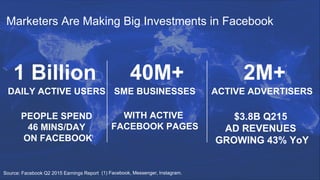
SME BUSINESSES
WITH ACTIVE
FACEBOOK PAGES
40M+
Source: Facebook Q2 2015 Earnings Report
2M+
$3.8B Q215
AD REVENUES
GROWING 43% YoY
ACTIVE ADVERTISERSDAILY ACTIVE USERS
1 Billion
PEOPLE SPEND
46 MINS/DAY
ON FACEBOOK
(1) Facebook, Messenger, Instagram.
1
Marketers Are Making Big Investments in Facebook
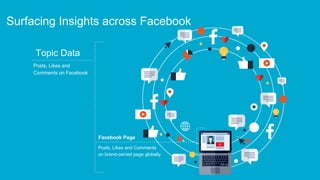
Surfacing Insights across Facebook
Facebook Page
Topic Data
Posts, Likes and Comments
on brand-owned page globally
Posts, Likes and
Comments on Facebook
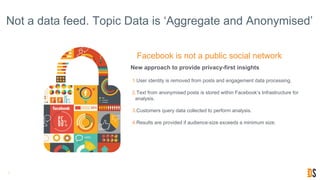
Not a data feed. Topic Data is ‘Aggregate and Anonymised’
7
New approach to provide privacy-first insights
1.User identity is removed from posts and engagement data processing.
2.Text from anonymised posts is stored within Facebook’s Infrastructure for
analysis.
3.Customers query data collected to perform analysis.
4.Results are provided if audience-size exceeds a minimum size.
Facebook is not a public social network
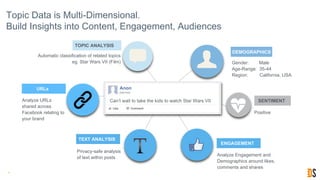
Topic Data is Multi-Dimensional.
Build Insights into Content, Engagement, Audiences
8
CONTENT
Privacy-safe analysis
of text within posts
CONTENTAutomatic classification of related topics
eg. Star Wars VII (Film)
CONTENT
Gender: Male
Age-Range: 35-44
Region: California, USA
CONTENT
Positive
TEXT ANALYSIS
TOPIC ANALYSIS
DEMOGRAPHICS
SENTIMENT
CONTENT
URLs
Analyze URLs
shared across
Facebook relating to
your brand
Analyze Engagement and
Demographics around likes,
comments and shares
ENGAGEMENT
Can’t wait to take the kids to watch Star Wars VII
Anon
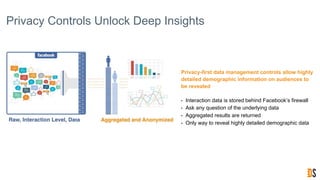
Privacy Controls Unlock Deep Insights
Privacy-first data management controls allow highly
detailed demographic information on audiences to
be revealed
• Interaction data is stored behind Facebook’s firewall
• Ask any question of the underlying data
• Aggregated results are returned
• Only way to reveal highly detailed demographic data
What’s new in Facebook topic
data?
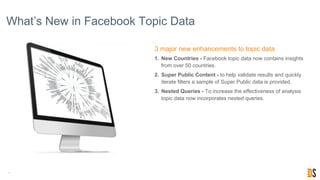
What’s New in Facebook Topic Data
11
3 major new enhancements to topic data
1. New Countries - Facebook topic data now contains insights
from over 50 countries.
2. Super Public Content - to help validate results and quickly
iterate filters a sample of Super Public data is provided.
3. Nested Queries - To increase the effectiveness of analysis
topic data now incorporates nested queries.
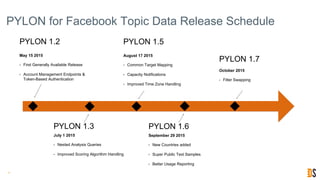
PYLON for Facebook Topic Data Release Schedule
12
PYLON 1.2
May 15 2015
• First Generally Available Release
• Account Management Endpoints &
Token-Based Authentication
PYLON 1.3
July 1 2015
• Nested Analysis Queries
• Improved Scoring Algorithm Handling
PYLON 1.6
September 29 2015
• New Countries added
• Super Public Text Samples
• Better Usage Reporting
PYLON 1.5
August 17 2015
• Common Target Mapping
• Capacity Notifications
• Improved Time Zone Handling
PYLON 1.7
October 2015
• Filter Swapping
Topic Data Available in Over 50 Countries
13
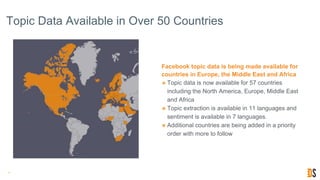
Facebook topic data is being made available for
countries in Europe, the Middle East and Africa
๏ Topic data is now available for 57 countries
including the North America, Europe, Middle East
and Africa
๏ Topic extraction is available in 11 languages and
sentiment is available in 7 languages.
๏ Additional countries are being added in a priority
order with more to follow
14
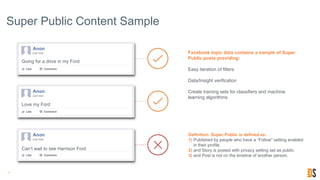
Facebook topic data contains a sample of Super
Public posts providing:
Easy iteration of filters
Data/Insight verification
Create training sets for classifiers and machine
learning algorithms
Definition: Super Public is defined as:
1) Published by people who have a “Follow” setting enabled
in their profile.
2) and Story is posted with privacy setting set as public.
3) and Post is not on the timeline of another person.
Going for a drive in my Ford
Anon
Love my Ford
Anon
Can’t wait to see Harrison Ford
Anon
Super Public Content Sample
Working with Super Public Content
๏ Receive a limit of 100 posts per recording per hour
(no engagements available)
๏ Use the count parameter to specify a number of posts between 10 and 100 for each request
๏ Use start/end parameters to restrict posts retrieved to a time range in the past. You can perform
repeated requests against the same time range. If you don't specify a time range, the most recent
available posts are delivered
๏ Use the filter parameter to use query filtering (secondary CSDL) to retrieve results relevant to the
specific aspect of your filter that you're trying to validate
15
What’s on your mind?
Ways to use Super Public Data
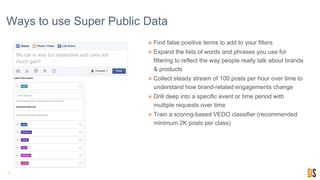
๏ Find false positive terms to add to your filters
๏ Expand the lists of words and phrases you use for
filtering to reflect the way people really talk about brands
& products
๏ Collect steady stream of 100 posts per hour over time to
understand how brand-related engagements change
๏ Drill deep into a specific event or time period with
multiple requests over time
๏ Train a scoring-based VEDO classifier (recommended
minimum 2K posts per class)
16
My car is way too expensive and uses too
much gas!!
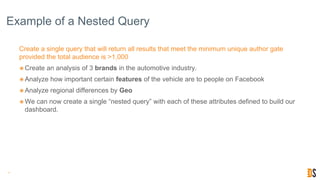
Example of a Nested Query
Create a single query that will return all results that meet the minimum unique author gate
provided the total audience is >1,000
๏Create an analysis of 3 brands in the automotive industry.
๏Analyze how important certain features of the vehicle are to people on Facebook
๏Analyze regional differences by Geo
๏We can now create a single “nested query” with each of these attributes defined to build our
dashboard.
17
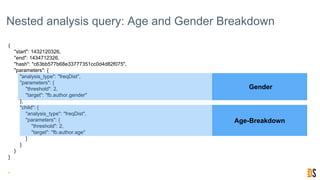
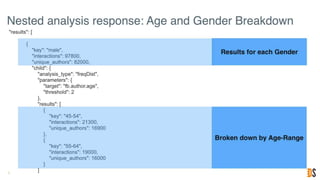
Nested analysis query: Age and Gender Breakdown
18
{
"start": 1432120326,
"end": 1434712326,
"hash": "c63bb577b68e33777351cc0d4d82f075",
"parameters": {
"analysis_type": "freqDist",
"parameters": {
"threshold": 2,
"target": "fb.author.gender"
},
"child": {
"analysis_type": "freqDist",
"parameters": {
"threshold": 2,
"target": "fb.author.age"
}
}
}
}
Gender
Age-Breakdown
Facebook topic data in action
21
Brand Analytics
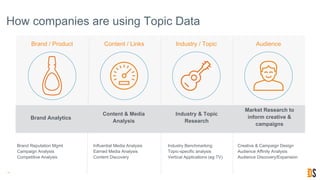
How companies are using Topic Data
Brand / Product Content / Links Industry / Topic Audience
Content & Media
Analysis
Industry & Topic
Research
Market Research to
inform creative &
campaigns
Brand Reputation Mgmt
Campaign Analysis
Competitive Analysis
Influential Media Analysis
Earned Media Analysis
Content Discovery
Industry Benchmarking
Topic-specific analysis
Vertical Applications (eg TV)
Creative & Campaign Design
Audience Affinity Analysis
Audience Discovery/Expansion
22
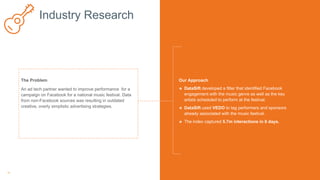
The Problem
An ad tech partner wanted to improve performance for a
campaign on Facebook for a national music festival. Data
from non-Facebook sources was resulting in outdated
creative, overly simplistic advertising strategies.
Our Approach
๏ DataSift developed a filter that identified Facebook
engagement with the music genre as well as the key
artists scheduled to perform at the festival.
๏ DataSift used VEDO to tag performers and sponsors
already associated with the music festival.
๏ The index captured 5.7m interactions in 8 days.
Industry Research
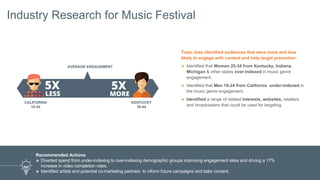
Topic data identified audiences that were more and less
likely to engage with content and help target promotion:
๏ Identified that Women 25-34 from Kentucky, Indiana,
Michigan & other states over-indexed in music genre
engagement.
๏ Identified that Men 18-24 from California under-indexed in
the music genre engagement.
๏ Identified a range of related interests, websites, retailers
and broadcasters that could be used for targeting.
Recommended Actions
๏ Diverted spend from under-indexing to over-indexing demographic groups improving engagement rates and driving a 17%
increase in video completion rates.
๏ Identified artists and potential co-marketing partners to inform future campaigns and tailor content.
CALIFORNIA
18-24
KENTUCKY
35-44
AVERAGE ENGAGEMENT
Industry Research for Music Festival
Q&A
THANK YOU

What's New in Facebook Topic Data

  • 1.
  • 2.
    Jason Rose SVP Marketing DataSift JayKrall Director of Product Management Datasift
  • 3.
    Facebook topic datain action What’s new in Facebook topic data Facebook topic data Overview Agenda 1 2 3 4 Q&A
  • 4.
  • 5.
    SME BUSINESSES WITH ACTIVE FACEBOOKPAGES 40M+ Source: Facebook Q2 2015 Earnings Report 2M+ $3.8B Q215 AD REVENUES GROWING 43% YoY ACTIVE ADVERTISERSDAILY ACTIVE USERS 1 Billion PEOPLE SPEND 46 MINS/DAY ON FACEBOOK (1) Facebook, Messenger, Instagram. 1 Marketers Are Making Big Investments in Facebook
  • 6.
    Surfacing Insights acrossFacebook Facebook Page Topic Data Posts, Likes and Comments on brand-owned page globally Posts, Likes and Comments on Facebook
  • 7.
    Not a datafeed. Topic Data is ‘Aggregate and Anonymised’ 7 New approach to provide privacy-first insights 1.User identity is removed from posts and engagement data processing. 2.Text from anonymised posts is stored within Facebook’s Infrastructure for analysis. 3.Customers query data collected to perform analysis. 4.Results are provided if audience-size exceeds a minimum size. Facebook is not a public social network
  • 8.
    Topic Data isMulti-Dimensional. Build Insights into Content, Engagement, Audiences 8 CONTENT Privacy-safe analysis of text within posts CONTENTAutomatic classification of related topics eg. Star Wars VII (Film) CONTENT Gender: Male Age-Range: 35-44 Region: California, USA CONTENT Positive TEXT ANALYSIS TOPIC ANALYSIS DEMOGRAPHICS SENTIMENT CONTENT URLs Analyze URLs shared across Facebook relating to your brand Analyze Engagement and Demographics around likes, comments and shares ENGAGEMENT Can’t wait to take the kids to watch Star Wars VII Anon
  • 9.
    Privacy Controls UnlockDeep Insights Privacy-first data management controls allow highly detailed demographic information on audiences to be revealed • Interaction data is stored behind Facebook’s firewall • Ask any question of the underlying data • Aggregated results are returned • Only way to reveal highly detailed demographic data
  • 10.
    What’s new inFacebook topic data?
  • 11.
    What’s New inFacebook Topic Data 11 3 major new enhancements to topic data 1. New Countries - Facebook topic data now contains insights from over 50 countries. 2. Super Public Content - to help validate results and quickly iterate filters a sample of Super Public data is provided. 3. Nested Queries - To increase the effectiveness of analysis topic data now incorporates nested queries.
  • 12.
    PYLON for FacebookTopic Data Release Schedule 12 PYLON 1.2 May 15 2015 • First Generally Available Release • Account Management Endpoints & Token-Based Authentication PYLON 1.3 July 1 2015 • Nested Analysis Queries • Improved Scoring Algorithm Handling PYLON 1.6 September 29 2015 • New Countries added • Super Public Text Samples • Better Usage Reporting PYLON 1.5 August 17 2015 • Common Target Mapping • Capacity Notifications • Improved Time Zone Handling PYLON 1.7 October 2015 • Filter Swapping
  • 13.
    Topic Data Availablein Over 50 Countries 13 Facebook topic data is being made available for countries in Europe, the Middle East and Africa ๏ Topic data is now available for 57 countries including the North America, Europe, Middle East and Africa ๏ Topic extraction is available in 11 languages and sentiment is available in 7 languages. ๏ Additional countries are being added in a priority order with more to follow
  • 14.
    14 Facebook topic datacontains a sample of Super Public posts providing: Easy iteration of filters Data/Insight verification Create training sets for classifiers and machine learning algorithms Definition: Super Public is defined as: 1) Published by people who have a “Follow” setting enabled in their profile. 2) and Story is posted with privacy setting set as public. 3) and Post is not on the timeline of another person. Going for a drive in my Ford Anon Love my Ford Anon Can’t wait to see Harrison Ford Anon Super Public Content Sample
  • 15.
    Working with SuperPublic Content ๏ Receive a limit of 100 posts per recording per hour (no engagements available) ๏ Use the count parameter to specify a number of posts between 10 and 100 for each request ๏ Use start/end parameters to restrict posts retrieved to a time range in the past. You can perform repeated requests against the same time range. If you don't specify a time range, the most recent available posts are delivered ๏ Use the filter parameter to use query filtering (secondary CSDL) to retrieve results relevant to the specific aspect of your filter that you're trying to validate 15
  • 16.
    What’s on yourmind? Ways to use Super Public Data ๏ Find false positive terms to add to your filters ๏ Expand the lists of words and phrases you use for filtering to reflect the way people really talk about brands & products ๏ Collect steady stream of 100 posts per hour over time to understand how brand-related engagements change ๏ Drill deep into a specific event or time period with multiple requests over time ๏ Train a scoring-based VEDO classifier (recommended minimum 2K posts per class) 16 My car is way too expensive and uses too much gas!!
  • 17.
    Example of aNested Query Create a single query that will return all results that meet the minimum unique author gate provided the total audience is >1,000 ๏Create an analysis of 3 brands in the automotive industry. ๏Analyze how important certain features of the vehicle are to people on Facebook ๏Analyze regional differences by Geo ๏We can now create a single “nested query” with each of these attributes defined to build our dashboard. 17
  • 18.
    Nested analysis query:Age and Gender Breakdown 18 { "start": 1432120326, "end": 1434712326, "hash": "c63bb577b68e33777351cc0d4d82f075", "parameters": { "analysis_type": "freqDist", "parameters": { "threshold": 2, "target": "fb.author.gender" }, "child": { "analysis_type": "freqDist", "parameters": { "threshold": 2, "target": "fb.author.age" } } } } Gender Age-Breakdown
  • 20.
  • 21.
    21 Brand Analytics How companiesare using Topic Data Brand / Product Content / Links Industry / Topic Audience Content & Media Analysis Industry & Topic Research Market Research to inform creative & campaigns Brand Reputation Mgmt Campaign Analysis Competitive Analysis Influential Media Analysis Earned Media Analysis Content Discovery Industry Benchmarking Topic-specific analysis Vertical Applications (eg TV) Creative & Campaign Design Audience Affinity Analysis Audience Discovery/Expansion
  • 22.
    22 The Problem An adtech partner wanted to improve performance for a campaign on Facebook for a national music festival. Data from non-Facebook sources was resulting in outdated creative, overly simplistic advertising strategies. Our Approach ๏ DataSift developed a filter that identified Facebook engagement with the music genre as well as the key artists scheduled to perform at the festival. ๏ DataSift used VEDO to tag performers and sponsors already associated with the music festival. ๏ The index captured 5.7m interactions in 8 days. Industry Research
  • 23.
    Topic data identifiedaudiences that were more and less likely to engage with content and help target promotion: ๏ Identified that Women 25-34 from Kentucky, Indiana, Michigan & other states over-indexed in music genre engagement. ๏ Identified that Men 18-24 from California under-indexed in the music genre engagement. ๏ Identified a range of related interests, websites, retailers and broadcasters that could be used for targeting. Recommended Actions ๏ Diverted spend from under-indexing to over-indexing demographic groups improving engagement rates and driving a 17% increase in video completion rates. ๏ Identified artists and potential co-marketing partners to inform future campaigns and tailor content. CALIFORNIA 18-24 KENTUCKY 35-44 AVERAGE ENGAGEMENT Industry Research for Music Festival
  • 24.
  • 25.