• According to the United Nations, 270,000
Rohingya people have entered Bangladesh
after fleeing Burma since August 25.
• And Burmese leader and Nobel Peace Prize
winner Aung San Suu Kyi has been fiercely
criticised over the crisis.
• But who are the Rohingya people, and why
have they been forced to leave their homes?
Who are the Rohingya?
• Newly arrived Rohingya Muslims in a refugee
camp in Bangladesh (Bernat Armangue/AP)
• The Muslim Rohingya people live in Buddhist-
majority Burma, particularly in the state of
Rakhine in the west of the country. Around
800,000 of them used to live there, according to a
UN report issued in February.
• The state is one of the poorest in the country, and
Muslims in particular face barriers to education
and freedom of movement.
• In Burma they are referred to as Bengali, with
many locals contending that they migrated illegally
from Bangladesh.
• Even though many have lived in Burma for
generations, they are heavily discriminated against
and over the years violence has erupted – the last
major incident being riots in 2012.
How did this start?
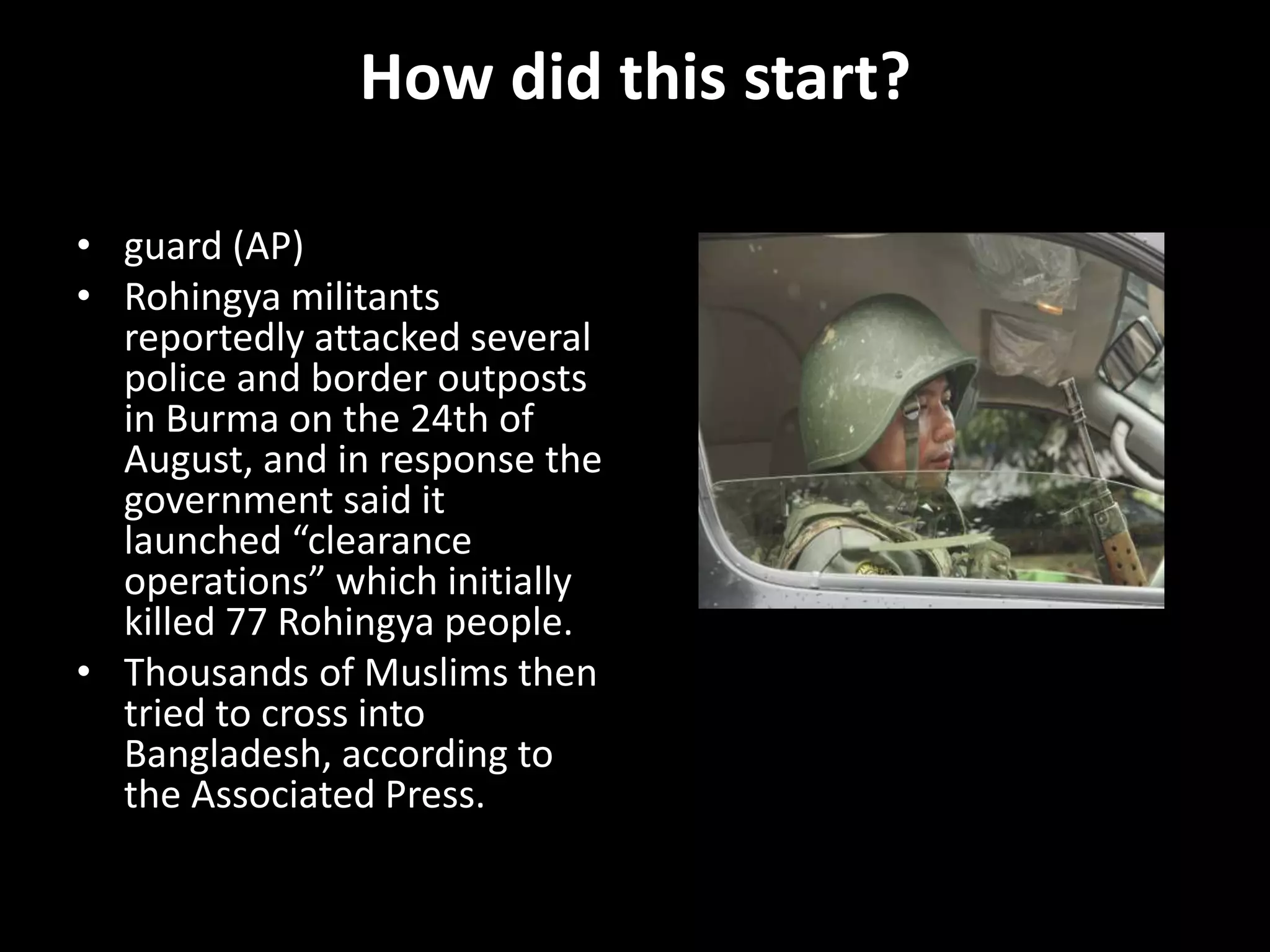
• guard (AP)
• Rohingya militants
reportedly attacked several
police and border outposts
in Burma on the 24th of
August, and in response the
government said it
launched “clearance
operations” which initially
killed 77 Rohingya people.
• Thousands of Muslims then
tried to cross into
Bangladesh, according to
the Associated Press.
What has happened to the Rohingya
people since?
• Remnants of Gawdu Zara village in the north of Rakhine
state (AP)
• Initially reports emerged from Rohingya supporters that the
Muslims’ villages were being burnt, and civilians were being
shot indiscriminately.
• Just a week after the initial clashes, the UN said 73,000
Rohingya people had crossed into Bangladesh, some of
whom described bomb attacks on their villages by the
Burmese military and attacks by Buddhist mobs in Rakhine.
• A hospital in Bangladesh near the Burmese border reported
that refugees were arriving with bullet wounds, and the
country plans to open another refugee camp to ease
pressure on one that already has 50,000 inhabitants.
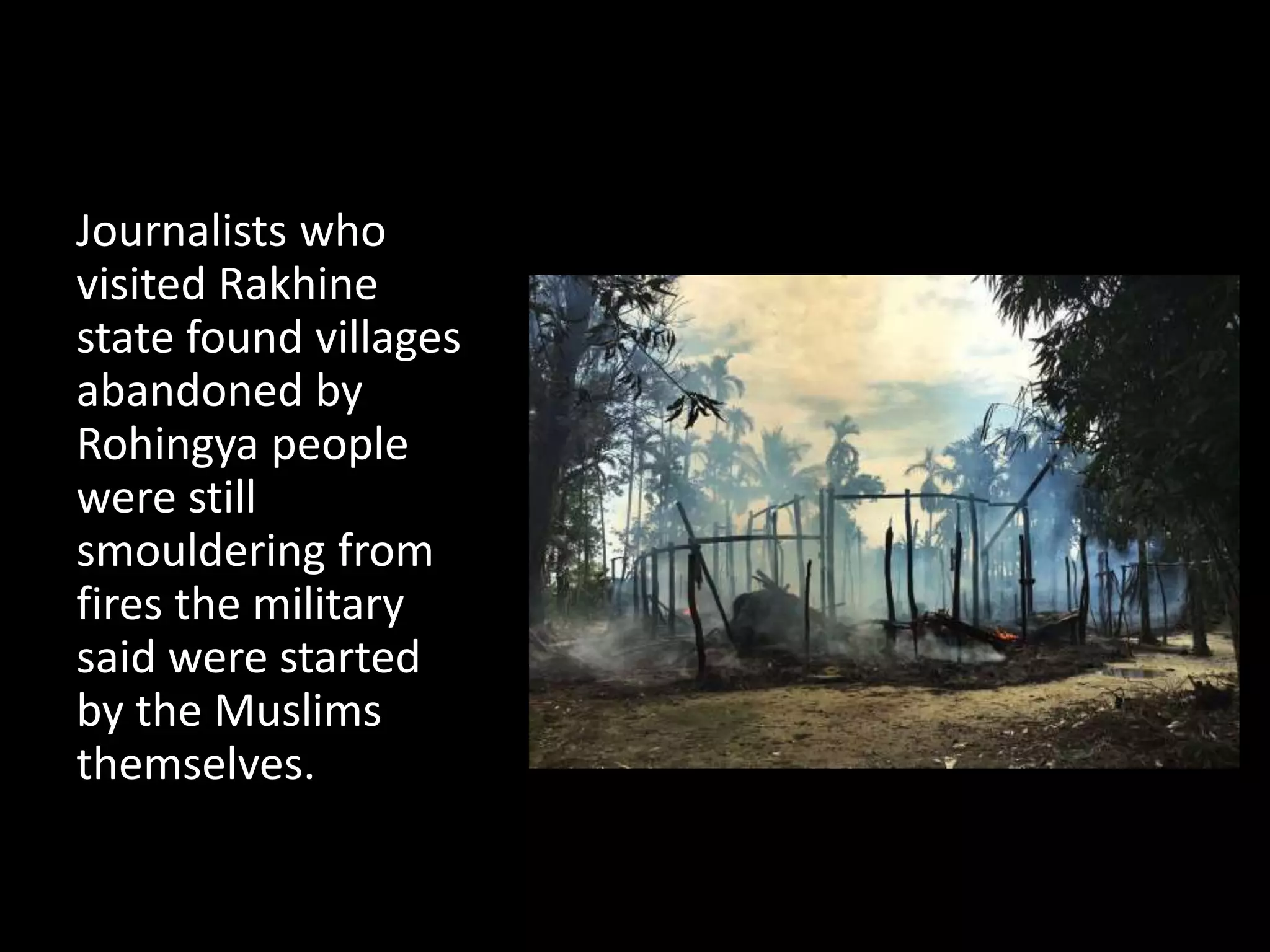
Journalists who
visited Rakhine
state found villages
abandoned by
Rohingya people
were still
smouldering from
fires the military
said were started
by the Muslims
themselves.
What’s the situation like in Burma?
• A burma police officer watches as
journalists look around a village (AP)
• Burma, also known as Myanmar – a name
its military leaders introduced – became
independent from Britain in 1947. After
just 15 years of democracy the nation was
subjected to a coup d’etat, and has had
only a handful of military leaders since.
• In 1978 one of these leaders led an
operation that caused an estimated
250,000 Rohingya Muslims to flee to
Bangladesh.
• Over the years, peaceful protesters from
all religions were arrested, and the
country held captive many political
prisoners and was accused of torturing
them.
A protester in India holds a burning image
of Aung San Suu Kyi (Bikas Das/AP)
Multi-party elections were eventually held
in Burma in 1990 after huge protests in the
late 1980s. Current leader Suu Kyi won by a
landslide, but was placed under house
arrest.
She won the Nobel Peace Prize in 1991 and
finally created a civilian government in
2015.
Throughout this political turmoil,
persecution and violence against Rohingya
Muslims has been consistent.
What has the world’s response been?
• A Rohingya Muslim child carries a
solar panel as she crosses the
border (Bernat Armangue/AP)
• Suu Kyi has dismissed the crisis as
misinformation helping to
promote terrorism, referring to
the initial attack on police.
• Fellow Nobel Prize winners
Malala Yousafzai and Desmond
Tutu have urged her to intervene,
as has the Pope and the Turkish
government.
• And UK Foreign Secretary Boris
Johnson has told Suu Kyi to use
“all her remarkable qualities” to
stop the violence.

What’s going on in burma

  • 3.
    • According tothe United Nations, 270,000 Rohingya people have entered Bangladesh after fleeing Burma since August 25. • And Burmese leader and Nobel Peace Prize winner Aung San Suu Kyi has been fiercely criticised over the crisis. • But who are the Rohingya people, and why have they been forced to leave their homes?
  • 4.
    Who are theRohingya? • Newly arrived Rohingya Muslims in a refugee camp in Bangladesh (Bernat Armangue/AP) • The Muslim Rohingya people live in Buddhist- majority Burma, particularly in the state of Rakhine in the west of the country. Around 800,000 of them used to live there, according to a UN report issued in February. • The state is one of the poorest in the country, and Muslims in particular face barriers to education and freedom of movement. • In Burma they are referred to as Bengali, with many locals contending that they migrated illegally from Bangladesh. • Even though many have lived in Burma for generations, they are heavily discriminated against and over the years violence has erupted – the last major incident being riots in 2012.
  • 5.
    How did thisstart? • guard (AP) • Rohingya militants reportedly attacked several police and border outposts in Burma on the 24th of August, and in response the government said it launched “clearance operations” which initially killed 77 Rohingya people. • Thousands of Muslims then tried to cross into Bangladesh, according to the Associated Press.
  • 6.
    What has happenedto the Rohingya people since? • Remnants of Gawdu Zara village in the north of Rakhine state (AP) • Initially reports emerged from Rohingya supporters that the Muslims’ villages were being burnt, and civilians were being shot indiscriminately. • Just a week after the initial clashes, the UN said 73,000 Rohingya people had crossed into Bangladesh, some of whom described bomb attacks on their villages by the Burmese military and attacks by Buddhist mobs in Rakhine. • A hospital in Bangladesh near the Burmese border reported that refugees were arriving with bullet wounds, and the country plans to open another refugee camp to ease pressure on one that already has 50,000 inhabitants.
  • 7.
    Journalists who visited Rakhine statefound villages abandoned by Rohingya people were still smouldering from fires the military said were started by the Muslims themselves.
  • 8.
    What’s the situationlike in Burma? • A burma police officer watches as journalists look around a village (AP) • Burma, also known as Myanmar – a name its military leaders introduced – became independent from Britain in 1947. After just 15 years of democracy the nation was subjected to a coup d’etat, and has had only a handful of military leaders since. • In 1978 one of these leaders led an operation that caused an estimated 250,000 Rohingya Muslims to flee to Bangladesh. • Over the years, peaceful protesters from all religions were arrested, and the country held captive many political prisoners and was accused of torturing them.
  • 9.
    A protester inIndia holds a burning image of Aung San Suu Kyi (Bikas Das/AP) Multi-party elections were eventually held in Burma in 1990 after huge protests in the late 1980s. Current leader Suu Kyi won by a landslide, but was placed under house arrest. She won the Nobel Peace Prize in 1991 and finally created a civilian government in 2015. Throughout this political turmoil, persecution and violence against Rohingya Muslims has been consistent.
  • 10.
    What has theworld’s response been? • A Rohingya Muslim child carries a solar panel as she crosses the border (Bernat Armangue/AP) • Suu Kyi has dismissed the crisis as misinformation helping to promote terrorism, referring to the initial attack on police. • Fellow Nobel Prize winners Malala Yousafzai and Desmond Tutu have urged her to intervene, as has the Pope and the Turkish government. • And UK Foreign Secretary Boris Johnson has told Suu Kyi to use “all her remarkable qualities” to stop the violence.