RUKHSAR Ali
15171515-012
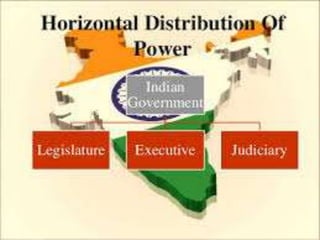
There are three branches of government in India.
 Legislature
 Executive
 judiciary
In India the central legislature is called the Parliament,
which has two Houses:
(1) Lok Sabha and
(2) Rajya Sabha.
 Making of law
 Control of budget
 Amendment of the constitution
 Electoral
 Judicial functions
Executive takes decisions and sees that it is implemented
well.
 responsible for implementation of laws and police
adopted by legislature.
 political executive is involved in framing the policy
 responsible for day to day administration
Judiciary is important for settling the disputes between
individuals and private parties. but besides, sorting out
disputes it also performs a very vital political function.
that is to protect rights of individuals. it interprets the
provisions of constitution and protects the rights of
citizens.
 Prevention of violation of law
 Making of new law
 Administrative function
 Advisory function
 Protection of fundamental rights
In parliamentary systems such as India, the three
“powers" are not separated (although the judiciary is
independent). However, this has not threatened Indian
stability, because the strong tradition of parliamentary
sovereignty serves the purpose of limiting executive
power.

ORGANS OF INDIAN GOVERNMENT

  • 1.
  • 3.
    There are threebranches of government in India.  Legislature  Executive  judiciary
  • 5.
    In India thecentral legislature is called the Parliament, which has two Houses: (1) Lok Sabha and (2) Rajya Sabha.
  • 6.
     Making oflaw  Control of budget  Amendment of the constitution  Electoral  Judicial functions
  • 7.
    Executive takes decisionsand sees that it is implemented well.
  • 8.
     responsible forimplementation of laws and police adopted by legislature.  political executive is involved in framing the policy  responsible for day to day administration
  • 9.
    Judiciary is importantfor settling the disputes between individuals and private parties. but besides, sorting out disputes it also performs a very vital political function. that is to protect rights of individuals. it interprets the provisions of constitution and protects the rights of citizens.
  • 10.
     Prevention ofviolation of law  Making of new law  Administrative function  Advisory function  Protection of fundamental rights
  • 11.
    In parliamentary systemssuch as India, the three “powers" are not separated (although the judiciary is independent). However, this has not threatened Indian stability, because the strong tradition of parliamentary sovereignty serves the purpose of limiting executive power.