Rohingy
   a
the forgotten people

           Qolbi Lillah
Rohingya


Country of origin : Burma ,Arakan
Rohingya


Countries of residence
: Bangladesh, India,
Thailand, Malaysia,
China, UAE, Saudi
Arabia
Rohingya


Total population : approx 1.5 million in Burma,
approx 200,000 in Bangladesh
Rohingya


Language : Rohingyan, Bengali, Arakanese
Religion : Islam
Who are the Rohingyas? (1)

• The Rohingyas are one of the most persecuted
  communities in the world.


                                 Persecuted v.
                                 meaning
                                 to treat someone cruelly or
                                 unfairly over a period of time,
                                 especially because of their
                                 religious or political beliefs:
Who are the Rohingyas? (2)

They have been living in the state
of Arakan since the 8th century.

They have been under extreme
scrutiny by the Burmese
government.

They haven't been recognised as
citizens of The Union of Burma
since Burmese independence in
1948, instead they are known as
'non citizens‘.
Why are the Rohingyas in
               trouble? (3)

  The Burmese Junta have discriminated the Rohingya,
because they are not similar in ….


                           o Looks

                           o speak a different language

                           o have a different religion.
Why are the Rohingyas in trouble? (4)


• As a means of clamping down on the Rohingya, the Junta
  have restricted even the most basic of rights such as
  education, marriage and citizenship.
Why are the Rohingyas in trouble? (5)

o The Burmese government endorse
the Burmese culture and the Buddhist
faith for their national citizens.
o But the Rohingyas fall
outside of this ideal criteria
because they want to retain
their own culture and the
Muslim faith.
o As a result, the Rohingyas, sidelined
and marginalised, have to live with
their derogatory national status of
'non-citizens‘.
The exodus
o Between 1978 and 1992, approximately 200,000 Rohingyas left
  Burma to escape the tyranny of the Burmese military.


o Most of them moved to southern
  Bangladesh where they remain as
  refugees.


o In one of the most densely populated countries in the world,
  life in Bangladesh proved just as hard as it did in Burma.
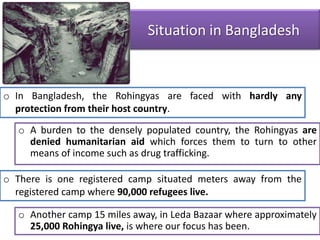
Situation in Bangladesh


o In Bangladesh, the Rohingyas are faced with hardly any
  protection from their host country.

   o A burden to the densely populated country, the Rohingyas are
     denied humanitarian aid which forces them to turn to other
     means of income such as drug trafficking.

o There is one registered camp situated meters away from the
  registered camp where 90,000 refugees live.

   o Another camp 15 miles away, in Leda Bazaar where approximately
     25,000 Rohingya live, is where our focus has been.
Human rights abuses against the
         Rohingyas in Burma (1)


• Human rights abuses against the Rohingyas in Burma.
Human rights abuses against
          the Rohingyas in Burma (2)
• In 1962, the Rohingyas were
  systematically denied of political,
  civil, economic and social human
  rights.


                                        • Nowadays, the Rohingyas in Burma
                                          cannot commute from one village to
                                          another due to the security forces
                                          known as 'Nasaka' who patrol their
• This affects their education and        movement at various checkpoints.
  access to medication.
Human rights abuses against
          the Rohingyas in Burma (3)

• Rohingyas are denied citizenship
  despite living in Arakan for centuries
  because Muslims are portrayed as
  'relics of a colonial past'.


                                           • This stems from the fact that
                                             Muslims supported the British
                                             during the colonial period because
                                             they were promised autonomy in
                                             Rakhine previously known as
                                             Arakan.
Human rights abuses against
    the Rohingyas in Burma (4)


• Rohingyas have been subject to the systematic use of rape as
  a weapon of war, forced labour, and land confiscation. Over
  3,500 villages have been destroyed since 1996.
What is the best solution
               for solving Rohingya issues ?
o This issue is very complex, we should try to deal with more
  than simply government policy, but a cultural divide as well.
o The intolerance spans throughout the general populace, thus
  you see violence against Rohingya, not only by authorities,
  but by 'lynch mobs' as well.
o The answer is two-fold; government policy change, and
  community development.
                                                 xenophobia (adj.)
o The government must set examples by integrating and or dislike of
                                                 strong fear
  showing tolerance, while equally, improving living conditions
                                                 people from other
  and industry in local communities.             countries
o Community cohesiveness must include the Rohingyas, as opposed
  to them, or any Muslim, being an easy targets for xenophobia.
What can we do for them? (1)


• Raise the Rohingya people issue in your local
communities, mosques, churches (and other
faith institutions) and gatherings.
What can we do for them? (2)


• Seek to meet with members from the
  Rohingya communities in order to learn from
  them directly.
What can we do for them? (3)

• Contribute to media
  outlets including social
  networks. In particular the
  interfaith networks need to
  be mobilized to ensure that
  religious differences are
  not abused by the ethnic
  tensions
What can we do for them? (4)


              • Lobby your local MP
                and bring local
                community pressure
                on them about the
                Rohingya people
                issue.
What can we do for them? (5)

• Write letters of protest
  to the Myanmar
  Embassy: Myanmar
  Embassy, Consulate
  Section, 19A Charles
  Street, Berkeley
  Square,London W1J
  5DX Tel.
  02033974463.
What can we do for them? (6)


• Lobby the Bangladesh Embassy in London and
  the Government to allow aid agencies to
  continue to work with existing refugees.
What can we do for them? (7)


• Encourage and contribute to charitable fund
  giving for the Rohingya people through
  registered charities, e.g. Muslim Aid.
Refferences
o http://www.restlessbeings.org/projects/rohingya
o http://merhrom.wordpress.com/2012/07/31/news-
  update-from-arakan-state/
o http://www.thestateless.com/2012/07/rohingya-say-
  they-are-being-terrorized.html
o http://islamicforumeurope.com/images_uploaded/2
  012/08/img3456.pdf
Thank you

Rohingya T_T

  • 4.
    Rohingy a the forgotten people Qolbi Lillah
  • 5.
  • 7.
    Rohingya Countries of residence :Bangladesh, India, Thailand, Malaysia, China, UAE, Saudi Arabia
  • 8.
    Rohingya Total population :approx 1.5 million in Burma, approx 200,000 in Bangladesh
  • 10.
    Rohingya Language : Rohingyan,Bengali, Arakanese Religion : Islam
  • 11.
    Who are theRohingyas? (1) • The Rohingyas are one of the most persecuted communities in the world. Persecuted v. meaning to treat someone cruelly or unfairly over a period of time, especially because of their religious or political beliefs:
  • 14.
    Who are theRohingyas? (2) They have been living in the state of Arakan since the 8th century. They have been under extreme scrutiny by the Burmese government. They haven't been recognised as citizens of The Union of Burma since Burmese independence in 1948, instead they are known as 'non citizens‘.
  • 15.
    Why are theRohingyas in trouble? (3) The Burmese Junta have discriminated the Rohingya, because they are not similar in …. o Looks o speak a different language o have a different religion.
  • 16.
    Why are theRohingyas in trouble? (4) • As a means of clamping down on the Rohingya, the Junta have restricted even the most basic of rights such as education, marriage and citizenship.
  • 22.
    Why are theRohingyas in trouble? (5) o The Burmese government endorse the Burmese culture and the Buddhist faith for their national citizens. o But the Rohingyas fall outside of this ideal criteria because they want to retain their own culture and the Muslim faith. o As a result, the Rohingyas, sidelined and marginalised, have to live with their derogatory national status of 'non-citizens‘.
  • 24.
    The exodus o Between1978 and 1992, approximately 200,000 Rohingyas left Burma to escape the tyranny of the Burmese military. o Most of them moved to southern Bangladesh where they remain as refugees. o In one of the most densely populated countries in the world, life in Bangladesh proved just as hard as it did in Burma.
  • 25.
    Situation in Bangladesh oIn Bangladesh, the Rohingyas are faced with hardly any protection from their host country. o A burden to the densely populated country, the Rohingyas are denied humanitarian aid which forces them to turn to other means of income such as drug trafficking. o There is one registered camp situated meters away from the registered camp where 90,000 refugees live. o Another camp 15 miles away, in Leda Bazaar where approximately 25,000 Rohingya live, is where our focus has been.
  • 27.
    Human rights abusesagainst the Rohingyas in Burma (1) • Human rights abuses against the Rohingyas in Burma.
  • 28.
    Human rights abusesagainst the Rohingyas in Burma (2) • In 1962, the Rohingyas were systematically denied of political, civil, economic and social human rights. • Nowadays, the Rohingyas in Burma cannot commute from one village to another due to the security forces known as 'Nasaka' who patrol their • This affects their education and movement at various checkpoints. access to medication.
  • 29.
    Human rights abusesagainst the Rohingyas in Burma (3) • Rohingyas are denied citizenship despite living in Arakan for centuries because Muslims are portrayed as 'relics of a colonial past'. • This stems from the fact that Muslims supported the British during the colonial period because they were promised autonomy in Rakhine previously known as Arakan.
  • 30.
    Human rights abusesagainst the Rohingyas in Burma (4) • Rohingyas have been subject to the systematic use of rape as a weapon of war, forced labour, and land confiscation. Over 3,500 villages have been destroyed since 1996.
  • 31.
    What is thebest solution for solving Rohingya issues ? o This issue is very complex, we should try to deal with more than simply government policy, but a cultural divide as well. o The intolerance spans throughout the general populace, thus you see violence against Rohingya, not only by authorities, but by 'lynch mobs' as well. o The answer is two-fold; government policy change, and community development. xenophobia (adj.) o The government must set examples by integrating and or dislike of strong fear showing tolerance, while equally, improving living conditions people from other and industry in local communities. countries o Community cohesiveness must include the Rohingyas, as opposed to them, or any Muslim, being an easy targets for xenophobia.
  • 32.
    What can wedo for them? (1) • Raise the Rohingya people issue in your local communities, mosques, churches (and other faith institutions) and gatherings.
  • 33.
    What can wedo for them? (2) • Seek to meet with members from the Rohingya communities in order to learn from them directly.
  • 35.
    What can wedo for them? (3) • Contribute to media outlets including social networks. In particular the interfaith networks need to be mobilized to ensure that religious differences are not abused by the ethnic tensions
  • 36.
    What can wedo for them? (4) • Lobby your local MP and bring local community pressure on them about the Rohingya people issue.
  • 37.
    What can wedo for them? (5) • Write letters of protest to the Myanmar Embassy: Myanmar Embassy, Consulate Section, 19A Charles Street, Berkeley Square,London W1J 5DX Tel. 02033974463.
  • 38.
    What can wedo for them? (6) • Lobby the Bangladesh Embassy in London and the Government to allow aid agencies to continue to work with existing refugees.
  • 39.
    What can wedo for them? (7) • Encourage and contribute to charitable fund giving for the Rohingya people through registered charities, e.g. Muslim Aid.
  • 40.
    Refferences o http://www.restlessbeings.org/projects/rohingya o http://merhrom.wordpress.com/2012/07/31/news- update-from-arakan-state/ o http://www.thestateless.com/2012/07/rohingya-say- they-are-being-terrorized.html o http://islamicforumeurope.com/images_uploaded/2 012/08/img3456.pdf
  • 41.