Public schools have both advantages and disadvantages. The key advantages are that they are less expensive than private schools, promote diversity among students, and are required to provide certain support services. However, public schools also have large class sizes, face funding disparities between rich and poor districts, and subject students to frequent standardized testing. While some think private schools lead to better academic performance, research shows public and private school student achievement is largely comparable.
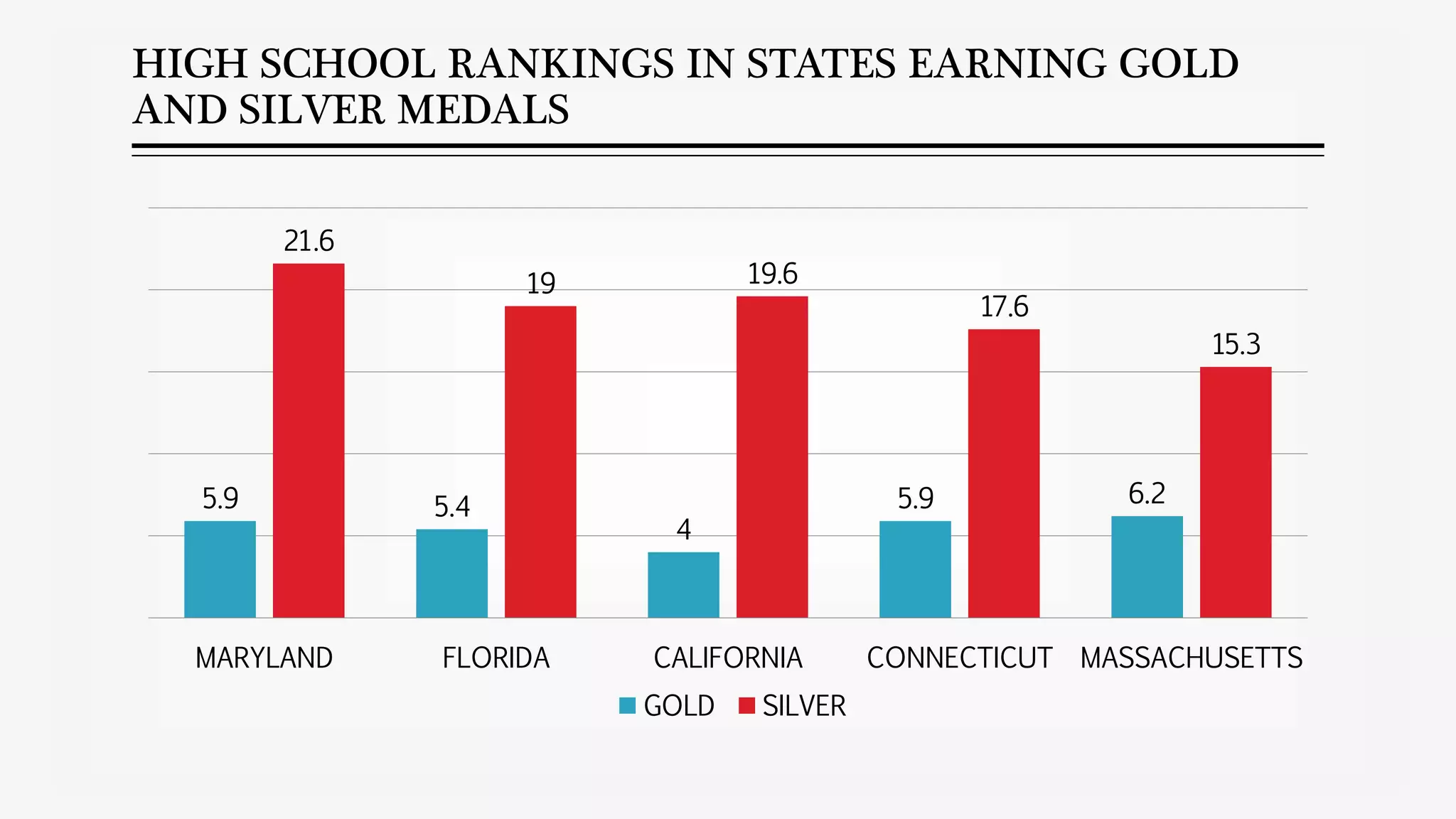
HIGH SCHOOL RANKINGSIN STATES EARNING GOLD
AND SILVER MEDALS
5.9 5.4
4
5.9 6.2
21.6
19 19.6
17.6
15.3
MARYLAND FLORIDA CALIFORNIA CONNECTICUT MASSACHUSETTS
GOLD SILVER
4.
Introduction
Every child inthe must go to school. There are no
exceptions. By law the compulsory age to attend school
is between 5 and 16, and parents are to ensure that their
children are involved in some type of educational system.
Most parents will choose a public school setting, but
others will choose to enroll their children in a private
school or to home school their children. This article is
meant to give the pros and cons of each type of school
system so that the reader can make an informed decision
on the type of schooling for their child.
PUBLIC SCHOOLS HAVEA FOLLOWING ADVANTAGES
Less expensive
Diversity
Services
Teachers qualification
Accountability
7.
LESS EXPENSIVE
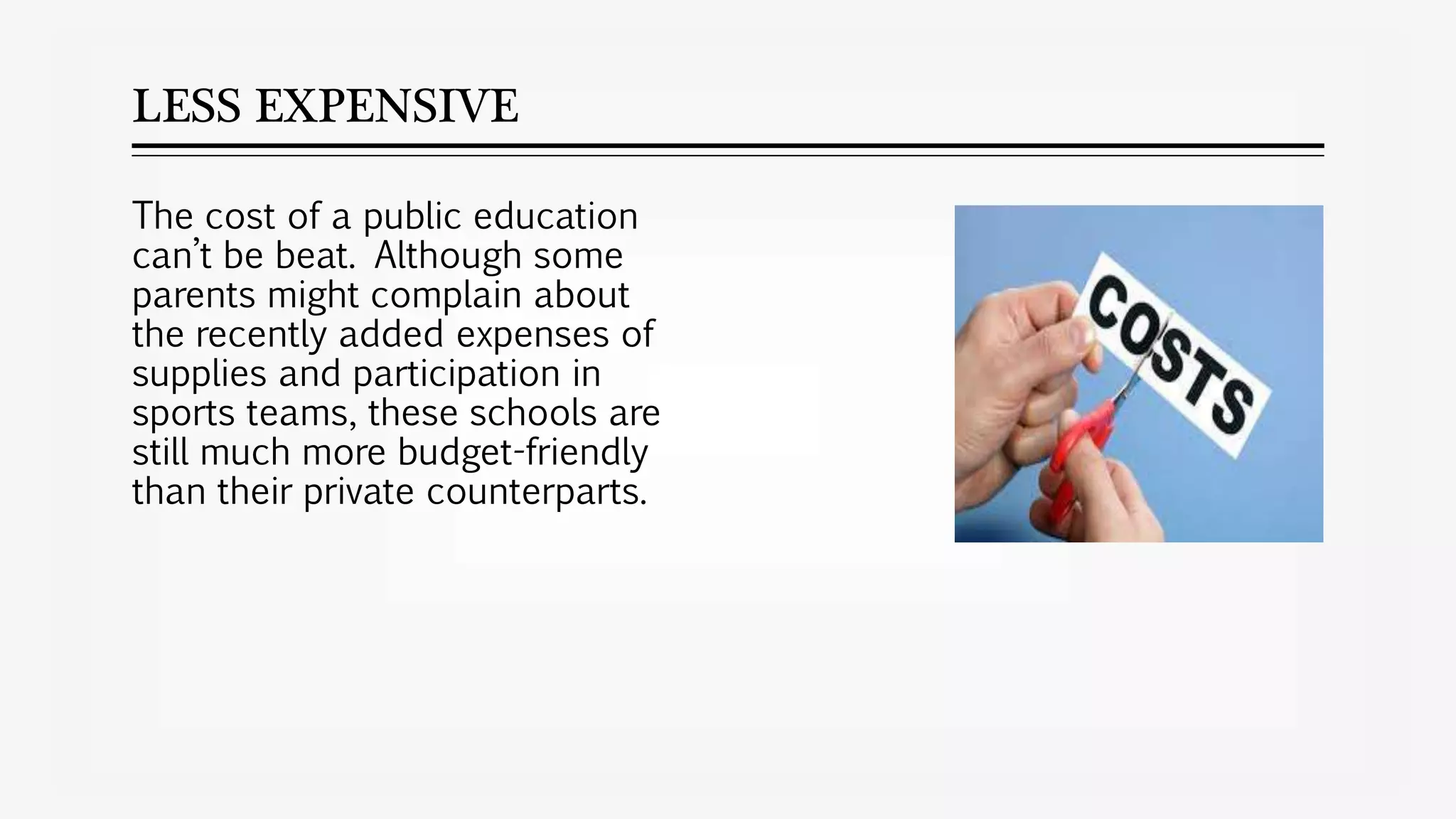
The costof a public education
can’t be beat. Although some
parents might complain about
the recently added expenses of
supplies and participation in
sports teams, these schools are
still much more budget-friendly
than their private counterparts.
8.
Diversity
Because public schoolsadmit all
children in the community, those that
attend the schools are more likely to
be in classrooms with other children
that don’t think, act or look exactly
like them. Students are more apt to
be exposed to students from different
cultures or income levels. They may
learn to work with other students with
mental and physical disabilities. The
diversity of the student body can be
an important learning experience in
itself for all of the children that attend
a particular school.
9.
Services
By law, publicschools are also
required to provide certain services to
students. Some, such as
transportation to and from school, are
offered to all the students. Others,
such as reduced-price lunches and
academic assistance, are provided to
students who qualify. Because the
services are required, public schools
have a staff of special education
teachers and learning specialists at
the parents’ and students’ disposal.
Private schools may not offer such
services because they are not
required to admit students that meet
these needs.
10.
Teachers qualification
Teachers inpublic schools are required to be
certified by the state. Certification also
requires ongoing education and periodic
renewal of credentials. Charter schools and
private schools do not have this requirement,
which means parents don’t always know the
level of training attained by the teacher in
their child’s classroom. In some cases, these
schools might not even require teachers to
have a four-year degree to work in the
classroom.
11.
Accountability
By the sametoken, public schools are
held accountable by the state for their
academic performance. While some
have complained this has led to an
overabundance of standardized
testing, the schools do at least have a
higher authority they must answer to.
This prevents abuse and leads to
management of failing schools much
more quickly than if the school did
not have such accountability.
PUBLIC SCHOOLS HAVEFOLLOWING DISADVANTAGES
Frequent testing to meet requirements
Large class size
Disproportionate resources
Bulling and violence
Out-dated books and equipments
14.
Frequent testing tomeet requirements
Test results are the only way the
government measures accountability.
Regardless of the state, students in public
schools take lengthy accountability tests,
and high school students must take
cumulative, high-stakes tests such as the
California High School Exit Exam in order
to receive a diploma. While testing isn't
inherently bad, these standardized tests
take up a lot of valuable instructional time
-- the CAHSEE takes over eight hours to
complete -- and they are not always
accurate measurements of teacher
accountability or student achievement
since they do not measure a student's
academic growth.
15.
Large class size
Teachersand parents alike bemoan
the large size of public schools . A
low student teacher ratio is
considered preferable because
students get more attention when
teachers are not dealing with a large
class
16.
Disproportionate resources
Although someschool funding comes
from the federal government, much of it
also comes from local taxes, giving
students in affluent areas a distinct
advantage over their low-income peers.
Some affluent school districts, like the
Seattle Public School District, are able to
fund music teachers and other
supplemental programs by soliciting
parent donations. This is not an option
for lower-income districts, where many
schools cut supplemental services like
transportation and class trips due to
budget constraints
17.
Bullying and violence
Approximately28 percent of
students ages eight to twelve
reported being bullied,
according to data compiled in
2009 by the National Center for
Education Statistics. Of those,
a higher percentage of public
school than private school
students reported being bullied
on school grounds .
18.
Outdated books andequipments
The old teachers in public
schools used old equipments
to teach students . Teachers
are not able to focus more
attention on individual students
. They don’t bother for their
education and ignore them .
Certification is required to get
government job .
20.
COMPARISION
Many people thinkthat student that is enrolled in a private tends to learn and perform
better academically wise then the student in public schools . But the department of
education think they both the same and that they perform the same academicals
achievement . They also have same high performs on tests such as math , reading ,
science and history . Private schools have smaller student teacher ratio then public
school because there is fewer students that attend private school then public . Also
another reason why people choose to put their children in private school is because of
one on one help that child can obtain with their teachers . Many publics schools can
be over loaded and can obtained with their teachers . Many public schools can be
over loaded and can cost a problem with the student learn process . In a public
school they offer more programs then any private schools . They offer program such
as sports , music , arts , and foreign language . Private schools cannot compete in
essential educational requirements of staffs that the government schools fulfill .
Editor's Notes
#2 NOTE:
To change the image on this slide, select the picture and delete it. Then click the Pictures icon in the placeholder to insert your own image.