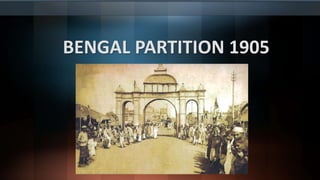
BENGAL PARTITION 1905
LEARNING OBJECTIVES:
• To know the reasons why British partitioned Bengal?
• Reaction of Hindus over Bengal Partition.
• Muslims’ response for Bengal Partition.
• How did Hindus oppose this decision between 1905-1911?
Introduction
• Bengal was the biggest province with a population of over 80 million.
• The whole province was under one Lieutenant-Governor who could not
look after the requirements of such a huge area alone.
• Consequently a major portion of the province remain neglected and it was
felt that the province of Bengal should be divided into two parts in order to
facilitate the requirements of the vast area.
• Lord Curzon became the Viceroy of India in 1899 and undertook an
extensive tour of Bengal and felt that the province was too big to be
administered effectively.
• Lord Curzon decided to divide the province into two provinces.
• He prepared a plan of the partition of Bengal in 1905 and sent it to England
for approval.
• The British Crown gave approval for partition and Bengal was divided into
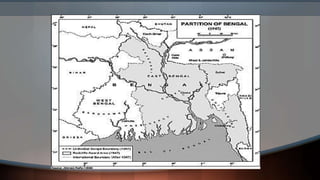
two parts on 16th October 1905; Western Bengal and Eastern Bengal.
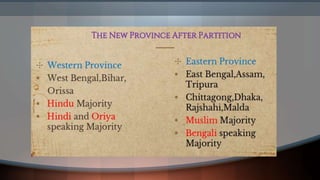
• The new province of Eastern Bengal consisted of Dhaka as capital with
majority Muslim.
• West Bengal with the capital of Calcutta and become the Hindu Majority.
• East Bengal contained a population of eighteen million Muslims and twelve
million Hindus.
• Whereas West Bengal had a population fifty four million of which 42 million
were Hindus.
MAP AFTER PARTITION
Western
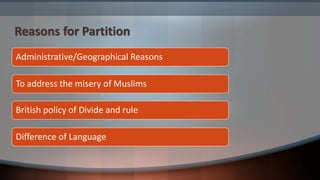
Reasons for Partition
Administrative/Geographical Reasons
To address the misery of Muslims
British policy of Divide and rule
Difference of Language
Administrative/Geographical Reasons
• The Province was spread over the area of 1, 89, 000 square miles with the
population of over 80 million, which was too vast to be managed by one
lieutenant Governor. He could not make a tour for the whole province due
to its vastness once in his tenure.
• The administrative machinery of the province was under-staffed. Especially
in east Bengal, in countryside so cut off by rivers, forests and creeks.
• No special attention had been paid to the unusual difficulties of police work
till the last decade of the 19th century. Organized piracy in the waterways
had existed for at least a century.
• Poor means of communications, difficulties in relief work during times of
trouble (famine, epidemics), smaller units can be managed efficiently.
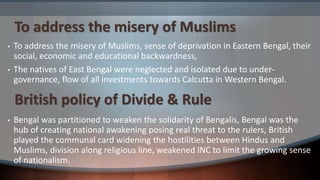
To address the misery of Muslims
• To address the misery of Muslims, sense of deprivation in Eastern Bengal, their
social, economic and educational backwardness,
• The natives of East Bengal were neglected and isolated due to under-
governance, flow of all investments towards Calcutta in Western Bengal.
• Bengal was partitioned to weaken the solidarity of Bengalis, Bengal was the
hub of creating national awakening posing real threat to the rulers, British
played the communal card widening the hostilities between Hindus and
Muslims, division along religious line, weakened INC to limit the growing sense
of nationalism.
British policy of Divide & Rule
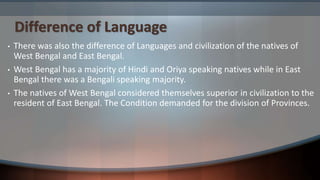
Difference of Language
• There was also the difference of Languages and civilization of the natives of
West Bengal and East Bengal.
• West Bengal has a majority of Hindi and Oriya speaking natives while in East
Bengal there was a Bengali speaking majority.
• The natives of West Bengal considered themselves superior in civilization to the
resident of East Bengal. The Condition demanded for the division of Provinces.
Hindu Reaction After Partition
The Hindus reacted toward the partition of Bengal in a hostile and violent manner.
They clearly saw the aim of the British to break the unity of the Bengali people on
communal lines and thus weaken the nationalist movement.
The Hindus believed that they would come under the domination of the Muslim majority
in the new province.
The provincial High Court and other judicial bodies were to be shifted to Dhaka, the
Hindu lawyers feared that their legal practice would be affected.
The Hindu landlords, capitalists and traders did not like the partition as it was to put an
end to their exploitation of the poor Muslims.
The day of partition was observed as a day of mourning . All business came to a standstill.
On the suggestion of the great poet Rabindranath Tagore the day was also observed as a
day of unity and solidarity of the people.
• During the movement to lend the partition of Bengal, new methods of
struggle were adopted.
• These methods, which included Swadeshi Movement, brought in
participation by the common people in the anti British political activities.
“Bande Mataram” became their movements main anthem.
• To support Anti Partition Movement that was launched on 7th August, 1905 in a massive
gathering held at Calcutta Town Hall, Bengal.
• As a reaction to Partition, People fasted, walked barefooted singing ‘Bande Matram’.
People tied Rakhis on each other’s hands as a symbol of unity of the two halves of
Bengal. October 16th, 1905 was observed as a Day of National Mourning throughout
Bengal.
SWADESHI MOVEMENT
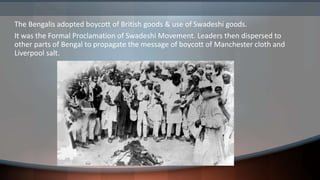
The Bengalis adopted boycott of British goods & use of Swadeshi goods.
It was the Formal Proclamation of Swadeshi Movement. Leaders then dispersed to
other parts of Bengal to propagate the message of boycott of Manchester cloth and
Liverpool salt.
•The new province of Eastern Bengal gave happier prospects of economic political
and social life to the Muslims.
•The partition gave huge chances of progress to the Muslims who were supressed
and dominated class of society before the partition.
•They now hoped that their social status would get a tremendous boost in the new
province.
•Therefore they expressed the utmost happiness and gratitude to the government
over the partition of Bengal.
Muslims Reaction After Partition

Bengal partition 1905

  • 1.
  • 2.
    LEARNING OBJECTIVES: • Toknow the reasons why British partitioned Bengal? • Reaction of Hindus over Bengal Partition. • Muslims’ response for Bengal Partition. • How did Hindus oppose this decision between 1905-1911?
  • 3.
    Introduction • Bengal wasthe biggest province with a population of over 80 million. • The whole province was under one Lieutenant-Governor who could not look after the requirements of such a huge area alone. • Consequently a major portion of the province remain neglected and it was felt that the province of Bengal should be divided into two parts in order to facilitate the requirements of the vast area. • Lord Curzon became the Viceroy of India in 1899 and undertook an extensive tour of Bengal and felt that the province was too big to be administered effectively.
  • 4.
    • Lord Curzondecided to divide the province into two provinces. • He prepared a plan of the partition of Bengal in 1905 and sent it to England for approval. • The British Crown gave approval for partition and Bengal was divided into two parts on 16th October 1905; Western Bengal and Eastern Bengal. • The new province of Eastern Bengal consisted of Dhaka as capital with majority Muslim. • West Bengal with the capital of Calcutta and become the Hindu Majority. • East Bengal contained a population of eighteen million Muslims and twelve million Hindus. • Whereas West Bengal had a population fifty four million of which 42 million were Hindus.
  • 5.
  • 7.
    Reasons for Partition Administrative/GeographicalReasons To address the misery of Muslims British policy of Divide and rule Difference of Language
  • 9.
    Administrative/Geographical Reasons • TheProvince was spread over the area of 1, 89, 000 square miles with the population of over 80 million, which was too vast to be managed by one lieutenant Governor. He could not make a tour for the whole province due to its vastness once in his tenure. • The administrative machinery of the province was under-staffed. Especially in east Bengal, in countryside so cut off by rivers, forests and creeks. • No special attention had been paid to the unusual difficulties of police work till the last decade of the 19th century. Organized piracy in the waterways had existed for at least a century. • Poor means of communications, difficulties in relief work during times of trouble (famine, epidemics), smaller units can be managed efficiently.
  • 10.
    To address themisery of Muslims • To address the misery of Muslims, sense of deprivation in Eastern Bengal, their social, economic and educational backwardness, • The natives of East Bengal were neglected and isolated due to under- governance, flow of all investments towards Calcutta in Western Bengal. • Bengal was partitioned to weaken the solidarity of Bengalis, Bengal was the hub of creating national awakening posing real threat to the rulers, British played the communal card widening the hostilities between Hindus and Muslims, division along religious line, weakened INC to limit the growing sense of nationalism. British policy of Divide & Rule
  • 11.
    Difference of Language •There was also the difference of Languages and civilization of the natives of West Bengal and East Bengal. • West Bengal has a majority of Hindi and Oriya speaking natives while in East Bengal there was a Bengali speaking majority. • The natives of West Bengal considered themselves superior in civilization to the resident of East Bengal. The Condition demanded for the division of Provinces.
  • 12.
    Hindu Reaction AfterPartition The Hindus reacted toward the partition of Bengal in a hostile and violent manner. They clearly saw the aim of the British to break the unity of the Bengali people on communal lines and thus weaken the nationalist movement. The Hindus believed that they would come under the domination of the Muslim majority in the new province. The provincial High Court and other judicial bodies were to be shifted to Dhaka, the Hindu lawyers feared that their legal practice would be affected. The Hindu landlords, capitalists and traders did not like the partition as it was to put an end to their exploitation of the poor Muslims. The day of partition was observed as a day of mourning . All business came to a standstill. On the suggestion of the great poet Rabindranath Tagore the day was also observed as a day of unity and solidarity of the people.
  • 13.
    • During themovement to lend the partition of Bengal, new methods of struggle were adopted. • These methods, which included Swadeshi Movement, brought in participation by the common people in the anti British political activities. “Bande Mataram” became their movements main anthem. • To support Anti Partition Movement that was launched on 7th August, 1905 in a massive gathering held at Calcutta Town Hall, Bengal. • As a reaction to Partition, People fasted, walked barefooted singing ‘Bande Matram’. People tied Rakhis on each other’s hands as a symbol of unity of the two halves of Bengal. October 16th, 1905 was observed as a Day of National Mourning throughout Bengal. SWADESHI MOVEMENT
  • 14.
    The Bengalis adoptedboycott of British goods & use of Swadeshi goods. It was the Formal Proclamation of Swadeshi Movement. Leaders then dispersed to other parts of Bengal to propagate the message of boycott of Manchester cloth and Liverpool salt.
  • 15.
    •The new provinceof Eastern Bengal gave happier prospects of economic political and social life to the Muslims. •The partition gave huge chances of progress to the Muslims who were supressed and dominated class of society before the partition. •They now hoped that their social status would get a tremendous boost in the new province. •Therefore they expressed the utmost happiness and gratitude to the government over the partition of Bengal. Muslims Reaction After Partition