What would farmers do? Adaptive management
intentions of Corn Belt farmers given a climate
change scenario
Gabrielle Roesch-McNally, J. Gordon Arbuckle Jr., and John Tyndall
“The vulnerability of agriculture to climate change is
strongly dependent not just on ...biophysical effects...,
but also on the responses taken by humans to moderate
those effects…”(Walthall et al. 2013, p.13)
This research is part of a regional collaborative project supported by the USDA-NIFA, Award No. 2011-68002-30190:
Cropping Systems Coordinated Agricultural Project: Climate Change, Mitigation, and Adaptation in Corn-based Cropping Systems
Project Web site: sustainablecorn.org
@G_Roesch
Roadmap
• Study Details
• Context: Climate Change & Agriculture;
Adaptation & Resilience
• Analysis
• Next Steps
Survey Scope & Scale
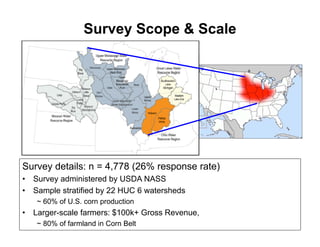
Survey details: n = 4,778 (26% response rate)
• Survey administered by USDA NASS
• Sample stratified by 22 HUC 6 watersheds
~ 60% of U.S. corn production
• Larger-scale farmers: $100k+ Gross Revenue,
~ 80% of farmland in Corn Belt
Research Questions
– What factors influence farmers’ predicted
adaptive response to climate change?
– What types of practices do farmers anticipate
utilizing or increasing?
– Are there differences between farmer
characteristics and adaptive response?
Predicted Climate Change
Impacts: US Corn Belt
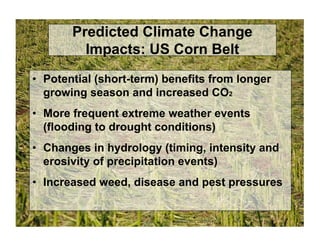
• Potential (short-term) benefits from longer
growing season and increased CO2
• More frequent extreme weather events
(flooding to drought conditions)
• Changes in hydrology (timing, intensity and
erosivity of precipitation events)
• Increased weed, disease and pest pressures
Climate Change Belief
“Please select the statement that best reflects your beliefs
about climate change”
Climate change is occurring, and it is caused mostly by human
activities
8%
Climate change is occurring, and it is caused more or less equally by
natural changes in the environment and human activities
33%
Climate change is occurring, and it is caused mostly by natural
changes in the environment
25%
There is not sufficient evidence to know with certainty whether climate
change is occurring or not
31%
Climate change is not occurring 4%
Adaptation on the Farm
“The process or adjustment to actual or expected
climate and its effects...Adaptation seeks to
moderate or avoid harm or exploit beneficial
opportunities.” (IPCC 2014)
“Farming is weather and weather is farming
so, you know…one year is not like the
next…”
(MI farmer)
Farmer as Adapter
Adaptation as Sustainability?
Figure:  Jackson et al. 2010, Biodiversity and agricultural sustainability: from assessment to adaptive management
Farmers’ 
adaptation 
processes are 
“embedded in 
intertwined social, 
technical & 
ecological 
contexts”
(Crane et al. 2011)
A Resilient Farm
“The capacity of... systems to cope with a
hazardous event or trend or disturbance,
responding in ways that maintain their essential
function, identity, & structure, while also
maintaining the capacity for adaptation, learning
& transformation.” (IPCC 2014)
Adoption of key conservation practices one tool
in building more resilient agricultural systems.
Managing Production & Environmental
Risk
• In field (“Cultural”) Practices
– Reduced (no) tillage
– Manure, fertilizer management/reduction
– Cover crops, 
– Rotation and or cropping changes
– Land retirement  
• Structural Practices
– Buffers, prairie strips
– Grassed Waterways
– Terraces
– Restored/ reconstructed wetlands 
– Denitrification bioreactors
– Controlled drainage
– Wetland restoration
– Tree planting
We examined different actions farmers can take at the field/farm scale: 
The Scenario
• Violent storms/extreme rain events will become more frequent,
particularly in the spring.
• More extreme rain events will increase likelihood of flooding & saturated
soils.
• Periods between rains will be longer, increasing likelihood of drought.
• Changes in the weather patterns will increase crop insect, weed &
disease problems.
The Question
If you knew with certainty that the above conditions would occur,
would the following practices on the cropland you own and rent
decrease, increase, or stay the same?
Behavioral Intentions Under Climate
Change Scenario
No‐till
Tile Drainage
Cover Crop
Example 
Practices
% 
Decrease 
% Stay the 
Same
% 
Increase
% Don't 
Know
No‐till 2 48 24 13
Cover Crops 1 38 22 25
Subsurface 
tile or other 
drainage
1 32 43 11
Adaptation Intentions in
Response to Increased Extremes
Conceptual Model of Adaptation:
Focus on farm practices
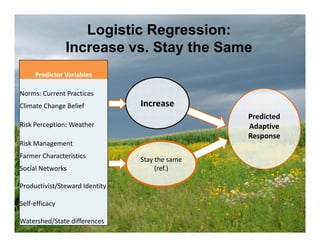
Logistic Regression:
Increase vs. Stay the Same
Predicted
Adaptive
Response
Stay the same 
(ref.)
Increase
Predictor Variables
Norms: Current Practices
Climate Change Belief
Risk Perception: Weather
Risk Management 
Farmer Characteristics
Social Networks
Productivist/Steward Identity
Self‐efficacy
Watershed/State differences
All Dependent Variables Used (22)
Parameters significant in 
some/all models
Current Practices Current Cover Crop Use 0/3
(prior knowledge) Current no‐till use  2/3
Current Reduced tillage use  0/3
Current diversified rotations use  2/3
Current Drainage Water Mgt. use  0/3
Beliefs CCBELIEF 0/3
My operation will be harmed by climate change  1/3
Perceived Risks Increased soil erosion concern 2/3
Flooding concern  0/3
Extreme rains concern  2/3
Drought concern 1/3
Too much uncertainty  3/3
Risk Management Strategies EdgefieldCons 0/3
Infield Cons 1/3
Crop Insurance 0/3
Diversifying  0/3
Demographics Age  2/3
Education level  1/3
Identity F_productivist identity 1/3
F_steward identity  1/3
Self‐efficacy Confidence in current practices  3/3
I have knowledge and skills to deal with climate 
change  1/3
Networks Visit other farmers   3/3
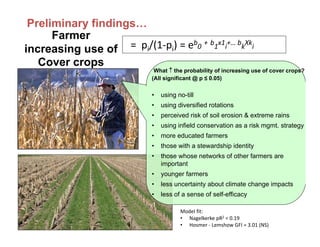
What  the probability of increasing use of cover crops?
(All significant @ p ≤ 0.05)
• using no-till
• using diversified rotations
• perceived risk of soil erosion & extreme rains
• using infield conservation as a risk mgmt. strategy
• more educated farmers
• those with a stewardship identity
• those whose networks of other farmers are
important
• younger farmers
• less uncertainty about climate change impacts
• less of a sense of self-efficacy
Preliminary findings…
=  pi/(1‐pi) = eb
0
+ b
1
x1
i
+… b
k
Xk
i
Farmer
increasing use of
Cover crops
Model fit: 
• Nagelkerke pR2 = 0.19
• Hosmer ‐ Lemshow GFI = 3.01 (NS)
What  the probability of increasing the use of no-till?
(All significant @ p ≤ 0.05)
• farmer currently uses no-till
• farmer believes that climate change might harm
their operation
• certainty concerning climate change risks
• farmer is concerned about increased soil erosion
risk
• farmers who value networks with other farmers
• less confidence in current practices
Preliminary findings…
=  pi/(1‐pi) = eb
0
+ b
1
x1
i
+… b
k
Xk
i
Farmer increasing
use of no-till
Model fit: 
• Nagelkerke pR2 = 0.08
• Hosmer ‐ Lemshow GFI = 6.5 (NS)
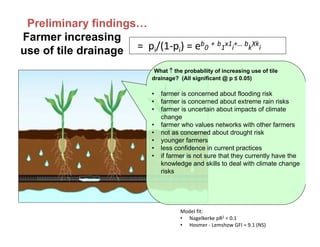
What  the probability of increasing use of tile
drainage? (All significant @ p ≤ 0.05)
• farmer is concerned about flooding risk
• farmer is concerned about extreme rain risks
• farmer is uncertain about impacts of climate
change
• farmer who values networks with other farmers
• not as concerned about drought risk
• younger farmers
• less confidence in current practices
• if farmer is not sure that they currently have the
knowledge and skills to deal with climate change
risks
Preliminary findings…
=  pi/(1‐pi) = eb
0
+ b
1
x1
i
+… b
k
Xk
i
Farmer increasing
use of tile drainage
Model fit: 
• Nagelkerke pR2 = 0.1
• Hosmer ‐ Lemshow GFI = 9.1 (NS)
• Further analysis might lead to SEM or other
regression model(s)
• Multi-level model (structural components)
“agency” within larger agricultural system in
the Corn Belt
• In-depth interviews (n=159): deepen and
explore adaptation and climate change belief
Next Steps
This research is part of a regional collaborative project supported by the USDA-NIFA, Award No. 2011-68002-30190:
Cropping Systems Coordinated Agricultural Project: Climate Change, Mitigation, and Adaptation in Corn-based Cropping Systems
Project Web site: sustainablecorn.org
“The greatest barrier to public recognition of
human-made climate change is probably the
natural vulnerability of local climate. How can a
person discern long-term climate change,
given the notorious variability of local weather
and climate from day to day & year to year?”
(Hansen, Sato & Ruedy 2012, p. 1)
Photo by Anna MacDonald

What would farmers do

  • 1.
    What would farmersdo? Adaptive management intentions of Corn Belt farmers given a climate change scenario Gabrielle Roesch-McNally, J. Gordon Arbuckle Jr., and John Tyndall “The vulnerability of agriculture to climate change is strongly dependent not just on ...biophysical effects..., but also on the responses taken by humans to moderate those effects…”(Walthall et al. 2013, p.13) This research is part of a regional collaborative project supported by the USDA-NIFA, Award No. 2011-68002-30190: Cropping Systems Coordinated Agricultural Project: Climate Change, Mitigation, and Adaptation in Corn-based Cropping Systems Project Web site: sustainablecorn.org @G_Roesch
  • 2.
    Roadmap • Study Details •Context: Climate Change & Agriculture; Adaptation & Resilience • Analysis • Next Steps
  • 3.
    Survey Scope &Scale Survey details: n = 4,778 (26% response rate) • Survey administered by USDA NASS • Sample stratified by 22 HUC 6 watersheds ~ 60% of U.S. corn production • Larger-scale farmers: $100k+ Gross Revenue, ~ 80% of farmland in Corn Belt
  • 4.
    Research Questions – Whatfactors influence farmers’ predicted adaptive response to climate change? – What types of practices do farmers anticipate utilizing or increasing? – Are there differences between farmer characteristics and adaptive response?
  • 5.
    Predicted Climate Change Impacts:US Corn Belt • Potential (short-term) benefits from longer growing season and increased CO2 • More frequent extreme weather events (flooding to drought conditions) • Changes in hydrology (timing, intensity and erosivity of precipitation events) • Increased weed, disease and pest pressures
  • 6.
    Climate Change Belief “Pleaseselect the statement that best reflects your beliefs about climate change” Climate change is occurring, and it is caused mostly by human activities 8% Climate change is occurring, and it is caused more or less equally by natural changes in the environment and human activities 33% Climate change is occurring, and it is caused mostly by natural changes in the environment 25% There is not sufficient evidence to know with certainty whether climate change is occurring or not 31% Climate change is not occurring 4%
  • 7.
    Adaptation on theFarm “The process or adjustment to actual or expected climate and its effects...Adaptation seeks to moderate or avoid harm or exploit beneficial opportunities.” (IPCC 2014)
  • 8.
    “Farming is weatherand weather is farming so, you know…one year is not like the next…” (MI farmer) Farmer as Adapter
  • 9.
  • 10.
    A Resilient Farm “Thecapacity of... systems to cope with a hazardous event or trend or disturbance, responding in ways that maintain their essential function, identity, & structure, while also maintaining the capacity for adaptation, learning & transformation.” (IPCC 2014) Adoption of key conservation practices one tool in building more resilient agricultural systems.
  • 11.
    Managing Production &Environmental Risk • In field (“Cultural”) Practices – Reduced (no) tillage – Manure, fertilizer management/reduction – Cover crops,  – Rotation and or cropping changes – Land retirement   • Structural Practices – Buffers, prairie strips – Grassed Waterways – Terraces – Restored/ reconstructed wetlands  – Denitrification bioreactors – Controlled drainage – Wetland restoration – Tree planting We examined different actions farmers can take at the field/farm scale: 
  • 12.
    The Scenario • Violentstorms/extreme rain events will become more frequent, particularly in the spring. • More extreme rain events will increase likelihood of flooding & saturated soils. • Periods between rains will be longer, increasing likelihood of drought. • Changes in the weather patterns will increase crop insect, weed & disease problems. The Question If you knew with certainty that the above conditions would occur, would the following practices on the cropland you own and rent decrease, increase, or stay the same? Behavioral Intentions Under Climate Change Scenario
  • 13.
    No‐till Tile Drainage Cover Crop Example  Practices %  Decrease  % Stay the  Same %  Increase % Don't  Know No‐till 2 4824 13 Cover Crops 1 38 22 25 Subsurface  tile or other  drainage 1 32 43 11 Adaptation Intentions in Response to Increased Extremes
  • 14.
    Conceptual Model ofAdaptation: Focus on farm practices
  • 15.
    Logistic Regression: Increase vs.Stay the Same Predicted Adaptive Response Stay the same  (ref.) Increase Predictor Variables Norms: Current Practices Climate Change Belief Risk Perception: Weather Risk Management  Farmer Characteristics Social Networks Productivist/Steward Identity Self‐efficacy Watershed/State differences
  • 16.
    All Dependent Variables Used (22) Parameters significant in  some/all models Current Practices Current Cover Crop Use0/3 (prior knowledge) Current no‐till use  2/3 Current Reduced tillage use  0/3 Current diversified rotations use  2/3 Current Drainage Water Mgt. use  0/3 Beliefs CCBELIEF 0/3 My operation will be harmed by climate change  1/3 Perceived Risks Increased soil erosion concern 2/3 Flooding concern  0/3 Extreme rains concern  2/3 Drought concern 1/3 Too much uncertainty  3/3 Risk Management Strategies EdgefieldCons 0/3 Infield Cons 1/3 Crop Insurance 0/3 Diversifying  0/3 Demographics Age  2/3 Education level  1/3 Identity F_productivist identity 1/3 F_steward identity  1/3 Self‐efficacy Confidence in current practices  3/3 I have knowledge and skills to deal with climate  change  1/3 Networks Visit other farmers   3/3
  • 17.
    What  theprobability of increasing use of cover crops? (All significant @ p ≤ 0.05) • using no-till • using diversified rotations • perceived risk of soil erosion & extreme rains • using infield conservation as a risk mgmt. strategy • more educated farmers • those with a stewardship identity • those whose networks of other farmers are important • younger farmers • less uncertainty about climate change impacts • less of a sense of self-efficacy Preliminary findings… =  pi/(1‐pi) = eb 0 + b 1 x1 i +… b k Xk i Farmer increasing use of Cover crops Model fit:  • Nagelkerke pR2 = 0.19 • Hosmer ‐ Lemshow GFI = 3.01 (NS)
  • 18.
    What  theprobability of increasing the use of no-till? (All significant @ p ≤ 0.05) • farmer currently uses no-till • farmer believes that climate change might harm their operation • certainty concerning climate change risks • farmer is concerned about increased soil erosion risk • farmers who value networks with other farmers • less confidence in current practices Preliminary findings… =  pi/(1‐pi) = eb 0 + b 1 x1 i +… b k Xk i Farmer increasing use of no-till Model fit:  • Nagelkerke pR2 = 0.08 • Hosmer ‐ Lemshow GFI = 6.5 (NS)
  • 19.
    What  theprobability of increasing use of tile drainage? (All significant @ p ≤ 0.05) • farmer is concerned about flooding risk • farmer is concerned about extreme rain risks • farmer is uncertain about impacts of climate change • farmer who values networks with other farmers • not as concerned about drought risk • younger farmers • less confidence in current practices • if farmer is not sure that they currently have the knowledge and skills to deal with climate change risks Preliminary findings… =  pi/(1‐pi) = eb 0 + b 1 x1 i +… b k Xk i Farmer increasing use of tile drainage Model fit:  • Nagelkerke pR2 = 0.1 • Hosmer ‐ Lemshow GFI = 9.1 (NS)
  • 20.
    • Further analysismight lead to SEM or other regression model(s) • Multi-level model (structural components) “agency” within larger agricultural system in the Corn Belt • In-depth interviews (n=159): deepen and explore adaptation and climate change belief Next Steps
  • 21.
    This research ispart of a regional collaborative project supported by the USDA-NIFA, Award No. 2011-68002-30190: Cropping Systems Coordinated Agricultural Project: Climate Change, Mitigation, and Adaptation in Corn-based Cropping Systems Project Web site: sustainablecorn.org “The greatest barrier to public recognition of human-made climate change is probably the natural vulnerability of local climate. How can a person discern long-term climate change, given the notorious variability of local weather and climate from day to day & year to year?” (Hansen, Sato & Ruedy 2012, p. 1) Photo by Anna MacDonald