What  type  of  person  are  you?
Management series
Inspiration from Management book
To know how you function in the office
What you are best and worst at, is all part of knowing yourself
Some manager’s deal with people in just the rich way: neither too bossy nor too appeasing, they handle staff with tact and sensitivity, careful not to over look individual needs while ensuring that the team or the department thrives as a whole.  They also tend to get the job done for everyone benefits .
Carl Jung pioneered the study of personality types at the beginning of the century.
He thought that people oriented themselves toward the world in either of two basic ways Introverts Extroverts
Introverts A re most happy when they are by themselves, doing their own thing they do not pursue social activity and often feel uncomfortable in it
Extroverts  Give their lives meaning from interaction with people and can feel at loss when by themselves
Human being are complex and don’t fit into boxes, but some theories are a useful starting point for the difficult task of self analysis
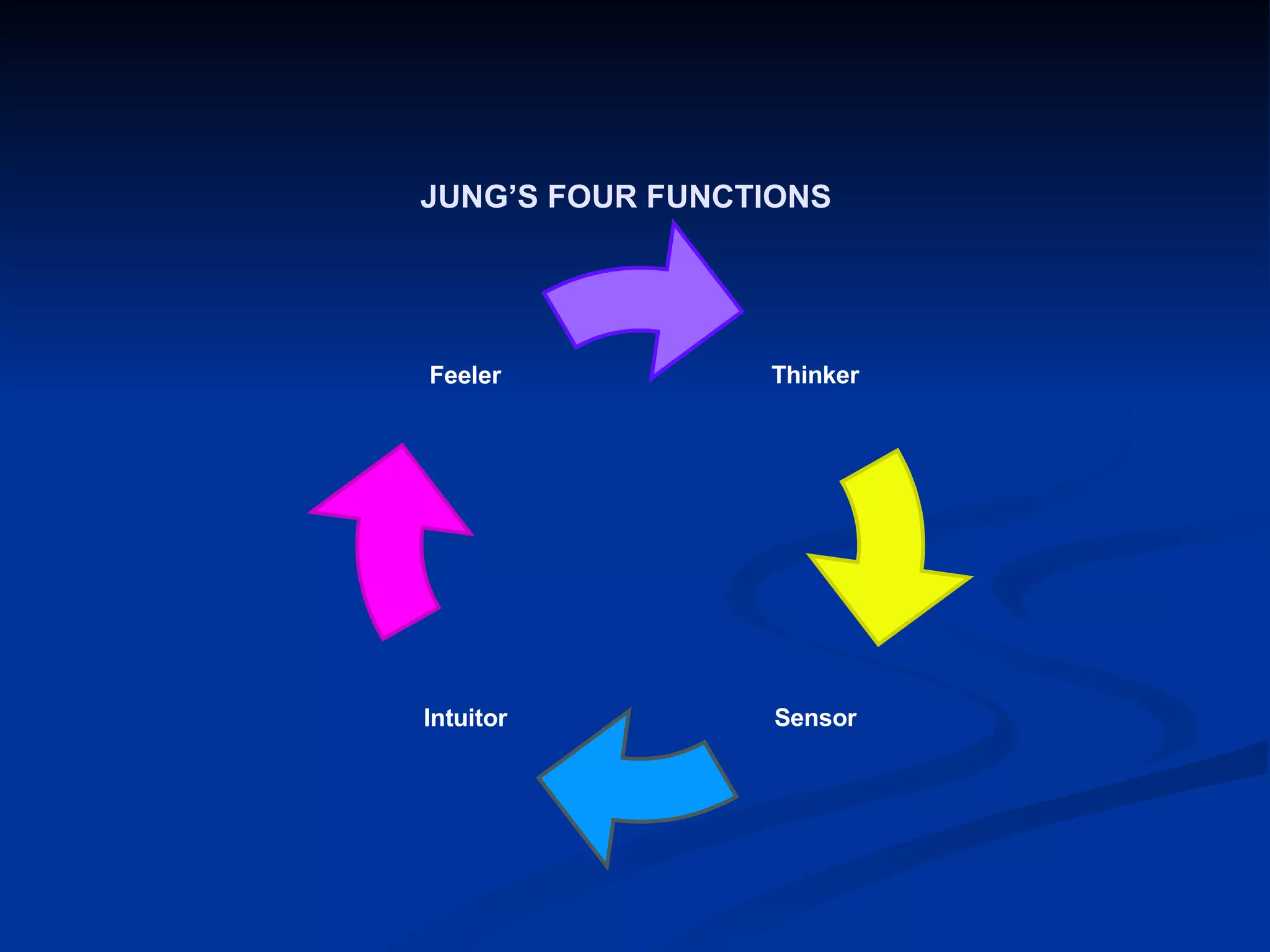
Jung’s thought that we receive and process data via four functions:- Thinking Intuiting Feeling  Sensing
Before further illustration, critical analysis is required
Concentrate on your thoughts 1. Try to recognize your basic bent or direction 2. Work out what your strengths are 3. Ensure that your weakness are covered 4. If you decide that you lack challenge or are going in the wrong direction, it may be that they only solution is to change job or change thoughts
JUNG’S FOUR FUNCTIONS As a manager it is useful to know whether you are in introvert or extrovert and which of the four function is your stronger and which the weakest, also if you can spot the strong and weak functions of your subordinates, it will help you decide who will be most useful for different task and enable you to build  effective teams.
Feeler Intuitor Sensor Thinker JUNG’S FOUR FUNCTIONS
Thinker * Enjoys tackling problems with logic * Is strong on analysis but weak on   implementing solutions * Is a methodical worker * Is skeptical or projects unless backed   up with sound, rational arguments
Sensor *  Is good at getting things done, often   impatient with the planning stage * Feels at home with routine work * Has a lot of common sense and is   practical * Works hard and is usually well   organized * Is energetic and single minded?
Intuitor *  Enjoys playing with ideas and theories * Is good at seeing the “overview” but   misses the details * Is creative and has s strong   imaginative sense * Will often get bunches about thing that   turn out correctly
Feeler * Enjoys human company * Assesses on personal values not   technical merit * Is warm and sympathetic * Is perceptive about peoples, moods,    feeling and reactions * May overlook blatant facts in favor of gut feelings
Thank you,  [email_address] www.amirsaiftaz.blogspot.com

What Type Of Person Are You

  • 1.
    What type of person are you?
  • 2.
  • 3.
  • 4.
    To know howyou function in the office
  • 5.
    What you arebest and worst at, is all part of knowing yourself
  • 6.
    Some manager’s dealwith people in just the rich way: neither too bossy nor too appeasing, they handle staff with tact and sensitivity, careful not to over look individual needs while ensuring that the team or the department thrives as a whole. They also tend to get the job done for everyone benefits .
  • 7.
    Carl Jung pioneeredthe study of personality types at the beginning of the century.
  • 8.
    He thought thatpeople oriented themselves toward the world in either of two basic ways Introverts Extroverts
  • 9.
    Introverts A remost happy when they are by themselves, doing their own thing they do not pursue social activity and often feel uncomfortable in it
  • 10.
    Extroverts Givetheir lives meaning from interaction with people and can feel at loss when by themselves
  • 11.
    Human being arecomplex and don’t fit into boxes, but some theories are a useful starting point for the difficult task of self analysis
  • 12.
    Jung’s thought thatwe receive and process data via four functions:- Thinking Intuiting Feeling Sensing
  • 13.
    Before further illustration,critical analysis is required
  • 14.
    Concentrate on yourthoughts 1. Try to recognize your basic bent or direction 2. Work out what your strengths are 3. Ensure that your weakness are covered 4. If you decide that you lack challenge or are going in the wrong direction, it may be that they only solution is to change job or change thoughts
  • 15.
    JUNG’S FOUR FUNCTIONSAs a manager it is useful to know whether you are in introvert or extrovert and which of the four function is your stronger and which the weakest, also if you can spot the strong and weak functions of your subordinates, it will help you decide who will be most useful for different task and enable you to build effective teams.
  • 16.
    Feeler Intuitor SensorThinker JUNG’S FOUR FUNCTIONS
  • 17.
    Thinker * Enjoystackling problems with logic * Is strong on analysis but weak on implementing solutions * Is a methodical worker * Is skeptical or projects unless backed up with sound, rational arguments
  • 18.
    Sensor * Is good at getting things done, often impatient with the planning stage * Feels at home with routine work * Has a lot of common sense and is practical * Works hard and is usually well organized * Is energetic and single minded?
  • 19.
    Intuitor * Enjoys playing with ideas and theories * Is good at seeing the “overview” but misses the details * Is creative and has s strong imaginative sense * Will often get bunches about thing that turn out correctly
  • 20.
    Feeler * Enjoyshuman company * Assesses on personal values not technical merit * Is warm and sympathetic * Is perceptive about peoples, moods, feeling and reactions * May overlook blatant facts in favor of gut feelings
  • 21.
    Thank you, [email_address] www.amirsaiftaz.blogspot.com