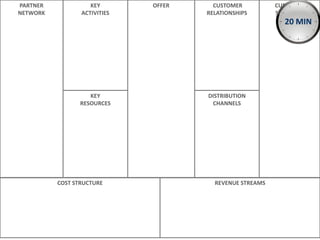
OFFER
DISTRIBUTION
CHANNELS
CUSTOMER
RELATIONSHIPS
CUSTOMER
SEGMENTS
REVENUE STREAMSCOST STRUCTURE
KEY
ACTIVITIES
PARTNER
NETWORK
KEY
RESOURCES
20 MIN
4
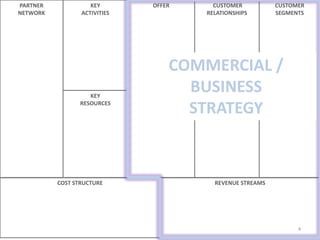
OFFER
DISTRIBUTION
CHANNELS
CUSTOMER
RELATIONSHIPS
CUSTOMER
SEGMENTS
REVENUE STREAMSCOST STRUCTURE
KEY
ACTIVITIES
PARTNER
NETWORK
KEY
RESOURCES
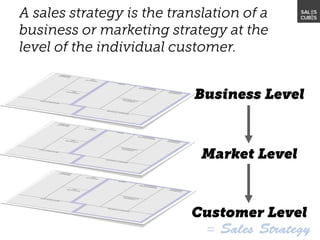
COMMERCIAL /
BUSINESS
STRATEGY
OFFER
DISTRIBUTION
CHANNELS
CUSTOMER
RELATIONSHIPS
CUSTOMER
SEGMENTS
REVENUE STREAMSCOST STRUCTURE
KEY
ACTIVITIES
PARTNER
NETWORK
KEY
RESOURCES
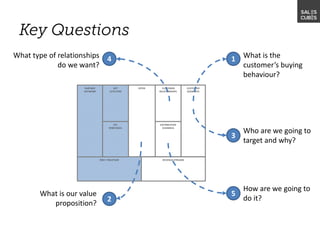
1 What is the
customer’s buying
behaviour?
2
What is our value
proposition?
3
Who are we going to
target and why?
4What type of relationships
do we want?
5
How are we going to
do it?
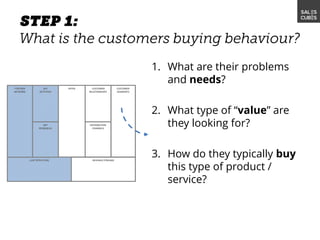
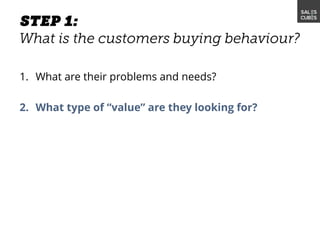
1. What are their problems
and needs?
2. What type of “value” are
they looking for?
3. How do they typically buy
this type of product /
service?
OFFER
DISTRIBUTION
CHANNELS
CUSTOMER
RELATIONSHIPS
CUSTOMER
SEGMENTS
REVENUE STREAMSCOST STRUCTURE
KEY
ACTIVITIES
PARTNER
NETWORK
KEY
RESOURCES
1. What are their problems and needs?
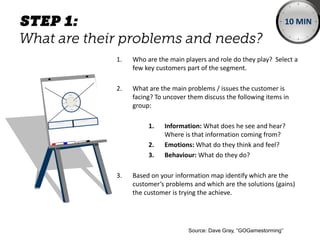
1. Who are the main players and role do they play? Select a
few key customers part of the segment.
2. What are the main problems / issues the customer is
facing? To uncover them discuss the following items in
group:
1. Information: What does he see and hear?
Where is that information coming from?
2. Emotions: What do they think and feel?
3. Behaviour: What do they do?
3. Based on your information map identify which are the
customer’s problems and which are the solutions (gains)
the customer is trying the achieve.
Source: Dave Gray, “GOGamestorming”
10 MIN
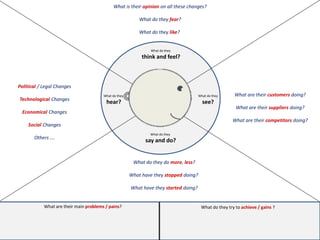
What are their customers doing?
What are their suppliers doing?
What are their competitors doing?
Political / Legal Changes
Technological Changes
Economical Changes
Social Changes
Others ….
What is their opinion on all these changes?
What do they fear?
What do they like?
What do they do more, less?
What have they stopped doing?
What have they started doing?
What do they
see?
What do they
hear?
What do they
think and feel?
What do they
say and do?
What are their main problems / pains? What do they try to achieve / gains ?
1. What are their problems and needs?
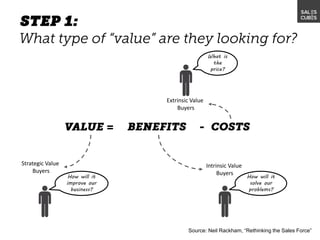
2. What type of “value” are they looking for?
Source: Neil Rackham, “Rethinking the Sales Force”
Extrinsic Value
Buyers
Intrinsic Value
Buyers
Strategic Value
Buyers
What is
the
price?
How will it
solve our
problems?
How will it
improve our
business?
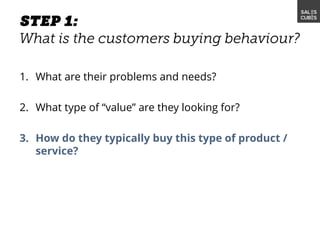
1. What are their problems and needs?
2. What type of “value” are they looking for?
3. How do they typically buy this type of product /
service?
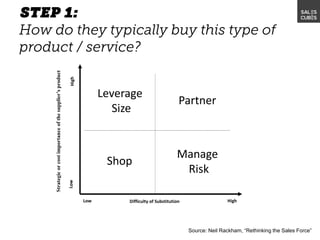
Source: Neil Rackham, “Rethinking the Sales Force”
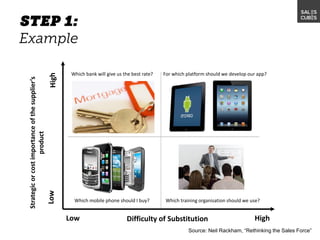
Strategicorcostimportanceofthesupplier’sproduct
Difficulty of SubstitutionLow High
Leverage
Size
Shop
Partner
Manage
Risk
Source: Neil Rackham, “Rethinking the Sales Force”
Strategicorcostimportanceofthesupplier’s
product
Difficulty of SubstitutionLow High
Leverage Size
Shop
Partner
Manage risk
Which mobile phone should I buy?
For which platform should we develop our app?Which bank will give us the best rate?
Which training organisation should we use?
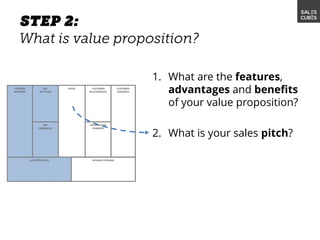
1. What are the features,
advantages and benefits
of your value proposition?
2. What is your sales pitch?
OFFER
DISTRIBUTION
CHANNELS
CUSTOMER
RELATIONSHIPS
CUSTOMER
SEGMENTS
REVENUE STREAMSCOST STRUCTURE
KEY
ACTIVITIES
PARTNER
NETWORK
KEY
RESOURCES
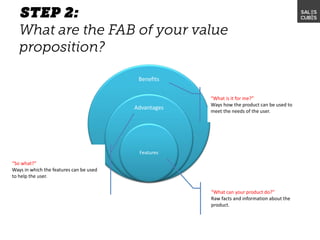
1. What are the features, advantages and benefits
of your value proposition?
Benefits
Advantages
Features
“So what?”
Ways in which the features can be used
to help the user.
“What can your product do?”
Raw facts and information about the
product.
“What is it for me?”
Ways how the product can be used to
meet the needs of the user.
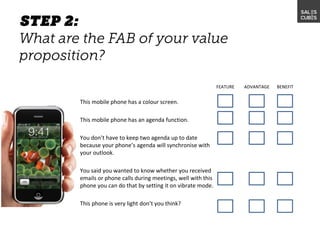
This mobile phone has a colour screen.
This mobile phone has an agenda function.
You don’t have to keep two agenda up to date
because your phone’s agenda will synchronise with
your outlook.
You said you wanted to know whether you received
emails or phone calls during meetings, well with this
phone you can do that by setting it on vibrate mode.
This phone is very light don’t you think?
FEATURE ADVANTAGE BENEFIT
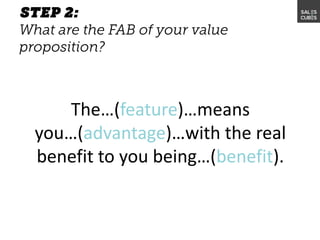
The…(feature)…means
you…(advantage)…with the real
benefit to you being…(benefit).
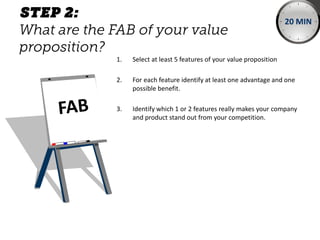
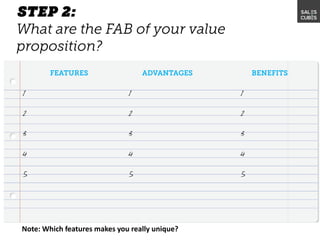
1. Select at least 5 features of your value proposition
2. For each feature identify at least one advantage and one
possible benefit.
3. Identify which 1 or 2 features really makes your company
and product stand out from your competition.
20 MIN
1
2
3
4
5
Note: Which features makes you really unique?
1
2
3
4
5
1
2
3
4
5
1. What are the features, advantages and benefits of
your value proposition?
2. What is your sales pitch?
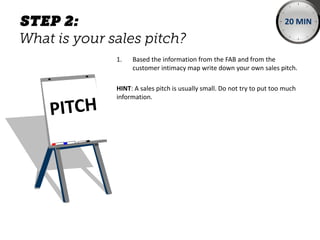
1. Based the information from the FAB and from the
customer intimacy map write down your own sales pitch.
HINT: A sales pitch is usually small. Do not try to put too much
information.
20 MIN
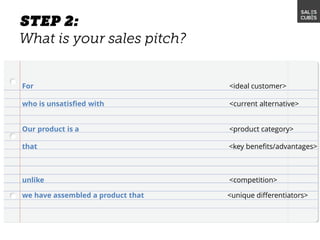
For
who is unsatisfied with
Our product is a
that
unlike
we have assembled a product that
<ideal customer>
<current alternative>
<product category>
<key benefits/advantages>
<competition>
<unique differentiators>
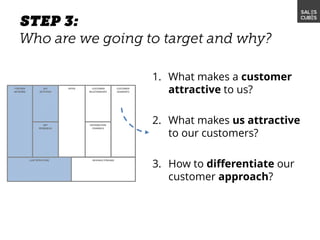
1. What makes a customer
attractive to us?
2. What makes us attractive
to our customers?
3. How to differentiate our
customer approach?
OFFER
DISTRIBUTION
CHANNELS
CUSTOMER
RELATIONSHIPS
CUSTOMER
SEGMENTS
REVENUE STREAMSCOST STRUCTURE
KEY
ACTIVITIES
PARTNER
NETWORK
KEY
RESOURCES
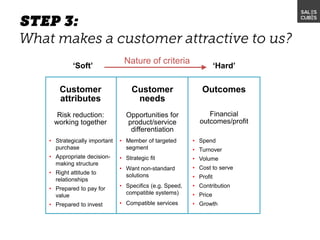
1. What makes a customer attractive to us?
Customer
attributes
Risk reduction:
working together
‘Hard’
Nature of criteria
‘Soft’
• Spend
• Turnover
• Volume
• Cost to serve
• Profit
• Contribution
• Price
• Growth
• Strategically important
purchase
• Appropriate decision-
making structure
• Right attitude to
relationships
• Prepared to pay for
value
• Prepared to invest
• Member of targeted
segment
• Strategic fit
• Want non-standard
solutions
• Specifics (e.g. Speed,
compatible systems)
• Compatible services
Customer
needs
Opportunities for
product/service
differentiation
Outcomes
Financial
outcomes/profit
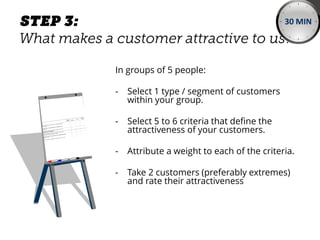
In groups of 5 people:
- Select 1 type / segment of customers
within your group.
- Select 5 to 6 criteria that define the
attractiveness of your customers.
- Attribute a weight to each of the criteria.
- Take 2 customers (preferably extremes)
and rate their attractiveness
30 MIN
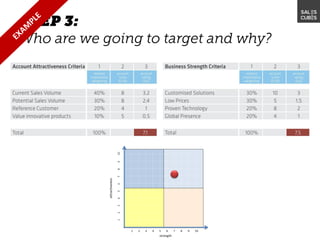
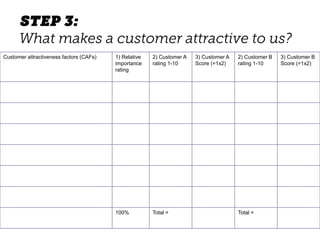
Customer attractiveness factors (CAFs) 1) Relative
importance
rating
2) Customer A
rating 1-10
3) Customer A
Score (=1x2)
2) Customer B
rating 1-10
3) Customer B
Score (=1x2)
100% Total = Total =
1. What makes a customer attractive to us?
2. What makes us attractive to our customers?
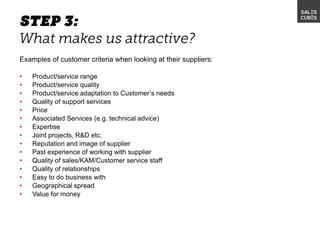
Examples of customer criteria when looking at their suppliers:
• Product/service range
• Product/service quality
• Product/service adaptation to Customer’s needs
• Quality of support services
• Price
• Associated Services (e.g. technical advice)
• Expertise
• Joint projects, R&D etc.
• Reputation and image of supplier
• Past experience of working with supplier
• Quality of sales/KAM/Customer service staff
• Quality of relationships
• Easy to do business with
• Geographical spread
• Value for money
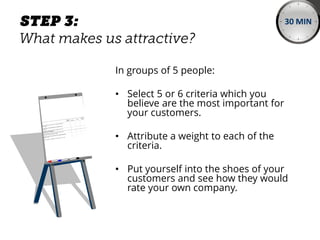
In groups of 5 people:
• Select 5 or 6 criteria which you
believe are the most important for
your customers.
• Attribute a weight to each of the
criteria.
• Put yourself into the shoes of your
customers and see how they would
rate your own company.
30 MIN
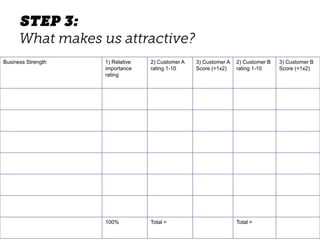
Business Strength 1) Relative
importance
rating
2) Customer A
rating 1-10
3) Customer A
Score (=1x2)
2) Customer B
rating 1-10
3) Customer B
Score (=1x2)
100% Total = Total =
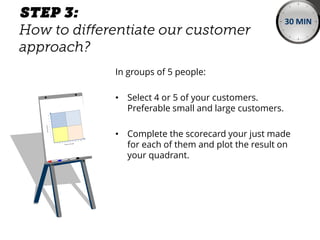
In groups of 5 people:
• Select 4 or 5 of your customers.
Preferable small and large customers.
• Complete the scorecard your just made
for each of them and plot the result on
your quadrant.
30 MIN
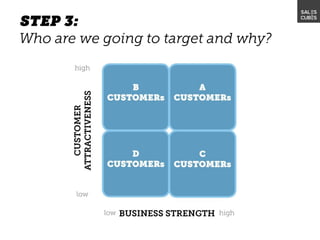
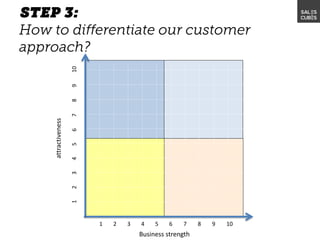
attractiveness
12345678910
1 2 3 4 5 6 7 8 9 10
Business strength
1. What makes a customer attractive to us?
2. What makes us attractive to our customers?
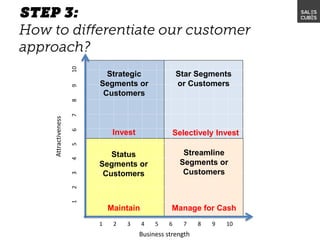
3. How to differentiate our customer approach?
Attractiveness
12345678910
1 2 3 4 5 6 7 8 9 10
Business strength
Star Segments
or Customers
Strategic
Segments or
Customers
Status
Segments or
Customers
Streamline
Segments or
Customers
Invest
Maintain Manage for Cash
Selectively Invest
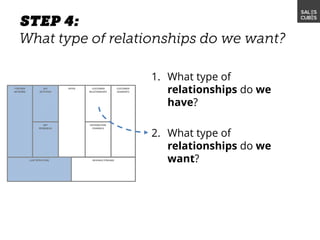
1. What type of
relationships do we
have?
2. What type of
relationships do we
want?
OFFER
DISTRIBUTION
CHANNELS
CUSTOMER
RELATIONSHIPS
CUSTOMER
SEGMENTS
REVENUE STREAMSCOST STRUCTURE
KEY
ACTIVITIES
PARTNER
NETWORK
KEY
RESOURCES
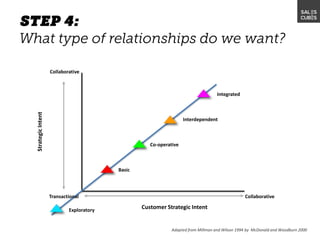
1. What type of relationships do we have?
Adapted from Millman and Wilson 1994 by McDonald and Woodburn 2000
Customer Strategic Intent
Integrated
Interdependent
Co-operative
Basic
Exploratory
Collaborative
Transactional Collaborative
StrategicIntent
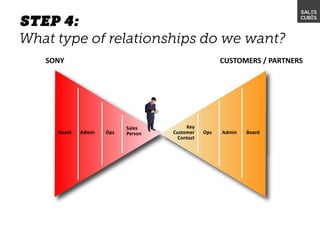
Board BoardAdmin AdminOps Ops
Sales
Person
Key
Customer
Contact
SONY CUSTOMERS / PARTNERS
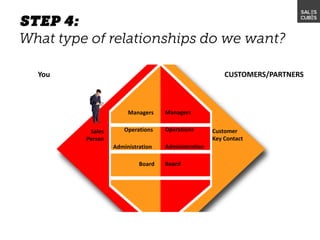
Managers
Operations Operations
Administration Administration
Board Board
Sales
Person
Customer
Key Contact
Managers
You CUSTOMERS/PARTNERS
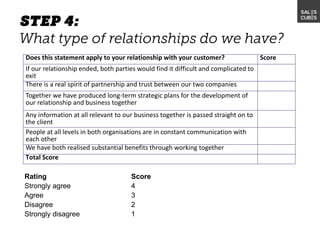
Rating Score
Strongly agree 4
Agree 3
Disagree 2
Strongly disagree 1
Does this statement apply to your relationship with your customer? Score
If our relationship ended, both parties would find it difficult and complicated to
exit
There is a real spirit of partnership and trust between our two companies
Together we have produced long-term strategic plans for the development of
our relationship and business together
Any information at all relevant to our business together is passed straight on to
the client
People at all levels in both organisations are in constant communication with
each other
We have both realised substantial benefits through working together
Total Score
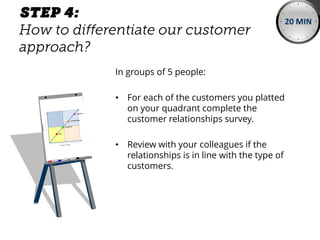
In groups of 5 people:
• For each of the customers you platted
on your quadrant complete the
customer relationships survey.
• Review with your colleagues if the
relationships is in line with the type of
customers.
20 MIN
1. What type of relationships do we have?
2. What type of relationships do we want?
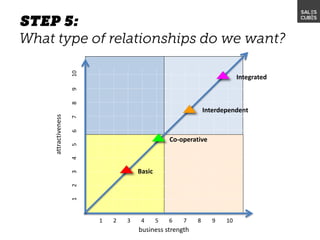
attractiveness
12345678910
1 2 3 4 5 6 7 8 9 10
business strength
Integrated
Interdependent
Co-operative
Basic
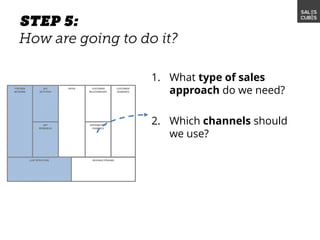
1. What type of sales
approach do we need?
2. Which channels should
we use?
OFFER
DISTRIBUTION
CHANNELS
CUSTOMER
RELATIONSHIPS
CUSTOMER
SEGMENTS
REVENUE STREAMSCOST STRUCTURE
KEY
ACTIVITIES
PARTNER
NETWORK
KEY
RESOURCES
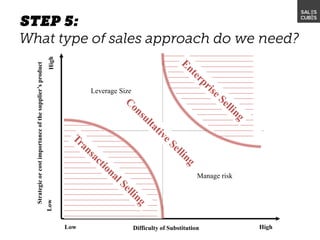
1. What type of sales approach do we need?
Strategicorcostimportanceofthesupplier’sproduct
Difficulty of SubstitutionLow High
Leverage Size
Shop
Partner
Manage risk
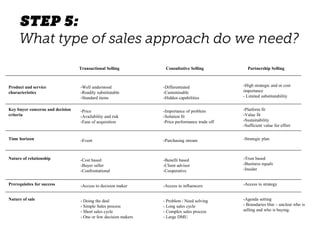
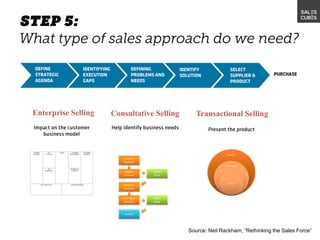
Transactional Selling Consultative Selling Partnership Selling
Product and service
characteristics
-Well understood
-Readily substitutable
-Standard items
-Differentiated
-Customisable
-Hidden capabilities
-High strategic and or cost
importance
- Limited substitutability
Key buyer concerns and decision
criteria
-Price
-Availability and risk
-Ease of acquisition
-Importance of problem
-Solution fit
-Price performance trade off
-Platform fit
-Value fit
-Sustainability
-Sufficient value for effort
Time horizon -Event -Purchasing stream -Strategic plan
Nature of relationship -Cost based
-Buyer seller
-Confrontational
-Benefit based
-Client advisor
-Cooperative
-Trust based
-Business equals
-Insider
Prerequisites for success -Access to decision maker -Access to influencers -Access to strategy
Nature of sale - Doing the deal
- Simple Sales process
- Short sales cycle
- One or few decision makers
- Problem / Need solving
- Long sales cycle
- Complex sales process
- Large DMU
-Agenda setting
- Boundaries blur – unclear who is
selling and who is buying.
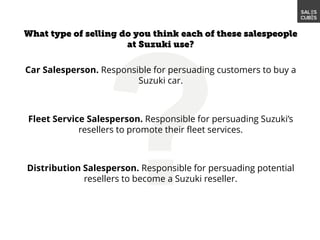
Car Salesperson. Responsible for persuading customers to buy a
Suzuki car.
Fleet Service Salesperson. Responsible for persuading Suzuki’s
resellers to promote their fleet services.
Distribution Salesperson. Responsible for persuading potential
resellers to become a Suzuki reseller.
Source: Neil Rackham, “Rethinking the Sales Force”
IDENTIFYING
EXECUTION
GAPS
DEFINING
PROBLEMS AND
NEEDS
IDENTIFY
SOLUTION
SELECT
SUPPLIER &
PRODUCT
PURCHASE
DEFINE
STRATEGIC
AGENDA
Transactional SellingConsultative SellingEnterprise Selling
1. What type of sales approach do we need?
2. Which channels should we use?
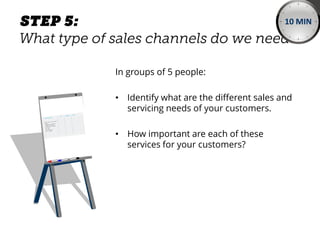
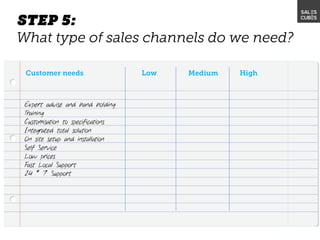
In groups of 5 people:
• Identify what are the different sales and
servicing needs of your customers.
• How important are each of these
services for your customers?
10 MIN
Expert advise and hand holding
Training
Customisation to specifications
Integrated total solution
On site setup and installation
Self Service
Low prices
Fast Local Support
24 * 7 Support
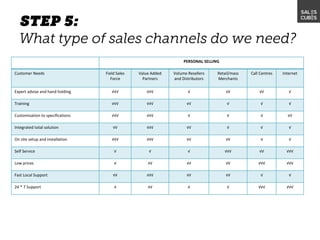
PERSONAL SELLING
Customer Needs Field Sales
Force
Value Added
Partners
Volume Resellers
and Distributors
Retail/mass
Merchants
Call Centres Internet
Expert advise and hand holding √√√ √√√ √ √√ √√ √
Training √√√ √√√ √√ √ √ √
Customisation to specifications √√√ √√√ √ √ √ √√
Integrated total solution √√ √√√ √√ √ √ √
On site setup and installation √√√ √√√ √√ √√ √ √
Self Service √ √ √ √√√ √√ √√√
Low prices √ √√ √√ √√ √√√ √√√
Fast Local Support √√ √√√ √√ √√ √ √
24 * 7 Support √ √√ √ √ √√√ √√√
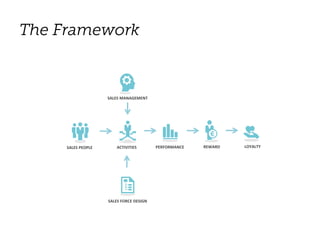
SALES MANAGEMENT
ACTIVITIES PERFORMANCE REWARD LOYALTYSALES PEOPLE
SALES FORCE DESIGN
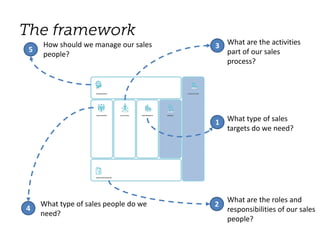
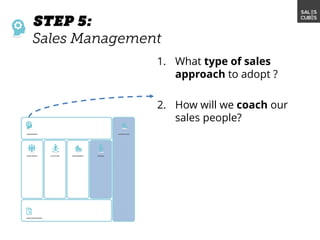
1 What type of sales
targets do we need?
2
What are the roles and
responsibilities of our sales
people?
4
What type of sales people do we
need?
3 What are the activities
part of our sales
process?
5
How should we manage our sales
people?
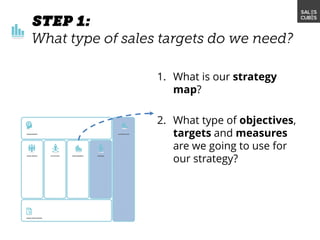
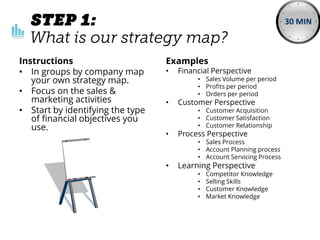
1. What is our strategy
map?
2. What type of objectives,
targets and measures
are we going to use for
our strategy?
Instructions
• In groups by company map
your own strategy map.
• Focus on the sales &
marketing activities
• Start by identifying the type
of financial objectives you
use.
Examples
• Financial Perspective
• Sales Volume per period
• Profits per period
• Orders per period
• Customer Perspective
• Customer Acquisition
• Customer Satisfaction
• Customer Relationship
• Process Perspective
• Sales Process
• Account Planning process
• Account Servicing Process
• Learning Perspective
• Competitor Knowledge
• Selling Skills
• Customer Knowledge
• Market Knowledge
30 MIN
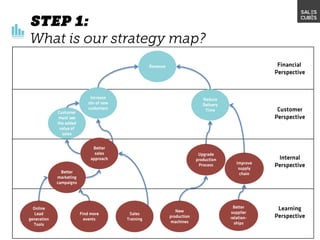
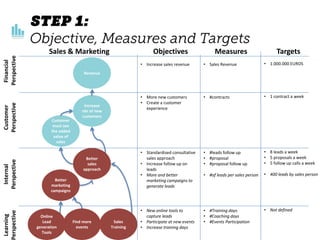
Revenue
Better
sales
approach
Increase
nbr of new
customers
Customer
must see
the added
value of
sales
Better
marketing
campaigns
Online
Lead
generation
Tools
Find more
events
Sales
Training
Sales & Marketing Objectives Measures Targets
• Increase sales revenue
• More new customers
• Create a customer
experience
• Standardised consultative
sales approach
• Increase follow up on
leads
• More and better
marketing campaigns to
generate leads
• New online tools to
capture leads
• Participate at new events
• Increase training days
• Sales Revenue
• #contracts
• #leads follow up
• #proposal
• #proposal follow up
• #of leads per sales person
• #Training days
• #Coaching days
• #Events Participation
Financial
Perspective
Customer
Perspective
Internal
Perspective
Learning
Perspective
• 1.000.000 EUROS
• 1 contract a week
• 8 leads a week
• 5 proposals a week
• 5 follow up calls a week
• 400 leads by sales person
• Not defined
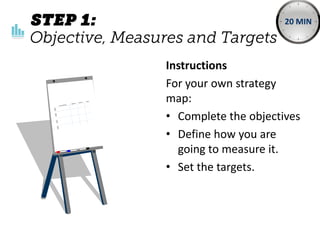
Instructions
For your own strategy
map:
• Complete the objectives
• Define how you are
going to measure it.
• Set the targets.
20 MIN
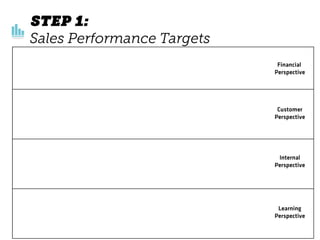
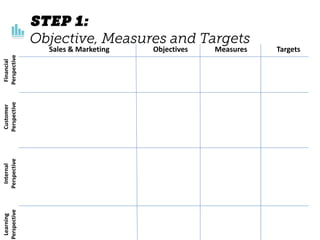
Sales & Marketing Objectives Measures Targets
Financial
Perspective
Customer
Perspective
Internal
Perspective
Learning
Perspective
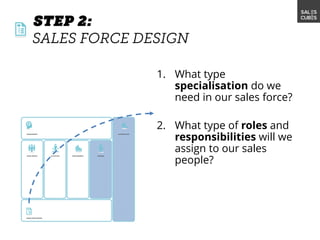
1. What type
specialisation do we
need in our sales force?
2. What type of roles and
responsibilities will we
assign to our sales
people?
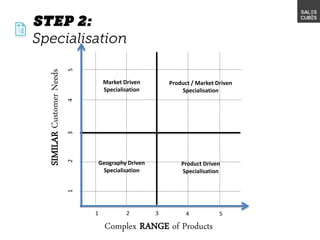
Complex RANGE of Products
SIMILARCustomerNeeds
12345
1 2 3 4 5
Product Driven
Specialisation
Geography Driven
Specialisation
Product / Market Driven
Specialisation
Market Driven
Specialisation
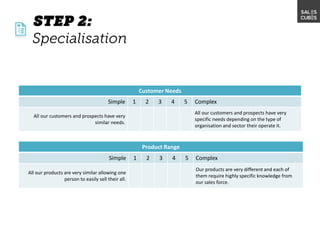
Customer Needs
Simple 1 2 3 4 5 Complex
All our customers and prospects have very
similar needs.
All our customers and prospects have very
specific needs depending on the type of
organisation and sector their operate it.
Product Range
Simple 1 2 3 4 5 Complex
All our products are very similar allowing one
person to easily sell their all.
Our products are very different and each of
them require highly specific knowledge from
our sales force.
They manage large scale and
value of sale. Long negotiation,
complex purchase decision,
usage of the product is different
from consumer sale. Main
activities are relationship
selling, and prospecting.
Sales person is not permitted or
expected to take orders. The
objective is to create goodwill or
educate the customer Main activities
are delivering samples, education ad
promotional activities and sales
service.
They seek out new channels
and support existing ones.
Main activities are channel
management, Prospecting,
Training and Recruiting and
entertaining. Additionally some
relationship selling
Salesperson predominantly
delivers the product. Selling
skills as secondary to good
servicing skills. Main activities
are stock shelving, writing up
orders, and checking inventory
.
Their objective and main
activities are providing support
to the sales people who are in
the field.
Maintaining close long-term
relationships with
organisational customers. They
are often involved in team
selling. Main activities are
providing product support,
maintenance and installation
and entertaining.
The objective is to win new
business by identifying and
selling to prospects.
Main activities are Prospecting
and Relationship selling.
They provide support to the
retailers and wholesales to
ensure that their product is well
represented and displayed.
Main activities are promotion
activities and servicing.
Retail sales assistant, customer
chooses freely the product.
Sales person only handles the
transaction. Telemarketing
taking orders from customers
how are calling in.
Position where the salesperson
is predominantly an order taker
Helping the customer to make
their choice and complete the
transaction.
They are involved in complex and
highly technical sales as support of
the sales team. They play a dual
role of sales person and advisor.
Main activities are analysing the
customer’s problems and needs and
proposing a tailored solution.
Identifying potential business
opportunities by analysing market
trends and developing strategies.
Closing new business opportunities
by coordinating requirements;
developing and negotiating
contracts.
1. What type of activities
should our sales people
do?
2. What does our sales
process look like?
LEADS
DEAL
Consists of activities that
enable the customer to
become aware of the
needs for your product or
services.
Consists of the activities
that will stimulate
interest with the
customer for your
product or service.
Consists of the activities
that are likely to
stimulate your customer
to desire / want your
product or service.
Consists of the activities
that will get the customer
to actually purchase your
product or service.
AWARENESS INTREST DESIRE ACTION
Applicable for:
- Short sales cycles (1 to 2 visits to close a sales)
- Consumer sales
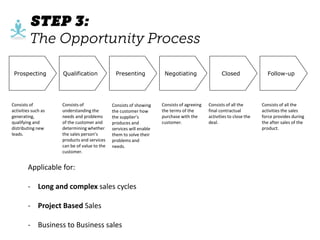
- Product Based Sales
Prospecting Qualification Presenting Negotiating Closed Follow-up
Consists of
activities such as
generating,
qualifying and
distributing new
leads.
Consists of
understanding the
needs and problems
of the customer and
determining whether
the sales person’s
products and services
can be of value to the
customer.
Consists of showing
the customer how
the supplier’s
produces and
services will enable
them to solve their
problems and
needs.
Consists of agreeing
the terms of the
purchase with the
customer.
Consists of all the
final contractual
activities to close the
deal.
Consists of all the
activities the sales
force provides during
the after sales of the
product.
Applicable for:
- Long and complex sales cycles
- Project Based Sales
- Business to Business sales
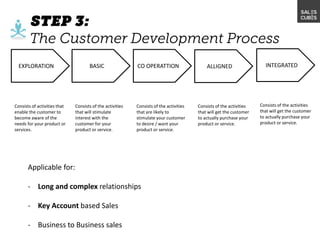
Consists of activities that
enable the customer to
become aware of the
needs for your product or
services.
Consists of the activities
that will stimulate
interest with the
customer for your
product or service.
Consists of the activities
that are likely to
stimulate your customer
to desire / want your
product or service.
Consists of the activities
that will get the customer
to actually purchase your
product or service.
EXPLORATION BASIC CO OPERATTION ALLIGNED
Consists of the activities
that will get the customer
to actually purchase your
product or service.
INTEGRATED
Applicable for:
- Long and complex relationships
- Key Account based Sales
- Business to Business sales
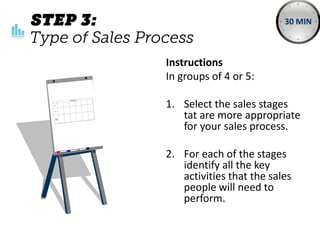
Instructions
In groups of 4 or 5:
1. Select the sales stages
tat are more appropriate
for your sales process.
2. For each of the stages
identify all the key
activities that the sales
people will need to
perform.
30 MIN
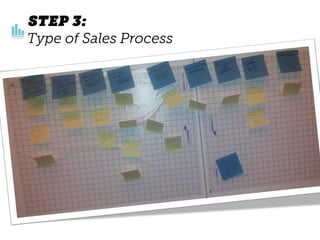
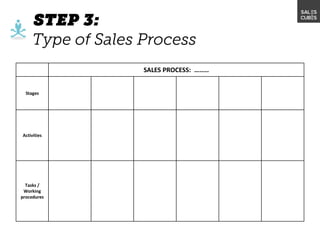
SALES PROCESS: ….....
Stages
Activities
Tasks /
Working
procedures
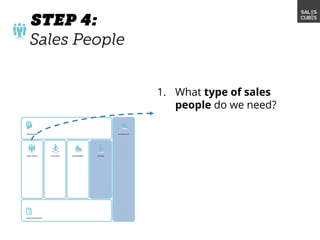
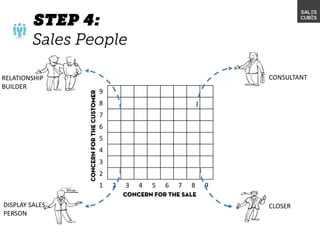
1. What type of sales
people do we need?
9
8
7
6
5
4
3
2
1 2 3 4 5 6 7 8 9
CLOSER
CONSULTANTRELATIONSHIP
BUILDER
DISPLAY SALES
PERSON
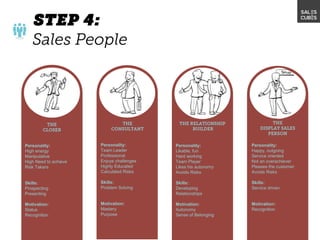
Personality:
High energy
Manipulative
High Need to achieve
Risk Takers
Skills:
Prospecting
Presenting
Motivation:
Status
Recognition
Personality:
Team Leader
Professional
Enjoys challenges
Highly Educated
Calculated Risks
Skills:
Problem Solving
Motivation:
Mastery
Purpose
Personality:
Likable, fun
Hard working
Team Player
Likes his autonomy
Avoids Risks
Skills:
Developing
Relationships
Motivation:
Autonomy
Sense of Belonging
Personality:
Happy, outgoing
Service oriented
Not an overachiever
Pleases the customer
Avoids Risks
Skills:
Service driven
Motivation:
Recognition
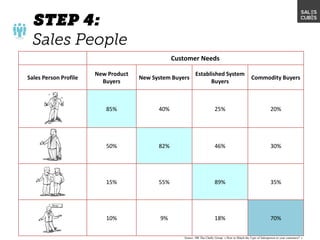
Customer Needs
Sales Person Profile
New Product
Buyers
New System Buyers
Established System
Buyers
Commodity Buyers
85% 40% 25% 20%
50% 82% 46% 30%
15% 55% 89% 35%
10% 9% 18% 70%
Source: HR The Chally Group: « How to Match the Type of Salesperson to your customers? »
1. What type of sales
approach to adopt ?
2. How will we coach our
sales people?
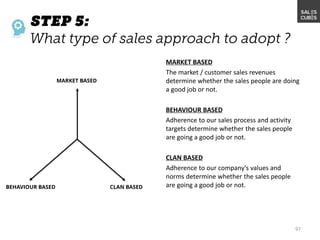
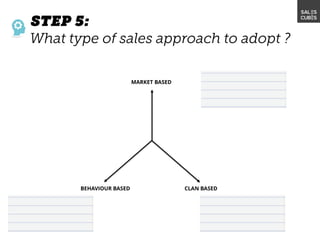
MARKET BASED
The market / customer sales revenues
determine whether the sales people are doing
a good job or not.
BEHAVIOUR BASED
Adherence to our sales process and activity
targets determine whether the sales people
are going a good job or not.
CLAN BASED
Adherence to our company’s values and
norms determine whether the sales people
are going a good job or not.
97
MARKET BASED
BEHAVIOUR BASED CLAN BASED
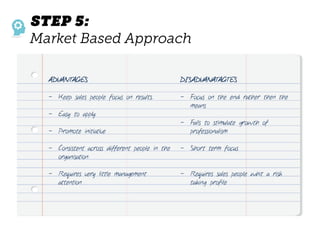
ADVANTAGES
- Keep sales people focus on results.
- Easy to apply.
- Promote initiative
- Consistent across different people in the
organisation
- Requires very little management
attention
DISADVANATAGTES
- Focus on the end rather then the
means
- Fails to stimulate growth of
professionalism
- Short term focus
- Requires sales people whit a risk
taking profile
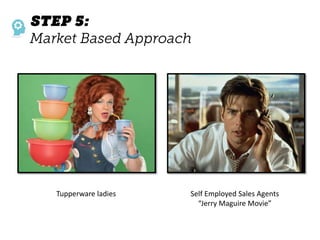
Tupperware ladies Self Employed Sales Agents
“Jerry Maguire Movie”
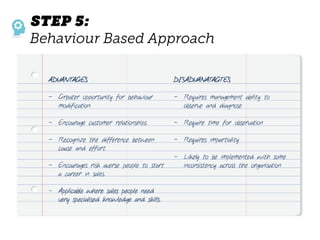
ADVANTAGES
- Greater opportunity for behaviour
modification.
- Encourage customer relationships.
- Recognize the difference between
cause and effort.
- Encourages risk averse people to start
a career in sales.
- Applicable where sales people need
very specialised knowledge and skills.
DISADVANATAGTES
- Requires management ability to
observe and diagnose
- Require time for observation
- Requires impartiality
- Likely to be implemented with some
inconsistency across the organisation
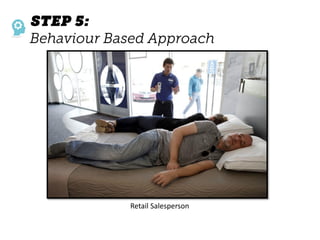
Retail Salesperson
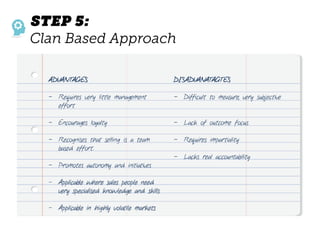
ADVANTAGES
- Requires very little management
effort
- Encourages loyalty
- Recognises that selling is a team
based effort.
- Promotes autonomy and initiatives
- Applicable where sales people need
very specialised knowledge and skills
- Applicable in highly volatile markets
DISADVANATAGTES
- Difficult to measure, very subjective
- Lack of outcome focus
- Requires impartiality
- Lacks real accountability
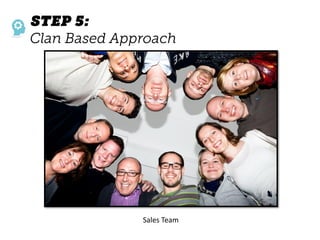
Sales Team
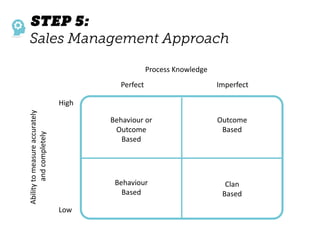
Behaviour or
Outcome
Based
Behaviour
Based
Outcome
Based
Clan
Based
Process Knowledge
Perfect Imperfect
High
Low
Abilitytomeasureaccurately
andcompletely
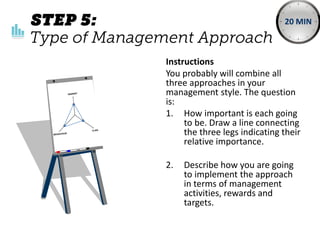
Instructions
You probably will combine all
three approaches in your
management style. The question
is:
1. How important is each going
to be. Draw a line connecting
the three legs indicating their
relative importance.
2. Describe how you are going
to implement the approach
in terms of management
activities, rewards and
targets.
20 MIN
MARKET BASED
BEHAVIOUR BASED CLAN BASED
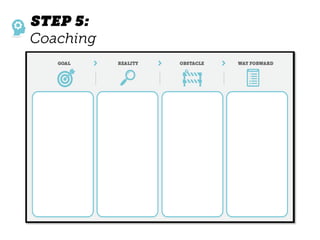
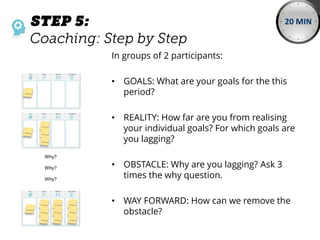
In groups of 2 participants:
• GOALS: What are your goals for the this
period?
• REALITY: How far are you from realising
your individual goals? For which goals are
you lagging?
• OBSTACLE: Why are you lagging? Ask 3
times the why question.
• WAY FORWARD: How can we remove the
obstacle?
20 MIN
Why?
Why?
Why?

Sales strategy workshop 2013 slideshare

  • 3.
  • 4.
  • 8.
    OFFER DISTRIBUTION CHANNELS CUSTOMER RELATIONSHIPS CUSTOMER SEGMENTS REVENUE STREAMSCOST STRUCTURE KEY ACTIVITIES PARTNER NETWORK KEY RESOURCES 1What is the customer’s buying behaviour? 2 What is our value proposition? 3 Who are we going to target and why? 4What type of relationships do we want? 5 How are we going to do it?
  • 9.
    1. What aretheir problems and needs? 2. What type of “value” are they looking for? 3. How do they typically buy this type of product / service? OFFER DISTRIBUTION CHANNELS CUSTOMER RELATIONSHIPS CUSTOMER SEGMENTS REVENUE STREAMSCOST STRUCTURE KEY ACTIVITIES PARTNER NETWORK KEY RESOURCES
  • 10.
    1. What aretheir problems and needs?
  • 11.
    1. Who arethe main players and role do they play? Select a few key customers part of the segment. 2. What are the main problems / issues the customer is facing? To uncover them discuss the following items in group: 1. Information: What does he see and hear? Where is that information coming from? 2. Emotions: What do they think and feel? 3. Behaviour: What do they do? 3. Based on your information map identify which are the customer’s problems and which are the solutions (gains) the customer is trying the achieve. Source: Dave Gray, “GOGamestorming” 10 MIN
  • 12.
    What are theircustomers doing? What are their suppliers doing? What are their competitors doing? Political / Legal Changes Technological Changes Economical Changes Social Changes Others …. What is their opinion on all these changes? What do they fear? What do they like? What do they do more, less? What have they stopped doing? What have they started doing? What do they see? What do they hear? What do they think and feel? What do they say and do? What are their main problems / pains? What do they try to achieve / gains ?
  • 13.
    1. What aretheir problems and needs? 2. What type of “value” are they looking for?
  • 14.
    Source: Neil Rackham,“Rethinking the Sales Force” Extrinsic Value Buyers Intrinsic Value Buyers Strategic Value Buyers What is the price? How will it solve our problems? How will it improve our business?
  • 15.
    1. What aretheir problems and needs? 2. What type of “value” are they looking for? 3. How do they typically buy this type of product / service?
  • 16.
    Source: Neil Rackham,“Rethinking the Sales Force” Strategicorcostimportanceofthesupplier’sproduct Difficulty of SubstitutionLow High Leverage Size Shop Partner Manage Risk
  • 17.
    Source: Neil Rackham,“Rethinking the Sales Force” Strategicorcostimportanceofthesupplier’s product Difficulty of SubstitutionLow High Leverage Size Shop Partner Manage risk Which mobile phone should I buy? For which platform should we develop our app?Which bank will give us the best rate? Which training organisation should we use?
  • 19.
    1. What arethe features, advantages and benefits of your value proposition? 2. What is your sales pitch? OFFER DISTRIBUTION CHANNELS CUSTOMER RELATIONSHIPS CUSTOMER SEGMENTS REVENUE STREAMSCOST STRUCTURE KEY ACTIVITIES PARTNER NETWORK KEY RESOURCES
  • 20.
    1. What arethe features, advantages and benefits of your value proposition?
  • 21.
    Benefits Advantages Features “So what?” Ways inwhich the features can be used to help the user. “What can your product do?” Raw facts and information about the product. “What is it for me?” Ways how the product can be used to meet the needs of the user.
  • 22.
    This mobile phonehas a colour screen. This mobile phone has an agenda function. You don’t have to keep two agenda up to date because your phone’s agenda will synchronise with your outlook. You said you wanted to know whether you received emails or phone calls during meetings, well with this phone you can do that by setting it on vibrate mode. This phone is very light don’t you think? FEATURE ADVANTAGE BENEFIT
  • 23.
  • 24.
    1. Select atleast 5 features of your value proposition 2. For each feature identify at least one advantage and one possible benefit. 3. Identify which 1 or 2 features really makes your company and product stand out from your competition. 20 MIN
  • 25.
    1 2 3 4 5 Note: Which featuresmakes you really unique? 1 2 3 4 5 1 2 3 4 5
  • 26.
    1. What arethe features, advantages and benefits of your value proposition? 2. What is your sales pitch?
  • 27.
    1. Based theinformation from the FAB and from the customer intimacy map write down your own sales pitch. HINT: A sales pitch is usually small. Do not try to put too much information. 20 MIN
  • 28.
    For who is unsatisfiedwith Our product is a that unlike we have assembled a product that <ideal customer> <current alternative> <product category> <key benefits/advantages> <competition> <unique differentiators>
  • 29.
    1. What makesa customer attractive to us? 2. What makes us attractive to our customers? 3. How to differentiate our customer approach? OFFER DISTRIBUTION CHANNELS CUSTOMER RELATIONSHIPS CUSTOMER SEGMENTS REVENUE STREAMSCOST STRUCTURE KEY ACTIVITIES PARTNER NETWORK KEY RESOURCES
  • 30.
    1. What makesa customer attractive to us?
  • 33.
    Customer attributes Risk reduction: working together ‘Hard’ Natureof criteria ‘Soft’ • Spend • Turnover • Volume • Cost to serve • Profit • Contribution • Price • Growth • Strategically important purchase • Appropriate decision- making structure • Right attitude to relationships • Prepared to pay for value • Prepared to invest • Member of targeted segment • Strategic fit • Want non-standard solutions • Specifics (e.g. Speed, compatible systems) • Compatible services Customer needs Opportunities for product/service differentiation Outcomes Financial outcomes/profit
  • 34.
    In groups of5 people: - Select 1 type / segment of customers within your group. - Select 5 to 6 criteria that define the attractiveness of your customers. - Attribute a weight to each of the criteria. - Take 2 customers (preferably extremes) and rate their attractiveness 30 MIN
  • 35.
    Customer attractiveness factors(CAFs) 1) Relative importance rating 2) Customer A rating 1-10 3) Customer A Score (=1x2) 2) Customer B rating 1-10 3) Customer B Score (=1x2) 100% Total = Total =
  • 36.
    1. What makesa customer attractive to us? 2. What makes us attractive to our customers?
  • 37.
    Examples of customercriteria when looking at their suppliers: • Product/service range • Product/service quality • Product/service adaptation to Customer’s needs • Quality of support services • Price • Associated Services (e.g. technical advice) • Expertise • Joint projects, R&D etc. • Reputation and image of supplier • Past experience of working with supplier • Quality of sales/KAM/Customer service staff • Quality of relationships • Easy to do business with • Geographical spread • Value for money
  • 38.
    In groups of5 people: • Select 5 or 6 criteria which you believe are the most important for your customers. • Attribute a weight to each of the criteria. • Put yourself into the shoes of your customers and see how they would rate your own company. 30 MIN
  • 39.
    Business Strength 1)Relative importance rating 2) Customer A rating 1-10 3) Customer A Score (=1x2) 2) Customer B rating 1-10 3) Customer B Score (=1x2) 100% Total = Total =
  • 40.
    In groups of5 people: • Select 4 or 5 of your customers. Preferable small and large customers. • Complete the scorecard your just made for each of them and plot the result on your quadrant. 30 MIN
  • 41.
    attractiveness 12345678910 1 2 34 5 6 7 8 9 10 Business strength
  • 42.
    1. What makesa customer attractive to us? 2. What makes us attractive to our customers? 3. How to differentiate our customer approach?
  • 43.
    Attractiveness 12345678910 1 2 34 5 6 7 8 9 10 Business strength Star Segments or Customers Strategic Segments or Customers Status Segments or Customers Streamline Segments or Customers Invest Maintain Manage for Cash Selectively Invest
  • 44.
    1. What typeof relationships do we have? 2. What type of relationships do we want? OFFER DISTRIBUTION CHANNELS CUSTOMER RELATIONSHIPS CUSTOMER SEGMENTS REVENUE STREAMSCOST STRUCTURE KEY ACTIVITIES PARTNER NETWORK KEY RESOURCES
  • 45.
    1. What typeof relationships do we have?
  • 46.
    Adapted from Millmanand Wilson 1994 by McDonald and Woodburn 2000 Customer Strategic Intent Integrated Interdependent Co-operative Basic Exploratory Collaborative Transactional Collaborative StrategicIntent
  • 47.
    Board BoardAdmin AdminOpsOps Sales Person Key Customer Contact SONY CUSTOMERS / PARTNERS
  • 48.
    Managers Operations Operations Administration Administration BoardBoard Sales Person Customer Key Contact Managers You CUSTOMERS/PARTNERS
  • 49.
    Rating Score Strongly agree4 Agree 3 Disagree 2 Strongly disagree 1 Does this statement apply to your relationship with your customer? Score If our relationship ended, both parties would find it difficult and complicated to exit There is a real spirit of partnership and trust between our two companies Together we have produced long-term strategic plans for the development of our relationship and business together Any information at all relevant to our business together is passed straight on to the client People at all levels in both organisations are in constant communication with each other We have both realised substantial benefits through working together Total Score
  • 50.
    In groups of5 people: • For each of the customers you platted on your quadrant complete the customer relationships survey. • Review with your colleagues if the relationships is in line with the type of customers. 20 MIN
  • 51.
    1. What typeof relationships do we have? 2. What type of relationships do we want?
  • 52.
    attractiveness 12345678910 1 2 34 5 6 7 8 9 10 business strength Integrated Interdependent Co-operative Basic
  • 53.
    1. What typeof sales approach do we need? 2. Which channels should we use? OFFER DISTRIBUTION CHANNELS CUSTOMER RELATIONSHIPS CUSTOMER SEGMENTS REVENUE STREAMSCOST STRUCTURE KEY ACTIVITIES PARTNER NETWORK KEY RESOURCES
  • 54.
    1. What typeof sales approach do we need?
  • 55.
  • 56.
    Transactional Selling ConsultativeSelling Partnership Selling Product and service characteristics -Well understood -Readily substitutable -Standard items -Differentiated -Customisable -Hidden capabilities -High strategic and or cost importance - Limited substitutability Key buyer concerns and decision criteria -Price -Availability and risk -Ease of acquisition -Importance of problem -Solution fit -Price performance trade off -Platform fit -Value fit -Sustainability -Sufficient value for effort Time horizon -Event -Purchasing stream -Strategic plan Nature of relationship -Cost based -Buyer seller -Confrontational -Benefit based -Client advisor -Cooperative -Trust based -Business equals -Insider Prerequisites for success -Access to decision maker -Access to influencers -Access to strategy Nature of sale - Doing the deal - Simple Sales process - Short sales cycle - One or few decision makers - Problem / Need solving - Long sales cycle - Complex sales process - Large DMU -Agenda setting - Boundaries blur – unclear who is selling and who is buying.
  • 57.
    Car Salesperson. Responsiblefor persuading customers to buy a Suzuki car. Fleet Service Salesperson. Responsible for persuading Suzuki’s resellers to promote their fleet services. Distribution Salesperson. Responsible for persuading potential resellers to become a Suzuki reseller.
  • 58.
    Source: Neil Rackham,“Rethinking the Sales Force” IDENTIFYING EXECUTION GAPS DEFINING PROBLEMS AND NEEDS IDENTIFY SOLUTION SELECT SUPPLIER & PRODUCT PURCHASE DEFINE STRATEGIC AGENDA Transactional SellingConsultative SellingEnterprise Selling
  • 60.
    1. What typeof sales approach do we need? 2. Which channels should we use?
  • 61.
    In groups of5 people: • Identify what are the different sales and servicing needs of your customers. • How important are each of these services for your customers? 10 MIN
  • 62.
    Expert advise andhand holding Training Customisation to specifications Integrated total solution On site setup and installation Self Service Low prices Fast Local Support 24 * 7 Support
  • 63.
    PERSONAL SELLING Customer NeedsField Sales Force Value Added Partners Volume Resellers and Distributors Retail/mass Merchants Call Centres Internet Expert advise and hand holding √√√ √√√ √ √√ √√ √ Training √√√ √√√ √√ √ √ √ Customisation to specifications √√√ √√√ √ √ √ √√ Integrated total solution √√ √√√ √√ √ √ √ On site setup and installation √√√ √√√ √√ √√ √ √ Self Service √ √ √ √√√ √√ √√√ Low prices √ √√ √√ √√ √√√ √√√ Fast Local Support √√ √√√ √√ √√ √ √ 24 * 7 Support √ √√ √ √ √√√ √√√
  • 66.
    SALES MANAGEMENT ACTIVITIES PERFORMANCEREWARD LOYALTYSALES PEOPLE SALES FORCE DESIGN
  • 67.
    1 What typeof sales targets do we need? 2 What are the roles and responsibilities of our sales people? 4 What type of sales people do we need? 3 What are the activities part of our sales process? 5 How should we manage our sales people?
  • 68.
    1. What isour strategy map? 2. What type of objectives, targets and measures are we going to use for our strategy?
  • 70.
    Instructions • In groupsby company map your own strategy map. • Focus on the sales & marketing activities • Start by identifying the type of financial objectives you use. Examples • Financial Perspective • Sales Volume per period • Profits per period • Orders per period • Customer Perspective • Customer Acquisition • Customer Satisfaction • Customer Relationship • Process Perspective • Sales Process • Account Planning process • Account Servicing Process • Learning Perspective • Competitor Knowledge • Selling Skills • Customer Knowledge • Market Knowledge 30 MIN
  • 72.
    Revenue Better sales approach Increase nbr of new customers Customer mustsee the added value of sales Better marketing campaigns Online Lead generation Tools Find more events Sales Training Sales & Marketing Objectives Measures Targets • Increase sales revenue • More new customers • Create a customer experience • Standardised consultative sales approach • Increase follow up on leads • More and better marketing campaigns to generate leads • New online tools to capture leads • Participate at new events • Increase training days • Sales Revenue • #contracts • #leads follow up • #proposal • #proposal follow up • #of leads per sales person • #Training days • #Coaching days • #Events Participation Financial Perspective Customer Perspective Internal Perspective Learning Perspective • 1.000.000 EUROS • 1 contract a week • 8 leads a week • 5 proposals a week • 5 follow up calls a week • 400 leads by sales person • Not defined
  • 73.
    Instructions For your ownstrategy map: • Complete the objectives • Define how you are going to measure it. • Set the targets. 20 MIN
  • 74.
    Sales & MarketingObjectives Measures Targets Financial Perspective Customer Perspective Internal Perspective Learning Perspective
  • 75.
    1. What type specialisationdo we need in our sales force? 2. What type of roles and responsibilities will we assign to our sales people?
  • 76.
    Complex RANGE ofProducts SIMILARCustomerNeeds 12345 1 2 3 4 5 Product Driven Specialisation Geography Driven Specialisation Product / Market Driven Specialisation Market Driven Specialisation
  • 77.
    Customer Needs Simple 12 3 4 5 Complex All our customers and prospects have very similar needs. All our customers and prospects have very specific needs depending on the type of organisation and sector their operate it. Product Range Simple 1 2 3 4 5 Complex All our products are very similar allowing one person to easily sell their all. Our products are very different and each of them require highly specific knowledge from our sales force.
  • 79.
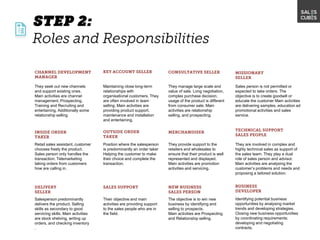
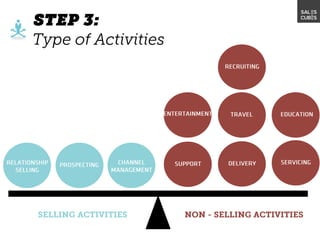
    They manage largescale and value of sale. Long negotiation, complex purchase decision, usage of the product is different from consumer sale. Main activities are relationship selling, and prospecting. Sales person is not permitted or expected to take orders. The objective is to create goodwill or educate the customer Main activities are delivering samples, education ad promotional activities and sales service. They seek out new channels and support existing ones. Main activities are channel management, Prospecting, Training and Recruiting and entertaining. Additionally some relationship selling Salesperson predominantly delivers the product. Selling skills as secondary to good servicing skills. Main activities are stock shelving, writing up orders, and checking inventory . Their objective and main activities are providing support to the sales people who are in the field. Maintaining close long-term relationships with organisational customers. They are often involved in team selling. Main activities are providing product support, maintenance and installation and entertaining. The objective is to win new business by identifying and selling to prospects. Main activities are Prospecting and Relationship selling. They provide support to the retailers and wholesales to ensure that their product is well represented and displayed. Main activities are promotion activities and servicing. Retail sales assistant, customer chooses freely the product. Sales person only handles the transaction. Telemarketing taking orders from customers how are calling in. Position where the salesperson is predominantly an order taker Helping the customer to make their choice and complete the transaction. They are involved in complex and highly technical sales as support of the sales team. They play a dual role of sales person and advisor. Main activities are analysing the customer’s problems and needs and proposing a tailored solution. Identifying potential business opportunities by analysing market trends and developing strategies. Closing new business opportunities by coordinating requirements; developing and negotiating contracts.
  • 81.
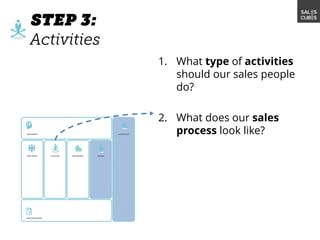
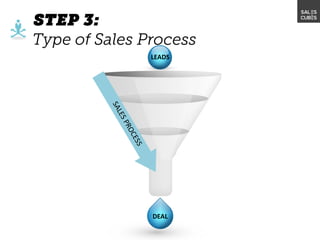
    1. What typeof activities should our sales people do? 2. What does our sales process look like?
  • 84.
  • 85.
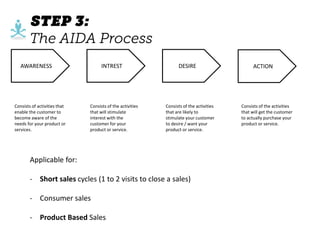
    Consists of activitiesthat enable the customer to become aware of the needs for your product or services. Consists of the activities that will stimulate interest with the customer for your product or service. Consists of the activities that are likely to stimulate your customer to desire / want your product or service. Consists of the activities that will get the customer to actually purchase your product or service. AWARENESS INTREST DESIRE ACTION Applicable for: - Short sales cycles (1 to 2 visits to close a sales) - Consumer sales - Product Based Sales
  • 86.
    Prospecting Qualification PresentingNegotiating Closed Follow-up Consists of activities such as generating, qualifying and distributing new leads. Consists of understanding the needs and problems of the customer and determining whether the sales person’s products and services can be of value to the customer. Consists of showing the customer how the supplier’s produces and services will enable them to solve their problems and needs. Consists of agreeing the terms of the purchase with the customer. Consists of all the final contractual activities to close the deal. Consists of all the activities the sales force provides during the after sales of the product. Applicable for: - Long and complex sales cycles - Project Based Sales - Business to Business sales
  • 87.
    Consists of activitiesthat enable the customer to become aware of the needs for your product or services. Consists of the activities that will stimulate interest with the customer for your product or service. Consists of the activities that are likely to stimulate your customer to desire / want your product or service. Consists of the activities that will get the customer to actually purchase your product or service. EXPLORATION BASIC CO OPERATTION ALLIGNED Consists of the activities that will get the customer to actually purchase your product or service. INTEGRATED Applicable for: - Long and complex relationships - Key Account based Sales - Business to Business sales
  • 88.
    Instructions In groups of4 or 5: 1. Select the sales stages tat are more appropriate for your sales process. 2. For each of the stages identify all the key activities that the sales people will need to perform. 30 MIN
  • 90.
  • 91.
    1. What typeof sales people do we need?
  • 92.
    9 8 7 6 5 4 3 2 1 2 34 5 6 7 8 9 CLOSER CONSULTANTRELATIONSHIP BUILDER DISPLAY SALES PERSON
  • 93.
    Personality: High energy Manipulative High Needto achieve Risk Takers Skills: Prospecting Presenting Motivation: Status Recognition Personality: Team Leader Professional Enjoys challenges Highly Educated Calculated Risks Skills: Problem Solving Motivation: Mastery Purpose Personality: Likable, fun Hard working Team Player Likes his autonomy Avoids Risks Skills: Developing Relationships Motivation: Autonomy Sense of Belonging Personality: Happy, outgoing Service oriented Not an overachiever Pleases the customer Avoids Risks Skills: Service driven Motivation: Recognition
  • 94.
    Customer Needs Sales PersonProfile New Product Buyers New System Buyers Established System Buyers Commodity Buyers 85% 40% 25% 20% 50% 82% 46% 30% 15% 55% 89% 35% 10% 9% 18% 70% Source: HR The Chally Group: « How to Match the Type of Salesperson to your customers? »
  • 96.
    1. What typeof sales approach to adopt ? 2. How will we coach our sales people?
  • 97.
    MARKET BASED The market/ customer sales revenues determine whether the sales people are doing a good job or not. BEHAVIOUR BASED Adherence to our sales process and activity targets determine whether the sales people are going a good job or not. CLAN BASED Adherence to our company’s values and norms determine whether the sales people are going a good job or not. 97 MARKET BASED BEHAVIOUR BASED CLAN BASED
  • 98.
    ADVANTAGES - Keep salespeople focus on results. - Easy to apply. - Promote initiative - Consistent across different people in the organisation - Requires very little management attention DISADVANATAGTES - Focus on the end rather then the means - Fails to stimulate growth of professionalism - Short term focus - Requires sales people whit a risk taking profile
  • 99.
    Tupperware ladies SelfEmployed Sales Agents “Jerry Maguire Movie”
  • 100.
    ADVANTAGES - Greater opportunityfor behaviour modification. - Encourage customer relationships. - Recognize the difference between cause and effort. - Encourages risk averse people to start a career in sales. - Applicable where sales people need very specialised knowledge and skills. DISADVANATAGTES - Requires management ability to observe and diagnose - Require time for observation - Requires impartiality - Likely to be implemented with some inconsistency across the organisation
  • 101.
  • 102.
    ADVANTAGES - Requires verylittle management effort - Encourages loyalty - Recognises that selling is a team based effort. - Promotes autonomy and initiatives - Applicable where sales people need very specialised knowledge and skills - Applicable in highly volatile markets DISADVANATAGTES - Difficult to measure, very subjective - Lack of outcome focus - Requires impartiality - Lacks real accountability
  • 103.
  • 104.
  • 105.
    Instructions You probably willcombine all three approaches in your management style. The question is: 1. How important is each going to be. Draw a line connecting the three legs indicating their relative importance. 2. Describe how you are going to implement the approach in terms of management activities, rewards and targets. 20 MIN
  • 106.
  • 108.
    In groups of2 participants: • GOALS: What are your goals for the this period? • REALITY: How far are you from realising your individual goals? For which goals are you lagging? • OBSTACLE: Why are you lagging? Ask 3 times the why question. • WAY FORWARD: How can we remove the obstacle? 20 MIN Why? Why? Why?