P
S
I
Copyright 2010 by HRDQ. All rights reserved.
Not for resale. www.hrdq.com
Presented by:
Keera Godfrey, MBA M.S.
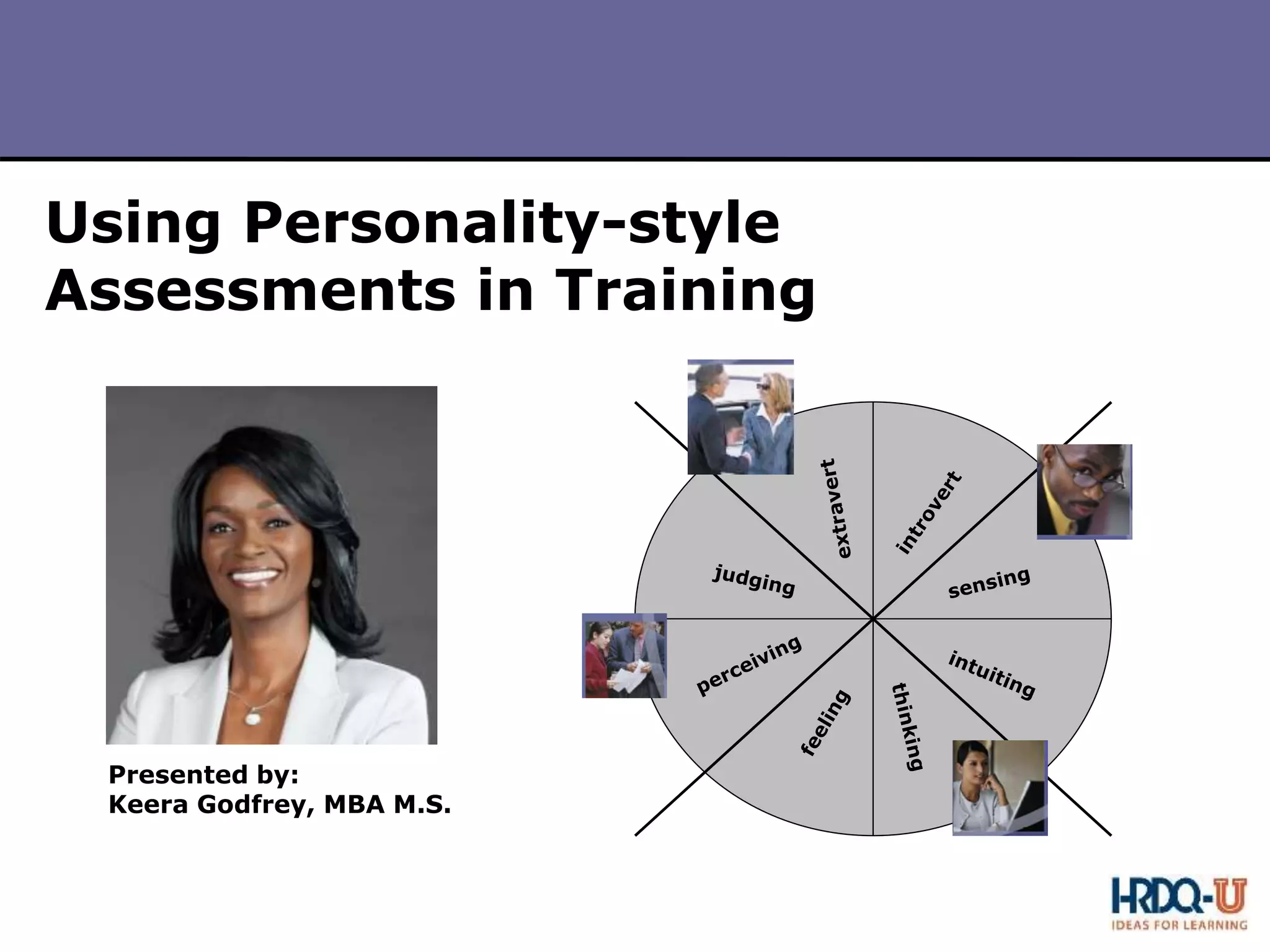
Using Personality-style
Assessments in Training
P
S
I
Copyright 2010 by HRDQ. All rights reserved.
Not for resale. www.hrdq.com
 What are personality-style assessments
 What they are NOT
 Why use one
 Four dimensions of Jungian theory
 Strengths and weaknesses of each
 Clashes of preferences
 Applications of style awareness
 Question and Answer
Today’s Agenda
P
S
I
Copyright 2010 by HRDQ. All rights reserved.
Not for resale. www.hrdq.com
Poll
Who do we have joining us today?
Are you a…
 Trainer/OD Designer
 HR Specialist
 Manager
 Sales Rep
 Other
P
S
I
Copyright 2010 by HRDQ. All rights reserved.
Not for resale. www.hrdq.com
Poll
How familiar are you with
personality-style assessments?
 Certified expert
 Trained using some
 Only taken one as a participant
 Little to no experience
P
S
I
Copyright 2010 by HRDQ. All rights reserved.
Not for resale. www.hrdq.com
What are they…
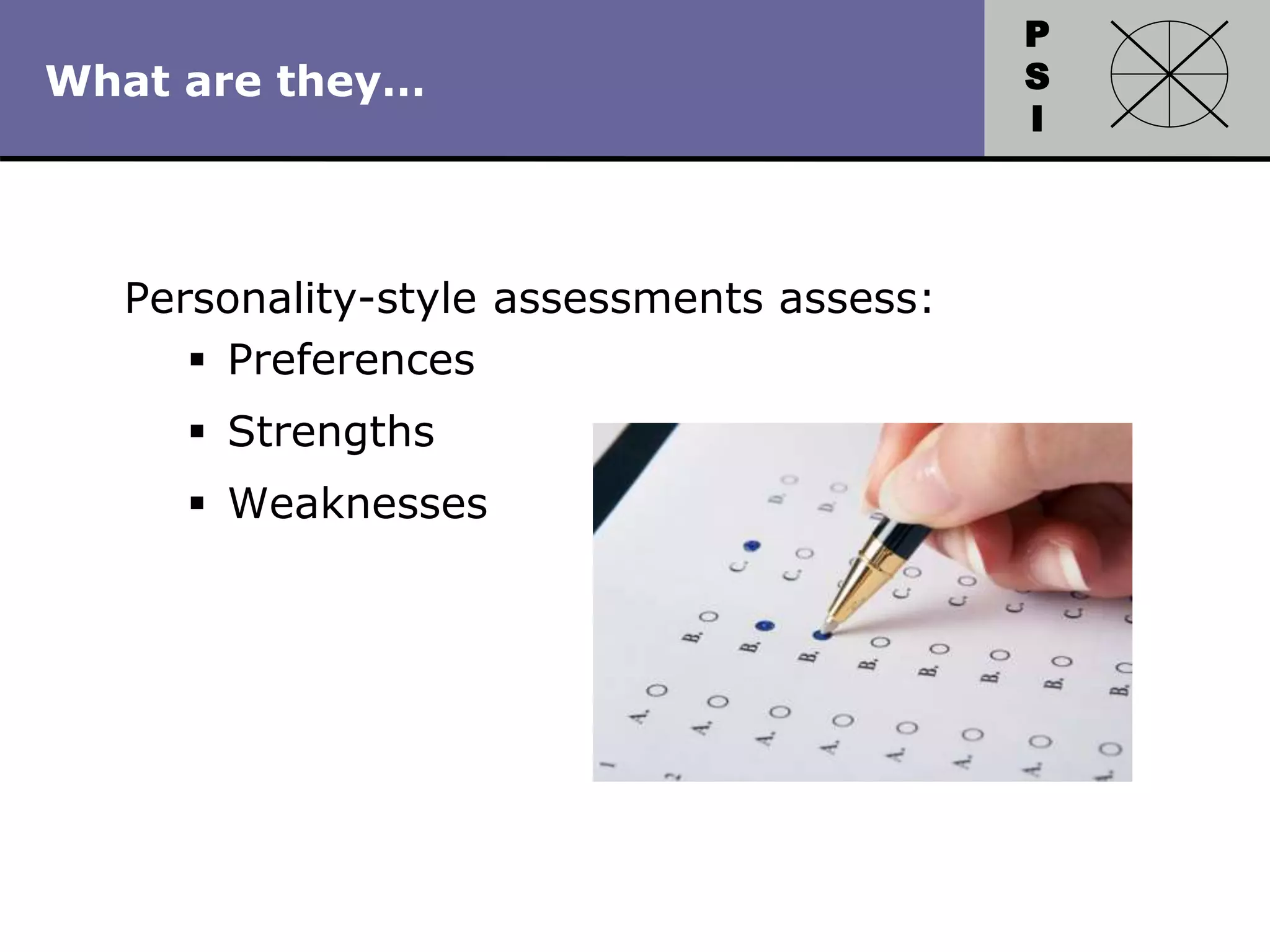
Personality-style assessments assess:
 Preferences
 Strengths
 Weaknesses
P
S
I
Copyright 2010 by HRDQ. All rights reserved.
Not for resale. www.hrdq.com
They are NOT…
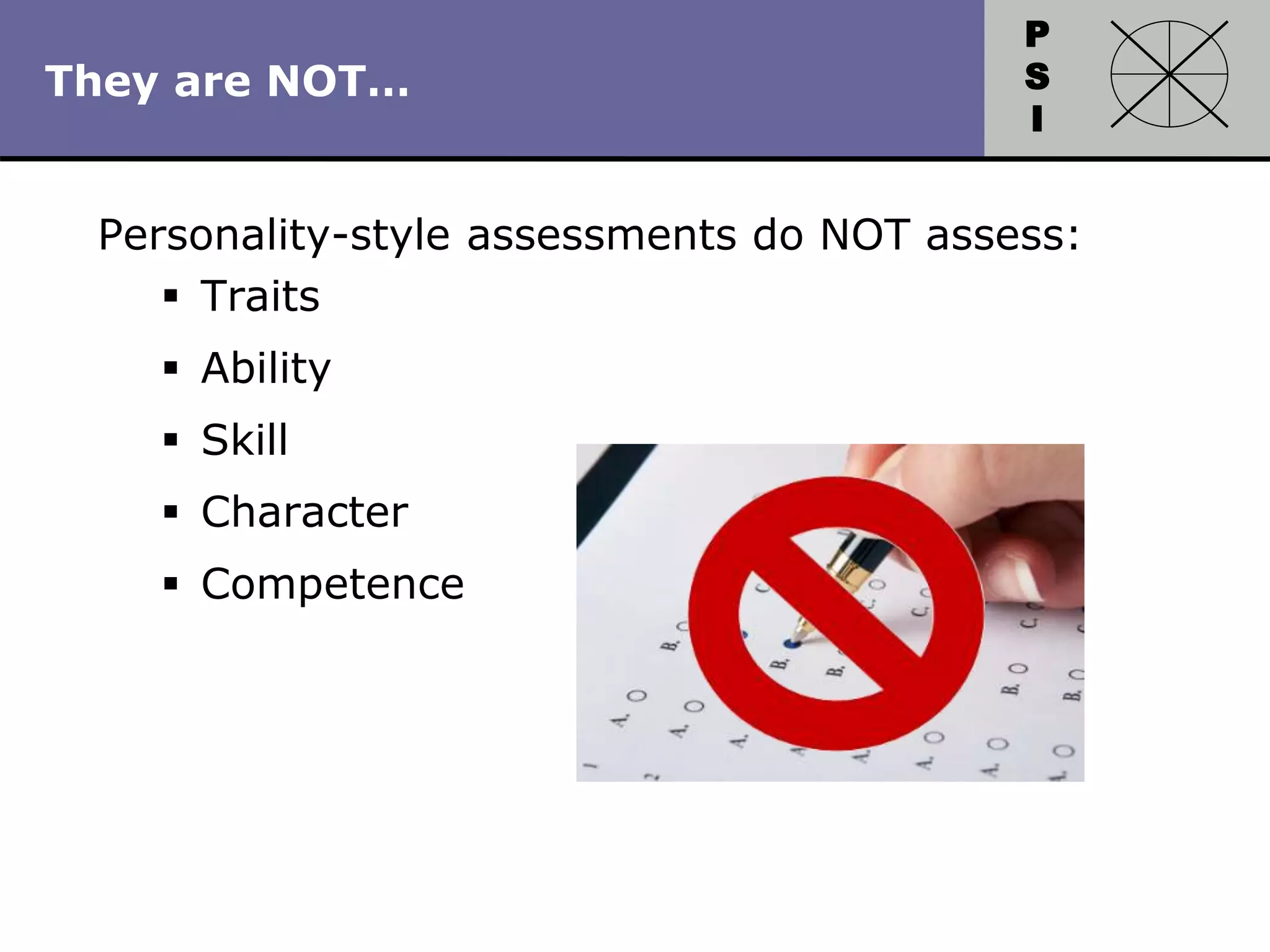
Personality-style assessments do NOT assess:
 Traits
 Ability
 Skill
 Character
 Competence
P
S
I
Copyright 2010 by HRDQ. All rights reserved.
Not for resale. www.hrdq.com
Why use one?
 Individuals learn about themselves, their preferences, and
their behavior
 Raises self esteem
 Enables constructive use of individual differences
 Improves communication
 Leads to effective conflict management
 Provides insight for how to influence others effectively
 Professional development
P
S
I
Copyright 2010 by HRDQ. All rights reserved.
Not for resale. www.hrdq.com
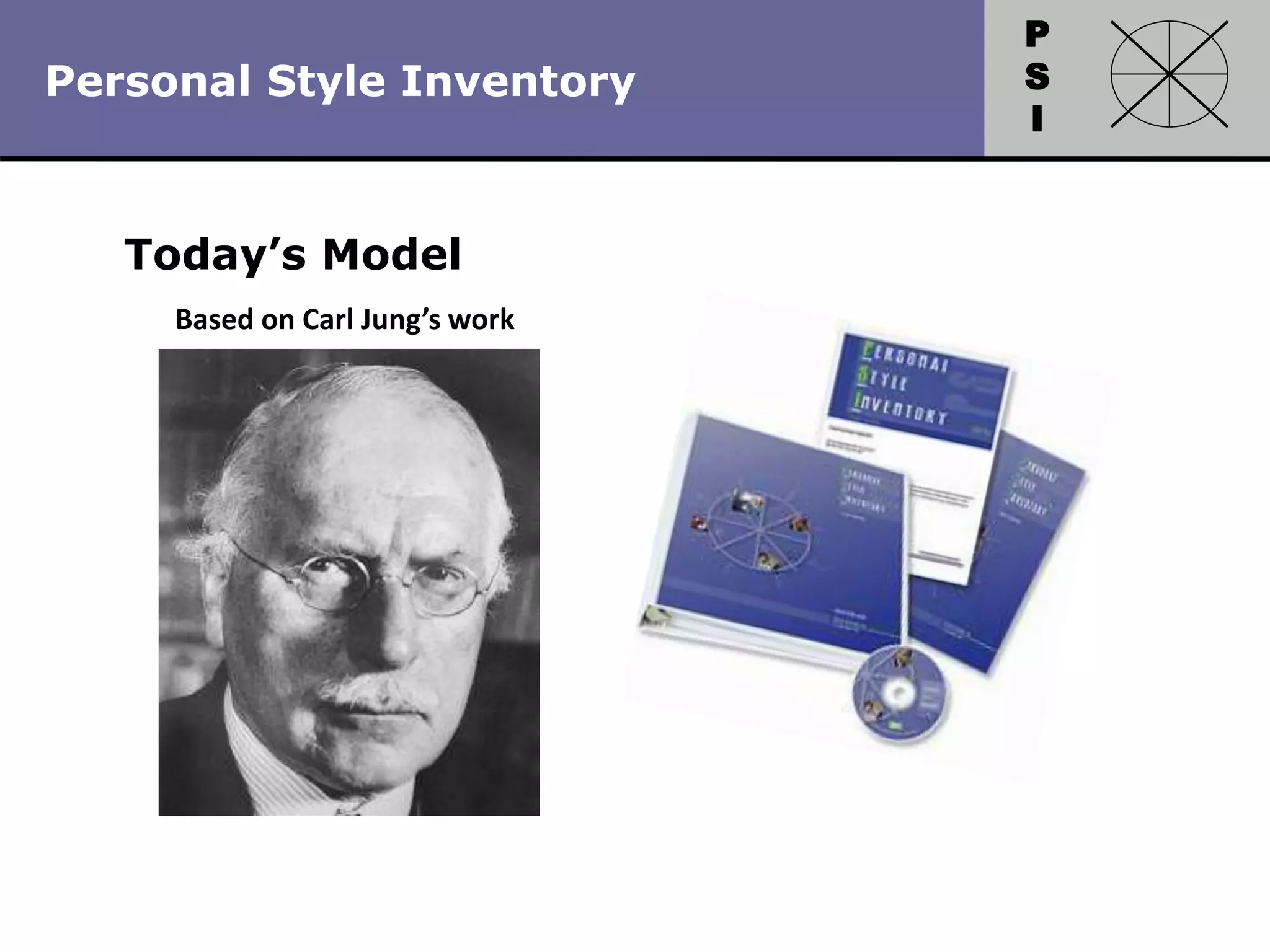
Personal Style Inventory
Based on Carl Jung’s work
Today’s Model
P
S
I
Copyright 2010 by HRDQ. All rights reserved.
Not for resale. www.hrdq.com
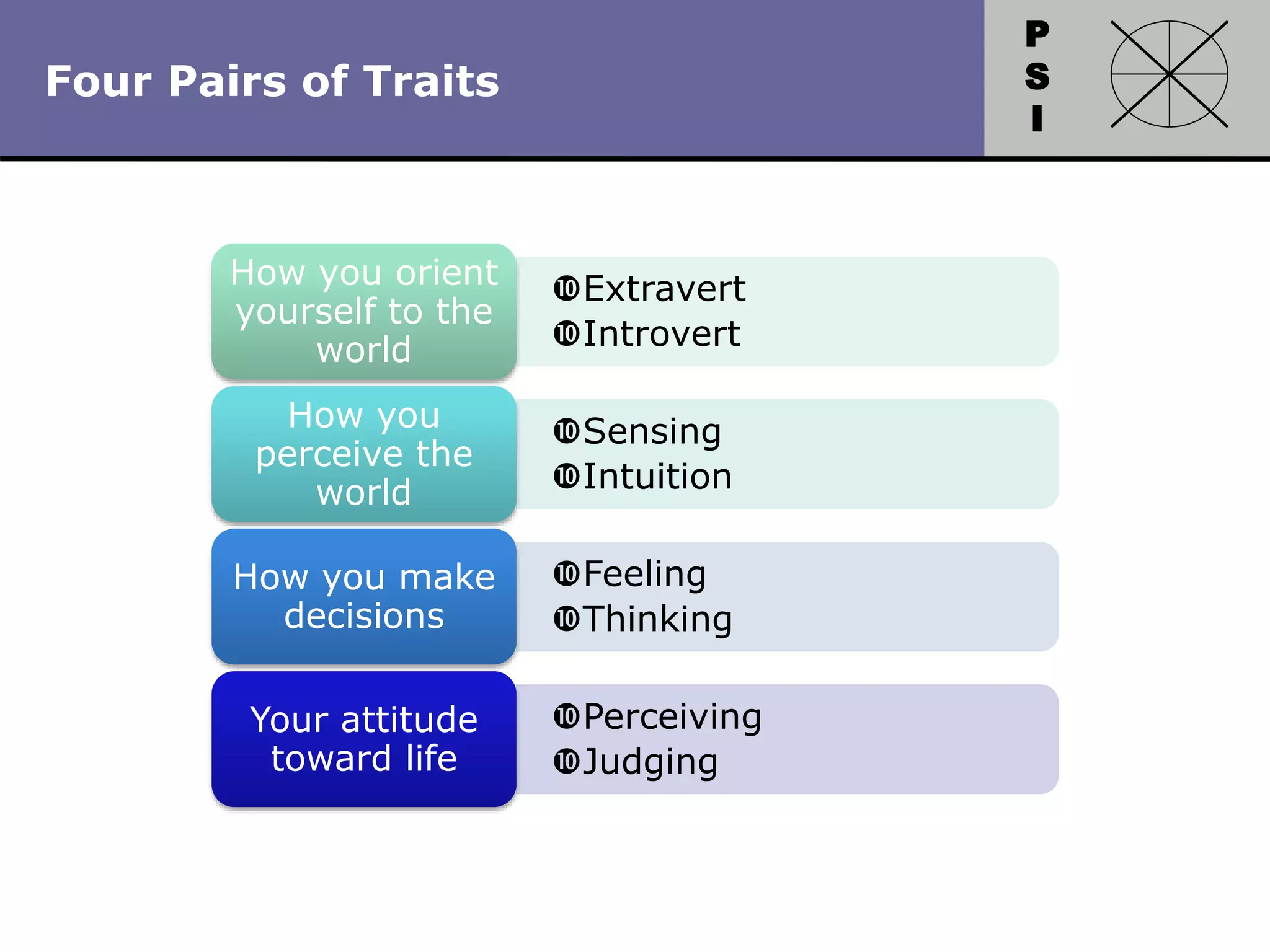
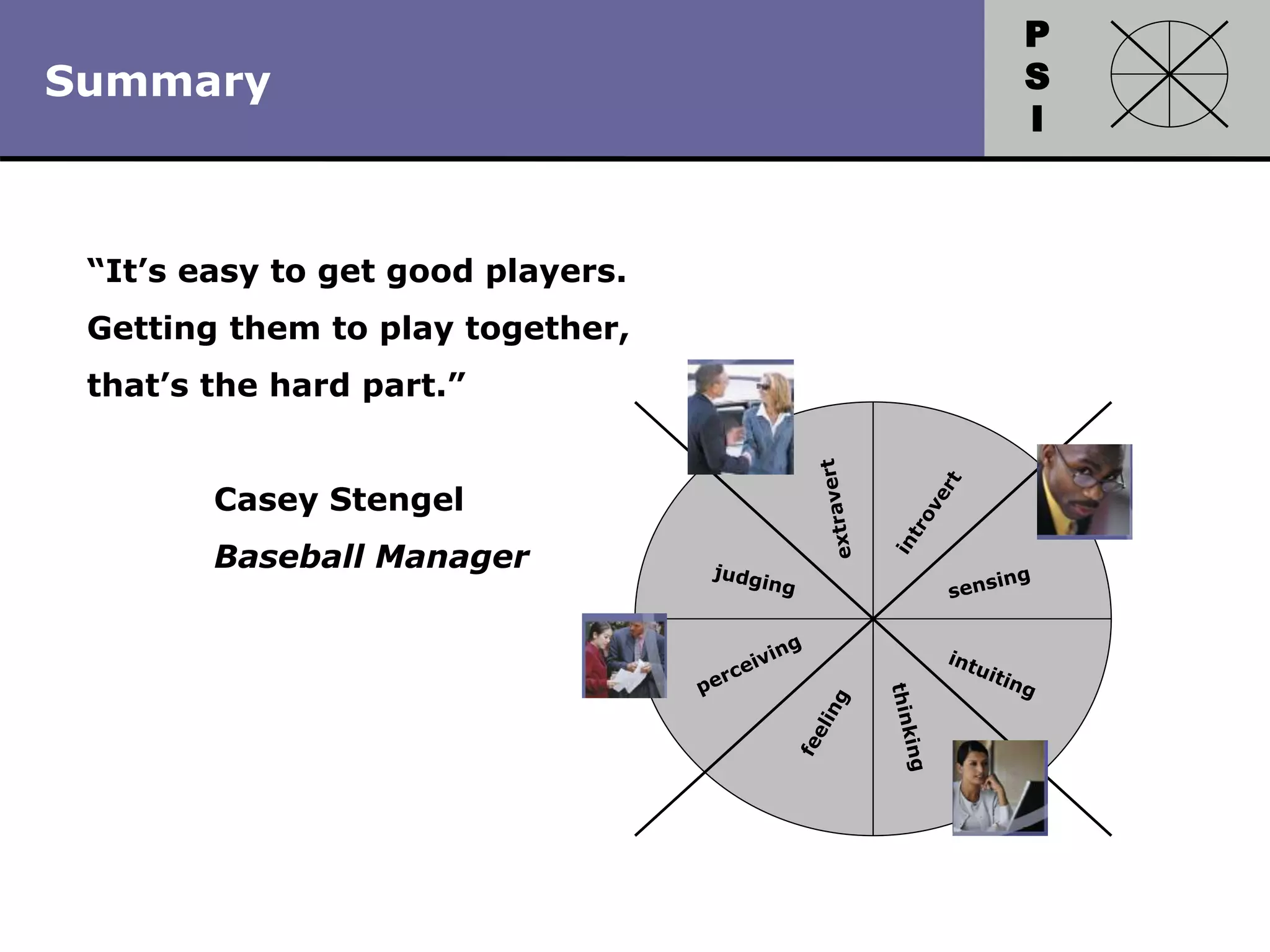
Four Pairs of Traits
Extravert
Introvert
How you orient
yourself to the
world
Sensing
Intuition
How you
perceive the
world
Feeling
Thinking
How you make
decisions
Perceiving
Judging
Your attitude
toward life
P
S
I
Copyright 2010 by HRDQ. All rights reserved.
Not for resale. www.hrdq.com
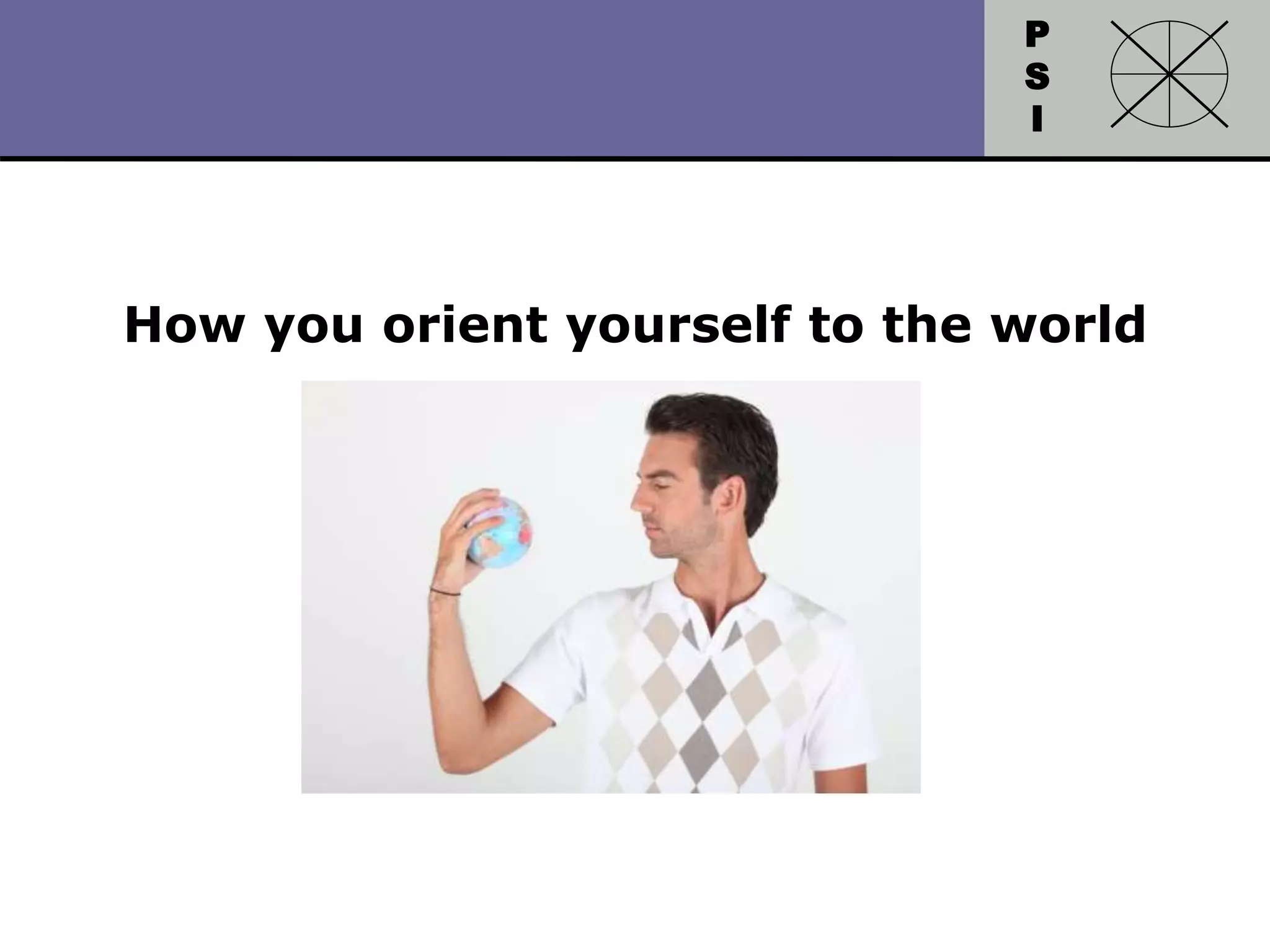
How you orient yourself to the world
P
S
I
Copyright 2010 by HRDQ. All rights reserved.
Not for resale. www.hrdq.com
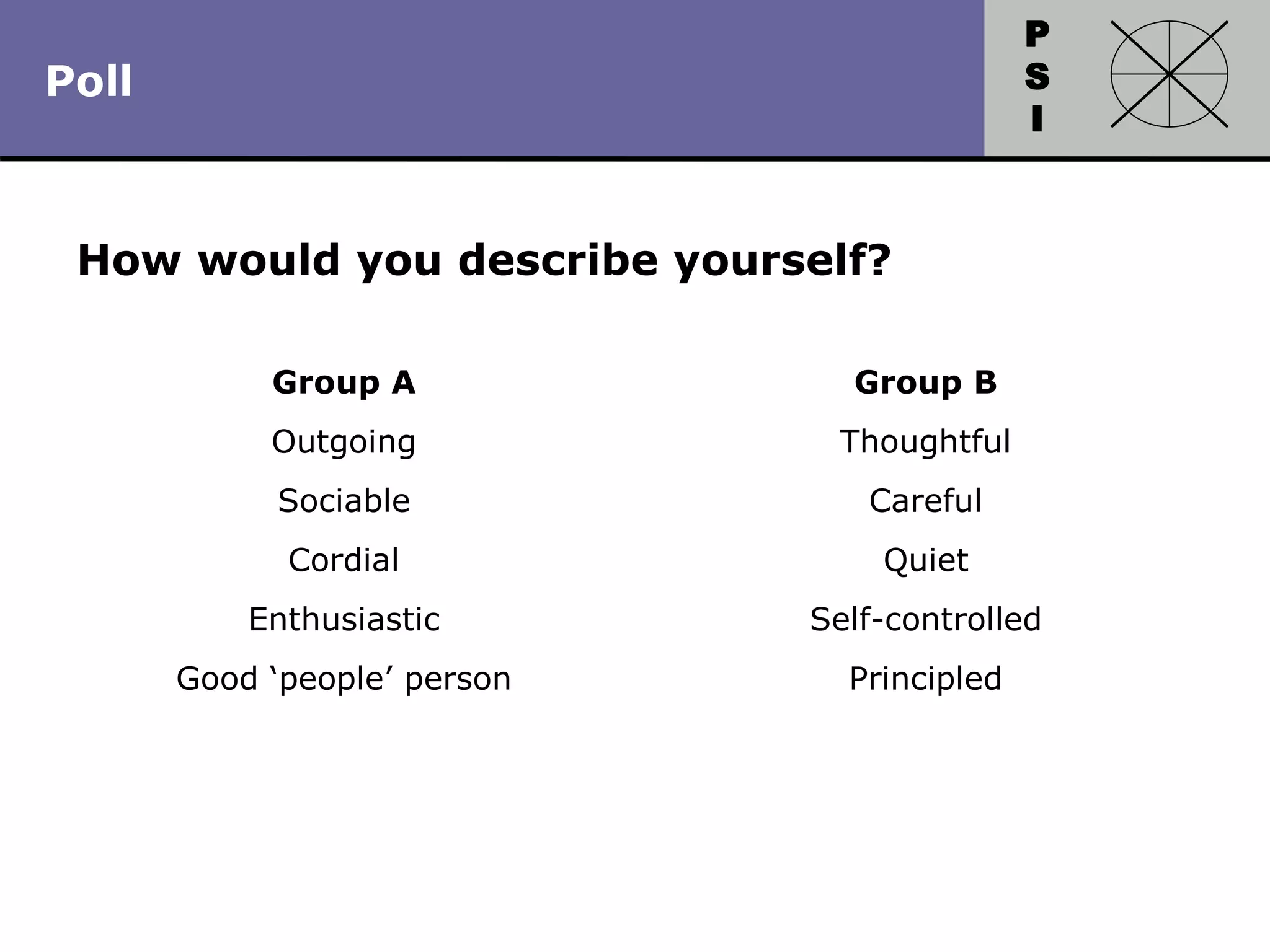
How would you describe yourself?
Group A
Outgoing
Sociable
Cordial
Enthusiastic
Good ‘people’ person
Group B
Thoughtful
Careful
Quiet
Self-controlled
Principled
Poll
P
S
I
Copyright 2010 by HRDQ. All rights reserved.
Not for resale. www.hrdq.com
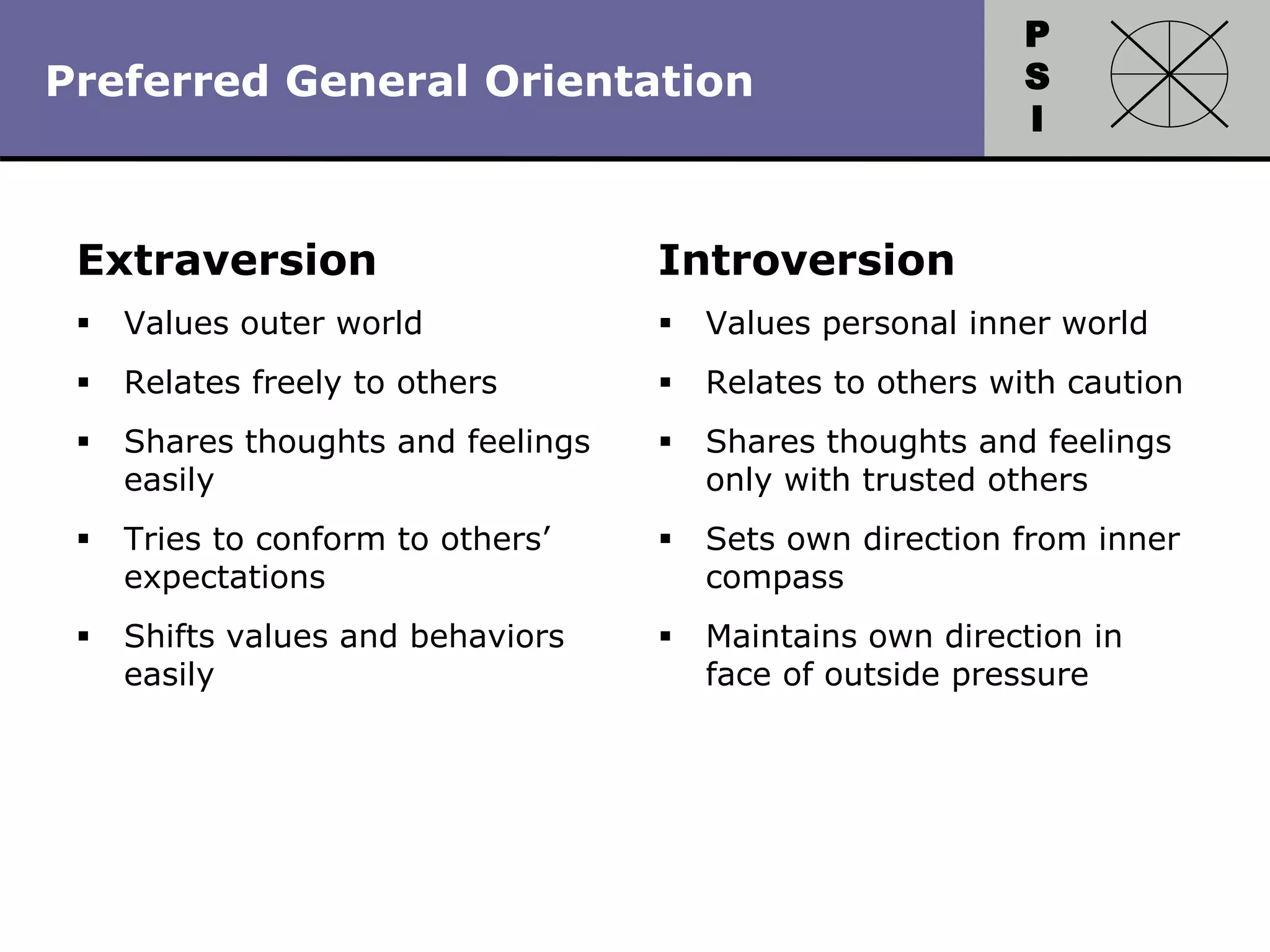
Extraversion
 Values outer world
 Relates freely to others
 Shares thoughts and feelings
easily
 Tries to conform to others’
expectations
 Shifts values and behaviors
easily
Introversion
 Values personal inner world
 Relates to others with caution
 Shares thoughts and feelings
only with trusted others
 Sets own direction from inner
compass
 Maintains own direction in
face of outside pressure
Preferred General Orientation
P
S
I
Copyright 2010 by HRDQ. All rights reserved.
Not for resale. www.hrdq.com
Strengths
 Understanding what the
external world wants
 Interacting with others
 Using group consensus to
solve problems
 Going along with group
decisions
Weaknesses
x Making independent decisions
and sticking to them
x Getting tasks done alone
x Maintaining attention to
tedious, solitary activities
x Having meetings with memos
or email would be more
appropriate
Extraverts
P
S
I
Copyright 2010 by HRDQ. All rights reserved.
Not for resale. www.hrdq.com
Strengths
 Working alone
 Independent thought
 Non-impulsive, reflective
action
 The ability to concentrate
 Working with ideas
 Having a clear direction
Weaknesses
x Being aware of the world
around them
x Missing opportunities
x Not making the critical input
to influence decisions
x Not establishing context for
ideas so others may relate
and accept more easily
Introverts
P
S
I
Copyright 2010 by HRDQ. All rights reserved.
Not for resale. www.hrdq.com
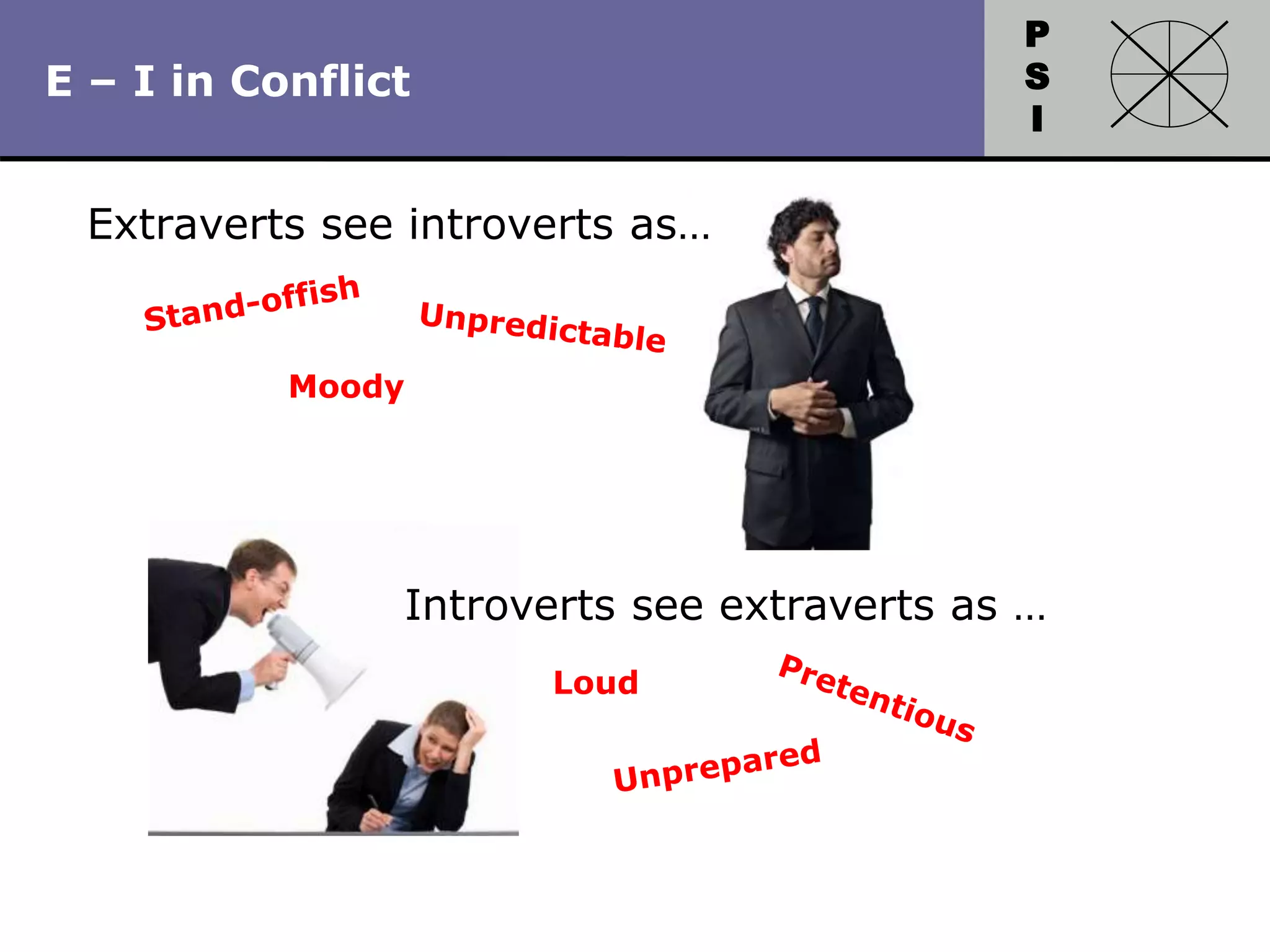
E – I in Conflict
Extraverts see introverts as…
Introverts see extraverts as …
Loud
Moody
P
S
I
Copyright 2010 by HRDQ. All rights reserved.
Not for resale. www.hrdq.com
How you perceive the world
P
S
I
Copyright 2010 by HRDQ. All rights reserved.
Not for resale. www.hrdq.com
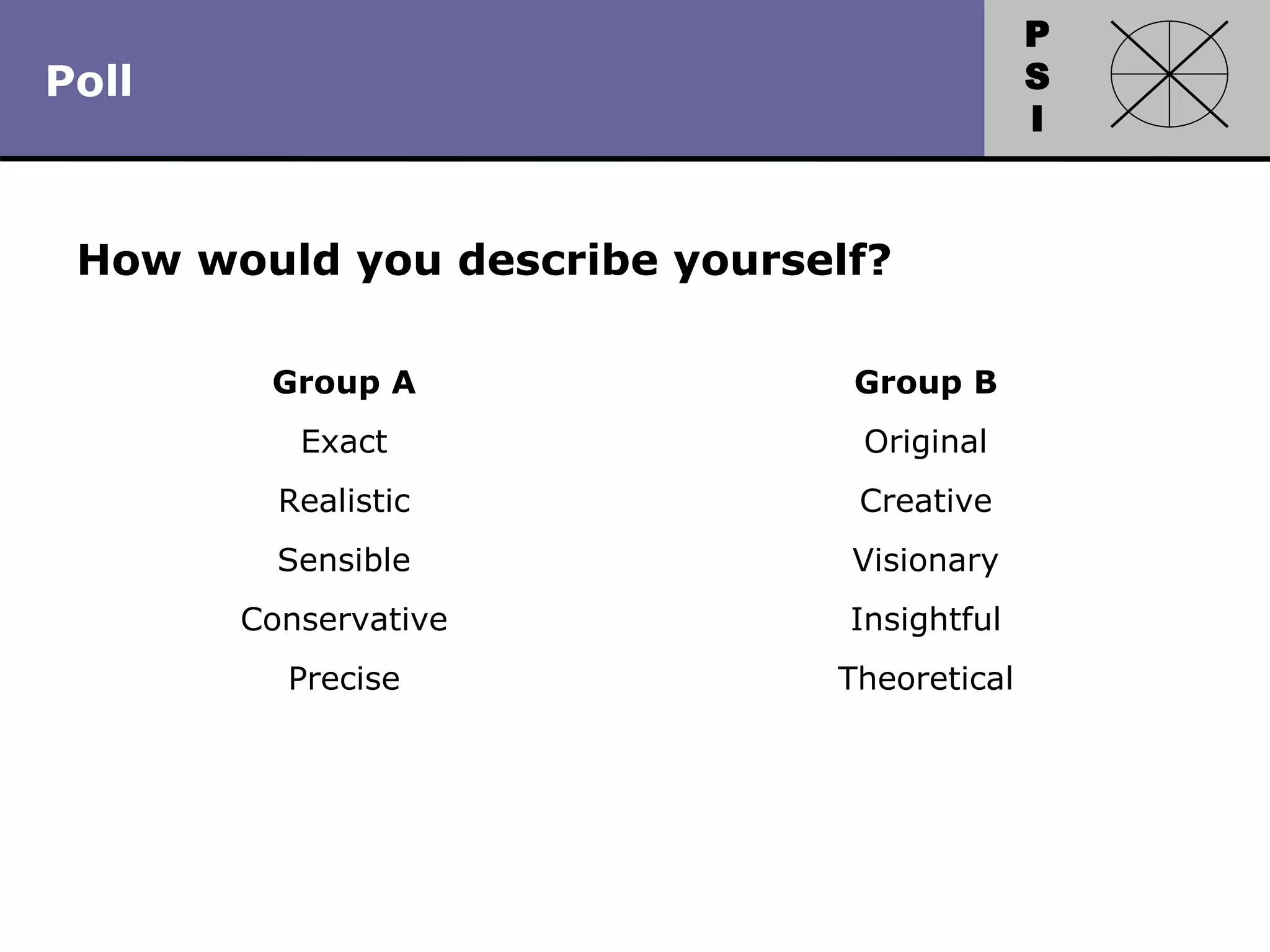
How would you describe yourself?
Group A
Exact
Realistic
Sensible
Conservative
Precise
Group B
Original
Creative
Visionary
Insightful
Theoretical
Poll
P
S
I
Copyright 2010 by HRDQ. All rights reserved.
Not for resale. www.hrdq.com
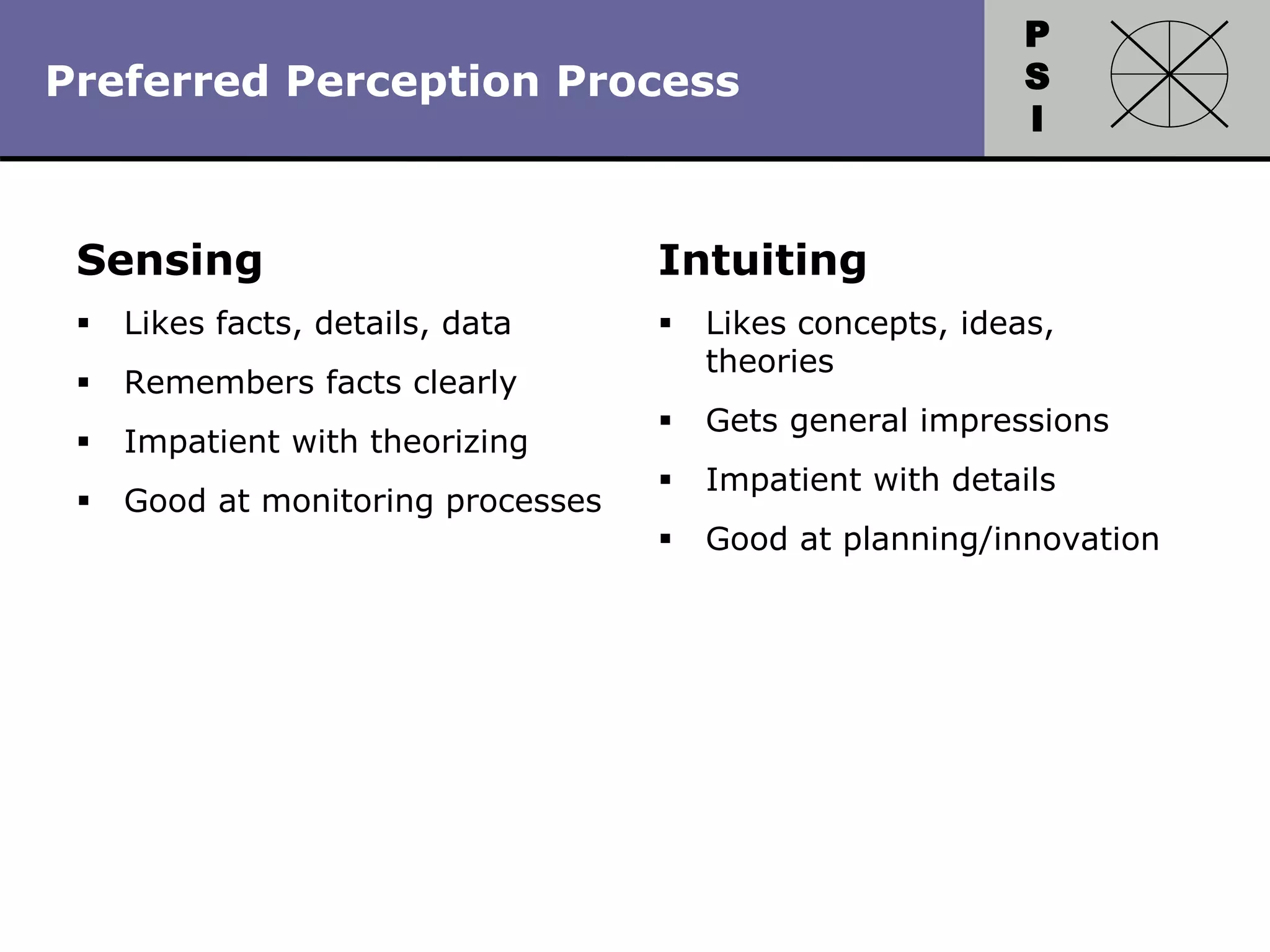
Sensing
 Likes facts, details, data
 Remembers facts clearly
 Impatient with theorizing
 Good at monitoring processes
Intuiting
 Likes concepts, ideas,
theories
 Gets general impressions
 Impatient with details
 Good at planning/innovation
Preferred Perception Process
P
S
I
Copyright 2010 by HRDQ. All rights reserved.
Not for resale. www.hrdq.com
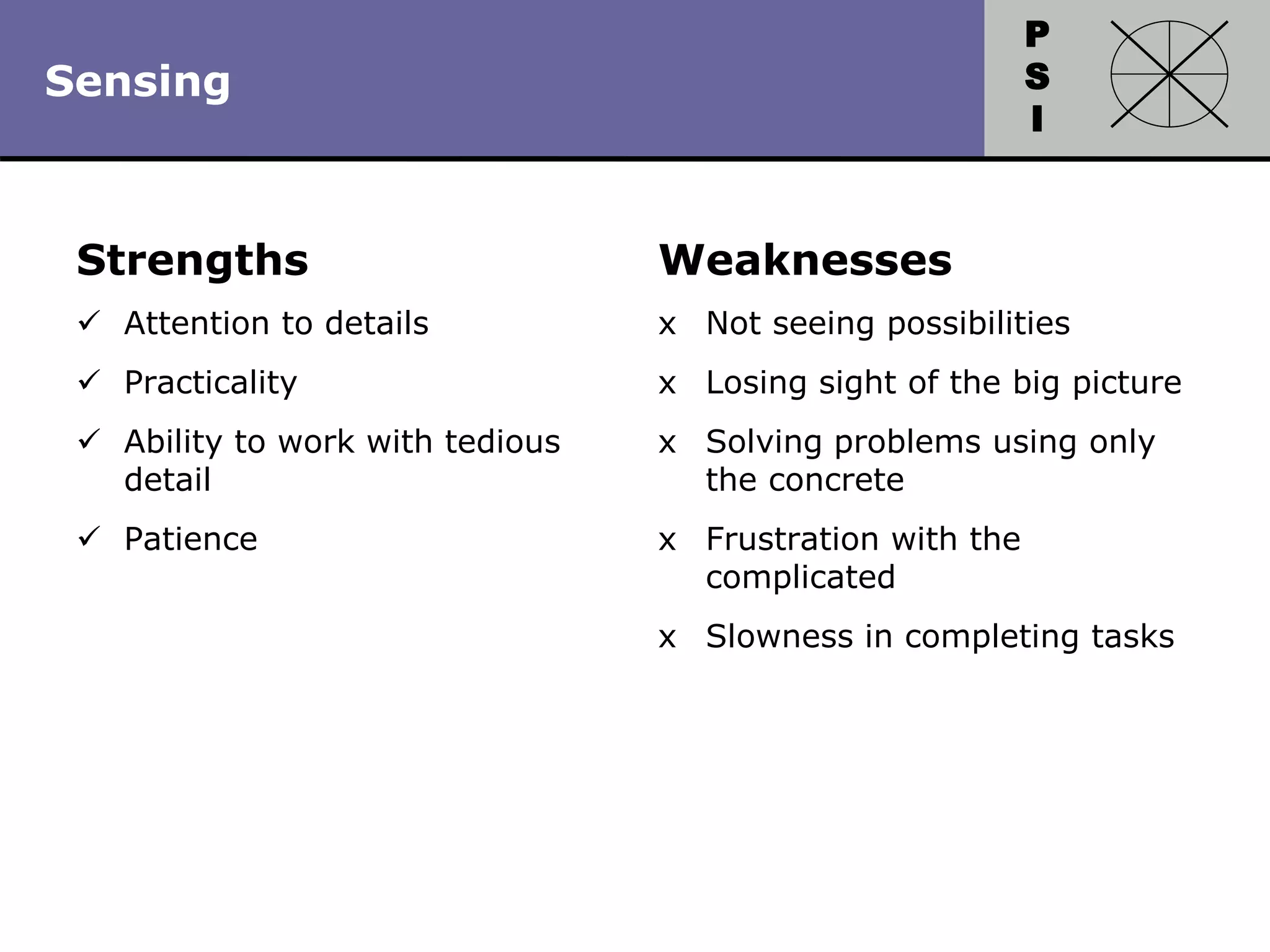
Strengths
 Attention to details
 Practicality
 Ability to work with tedious
detail
 Patience
Weaknesses
x Not seeing possibilities
x Losing sight of the big picture
x Solving problems using only
the concrete
x Frustration with the
complicated
x Slowness in completing tasks
Sensing
P
S
I
Copyright 2010 by HRDQ. All rights reserved.
Not for resale. www.hrdq.com
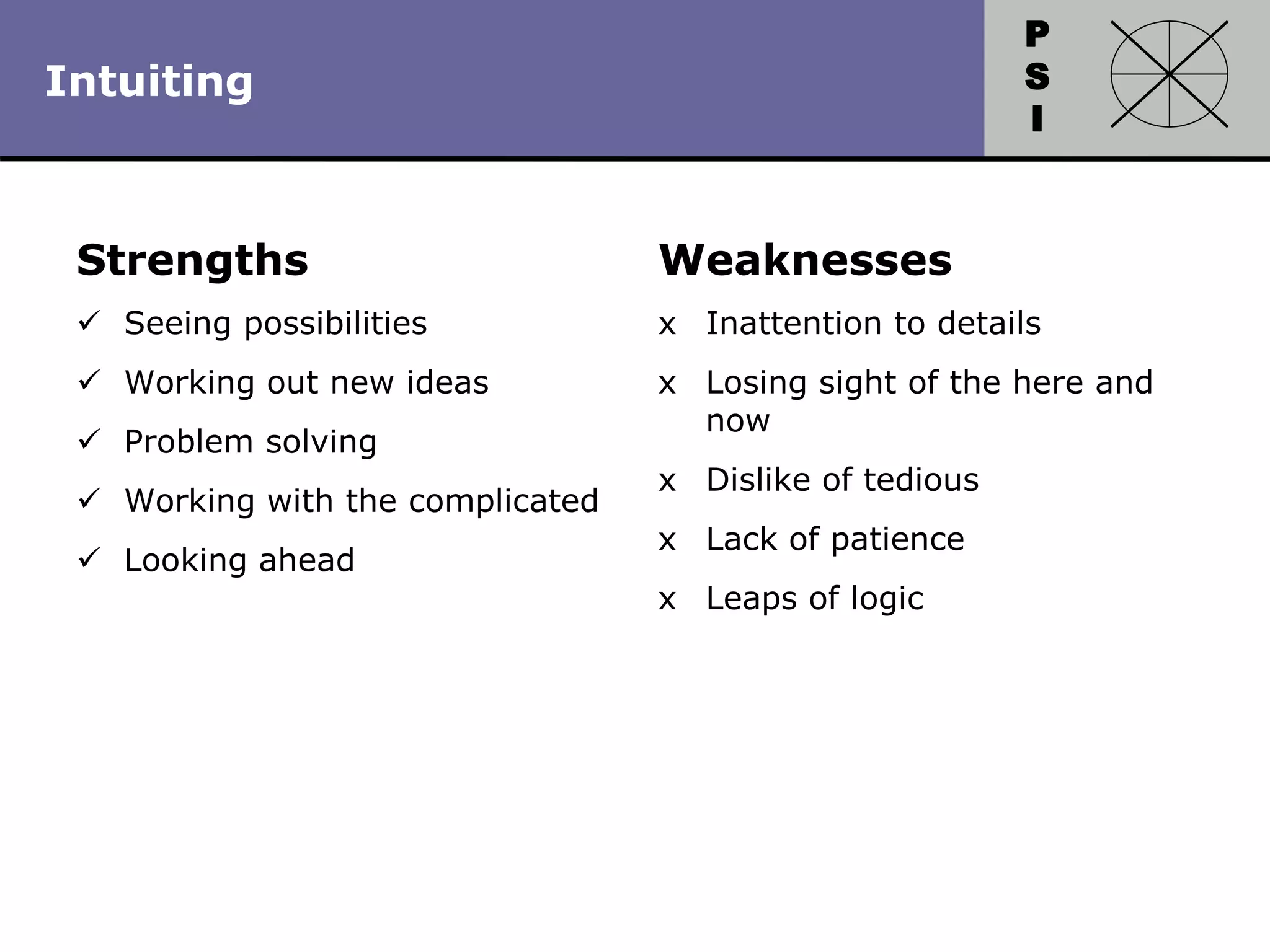
Strengths
 Seeing possibilities
 Working out new ideas
 Problem solving
 Working with the complicated
 Looking ahead
Weaknesses
x Inattention to details
x Losing sight of the here and
now
x Dislike of tedious
x Lack of patience
x Leaps of logic
Intuiting
P
S
I
Copyright 2010 by HRDQ. All rights reserved.
Not for resale. www.hrdq.com
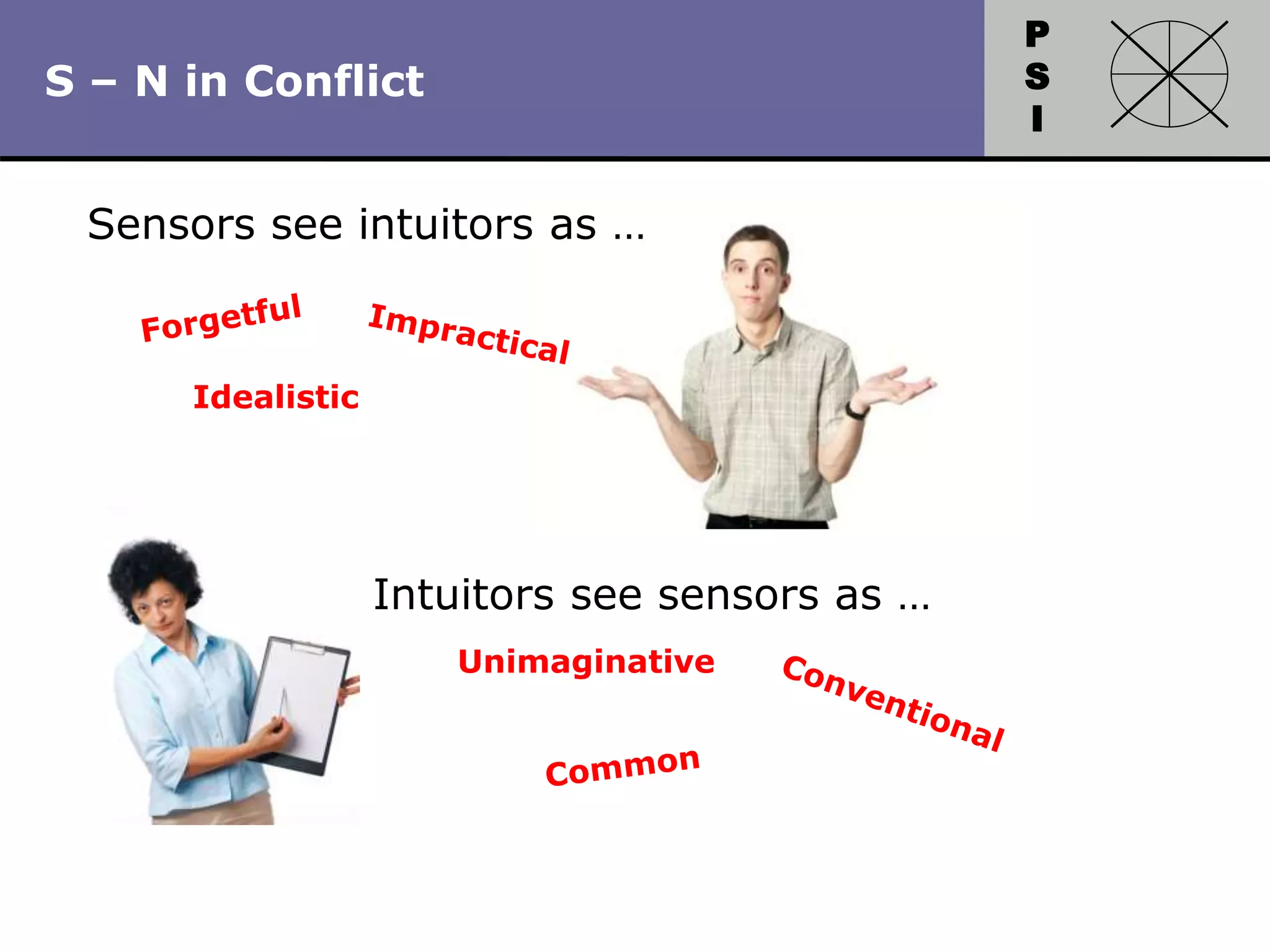
S – N in Conflict
Sensors see intuitors as …
Intuitors see sensors as …
Unimaginative
Idealistic
P
S
I
Copyright 2010 by HRDQ. All rights reserved.
Not for resale. www.hrdq.com
How you make decisions
P
S
I
Copyright 2010 by HRDQ. All rights reserved.
Not for resale. www.hrdq.com
How would you describe yourself?
Group A
Systematic
Logical
Objective
Reasonable
Calculating
Group B
Humanistic
Empathetic
Compassionate
Warm
Sentimental
Poll
P
S
I
Copyright 2010 by HRDQ. All rights reserved.
Not for resale. www.hrdq.com
Thinking
 Uses rational thought
 Is analytical, logical
 Prefers rules, procedures,
systems
 Suspicious of Feelers
Feeling
 Uses personal
reactions/convictions
 Believes feelings are superior
to logic
 Feels confined by rules,
procedures, systems
 Impatient with ‘analytical
types’
Preferred Decision Style
P
S
I
Copyright 2010 by HRDQ. All rights reserved.
Not for resale. www.hrdq.com
Strengths
 Logical analysis
 Objectivity, even in personal
situations
 Organization
 Critical ability
 Standing firm
Weaknesses
x Not noticing people’s feelings
x Misunderstanding others
values and their importance
x Lack of interest in conciliation
x Not expressing feelings
x Lack of interest in persuading
or motivating others
Thinking
P
S
I
Copyright 2010 by HRDQ. All rights reserved.
Not for resale. www.hrdq.com
Strengths
 Considering others’ feelings
 Understanding needs, values
and feelings of others
 Interest in conciliation
 Ability and interest in
persuading and arousing
enthusiasm
Weaknesses
x Not being logical
x Not being objective
x Being organized around
values rather than logic
x Being uncritical and overly
accepting
x Basing decisions on values
and feelings alone
Feeling
P
S
I
Copyright 2010 by HRDQ. All rights reserved.
Not for resale. www.hrdq.com
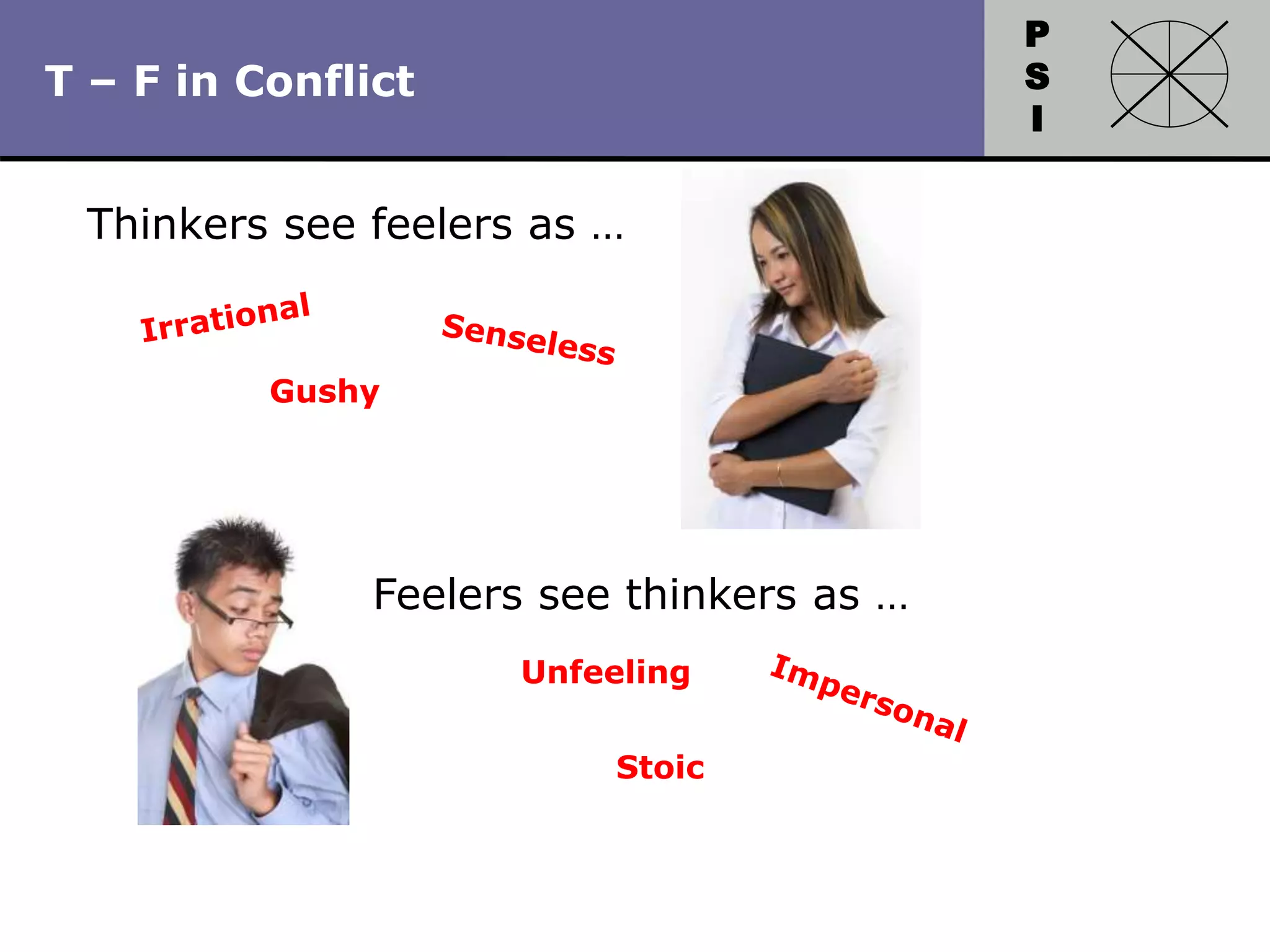
T – F in Conflict
Thinkers see feelers as …
Feelers see thinkers as …
Unfeeling
Stoic
Gushy
P
S
I
Copyright 2010 by HRDQ. All rights reserved.
Not for resale. www.hrdq.com
Your attitude toward life
P
S
I
Copyright 2010 by HRDQ. All rights reserved.
Not for resale. www.hrdq.com
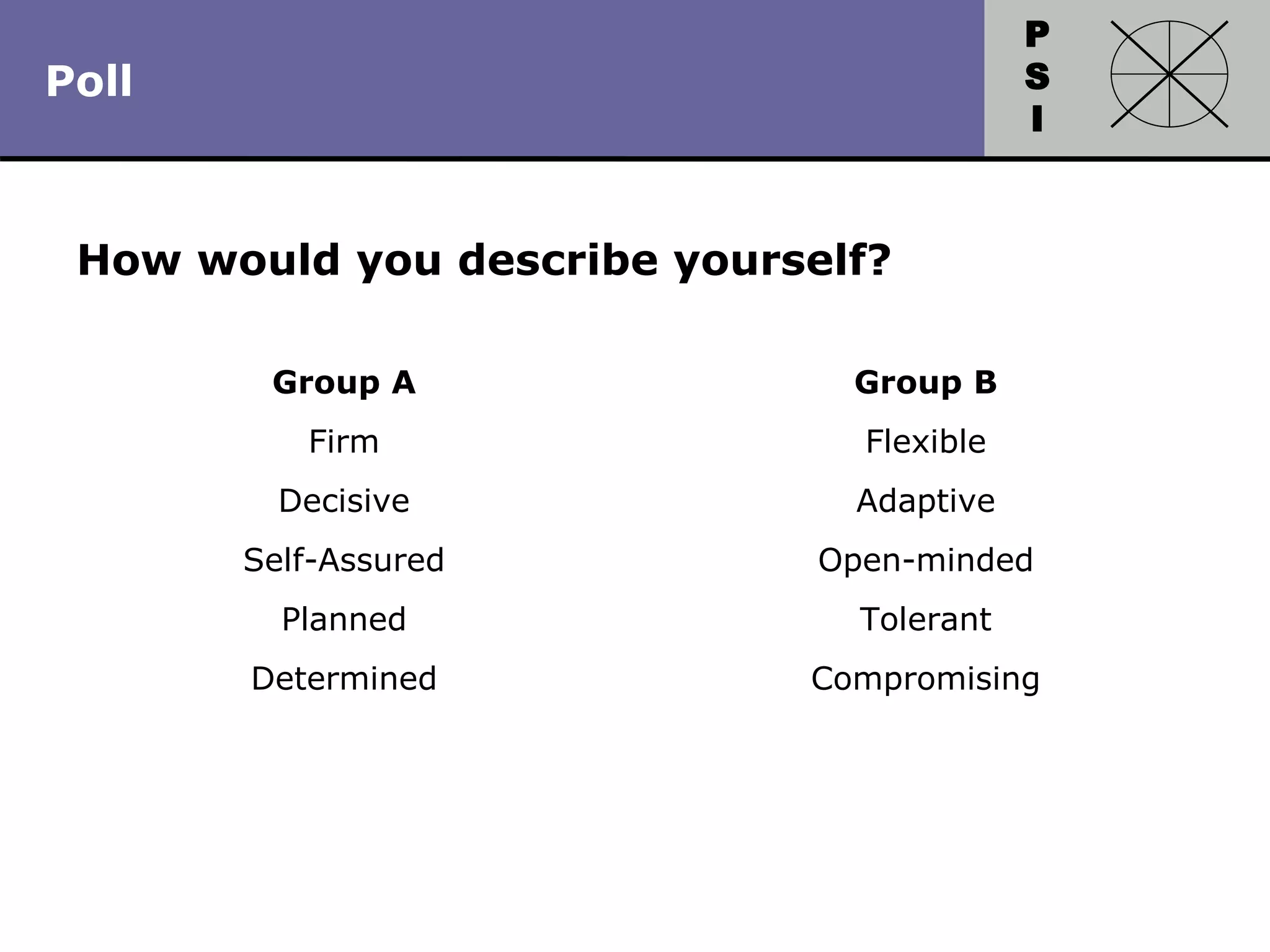
How would you describe yourself?
Group A
Firm
Decisive
Self-Assured
Planned
Determined
Group B
Flexible
Adaptive
Open-minded
Tolerant
Compromising
Poll
P
S
I
Copyright 2010 by HRDQ. All rights reserved.
Not for resale. www.hrdq.com
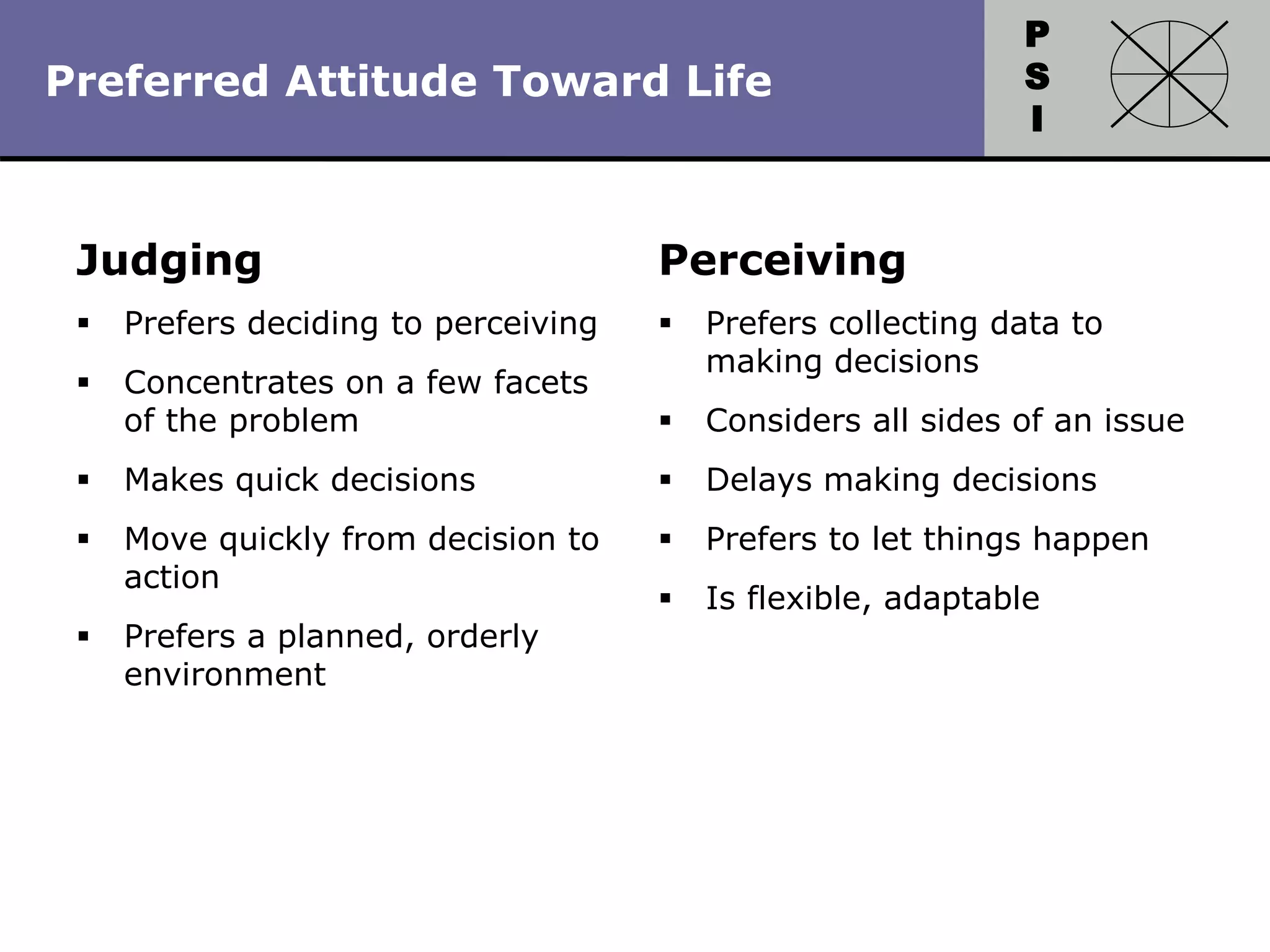
Judging
 Prefers deciding to perceiving
 Concentrates on a few facets
of the problem
 Makes quick decisions
 Move quickly from decision to
action
 Prefers a planned, orderly
environment
Perceiving
 Prefers collecting data to
making decisions
 Considers all sides of an issue
 Delays making decisions
 Prefers to let things happen
 Is flexible, adaptable
Preferred Attitude Toward Life
P
S
I
Copyright 2010 by HRDQ. All rights reserved.
Not for resale. www.hrdq.com
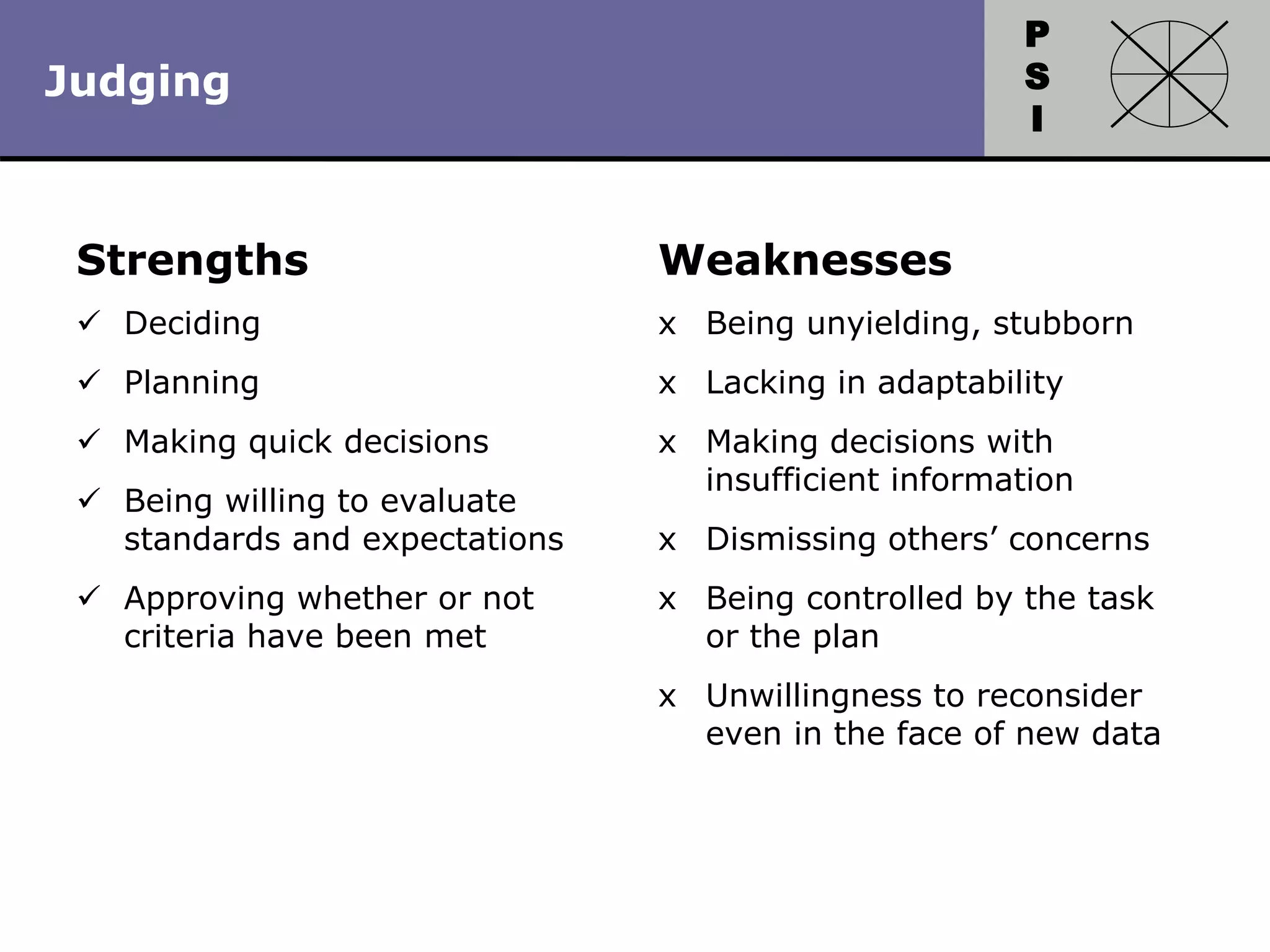
Strengths
 Deciding
 Planning
 Making quick decisions
 Being willing to evaluate
standards and expectations
 Approving whether or not
criteria have been met
Weaknesses
x Being unyielding, stubborn
x Lacking in adaptability
x Making decisions with
insufficient information
x Dismissing others’ concerns
x Being controlled by the task
or the plan
x Unwillingness to reconsider
even in the face of new data
Judging
P
S
I
Copyright 2010 by HRDQ. All rights reserved.
Not for resale. www.hrdq.com
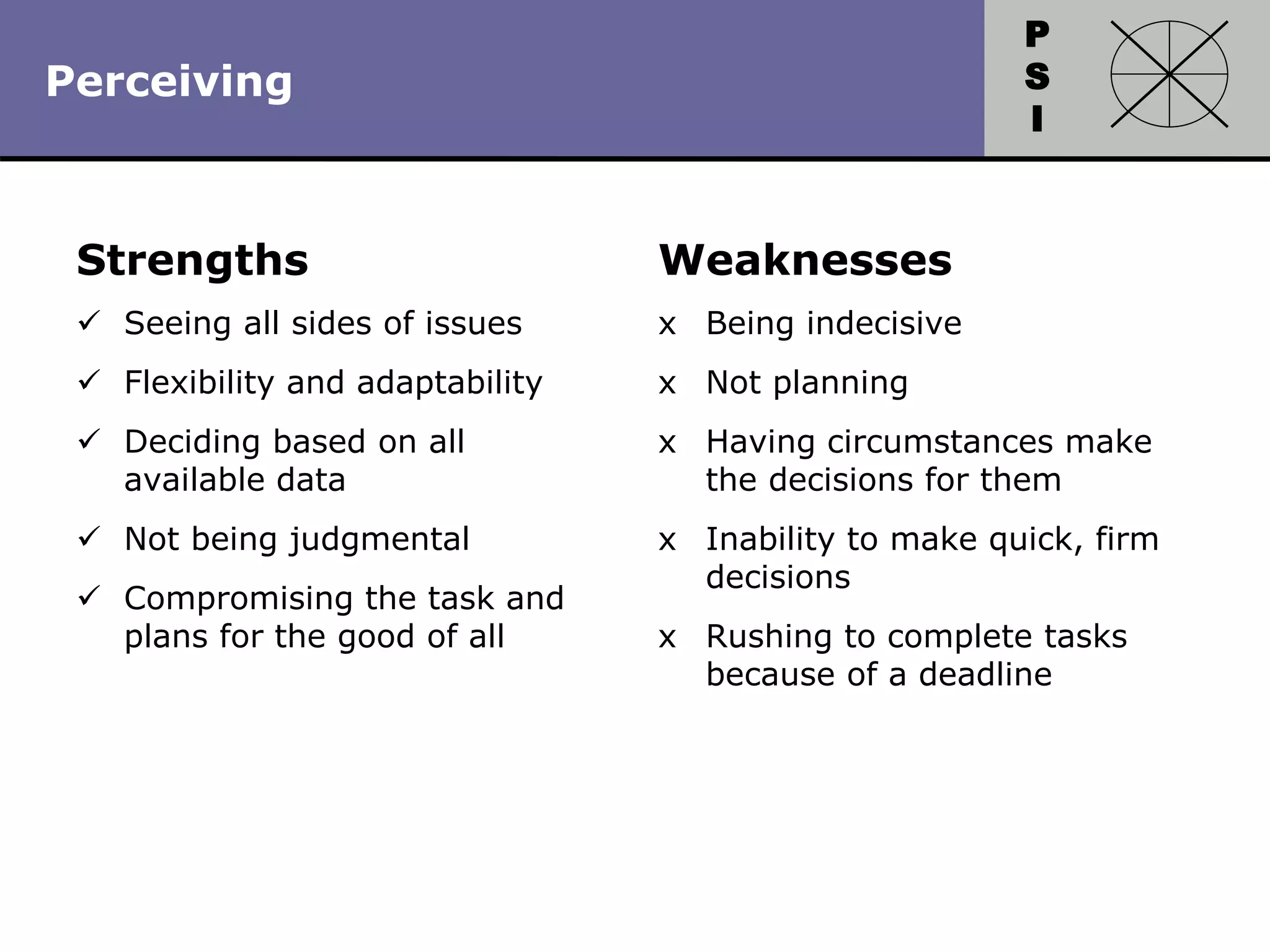
Strengths
 Seeing all sides of issues
 Flexibility and adaptability
 Deciding based on all
available data
 Not being judgmental
 Compromising the task and
plans for the good of all
Weaknesses
x Being indecisive
x Not planning
x Having circumstances make
the decisions for them
x Inability to make quick, firm
decisions
x Rushing to complete tasks
because of a deadline
Perceiving
P
S
I
Copyright 2010 by HRDQ. All rights reserved.
Not for resale. www.hrdq.com
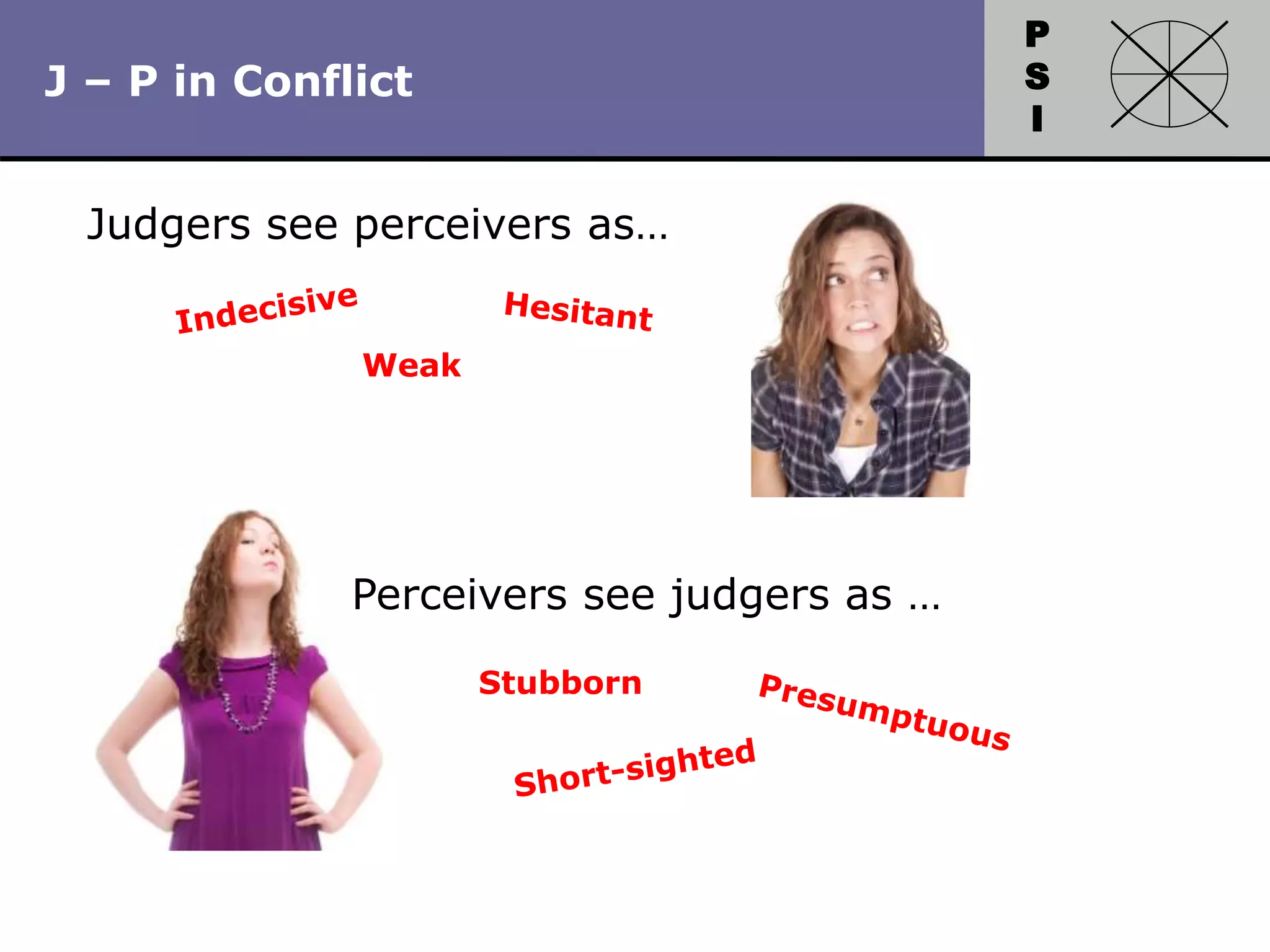
J – P in Conflict
Judgers see perceivers as…
Perceivers see judgers as …
Stubborn
Weak
P
S
I
Copyright 2010 by HRDQ. All rights reserved.
Not for resale. www.hrdq.com
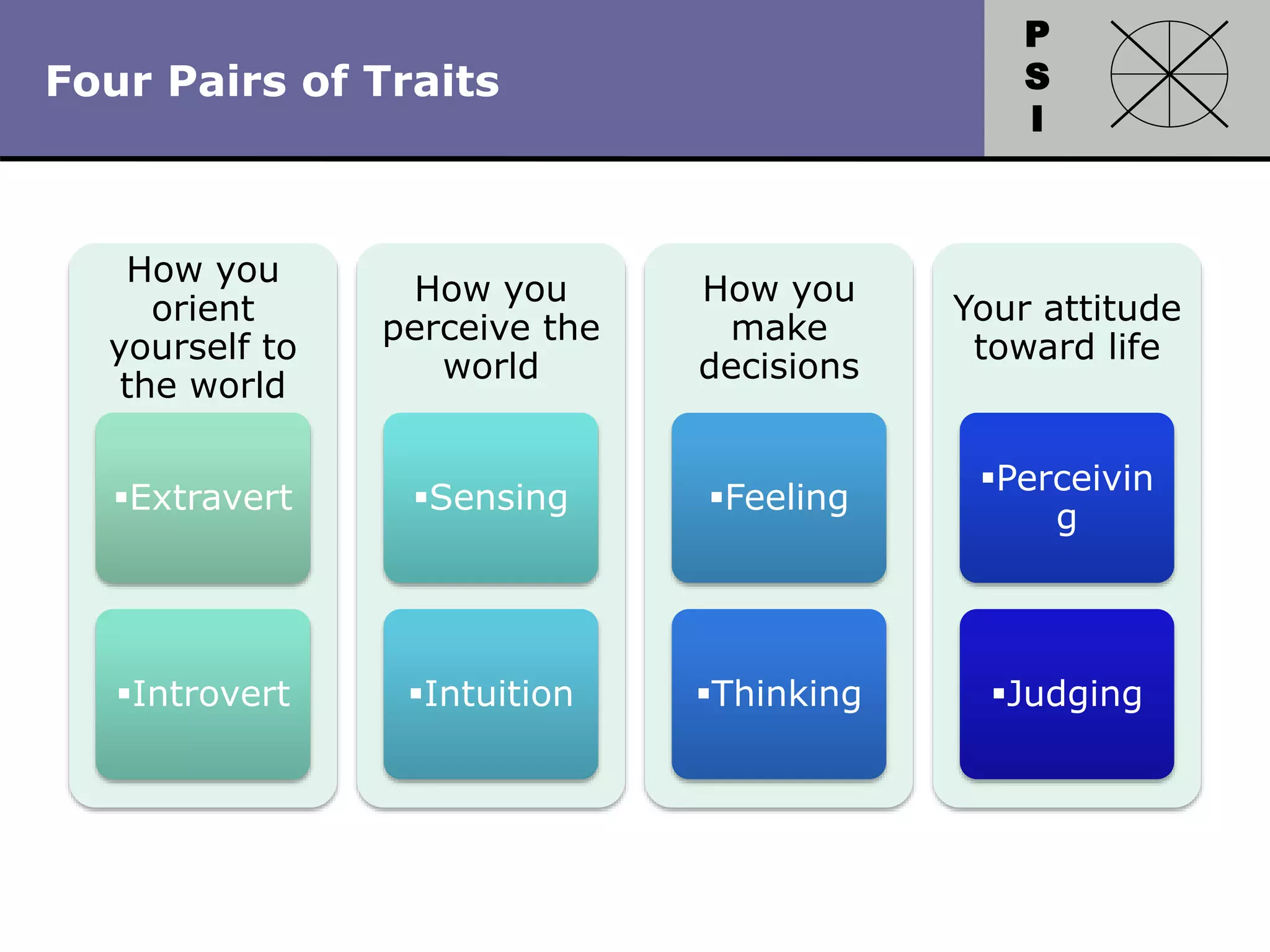
Four Pairs of Traits
How you
orient
yourself to
the world
Extravert
Introvert
How you
perceive the
world
Sensing
Intuition
How you
make
decisions
Feeling
Thinking
Your attitude
toward life
Perceivin
g
Judging
P
S
I
Copyright 2010 by HRDQ. All rights reserved.
Not for resale. www.hrdq.com
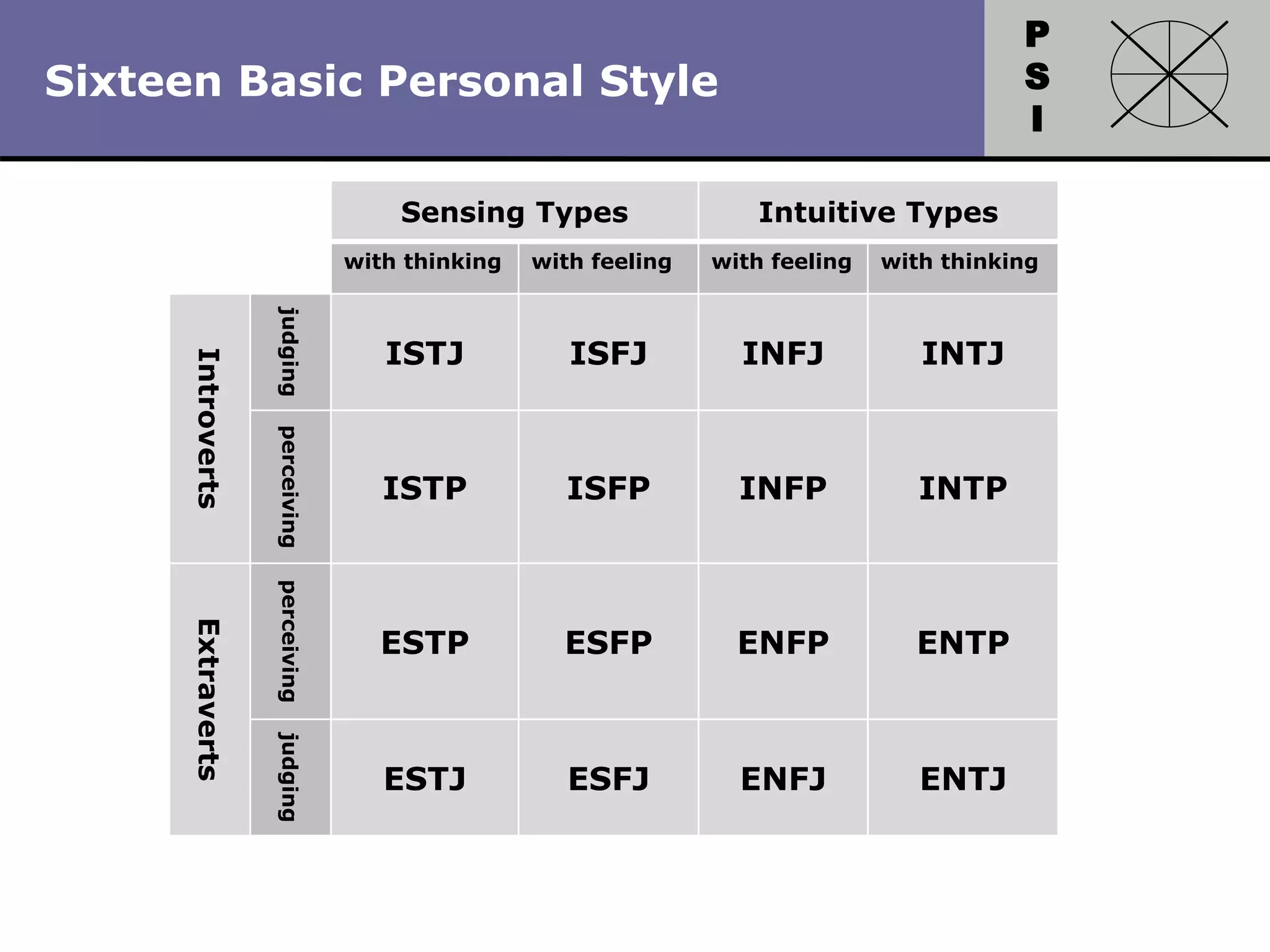
Sixteen Basic Personal Style
Sensing Types Intuitive Types
with thinking with feeling with feeling with thinking
Introverts
judging
ISTJ ISFJ INFJ INTJ
perceiving
ISTP ISFP INFP INTP
Extraverts
perceiving
ESTP ESFP ENFP ENTP
judging
ESTJ ESFJ ENFJ ENTJ
P
S
I
Copyright 2010 by HRDQ. All rights reserved.
Not for resale. www.hrdq.com
Teambuilding Application
“Teams succeed because they are exceedingly human. By
acknowledging the imperfections of their humanity, members
of functional teams overcome the natural tendencies that make
teamwork so elusive.”
Patrick Lencioni
Five Dysfunctions of a Team
P
S
I
Copyright 2010 by HRDQ. All rights reserved.
Not for resale. www.hrdq.com
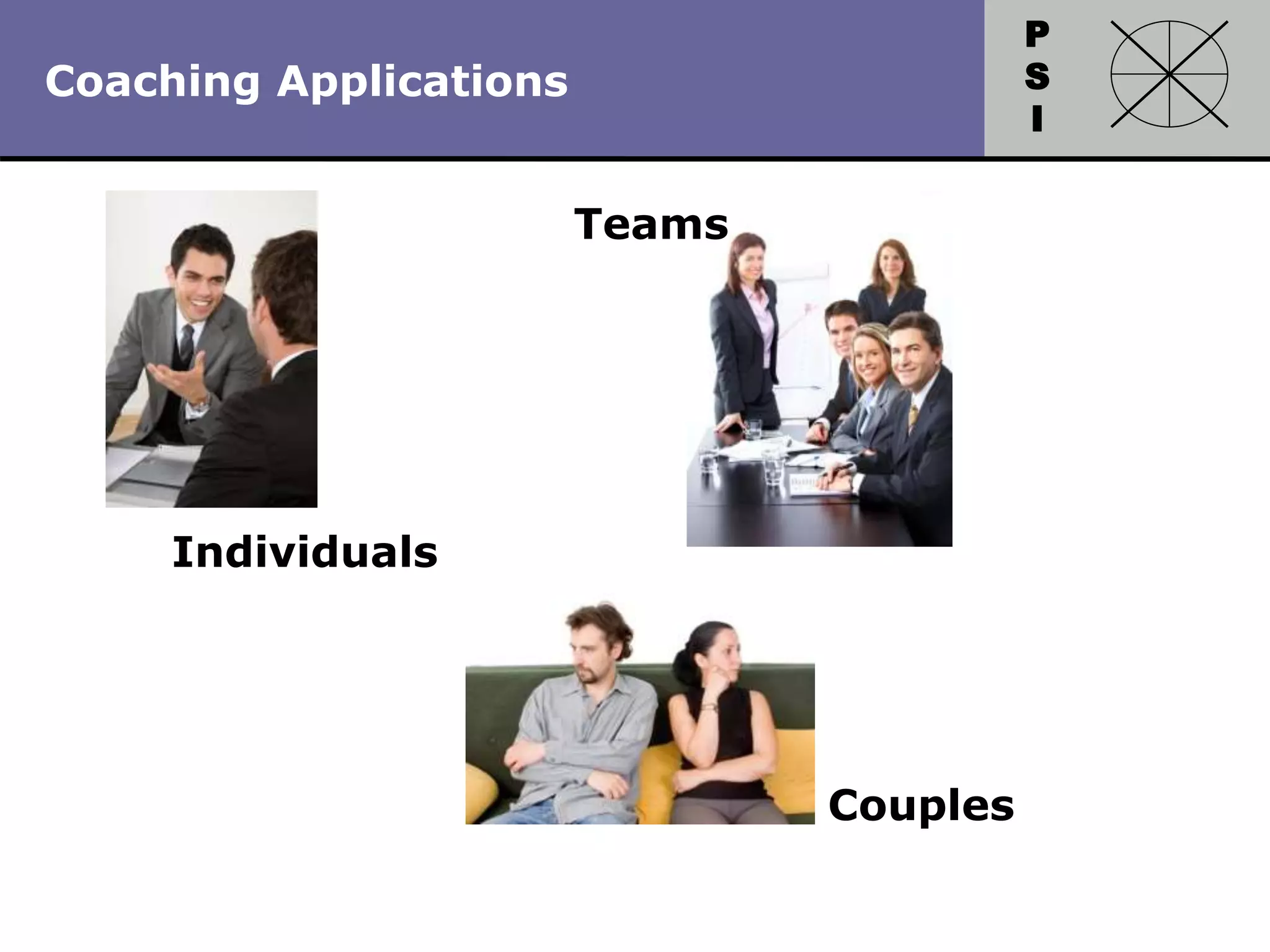
Coaching Applications
Individuals
Teams
Couples
P
S
I
Copyright 2010 by HRDQ. All rights reserved.
Not for resale. www.hrdq.com
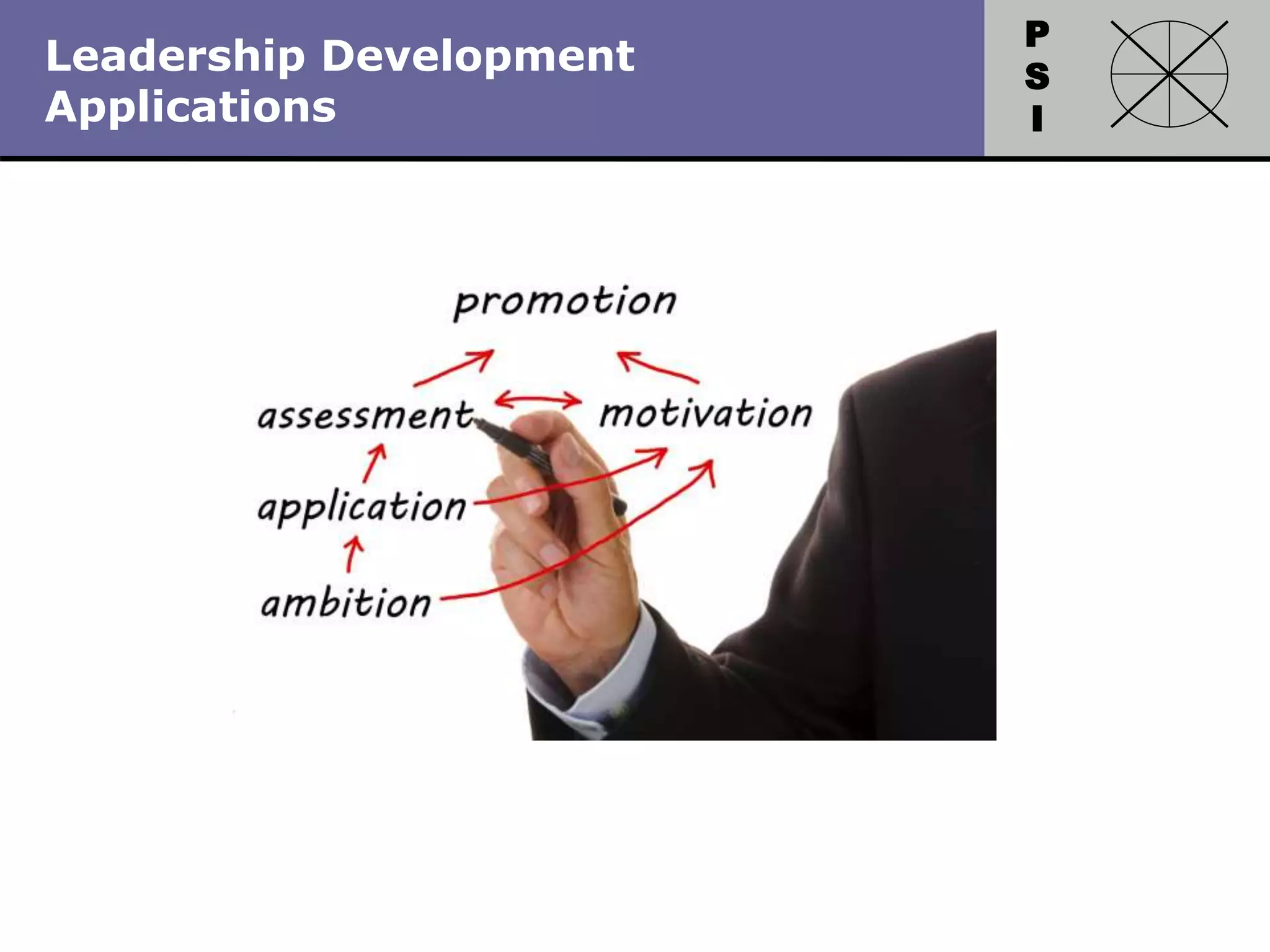
Leadership Development
Applications
P
S
I
Copyright 2010 by HRDQ. All rights reserved.
Not for resale. www.hrdq.com
Summary
“It’s easy to get good players.
Getting them to play together,
that’s the hard part.”
Casey Stengel
Baseball Manager
P
S
I
Copyright 2010 by HRDQ. All rights reserved.
Not for resale. www.hrdq.com
Please submit your
questions now.
Questions?
P
S
I
Copyright 2010 by HRDQ. All rights reserved.
Not for resale. www.hrdq.com
Exclusive offer!
Take 25% off your Personal Style Inventory - Starter
Kit purchase now through October 3rd, 2018.
Enter coupon code PSIWEBINAR18 at checkout.
Visit us at:
www.hrdqstore.com
Thank you

Using Personality Style Assessments in Training

  • 1.
    P S I Copyright 2010 byHRDQ. All rights reserved. Not for resale. www.hrdq.com Presented by: Keera Godfrey, MBA M.S. Using Personality-style Assessments in Training
  • 2.
    P S I Copyright 2010 byHRDQ. All rights reserved. Not for resale. www.hrdq.com  What are personality-style assessments  What they are NOT  Why use one  Four dimensions of Jungian theory  Strengths and weaknesses of each  Clashes of preferences  Applications of style awareness  Question and Answer Today’s Agenda
  • 3.
    P S I Copyright 2010 byHRDQ. All rights reserved. Not for resale. www.hrdq.com Poll Who do we have joining us today? Are you a…  Trainer/OD Designer  HR Specialist  Manager  Sales Rep  Other
  • 4.
    P S I Copyright 2010 byHRDQ. All rights reserved. Not for resale. www.hrdq.com Poll How familiar are you with personality-style assessments?  Certified expert  Trained using some  Only taken one as a participant  Little to no experience
  • 5.
    P S I Copyright 2010 byHRDQ. All rights reserved. Not for resale. www.hrdq.com What are they… Personality-style assessments assess:  Preferences  Strengths  Weaknesses
  • 6.
    P S I Copyright 2010 byHRDQ. All rights reserved. Not for resale. www.hrdq.com They are NOT… Personality-style assessments do NOT assess:  Traits  Ability  Skill  Character  Competence
  • 7.
    P S I Copyright 2010 byHRDQ. All rights reserved. Not for resale. www.hrdq.com Why use one?  Individuals learn about themselves, their preferences, and their behavior  Raises self esteem  Enables constructive use of individual differences  Improves communication  Leads to effective conflict management  Provides insight for how to influence others effectively  Professional development
  • 8.
    P S I Copyright 2010 byHRDQ. All rights reserved. Not for resale. www.hrdq.com Personal Style Inventory Based on Carl Jung’s work Today’s Model
  • 9.
    P S I Copyright 2010 byHRDQ. All rights reserved. Not for resale. www.hrdq.com Four Pairs of Traits Extravert Introvert How you orient yourself to the world Sensing Intuition How you perceive the world Feeling Thinking How you make decisions Perceiving Judging Your attitude toward life
  • 10.
    P S I Copyright 2010 byHRDQ. All rights reserved. Not for resale. www.hrdq.com How you orient yourself to the world
  • 11.
    P S I Copyright 2010 byHRDQ. All rights reserved. Not for resale. www.hrdq.com How would you describe yourself? Group A Outgoing Sociable Cordial Enthusiastic Good ‘people’ person Group B Thoughtful Careful Quiet Self-controlled Principled Poll
  • 12.
    P S I Copyright 2010 byHRDQ. All rights reserved. Not for resale. www.hrdq.com Extraversion  Values outer world  Relates freely to others  Shares thoughts and feelings easily  Tries to conform to others’ expectations  Shifts values and behaviors easily Introversion  Values personal inner world  Relates to others with caution  Shares thoughts and feelings only with trusted others  Sets own direction from inner compass  Maintains own direction in face of outside pressure Preferred General Orientation
  • 13.
    P S I Copyright 2010 byHRDQ. All rights reserved. Not for resale. www.hrdq.com Strengths  Understanding what the external world wants  Interacting with others  Using group consensus to solve problems  Going along with group decisions Weaknesses x Making independent decisions and sticking to them x Getting tasks done alone x Maintaining attention to tedious, solitary activities x Having meetings with memos or email would be more appropriate Extraverts
  • 14.
    P S I Copyright 2010 byHRDQ. All rights reserved. Not for resale. www.hrdq.com Strengths  Working alone  Independent thought  Non-impulsive, reflective action  The ability to concentrate  Working with ideas  Having a clear direction Weaknesses x Being aware of the world around them x Missing opportunities x Not making the critical input to influence decisions x Not establishing context for ideas so others may relate and accept more easily Introverts
  • 15.
    P S I Copyright 2010 byHRDQ. All rights reserved. Not for resale. www.hrdq.com E – I in Conflict Extraverts see introverts as… Introverts see extraverts as … Loud Moody
  • 16.
    P S I Copyright 2010 byHRDQ. All rights reserved. Not for resale. www.hrdq.com How you perceive the world
  • 17.
    P S I Copyright 2010 byHRDQ. All rights reserved. Not for resale. www.hrdq.com How would you describe yourself? Group A Exact Realistic Sensible Conservative Precise Group B Original Creative Visionary Insightful Theoretical Poll
  • 18.
    P S I Copyright 2010 byHRDQ. All rights reserved. Not for resale. www.hrdq.com Sensing  Likes facts, details, data  Remembers facts clearly  Impatient with theorizing  Good at monitoring processes Intuiting  Likes concepts, ideas, theories  Gets general impressions  Impatient with details  Good at planning/innovation Preferred Perception Process
  • 19.
    P S I Copyright 2010 byHRDQ. All rights reserved. Not for resale. www.hrdq.com Strengths  Attention to details  Practicality  Ability to work with tedious detail  Patience Weaknesses x Not seeing possibilities x Losing sight of the big picture x Solving problems using only the concrete x Frustration with the complicated x Slowness in completing tasks Sensing
  • 20.
    P S I Copyright 2010 byHRDQ. All rights reserved. Not for resale. www.hrdq.com Strengths  Seeing possibilities  Working out new ideas  Problem solving  Working with the complicated  Looking ahead Weaknesses x Inattention to details x Losing sight of the here and now x Dislike of tedious x Lack of patience x Leaps of logic Intuiting
  • 21.
    P S I Copyright 2010 byHRDQ. All rights reserved. Not for resale. www.hrdq.com S – N in Conflict Sensors see intuitors as … Intuitors see sensors as … Unimaginative Idealistic
  • 22.
    P S I Copyright 2010 byHRDQ. All rights reserved. Not for resale. www.hrdq.com How you make decisions
  • 23.
    P S I Copyright 2010 byHRDQ. All rights reserved. Not for resale. www.hrdq.com How would you describe yourself? Group A Systematic Logical Objective Reasonable Calculating Group B Humanistic Empathetic Compassionate Warm Sentimental Poll
  • 24.
    P S I Copyright 2010 byHRDQ. All rights reserved. Not for resale. www.hrdq.com Thinking  Uses rational thought  Is analytical, logical  Prefers rules, procedures, systems  Suspicious of Feelers Feeling  Uses personal reactions/convictions  Believes feelings are superior to logic  Feels confined by rules, procedures, systems  Impatient with ‘analytical types’ Preferred Decision Style
  • 25.
    P S I Copyright 2010 byHRDQ. All rights reserved. Not for resale. www.hrdq.com Strengths  Logical analysis  Objectivity, even in personal situations  Organization  Critical ability  Standing firm Weaknesses x Not noticing people’s feelings x Misunderstanding others values and their importance x Lack of interest in conciliation x Not expressing feelings x Lack of interest in persuading or motivating others Thinking
  • 26.
    P S I Copyright 2010 byHRDQ. All rights reserved. Not for resale. www.hrdq.com Strengths  Considering others’ feelings  Understanding needs, values and feelings of others  Interest in conciliation  Ability and interest in persuading and arousing enthusiasm Weaknesses x Not being logical x Not being objective x Being organized around values rather than logic x Being uncritical and overly accepting x Basing decisions on values and feelings alone Feeling
  • 27.
    P S I Copyright 2010 byHRDQ. All rights reserved. Not for resale. www.hrdq.com T – F in Conflict Thinkers see feelers as … Feelers see thinkers as … Unfeeling Stoic Gushy
  • 28.
    P S I Copyright 2010 byHRDQ. All rights reserved. Not for resale. www.hrdq.com Your attitude toward life
  • 29.
    P S I Copyright 2010 byHRDQ. All rights reserved. Not for resale. www.hrdq.com How would you describe yourself? Group A Firm Decisive Self-Assured Planned Determined Group B Flexible Adaptive Open-minded Tolerant Compromising Poll
  • 30.
    P S I Copyright 2010 byHRDQ. All rights reserved. Not for resale. www.hrdq.com Judging  Prefers deciding to perceiving  Concentrates on a few facets of the problem  Makes quick decisions  Move quickly from decision to action  Prefers a planned, orderly environment Perceiving  Prefers collecting data to making decisions  Considers all sides of an issue  Delays making decisions  Prefers to let things happen  Is flexible, adaptable Preferred Attitude Toward Life
  • 31.
    P S I Copyright 2010 byHRDQ. All rights reserved. Not for resale. www.hrdq.com Strengths  Deciding  Planning  Making quick decisions  Being willing to evaluate standards and expectations  Approving whether or not criteria have been met Weaknesses x Being unyielding, stubborn x Lacking in adaptability x Making decisions with insufficient information x Dismissing others’ concerns x Being controlled by the task or the plan x Unwillingness to reconsider even in the face of new data Judging
  • 32.
    P S I Copyright 2010 byHRDQ. All rights reserved. Not for resale. www.hrdq.com Strengths  Seeing all sides of issues  Flexibility and adaptability  Deciding based on all available data  Not being judgmental  Compromising the task and plans for the good of all Weaknesses x Being indecisive x Not planning x Having circumstances make the decisions for them x Inability to make quick, firm decisions x Rushing to complete tasks because of a deadline Perceiving
  • 33.
    P S I Copyright 2010 byHRDQ. All rights reserved. Not for resale. www.hrdq.com J – P in Conflict Judgers see perceivers as… Perceivers see judgers as … Stubborn Weak
  • 34.
    P S I Copyright 2010 byHRDQ. All rights reserved. Not for resale. www.hrdq.com Four Pairs of Traits How you orient yourself to the world Extravert Introvert How you perceive the world Sensing Intuition How you make decisions Feeling Thinking Your attitude toward life Perceivin g Judging
  • 35.
    P S I Copyright 2010 byHRDQ. All rights reserved. Not for resale. www.hrdq.com Sixteen Basic Personal Style Sensing Types Intuitive Types with thinking with feeling with feeling with thinking Introverts judging ISTJ ISFJ INFJ INTJ perceiving ISTP ISFP INFP INTP Extraverts perceiving ESTP ESFP ENFP ENTP judging ESTJ ESFJ ENFJ ENTJ
  • 36.
    P S I Copyright 2010 byHRDQ. All rights reserved. Not for resale. www.hrdq.com Teambuilding Application “Teams succeed because they are exceedingly human. By acknowledging the imperfections of their humanity, members of functional teams overcome the natural tendencies that make teamwork so elusive.” Patrick Lencioni Five Dysfunctions of a Team
  • 37.
    P S I Copyright 2010 byHRDQ. All rights reserved. Not for resale. www.hrdq.com Coaching Applications Individuals Teams Couples
  • 38.
    P S I Copyright 2010 byHRDQ. All rights reserved. Not for resale. www.hrdq.com Leadership Development Applications
  • 39.
    P S I Copyright 2010 byHRDQ. All rights reserved. Not for resale. www.hrdq.com Summary “It’s easy to get good players. Getting them to play together, that’s the hard part.” Casey Stengel Baseball Manager
  • 40.
    P S I Copyright 2010 byHRDQ. All rights reserved. Not for resale. www.hrdq.com Please submit your questions now. Questions?
  • 41.
    P S I Copyright 2010 byHRDQ. All rights reserved. Not for resale. www.hrdq.com Exclusive offer! Take 25% off your Personal Style Inventory - Starter Kit purchase now through October 3rd, 2018. Enter coupon code PSIWEBINAR18 at checkout. Visit us at: www.hrdqstore.com Thank you

Editor's Notes

  • #2  Thank you so much Sarah! It is always a pleasure to work with HRDQ. Good afternoon to all of you. As Sara mentioned, my name is Keera Godfrey and I am delighted to be your facilitator for this session entitled Using Personality-style Assessments in Training. I have personally used Personality-style assessments in my training sessions so it is a pleasure to talk about this subject. We have a lot to cover so let’s get right into it.
  • #3 Here is our agenda for today. We will talk about: What are personality-style assessments What they are NOT Why use one Four dimensions of Jungian theory Strengths and weaknesses of each Clashes of preferences Applications of style awareness Question and Answer
  • #6 The Personal Style Inventory (PSI) has been developed to provide you with some useful insights into your preferences for using your mind, will, and emotions. These preferences produce a personal style that characterizes your most frequently used pattern of thinking and behaving. Your thoughts are linked to your behavior. I am sure many of you have heard motivational speakers say ‘if you want to change your life, change your thoughts or the way you think“. These statements are true. Your individual preferences are inborn and are then developed by your life experiences. The words Personality-style and behavioral style are interchangeable. The personality-style assessments also assess your Strengths and weaknesses. This is not from a performance point of view, but rather from a personality perspective. For example, it is assesses your ability to collaborate, or to listen attentively, to be patient in times of high stress. Overall, personality-style is all about assess how you show up in the world.
  • #7 However, let’s talk about what the Personality-style assessment do NOT assess. Personality-style assessments do not [CLICK] assess your Traits- a distinguishing characteristic about your personal nature (good or bad) Ability- what you can accomplish Skill – how well you can do a task It does not assess your Character-your ability to do what is right Competence-your ability to comprehend and perform in a particular area or job
  • #8 Let talk about why understand and use Personality Style Assessments? And I would say that this is especially true for those of you who work in large groups, train over multiple days. Or teach sales, leadership, negotiation or related courses. Why is it important to understand them? Often, self-knowledge can free us to try new ways of being and doing, or it allows us to accept ourselves and others more fully. Our communication with others can become more honest and effective as we gain a better understanding of ourselves and others. Use Personality Style Assessment, when: Individuals learn about themselves, their preferences, and their behavior Raises self esteem Enables constructive use of individual differences Improves communication Leads to effective conflict management Provides insight for how to influence others effectively Professional development All of these things are critical when conducting leadership training, project management, basically anything involving training people to interact with colleagues or stakeholders.
  • #9 The four traits in the PSI inventory I was going to share with you were first described by Carl Jung in 1921, in Psychological Types, Volume Six of his Collected Works. Jung developed these categories from decades of observations of his clients in his clinical practice as a psychoanalyst. He also found evidence of these preferences in history, politics, literature, music, art, and the world around him, in every culture he studied. Many if not all of the behavioral assessments were developed based on Carl Jung’s research.
  • #10 So what are the four pairs of traits. The PSI measures your relative preference in four pairs of traits that relate to perceiving (the types of information to which you pay attention) and judging (how you make decisions). Differences in the way people prefer to perceive and make judgments about their perceptions lead to differences in behavior or personal style. People have preferences about where they choose to exercise their perception and judgment. Some people are outer-world oriented. They are referred to as Extraverts. Others are inner-world oriented. They are called Introverts. Perceiving refers to the way in which people become aware of things, people, occurrences, and ideas. There are two ways of perceiving: Sensing and Intuition. Judging refers to the way in which people come to conclusions about what they have perceived. There are two ways of judging: Thinking and Feeling. And finally, people prefer one mental process to the other. Some people favor the Perceiving process; others favor the Judging process. The following preferences are present to some degree in all people. It is the extremes that are described here. The strength of a preference is indicated by your score on the PSI. That strength will determine how closely the following descriptions will fit your own personality.
  • #11 how you orient yourself to the world Although this pair of traits traditionally is listed first when talking about Jungian Type characteristics, it is discussed last here based on the belief that the concept is easier to understand if there is first some understanding of the other pairs. Because the words extraversion and introversion are used often in everyday language, it is useful to separate Jung’s meanings from this common usage. When most people hear the word extravert, think of happy-go-lucky, party people. Introverts are thought of as social misfits who sit by themselves and dream a lot. While some of these stereotypes may be associated with these general approaches to life, there are many extraverts who are boorish, social clods and many introverts who have developed great social skills. Jung included far more than these simple meanings in his definitions of Extravert and Introvert. In our perceptions of the world and our judging about the world, we selectively attend to specific data, and we value certain kinds of decisions as being more important than others. The basis for this selection process comes from our extraverted or introverted orientation, our attitude toward the world.
  • #13 Extraverts (E) attend to the outer world — the people, events, rules, and expectations of others and society — more than their inner world. They are sensitive to the outer-world ways of being and try to fit in and become what is accepted and valued by that world. Dominant Extraverts must interact with and observe the outer world to find out what its expectations are for them so they can move comfortably toward those expectations. Introverts (I) may know what the outer world expects but they attend more to their inner beliefs, expectations, desires, values, and logic. Introverts seek to behave in ways that have meaning to them as individuals. They use their own inner processes as their barometer of the behaviors that seem appropriate to them. Dominant Introverts must step back from the world so they can decide what it means to them and how they will choose to respond to it.
  • #16 Although our culture has placed a premium on Extraversion, there is nothing inherently negative or positive about either orientation. However, this is another area in which our differences clearly serve as a basis for conflict and misunderstanding.
  • #17 how you perceive the world People have two general ways of finding out about the world: through their senses and through a process that transcends the senses, commonly referred to as intuition. Both ways of perceiving are used to some extent by all individuals. From infancy on, however, people develop definite preferences. These preferences become more trustworthy as they are reinforced and developed through use, so that either intuition or sensing becomes the preferred way of experiencing the world.
  • #19 Sensers (S) pay most attention to specific, factual, concrete details. They are interested in evidence they see, hear, feel, touch, and smell in their internal and external worlds. Because their awareness is usually in the here and now, they are generally thought of as having their “feet on the ground.” They can be trusted to record events accurately and are able to recall and use them with great skill. For issues requiring careful consideration of details, Sensing types are effective problem solvers. Intuitors (N) are constantly looking for meanings and relationships beyond the reach of the typical five senses. They are interested in theory, ideas, and meaning; they speculate using “what if” questions. Because they do not pay careful attention to the here and now, they may ignore facts and details. Instead, they are capable of making spontaneous leaps of imagination that enable them to solve certain kinds of difficult problems easily. “Why?” is the general mode of the Intuitor. There are advantages and blind spots in each way of perceiving. We all use both processes, but through inclination and practice we develop one perceiving function more than the other. Aswe become better at the function we practice, we often forget that the other function exists. Sometimes we get impatient with those around us who use the opposite function for perceiving.
  • #21 Here are a few strengths and weaknesses of intuiting.
  • #23 how you make decisions Thinking and Feeling are two different ways you make judgments based on your perceptions. Neither way is better than the other; they simply are different and more or less effective, depending on the situation.
  • #25 Thinkers (T) make decisions using logic and analysis. They weigh evidence and draw conclusions based on the strength of the evidence. Thinkers prefer situations in which systems and procedures have been carefully constructed and communicated. Consequently, much of the Thinker’s energy may go into creating logical systems for deciding. Feelers (F) make decisions on the basis of empathy, personal values, and strong gut-level convictions. Underlying the Feeler’s decision process is a set of values about how the world should be — what is right and wrong. Consequently, Feelers often commit their energy to shaping the world into their image of the way it ought to be.
  • #29 your attitude toward life Almost all of us have developed a general mental process that we use in our daily lives. Although we all must make decisions every day, some of us are more interested in the data-collection process — perceiving; and some of us are more interested in the outcomes — judging. Jung found that almost all of his clients, and others whom he knew well, had developed one member of each of these pairs of traits more than the other. He noticed that most people tended to be either dominant Perceivers or dominant Judgers. Although Jung discovered the importance of perceiving or judging to individuals by talking with them over long periods of time, later workers in this field of study added the last pair of dimensions measured by the PSI — Judging–Perceiving
  • #31 Judgers (J) are firm, decisive, and sure of themselves. They prefer to examine a few facets they consider relevant to the problem and then come to definite conclusions. Once the decision has been made, Judgers rarely reconsider it because they are less open to new perceptions or data. Having made a decision, they move on. Perceivers (P) are more interested in data than the outcome. They prefer gathering information from many sources and remaining flexible, non-judgmental, and adaptable to new or conflicting data. Even after Perceivers make a decision, they are willing to reconsider it and continue to be open to the possibility of change.
  • #34 One can guess that these two attitudes toward data and decision making might cause conflicts between people with opposite preferences. Jung believed that these differences are the basis of most interpersonal disputes and relationship problems. Judgers often think of Perceivers as wishy-washy people with little sense of time about getting things done. Perceivers see Judgers as rushing headlong into things, somewhat like a bull in a china shop. This is one area in particular in which we do not appreciate being reminded of our differences by our opposites.
  • #35 So what are the four pairs of traits. The PSI measures your relative preference in four pairs of traits that relate to perceiving (the types of information to which you pay attention) and judging (how you make decisions). Differences in the way people prefer to perceive and make judgments about their perceptions lead to differences in behavior or personal style. People have preferences about where they choose to exercise their perception and judgment. Some people are outer-world oriented. They are referred to as Extraverts. Others are inner-world oriented. They are called Introverts. Perceiving refers to the way in which people become aware of things, people, occurrences, and ideas. There are two ways of perceiving: Sensing and Intuition. Judging refers to the way in which people come to conclusions about what they have perceived. There are two ways of judging: Thinking and Feeling. And finally, people prefer one mental process to the other. Some people favor the Perceiving process; others favor the Judging process. The following preferences are present to some degree in all people. It is the extremes that are described here. The strength of a preference is indicated by your score on the PSI. That strength will determine how closely the following descriptions will fit your own personality.
  • #36 There are 16 possible combinations, depending on the mix of your preferences. For example, INFJ would be the Personal Style for an individual whose preferences are Introversion (I), Intuition (N), Feeling (F), and Judging (J). Notice that you have some degree of strength in each of the eight preferences. Each one of these represent a personality style: For example INTJ is Driven by inner vision of the possibilities. Determined. Individualistic. Interested in pioneering. Convinced of the validity of intuition. Likes to reorganize things. Here is another example ISTJ.Systematic, painstaking, thorough. Patient with detail. Adapts easily to routine. Stable. Emphasizes logic, analysis, decisiveness.
  • #38 A strength carried to excess becomes a blind spot that can hurt your performance, result in bad decisions, and lose the contributions others could make to good solutions. If you have over-developed one attitude or dimension to the virtual exclusion of its opposite, then you may find yourself unbalanced. There are several coaching applications for a Personality Style Assessment, ranging from Teams at work or play, to Individuals at work or play, and to Couples,
  • #39 Usually people with specific personality styles display characteristic behavior patterns in their personal and work-related lives. The lists we reviewed represent some of the common behaviors associated with each of the preferences. So how can you apply this in a leadership situation? If you have a team of Introvert, you now understand that they works best alone or on individual activities. Slow to get involved in new situations Thinks carefully before taking action Therefore, you can point it out. Work alone then come together.