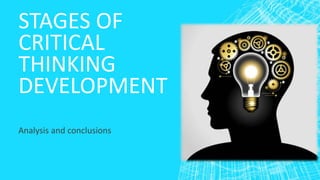
STAGES OF
CRITICAL
THINKING
DEVELOPMENT
Analysis and conclusions
UNREFLECTIVE THINKER
▪ Unreflective thinking is when we don’t notice that we
are continually making assumptions, forming
concepts and opinions, drawing conclusions, and
thinking within points of view.
UNREFLECTIVE THINKER
▪ Our egocentric tendencies at this stage play a
dominant role in our thinking.
▪ We lack the skills and motivation to notice how self-
centered and prejudiced we are.
UNREFLECTIVE THINKER
▪ Unreflective thinkers may have developed a variety of
skills in thinking without being aware of them.
However, these skills are inconsistently applied
because of the lack of self-monitoring of thought.
UNREFLECTIVE THINKER
CHALLENGED
THINKER
Are those who are
initially aware of the
determining role of
thinking in one’s life
and of basic
problems that come
from poor thinking
We began to notice that we:
Make questionable assumptions
Use false, incomplete , or
misleading information.
Make inferences that do not
fallow from the evidence we have.
Fail to recognize important
implications in our thought.
Fail to recognize problems we
have.
Form faulty concepts
Think egocentrically and
irrationally.
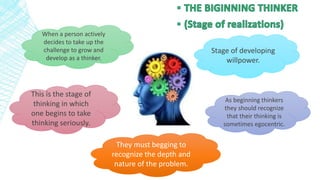
When a person actively
decides to take up the
challenge to grow and
develop as a thinker.
This is the stage of
thinking in which
one begins to take
thinking seriously.
As beginning thinkers
they should recognize
that their thinking is
sometimes egocentric.
They must begging to
recognize the depth and
nature of the problem.
Stage of developing
willpower.
• Analyze the logic of situations and problems.
• Express clear and precise questions.
• Check information for accuracy and relevance.
• Distinguish between raw information and someone’s
interpretation of it.
• Recognize assumptions guiding inferences.
• Notice when our selfish interests bias our viewpoint.
They are becoming aware of how to deal with the structures at
work in thinking:
• Purposes
• Questions
• Informayions
• Interpretations, etc.
They are also beginning to apreciate their thinking in terms of its:
• Clarity
• Accuracy
• Relevance
• Precision
• Logicalness
• Justifiability
• Breadth & Depth
STAGE FOUR
PRACTICING THINKER
DEFINING FEATURE
▪ Thinkers at this stage have a sense of the habits they need to
develop to take charge of their thinking.
▪ They not only recognize that problems exist in their thinking,
but they also recognize the need to attack these problems
globally and systematically.
PRINCIPAL CHALLENGE
▪ To begin to develop awareness of the need for systematic
practice in thinking.
KNOWLEDGE OF THINKING
▪ Practicing thinkers, unlike beginning thinkers are becoming
knowledgeable of what it would take to systematically
monitor the role in their thinking of concepts, assumptions,
inferences, implications, points of view, etc.
SKILL IN THINKING
▪ Practicing thinkers have enough skill in thinking to critique
their own plan for systematic practice.
▪ The key intellectual trait required to move to this stage is
intellectual perseverance.
▪ We must teach in such a way that students come to
understand the power in knowing that whenever humans
reason
Stage Five: The Advanced Thinker
Defining Feature:
Advanced thinkers have good general
command over their egocentric nature.
They continually strive to be fair-minded.
Principal Challenge:
Ability to identify areas of significant
ignorance and prejudice.
Knowledge of Thinking:
Successfully engaged in
systematically monitoring the role
in their thinking of concepts. Knowledgeable of what it takes
to regularly assess their
thinking for clarity.
They have a deep understanding
of the powerful role that thinking
plays in the quality of their lives.
Skill in Thinking:
They insightfully articulate the strengths
and weaknesses in their thinking.
They effectively use a number of strategies to
reduce the power of their egocentric thoughts.
Relevant Intellectual Traits:
a) The intellectual insight and perseverance to actually
develop new fundamental habits of thought based on
deep values to which one has committed oneself.
b) The intellectual integrity to recognize areas of
inconsistency and contradiction in one’s life.
c) The intellectual empathy necessary to put oneself in
the place of others in order to genuinely understand them.
d) The intellectual courage to face and fairly
address ideas, beliefs, or viewpoints toward
which one has strong negative emotions
e) The fair-mindedness necessary to
approach all viewpoints without prejudice
We can help students move in this direction
by fostering their awareness of egocentrism
and sociocentrism in their thinking
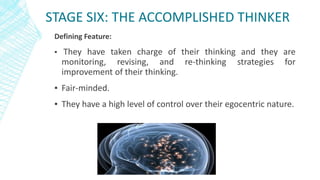
STAGE SIX: THE ACCOMPLISHED THINKER
Defining Feature:
▪ They have taken charge of their thinking and they are
monitoring, revising, and re-thinking strategies for
improvement of their thinking.
▪ Fair-minded.
▪ They have a high level of control over their egocentric nature.
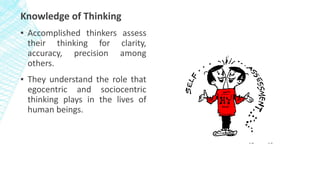
Knowledge of Thinking
▪ Accomplished thinkers assess
their thinking for clarity,
accuracy, precision among
others.
▪ They understand the role that
egocentric and sociocentric
thinking plays in the lives of
human beings.
Skill in Thinking
▪ To articulate the strengths and
weaknesses in their thinking.
Relevant Intellectual Traits
▪ Humility, intellectual integrity,
intellectual perseverance,
intellectual autonomy, fair-
mindedness, among others.
▪ Egocentric and sociocentric is
uncommon.
Some implications for instruction
▪ Students will never become
accomplished thinkers.
THANKS FOR YOUR
ATTENTION
Designed by Fab Rod.

Critical thinking slide deck

  • 1.
  • 2.
    UNREFLECTIVE THINKER ▪ Unreflectivethinking is when we don’t notice that we are continually making assumptions, forming concepts and opinions, drawing conclusions, and thinking within points of view.
  • 3.
    UNREFLECTIVE THINKER ▪ Ouregocentric tendencies at this stage play a dominant role in our thinking.
  • 4.
    ▪ We lackthe skills and motivation to notice how self- centered and prejudiced we are. UNREFLECTIVE THINKER
  • 5.
    ▪ Unreflective thinkersmay have developed a variety of skills in thinking without being aware of them. However, these skills are inconsistently applied because of the lack of self-monitoring of thought. UNREFLECTIVE THINKER
  • 6.
    CHALLENGED THINKER Are those whoare initially aware of the determining role of thinking in one’s life and of basic problems that come from poor thinking We began to notice that we: Make questionable assumptions Use false, incomplete , or misleading information. Make inferences that do not fallow from the evidence we have. Fail to recognize important implications in our thought. Fail to recognize problems we have. Form faulty concepts Think egocentrically and irrationally.
  • 7.
    When a personactively decides to take up the challenge to grow and develop as a thinker. This is the stage of thinking in which one begins to take thinking seriously. As beginning thinkers they should recognize that their thinking is sometimes egocentric. They must begging to recognize the depth and nature of the problem. Stage of developing willpower.
  • 8.
    • Analyze thelogic of situations and problems. • Express clear and precise questions. • Check information for accuracy and relevance. • Distinguish between raw information and someone’s interpretation of it. • Recognize assumptions guiding inferences. • Notice when our selfish interests bias our viewpoint.
  • 9.
    They are becomingaware of how to deal with the structures at work in thinking: • Purposes • Questions • Informayions • Interpretations, etc. They are also beginning to apreciate their thinking in terms of its: • Clarity • Accuracy • Relevance • Precision • Logicalness • Justifiability • Breadth & Depth
  • 10.
  • 11.
    DEFINING FEATURE ▪ Thinkersat this stage have a sense of the habits they need to develop to take charge of their thinking. ▪ They not only recognize that problems exist in their thinking, but they also recognize the need to attack these problems globally and systematically.
  • 12.
    PRINCIPAL CHALLENGE ▪ Tobegin to develop awareness of the need for systematic practice in thinking.
  • 13.
    KNOWLEDGE OF THINKING ▪Practicing thinkers, unlike beginning thinkers are becoming knowledgeable of what it would take to systematically monitor the role in their thinking of concepts, assumptions, inferences, implications, points of view, etc.
  • 14.
    SKILL IN THINKING ▪Practicing thinkers have enough skill in thinking to critique their own plan for systematic practice. ▪ The key intellectual trait required to move to this stage is intellectual perseverance. ▪ We must teach in such a way that students come to understand the power in knowing that whenever humans reason
  • 16.
    Stage Five: TheAdvanced Thinker Defining Feature: Advanced thinkers have good general command over their egocentric nature. They continually strive to be fair-minded.
  • 17.
    Principal Challenge: Ability toidentify areas of significant ignorance and prejudice.
  • 18.
    Knowledge of Thinking: Successfullyengaged in systematically monitoring the role in their thinking of concepts. Knowledgeable of what it takes to regularly assess their thinking for clarity. They have a deep understanding of the powerful role that thinking plays in the quality of their lives.
  • 19.
    Skill in Thinking: Theyinsightfully articulate the strengths and weaknesses in their thinking. They effectively use a number of strategies to reduce the power of their egocentric thoughts.
  • 20.
    Relevant Intellectual Traits: a)The intellectual insight and perseverance to actually develop new fundamental habits of thought based on deep values to which one has committed oneself. b) The intellectual integrity to recognize areas of inconsistency and contradiction in one’s life. c) The intellectual empathy necessary to put oneself in the place of others in order to genuinely understand them.
  • 21.
    d) The intellectualcourage to face and fairly address ideas, beliefs, or viewpoints toward which one has strong negative emotions e) The fair-mindedness necessary to approach all viewpoints without prejudice We can help students move in this direction by fostering their awareness of egocentrism and sociocentrism in their thinking
  • 22.
    STAGE SIX: THEACCOMPLISHED THINKER Defining Feature: ▪ They have taken charge of their thinking and they are monitoring, revising, and re-thinking strategies for improvement of their thinking. ▪ Fair-minded. ▪ They have a high level of control over their egocentric nature.
  • 23.
    Knowledge of Thinking ▪Accomplished thinkers assess their thinking for clarity, accuracy, precision among others. ▪ They understand the role that egocentric and sociocentric thinking plays in the lives of human beings.
  • 24.
    Skill in Thinking ▪To articulate the strengths and weaknesses in their thinking. Relevant Intellectual Traits ▪ Humility, intellectual integrity, intellectual perseverance, intellectual autonomy, fair- mindedness, among others. ▪ Egocentric and sociocentric is uncommon.
  • 25.
    Some implications forinstruction ▪ Students will never become accomplished thinkers.
  • 26.