STUDY ABOUT MRI
SIR SYED UNIVERSITY OF ENGINEERING AND
TECHNOLOGY
SYED HAMMAD
AKHTER
2012-BM-071
PRESENTED TO
ENGR. FAHAD
AKBER
A technique to visualize the interior of the human body using a magnetic force and
electromagnetic waves
Magnetic Resonance
Imaging
Basics terms of magnetic resonance imaging system (mri)
Static field magnet gradient coil magnet
Radiofrequency coil
Phase concept
Resonance frequency
Employ radio-frequency waves and intense
magnetic field to excite atoms
Gives real time image & 3D view
Can detect Pre-cancerous cells
Use proton
ADVANTAGES
Non radiative method
Efficient for soft tissue imaging specially
brain
Anatomical as well physiological
Provide 3D image
Depth of effected Area
As human body composed of 58-65% of water (H2O)
Hydrogen is abundant in a water molecules (as
consist 2-hydrogen & 1-oxygen).
Electron spin around a nuclei (as moon spin around
earth).
Proton spin on its axis (as earth spins on its axis)
The nuclei of Hydrogen act like a “small bar magnet”.
How H2O is
helpful ?
Phenomenon
In the absence of an external magnetic field, the
hydrogen nuclei in the human body are randomly
oriented.
1. (Free status)
2. When a static magnetic field is applied
When a strong magnetic field is applied, the nuclei are
aligned in the same direction
(direction of the static field)
3. When an RF pulse is applied to the hydrogen nuclei aligned in a
static field
When an RF pulse is applied, the hydrogen nuclei are
aligned in a specific direction.
4. When the RF pulse is turned OFF
When the RF pulse is turned OFF, the hydrogen
nuclei return to their original orientation. (=
Relaxation)
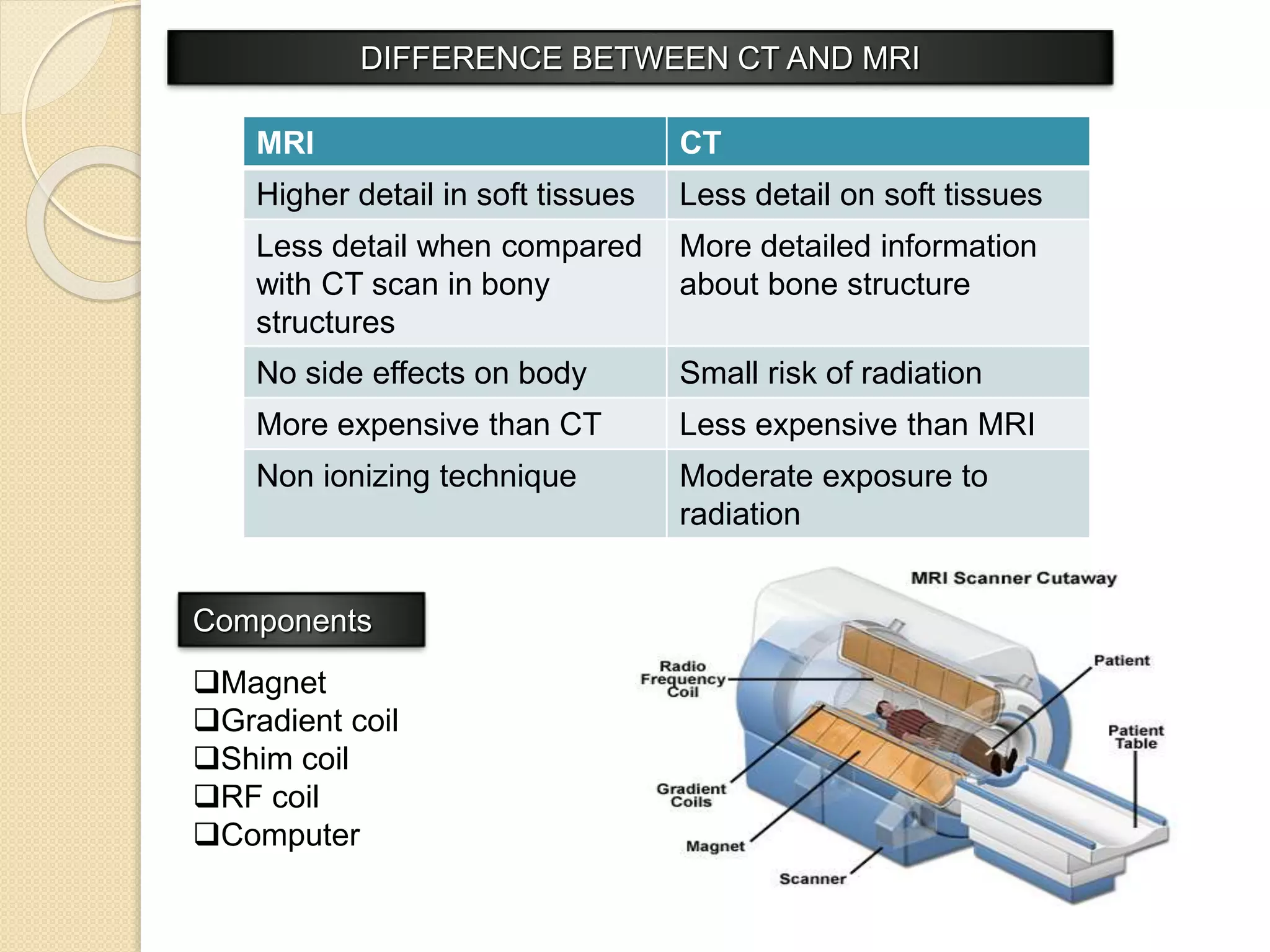
MRI CT
Higher detail in soft tissues Less detail on soft tissues
Less detail when compared
with CT scan in bony
structures
More detailed information
about bone structure
No side effects on body Small risk of radiation
More expensive than CT Less expensive than MRI
Non ionizing technique Moderate exposure to
radiation
DIFFERENCE BETWEEN CT AND MRI
Components
Magnet
Gradient coil
Shim coil
RF coil
Computer

What is mri

  • 1.
    STUDY ABOUT MRI SIRSYED UNIVERSITY OF ENGINEERING AND TECHNOLOGY SYED HAMMAD AKHTER 2012-BM-071 PRESENTED TO ENGR. FAHAD AKBER
  • 2.
    A technique tovisualize the interior of the human body using a magnetic force and electromagnetic waves Magnetic Resonance Imaging Basics terms of magnetic resonance imaging system (mri) Static field magnet gradient coil magnet Radiofrequency coil Phase concept Resonance frequency Employ radio-frequency waves and intense magnetic field to excite atoms Gives real time image & 3D view Can detect Pre-cancerous cells Use proton
  • 3.
    ADVANTAGES Non radiative method Efficientfor soft tissue imaging specially brain Anatomical as well physiological Provide 3D image Depth of effected Area As human body composed of 58-65% of water (H2O) Hydrogen is abundant in a water molecules (as consist 2-hydrogen & 1-oxygen). Electron spin around a nuclei (as moon spin around earth). Proton spin on its axis (as earth spins on its axis) The nuclei of Hydrogen act like a “small bar magnet”. How H2O is helpful ?
  • 4.
    Phenomenon In the absenceof an external magnetic field, the hydrogen nuclei in the human body are randomly oriented. 1. (Free status) 2. When a static magnetic field is applied When a strong magnetic field is applied, the nuclei are aligned in the same direction (direction of the static field) 3. When an RF pulse is applied to the hydrogen nuclei aligned in a static field When an RF pulse is applied, the hydrogen nuclei are aligned in a specific direction. 4. When the RF pulse is turned OFF When the RF pulse is turned OFF, the hydrogen nuclei return to their original orientation. (= Relaxation)
  • 5.
    MRI CT Higher detailin soft tissues Less detail on soft tissues Less detail when compared with CT scan in bony structures More detailed information about bone structure No side effects on body Small risk of radiation More expensive than CT Less expensive than MRI Non ionizing technique Moderate exposure to radiation DIFFERENCE BETWEEN CT AND MRI Components Magnet Gradient coil Shim coil RF coil Computer