Types of machine
learning
1
What is machine learning?
Arthur Samuel (1959): ”Machine learning is about giving computers the ability to learn without
being explicitly programmed."[1]
Bottom-up approach
◦ Data-driven
◦ Use a learning algorithm that extracts patterns from data
◦ Opposite of classic-AI (handcrafted rules)
No direct control
◦ Choice of algorithm (but not much else)
◦ Parameters of the algorithm
◦ Not possible to include explicit rules or directly affect the outcome
Most successful field of AI
◦ Facilitated by the big data explosion
2
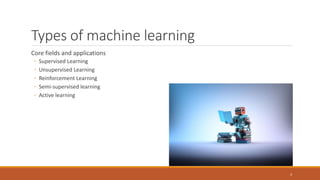
Types of machine learning
Core fields and applications
◦ Supervised Learning
◦ Unsupervised Learning
◦ Reinforcement Learning
◦ Semi-supervised learning
◦ Active learning
3
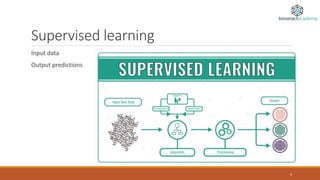
Supervised learning
Input data
Output predictions
4
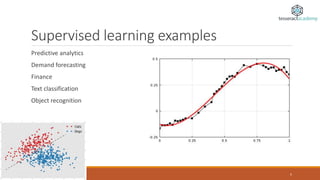
Supervised learning examples
Predictive analytics
Demand forecasting
Finance
Text classification
Object recognition
5
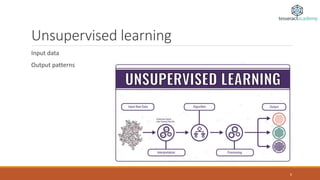
Unsupervised learning
Input data
Output patterns
6
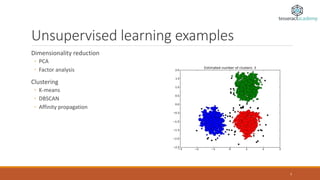
Unsupervised learning examples
Dimensionality reduction
◦ PCA
◦ Factor analysis
Clustering
◦ K-means
◦ DBSCAN
◦ Affinity propagation
7
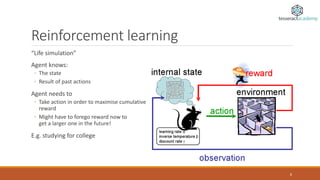
Reinforcement learning
“Life simulation”
Agent knows:
◦ The state
◦ Result of past actions
Agent needs to
◦ Take action in order to maximise cumulative
reward
◦ Might have to forego reward now to
get a larger one in the future!
E.g. studying for college
8
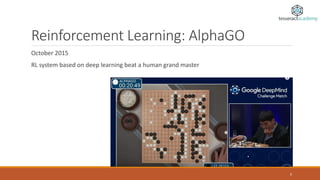
Reinforcement Learning: AlphaGO
October 2015
RL system based on deep learning beat a human grand master
9
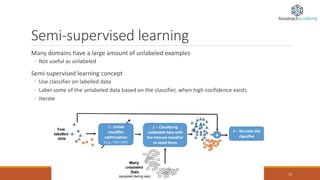
Semi-supervised learning
Many domains have a large amount of unlabeled examples
◦ Not useful as unlabeled
Semi-supervised learning concept
◦ Use classifier on labelled data
◦ Label some of the unlabeled data based on the classifier, when high confidence exists
◦ Iterate
10
Active learning
Not all examples are created equal
Use an oracle (e.g. human or a DB) to ask about the truth of the most informative examples
In active learning there are many strategies to find the most informative examples
11
Learn more
Tesseract Academy
◦ http://tesseract.academy
◦ https://www.youtube.com/watch?v=QEBDeIw60FA&index=14&list=PLVce3C5Hi9BBfabvhEzYQTQDYEg2v
tuxH
◦ https://www.youtube.com/watch?v=WxY2gvLsw7k&index=15&list=PLVce3C5Hi9BBfabvhEzYQTQDYEg2v
tuxH
◦ Data science, big data and blockchain for executives and managers.
The Data scientist
◦ Personal blog
◦ Covers data science, analytics, blockchain, tokenomics and many more subjects
◦ http://thedatascientist.com/
13

What is ml

  • 1.
  • 2.
    What is machinelearning? Arthur Samuel (1959): ”Machine learning is about giving computers the ability to learn without being explicitly programmed."[1] Bottom-up approach ◦ Data-driven ◦ Use a learning algorithm that extracts patterns from data ◦ Opposite of classic-AI (handcrafted rules) No direct control ◦ Choice of algorithm (but not much else) ◦ Parameters of the algorithm ◦ Not possible to include explicit rules or directly affect the outcome Most successful field of AI ◦ Facilitated by the big data explosion 2
  • 3.
    Types of machinelearning Core fields and applications ◦ Supervised Learning ◦ Unsupervised Learning ◦ Reinforcement Learning ◦ Semi-supervised learning ◦ Active learning 3
  • 4.
  • 5.
    Supervised learning examples Predictiveanalytics Demand forecasting Finance Text classification Object recognition 5
  • 6.
  • 7.
    Unsupervised learning examples Dimensionalityreduction ◦ PCA ◦ Factor analysis Clustering ◦ K-means ◦ DBSCAN ◦ Affinity propagation 7
  • 8.
    Reinforcement learning “Life simulation” Agentknows: ◦ The state ◦ Result of past actions Agent needs to ◦ Take action in order to maximise cumulative reward ◦ Might have to forego reward now to get a larger one in the future! E.g. studying for college 8
  • 9.
    Reinforcement Learning: AlphaGO October2015 RL system based on deep learning beat a human grand master 9
  • 10.
    Semi-supervised learning Many domainshave a large amount of unlabeled examples ◦ Not useful as unlabeled Semi-supervised learning concept ◦ Use classifier on labelled data ◦ Label some of the unlabeled data based on the classifier, when high confidence exists ◦ Iterate 10
  • 11.
    Active learning Not allexamples are created equal Use an oracle (e.g. human or a DB) to ask about the truth of the most informative examples In active learning there are many strategies to find the most informative examples 11
  • 12.
    Learn more Tesseract Academy ◦http://tesseract.academy ◦ https://www.youtube.com/watch?v=QEBDeIw60FA&index=14&list=PLVce3C5Hi9BBfabvhEzYQTQDYEg2v tuxH ◦ https://www.youtube.com/watch?v=WxY2gvLsw7k&index=15&list=PLVce3C5Hi9BBfabvhEzYQTQDYEg2v tuxH ◦ Data science, big data and blockchain for executives and managers. The Data scientist ◦ Personal blog ◦ Covers data science, analytics, blockchain, tokenomics and many more subjects ◦ http://thedatascientist.com/
  • 13.