Introduction to
Machine
Learning
A.G Patil Institute of Technology,
Solapur.
Agenda
 What is Machine Learning ?
 Why Machine Learning ?
 ML Life cycle
 Definetion of ML
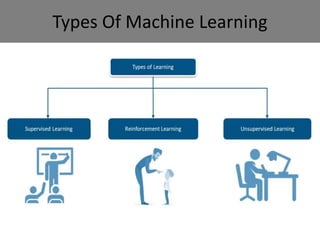
 Types of ML
o Supervised Learning
o Unsupervised Learning
o Reinforcement Learning
 Applications of ML
 Q&A
What is Machine Learning ?
Machine Learning is a science of Making computers
Learn and act like humans by feeding data and
information without being explicitly programmed.
Is machine learning only for making computers/bots
behave like humans ?
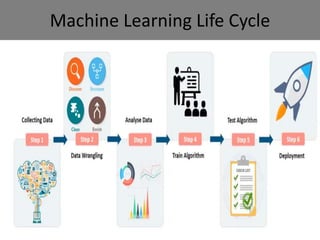
Machine Learning Life Cycle
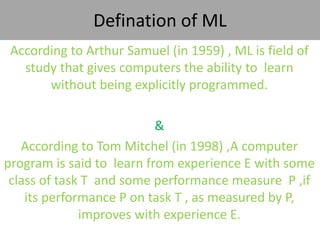
Defination of ML
According to Arthur Samuel (in 1959) , ML is field of
study that gives computers the ability to learn
without being explicitly programmed.
&
According to Tom Mitchel (in 1998) ,A computer
program is said to learn from experience E with some
class of task T and some performance measure P ,if
its performance P on task T , as measured by P,
improves with experience E.
Types Of Machine Learning
Supervised Learning
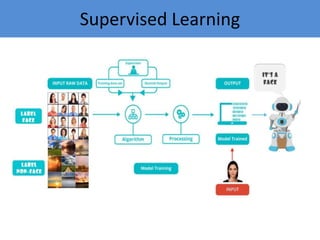
Supervised learning is where you have input
varibles(x) and output variable (y) and you use an
algoritham to learn the mapping function from the
input to output.
Here data is provided with label which is most
important thing for supervised learning.
Supervised Learning
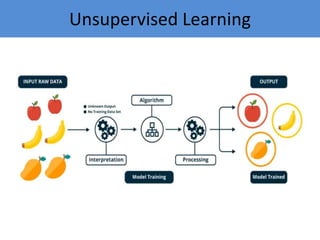
As name itself suggest that , its opposite to that of
supervised learning because here data is provided
without label and random.
So , here clustring is used which is the best algorithm
For unsupervised learning , it finds the hidden
structure of data and also hidden data .
Unsupervised learning is mostly used for Data mining
as it finds the hidden data and their structure.
Unsupervised Learning
Reinforcement Learning
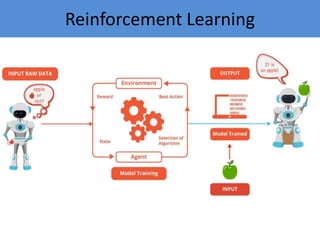
Reinforcement learning is a type of machine learning
where an agent learns to behave in an environment
By performing actions and observing the
outcomes(results).
It is simply means that here the agent requires the
feedback of environment and environment can be
anything it may be a human , thing or another
computer .
Reinforcement Learning
Applications of Machine Learning
• Virtual asistant
• Google map
• Marketing
• Face ,voice,pattern Recogonition
• Predicting deases
• Computer vision
• Computer network
• Brain machine interface
• Games (modern)
Thank You

Machine learning

  • 1.
    Introduction to Machine Learning A.G PatilInstitute of Technology, Solapur.
  • 2.
    Agenda  What isMachine Learning ?  Why Machine Learning ?  ML Life cycle  Definetion of ML  Types of ML o Supervised Learning o Unsupervised Learning o Reinforcement Learning  Applications of ML  Q&A
  • 3.
    What is MachineLearning ? Machine Learning is a science of Making computers Learn and act like humans by feeding data and information without being explicitly programmed. Is machine learning only for making computers/bots behave like humans ?
  • 6.
  • 7.
    Defination of ML Accordingto Arthur Samuel (in 1959) , ML is field of study that gives computers the ability to learn without being explicitly programmed. & According to Tom Mitchel (in 1998) ,A computer program is said to learn from experience E with some class of task T and some performance measure P ,if its performance P on task T , as measured by P, improves with experience E.
  • 8.
  • 9.
    Supervised Learning Supervised learningis where you have input varibles(x) and output variable (y) and you use an algoritham to learn the mapping function from the input to output. Here data is provided with label which is most important thing for supervised learning.
  • 10.
  • 11.
    As name itselfsuggest that , its opposite to that of supervised learning because here data is provided without label and random. So , here clustring is used which is the best algorithm For unsupervised learning , it finds the hidden structure of data and also hidden data . Unsupervised learning is mostly used for Data mining as it finds the hidden data and their structure. Unsupervised Learning
  • 12.
  • 13.
    Reinforcement Learning Reinforcement learningis a type of machine learning where an agent learns to behave in an environment By performing actions and observing the outcomes(results). It is simply means that here the agent requires the feedback of environment and environment can be anything it may be a human , thing or another computer .
  • 14.
  • 15.
    Applications of MachineLearning • Virtual asistant • Google map • Marketing • Face ,voice,pattern Recogonition • Predicting deases • Computer vision • Computer network • Brain machine interface • Games (modern)
  • 16.