Agent based modelling
A GREAT TOOL FOR ANALYSING TOKEN ECONOMIES
1
What is agent based modelling?
A type of modelling where we simulate individual autonomous heterogeneous agents
Existed since the 1940s, but started to become popular in the 1990s
Why is it useful?
◦ Mathematical modeling is a useful abstraction
◦ Many systems (e.g. social or economical) are not always amenable to abstractions
◦ ABM allows modelling at the lowest level
Blockchain and ICO
◦ ABM has been a very popular tool in computational economics
◦ Blockchain popularised artificial economies -> ABM
2
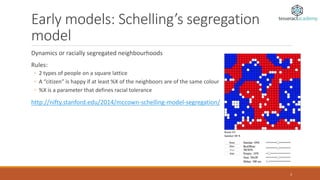
Early models: Schelling’s segregation
model
Dynamics or racially segregated neighbourhoods
Rules:
◦ 2 types of people on a square lattice
◦ A “citizen” is happy if at least %X of the neighboors are of the same colour
◦ %X is a parameter that defines racial tolerance
http://nifty.stanford.edu/2014/mccown-schelling-model-segregation/
3
Video
4
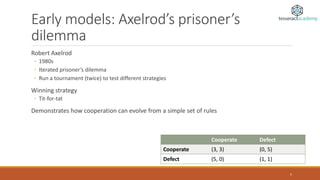
Early models: Axelrod’s prisoner’s
dilemma
Robert Axelrod
◦ 1980s
◦ Iterated prisoner’s dilemma
◦ Run a tournament (twice) to test different strategies
Winning strategy
◦ Tit-for-tat
Demonstrates how cooperation can evolve from a simple set of rules
Cooperate Defect
Cooperate (3, 3) (0, 5)
Defect (5, 0) (1, 1)
5
Later models: Sugarscape
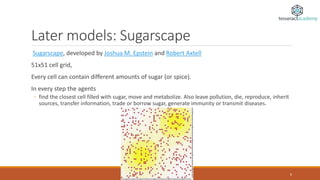
Sugarscape, developed by Joshua M. Epstein and Robert Axtell
51x51 cell grid,
Every cell can contain different amounts of sugar (or spice).
In every step the agents
◦ find the closest cell filled with sugar, move and metabolize. Also leave pollution, die, reproduce, inherit
sources, transfer information, trade or borrow sugar, generate immunity or transmit diseases.
6
ABM and blockchain
Initial Coin Offerings (ICOs) and tokenized blockchain startups create artificial economies
There are not really many proper tokenomics models to use in this context
Agent based modelling to the rescue
◦ No need for theory
◦ Explicitly encode assumptions, behaviours etc.
http://thedatascientist.com/agent-based-modelling-tokenomics/
7
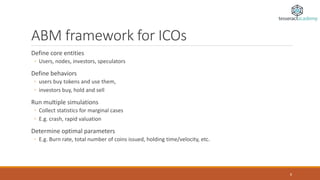
ABM framework for ICOs
Define core entities
◦ Users, nodes, investors, speculators
Define behaviors
◦ users buy tokens and use them,
◦ investors buy, hold and sell
Run multiple simulations
◦ Collect statistics for marginal cases
◦ E.g. crash, rapid valuation
Determine optimal parameters
◦ E.g. Burn rate, total number of coins issued, holding time/velocity, etc.
8
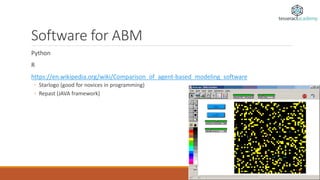
Software for ABM
Python
R
https://en.wikipedia.org/wiki/Comparison_of_agent-based_modeling_software
◦ Starlogo (good for novices in programming)
◦ Repast (JAVA framework)
9
Learn more
Tesseract Academy
◦ http://tesseract.academy
◦ https://youtu.be/pkI0NW4jZ5g
◦ https://youtu.be/0VGBCus8VK8
◦ Data science, big data and blockchain for executives and managers.
The Data scientist
◦ Personal blog
◦ Covers data science, analytics, blockchain, tokenomics and many more subjects
◦ http://thedatascientist.com/tokenomics/
◦ http://thedatascientist.com/agent-based-modelling-tokenomics/
11

Agent based modelling

  • 1.
    Agent based modelling AGREAT TOOL FOR ANALYSING TOKEN ECONOMIES 1
  • 2.
    What is agentbased modelling? A type of modelling where we simulate individual autonomous heterogeneous agents Existed since the 1940s, but started to become popular in the 1990s Why is it useful? ◦ Mathematical modeling is a useful abstraction ◦ Many systems (e.g. social or economical) are not always amenable to abstractions ◦ ABM allows modelling at the lowest level Blockchain and ICO ◦ ABM has been a very popular tool in computational economics ◦ Blockchain popularised artificial economies -> ABM 2
  • 3.
    Early models: Schelling’ssegregation model Dynamics or racially segregated neighbourhoods Rules: ◦ 2 types of people on a square lattice ◦ A “citizen” is happy if at least %X of the neighboors are of the same colour ◦ %X is a parameter that defines racial tolerance http://nifty.stanford.edu/2014/mccown-schelling-model-segregation/ 3
  • 4.
  • 5.
    Early models: Axelrod’sprisoner’s dilemma Robert Axelrod ◦ 1980s ◦ Iterated prisoner’s dilemma ◦ Run a tournament (twice) to test different strategies Winning strategy ◦ Tit-for-tat Demonstrates how cooperation can evolve from a simple set of rules Cooperate Defect Cooperate (3, 3) (0, 5) Defect (5, 0) (1, 1) 5
  • 6.
    Later models: Sugarscape Sugarscape,developed by Joshua M. Epstein and Robert Axtell 51x51 cell grid, Every cell can contain different amounts of sugar (or spice). In every step the agents ◦ find the closest cell filled with sugar, move and metabolize. Also leave pollution, die, reproduce, inherit sources, transfer information, trade or borrow sugar, generate immunity or transmit diseases. 6
  • 7.
    ABM and blockchain InitialCoin Offerings (ICOs) and tokenized blockchain startups create artificial economies There are not really many proper tokenomics models to use in this context Agent based modelling to the rescue ◦ No need for theory ◦ Explicitly encode assumptions, behaviours etc. http://thedatascientist.com/agent-based-modelling-tokenomics/ 7
  • 8.
    ABM framework forICOs Define core entities ◦ Users, nodes, investors, speculators Define behaviors ◦ users buy tokens and use them, ◦ investors buy, hold and sell Run multiple simulations ◦ Collect statistics for marginal cases ◦ E.g. crash, rapid valuation Determine optimal parameters ◦ E.g. Burn rate, total number of coins issued, holding time/velocity, etc. 8
  • 9.
    Software for ABM Python R https://en.wikipedia.org/wiki/Comparison_of_agent-based_modeling_software ◦Starlogo (good for novices in programming) ◦ Repast (JAVA framework) 9
  • 10.
    Learn more Tesseract Academy ◦http://tesseract.academy ◦ https://youtu.be/pkI0NW4jZ5g ◦ https://youtu.be/0VGBCus8VK8 ◦ Data science, big data and blockchain for executives and managers. The Data scientist ◦ Personal blog ◦ Covers data science, analytics, blockchain, tokenomics and many more subjects ◦ http://thedatascientist.com/tokenomics/ ◦ http://thedatascientist.com/agent-based-modelling-tokenomics/
  • 11.