Tokenomics
AND WHY THEY ARE NEEDED
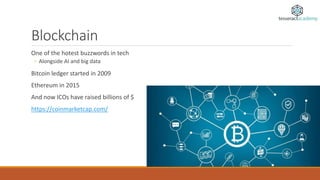
Blockchain
One of the hotest buzzwords in tech
◦ Alongside AI and big data
Bitcoin ledger started in 2009
Ethereum in 2015
And now ICOs have raised billions of $
https://coinmarketcap.com/
What is an ICO?
Sell tokens in exchange for bitcoin and ether
Allows the creation of artificial economies
◦ Arbitrary incentives
Filecoin
◦ Tokens represent MB in hard drive space
Environmental tech startups
◦ Rewarded with tokens for producing clean energy
Health apps
◦ Rewarded with tokens for healthy activities
Types of tokens
Security tokens
◦ Assets such as participation in
◦ real physical underlyings,
◦ dividends.
◦ Analogous to equities, bonds or derivatives.
Utility tokens
◦ This category provides access to the goods & services provided by the project
◦ Discount or premium access to the goods & services of the project.
Tokenomics
Or cryptoeconomics
What numbers to use for the ICO?
◦ E.g. number of tokens issued
◦ % spent on a bounty program
Will a token appreciate in value?
◦ Incentive for investors
Controlling the economy
◦ Inflation
◦ Volatility
User incentives
◦ Is my coin just a replacement for fiat?
Common fallacies
Using tokens as a replacement for fiat
◦ E.g. e-commerce
Burning tokens permanently
◦ Long-term viability?
◦ Maybe re-buy or re-issue tokens?
Wrong auction mechanism
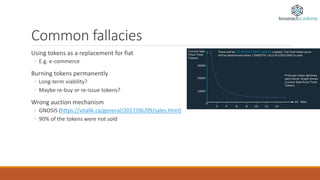
◦ GNOSIS (https://vitalik.ca/general/2017/06/09/sales.html)
◦ 90% of the tokens were not sold
Other considerations
ICOs
◦ Hard cap or soft cap
◦ 100 million or 1 billion tokens
◦ Reserve around 20-25% for the founders
◦ Bounty programs (e.g. 5%)
◦ ERC20 compliant (can be exchanged on Ethereum)
Legal issues
◦ SEC
◦ Security tokens are not allowed in the US
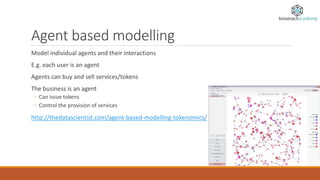
Agent based modelling
Model individual agents and their interactions
E.g. each user is an agent
Agents can buy and sell services/tokens
The business is an agent
◦ Can issue tokens
◦ Control the provision of services
http://thedatascientist.com/agent-based-modelling-tokenomics/
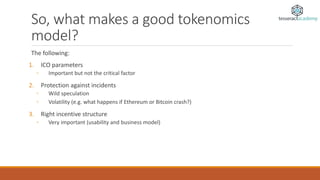
So, what makes a good tokenomics
model?
The following:
1. ICO parameters
◦ Important but not the critical factor
2. Protection against incidents
◦ Wild speculation
◦ Volatility (e.g. what happens if Ethereum or Bitcoin crash?)
3. Right incentive structure
◦ Very important (usability and business model)
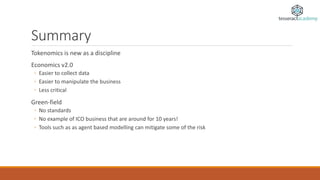
Summary
Tokenomics is new as a discipline
Economics v2.0
◦ Easier to collect data
◦ Easier to manipulate the business
◦ Less critical
Green-field
◦ No standards
◦ No example of ICO business that are around for 10 years!
◦ Tools such as as agent based modelling can mitigate some of the risk
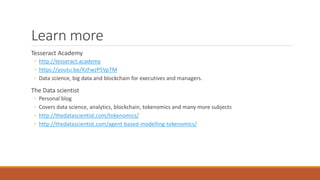
Learn more
Tesseract Academy
◦ http://tesseract.academy
◦ https://youtu.be/XzFwzP5VpTM
◦ Data science, big data and blockchain for executives and managers.
The Data scientist
◦ Personal blog
◦ Covers data science, analytics, blockchain, tokenomics and many more subjects
◦ http://thedatascientist.com/tokenomics/
◦ http://thedatascientist.com/agent-based-modelling-tokenomics/
Tokenomics

Tokenomics

  • 1.
  • 2.
    Blockchain One of thehotest buzzwords in tech ◦ Alongside AI and big data Bitcoin ledger started in 2009 Ethereum in 2015 And now ICOs have raised billions of $ https://coinmarketcap.com/
  • 3.
    What is anICO? Sell tokens in exchange for bitcoin and ether Allows the creation of artificial economies ◦ Arbitrary incentives Filecoin ◦ Tokens represent MB in hard drive space Environmental tech startups ◦ Rewarded with tokens for producing clean energy Health apps ◦ Rewarded with tokens for healthy activities
  • 4.
    Types of tokens Securitytokens ◦ Assets such as participation in ◦ real physical underlyings, ◦ dividends. ◦ Analogous to equities, bonds or derivatives. Utility tokens ◦ This category provides access to the goods & services provided by the project ◦ Discount or premium access to the goods & services of the project.
  • 5.
    Tokenomics Or cryptoeconomics What numbersto use for the ICO? ◦ E.g. number of tokens issued ◦ % spent on a bounty program Will a token appreciate in value? ◦ Incentive for investors Controlling the economy ◦ Inflation ◦ Volatility User incentives ◦ Is my coin just a replacement for fiat?
  • 6.
    Common fallacies Using tokensas a replacement for fiat ◦ E.g. e-commerce Burning tokens permanently ◦ Long-term viability? ◦ Maybe re-buy or re-issue tokens? Wrong auction mechanism ◦ GNOSIS (https://vitalik.ca/general/2017/06/09/sales.html) ◦ 90% of the tokens were not sold
  • 7.
    Other considerations ICOs ◦ Hardcap or soft cap ◦ 100 million or 1 billion tokens ◦ Reserve around 20-25% for the founders ◦ Bounty programs (e.g. 5%) ◦ ERC20 compliant (can be exchanged on Ethereum) Legal issues ◦ SEC ◦ Security tokens are not allowed in the US
  • 8.
    Agent based modelling Modelindividual agents and their interactions E.g. each user is an agent Agents can buy and sell services/tokens The business is an agent ◦ Can issue tokens ◦ Control the provision of services http://thedatascientist.com/agent-based-modelling-tokenomics/
  • 9.
    So, what makesa good tokenomics model? The following: 1. ICO parameters ◦ Important but not the critical factor 2. Protection against incidents ◦ Wild speculation ◦ Volatility (e.g. what happens if Ethereum or Bitcoin crash?) 3. Right incentive structure ◦ Very important (usability and business model)
  • 10.
    Summary Tokenomics is newas a discipline Economics v2.0 ◦ Easier to collect data ◦ Easier to manipulate the business ◦ Less critical Green-field ◦ No standards ◦ No example of ICO business that are around for 10 years! ◦ Tools such as as agent based modelling can mitigate some of the risk
  • 11.
    Learn more Tesseract Academy ◦http://tesseract.academy ◦ https://youtu.be/XzFwzP5VpTM ◦ Data science, big data and blockchain for executives and managers. The Data scientist ◦ Personal blog ◦ Covers data science, analytics, blockchain, tokenomics and many more subjects ◦ http://thedatascientist.com/tokenomics/ ◦ http://thedatascientist.com/agent-based-modelling-tokenomics/