Machine Learning
Machine Learning
Definition:
The ability of a machine to improve its performance
based on previous results.
Components to be learned







Direct-mapping from conditions on the current state to actions
Means to infer properties from the percept sequence
Information about the way the world evolves
Utility information on desirability of world states
Action information
Goals describe the maximum achievement
Machine Learning methods
•
•
•
•

Symbol-based – symbols represent entities & relationships
Connectionist – patterns of activity in networks
Genetic – Imitation of genetic & evolutionary process
Stochastic – Insight that support Bayes' rule
Exercise
How to locate the license plate area
and recognize the license plate info?
Why machine learning?
•
•
•
•

Recent progress in algorithms & theory
Growing flood of online data
Computational power is available
Budding industry
Three niches on machine learning
•
•

Data mining: using historical data to improve decision
Software applications we can't program by hand
– Autonomous driving
– Speech recognition
•
Self customizing programs
- Newsreader that learns user interests
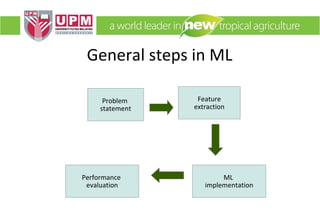
General steps in ML
Problem
statement

Performance
evaluation

Feature
extraction

ML
implementation
Example problem: movie critics
Example method: K-means clustering
algorithm
Group discussion
Group 1 – amira, meng kwang, nogol, musobi, hadi
Problem: ML for recycling centre – paper, glass, plastic
Group discussion
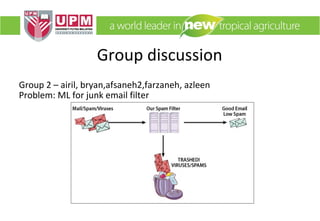
Group 2 – airil, bryan,afsaneh2,farzaneh, azleen
Problem: ML for junk email filter
Group discussion
Group 3 – malina, syaza, laith, afsaneh1,
mehrdad
Problem: ML for electronics gadget
recommendation system ( can be specific –
smartphone or tablet)
Group discussion – expected
discussion
1. Explanation on problem statement
2. List of appropriate features
3. Chosen features (significant)
4. ML Method
5. Expected results
Class discussion
1. How do algorithms make recommendations from data?
2. Why are features important?
3. Would K-means work the same with more than 2 features?
4. Could we visualize more than 2 features? More than 3?
5. Think of how Euclidean Distance is calculated. Do all the
features need to be on the same scale?
6. What are challenges in solving your problem?

Machine learning

  • 1.
  • 2.
    Machine Learning Definition: The abilityof a machine to improve its performance based on previous results.
  • 3.
    Components to belearned       Direct-mapping from conditions on the current state to actions Means to infer properties from the percept sequence Information about the way the world evolves Utility information on desirability of world states Action information Goals describe the maximum achievement
  • 4.
    Machine Learning methods • • • • Symbol-based– symbols represent entities & relationships Connectionist – patterns of activity in networks Genetic – Imitation of genetic & evolutionary process Stochastic – Insight that support Bayes' rule
  • 5.
  • 6.
    How to locatethe license plate area and recognize the license plate info?
  • 7.
    Why machine learning? • • • • Recentprogress in algorithms & theory Growing flood of online data Computational power is available Budding industry
  • 8.
    Three niches onmachine learning • • Data mining: using historical data to improve decision Software applications we can't program by hand – Autonomous driving – Speech recognition • Self customizing programs - Newsreader that learns user interests
  • 9.
    General steps inML Problem statement Performance evaluation Feature extraction ML implementation
  • 10.
    Example problem: moviecritics Example method: K-means clustering algorithm
  • 11.
    Group discussion Group 1– amira, meng kwang, nogol, musobi, hadi Problem: ML for recycling centre – paper, glass, plastic
  • 12.
    Group discussion Group 2– airil, bryan,afsaneh2,farzaneh, azleen Problem: ML for junk email filter
  • 13.
    Group discussion Group 3– malina, syaza, laith, afsaneh1, mehrdad Problem: ML for electronics gadget recommendation system ( can be specific – smartphone or tablet)
  • 14.
    Group discussion –expected discussion 1. Explanation on problem statement 2. List of appropriate features 3. Chosen features (significant) 4. ML Method 5. Expected results
  • 15.
    Class discussion 1. Howdo algorithms make recommendations from data? 2. Why are features important? 3. Would K-means work the same with more than 2 features? 4. Could we visualize more than 2 features? More than 3? 5. Think of how Euclidean Distance is calculated. Do all the features need to be on the same scale? 6. What are challenges in solving your problem?