MACHINE LEARNING
Submitted By:
MAHIRA
BCA 3-M
OUTLINE
1. WHAT IS MACHINE LEARNING
2. HISTORY OF ML
3. WHY ML
4. APPLICATIONS OF ML
5. TYPES OF ML
6. HOW MACHINE LEARNING WORKS
7. CHALLENGES AND CONSIDERATIONS
8. BEST PROGRAMMING LANGUAGES FOR MACHINE LEARNING
9. CONCLUSION
WHAT IS MACHINE LEARNING ?
• ML is a branch of artificial intelligence, concerned with the design
and development of algorithms that allow computers to evolve
behaviors based on data or past experience.
• It focuses on the use of data and algorithms to imitate the way that
humans learn, gradually improving its accuracy.
• The field of study known as machine learning is concerned with the
question of how to construct computer programs that automatically
improve with experience.
FOR EXAMPLE
Imagine you have some sets of the pair of numbers.
(2,4) , (3,6) , (4,9)
The computer program has to predict the second number for
(5,?)
The program first needs to find the logic between the pairs and
then apply the same logic to predict the number. To find that logic
is called “machine learning”. So that after finding the logic it can
apply the same logic to predict each number.
HISTORY
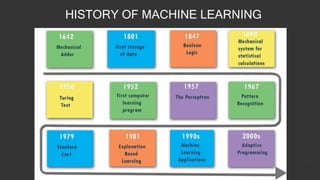
Arthur Samuel, an early American leader in the field of
computer gaming and artificial intelligence, coined the term
“Machine Learning ” in 1959 while at IBM. He defined machine
learning as “the field of study that gives computers the ability to
learn without being explicitly programmed “. However, there is
no universally accepted definition for machine learning.
Different authors define the term differently.
Definition by Tom Mitchell (1998):
Machine Learning is the study of algorithms that
• improve their performance P
• at some task T
• with experience E.
A well-defined learning task is given by P,T,R.
HISTORY OF MACHINE LEARNING
WHY MACHINE LEARNING ?
• Develop systems that can automatically adapt and customize themselves to individual users.
Personalized news or mail filter
• Discover new knowledge from large databases (data mining).
Market basket analysis
• Ability to mimic human and replace certain monotonous tasks which require some
intelligence.
Like recognizing handwritten characters
• Human expertise
Face/handwriting/speech recognition
Driving a car
Flying a plane
CONTD.
• Rapidly changing phenomena
Credit scoring, financial modeling, Diagnosis, fraud detection
• Need for customization/personalization
Personalized news reader
Movie/book recommendation
• Flood of available data (especially with the advent of the Internet)
• Increasing computational power
• Growing progress in available algorithms and theory developed by researchers
• Increasing support from industries
• Develop systems that are too difficult/expensive to construct manually because they require
specific detailed skills or knowledge tuned to a specific task
APPLICATIONS OF
MACHINE LEARNING
1. IMAGE RECOGNITION:
FACE ID , FACEBOOK’S “DEEP FACE”
2. SPEECH RECOGNITION:
"SPEECH TO TEXT"
“WAVE FORM OF SAYING HELLO"
3. TRAFFIC PREDICTION:
4. PRODUCT RECOMMENDATIONS:
5. SELF-DRIVING CARS:
TYPES OF MACHINE LEARNING
• Supervised Learning
• Unsupervised Learning
• Reinforcement Learning
SUPERVISED LEARNING
• Supervised Learning is a technique where the program is given labelled input data and
the expected output data. It gets the data from training data containing sets of examples.
• They generate two kinds of results :
Classification: They notify the class of the data it is presented with.
Regression: They expect the product to produce a numerical value.
• Supervised learning is the machine learning task of learning a function that maps an input
to an output based on example input-output pairs.
• The given data is labeled and it works on the basis of prediction.
UNSUPERVISED LEARNING
• This type of algorithm consists of input data without labelled response.
• There will not be any pre existing labels and human intervention is also less and it works
on the basis of interpretation, algorithms, processing.
• It is mostly used in exploratory analysis as it can automatically identify the structure in
data.
• In unsupervised learning algorithms, classification or categorization is not included in the
observations.
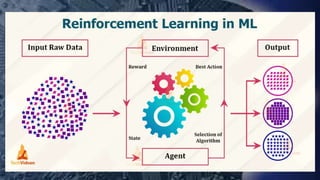
REINFORCEMENT LEARNING
• This model is used in making a sequence of decisions.
• It is an learning by interacting with the environment.
• It is based on the observation that intelligent agents tend to repeat the action
• It can be said that it is an TRAIL AND ERROR METHOD in finding the best outcome
based on experience.
• Reinforcement learning is the problem of getting an agent to act in the world so as to
maximize its rewards.
HOW MACHINE LEARNING WORKS
• Machine learning is a form of artificial intelligence (AI) that teaches computers to think in a
similar way to how humans do: Learning and improving upon past experiences.
• It works by exploring data and identifying patterns, and involves minimal human
intervention.
• Almost any task that can be completed with a data-defined pattern or set of rules can be
automated with machine learning.
• This allows companies to transform processes that were previously only possible for
humans to perform—think responding to customer service calls, bookkeeping, and
reviewing resumes.
CHALLENGES AND CONSIDERATIONS
1. Poor quality of data=
Noisy data, incomplete data, inaccurate data
Unclean data lead to less accuracy in classification and low-quality results
2. Underfitting of Training Data=
Data is unable to establish an accurate relationship between input and output variables
To overcome this issue:
• Maximize the training time
• Enhance the complexity of the model
• Add more features to the data
• Reduce regular parameters
• Increasing the training time of model
CHALLENGES AND CONSIDERATIONS
3. Overfitting of Training Data=
A machine learning model trained with a massive amount of data that negatively affect its
performance.
We can tackle this issue by:
• Analyzing the data with the utmost level of perfection
• Use data augmentation technique
• Remove outliers in the training set
• Select a model with lesser features
4. Machine Learning is a Complex Process=
High chances of error which makes the learning complex.
It includes analyzing the data, removing data bias, training data, applying complex
mathematical calculations, and a lot more.
CHALLENGES AND CONSIDERATIONS
5. Lack of Training Data=
Less amount training data will produce inaccurate or too biased predictions.
6. Slow Implementation=
Takes a tremendous amount of time.
Slow programs, data overload, and excessive requirements usually take a lot of time to
provide accurate results.
BEST PROGRAMMING LANGUAGES
FOR MACHINE LEARNING
Some of the best and most commonly used machine learning programs are
• Python,
• Java,
• C,
• C++,
• Shell,
• R,
• Javascript,
• Scala,
• Shell,
• Julia.
CONCLUSION
We have a simple overview of some techniques and algorithms in machine learning. Furthermore,
there are more and more techniques apply machine learning as a solution. In the future, machine
learning will play an important role in our daily life. Machine learning is all set to bring a big bang
transformation in technology. It is one of the most rapidly growing technologies used in medical
diagnosis, speech recognition, robotic training, product recommendations, video surveillance, and this
list goes on. This continuously evolving domain offers immense job satisfaction, excellent
opportunities, global exposure, and exorbitant salary. It is a high risk and a high return technology.
THANK YOU!!

MACHINE LEARNING PRESENTATION (ARTIFICIAL INTELLIGENCE)

  • 1.
  • 2.
    OUTLINE 1. WHAT ISMACHINE LEARNING 2. HISTORY OF ML 3. WHY ML 4. APPLICATIONS OF ML 5. TYPES OF ML 6. HOW MACHINE LEARNING WORKS 7. CHALLENGES AND CONSIDERATIONS 8. BEST PROGRAMMING LANGUAGES FOR MACHINE LEARNING 9. CONCLUSION
  • 3.
    WHAT IS MACHINELEARNING ? • ML is a branch of artificial intelligence, concerned with the design and development of algorithms that allow computers to evolve behaviors based on data or past experience. • It focuses on the use of data and algorithms to imitate the way that humans learn, gradually improving its accuracy. • The field of study known as machine learning is concerned with the question of how to construct computer programs that automatically improve with experience.
  • 4.
    FOR EXAMPLE Imagine youhave some sets of the pair of numbers. (2,4) , (3,6) , (4,9) The computer program has to predict the second number for (5,?) The program first needs to find the logic between the pairs and then apply the same logic to predict the number. To find that logic is called “machine learning”. So that after finding the logic it can apply the same logic to predict each number.
  • 5.
    HISTORY Arthur Samuel, anearly American leader in the field of computer gaming and artificial intelligence, coined the term “Machine Learning ” in 1959 while at IBM. He defined machine learning as “the field of study that gives computers the ability to learn without being explicitly programmed “. However, there is no universally accepted definition for machine learning. Different authors define the term differently. Definition by Tom Mitchell (1998): Machine Learning is the study of algorithms that • improve their performance P • at some task T • with experience E. A well-defined learning task is given by P,T,R.
  • 6.
  • 7.
    WHY MACHINE LEARNING? • Develop systems that can automatically adapt and customize themselves to individual users. Personalized news or mail filter • Discover new knowledge from large databases (data mining). Market basket analysis • Ability to mimic human and replace certain monotonous tasks which require some intelligence. Like recognizing handwritten characters • Human expertise Face/handwriting/speech recognition Driving a car Flying a plane
  • 8.
    CONTD. • Rapidly changingphenomena Credit scoring, financial modeling, Diagnosis, fraud detection • Need for customization/personalization Personalized news reader Movie/book recommendation • Flood of available data (especially with the advent of the Internet) • Increasing computational power • Growing progress in available algorithms and theory developed by researchers • Increasing support from industries • Develop systems that are too difficult/expensive to construct manually because they require specific detailed skills or knowledge tuned to a specific task
  • 9.
  • 10.
    1. IMAGE RECOGNITION: FACEID , FACEBOOK’S “DEEP FACE”
  • 11.
    2. SPEECH RECOGNITION: "SPEECHTO TEXT" “WAVE FORM OF SAYING HELLO"
  • 12.
  • 13.
  • 14.
  • 15.
    TYPES OF MACHINELEARNING • Supervised Learning • Unsupervised Learning • Reinforcement Learning
  • 17.
    SUPERVISED LEARNING • SupervisedLearning is a technique where the program is given labelled input data and the expected output data. It gets the data from training data containing sets of examples. • They generate two kinds of results : Classification: They notify the class of the data it is presented with. Regression: They expect the product to produce a numerical value. • Supervised learning is the machine learning task of learning a function that maps an input to an output based on example input-output pairs. • The given data is labeled and it works on the basis of prediction.
  • 19.
    UNSUPERVISED LEARNING • Thistype of algorithm consists of input data without labelled response. • There will not be any pre existing labels and human intervention is also less and it works on the basis of interpretation, algorithms, processing. • It is mostly used in exploratory analysis as it can automatically identify the structure in data. • In unsupervised learning algorithms, classification or categorization is not included in the observations.
  • 21.
    REINFORCEMENT LEARNING • Thismodel is used in making a sequence of decisions. • It is an learning by interacting with the environment. • It is based on the observation that intelligent agents tend to repeat the action • It can be said that it is an TRAIL AND ERROR METHOD in finding the best outcome based on experience. • Reinforcement learning is the problem of getting an agent to act in the world so as to maximize its rewards.
  • 23.
    HOW MACHINE LEARNINGWORKS • Machine learning is a form of artificial intelligence (AI) that teaches computers to think in a similar way to how humans do: Learning and improving upon past experiences. • It works by exploring data and identifying patterns, and involves minimal human intervention. • Almost any task that can be completed with a data-defined pattern or set of rules can be automated with machine learning. • This allows companies to transform processes that were previously only possible for humans to perform—think responding to customer service calls, bookkeeping, and reviewing resumes.
  • 24.
    CHALLENGES AND CONSIDERATIONS 1.Poor quality of data= Noisy data, incomplete data, inaccurate data Unclean data lead to less accuracy in classification and low-quality results 2. Underfitting of Training Data= Data is unable to establish an accurate relationship between input and output variables To overcome this issue: • Maximize the training time • Enhance the complexity of the model • Add more features to the data • Reduce regular parameters • Increasing the training time of model
  • 25.
    CHALLENGES AND CONSIDERATIONS 3.Overfitting of Training Data= A machine learning model trained with a massive amount of data that negatively affect its performance. We can tackle this issue by: • Analyzing the data with the utmost level of perfection • Use data augmentation technique • Remove outliers in the training set • Select a model with lesser features 4. Machine Learning is a Complex Process= High chances of error which makes the learning complex. It includes analyzing the data, removing data bias, training data, applying complex mathematical calculations, and a lot more.
  • 26.
    CHALLENGES AND CONSIDERATIONS 5.Lack of Training Data= Less amount training data will produce inaccurate or too biased predictions. 6. Slow Implementation= Takes a tremendous amount of time. Slow programs, data overload, and excessive requirements usually take a lot of time to provide accurate results.
  • 27.
    BEST PROGRAMMING LANGUAGES FORMACHINE LEARNING Some of the best and most commonly used machine learning programs are • Python, • Java, • C, • C++, • Shell, • R, • Javascript, • Scala, • Shell, • Julia.
  • 28.
    CONCLUSION We have asimple overview of some techniques and algorithms in machine learning. Furthermore, there are more and more techniques apply machine learning as a solution. In the future, machine learning will play an important role in our daily life. Machine learning is all set to bring a big bang transformation in technology. It is one of the most rapidly growing technologies used in medical diagnosis, speech recognition, robotic training, product recommendations, video surveillance, and this list goes on. This continuously evolving domain offers immense job satisfaction, excellent opportunities, global exposure, and exorbitant salary. It is a high risk and a high return technology.
  • 29.