Machine Learning
What is Machine Learning
• Machine Learning is the field of study that gives computers the ability to learn without being
explicitly programmed.
• A computer program is said to learn from experience E with respect to some task T and some
performance measure P, if its performance on T, as measured by P, improves with experience E.
• Machine learning is programming computers to optimize a performance criterion using example data
or past experience.
What is Machine Learning
• Suppose your twitter program watches which tweet you do or do not mark as cyberbullying, and based
on that learns how to better filter bullying tweet. What is the task T in this setting?
a. Classifying tweets as bully or no bully.
b. Watching you label tweets as bully or no bully.
c. The number (or fraction) of tweets correctly classified as bully or no bully.
d. None of the above—this is not a machine learning problem.
Importance of Machine Learning
• Learning general models from a data of particular examples
• Data is cheap and abundant (data warehouses, data marts); knowledge is expensive
and scarce.
• Example in retail: Customer transactions to consumer behavior
• Build a model that is a good and useful approximation to the data.
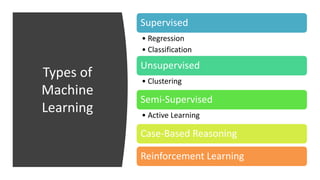
Types of
Machine
Learning
Supervised
• Regression
• Classification
Unsupervised
• Clustering
Semi-Supervised
• Active Learning
Case-Based Reasoning
Reinforcement Learning
Supervised Learning
Supervised Learning
Supervised Learning
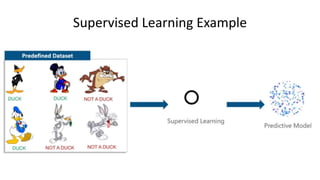
Supervised Learning Example
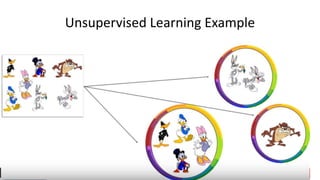
Unsupervised Learning
Unsupervised Learning Example
Semi-Supervised Learning
• The crux of the semi-supervised machine learning or Active Learning
approaches is that machine learning algorithms can obtain optimum
classification accuracy with only a few labeled instances.
• These approaches are beneficial where un- labeled data can be
obtained easily in huge volumes; nonetheless, the labeling of the
collected data is difficult, laborious, and expensive.
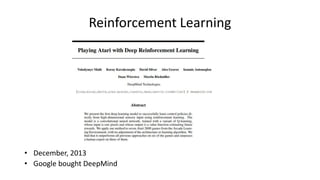
Reinforcement Learning
• December, 2013
• Google bought DeepMind
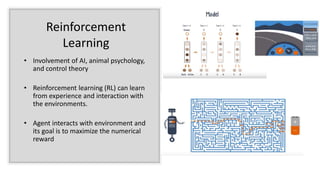
Reinforcement
Learning
• Involvement of AI, animal psychology,
and control theory
• Reinforcement learning (RL) can learn
from experience and interaction with
the environments.
• Agent interacts with environment and
its goal is to maximize the numerical
reward
Lec 1.pptx
Lec 1.pptx
Lec 1.pptx
Lec 1.pptx
Lec 1.pptx

Lec 1.pptx

  • 1.
  • 2.
    What is MachineLearning • Machine Learning is the field of study that gives computers the ability to learn without being explicitly programmed. • A computer program is said to learn from experience E with respect to some task T and some performance measure P, if its performance on T, as measured by P, improves with experience E. • Machine learning is programming computers to optimize a performance criterion using example data or past experience.
  • 3.
    What is MachineLearning • Suppose your twitter program watches which tweet you do or do not mark as cyberbullying, and based on that learns how to better filter bullying tweet. What is the task T in this setting? a. Classifying tweets as bully or no bully. b. Watching you label tweets as bully or no bully. c. The number (or fraction) of tweets correctly classified as bully or no bully. d. None of the above—this is not a machine learning problem.
  • 5.
    Importance of MachineLearning • Learning general models from a data of particular examples • Data is cheap and abundant (data warehouses, data marts); knowledge is expensive and scarce. • Example in retail: Customer transactions to consumer behavior • Build a model that is a good and useful approximation to the data.
  • 6.
    Types of Machine Learning Supervised • Regression •Classification Unsupervised • Clustering Semi-Supervised • Active Learning Case-Based Reasoning Reinforcement Learning
  • 7.
  • 8.
  • 9.
  • 10.
  • 11.
  • 14.
  • 15.
  • 19.
    Semi-Supervised Learning • Thecrux of the semi-supervised machine learning or Active Learning approaches is that machine learning algorithms can obtain optimum classification accuracy with only a few labeled instances. • These approaches are beneficial where un- labeled data can be obtained easily in huge volumes; nonetheless, the labeling of the collected data is difficult, laborious, and expensive.
  • 20.
    Reinforcement Learning • December,2013 • Google bought DeepMind
  • 21.
    Reinforcement Learning • Involvement ofAI, animal psychology, and control theory • Reinforcement learning (RL) can learn from experience and interaction with the environments. • Agent interacts with environment and its goal is to maximize the numerical reward