MINDSET
What is Mindset ?
-set of attitudes or beliefs
that we hold.
- belief about your abilities.
- how we think, believe & act.
Types of Mindset :
1. Growth Mindset
2. Fixed Mindset
Mindset Quiz- Agree or Not
1. My intelligence is something very basic about me that I can’t really
change.
2. When I don’t understand something I like to slow down and try to figure
it out.
3. I am intimidated by academic challenges.
4. I have been told by others that I am smart.
5. Learning is fun.
6. I often feel unmotivated to learn.
7. When I don’t do well in a subject I think that I must not be very good at
that particular subject.
8. When I perform poorly academically I do not get discouraged.
9. When I don’t understand something, I get very frustrated and want to
give up.
10. I shouldn’t have to work as hard in subjects that I am naturally good
at.
Quiz adapted from “The Curse of the ‘Smart’ Student” at extremebiology.net.
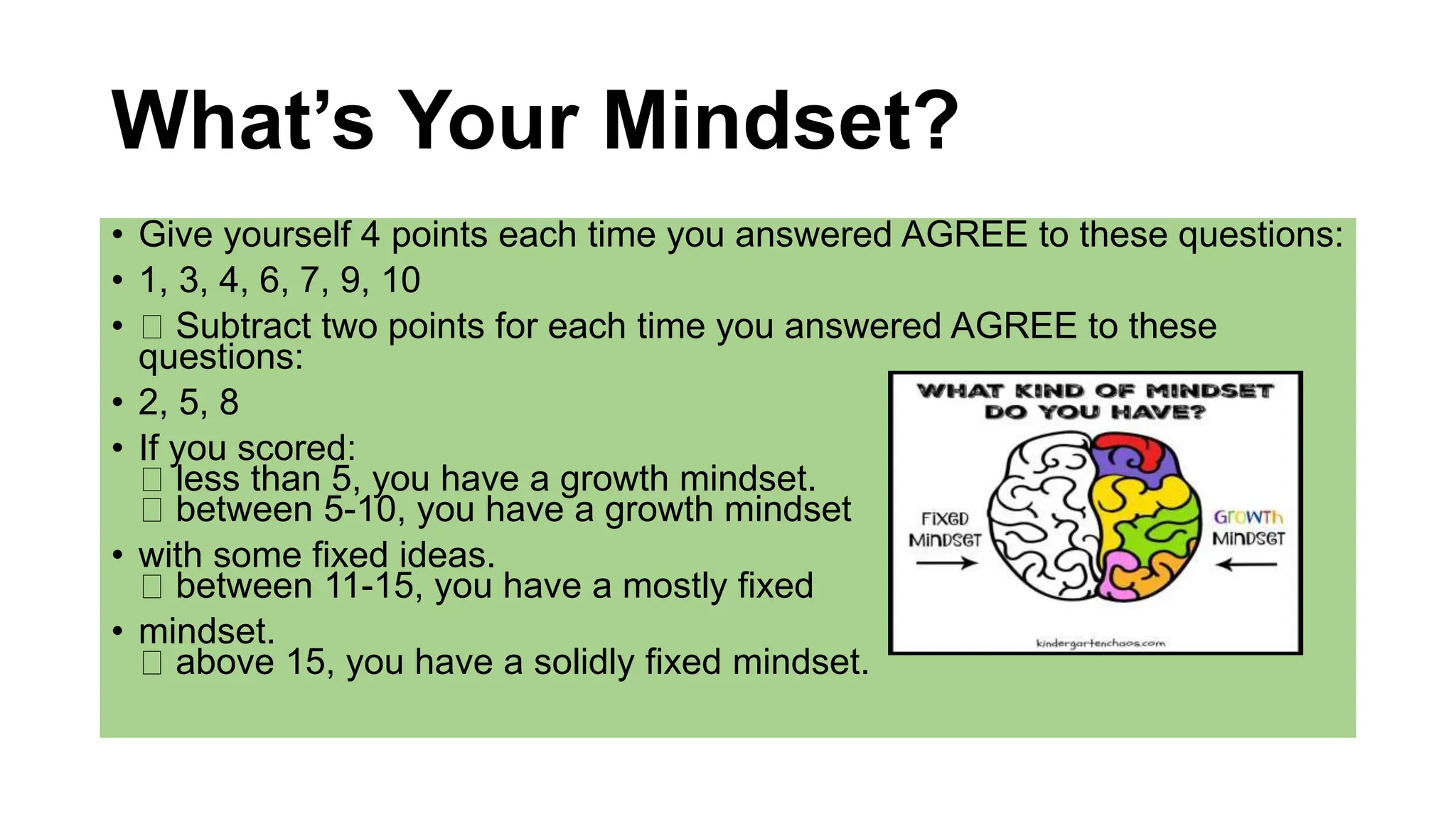
What’s Your Mindset?
• Give yourself 4 points each time you answered AGREE to these questions:
• 1, 3, 4, 6, 7, 9, 10
• Subtract two points for each time you answered AGREE to these
questions:
• 2, 5, 8
• If you scored:
less than 5, you have a growth mindset.
between 5-10, you have a growth mindset
• with some fixed ideas.
between 11-15, you have a mostly fixed
• mindset.
above 15, you have a solidly fixed mindset.
YESTERDAY’S THEORY: WE ARE
BORN WITH INTELLIGENCE
• Alfred Binet Invented the first useable IQ test
• Yesterday’s Theory- No matter how much you
learn or how hard you work your intelligence
stays the same!
THEORY OF INTELLIGENCE
•IN OTHER WORDS...It’s not what you
are born with, that matters; it’s your
mindset that matters.
•Growth Mindset: Intelligence is a
quality that can be changed and
developed.
What
is a
growth
mindset?
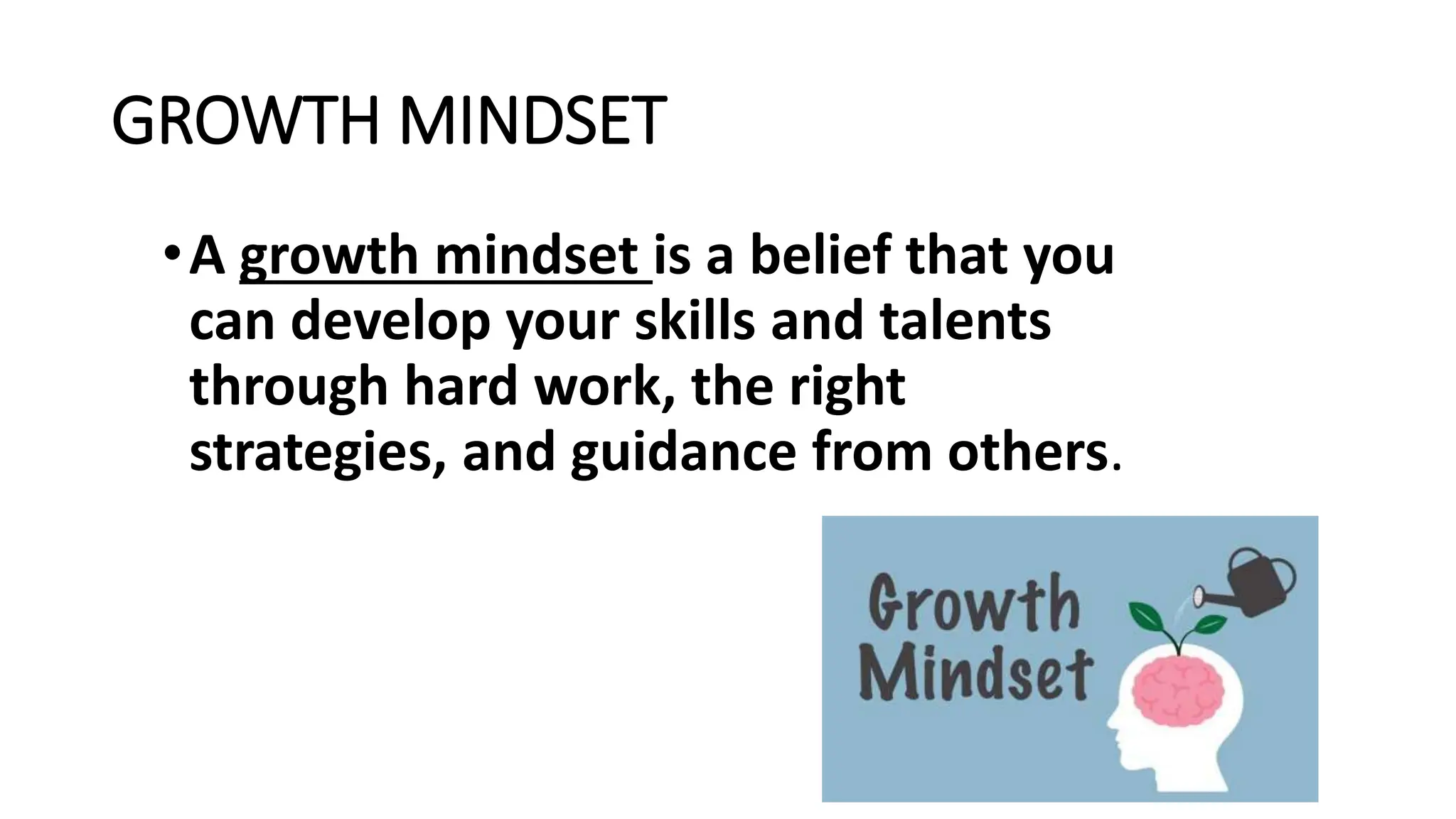
GROWTH MINDSET
•A growth mindset is a belief that you
can develop your skills and talents
through hard work, the right
strategies, and guidance from others.
GROWTH MINDSET
VS.
FIXED MINDSET
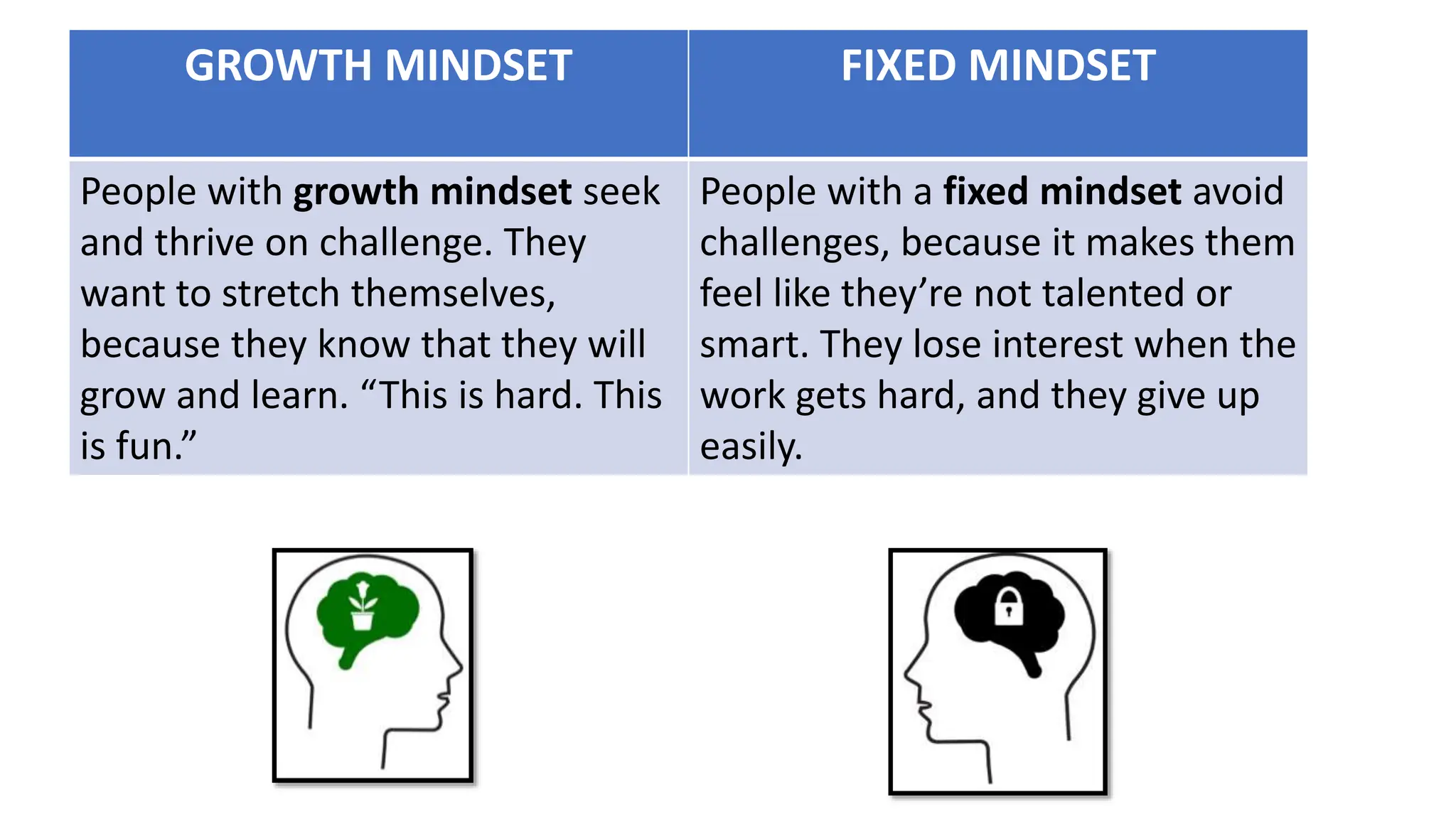
GROWTH MINDSET FIXED MINDSET
People with growth mindset seek
and thrive on challenge. They
want to stretch themselves,
because they know that they will
grow and learn. “This is hard. This
is fun.”
People with a fixed mindset avoid
challenges, because it makes them
feel like they’re not talented or
smart. They lose interest when the
work gets hard, and they give up
easily.
When faced with failure and challenges,
people with a FIXED MINDSET:
- get depressed, de – energized, and
lose self – esteem.
- denigrate their intelligence: I’m Stupid
When faced with failure and challenges,
people with a FIXED MINDSET:
- helpless
- do not pay attention to learning
information.
When faced with failure and challenges,
people with a GROWTH MINDSET:
- try out new ways of doing things.
- pay attention to learning
information.
When faced with failure and challenges,
people with a GROWTH MINDSET:
- try and try until you succeed.
- focus on what they are learning,
rather than focusing on how they
feel.
EFFORT
FIXED MINSET:
- view EFFORT as a
reflection of low
intelligence.
- hard work means I don’t
get it; I’m not intelligent.
- Effort = lack of ability
GROWTH MINSET:
- EFFORT is a necessary
part of success.
- try harder when faced
with setback.
- Effort = success
- Use effort to overcome
difficulty.
DIFFICULTIES
FIXED MINSET:
- Conceal mistakes.
- lose focus
- panic
- give up
- feel helpless
GROWTH MINSET:
- confront deficiencies
- try new strategies
- focus on improvement
GOALS
GROWTH MINSET:
- create learning
- mastery
- competence
- increase
performance
FIXED MINSET:
- create performance.
- potentials can be
measured.
- aim to receive validation
from others
GROWTH MINSET:
- abilities can be
developed
- embrace challenges
- effort is a path to
mastery
- persist obstacles
FIXED MINSET:
- avoid challenges.
- effort is seen as waste of
time
- feels threatened by
others’ success
- basic qualities are fixed
SAMPLE SITUATIONS
FIXED MINDSET
VS.
GROWTH MINDSET
Sample Situation: You got an outstanding performance
in your IPCR.
Great! I must be
really intelligent in
this area!
FIXED
MINDSET
GROWTH
MINDSET
Great! I must have
worked hard and
learned a lot.
Sample Situation: You’re given a school program to
handle.
I hope this will
be easy for me.
FIXED
MINDSET
GROWTH
MINDSET
I hope this will
be interesting!
Sample Situation: You get negative feedback on your
work from your head.
Oh no! This
proves I’m no
good at this.
FIXED
MINDSET
GROWTH
MINDSET
Okay, I need to
get back to work
and learn more.
Sample Situation: You are given a new designation by
the school head.
No! Not my thing!
FIXED
MINDSET
GROWTH
MINDSET
Bring it on!
Who has the potential of growing? Why?
7 Practices for Teachers to Develop
Growth Mindset
Never stop growing.
• Show your students and co-teachers that you are a
lifelong learner.
• Study something along with your students.
• Try a new classroom technique.
• Read up on the latest research and stay hungry for
knowledge.
Experiment and Innovate
Experiment
and Innovate
• Many schools are teaching students to be young
innovators, makers, and design-thinkers in order to
succeed in an evolving global economy. Therefore,
shouldn’t teachers be innovators too?
•Don’t just follow the herd. Lead the
charge and stay open to what’s possible.
Ask Questions
Ask
Questions
• What if teachers approached school-based problems
and ideas through an inquiry lens? Imagine how
much deeper we could dive and how much more
creative our ideas would be. Learning a new
technique or philosophy in PD?
•Use inquiry techniques and guide
teachers to become questioners again.
The more we question, the more we
learn and grow.
Be Flexible
Be
Flexible
•Great things can be achieved when we let go
of or stretch our rules, expectations, or
boundaries, and include outside
perspectives.
•We must be willing to adapt our
practice to the needs and best interests
of our students and find a way to
include the input and contributions of
our colleagues.
Learn New Technology
Learn New
Technology
Can you think of a teacher who barely
uses email or who says things like “I’m not
good with technology?” It’s true that there’s
so much to learn. It seems like it’s all
constantly shifting, but here’s the reality:
Educators don’t have to be experts on all
things technology — but we do have to keep
up.
Truly Listen
Truly
Listen
• Imagine a typical school staff meeting. A teacher is speaking about an
idea and maybe you’ve tuned out or you’re busy thinking about your
response — or you’re watching the clock and counting the minutes
until lunch. How often to do you really, deeply listen to the
contributions of others and take time to seriously consider what
they’ve said before offering a response? Chances are, not very
often.
The next time someone is speaking to you,
try this:
•Do not interject.
•Do not consider a response.
•Don’t let your eyes or mind wander.
Just look and listen.
•The more we listen and collaborate
with one another, the more we grow
together.
Reflect, Reflect, Reflect
Reflect, Reflect,
Reflect
•In order to continue to grow and
improve, we must consistently
take time to evaluate our work
and analyze how we’re doing.
Reflect, Reflect,
Reflect
•When you regularly examine your
strengths, weaknesses, triumphs,
failures, and goals, you have to
continuously adjust, which
ensures that you’re on track with
success in sight.
The school year is so busy and self-reflection
is hard to prioritize. One solution is to build
reflection activities into professional
development or into teacher meetings to
maintain a consistent and meaningful routine.
So, are up for the
challenge to grow!
According to Carol Dweck, it is more beneficial to
praise students’ efforts in education rather than
their intelligence; as it may encourage them to face
more difficult challenges. In another study, her
research showed that the learners who were taught
how to build their level of intelligence performed
far better in education and demonstrated more
motivation in the learning experience.
SIGNIFICANCE OF GROWTH MINDSET IN
EDUCATION
Individuals with a growth mindset are more likely to
become successful people, as they are more ready
to accept new information. This allows learners with
growth mindset to become more open to learning
in the future. When a learner perceives that he may
achieve anything by way of hard work, he may show
better academic performance and more motivation
to dig into his course content.
SIGNIFICANCE OF GROWTH MINDSET IN
EDUCATION
People with a growth mindset are more likely to
show more confidence to face challenges and to
achieve high-risk goals.
SIGNIFICANCE OF GROWTH MINDSET IN
EDUCATION
They exhibit better brain development; lesser
anxiety, stress and depression; higher human
motivation; higher performance levels; and
better work relationships.
SIGNIFICANCE OF GROWTH MINDSET IN
EDUCATION
SOURCES
• https://medium.com/leadership-motivation-and-impact/fixed-v-growth-mindset-
902e7d0081b3
• https://www.futurelearn.com/info/blog/general/develop-growth-mindset
• https://resilienteducator.com/classroom-resources/growth-mindset-for-teachers/

What is growth mind set and the difference between fixed and growth mind set

  • 1.
  • 2.
    What is Mindset? -set of attitudes or beliefs that we hold. - belief about your abilities. - how we think, believe & act.
  • 3.
    Types of Mindset: 1. Growth Mindset 2. Fixed Mindset
  • 4.
    Mindset Quiz- Agreeor Not 1. My intelligence is something very basic about me that I can’t really change. 2. When I don’t understand something I like to slow down and try to figure it out. 3. I am intimidated by academic challenges. 4. I have been told by others that I am smart. 5. Learning is fun. 6. I often feel unmotivated to learn. 7. When I don’t do well in a subject I think that I must not be very good at that particular subject. 8. When I perform poorly academically I do not get discouraged. 9. When I don’t understand something, I get very frustrated and want to give up. 10. I shouldn’t have to work as hard in subjects that I am naturally good at. Quiz adapted from “The Curse of the ‘Smart’ Student” at extremebiology.net.
  • 5.
    What’s Your Mindset? •Give yourself 4 points each time you answered AGREE to these questions: • 1, 3, 4, 6, 7, 9, 10 • Subtract two points for each time you answered AGREE to these questions: • 2, 5, 8 • If you scored: less than 5, you have a growth mindset. between 5-10, you have a growth mindset • with some fixed ideas. between 11-15, you have a mostly fixed • mindset. above 15, you have a solidly fixed mindset.
  • 6.
    YESTERDAY’S THEORY: WEARE BORN WITH INTELLIGENCE • Alfred Binet Invented the first useable IQ test • Yesterday’s Theory- No matter how much you learn or how hard you work your intelligence stays the same!
  • 7.
    THEORY OF INTELLIGENCE •INOTHER WORDS...It’s not what you are born with, that matters; it’s your mindset that matters. •Growth Mindset: Intelligence is a quality that can be changed and developed.
  • 8.
  • 9.
    GROWTH MINDSET •A growthmindset is a belief that you can develop your skills and talents through hard work, the right strategies, and guidance from others.
  • 10.
  • 11.
    GROWTH MINDSET FIXEDMINDSET People with growth mindset seek and thrive on challenge. They want to stretch themselves, because they know that they will grow and learn. “This is hard. This is fun.” People with a fixed mindset avoid challenges, because it makes them feel like they’re not talented or smart. They lose interest when the work gets hard, and they give up easily.
  • 13.
    When faced withfailure and challenges, people with a FIXED MINDSET: - get depressed, de – energized, and lose self – esteem. - denigrate their intelligence: I’m Stupid
  • 14.
    When faced withfailure and challenges, people with a FIXED MINDSET: - helpless - do not pay attention to learning information.
  • 15.
    When faced withfailure and challenges, people with a GROWTH MINDSET: - try out new ways of doing things. - pay attention to learning information.
  • 16.
    When faced withfailure and challenges, people with a GROWTH MINDSET: - try and try until you succeed. - focus on what they are learning, rather than focusing on how they feel.
  • 17.
    EFFORT FIXED MINSET: - viewEFFORT as a reflection of low intelligence. - hard work means I don’t get it; I’m not intelligent. - Effort = lack of ability GROWTH MINSET: - EFFORT is a necessary part of success. - try harder when faced with setback. - Effort = success - Use effort to overcome difficulty.
  • 18.
    DIFFICULTIES FIXED MINSET: - Concealmistakes. - lose focus - panic - give up - feel helpless GROWTH MINSET: - confront deficiencies - try new strategies - focus on improvement
  • 19.
    GOALS GROWTH MINSET: - createlearning - mastery - competence - increase performance FIXED MINSET: - create performance. - potentials can be measured. - aim to receive validation from others
  • 20.
    GROWTH MINSET: - abilitiescan be developed - embrace challenges - effort is a path to mastery - persist obstacles FIXED MINSET: - avoid challenges. - effort is seen as waste of time - feels threatened by others’ success - basic qualities are fixed
  • 21.
  • 22.
    Sample Situation: Yougot an outstanding performance in your IPCR. Great! I must be really intelligent in this area! FIXED MINDSET GROWTH MINDSET Great! I must have worked hard and learned a lot.
  • 23.
    Sample Situation: You’regiven a school program to handle. I hope this will be easy for me. FIXED MINDSET GROWTH MINDSET I hope this will be interesting!
  • 24.
    Sample Situation: Youget negative feedback on your work from your head. Oh no! This proves I’m no good at this. FIXED MINDSET GROWTH MINDSET Okay, I need to get back to work and learn more.
  • 25.
    Sample Situation: Youare given a new designation by the school head. No! Not my thing! FIXED MINDSET GROWTH MINDSET Bring it on!
  • 26.
    Who has thepotential of growing? Why?
  • 27.
    Who has thepotential of growing? Why?
  • 28.
    7 Practices forTeachers to Develop Growth Mindset
  • 29.
  • 30.
    • Show yourstudents and co-teachers that you are a lifelong learner. • Study something along with your students. • Try a new classroom technique. • Read up on the latest research and stay hungry for knowledge.
  • 31.
  • 32.
    Experiment and Innovate • Manyschools are teaching students to be young innovators, makers, and design-thinkers in order to succeed in an evolving global economy. Therefore, shouldn’t teachers be innovators too?
  • 33.
    •Don’t just followthe herd. Lead the charge and stay open to what’s possible.
  • 34.
  • 35.
    Ask Questions • What ifteachers approached school-based problems and ideas through an inquiry lens? Imagine how much deeper we could dive and how much more creative our ideas would be. Learning a new technique or philosophy in PD?
  • 36.
    •Use inquiry techniquesand guide teachers to become questioners again. The more we question, the more we learn and grow.
  • 37.
  • 38.
    Be Flexible •Great things canbe achieved when we let go of or stretch our rules, expectations, or boundaries, and include outside perspectives.
  • 39.
    •We must bewilling to adapt our practice to the needs and best interests of our students and find a way to include the input and contributions of our colleagues.
  • 40.
  • 41.
    Learn New Technology Can youthink of a teacher who barely uses email or who says things like “I’m not good with technology?” It’s true that there’s so much to learn. It seems like it’s all constantly shifting, but here’s the reality: Educators don’t have to be experts on all things technology — but we do have to keep up.
  • 42.
  • 43.
    Truly Listen • Imagine atypical school staff meeting. A teacher is speaking about an idea and maybe you’ve tuned out or you’re busy thinking about your response — or you’re watching the clock and counting the minutes until lunch. How often to do you really, deeply listen to the contributions of others and take time to seriously consider what they’ve said before offering a response? Chances are, not very often.
  • 44.
    The next timesomeone is speaking to you, try this: •Do not interject. •Do not consider a response. •Don’t let your eyes or mind wander. Just look and listen. •The more we listen and collaborate with one another, the more we grow together.
  • 45.
  • 46.
    Reflect, Reflect, Reflect •In orderto continue to grow and improve, we must consistently take time to evaluate our work and analyze how we’re doing.
  • 47.
    Reflect, Reflect, Reflect •When youregularly examine your strengths, weaknesses, triumphs, failures, and goals, you have to continuously adjust, which ensures that you’re on track with success in sight.
  • 48.
    The school yearis so busy and self-reflection is hard to prioritize. One solution is to build reflection activities into professional development or into teacher meetings to maintain a consistent and meaningful routine.
  • 49.
    So, are upfor the challenge to grow!
  • 50.
    According to CarolDweck, it is more beneficial to praise students’ efforts in education rather than their intelligence; as it may encourage them to face more difficult challenges. In another study, her research showed that the learners who were taught how to build their level of intelligence performed far better in education and demonstrated more motivation in the learning experience. SIGNIFICANCE OF GROWTH MINDSET IN EDUCATION
  • 51.
    Individuals with agrowth mindset are more likely to become successful people, as they are more ready to accept new information. This allows learners with growth mindset to become more open to learning in the future. When a learner perceives that he may achieve anything by way of hard work, he may show better academic performance and more motivation to dig into his course content. SIGNIFICANCE OF GROWTH MINDSET IN EDUCATION
  • 52.
    People with agrowth mindset are more likely to show more confidence to face challenges and to achieve high-risk goals. SIGNIFICANCE OF GROWTH MINDSET IN EDUCATION
  • 53.
    They exhibit betterbrain development; lesser anxiety, stress and depression; higher human motivation; higher performance levels; and better work relationships. SIGNIFICANCE OF GROWTH MINDSET IN EDUCATION
  • 57.