Developing a Growth
Mindset
From this Lesson You Will Learn:
• Intelligence can be developed
• The brain is pliable and capable of changing
• Doing challenging work is the best way to make
the brain stronger and smarter
What is Mindset?
• What is mindset?
• A mental attitude that determines how you will
interpret and respond to situations.
Mindset Quiz- Agree or Not
1. My intelligence is something very basic about me that I can’t really
change.
2. When I don’t understand something I like to slow down and try to figure
it out.
3. I am intimidated by academic challenges.
4. I have been told by others that I am smart.
5. Learning is fun.
6. I often feel unmotivated to learn.
7. When I don’t do well in a subject I think that I must not be very good at
that particular subject.
8. When I perform poorly academically I do not get discouraged.
9. When I don’t understand something, I get very frustrated and want to
give up.
10. I shouldn’t have to work as hard in subjects that I am naturally good
at.
Quiz adapted from “The Curse of the ‘Smart’ Student” at extremebiology.net.
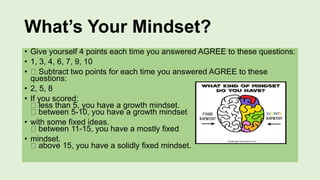
What’s Your Mindset?
• Give yourself 4 points each time you answered AGREE to these questions:
• 1, 3, 4, 6, 7, 9, 10
• Subtract two points for each time you answered AGREE to these
questions:
• 2, 5, 8
• If you scored:
less than 5, you have a growth mindset.
between 5-10, you have a growth mindset
• with some fixed ideas.
between 11-15, you have a mostly fixed
• mindset.
above 15, you have a solidly fixed mindset.
YESTERDAY’S THEORY: WE ARE
BORN WITH INTELLIGENCE
• Alfred Binet Invented the first useable IQ test
• Yesterday’s Theory- No matter how much you
learn or how hard you work your intelligence
stays the same!
TODAY’S THEORY:
MINDSET MATTERS
•IN OTHER WORDS...It’s not what you
are born with that matters; it’s your
mindset that matters.
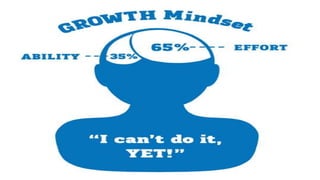
•Growth Mindset: Intelligence is a
quality that can be changed and
developed.
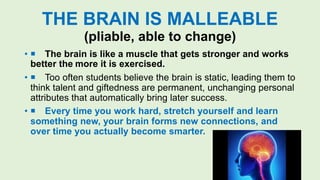
THE BRAIN IS MALLEABLE
(pliable, able to change)
•  The brain is like a muscle that gets stronger and works
better the more it is exercised.
•  Too often students believe the brain is static, leading them to
think talent and giftedness are permanent, unchanging personal
attributes that automatically bring later success.
•  Every time you work hard, stretch yourself and learn
something new, your brain forms new connections, and
over time you actually become smarter.
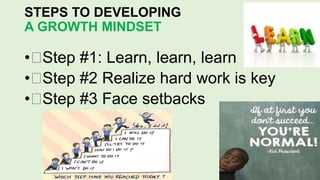
STEPS TO DEVELOPING
A GROWTH MINDSET
• Step #1: Learn, learn, learn
• Step #2 Realize hard work is key
• Step #3 Face setbacks
When You
Make A Bad
Grade
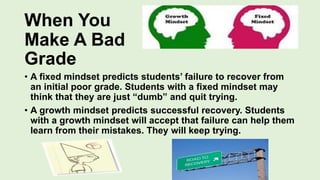
• A fixed mindset predicts students’ failure to recover from
an initial poor grade. Students with a fixed mindset may
think that they are just “dumb” and quit trying.
• A growth mindset predicts successful recovery. Students
with a growth mindset will accept that failure can help them
learn from their mistakes. They will keep trying.
Facing Setbacks
• Fixed Mindset: Hide mistakes and conceal weaknesses,
retreat, blame others, act superior
• “I’ll spend less time on this subject from now on”
• “I will try not to take this subject ever again”
• “I will try to cheat on the next test”
• ✔Growth Mindset:
• Learn from mistakes and confront weaknesses
• “I will work harder in class from now on”
• “I will spend more time studying for the test”
REALIZING
HARD WORK IS KEY
• Fixed Mindset: Learning should come naturally
“When I have to work really hard in a subject, I don’t feel very
smart.”
• Growth Mindset: Putting a lot of effort into learning and
working hard is key
• “The harder I have to work at something, the more effort I put
into something, the better I’ll be at it.”
To Develop a Growth Mindset
•  Focus on effort and persistence despite setbacks
•  Choose difficult tasks
•  Focus on strategies and reflect on different
strategies that work and don’t work
•  Focus on learning and improving
•  Seek challenges
•  Work hard
Growth MindsetGrowth MindsetGrowth Mindset.pptx

Growth MindsetGrowth MindsetGrowth Mindset.pptx

  • 1.
  • 2.
    From this LessonYou Will Learn: • Intelligence can be developed • The brain is pliable and capable of changing • Doing challenging work is the best way to make the brain stronger and smarter
  • 3.
    What is Mindset? •What is mindset? • A mental attitude that determines how you will interpret and respond to situations.
  • 5.
    Mindset Quiz- Agreeor Not 1. My intelligence is something very basic about me that I can’t really change. 2. When I don’t understand something I like to slow down and try to figure it out. 3. I am intimidated by academic challenges. 4. I have been told by others that I am smart. 5. Learning is fun. 6. I often feel unmotivated to learn. 7. When I don’t do well in a subject I think that I must not be very good at that particular subject. 8. When I perform poorly academically I do not get discouraged. 9. When I don’t understand something, I get very frustrated and want to give up. 10. I shouldn’t have to work as hard in subjects that I am naturally good at. Quiz adapted from “The Curse of the ‘Smart’ Student” at extremebiology.net.
  • 6.
    What’s Your Mindset? •Give yourself 4 points each time you answered AGREE to these questions: • 1, 3, 4, 6, 7, 9, 10 • Subtract two points for each time you answered AGREE to these questions: • 2, 5, 8 • If you scored: less than 5, you have a growth mindset. between 5-10, you have a growth mindset • with some fixed ideas. between 11-15, you have a mostly fixed • mindset. above 15, you have a solidly fixed mindset.
  • 7.
    YESTERDAY’S THEORY: WEARE BORN WITH INTELLIGENCE • Alfred Binet Invented the first useable IQ test • Yesterday’s Theory- No matter how much you learn or how hard you work your intelligence stays the same!
  • 8.
    TODAY’S THEORY: MINDSET MATTERS •INOTHER WORDS...It’s not what you are born with that matters; it’s your mindset that matters. •Growth Mindset: Intelligence is a quality that can be changed and developed.
  • 10.
    THE BRAIN ISMALLEABLE (pliable, able to change) •  The brain is like a muscle that gets stronger and works better the more it is exercised. •  Too often students believe the brain is static, leading them to think talent and giftedness are permanent, unchanging personal attributes that automatically bring later success. •  Every time you work hard, stretch yourself and learn something new, your brain forms new connections, and over time you actually become smarter.
  • 11.
    STEPS TO DEVELOPING AGROWTH MINDSET • Step #1: Learn, learn, learn • Step #2 Realize hard work is key • Step #3 Face setbacks
  • 12.
    When You Make ABad Grade • A fixed mindset predicts students’ failure to recover from an initial poor grade. Students with a fixed mindset may think that they are just “dumb” and quit trying. • A growth mindset predicts successful recovery. Students with a growth mindset will accept that failure can help them learn from their mistakes. They will keep trying.
  • 13.
    Facing Setbacks • FixedMindset: Hide mistakes and conceal weaknesses, retreat, blame others, act superior • “I’ll spend less time on this subject from now on” • “I will try not to take this subject ever again” • “I will try to cheat on the next test” • ✔Growth Mindset: • Learn from mistakes and confront weaknesses • “I will work harder in class from now on” • “I will spend more time studying for the test”
  • 14.
    REALIZING HARD WORK ISKEY • Fixed Mindset: Learning should come naturally “When I have to work really hard in a subject, I don’t feel very smart.” • Growth Mindset: Putting a lot of effort into learning and working hard is key • “The harder I have to work at something, the more effort I put into something, the better I’ll be at it.”
  • 15.
    To Develop aGrowth Mindset •  Focus on effort and persistence despite setbacks •  Choose difficult tasks •  Focus on strategies and reflect on different strategies that work and don’t work •  Focus on learning and improving •  Seek challenges •  Work hard