+
It’s all in the mindset!
Developing a growth mindset culture
T&L Briefing 2nd
March 2016
+
Wider Reading
+
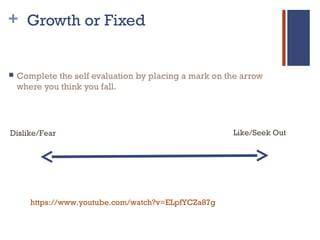
 Complete the self evaluation by placing a mark on the arrow
where you think you fall.
Growth or Fixed
https://www.youtube.com/watch?v=ELpfYCZa87g
Dislike/Fear Like/Seek Out
+
How often do you hear students
say these things in your lessons?
“I’m no good at this sort of question”
“I can’t study, I always forget things”
“I’m no good at maths so there is no point”
“This is too hard , I will never get this”
“I’m not as intelligent as she is”
Do you ever find yourself saying
any of these?
“ You are really talented at that –well done”
“ Why are you messing around in class – you are
really intelligent and it is such a waste”
“Some students would love to have your ability –
stop wasting your time”
“You’re bright – this should be easy for you”
“This bit will be no problem for intelligent people
like you”
+
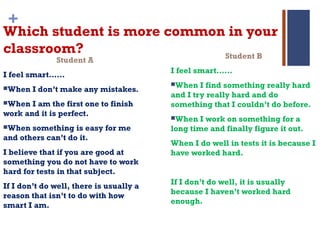
Which student is more common in your
classroom?
Student A
I feel smart……
When I don’t make any mistakes.
When I am the first one to finish
work and it is perfect.
When something is easy for me
and others can’t do it.
I believe that if you are good at
something you do not have to work
hard for tests in that subject.
If I don’t do well, there is usually a
reason that isn’t to do with how
smart I am.
Student B
I feel smart……
When I find something really hard
and I try really hard and do
something that I couldn’t do before.
When I work on something for a
long time and finally figure it out.
When I do well in tests it is because I
have worked hard.
If I don’t do well, it is usually
because I haven’t worked hard
enough.
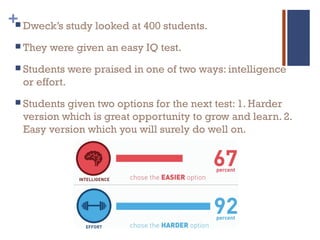
+ Dweck’s study looked at 400 students.
 They were given an easy IQ test.
 Students were praised in one of two ways: intelligence
or effort.
 Students given two options for the next test: 1. Harder
version which is great opportunity to grow and learn. 2.
Easy version which you will surely do well on.
+
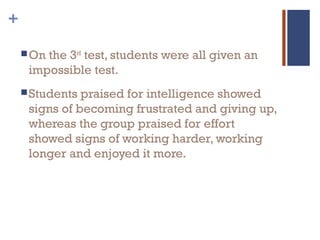
On the 3rd
test, students were all given an
impossible test.
Students praised for intelligence showed
signs of becoming frustrated and giving up,
whereas the group praised for effort
showed signs of working harder, working
longer and enjoyed it more.
+
Language of praise
+
3 things we can do to
encourage growth
mindsets in our
students
+
1. Have a growth
mindset ourselves.
+
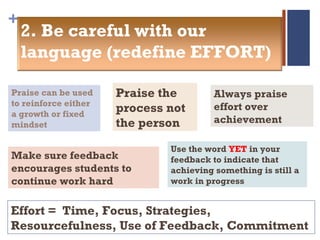
2. Be careful with our
language (redefine EFFORT)
Praise can be used
to reinforce either
a growth or fixed
mindset
Praise the
process not
the person
Always praise
effort over
achievement
Make sure feedback
encourages students to
continue work hard
Use the word YET in your
feedback to indicate that
achieving something is still a
work in progress
Effort = Time, Focus, Strategies,
Resourcefulness, Use of Feedback, Commitment
+
3. Challenge
students’ fixed
mindset language
every time you hear it
+
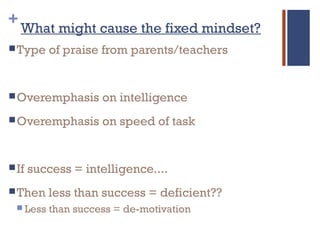
What might cause the fixed mindset?
Type of praise from parents/teachers
Overemphasis on intelligence
Overemphasis on speed of task
If success = intelligence....
Then less than success = deficient??
 Less than success = de-motivation
Growth mindset 1

Growth mindset 1

  • 1.
    + It’s all inthe mindset! Developing a growth mindset culture T&L Briefing 2nd March 2016
  • 2.
  • 3.
    +  Complete theself evaluation by placing a mark on the arrow where you think you fall. Growth or Fixed https://www.youtube.com/watch?v=ELpfYCZa87g Dislike/Fear Like/Seek Out
  • 4.
  • 5.
    How often doyou hear students say these things in your lessons? “I’m no good at this sort of question” “I can’t study, I always forget things” “I’m no good at maths so there is no point” “This is too hard , I will never get this” “I’m not as intelligent as she is”
  • 6.
    Do you everfind yourself saying any of these? “ You are really talented at that –well done” “ Why are you messing around in class – you are really intelligent and it is such a waste” “Some students would love to have your ability – stop wasting your time” “You’re bright – this should be easy for you” “This bit will be no problem for intelligent people like you”
  • 7.
    + Which student ismore common in your classroom? Student A I feel smart…… When I don’t make any mistakes. When I am the first one to finish work and it is perfect. When something is easy for me and others can’t do it. I believe that if you are good at something you do not have to work hard for tests in that subject. If I don’t do well, there is usually a reason that isn’t to do with how smart I am. Student B I feel smart…… When I find something really hard and I try really hard and do something that I couldn’t do before. When I work on something for a long time and finally figure it out. When I do well in tests it is because I have worked hard. If I don’t do well, it is usually because I haven’t worked hard enough.
  • 8.
    + Dweck’s studylooked at 400 students.  They were given an easy IQ test.  Students were praised in one of two ways: intelligence or effort.  Students given two options for the next test: 1. Harder version which is great opportunity to grow and learn. 2. Easy version which you will surely do well on.
  • 9.
    + On the 3rd test,students were all given an impossible test. Students praised for intelligence showed signs of becoming frustrated and giving up, whereas the group praised for effort showed signs of working harder, working longer and enjoyed it more.
  • 10.
  • 11.
    + 3 things wecan do to encourage growth mindsets in our students
  • 12.
    + 1. Have agrowth mindset ourselves.
  • 13.
    + 2. Be carefulwith our language (redefine EFFORT) Praise can be used to reinforce either a growth or fixed mindset Praise the process not the person Always praise effort over achievement Make sure feedback encourages students to continue work hard Use the word YET in your feedback to indicate that achieving something is still a work in progress Effort = Time, Focus, Strategies, Resourcefulness, Use of Feedback, Commitment
  • 14.
    + 3. Challenge students’ fixed mindsetlanguage every time you hear it
  • 15.
    + What might causethe fixed mindset? Type of praise from parents/teachers Overemphasis on intelligence Overemphasis on speed of task If success = intelligence.... Then less than success = deficient??  Less than success = de-motivation

Editor's Notes

  • #8 http://www.youtube.com/watch?v=o8JycfeoVzg&safe=active
  • #17 Article is hyperlinked